ORIGINAL RESEARCH ARTICLE
Nationwide rates of limited fasciectomy for Dupuytren’s contracture: data from the Finnish National Registry
Mikko Petteri Räisänena,b, Teemu Valtteri Karjalainenc, Tuomas Tapani Huttunena,d, Ville Matti Mattilaa,e, Aleksi Rafael Reitoe, Olli Ville Leppänene, Janne Johannes Soikkelif and Jarkko Juhani Jokihaaraa,e
aFaculty of Medicine and Health Technology, Tampere University, Tampere, Finland; bDepartment of Orthopaedics, Traumatology and Hand Surgery, Kuopio University Hospital, Kuopio, Finland; cDepartment of Surgery, Hospital Nova of Central Finland, Jyväskylä, Finland; dDepartment of Anaesthesiology, Tampere University Hospital, Tampere, Finland; eDivision of Musculoskeletal Diseases, Tampere University Hospital, Tampere, Finland; fDepartment of Hand Surgery and Orthopaedics, Oulu University Hospital, Oulu, Finland
ABSTRACT
Dupuytren’s contracture (DC) is often treated with limited fasciectomy (LF), while percutaneous treatment options are gaining popularity. The recent trends in the incidence rates of LF are not well known. Our study aimed to investigate the incidence rates of LF over time, and we collected nationwide data on all LF performed between January 1, 1997 and December 31, 2018.
The main outcome variables were the incidence rates of first and subsequent LF for each patient per 100,000 person-years, calculated for each study year, gender, and age group. Data were obtained from the Finnish National Hospital Discharge Registry, which covers the entire population of Finland. Reporting to the registry is mandatory for all public and private hospitals, and the validity has been found to be excellent. All adult patients with a diagnosis code of M72.0 for DC and a surgical procedure code of NDM10 for LF were included in this study.
The incidence rate of the first LF declined from 36.5 to 11.7, while the rate of subsequent LF increased from 2.3 to 14.0 from 1997 to 2011 and then declined to 9.3 in 2018. LF was performed significantly more often in men than in women (ratio 4:1). Additionally, it was performed significantly more often in patients between 60 and 79 years than in other age groups.
Despite the estimated increase in the prevalence of DC, our data show that the incidence rate of first LF has declined, and there was no discernible consistent trend in the incidence of subsequent LF during the same period.
KEYWORDS: Dupuytren’s disease; Dupuytren’s contracture; limited fasciectomy; limited aponeurectomy; incidence; nationwide rates
Citation: Journal of Plastic Surgery and Hand Surgery 2025; 60: 71–77. DOI: https://doi.org/10.2340/jphs.v60.40569.
Copyright: © 2025 The Author(s). Published by MJS Publishing on behalf of Acta Chirurgica Scandinavica. This is an Open Access article distributed under the terms of the Creative Commons Attribution 4.0 International License (http://creativecommons.org/licenses/by/4.0/), allowing third parties to copy and redistribute the material in any medium or format and to remix, transform, and build upon the material, with the condition of proper attribution to the original work.
Received: 15 April 2024; Accepted: 11 January 2025; Published: 19 March 2025
CONTACT: Mikko Petteri Räisänen mikko.raisanen@tuni.fi Faculty of Medicine and Health Technology, Tampere University, Arvo Ylpön katu 34, 33520 Tampere, Finland
Supplemental data for this article can be accessed online at https://doi.org/10.2340/jphs.v60.40569
Competing interests and funding: The authors report there are no competing interests to declare.
The first author received a 1-year clinical researcher grant from the Finnish Medical Foundation to write this article. The Finnish Medical Foundation has had no role in the data collection, analysis, or writing of the article. None of the other authors received any specific grant from any funding agency in the public, commercial, or not-for-profit sectors.
Introduction
Dupuytren’s contracture (DC) is a prevalent connective tissue ailment afflicting the hand. This condition is characterized by thickening of the palmar fascia, leading to the development of painless flexion contractures primarily affecting the metacarpophalangeal and proximal interphalangeal joints, with a predilection for the ring and small fingers [1]. Its prevalence increases with age [2], and the ratio between men and women is estimated to be 7:1 [3]. The estimated global prevalence is 8.2% [4], and it is projected to increase with aging population. Bebbington et al. reported that the number of DC patients treated in England increased by 40% (10,683–15,255) between years 2000 and 2011, and the rate is expected to further increase through to year 2030 [5].
A typical indication for operative treatment is a 30-degree extension deficit in the metacarpophalangeal or any extension deficit in proximal interphalangeal joint [6]. A similar indication is also commonly used in Finland for the treatment of DC. The goal of the treatment is to improve the function by dividing or removing the contracted thick cords of palmar fascia, thus reducing the extension deficit [7]. Currently, there are no effective noninvasive treatment options [8] and limited fasciectomy (LF), that is, the excision of cords causing finger extension deficits, has been the standard treatment for decades [9].
LF is performed in an operating theater. During the procedure, the portion of the palmar fascia restricting finger extension is exposed and excised. If a proximal interphalangeal joint contracture persists after excision of the DC cords, surgeons often perform gentle passive manipulation or release accessory collateral ligaments, check-rein ligaments, Cleland’s ligaments, Grayson’s ligaments, and other constraining soft tissues as deemed necessary [10]. Postoperatively, an extension splint may be used for up to a few months at nights if the surgeon considers it beneficial [11].
Percutaneous treatment options include collagenase clostridium histolyticum injections [12] and needle fasciotomy [13]. Since the introduction of clostridium injections as an option for treating DC, its use has gained popularity and may have affected the incidence of LF [14, 15]. Collagenase and needle have the possibility to challenge LF in short-term treatment outcomes [16, 17], but usually in the longer follow-up surgery, is superior [18, 19].
There is no curative treatment for DC, and its treatment often requires repeated interventions. These may entail treating the same finger ray again, that is, recurrence of the disease, or another finger ray in the same or contralateral hand, that is, extension of the disease [20]. Symptom recurrence after LF occurs in approximately 20% [18] of patients, and after percutaneous treatments, it occurs up to 50% of patients in the long-term follow-up [19]. Knowledge of the first and subsequent LF incidence rates is needed for planning the treatment guidelines and resource allocation.
The primary aim of this study was to investigate the annual changes in the nationwide incidences of the first and subsequent LF for DC between 1997 and 2018. The secondary aim was to conduct a subgroup analysis by age group and gender.
Materials and methods
This study is reported in accordance with the ‘Strengthening the Reporting of Observational Studies in Epidemiology (STROBE) Statement’ (Supplementary material, Table S2) [21]. All LF for DC between January 1, 1997 and December 31, 2018 were included in the analysis. Due to the significant impact of the COVID-19 pandemic on healthcare, data collection was limited to the year 2018. Data were obtained from the Finnish National Hospital Discharge Registry, established in 1967, which provides information on patients’ age, sex, duration of hospital stays, primary and secondary diagnoses, and all operative treatments. Reporting data to the registry is mandatory for all public and private hospitals. The data cover the entire Finland, and its validity has been found to be excellent in terms of coverage and accuracy in describing the rates of surgical procedures [22, 23].
All adult patients with International Classification of Diseases (ICD) code [24] M72.0 (palmar fascial fibromatosis) for DC and surgical procedure code NDM10 (palmar fasciotomy of hand) for LF in the Nordic Medico-Statistical Committee (NOMESCO) classification of surgical procedures [25] (Finnish version) were included in this study. The code encompasses all LF of any digital ray in either hand. We identified the first and any subsequent LF for each patient. It was not possible to determine from the data whether the subsequent LF was on the same (recurrence) or another digital ray (extension of the disease in the same or the contralateral hand). For the purpose of this data analysis, we defined ‘first LF’ and ‘subsequent LF’ to assess both number of individual patients and the proportion multiple LF in the same patient. In Finland, the indication for surgical treatment of DC is a ≥ 30-degree extension deficit in the metacarpophalangeal or proximal interphalangeal joints, or both. This indication applies to the treatment of primary disease, recurrence, or extension of the disease, for one or multiple fingers.
The main outcome variable was the incidence rate of LF per 100,000 person-years, that is, 100,000 persons in 1 year, calculated for each study year, gender, and age group (18–39, 40–59, 60–79, and ≥ 80 years). Population statistics, including the number of people in the adult population and the age groups mentioned earlier, were obtained from the Official Statistics of Finland, a statutory electronic national population register (Official Statistics of Finland: Labour Force Survey, 2018).
Continuous data are presented as means with standard deviation (SD) and range (minimum and maximum). The yearly changes in the total incidence of first and subsequent LF, for men and women, and different age groups were analyzed using Poisson regression, and the results are reported with 95% confidence intervals (CI) and p-values. Incidence rate ratios for age and gender for the first and subsequent LF were also analyzed with Poisson regression. In these analyses, age was categorized into two groups, 18–49 and 50 years and over, as the incidence of symptomatic DC significantly increases after 50 years of age [2]. Linear regression analysis was performed to estimate the yearly change of mean age, and we reported the annual change, 95% CI, and p-value.
Ethics
This study is a retrospective registry analysis, hence institutional review board evaluation and approval were not required.
Results
The total number of LF in our study was 30,735, of which 70% were first LF. During the study period, the yearly number of all LF decreased by 31%, from 1,544 in 1997 to 941 in 2018.
First LF
The total number of first LF between years 1997 and 2018 was 21,465. The mean age of patient at the time of their first LF was 61.2 years (SD 11.4, range 19–98 years) for all patients in the study period. It increased from 58.4 years (SD 12.2, range 20–92 years) to 63.3 years (SD 11.1, range 20–87 years). Linear regression analysis showed a yearly increase of 0.23 years (95% CI: 0.18 to 0.28; p < 0.001).
The mean incidence of first LF per 100,000 person-years during the study period was 23.4 (SD 7.6, range 10.9–36.5) for all, 38.2 (SD 12.0, range 16.9–57.1) for men, and 9.6 (SD 3.8, range 4.2–17.4) for women (mean gender ratio 4:1). The incidence of first LF was consistently declining during the study period in both genders (Figure 1). In the Poisson regression analysis, the yearly relative change in the incidence of all first LF was an average of −4.8% (95% CI: −6.1% to −3.5%; p < 0.001).
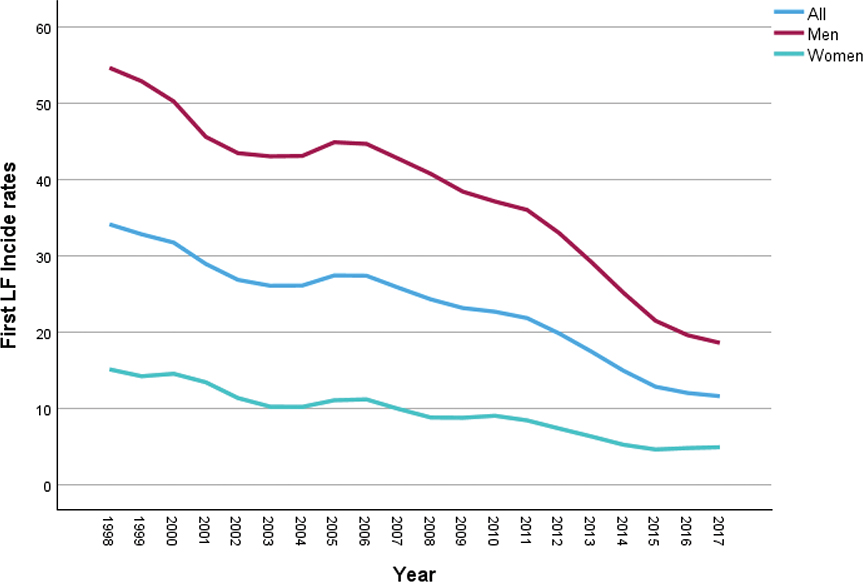
Figure 1. Incidence rates of first LF in men, women, and all (per 100,000 person-years) in a 2-period moving average.
The incidence rate of first LF was highest in the age group 60–79 years for both genders, and the rate declined in all age groups within the study period (Figure 2). In men, the largest relative change in the incidence rate was observed in the age group 18–39 years (−7.0%, 95% CI: −10.5% to −3.4%, p < 0.001) and the smallest change in the age group ≥80 years (−4.8%, 95% CI: −5.8% to −3.7%, p < 0.001). However, the absolute incidences in these age groups were small when compared with the age groups 40–59 and 60–79 years (−5.5%, 95% CI: −6.5% to −4.5%, p < 0.001; and −5.2%, 95% CI: −5.9% to −4.6%, p < 0.001, respectively). Similarly, in women, the largest relative change was observed in the age group 18–39 years (−9.6%, 95% CI: −14.5% to −4.5%, p < 0.001) and the smallest change in the age group 60–79 years (−4.5%, 95% CI: −6.0% to −3.1%, p < 0.001).
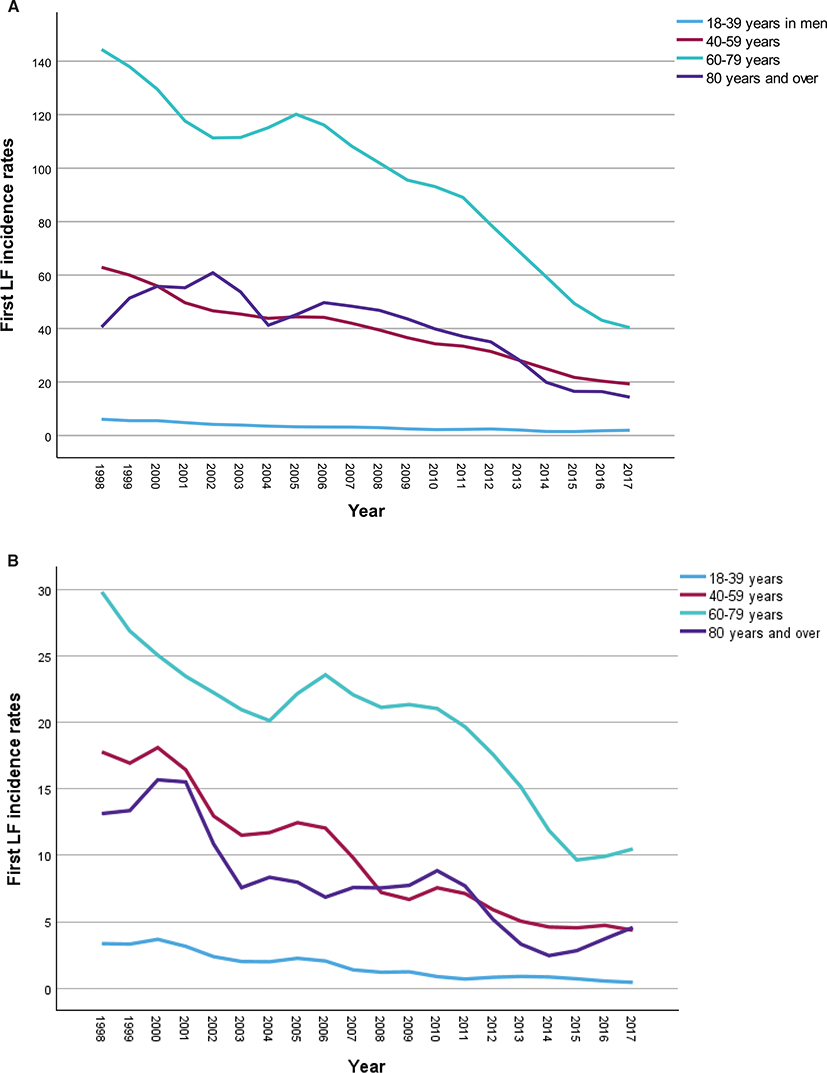
Figure 2. Incidence rates (per 100,000 person-years) in different age groups in a) men and b) women in a 2-period moving average.
Subsequent LF
The total number of subsequent LF was 9,270 (30% of all LF) during the study period. The mean age of patients at the time of their subsequent LF was 63.0 years (SD 9.8, range 19–91 years) for all patients. The mean patient age increased over the study period from 59.4 years (SD 11.3, range 26–80 years) to 65.4 years (SD 8.6, range 35–89 years). Linear regression analysis showed a yearly increase of 0.31 (95% CI: 0.27 to 0.35; p < 0.001) in the mean age.
The mean incidence rate for any subsequent LF per 100,000 person-years was 10.0 (SD 2.6, range 2.3–14.0) for all, 17.9 (SD 4.9, range 3.7–25.6) for men, and 2.5 (SD 0.6, range 1.0–3.4) for women (mean gender ratio 7:1) (Figure 3). In the Poisson regression analysis, the incidence of subsequent LF increased by 2.1% (95% CI: −0.1% to 4.2%, p = 0.056) per year during the study period.
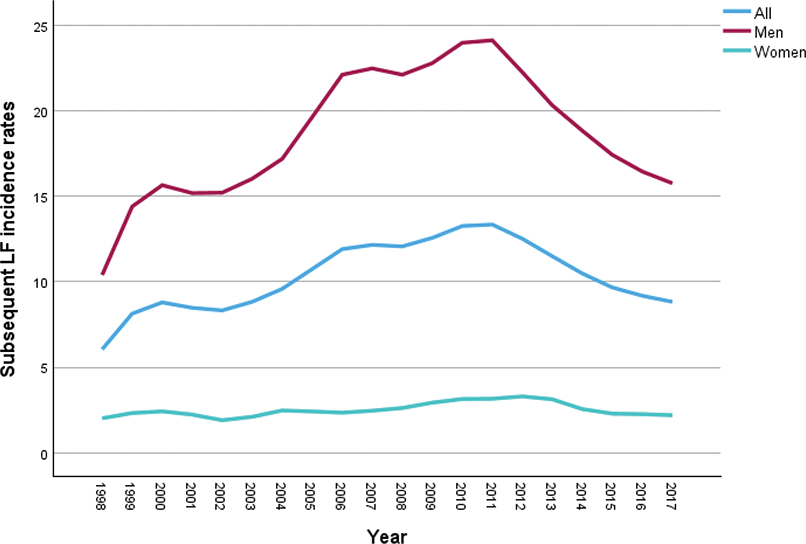
Figure 3. Incidence rates of the subsequent LF in men, women, and all (per 100,000 person-years) in a 2-period moving average.
Similar to the first LF, the incidence of subsequent LF was highest in the 60–79 years age group for both genders (Figure 4). In men, the largest relative change in incidence over the study period was observed in the 18–39 years age group (−5.1%, 95% CI: −12.4% to 2.8%, p = 0.198), and the highest increase in the age group of ≥ 80 years (4.0%, 95% CI: 2.2% to 5.8%, p < 0.001). However, the absolute incidences in these age groups were small when compared with the 40–59 and 60–79 years age groups (0.2%, 95% CI: −1.4% to 1.8%, p = 0.819; and 1.8%, 95% CI: 0.8% to 2.8%, p < 0.001, respectively). In women, the largest variation was observed in the age group 18–39 years and in the age group ≥80 years, but the absolute incidences were too small to analyze the yearly change. In the age groups 40–59 and 60–79 years, relative changes were −3.4% (95% CI: −7.8% to 1.3%, p = 0.156) and 2.4% (95% CI: −0.3 to 5.2%, p = 0.080), respectively.
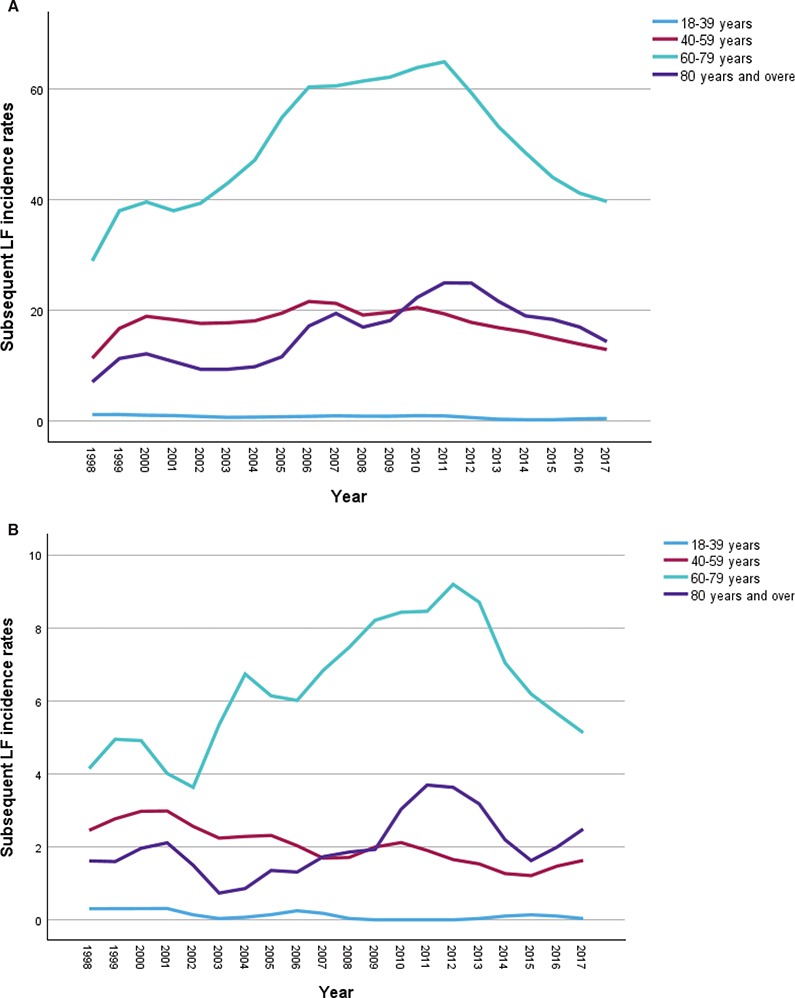
Figure 4. Incidence rates (per 100,000 person-years) in different age groups in a) men and b) women in a 2-period moving average.
Incidence rate ratios for LF
Incidence rates for both first and subsequent LF were higher for patients aged > 50 years and for men (Table 1).
| Estimated incidence rate ratio (95% CI) | P-value | |
| First LF | ||
| Age (18–49 years vs. ≥ 50 years) | 0.15 (0.12–0.18) | < 0.001 |
| Gender (men vs. women) | 4.0 (3.4–4.7) | < 0.001 |
| Subsequent LF | ||
| Age (18–49 years vs. ≥ 50 years) | 0.08 (0.06–0.12) | < 0.001 |
| Sex (men vs. women) | 7.6 (5.7–10.2) | < 0.001 |
| CI: confidence interval; LF: limited fasciectomy; y: years; vs: versus. *Multivariable analysis utilizing Poisson regression was performed with the year as a continuous variable, and sex and age group as categorical variables. |
||
Discussion
Our nationwide data revealed a consistent 70% decrease in the incidence of first LF across all age groups from 1997 to 2018. However, no discernible trend or statistically significant change was observed in the incidence of subsequent LF during the same period.
The first version of the Uniform Criteria for Access to Non-Emergency Care was introduced in Finland in 2010 with the aiming to standardize treatment criteria. The criteria publication also included indications for operative treatment of DC, which may have influenced the number of subsequent LF since its incidence began to decline in 2010. However, no change in the incidence of first LF was observed in 2010 or afterward, compared to the years preceding 2010.
One potential factor that could influence both first and subsequent LF is the progressively stricter criteria for surgical treatment over time. In the past, it was acceptable to excise asymptomatic DC nodules, for example, from the palm, but nowadays, this is mostly no longer recommended. In several countries, including Finland, the usual criterion for LF is a substantial extension deficit in either the metacarpophalangeal or proximal interphalangeal joint, which causes symptoms in ordinary daily life. However, there has been no veritable development or specific period during which these changes in the criteria occurred, making it difficult to estimate whether, or to what extent, this has affected the incidence of LF.
We hypothesize that the declining rates of LF may also be associated with the introduction of collagenase injection treatment, which became available in Finland in 2011. Following its introduction, many DC patients opted for collagenase injections instead of LF. However, our data indicate a decline in the incidence of first LF that started before the introduction of collagenase injection treatment. Unfortunately, we lack reliable data on the number of percutaneous treatments (collagenase injections or needle fasciotomy) performed in Finland during those years. In the United States, collagenase injection was introduced in 2010, and Zhao et al. reported a more than four-fold increase in its use within 4 years, with no significant trend in the use of needle fasciotomy between 2010 and 2013 [15]. Duquette et al. reported that the proportion of collagenase injections increased from 8% to 27% of all DC treatments between 2012 and 2014, while fasciotomies (open or closed) decreased from 23% to 18%, and open fasciectomies decreased from 69% to 55% in the Veterans Affairs System [14]. Needle fasciotomy may be gaining new popularity due to recent evidence showing similar efficacy to collagenase injections [17, 19, 26]. Nonetheless, the rates observed in our study suggest that LF is still likely the most frequently used treatment method in Finland. It is noteworthy that collagenase injection was withdrawn from the Finnish market in 2020, after our study period, and therefore does not affect the analyses.
Percutaneous treatments are generally safer when considering serious adverse events [27]. In addition, percutaneous treatments tend to be more cost-effective, particularly needle fasciotomy [28], and they typically result in lower morbidity for the treated hand during recovery, when compared with surgical intervention [17, 29]. This information has been emphasized since the introduction of collagenase injection to the market, and it may have influenced surgeons’ views on surgical treatment, potentially impacting LF incidences. However, this phenomenon could have affected the LF incidences only in the final years of the study period.
Our data align with previous findings from England, where fasciectomy rates for DC initially decreased by 17% from 2003 to 2008 [30], but later study reported a 30% increase in operative incidence between 2000 and 2011 [5]. While projections in England anticipate a 2.5-fold increase in LF by 2030, our data indicate a consistent decline since 1997. In contrast to our study, the data from England were collected from National Health Service-funded health care units and did not include private service providers; therefore, the data likely do not encompass all LF. In France, Maravic et al. reported 131,900 DC operations from 2002 to 2009, with 89% (117,227) being LF [31]. The average operation rate was 72 per 100,000 person-years, with no observed trend over time. France’s incidence rate was double the time of our study but did not distinguish between first and repeat LF. These differences may stem from variations in DC prevalence, such as Sweden’s 0.9% [32] and Iceland’s 13% [33], or differing treatment criteria across regions.
The primary strength of this study lies in its comprehensive coverage of a validated nationwide database. The registry’s data accuracy and coverage exceed 90% [22, 23], providing a robust foundation for the study. This extensive database encompasses the entire Finnish population and incorporates data from both public and private healthcare providers. The use of specific NOMESCO codes for LF and ICD-codes for DC enhances the precision of the information. Additionally, this study benefits from Finland’s universal healthcare system, ensuring that all individuals have access to it and can afford medical care. This combination of factors contributes to the reliability and generalizability of the study’s findings.
Our study encountered limitations related to data variables. Specifically, we were unable to distinguish whether a subsequent LF represented a re-surgery on a previously operated digital ray (recurrence) or the first LF on another digital ray (extension of the disease). This lack of granularity in the data prevents a detailed analysis of the specific nature of subsequent LF cases. Additionally, our reliance on registry data means that percutaneous treatments, such as collagenase injections and needle fasciotomies, performed in outpatient clinics were not included. The absence of this information hinders a comprehensive assessment of the total number of interventions for DC. Incorporating data on percutaneous treatments would have provided a more comprehensive understanding of the spectrum of interventions for DC.
In conclusion, contrary to predictions based on the rising prevalence rates of DC, our study in Finland does not reveal an increase in the incidence rate for surgical treatment. Instead, we observe a declining incidence rate for first LF and an initial rise followed by a decline in the incidence rate for subsequent LF, with no statistically significant changes, even in the context of an aging population. To gain a more comprehensive understanding of interventions for DC, future research should prioritize collecting data on the incidence rate of percutaneous interventions and assessing recurrence rates following such interventions. This approach will contribute to a nuanced perspective on the evolving trends and needs in the management of DC.
Acknowledgments
The first author is grateful to the Finnish Medical Foundation, which has made this article possible by granting the author a 1-year clinical researcher grant.
Author contributors
MPR: study design, data analysis, literature review, and drafting the article; TVK: data interpretation and reviewing the article; TTH: collecting and analyzing the data, and reviewing the article; VMM: data interpretation and reviewing the article; ARR: planning the statistical analysis and reviewing the article; OVL: data interpretation and reviewing the article; JJS: data interpretation and reviewing the article; JJJ: study design, data interpretation, and drafting the article.
All the authors approved the final version to be published and will take public responsibility for appropriate portions of the content.
Data accessibility statement
Data from this study are available to researchers who provide a methodologically sound proposal and reviewers of the journal where the article will be published (Supplemental material, Table S1). Proposals should be directed to mikko.raisanen@tuni.fi. To gain access, data requestors will need to sign a data access agreement.
ORCID
Mikko Petteri Räisänen  https://orcid.org/0000-0002-5680-4898
Teemu Valtteri Karjalainen https://orcid.org/0000–0002-5650-895X
Tuomas Tapani Huttunen https://orcid.org/0000-0001-7884-7533
Ville Matti Mattila https://orcid.org/0000-0001-9946-4830
Aleksi Rafael Reito https://orcid.org/0000-0002-6903-6461
Olli Ville Leppänen https://orcid.org/0000-0002-9782-8730
Janne Johannes Soikkeli https://orcid.org/0000-0001-5719-8204
Jarkko Juhani Jokihaara https://orcid.org/0000-0001-6153-2180
References
[1] McFarlane RM. Patterns of the diseased fascia in the fingers in Dupuytren’s contracture. Displacement of the neurovascular bundle. Plast Reconstr Surg. 1974;54(1):31–44. https://doi.org/10.1097/00006534-197407000-00004
[2] Lanting R, Broekstra DC, Werker PM, et al. A systematic review and meta-analysis on the prevalence of Dupuytren disease in the general population of Western countries. Plast Reconstr Surg. 2014;133(3):593–603. https://doi.org/10.1097/01.prs.0000438455.37604.0f
[3] Brenner P, Mailänder P, Berger A. Epidemiology of Dupuytren’s disease. In: Berger A, Delbrück A, Brenner P, Hinzmann R, editors. Dupuytren’s disease: pathobiochemistry and clinical management. Berlin, Heidelberg: Springer Berlin Heidelberg; 1994. p. 244–254.
[4] Salari N, Heydari M, Hassanabadi M, et al. The worldwide prevalence of the Dupuytren disease: a comprehensive systematic review and meta-analysis. J Orthop Surg Res. 2020;15(1):495. https://doi.org/10.1186/s13018-020-01999-7
[5] Bebbington E, Furniss D. Linear regression analysis of Hospital Episode Statistics predicts a large increase in demand for elective hand surgery in England. J Plast Reconstr Aesthet Surg. 2015;68(2):243–251. https://doi.org/10.1016/j.bjps.2014.10.011
[6] Trojian TH, Chu SM. Dupuytren’s disease: diagnosis and treatment. Am Fam Physician. 2007 Jul 1;76(1):86–89.
[7] Engstrand C, Krevers B, Nylander G, et al. Hand function and quality of life before and after fasciectomy for Dupuytren contracture. J Hand Surg Am. 2014 Jul;39(7):1333.e2–1343.e2. https://doi.org/10.1016/j.jhsa.2014.04.029
[8] Ball C, Izadi D, Verjee LS, et al. Systematic review of non-surgical treatments for early Dupuytren’s disease. BMC Musculoskelet Disord. 2016 Aug 15;17(1):345. https://doi.org/10.1186/s12891-016-1200-y
[9] Desai SS, Hentz VR. The treatment of Dupuytren disease. J Hand Surg Am. 2011 May;36(5):936–942. https://doi.org/10.1016/j.jhsa.2011.03.002
[10] Weinzweig N, Culver JE, Fleegler EJ. Severe contractures of the proximal interphalangeal joint in Dupuytren’s disease: combined fasciectomy with capsuloligamentous release versus fasciectomy alone. Plast Reconstr Surg. 1996;97(3):560–567. https://doi.org/10.1097/00006534-199603000-00011
[11] Jerosch-Herold C, Shepstone L, Chojnowski AJ, et al. Night-time splinting after fasciectomy or dermo-fasciectomy for Dupuytren’s contracture: a pragmatic, multi-centre, randomised controlled trial. BMC Musculoskelet Disord. 2011;12(1):136. https://doi.org/10.1186/1471-2474-12-136
[12] Hurst LC, Badalamente MA, Hentz VR, et al. Injectable collagenase clostridium histolyticum for Dupuytren’s contracture. N Engl J Med. 2009;361(10):968–979. https://doi.org/10.1056/NEJMoa0810866
[13] Strömberg J. Percutaneous needle fasciotomy for Dupuytren contracture. JBJS Essent Surg Tech. 2019 Mar 26;9(1):e6. https://doi.org/10.2106/JBJS.ST.18.00047
[14] Duquette S, Kuster R, Evans T, et al. Treatment of Dupuytren contracture with injectable collagenase within the veterans affairs system. JAMA Surg. 2017 Feb 1;152(2):204–205. https://doi.org/10.1001/jamasurg.2016.3605
[15] Zhao JZ, Hadley S, Floyd E, et al. The impact of collagenase clostridium histolyticum introduction on dupuytren treatment patterns in the United States. J Hand Surg. 2016;41(10):963–968. https://doi.org/10.1016/j.jhsa.2016.07.090
[16] Dias J, Tharmanathan P, Arundel C, et al. Collagenase Injection versus limited fasciectomy for Dupuytren’s Contracture. N Engl J Med. 2024 Oct 24;391(16):1499–1510. https://doi.org/10.1056/NEJMoa2312631
[17] Räisänen MP, Leppänen OV, Soikkeli J, et al. Surgery, needle fasciotomy, or collagenase injection for Dupuytren Contracture: a randomized controlled trial. Ann Intern Med. 2024 Mar;177(3):280–290. https://doi.org/10.7326/M23-1485
[18] van Rijssen AL, ter Linden H, Werker PM. Five-year results of a randomized clinical trial on treatment in Dupuytren’s disease: percutaneous needle fasciotomy versus limited fasciectomy. Plast Reconstr Surg. 2012;129(2):469–477. https://doi.org/10.1097/PRS.0b013e31823aea95
[19] Byström M, Ibsen Sörensen A, et al. Five-year results of a randomized, controlled trial of collagenase treatment compared with needle fasciotomy for Dupuytren contracture. J Hand Surg Am. 2022 Mar;47(3):211–217. https://doi.org/10.1016/j.jhsa.2021.11.019
[20] Werker PM, Pess GM, van Rijssen AL, et al. Correction of contracture and recurrence rates of Dupuytren contracture following invasive treatment: the importance of clear definitions. J Hand Surg Am. 2012;37(10):2095.e7–2105.e7. https://doi.org/10.1016/j.jhsa.2012.06.032
[21] Vandenbroucke JP, von Elm E, Altman DG, et al, Pocock SJ, et al. Strengthening the Reporting of Observational Studies in Epidemiology (STROBE): explanation and elaboration. Ann Intern Med. 2007 Oct 16;147(8):W163–W194. https://doi.org/10.7326/0003-4819-147-8-200710160-00010-w1
[22] Mattila VM, Sillanpaa P, Iivonen T, et al. Coverage and accuracy of diagnosis of cruciate ligament injury in the Finnish National Hospital Discharge Register. Injury. 2008;39(12):1373–1376. https://doi.org/10.1016/j.injury.2008.05.007
[23] Huttunen TT, Kannus P, Pihlajamaki H, et al. Pertrochanteric fracture of the femur in the Finnish National Hospital Discharge Register: validity of procedural coding, external cause for injury and diagnosis. BMC Musculoskelet Disord. 2014;15:98. https://doi.org/10.1186/1471-2474-15-98
[24] World Health Organization. International statistical classification of diseases and related health problems [Internet]. 10th revision, Fifth edition, 2016. ICD-10. Geneva: World Health Organization; 2015. Available from: https://apps.who.int/iris/handle/10665/246208
[25] Nomesco N. NOMESCO Classification of Surgical Procedures (NCSP), version 1.16. In 2009. Available from: https://api.semanticscholar.org/CorpusID:78459301
[26] Zhang D, Earp BE, Blazar P. Collagenase treatment versus needle fasciotomy for single-digit Dupuytren Contractures: a meta-analysis of randomized controlled trials. J Hand Surg Am. 2023 Dec;48(12):1200–1209. https://doi.org/10.1016/j.jhsa.2023.08.008
[27] Alhebshi ZA, Bamuqabel AO, Alqurain Z, et al. Comparing complications and patient satisfaction following injectable collagenase versus limited fasciectomy for Dupuytren’s disease: a systematic review and meta-analysis. Cureus. 2024 Jan;16(1):e53147. https://doi.org/10.7759/cureus.53147
[28] Fitzpatrick AV, Moltaji S, Ramji M, et al. Systematic review comparing cost analyses of fasciectomy, needle aponeurotomy, and collagenase injection for treatment of Dupuytren’s Contracture: une analyse de coûts systématique comparant la fasciectomie, l’aponévrotomie percutanée à l’aiguille et l’injection de collagénase pou traiter la maladie de Dupuytren. Plast Surg (Oakv). 2021 Nov;29(4):257–264. https://doi.org/10.1177/2292550320963111
[29] van Rijssen AL, Gerbrandy FS, Ter Linden H, et al. A comparison of the direct outcomes of percutaneous needle fasciotomy and limited fasciectomy for Dupuytren’s disease: a 6-week follow-up study. J Hand Surg Am. 2006;31(5): 717–725. https://doi.org/10.1016/j.jhsa.2006.02.021
[30] Gerber RA, Perry R, Thompson R, et al. Dupuytren’s contracture: a retrospective database analysis to assess clinical management and costs in England. BMC Musculoskelet Disord. 2011;12:73. https://doi.org/10.1186/1471-2474-12-73
[31] Maravic M, Lasbleiz S, Roulot E, et al. Hospitalization for Dupuytren’s disease: a French national descriptive analysis, 2002 to 2009. Orthop Traumatol Surg Res. 2014;100(6): 589–592. https://doi.org/10.1016/j.otsr.2014.05.013
[32] Nordenskjöld J, Englund M, Zhou C, et al. Prevalence and incidence of doctor-diagnosed Dupuytren’s disease: a population-based study. J Hand Surg Eur Vol. 2017;42(7):673–677. https://doi.org/10.1177/1753193416687914
[33] Guğmundsson KG, Arngrímsson R, Sigfússon N, et al. Prevalence of joint complaints amongst individuals with Dupuytren’s disease – from the Reykjavík study. Scand J Rheumatol. 1999;28(5):300–304. https://doi.org/10.1080/03009749950155481