RESEARCH LETTER
A population-based registry cohort study on the correlation between bladder-intact event-free survival and overall survival in cystectomy-ineligible/refusal muscle-invasive bladder cancer patients in Sweden
Oscar Laurina,b, Simona Baculeac, Sarah Côtéd, Samuel Spigelmane, Robert Szulkinf, Kelvin HM Kwokg, Frida Schaing, Christina V. Jonesg and Markus Alya,b
aDepartment of Molecular Medicine and Surgery, Karolinska Institutet, Stockholm, Sweden; bDepartment of Pelvic Cancer, Karolinska University Hospital, Stockholm, Sweden; cGlobal Market Access and Health Policy, Janssen Global Services LLC, High Wycombe, UK; dGlobal Market Access and Health Policy, Janssen Global Services LLC, Toronto, Canada; eGlobal Medical Affairs, Janssen Research and Development LLC, Raritan, NJ, USA; fSDS Life Science, Stockholm, Sweden; gSchain Research AB, Stockholm, Sweden
KEYWORDS: Bladder-intact event-free survival; chemoradiation; chemotherapy; cystectomy; radiotherapy; muscle-invasive bladder cancer; overall survival; Sweden
Citation: Scandinavian Journal of Urology 2024, VOL. 59, 137–140. https://doi.org/10.2340/sju.v59.40016.
Copyright: © 2024 The Author(s). Published by MJS Publishing on behalf of Acta Chirurgica Scandinavica. This is an Open Access article distributed under the terms of the Creative Commons Attribution 4.0 International License (https://creativecommons.org/licenses/by/4.0/), allowing third parties to copy and redistribute the material in any medium or format and to remix, transform, and build upon the material, with the condition of proper attribution to the original work.
Received: 9 February 2024; Accepted: 5 July 2024; Published: 2 September 2024
CONTACT Markus Aly markus.aly@ki.se Karolinska University Hospital, Solna, 171 76 Stockholm, Sweden.
Supplemental data for this article can be accessed online at https://doi.org/10.2340/sju.v59.40016
Competing interests and funding: Simona Baculea, Sarah Côte and Samuel Spigelman are employees of and own stocks in Janssen. Robert Szulkin is an employee of SDS Life Sciences – a Cytel company, and an affiliated researcher with Karolinska Institutet, Sweden. Kelvin HM Kwok, Christina V Jones and Frida Schain are employees of Schain Research AB. Frida Schain owns stocks in Schain Research. Schain Research receives consulting fees from Janssen Global Services LLC. Oscar Laurin and Markus Aly have no relevant conflicts to declare.
Introduction
Bladder cancer (BC) imposes a large societal burden globally with a worldwide incidence and mortality of more than 570,000 and 210,000 cases per year, respectively [1]. Radical cystectomy (RC) following neoadjuvant chemotherapy is currently the recommended standard of care for non-metastatic muscle-invasive bladder cancer (MIBC) according to European and American guidelines. Nevertheless, some patients are ineligible for RC due to high age and comorbidities. In Sweden, patients who are medically unfit for RC, and those who refuse it, may therefore be offered bladder-sparing treatments, including curative-intent chemoradiation or palliative treatment with radiotherapy or chemotherapy.
Bladder-intact event-free survival (BI-EFS), defined as time from treatment initiation to earliest event of either (1) histologically proven residual/recurrent MIBC, (2) nodal/distant metastases, (3) RC, or (4) death, has been proposed as a composite endpoint for MIBC patients, which incorporates both clinical efficacy outcomes and bladder preservation [2]. Though already included as primary or secondary endpoints in clinical trials [3] and cohort studies [2, 4], its relationship with overall survival (OS), a well-established clinical endpoint for MIBC [5], has yet to be established in trial settings or in real world. The objective of this study was to examine the correlation between BI-EFS and OS in cystectomy-ineligible/refusal MIBC patients in Sweden.
Materials and methods
Data sources
The MIBC patients were identified using the Swedish Cancer Register, which registers all newly reported cancer cases with a nationwide coverage. Treatment records were identified in the Swedish Patient Register, which contains information on all inpatient and outpatient care visits to specialized care in Sweden, as well as the Swedish Prescribed Drug Register, which collects data on all prescribed drugs dispensed by pharmacies in Sweden. Mortality information was obtained from the Cause of Death Register, which collects date and cause of death for all individuals in Sweden.
Study population
BC patients were identified in the Swedish Cancer Register based on International Classification of Diseases version 10 (ICD-10) diagnosis codes (C67.0–6, 8–9). The study cohort included individuals who (1) were diagnosed with BC between January 1st 2006 and December 31st 2017, (2) had MIBC (T2-4aN0M0 stage) at diagnosis, (3) were exposed to radiotherapy and/or chemotherapy after diagnosis as upfront treatment, and (4) were aged ≥18 years at the first registered date of upfront treatment (‘index date’). Exclusion criteria were patients (1) with <1 year of follow-up time, (2) diagnosed based on autopsy, (3) with other urothelial cancers prior to BC diagnosis, (4) with tumor staging of any of the following at diagnosis: missing, Ta, Tis, T0–1, T4 (non-specified as T4a/b), T4b, N1–3/X and M1/X, and (5) who underwent RC as upfront treatment (≤6 months after diagnosis). Patients with mixed histology were not excluded. The study was approved by the Swedish Ethical Review Authority (EPM; Dnr2019-05822 and Dnr2021-04460).
Treatment
RC was defined as a care visit associated with Swedish Classification of Care Measures (KVÅ) code KCC00, KCC10, KCC20, KCC30, or KCC96 in the Patient Register. Exposure to radiotherapy was defined as a care visit associated with KVÅ code DV007, DV009, DV011, DV012, DV013, DV014, DV015, DV016, DV017, DV018, DV019, DV022, DV027, DV040, DV064, DV069, DV079, DV144, DV070, DV071, or DV072 in the Patient Register. Exposure to chemotherapy was defined as a care visit associated with KVÅ code DT107, DT108, or DT116 in the Patient Register, or a dispensation record with Anatomical Therapeutic Chemical (ATC) code L01 in the Patient Register or Prescribed Drug Register. Exposure to chemoradiation was defined as a concomitant record of radiotherapy and chemotherapy within 7 days.
Statistical analyses
Charlson comorbidity index (CCI) was determined with a look-back period of 6 months prior to BC diagnosis; BC was excluded when calculating the comorbidity weightings (Supplementary Information). OS was defined as time from index date (date of upfront treatment initiation) until death. BI-EFS was defined as time from index date to the date of earliest evidence of any of the following: (1) initiation of anti-neoplastic treatment, as a proxy for histologically proven residual or recurrent MIBC and clinical evidence of nodal or metastatic disease, (2) RC, and (3) death. All patients were followed from index date until censoring (emigration or end of follow-up). Correlation between OS and BI-EFS was measured using an iterative multiple imputation method [6]. Using conditional multiple imputation, two original censored variables were transformed to have standard normal marginal distributions and produce the Van der Waerden rank correlation coefficient, Rw, which ranges between -1 and 1 for perfect negative and positive correlation, respectively, while the value 0 indicates no correlation.
Results
Baseline characteristics
A total of 11,129 individuals were diagnosed with BC with complete tumor staging information between 2006 and 2017 in Sweden. Of the 2,761 MIBC patients identified, 337 fulfilled all criteria for inclusion in this study (Supplementary Figure 1). The study population had a median age at diagnosis of 77 (interquartile range [IQR] 71–82) years (Table 1). At diagnosis, 39% of all patients had a CCI ≥3. Since the majority of patients (n = 286, 85%) had T2 stage at diagnosis, the remaining T3 and T4a patients (n = 51, 15%) were pooled together for subsequent analyses due to small sample size. Most of the included MIBC patients had an upfront treatment record of radiotherapy alone (84%), while the remaining had chemotherapy alone, consistent with a previous report, which showed that trimodal treatment involving chemoradiation is not commonly used as a bladder-sparing treatment in the MIBC setting in Sweden [7].
Survival analyses
Median OS in the entire cohort was 12 (95% confidence interval [CI] 11–15) months. When stratified by T stage, median OS was 13 (95% CI 11–16) and 9 (95% CI 6–17) months for T2 and T3/4a patients, respectively (Figure 1A–B, Supplementary Table 1).
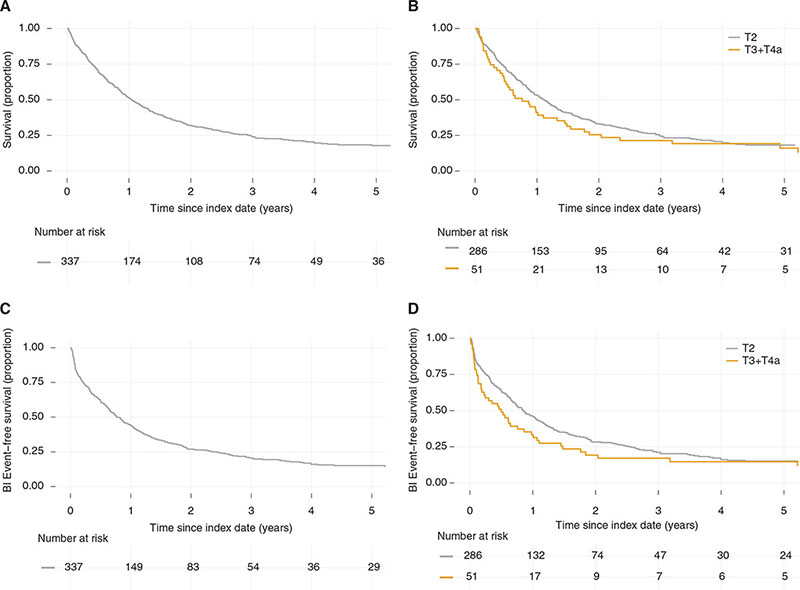
Figure 1. Survival of cystectomy-ineligible/refusal MIBC patients. (A) Overall survival (OS) in overall population from index date. (B) OS in T2 and T3/T4a MIBC patients from index date. (C) Bladder-intact event-free survival (BI-EFS) in overall population from index date. (D) BI-EFS in T2 and T3/T4a MIBC patients from index date. MIBC = muscle-invasive bladder cancer.
Median BI-EFS in the entire cohort was 9 (95% CI 8–12) months. When stratified by T stage, the median BI-EFS was 10 (95% CI 9–13) and 6 (95% CI 3–12) months for T2 and T3/T4a, respectively (Figure 1C–D, Supplementary Table 2).
Correlation between OS and BI-EFS
We next assessed the correlation between OS and BI-EFS. Overall, BI-EFS was correlated with OS with an Rw of 0.82 (95% CI 0.77–0.85). The correlation was stronger in T2 at 0.84 (95% CI 0.80–0.87) than in T3/4a patients at 0.65 (95% CI 0.44–0.79), likely due in part to a larger sample size in the former.
Discussion
In Sweden, RC is performed in the vast majority of MIBC patients unless clinicians deem patients too unfit or when patients refuse the surgery. Indeed, patients included in this study generally had high age and poor OS. Of note, the 1-year OS rate of 52% in our study appears higher than that in another Swedish study (37%) examining a largely similar MIBC population but with additional metastatic patients [7], whereas the 5-year OS rate of 18% observed here is similar to the 5-year OS of 14% reported in another study conducted on a similar cystectomy-ineligible MIBC patient population in Greece and Switzerland [8]. The strong correlation between BI-EFS and OS observed in our study can be partially attributed to the poor OS in this patient population, as most BI-EFS events captured were death (n = 245), followed by proxies for histologically proven residual/recurrent MIBC and clinical evidence of nodal/metastatic disease (n = 43), and few events of RC (n < 5) (Supplementary Table 3).
This study was based on data spanning >10 years from Swedish nationwide population-based registers with high data quality [9, 10]. Nevertheless, only patients with complete TNM information were included, hence patient number may be underestimated. Since these registers do not capture information on treatment response and events including recurrence, progression, and metastasis, proxies were used to identify BI-EFS events; medication administered in hospital including anti-neoplastic drugs are also not well-captured. These could have led to potential underestimation of events of interest.
Moreover, data from national registers neither capture eligibility or patient wish concerning particular treatments nor the treatment intent for any alternative therapies. Our study cohort included a small proportion of patients (16%) who received upfront chemotherapy although it is not the recommended treatment. The intention was to include all patients who potentially received curative-intent chemotherapy alone in clinical practice, as previous research conducted in a southern region of Sweden has shown that 14% of MIBC treated with bladder-sparing treatment received chemotherapy alone. But this in turn introduces heterogeneity in our cohort of cystectomy-ineligible/refusal patients, which may have included significant proportion of patients who received non-curative-intent treatment. These factors should be taken into account when applying the findings in populations receiving strictly curative treatment alone.
In conclusion, BI-EFS was strongly correlated with OS in cystectomy-ineligible/refusal MIBC patients who received radiotherapy and/or chemotherapy in Sweden. These results support the use of BI-EFS as a surrogate endpoint for OS in similar patient populations.
Acknowledgements
This study was sponsored by Janssen Global Services LLC. The authors would like to acknowledge the National Board of Health and Welfare in Sweden for excellent support with data extraction.
References
- Sung H, Ferlay J, Siegel RL, Laversanne M, Soerjomataram I, Jemal A, et al. Global cancer statistics 2020: GLOBOCAN estimates of incidence and mortality worldwide for 36 cancers in 185 countries. CA Cancer J Clin. 2021;71(3):209–49. https://doi.org/10.3322/caac.21660
- Voskuilen CS, van de Kamp MW, Schuring N, Mertens LS, Noordzij A, Pos F, et al. Radiation with concurrent radiosensitizing capecitabine tablets and single-dose mitomycin-C for muscle-invasive bladder cancer: a convenient alternative to 5-fluorouracil. Radiother Oncol. 2020 Sep 1;150:275–80. https://doi.org/10.1016/j.radonc.2020.07.057
- Kimura T, Ishikawa H, Kojima T, Kandori S, Kawahara T, Sekino Y, et al. Bladder preservation therapy for muscle invasive bladder cancer: the past, present and future. Jpn J Clin Oncol. 2020 Sep 28;50(10): 1097–107. https://doi.org/10.1093/jjco/hyaa155
- de Ruiter BM, van de Kamp MW, van Steenbergen JPZ, Franckena M, Boormans JL, de Feijter JM, et al. A multicenter retrospective cohort series of muscle-invasive bladder cancer patients treated with definitive concurrent chemoradiotherapy in daily practice. Eur Urol Open Sci. 2022 May 1;39:7–13. https://doi.org/10.1016/j.euros.2022.02.010
- Ding H, Fan N, Ning Z, Ma D. Trimodal therapy vs. radical cystectomy for muscle-invasive bladder cancer: a meta-analysis. Front Oncol. 2020 Oct 14;10:564779. https://doi.org/10.3389/fonc.2020.564779
- Schemper M, Kaider A, Wakounig S, Heinze G. Estimating the correlation of bivariate failure times under censoring. Stat Med. 2013 Nov 30;32(27):4781–90. https://doi.org/10.1002/sim.5874
- Westergren DO, Gårdmark T, Lindhagen L, Chau A, Malmström PU. A nationwide, population based analysis of patients with organ confined, muscle invasive bladder cancer not receiving curative intent therapy in Sweden from 1997 to 2014. J Urol. 2019 Nov;202(5): 905–12. https://doi.org/10.1097/JU.0000000000000350
- Bamias A, Tsantoulis P, Zilli T, Papatsoris A, Caparrotti F, Kyratsas C, et al. Outcome of patients with nonmetastatic muscle‐invasive bladder cancer not undergoing cystectomy after treatment with noncisplatin‐based chemotherapy and/or radiotherapy: a retrospective analysis. Cancer Med. 2016 Mar 22;5(6):1098–107. https://doi.org/10.1002/cam4.685
- Barlow L, Westergren K, Holmberg L, Talbäck M. The completeness of the Swedish Cancer Register – a sample survey for year 1998. Acta Oncol. 2009 Jan 1;48(1):27–33. https://doi.org/10.1080/02841860802247664
- Brooke HL, Talbäck M, Hörnblad J, Johansson LA, Ludvigsson JF, Druid H, et al. The Swedish cause of death register. Eur J Epidemiol. 2017;32(9):765–73. https://doi.org/10.1007/s10654-017-0316-1