ORIGINAL RESEARCH ARTICLE
Time trends for the use of active surveillance and deferred treatment for localised prostate cancer in Sweden: a nationwide study
Jovana Maljkovica,b , Anna Bill-Axelsonc, Hampus Hållbergd, Anders Berglundd, Pär Stattinc and Ola Bratta,b
aDepartment of Urology, Institute of Clinical Science, Sahlgrenska Academy, University of Gothenburg, Gothenburg, Sweden; bDepartment of Urology, Sahlgrenska University Hospital, Gothenburg, Sweden; cDepartment of Surgical Sciences, Uppsala University Hospital, Uppsala, Sweden; dEpiStat AB, Uppsala, Sweden
ABSTRACT
Objective: Active surveillance (AS) is recommended for low-risk and some favourable intermediate-risk prostate cancers, but criteria for AS and deferred treatment have changed over time. We assessed time trends for the use of AS and deferred treatment.
Material and methods: Nationwide Swedish register study of 76,191 men diagnosed with low- or intermediate-risk localised prostate cancer from 2008 to 2020. This study presents the proportion of men starting on AS, their clinical characteristics and proportion having deferred treatment. Cox regression was used to calculate hazard ratios for deferred treatment. Subgroup analyses were performed for men < 60 years with Charlson Comorbidity Index 0.
Results: Overall use of AS increased from 2008–2010 to 2017–2020: any low-risk: 40% to 81%, very low-risk disease: 57% to 91%, other low-risk: 37% to 77% and intermediate-risk: 16% to 20%. The relative increase in the use of AS in men < 60 years with Charlson Comorbidity Index 0 was similar to, or greater than, the increase overall. A total of 28,211 men started on AS. The crude proportions of men receiving deferred treatment were relatively stable over time; 2017–2020: very low-risk disease 8%, other low-risk 16% and intermediate-risk 23%. After adjustment for clinical characteristics, deferred treatment within 2 years decreased over time for very low-risk, was stable for other low-risk and increased for intermediate-risk cancer.
Conclusions: The use of AS greatly increased over time, not least amongst younger healthy men, whereas the use of deferred treatment was relatively stable. AS has been increasingly accepted as a safe approach for localised, favourable-risk prostate cancer.
KEYWORDS: Prostate cancer; active surveillance; deferred treatment; nationwide; trend analysis
Citation: Scandinavian Journal of Urology 2024, VOL. 59, 200–206. https://doi.org/10.2340/sju.v59.40123.
Copyright: © 2024 The Author(s). Published by MJS Publishing on behalf of Acta Chirurgica Scandinavica. This is an Open Access article distributed under the terms of the Creative Commons Attribution 4.0 International License (http://creativecommons.org/licenses/by/4.0/), allowing third parties to copy and redistribute the material in any medium or format and to remix, transform, and build upon the material, with the condition of proper attribution to the original work.
Received: 16 February 2024; Accepted: 29 October 2024; Published: 19 December 2024
CONTACT Jovana Maljkovic jovana.maljkovic@vgregion.se Department of Urology, Institute of Clinical Science, Sahlgrenska Academy, University of Gothenburg, Gothenburg, Sweden
Supplemental data for this article can be accessed online at https://doi.org/10.2340/sju.v59.40123
Introduction
Active surveillance (AS) with selective, delayed intervention was introduced over 20 years ago as an alternative to immediate curative treatment for men with low-risk or favourable intermediate-risk prostate cancer [1]. Various factors influence the choice of and adherence to AS. These factors are primarily tumour related, such as Gleason grade and tumour volume, but patient-related factors such as education, social support and knowledge also play a role [2].
When AS was introduced in routine clinical practice in the early 2000s, curative treatment was still recommended for most men with more than 10 years’ life expectancy, and there was little evidence for which men should be offered AS, how to schedule the follow-up and when to initiate deferred curative treatment [3]. The indications for AS in the 2010 European prostate cancer guidelines were still highly selective [4].
Over the years, knowledge about prostate cancer biology has improved. A growing body of evidence suggests that low-grade prostate cancer, graded according to modern criteria, is indolent and lacks metastatic potential [5–7]. According to the European guidelines, AS is currently recommended for most men with low-risk prostate cancer [8]. In Sweden, more than 90% of men with very low-risk prostate cancer currently start on AS [9].
As knowledge of AS increased, one may assume that clinical selection for and adherence to AS changed over time. For instance, the early studies of AS mainly included men with a moderately long life expectancy [10], but in more recent years, AS has been used also for younger, healthy men who may stay on AS for a very long time. Information about these changes may be useful for care givers and patients when discussing the option of AS, and for healthcare providers when planning for future resource allocation for AS.
Only one population-based study of time-trends for AS outside Sweden has been published, from the USA [11]. Therefore, we used the National Prostate Cancer Register of Sweden and its associated research database Prostate Cancer data Base Sweden (PCBaSe) to investigate time trends, as well as clinical characteristics of men starting on AS and use of subsequent deferred treatment. The aim of our study was to assess time trends for the use of AS and deferred treatment overall and for younger, healthy men.
Materials and methods
We used data from PCBaSe version 5.0, which includes all data in The National Prostate Cancer Register of Sweden (NPCR) linked to several other nationwide population-based registers, of which we derived information from the Swedish Cancer Registry, the National Patient Register, the National Cause of Death Register and the National Prescribed Drug Register [12, 13]. NPCR includes clinical characteristics at the time of diagnosis and information about the primary treatment for Swedish men diagnosed with prostate cancer since 1998, with nearly complete capture rate [14].
All men with localised low- or intermediate-risk PC diagnosed from 1st January 2008 to 31st December 2020 were identified in PCBaSe. The start date was chosen because detailed data on cancer characteristics and discrimination between AS (intention of curative treatment on progression) and watchful waiting (no intention of curative treatment) were not registered in the NPCR until 2008. These two different types of management were clearly defined in the Swedish guidelines and in the instructions for NPCR registration [15]. Only men with AS registered as the primary management were included in the analyses. Men who received active treatment within 6 months from the date of diagnosis were excluded. Last date of follow-up was 5th February 2022.
A Charlson Comorbidity Index (CCI) was determined for each man by using the International Classification of Diseases (ICD) discharge diagnosis codes in the inpatient register and the outpatient register for specialised care [16].
We used the same risk categories as the Swedish national guidelines [17]. Very low-risk prostate cancer was defined as clinical stage T1c, Gleason score ≤ 6, a total of ≤ 8 mm cancer in 1–4 of 8–12 systematic biopsy cores, PSA < 10 ng/mL and PSA density < 0.15 ng/ml/cm3; other low-risk prostate cancer was defined as any other cancer with stage T1–2, Gleason score ≤6 and PSA < 10 ng/mL. Intermediate-risk cancer was defined as T1–2 and Gleason score 7 and/or PSA 10–19 ng/mL. Clinical T categorisation was based on digital rectal examination according to the UICC-TNM classification. The number of biopsy cores with cancer and the total biopsy cancer length at diagnosis were registered for men diagnosed with systematic biopsies only.
Deferred treatment was defined as transition to any treatment, with (radiation therapy or radical prostatectomy) or without curative intent (hormonal therapy).
This study was approved by the Swedish Ethical Review Authority.
Statistics
We analysed trends across four time periods: 2008–2010, 2011–2013, 2014–2016 and 2017–2020. Numbers and proportions of men who started on AS and later received treatment with curative or non-curative intent within 2 and 5 years from diagnosis were retrieved. We repeated all analyses in a pre-specified subgroup of young (<60 years of age) otherwise healthy men (CCI 0). Continuous variables were expressed as medians with interquartile ranges (IQRs) and discrete variables as categories with proportions. Univariable and multivariable Cox regression models were used to study the time to treatment from AS by calendar period within 2 and 5 years expressed as hazard ratios (HRs) with 95% confidence intervals (CIs) adjusted for PSA, total cancer length on systematic biopsy, number of biopsy cores with cancer, prostate volume, age, CCI and T-stage at the time of diagnosis. The cumulative incidence function was used to illustrate the incidence of treatment within 2 and 5 years from AS, with death as the competing event.
Results
A total of 76,191 men were diagnosed with low- or intermediate-risk localised prostate cancer in Sweden from January 2008 through December 2020, of which 28,816 (38%) started on AS. After exclusion of men who received treatment within 6 months, 28,211 remained for analysis. The mean number of men starting on AS per year increased from 1,525 in the first time period (2008–2011) to 2,555 in the last (2017–2020).
The proportion of men starting on AS
From the first to the last time period, the proportion of men starting on AS increased from 40% to 81% in men with any low-risk, from 57% to 91% in men with very low-risk, from 37% to 77% in men with other low-risk and from 15% to 19% in men with intermediate-risk disease (Figure 1 and Table 1). Amongst healthy men (CCI 0) younger than 60 years, the relative increases were similar or greater (for other low-risk), although at lower levels (Figure 1 and Table 1).
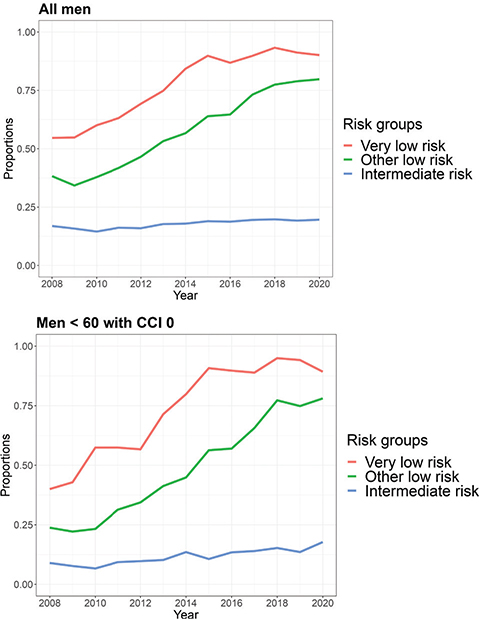
Figure 1. Proportions of men with who started on active surveillance (AS) per calendar year and risk group. Top: Overall. Bottom: Men younger than 60 years with Charlson Comorbidity Index (CCI) 0.
Clinical characteristics of men starting on AS
The clinical characteristics of men starting on AS (median age, CCI, PSA value, T stage, PSA density, total biopsy cancer length and number of biopsy cores with cancer) did not substantially change over the four time periods (Table 2).
Deferred treatment
The proportions of men who received deferred treatment within 2 and 5 years after diagnosis are shown in Table 3. The proportion of men with very low-risk disease who received deferred treatment within 2 years decreased from 13% to 8% overall and from 13% to 7% in men < 60 years with CCI 0 at the time of diagnosis. The corresponding proportions for treatment within 5 years were from 27% to 22% and from 27% to 22%. The use of deferred treatment decreased also in men < 60 years with CCI 0 who had intermediate-risk disease but was relatively stable for the other groups (Table 3). After 10 years, 43% of men with very low-risk, 53% with other low-risk and 59% with intermediate-risk cancer had received treatment (Figure 2).
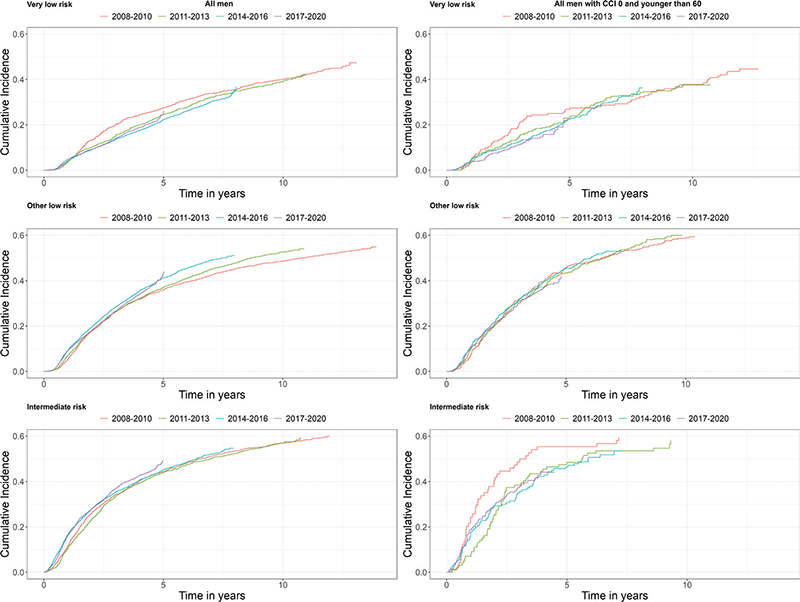
Figure 2. Cumulative incidence of deferred treatment per time period, calculated with the competing risk method with death as competing risk. Left: Overall. Right: Men younger than 60 years with Charlson Comorbidity Index (CCI) 0.
After adjustment for patient and cancer characteristics, deferred treatment within 2 years gradually decreased over time in men diagnosed with very low-risk disease, both overall and in men younger than 60 years with CCI 0; overall: HR 0.62 (95% CI 0.49–0.78), <60 years CCI 0: HR 0.40 (95% CI 0.22–0.71) in 2017–2020 versus 2008–2010. The adjusted rates of deferred treatment for the other groups did not change significantly (Figure 3). Of the men who received deferred treatment, almost 90% were treated with curative intent. This proportion was lower in men with intermediate-risk disease than amongst those with low-risk disease and slightly lower in the first time period (Supplementary Table S1).
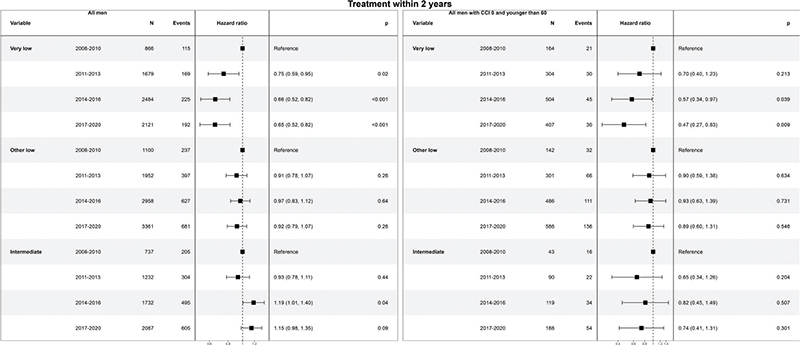
Figure 3. Hazard ratios for treatment within 2 years after initial active surveillance (AS) per time period in men with very low-, other low- and intermediate-risk-cancer, adjusted for PSA, cancer length on systematic biopsy, number of biopsy cores with cancer, prostate volume, age, Charlson Comorbidity Index and stage, all at the time of diagnosis. Left: Overall. Right: Men younger than 60 years with Charlson Comorbidity Index (CCI) 0.
Discussion
The use of AS in Swedish men with low-risk localised prostate cancer increased twofold between 2008 and 2020, from 40% to 81%. In 2017–2020, 92% of otherwise healthy men younger than 60 years with very low-risk disease started on AS. The use of AS increased also in men with intermediate-risk cancer, but at a lower level (from 15% to 19%); this increase remained after adjustment for tumour and patient characteristics.
The clinical characteristics of men starting on AS did not change over time. The use of deferred treatment gradually decreased over time in men with very-low-risk cancer and in otherwise healthy, younger men with intermediate-risk cancer, but was otherwise essentially unchanged. After adjustment for cancer and patient characteristics, the reduction of deferred treatment in men with very low-risk cancer was even more pronounced.
The rising uptake of AS in Sweden from 2009 to 2014 has been reported previously [9]. For example, between 2005 and 2015, the use of AS for low-risk prostate cancer increased from 4% to 39% in US veterans younger than 65 years and from 3% to 41% in those older than 65 years [18]. In 2021, 60% of men with low-risk disease started on AS [11]. A large Canadian study showed an increase of AS uptake from 38% in 2008 to 69% in 2014 [19]. A study from Australia showed rising AS uptake rates amongst men with low-risk disease [20]. Nationwide studies enhance the precision of findings and minimise selection bias. The only nationwide study outside Sweden is from the USA; it showed an increase in AS uptake for men with low-risk disease from 26% to 60% from the year 2014 to 2021 [11]. These proportions are substantially lower than those we now report from Sweden.
Not only was the use of AS more common in Sweden than in other countries during the study period, but the use of deferred treatment after initial AS was also somewhat lower. In a multicentre study across 12 countries (Movember GAP3 Consortium), including over 10,000 patients with low-risk disease, 41% had deferred treatment within 5 years [21]. In Sweden, 33% of men diagnosed with low-risk disease in 2014–2016 had deferred treatment within 5 years. A Canadian study including more than 8,000 men diagnosed with low-risk disease in 2008–2012 reported 51% deferred treatment after 2 years [19]; in Sweden, the corresponding proportion was 13%. In a UK study of 326 men diagnosed with low-risk disease in 2002–2006, 20% had deferred treatment at a median follow-up of 22 months [22]. The international multicentre study mentioned earlier has also reported deferred treatment in men younger than 60 years at the time of diagnosis: after 5 years, 39% of men with low-risk and 51% of men with intermediate-risk disease had deferred treatment [23]. In our nationwide Swedish study, 33% and 43% of otherwise healthy men younger than 60 years had deferred treatment in the last time period with available 5-year data. Comorbidity was not reported from the international multicentre study [23]. The PRIAS study included men with low-risk prostate cancer from 2006 through 2017 [24]. The cumulative incidence of deferred treatment after initial AS was 26% after 2 years and 43% after 5 years [25], which is more than during the first three periods in our study (an average of 15% after 2 years and 32% after 5 years). This can be explained by the different threshold for deferred treatment in the PRIAS study: men with Gleason score >3+3, more than two positive biopsy cores, or stage higher than cT2 were advised to switch to active treatment (until 2014, a PSA doubling time of <3 years was also a treatment criterion).
The reason for that use and continuation of AS have been, and probably still are, higher in Sweden than in other countries, may be a consequence of the clear recommendations in the national guidelines. The first national Swedish prostate cancer guidelines were published in 2014, and since then, AS is recommended as a first choice for all men with low-risk prostate cancer, for whom curative treatment would be considered on progression; for men with very low-risk disease, immediate treatment should only exceptionally be considered. For men with intermediate-risk cancer, AS was until 2022 only recommended for men whose life expectancy was too short to make curative treatment obviously indicated. These recommendations did not change during the study period. The subcategories favourable and unfavourable intermediate-risk cancer were not used in the national guidelines until 2023. Triggers for treatment are poorly underpinned by evidence but are currently being investigated in the randomised SPCG-17 trial [26].
The strength of our study is its nationwide and population-based design. This avoids selection bias, which may be an issue in institutional series. A notable strength of the study is the 98% NPCR capture rate of prostate cancer cases in the National Cancer Register [14]. Another strength is the incorporation of comorbidity data, which allowed for subgroup analysis of younger, otherwise healthy men with a long expected remaining lifetime. A weakness is that the NPCR does not include data on T stage subcategories (T2a-b-c) [27], which lead to some risk group misclassification: T2b and T2c tumours are usually categorised as an intermediate-risk (T2b) or high-risk (T2c) disease, but they were categorised as low-risk disease in our study. Had T2b and T2c tumours been excluded from the low-risk category, the proportion of men starting on AS for low-risk disease would probably have been slightly higher. It is unlikely that this misclassification affected trends over time, but it does impair comparisons with some other studies. Another limitation is that CCI was estimated using diagnoses registered in secondary healthcare only, and that risk factors affecting life expectancy such as smoking were not assessed. Further weaknesses are lack of information about the use of magnetic resonance imaging (MRI) before the treatment decision, results of follow-up investigations and reasons for deferred treatment. Since 2018, the Swedish guidelines recommend MRI before start of AS, and that MRI under certain conditions can replace re-biopsy during AS. MRI is now considered crucial for AS of localised prostate cancer, and its use may affect both the selection of patients for AS and discontinuation rates.
Conclusions
In Sweden, the number of men with low- and intermediate-risk localised prostate cancer starting on AS greatly increased from 2008 to 2020, not least amongst younger, otherwise healthy men. The use of deferred treatment gradually decreased over time in men with very-low-risk cancer and in otherwise healthy, younger men with intermediate-risk cancer but was otherwise essentially unchanged.
Our results suggest that AS over the past 15 years has been increasingly accepted by both patients and urologists as a safe approach to localised favourable prostate cancer. The dramatically increased numbers of men on AS must be considered when allocating resources for prostate cancer care.
Acknowledgements
This study was funded by Region Västra Götaland (REG-969400 & ALF). PCBaSe was made possible by the continuous work of the National Prostate Cancer Register of Sweden (NPCR) steering group: Elin Axén (register holder), Johan Styrke (co-chairman), Johan Stranne, Jon Kindblom, Camilla Thellenberg, Andreas Josefsson, Ingrida Verbiené, Hampus Nugin, Stefan Carlsson, Anna Kristiansen, Karin Holmsten, Mats Andén, Thomas Jiborn, Olof Akre, Per Fransson, Eva Johansson, Johan Stranne, Magnus Törnblom, Fredrik Jäderling, Marie Hjälm Eriksson, Lotta Renström Koskela, Jonas Hugosson, Ola Bratt, Erik Thimansson, Elin Trädgårdh, Viktoria Gaspar, Maria Nyberg, Fredrik Sandin, Marie Brus, Gustaf Hedström Anna Hedström, Nina Hageman, Christofer Lagerros, Hans Joelsson and Gert Malmberg.
References
- [1] Parker C. Active surveillance: towards a new paradigm in the management of early prostate cancer. Lancet Oncol. 2004;5(2):101–106. https://doi.org/10.1016/S1470-2045(04)01384-1
- [2] Kinsella N, Stattin P, Cahill D, et al. Factors influencing men’s choice of and adherence to active aurveillance for low-risk prostate cancer: a mixed-method systematic review. Eur Urol. 2018;74(3):261–280. https://doi.org/10.1016/j.eururo.2018.02.026
- [3] Aus G, Abbou CC, Bolla M, et al. EAU guidelines on prostate cancer. Eur Urol. 2005;48(4):546–551. https://doi.org/10.1016/j.eururo.2005.06.001
- [4] Heidenreich A, Bellmunt J, Bolla M, et al. EAU guidelines on prostate cancer. Part 1: screening, diagnosis, and treatment of clinically localised disease. Eur Urol. 2011;59(1):61–71. https://doi.org/10.1016/j.eururo.2010.10.039
- [5] Leslie SW, Soon-Sutton TL, Sajjad H, et al. Prostate cancer. Treasure Island, Florida, StatPearls Publishing; 2022.
- [6] Moschini M, Carroll PR, Eggener SE, et al. Low-risk prostate cancer: identification, management, and outcomes. Eur Urol. 2017;72(2):238–249. https://doi.org/10.1016/j.eururo.2017.03.009
- [7] Ross HM, Kryvenko ON, Cowan JE, et al. Do adenocarcinomas of the prostate with Gleason score (GS) ≤6 have the potential to metastasize to lymph nodes? Am J Surg Pathol. 2012;36(9):1346–1352. https://doi.org/10.1097/PAS.0b013e3182556dcd
- [8] European Association of Urology. EAU – EANM – ESTRO – ESUR – ISUP – SIOG guidelines on prostate cancer. Amsterdam; 2023. Available from: https://uroweb.org/guidelines/prostate-cancer [cited 9th january 2024]
- [9] Loeb S, Folkvaljon Y, Curnyn C, et al. Uptake of active surveillance for very-low-risk prostate cancer in Sweden. JAMA Oncol. 2017;3(10):1393–1398. https://doi.org/10.1001/jamaoncol.2016.3600
- [10] Klotz L. Active surveillance for prostate cancer: for whom? J Clin Oncol. 2005;23(32):8165–8169. https://doi.org/10.1200/JCO.2005.03.3134
- [11] Cooperberg MR, Meeks W, Fang R, et al. Time trends and variation in the use of active surveillance for management of low-risk prostate cancer in the US. JAMA Netw Open. 2023;6(3):e231439-e. https://doi.org/10.1001/jamanetworkopen.2023.1439
- [12] Van Hemelrijck M, Wigertz A, Sandin F, et al. Cohort profile: the National Prostate Cancer Register of Sweden and Prostate Cancer data Base Sweden 2.0. Int J Epidemiol. 2013;42(4):956–967. https://doi.org/10.1093/ije/dys068
- [13] Hagel E, Garmo H, Bill-Axelson A, et al. PCBaSe Sweden: a register-based resource for prostate cancer research. Scand J Urol Nephrol. 2009;43(5):342–349. https://doi.org/10.3109/00365590903024577
- [14] Tomic K, Berglund A, Robinson D, et al. Capture rate and representativity of The National Prostate Cancer Register of Sweden. Acta Oncol. 2015;54(2):158–163. https://doi.org/10.3109/0284186X.2014.939299
- [15] National guidelines for prostate cancer. Sweden; 2023. Available from: https://kunskapsbanken.cancercentrum.se/diagnoser/prostatacancer/vardprogram/primar-behandling-av-prostatacancer-utan-spridning/. [cited 4 february 2024]
- [16] Sundararajan V, Henderson T, Perry C, et al. New ICD-10 version of the Charlson comorbidity index predicted in-hospital mortality. J Clin Epidemiol. 2004;57(12):1288–1294. https://doi.org/10.1016/j.jclinepi.2004.03.012
- [17] Bratt O, Carlsson S, Fransson P, et al. The Swedish national guidelines on prostate cancer, part 1: early detection, diagnostics, staging, patient support and primary management of non-metastatic disease. Scand J Urol. 2022;56(4):265–273. https://doi.org/10.1080/21681805.2022.2094462
- [18] Loeb S, Byrne N, Makarov DV, et al. Use of conservative management for low-risk prostate cancer in the Veterans affairs integrated health care system from 2005–2015. JAMA. 2018;319(21):2231–2233. https://doi.org/10.1001/jama.2018.5616
- [19] Timilshina N, Komisarenko M, Martin LJ, et al. Factors associated with discontinuation of active surveillance among men with low-risk prostate cancer: a population-based study. J Urol. 2021;206(4):903–913. https://doi.org/10.1097/JU.0000000000001903
- [20] Weerakoon M, Papa N, Lawrentschuk N, et al. The current use of active surveillance in an Australian cohort of men: a pattern of care analysis from the Victorian Prostate Cancer Registry. BJU Int. 2015;115(S5):50–56. https://doi.org/10.1111/bju.13049
- [21] Van Hemelrijck M, Ji X, Helleman J, et al. Reasons for discontinuing active surveillance: Assessment of 21 centres in 12 countries in the Movember GAP3 consortium. Eur Urol. 2019;75(3):523–531.
- [22] van As NJ, Norman AR, Thomas K, et al. Predicting the probability of deferred radical treatment for localised prostate cancer managed by active surveillance. Eur Urol. 2008;54(6):1297–1305. https://doi.org/10.1016/j.eururo.2008.02.039
- [23] Remmers S, Helleman J, Nieboer D, et al. Active surveillance for men younger than 60 years or with intermediate-risk localized prostate cancer. Descriptive Analyses of Clinical Practice in the Movember GAP3 Initiative. Eur Urol Open Sci. 2022;41:126–33.
- [24] Bokhorst LP, Valdagni R, Rannikko A, et al. A decade of active surveillance in the PRIAS study: an update and evaluation of the criteria used to recommend a switch to active treatment. Eur Urol. 2016;70(6):954–960. https://doi.org/10.1016/j.eururo.2016.06.007
- [25] Beyer K, Straten V, Remmers S, et al. Secondary treatment for men with localized prostate cancer: a pooled analysis of PRIAS and ERSPC-Rotterdam data within the PIONEER data platform. J Pers Med. 2022;12(5):751. https://doi.org/10.3390/jpm12050751
- [26] Ahlberg MS, Adami H-O, Beckmann K, et al. PCASTt/SPCG-17 – a randomised trial of active surveillance in prostate cancer: rationale and design. BMJ Open. 2019;9(8):e027860. https://doi.org/10.1136/bmjopen-2018-027860
- [27] Cazzaniga W, Ventimiglia E, Alfano M, et al. Mini review on the use of clinical cancer registers for prostate cancer: the National Prostate Cancer Register (NPCR) of Sweden. Front Med. 2019;6:51. https://doi.org/10.3389/fmed.2019.00051