ORIGINAL RESEARCH ARTICLE
Exercise in primary care after robot-assisted radical cystectomy for urinary bladder cancer – effects on postoperative complications: a secondary analysis of a randomised controlled trial
Andrea Porseruda,b, Markus Alyc,d, Hanna Steinertze, Elisabeth Rydwika,b and Maria Hagströmera,f,g
aDivision of Physiotherapy, Department of Neurobiology, Care Sciences and Society, Karolinska Institutet, Stockholm, Sweden; bWomen’s Health and Allied Health Professionals Theme, Medical Unit Occupational Therapy & Physiotherapy, Karolinska University Hospital, Stockholm, Sweden; cDepartment of Molecular Medicine and Surgery, Karolinska Institutet, Stockholm, Sweden; dTheme Cancer, Patient Area Pelvic Cancer, Karolinska University Hospital, Stockholm, Sweden; eDepartment of Physiotherapy, Danderyd Hospital, Danderyd, Sweden; fAcademic Primary Health Care Centre, Region Stockholm, Stockholm, Sweden; gDepartment of Health Promoting Science, Sophiahemmet University, Stockholm, Sweden
ABSTRACT
Objective: An exercise programme in primary care soon after radical cystectomy for urinary bladder cancer was previously evaluated regarding its effects on physical function. A secondary aim, presented herein, was to evaluate the programme in terms of its effect on postoperative complications.
Materials and methods: Patients who were planned for robot-assisted radical cystectomy for urinary bladder cancer at Karolinska University Hospital between September 2019 and October 2022 were invited to participate. At discharge from hospital, they were randomised to intervention group including aerobic and resistance exercises with physiotherapist in primary care twice a week for 12 weeks and daily walks, or to unsupervised home-based exercise including daily walks. Readmission rates between 30 and 90 days after discharge, and complications according to Clavien Dindo were collected from the medical records and analysed.
Results: Ninety patients were randomised, with a mean (SD) age of 72 (9) years. Readmission rates between 30 and 90 days showed no difference between the groups. For readmitted patients, the intervention group had significantly fewer complications reported as Clavien Dindo grade 2 compared to the control group.
Conclusion: An exercise programme in primary care soon after robot-assisted radical cystectomy appears to be safe for patients, as measured by hospital readmission rates.
Trial registration: Clinical Trials (NCT03998579).
KEYWORDS Abdominal surgery; hernia; infection; physical activity; readmission; rehabilitation; robotic radical cystectomy with intracorporeal reconstruction
Citation: Scandinavian Journal of Urology 2024, VOL. 59, 193–199. https://doi.org/10.2340/sju.v59.42589.
Copyright: © 2024 The Author(s). Published by MJS Publishing on behalf of Acta Chirurgica Scandinavica. This is an Open Access article distributed under the terms of the Creative Commons Attribution 4.0 International License (http://creativecommons.org/licenses/by/4.0/), allowing third parties to copy and redistribute the material in any medium or format and to remix, transform, and build upon the material, with the condition of proper attribution to the original work.
Received: 1 July 2024; Accepted: 13 November 2024; Published: 18 December 2024
CONTACT Andrea Porserud andrea.porserud@ki.se Karolinska Institutet, Institutionen för Neurobiologi, vårdvetenskap och samhälle, Avdelningen för fysioterapi, 23100 141 83 Huddinge, Sweden
Supplemental data for this article can be accessed online at https://doi.org/10.2340/sju.v59.42589
Competing interests and funding: The authors declare that they have no conflict of interest. The study was supported by financial grants from the Swedish Research Council, Region Stockholm ALF-medicine and NSV, The Swedish Cancer Society, Åke Wiberg Foundation, Wallenius Foundation, Magnus Bergvalls Foundation, and Tornspiran Foundation. None of the funders for this project have taken part in the writing of the manuscript or the decision to submit it for publication.
Introduction
Patients who undergo radical cystectomy for urinary bladder cancer are at risk of being severely affected by postoperative complications [1]. Physical activity is thought to decrease the risk of postoperative complications after radical cystectomy [2, 3]. Common complications after the procedure are infection, ileus, thrombosis, metabolic imbalance and parastomal hernia [1, 4]. The readmission rate to hospital after radical cystectomy due to postoperative complications is high and thus also a financial burden for the health care system and society [1, 5]. This patient group generally includes people who are older and frail, suffer from comorbidities and are, or have been, smokers [6]. Older patients with comorbidities have a lower capacity to cope with postoperative complications [7].
The evidence on the effects of exercise on cancer-related symptoms is high and it has been shown to be safe and feasible [8, 9]. Patients with cancer who exercise have also shown to have a lower relative risk of cancer mortality and recurrence [9]. Exercise is a subset of physical activity that is planned, structured, and repetitive with the aim of improving or maintaining physical function or fitness [10]. Exercise recommendations for patients with cancer are aerobic exercise at moderate intensity at least 150 min per week, and muscle strengthening activities twice a week [8]. Exercise has a positive impact on blood circulation, the immune system, and bowel peristalsis and could thus decrease the risk of postoperative complications [11–13].
Studies that evaluate physical exercise after radical cystectomy and its impact on postoperative complications are lacking. Two studies investigated early rehabilitation after radical cystectomy in oncological inpatient settings, with exercise as one component, in which postoperative complications were reported [14, 15]. However, because the type of exercise was not described and adherence to the programme was not reported, the possible impact on postoperative complications is unknown. At discharge from hospital, patients who have undergone radical cystectomy are often recommended to engage in physical activity, like daily walks, and to avoid lifting heavy objects. However, most of these patients are feeble at discharge and may have difficulty following the general recommendations on physical activity. In a randomised controlled trial (RCT), we evaluated an exercise programme in primary care soon after discharge from hospital following robot-assisted radical cystectomy, in terms of impact on physical function, physical activity in daily life, and health-related quality of life [16]. Patients participated in a mean of 17 out of 24 sessions for 12 weeks. Four months after discharge, both the intervention group and the active control group took between 7000 and 8000 daily steps, but the intervention group had increased the daily number of steps more than the control group, compared to measurements at discharge from hospital. A secondary aim of the RCT, presented herein, was to evaluate the exercise programme in terms of its effect on readmission rates due to postoperative complications after discharge from hospital.
Materials and methods
Study design
A single-blind, two-arm RCT-study was conducted to evaluate the effects of a physical exercise programme. This study reports a preplanned secondary analysis of the RCT-study which evaluated the effects of a physical exercise programme on readmission rates due to postoperative complications. The study was registered in Clinical Trials (NCT03998579), approved by the regional ethical review board in Stockholm (Dnr 2012/2214-31/4 and 2020-06249), and described in a study protocol [17].
Participants and setting
Patients who were scheduled for a robot-assisted radical cystectomy for urinary bladder cancer at Karolinska University Hospital, Stockholm between 1 September 2019 and 31 October 2022 were consecutively invited to participate in the study. The patients underwent cystectomy with intracorporeal urinary diversion, either with an ileal conduit or orthotopic bladder reconstruction [18]. The patients had to be able to walk with or without a walking aid, understand and speak Swedish without an interpreter, and live in the Stockholm region. Patients who were planned for palliative surgery or had cognitive impairments, identified in the medical records, were not invited to join the study. The researchers screened potential patients for eligibility based on their medical records. Eligible patients were then given written information by a registered nurse at a preoperative meeting, and a few days later, one of the researchers provided more information in a phone call. Informed consent was signed before surgery. Prior to surgery, all patients received information on the importance of postoperative physical activity, and after surgery, the Activity Board, which is a standardised tool involving individual goal setting, was used on the ward to enhance mobilisation [19–21]. At discharge, patients were instructed to avoid lifting heavy objects and informed about the importance of physical activity at home. Patients who needed more rehabilitation before returning home were referred to stay for 1 week at an inpatient rehabilitation ward.
Eighteen primary care settings in the Stockholm region participated in the study, enabling patients in the intervention group to exercise with a physiotherapist at a primary care setting close to where they lived. A referral was sent to the chosen primary care setting from the physiotherapist at Karolinska University Hospital who conducted the assessments when the patients were discharged from hospital. The assessments are described in the published study protocol [17]. After assessments, the patients were allocated to either intervention or the control group, and a referral was sent. The physiotherapists at the primary care settings received education from the researchers before the study started regarding the study process, the patient group, robot-assisted radical cystectomy, postoperative restrictions, the exercise programme, and potential adverse events.
Intervention group
Patients who were randomised to the exercise programme led by a physiotherapist in primary care were scheduled to start the exercise programme during the third week after discharge. The patients paid 200 SEK for their visits to primary care, in line with usual fees. After the patients reached the high-cost threshold of 1400 SEK, visits were free. The programme was ongoing for 12 weeks, with two exercise sessions per week, and was individually targeted, but based on international recommendations for patients with cancer [8]. The programme consisted of aerobic exercise aiming for moderate intensity (30 min/session) and muscle strengthening exercises for endurance with 2 × 15 repetitions. The programme also included specific abdominal muscle training, including pelvic floor exercises, to minimise the risk of parastomal hernia [22]. The exercise programme was approved by the surgeons who performed the cystectomies at Karolinska, and restrictions relating to the use of abdominal muscles for 6 weeks due to surgical wounds were followed in the programme. Patients were also recommended to take daily walks. A recommended number of daily steps was set together with the physiotherapist in primary care once a week, based on the patient’s capacity the previous week. Individual goal setting, feedback, and self-monitoring of daily steps were used to support the patients’ daily walks.
Control group
Patients who were randomised to the active control group received written and oral instructions for a gradually increasing unsupervised exercise programme that included daily walks and a sit-to-stand exercise. The patients also received information on techniques to enhance physical activity such as the use of a pedometer, an exercise diary, and mobile phone applications.
Data collection and outcomes
The primary outcome was readmission to hospital between 30 and 90 days after discharge from hospital, related to the start and duration of the exercise programme. Secondary outcomes were readmission within 30 days after discharge, the severity of complications reported according to the Clavien Dindo classification among the readmitted, difference in values of haemoglobin and leukocytes, and rate of postoperative hernias within 6 months [23, 24]. The first author collected demographic and clinical data, as well as data on readmissions, complications, values of haemoglobin and leukocytes, and hernias from the patients’ medical records. The most severe complication on each occasion was included in the analysis. Physical tests, questionnaires and accelerometers were used at discharge and 4 months after discharge to evaluate the effect of the RCT in terms of physical function, physical activity, and health-related quality of life [16].
Sample size
Power was calculated on the proportion of patients who were readmitted to hospital within 90 days after discharge. Based on previous research and clinical experience, we anticipated a 20% readmission rate for the intervention group and a 45% readmission rate for the control group [17]. Forty-five per cent was the proportion of patients that we estimated were readmitted in the clinic when the study was planned. One hundred and twelve patients would provide a statistical power of 80% with the type 1 error set at 0.05. To allow for dropouts, the original plan was to include 120 patients (60 in each group). Due to the COVID-19 pandemic and the length of data collection, a decision was taken to halt recruitment at 100 patients.
Allocation
Randomisation was conducted in blocks of 2–6 patients, stratified by sex and age (<75, ≥75), through the ALEA system at the Centre for Clinical Cancer Studies at Karolinska University Hospital. After completing the tests at discharge from hospital, the physiotherapist received information from the researchers about which group the patient had been randomised to and informed the patient.
Blinding
The aim was that the physiotherapists conducting the measurements were to be blinded to the intervention. However, due to the pandemic and the lack of resources in the clinics, not all measurements were blinded.
Statistical analyses
Statistical analyses were conducted in SPSS version 28. Descriptive statistics were employed to ensure comparability between the groups prior to surgery and to describe the results of the outcomes. Due to non-normally distributed data and missing data, outcomes are described as median interquartile range (IQR), and the Mann-Whitney U-test was used to analyse between-group differences regarding primary and secondary outcomes. The alpha level was set to 0.05 and data was analysed using both an intention-to-treat and per-protocol approach. Also, the Holm-Bonferroni method was used to control for multiple comparisons.
Results
Out of 202 eligible patients, 100 accepted the invitation to participate in the study (Figure 1). One-third of the patients who declined participation were too stressed about the surgery to think about their rehabilitation. The other patients who declined prioritised other things or were not interested in the study. During the hospital stay, 10 patients dropped out, and at discharge, 90 patients were randomised with a mean (SD) age of 72 (9) years (Figure 1). There were no differences between the groups in terms of preoperative demographic or clinical characteristics, except for treatment with Bacillus Calmette-Guérin (BCG) and adjuvant chemotherapy. More patients in the intervention group had received BCG, and more patients in the control group had received adjuvant chemotherapy (Table 1). One-third of the randomised patients had non-muscle invasive tumour and two-thirds had muscle invasive tumour; almost all were grade 3 and nearly 50% had cancer in situ. Twenty-five patients began exercise in primary care, at a mean (SD) of 39 [21] days following discharge from hospital; within 90 days all patients, but one, had begun exercise.
| Demographic and characteristics | Exercise in primary care (intervention group) n = 47 | Home-based exercise (control group) n = 43 | ||
| Age, years, mean (SD) | 71.3 | (9.1) | 71.3 | (7.8) |
| Men | 31 | (66) | 31 | (72) |
| BMI ≥ 25 | 21 | (45) | 21 | (49) |
| Smoking status | ||||
| Smokers | 2 | (4) | 4 | (9) |
| Quit less than 6 months ago | 3 | (6) | 6 | (14) |
| Quit more than 6 months ago | 29 | (62) | 18 | (42) |
| Never smoked | 13 | (28) | 15 | (35) |
| Family status | ||||
| Living alone | 13 | (28) | 9 | (21) |
| Preoperative clinical characteristics | ||||
| Hypertension | 24 | (51) | 26 | (60) |
| Diabetes | 7 | (15) | 9 | (21) |
| Tumour stage | ||||
| NMIBC | 15 | (32) | 14 | (33) |
| MIBC | 31 | (66) | 27 | (63) |
| Locally advanced | 1 | (2) | 1 | (2) |
| T not known | 0 | 1 | (2) | |
| Nephrostomy prior to surgery | ||||
| One | 5 | (11) | 4 | (9) |
| Two | 0 | 1 | (2) | |
| ASA class | ||||
| 1 | 3 | (6) | 3 | (7) |
| 2 | 24 | (51) | 27 | (63) |
| 3 | 20 | (43) | 13 | (30) |
| Treatments before surgery | ||||
| Neoadjuvant chemotherapy | 14 | (30) | 15 | (35) |
| BCG | 13 | (28)* | 4 | (9)* |
| Previous abdominal surgery | 12 | (26) | 15 | (34) |
| Surgery | ||||
| Ileal conduit | 39 | (83) | 36 | (84) |
| Orthotopic neobladder | 8 | (17) | 7 | (16) |
| Operation time, minutes, mean (SD) | 275 | (64) | 301 | (47) |
| Postoperative clinical characteristics during hospital stay | ||||
| Ventricle drain | 14 | (30) | 9 | (21) |
| Reoperation | 3 | (6) | 1 | (2) |
| Length of hospital stay, days, mean (SD) | 8.5 | (3.7) | 8.9 | (6.7) |
| Discharged to rehabilitation ward | 32 | (68) | 23 | (53) |
| Adjuvant treatments after surgerya | n = 37 | n = 37 | ||
| Chemotherapy | 2 | (5)* | 10 | (27)* |
| Radiotherapy | 0 | 1 | (3) | |
| Radio and chemotherapy | 1 | (3) | 2 | (5) |
| BMI: Body mass index; Gx: Squamous epithelial; CIS: Cancer in situ; ASA: American Society of Anesthesiologists; BCG: Bacillus Calmette-Guérin. *Significant difference between the groups. aWithin 12 months after surgery. The Mann-Whitney U-test was used to analyse between-group differences. |
||||
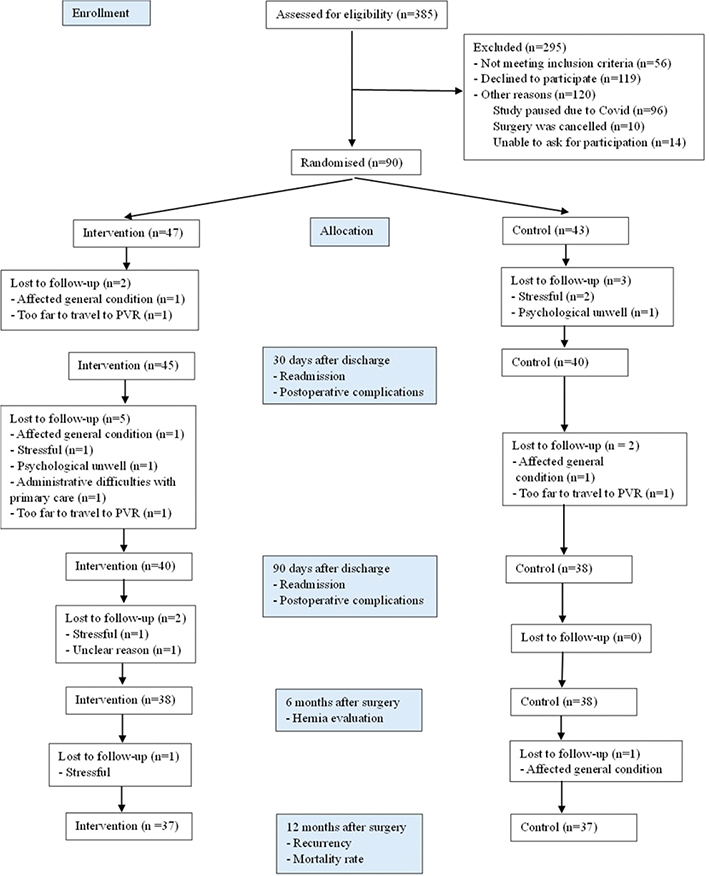
Figure 1. Flowchart of the study.
There was no intervention effect on readmission rates between 30 and 90 days after discharge (Table 2). In total, 22 (26%) patients were readmitted to hospital within 30 days after discharge, and 8 (10%) more patients within 90 days (Table 2). For patients readmitted between 30 and 90 days after discharge, the intervention group had significantly fewer grade 2 complications compared to the control group (Table 2). The most common complications among the readmitted were infections (Supplementary Table 1). Only 4 of 15 patients in the intervention group that were readmitted to hospital within 30 days had started the exercise programme in primary care within 30 days. Two of the four patients were diagnosed with minor complications and two with major complications.
| Readmission and hernia | Intervention group | Control group | P-value |
| Readmission between 30 and 90 days | Intention To Treat analysis | ||
| Intervention, n = 40 | Control, n = 38 | ||
| Readmission, n (%) | 2 (5) | 6 (16) | 0.149 |
| Clavien 1, n (%) | 0 | 0 | |
| Clavien 2, n (%) | 0 | 5a | 0.024 |
| Clavien 3a, n (%) | 1 | 1 | 1.0 |
| Clavien 3b, n (%) | 1 | 0 | 1.0 |
| Per protocol analysis, exercised at least 16 sessions | |||
| Intervention, n = 18 | Control, n = 38 | ||
| Readmission, n (%) | 0 | 6 (19) | 0.162 |
| Clavien 1, n (%) | 0 | ||
| Clavien 2, n (%) | 5 | 0.164 | |
| Clavien 3a, n (%) | 1 | 1.0 | |
| Readmission within 30 days | Intention To Treat analysis | ||
| Intervention, n = 45 | Control, n = 40 | ||
| Readmission, n (%) | 15 (33) | 7 (18) | 0.137 |
| Clavien 1, n (%) | 3 (7) | 2 (5) | 1.0 |
| Clavien 2, n (%) | 6 (13) | 3 (8) | 0.491 |
| Clavien 3a, n (%) | 6 (13) | 2 (5) | 0.272 |
| Per protocol analysis, exercised at least 16 sessions | |||
| Intervention, n = 18 | Control, n = 40 | ||
| Readmission, n (%) | 4 (22) | 7 (18) | 0.724 |
| Clavien 1, n (%) | 1 | 2 | 1.0 |
| Clavien 2, n (%) | 2 | 3 | 0.641 |
| Clavien 3a, n (%) | 1 | 2 | 1.0 |
| Hernia within 6 months | Intention To Treat analysis | ||
| Intervention, n = 38 | Control, n = 38 | ||
| Hernia, n (%) | 5 (13) | 5 (13) | 1.0 |
| Parastomal, n (%) | 3 (8) | 3 (8) | |
| Inguinal, n (%) | 1 | 2 | |
| Incisional, n (%) | 1 | 0 | |
| Per protocol analysis, patients with ileal conduit | |||
| Intervention, n = 33 | Control, n = 31 | ||
| Hernia, n (%) | 5 (15) | 5 (16) | 1.0 |
| Parastomal, n (%) | 3 (9) | 3 (10) | |
| Inguinal, n (%) | 1 (3) | 2 (6) | |
| Incisional, n (%) | 1 (3) | 0 | |
| aOne patient with orthotopic neobladder, four with ileal conduit. The Mann-Whitney U-test was used to analyse between-group differences. | |||
The results showed no intervention effect on haemoglobin, leukocytes or hernia rates (Tables 2 and 3). In total, 9% of the patients with ileal conduit developed a parastomal hernia (Table 2). At the end of the study, 1 year after the radical cystectomy, 10 patients of the 74 remaining in the study (14%) had been diagnosed with recurrence of urinary bladder cancer – two in the intervention group and eight in the control group (P = 0.085). One year after surgery, a total of five of 74 patients (7%) had deceased, of which four had been diagnosed with recurrence of bladder cancer.
Discussion
This study evaluated a preplanned secondary analysis of an exercise programme in primary care soon after robot-assisted radical cystectomy. No intention-to-treat-effect on the primary outcome of readmission to hospital between 30 and 90 days after discharge was observed. Given there was no difference between the groups in terms of readmission rates, this early exercise programme in primary care appears to be safe for patients. In addition, for patients who were readmitted between 30 and 90 days, the intervention group had significantly fewer complications reported as Clavien Dindo grade 2.
Compared to previous research on readmission rates after radical cystectomy, this study showed similar rates of readmission within 30 and 90 days after discharge from hospital [5, 25, 26]. The hypothesis was that early rehabilitation could reduce the rate of readmission due to postoperative complications, and that patients should begin exercise within the third week of discharge, which only six patients did. However, upon assessments 90 days after discharge, all, but one patient, had started the exercise in primary care. Results showed no intervention effect on the readmission rate, but the intervention group had significantly fewer grade 2 complications. Potentially the exercises the intervention group performed may have reduced complications that are reported as Clavien Dindo grade 2, which mainly are infections treated with antibiotics [23, 24]. Finding a way to reduce the rate of less-severe infections would be an important achievement in the care of these patients, since infections are the most common postoperative complications after radical cystectomy, and the most common reason for readmission to hospital [26, 27].
An assessment of patients readmitted within 30 days revealed that only a few patients in the intervention group had started the exercise in primary care and they had participated in just a few sessions. Given the small number of exercise sessions those patients participated in, it is theorised that those sessions did not have an impact on the readmission rate. The intervention group was also instructed to take daily walks. However, it is possible that adherence was lower than expected until the patients started the exercise programme in primary care. The active control group had an exercise programme including daily walks that started the day after discharge. A more defined instruction to take daily walks, with individual goal setting right after discharge, could have had an impact on the readmission rate for the intervention group, particularly given that most readmissions occur within the first 2 weeks after discharge, which is in line with the results of this study [25, 26]. In addition, previous research has shown that patients who participate in prehabilitation exercise before radical cystectomy improve their functional capacity [28]. If patients undertake exercise before surgery, it could be easier for them to continue soon after discharge from hospital. However, prehabilitation for this patient group is challenging due to the short window of time between diagnosis and radical cystectomy.
After radical cystectomy with ileal conduit, parastomal hernia is a common complication. In one review including 3,170 patients with ileal conduit, 17.1% developed parastomal hernia, diagnosed by clinical examination or cross-sectional imaging [4]. In this study, no intervention effect was seen on developing parastomal hernia, but in total only 9% of patients who had surgery with ileal conduit suffered a parastomal hernia. A body mass index (BMI) over 30 is a known predictor for the development of parastomal hernia. In the present study, however, both the intervention and control groups had a mean BMI value just above 25 [4, 29]. Also, both groups had relatively high level of daily steps 4 months after surgery. In addition to BMI values, higher physical activity levels could potentially also positively affect the risk of developing a parastomal hernia. No study has yet, to our knowledge, evaluated the association between postoperative objectively measured physical activity and parastomal hernia.
Limitations
One limitation in this study is power which was calculated on the proportion of patients who were readmitted to hospital within 90 days after discharge. However, because most of the patients started exercise more than 30 days after discharge, we report readmission rates between 30 and 90 days after discharge. The COVID-19 pandemic affected patient recruitment, which was capped at 100 patients, instead of the planned 120 and affected the proportion of patients who dropped out during the study, resulting in low power. In addition, the pandemic made it difficult for many patients to start exercise in primary care as early as planned. More than half of the patients were discharged from the hospital to an inpatient rehabilitation ward. However, we have no documentation of what kind of exercise the patients participated in during the week they spent at the rehabilitation ward or how it affected the results of this study.
Adjuvant treatment within 12 months after surgery was reported, but not how long after surgery. More patients in the control group had adjuvant chemotherapy, which might have affected the rate of readmission and complications. Also, in terms of the blood tests, there were variations in when the blood tests were administered (e.g. not always on postoperative day 14), and some patients might have had medical treatments before the blood tests were taken, which made it difficult to compare the blood tests and it may have impacted the results.
With the goal of minimising hernia risk, the intervention group was assigned specific abdominal exercises. However, patients were instructed to do the abdominal exercises at home due to insufficient time during the sessions in primary care. Adherence to the abdominal exercise regime was thereby not measured, which is a limitation. Also, hernias were intended to be diagnosed by cross-sectional imaging 6 months after surgery; but due to logistic difficulties, hernias were assessed through the patients’ medical records 6 months after surgery. The rate of hernias was low in this study, but 6 months could be considered a short follow-up period for parastomal hernia. Also, patients suffering hernias may have dropped out of the study, potentially skewing this aspect of the results. Finally, patients who participate in exercise studies often have fewer comorbidities and are more likely to be physically active than patients who decline participation, which affects the external validity.
Conclusion
Considering the limitations in this study, an exercise programme in primary care soon after discharge following robot-assisted radical cystectomy appears to be safe for patients as measured by hospital readmissions. Future similar studies should consider the risk of a high drop-out rate when planning the study, with the purpose of ensuring a fully-powered study.
ORCID
Andrea Porserud  , https://orcid.org/0000-0001-9144-7905
Markus Aly , https://orcid.org/0000-0002-7602-9198
Elisabeth Rydwik , https://orcid.org/0000-0003-0550-1675
Maria Hagströmer , https://orcid.org/0000-0002-4607-8677
References
- [1] Cicione A, De Nunzio C, Lombardo R, et al. Complications and quality of life of ileal conduit, orthotopic neobladder and ureterocutaneostomy: systematic review of reports using the Clavien-Dindo Classification. Minerva Urol Nefrol. 2020;72(4):408–419. https://doi.org/10.23736/S0393-2249.20.03641-3
- [2] Zhou Y, Li R, Liu Z, et al. The effect of the enhanced recovery after surgery program on radical cystectomy: a meta-analysis and systematic review. Front Surgery. 2023;10:1101098. https://doi.org/10.3389/fsurg.2023.1101098
- [3] Ljungqvist O, Scott M, Fearon KC. Enhanced recovery after surgery: a review. JAMA Surg. 2017;152(3):292–298. https://doi.org/10.1001/jamasurg.2016.4952
- [4] Narang SK, Alam NN, Campain NJ, et al. Parastomal hernia following cystectomy and ileal conduit urinary diversion: a systematic review. Hernia. 2017;21(2):163–175. https://doi.org/10.1007/s10029-016-1561-z
- [5] Novara G, Catto JW, Wilson T, et al. Systematic review and cumulative analysis of perioperative outcomes and complications after Robot-assisted radical cystectomy. Eur Urol. 2015;67(3):376–401. https://doi.org/10.1016/j.eururo.2014.12.007
- [6] Jensen BT, Lauridsen SV, Jensen JB. Optimal delivery of follow-up care after radical cystectomy for bladder cancer. Res Rep Urol. 2020;12:471–486. https://doi.org/10.2147/RRU.S270240
- [7] Lin HS, Watts JN, Peel NM, et al. Frailty and post-operative outcomes in older surgical patients: a systematic review. BMC Geriatr. 2016;16(1):157. https://doi.org/10.1186/s12877-016-0329-8
- [8] Campbell KL, Winters-Stone KM, Wiskemann J, et al. Exercise guidelines for cancer survivors: Consensus statement from international multidisciplinary roundtable. Med Sci Sports Exerc. 2019;51(11):2375–2390. https://doi.org/10.1249/MSS.0000000000002116
- [9] Cormie P, Zopf EM, Zhang X, et al. The impact of exercise on cancer mortality, recurrence, and treatment-related adverse effects. Epidemiol Rev. 2017;39(1):71–92. https://doi.org/10.1093/epirev/mxx007
- [10] Caspersen CJ, Powell KE, Christenson GM. Physical activity, exercise, and physical fitness: definitions and distinctions for health-related research. Public Health Rep. 1985;100(2):126–131.
- [11] Green DJ, Spence A, Halliwill JR, et al. Exercise and vascular adaptation in asymptomatic humans. Exp Physiol. 2011;96(2):57–70. https://doi.org/10.1113/expphysiol.2009.048694
- [12] Kasapis C, Thompson PD. The effects of physical activity on serum C-reactive protein and inflammatory markers: a systematic review. J Am Coll Cardiol. 2005;45(10):1563–1569. https://doi.org/10.1016/j.jacc.2004.12.077
- [13] Scott MJ, Baldini G, Fearon KC, et al. Enhanced recovery after surgery (ERAS) for gastrointestinal surgery, part 1: pathophysiological considerations. Acta Anaesthesiol Scand. 2015;59(10):1212–1231. https://doi.org/10.1111/aas.12601
- [14] Schulz GB, Grimm T, Buchner A, et al. Benefits and complications during the stay at an early rehabilitation facility after radical cystectomy and orthotopic ileum neobladder reconstruction. Urol Int. 2019;103(3):350–356. https://doi.org/10.1159/000502657
- [15] Götte M, Bahlburg H, Butea-Bocu MC, et al. Complications in the early recovery period after radical cystectomy-real data from impartial inpatient rehabilitation. Clin Genitourin Cancer. 2022;20(5):e424–e431. https://doi.org/10.1016/j.clgc.2022.05.008
- [16] Porserud A, Karlsson P, Aly M, et al. Effects of an exercise intervention in primary care after robot-assisted radical cystectomy for urinary bladder cancer: a randomised controlled trial. BMC Cancer. 2024;24(1):891. https://doi.org/10.1186/s12885-024-12647-2
- [17] Porserud A, Karlsson P, Rydwik E, et al. The CanMoRe trial – evaluating the effects of an exercise intervention after robotic-assisted radical cystectomy for urinary bladder cancer: the study protocol of a randomised controlled trial. BMC Cancer. 2020;20(1):805. https://doi.org/10.1186/s12885-020-07140-5
- [18] Hosseini A, Adding C, Nilsson A, et al. Robotic cystectomy: surgical technique. BJU Int. 2011;108(6 Pt 2):962–968. https://doi.org/10.1111/j.1464-410X.2011.10566.x
- [19] Porserud A, Aly M, Nygren-Bonnier M, et al. Objectively measured mobilisation is enhanced by a new behaviour support tool in patients undergoing abdominal cancer surgery. Eur J Surg Oncol. 2019;45(10):1847–1853. https://doi.org/10.1016/j.ejso.2019.04.013
- [20] Porserud A, Lundberg M, Eriksson J, et al. Like I said, I would not have likely gotten up otherwise: patient experiences of using an Activity Board after abdominal cancer surgery. Disabil Rehabil. 2022;45(6):1022–1029. https://doi.org/10.1080/09638288.2022.2048097
- [21] Karlsson P, Porserud A, Hagströmer M, et al. Healthcare professionals’ experiences of using the Activity Board as a tool for postoperative mobilization in patients after abdominal cancer surgery. J Cancer Rehabil. 2022;5:90–97.
- [22] Thompson MJ. Parastomal hernia: incidence, prevention and treatment strategies. Br J Nurs. 2008;17(2):S16, s8–s20. https://doi.org/10.12968/bjon.2008.17.Sup1.28145
- [23] Dindo D, Demartines N, Clavien PA. Classification of surgical complications: a new proposal with evaluation in a cohort of 6336 patients and results of a survey. Ann Surg. 2004;240(2):205–213. https://doi.org/10.1097/01.sla.0000133083.54934.ae
- [24] Clavien PA, Barkun J, de Oliveira ML, et al. The Clavien-Dindo classification of surgical complications: five-year experience. Ann Surg. 2009;250(2):187–196. https://doi.org/10.1097/SLA.0b013e3181b13ca2
- [25] Borza T, Jacobs BL, Montgomery JS, et al. No differences in population-based readmissions after open and Robotic-assisted radical cystectomy: implications for post-discharge care. Urology. 2017;104:77–83. https://doi.org/10.1016/j.urology.2017.01.042
- [26] Cacciamani GE, Medina L, Lin-Brande M, et al. Timing, patterns and predictors of 90-day readmission rate after Robotic radical cystectomy. J Urol. 2021;205(2):491–499. https://doi.org/10.1097/JU.0000000000001387
- [27] Clifford TG, Katebian B, Van Horn CM, et al. Urinary tract infections following radical cystectomy and urinary diversion: a review of 1133 patients. World J Urol. 2018;36(5):775–781. https://doi.org/10.1007/s00345-018-2181-2
- [28] Ellis JL, Dalimov Z, Chew L, et al. Preoperative optimization of the radical cystectomy patient: current state and future directions. J Surg Oncol. 2024;129(1):138–144. https://doi.org/10.1002/jso.27546
- [29] Ghoreifi A, Allgood E, Whang G, et al. Risk factors and natural history of parastomal hernia after radical cystectomy and ileal conduit. BJU Int. 2022;130(3):381–388. https://doi.org/10.1111/bju.15658