ORIGINAL RESEARCH ARTICLE
The Impact of Listening to Music During MRI-Fusion Prostate Biopsy Procedures on Pain and Anxiety Levels: A Randomized Controlled Trial
Çağrı Coşkuna , Ender Cem Bulutb, Serhat Çetinb, Uğur Aydına and Bora Küpelib
aDepartment of Urology, Ağrı Training and Research Hospital, Ağrı, Turkey; bDepartment of Urology, School of Medicine, Gazi University, Ankara, Turkey
ABSTRACT
Objective: Combined biopsy (CBx) is a combination of multiparametric magnetic resonance imaging (MpMRI)-targeted prostate biopsy (FBx) and systematic biopsy (SBx). CBx offers highly accurate diagnostic rates, but the increased number of cores taken and the longer procedure time may pose challenges in tolerability compared to traditional biopsies in terms of pain and anxiety. This situation leads to the need to evaluate pain and anxiety.
Methods: In a tertiary hospital in Turkey, 149 patients with suspicious lesions (PI-RADS ≥ 3 on MpMRI) who underwent transrectal CBx were included between May 2023 and August 2023. Following FBx, patients underwent a 12-core systematic biopsy. During CBx, 78 patients listened to classical music, while 71 patients used noise-canceling headphones without music. Ten minutes after the procedure, patients completed the Visual Analog Scale (VAS) and the State-Trait Anxiety Inventory (s-STAI, t-STAI) questionnaires to measure pain and anxiety. s-STAI determines how anxious a person feels at a specific moment. t-STAI indicates the general level of anxiety a person experiences independently of their current situation.
Results: Median VAS score was 3.6 (3.0 – 4.3) in the music group and 5.4 (4.4 – 6.9) in the control group (p < 0.001). The median s-STAI score was 38 (34 – 44) in the music group and 44 (39 – 48) in the control group (p < 0.001). For t-STAI scores, no significant difference between groups was observed.
Conclusion: Incorporating music during CBx, alongside traditional pain management, effectively reduces pain and anxiety levels. Its cost-effectiveness, accessibility, and non-invasive nature make routine use of music during CBx procedures advantageous for pain palliation.
KEYWORDS Fusion biopsy; music; pain; anxiety
Citation: Scandinavian Journal of Urology 2025, VOL. 60, 43–49. https://doi.org/10.2340/sju.v60.43106.
Copyright: © 2025 The Author(s). Published by MJS Publishing on behalf of Acta Chirurgica Scandinavica. This is an Open Access article distributed under the terms of the Creative Commons Attribution 4.0 International License (http://creativecommons.org/licenses/by/4.0/), allowing third parties to copy and redistribute the material in any medium or format and to remix, transform, and build upon the material, with the condition of proper attribution to the original work.
Received: 24 November 2024; Accepted: 3 February 2025; Published: 19 February 2025
CONTACT Çağrı Coşkun drcagricoskun@gmail.com Department of Urology, Ağrı Training and Research Hospital, 04200, Ağrı/Türkiye
Competing interests and funding:
There is no conflict of interest in this study.
The authors have no relevant financial or non-financial interests to disclose.
Introduction
Prostate cancer (PC) is the second most common malignancy among men [1]. The histopathological diagnosis of PC is established through prostate biopsy. The biopsy specifically targeting suspicious lesions identified in the multiparametric prostate magnetic resonance imaging (MpMRI), achieved by combining MpMRI and transrectal ultrasound (TRUS) images, is referred to as MpMRI/TRUS fusion prostate biopsy (FBx) [2–4].
It is believed that music positively affects pain and anxiety by diverting one’s attention away from negative stimuli and directing awareness toward the music [5]. Therefore, music therapy is seen as a cost-effective and non-invasive technique that can reduce pain and anxiety [6].
After interventional procedures, various scales and questionnaires can be used to assess pain. Among these, the most commonly used is the ‘Visual Analog Scale (VAS)’. VAS is a scale where the pain level is marked on a 10-centimeter line [7, 8]. For assessing anxiety, the ‘State-Trait Anxiety Inventory (STAI)’, consisting of two different questionnaires, has been developed. The State-STAI (s-STAI) determines how anxious a person feels at a specific moment. The Trait-STAI (t-STAI) indicates the general level of anxiety a person experiences independently of their current situation [9].
Based on the hypothesis of a positive effect of music on pain and anxiety, the primary aim of this study was to examine the impact of music on pain and anxiety during combined biopsy (CBx). The secondary aim was to investigate the effect of lesion characteristics on pain and anxiety in these groups.
Materials and methods
This randomized controlled prospective study was conducted at the Department of Urology, Gazi University Faculty of Medicine Hospital, one of the clinics where FBx was first implemented in Turkey and which served as a reference center. Over 4 months, between May 2023 and August 2023, the data of 165 consecutive patients who underwent CBx were recorded. Patients with bleeding diathesis (n = 0), previous prostate biopsy history (n = 3 (1.8%)), hemorrhoidal disease (n = 4 (2.4%)), lidocaine allergy (n = 1 (0.6%)), history of any psychiatric disorder (n = 3 (1.8%)), and hearing impairment (n = 2 (1.2%)) were excluded from the study. Additionally, patients who incorrectly or incompletely filled out the VAS score and STAI questionnaires were excluded from the analysis (n = 3 (1.8%)).
Finally, 149 patients who underwent CBx, including FBx and SBx, were included in the study. Of these patients, 78 listened to music during the procedure, while noise-canceling earphones were provided to the remaining 71 to prevent external environmental noise. The groups were randomly determined (Figure 1). Number tables were created by computer, and simple randomization was performed. Before the operator entered the biopsy room, a nurse put noise-canceling headphones on all the patients. The nurse assigned the patients to either the music group or the control group by looking at the number assigned by the computer. All the patients in the music group listened to the same classical music playlist in the same order. On the other hand, the patients in the control group wore only noise-canceling headphones without any music. The patients did not know their group until the procedure began. The doctor did not know the patient’s group until the procedure was complete.
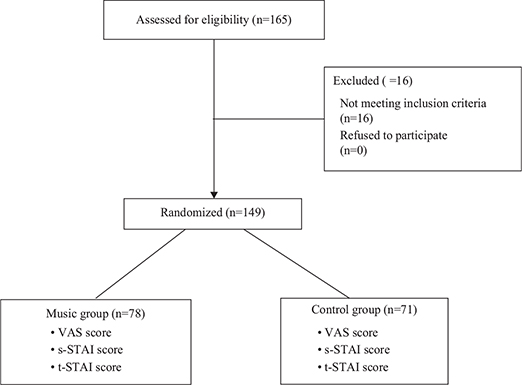
Figure 1. The flowchart of the study.
VAS: visual analogue scale; s-STAI: state-State and Trait Anxiety Scores; t-STAI: trait-State and Trait Anxiety Scores.
Patients with elevated prostate-specific antigen (PSA) levels, suspicious findings on rectal examination, and lesions classified as Prostate Imaging–Reporting and Data System (PI-RADS) ≥3 according to PI-RADS v2.1 on MpMRI, were decided to undergo CBx. Patients with bleeding diathesis, previous prostate biopsy history, hemorrhoidal disease, lidocaine allergy, history of any psychiatric disorder, and hearing impairment were excluded from the study. Additionally, patients who incorrectly or incompletely filled out the VAS score and STAI questionnaires were excluded from the analysis. Informed voluntary consent forms were obtained from all patients before the procedure. During this process, information about the purpose of the study, complications, VAS score, and STAI questionnaire was provided. The patient’s age, PSA levels, lesion characteristics on MpMRI, biopsy durations, pre- and post-procedure vital parameters, VAS scores, s-STAI scores, and t-STAI scores were recorded.
VAS scores, s-STAI, and t-STAI were used to measure pain and anxiety, which are the study’s primary outcomes. The VAS score is a questionnaire where patients mark their pain level on a 10-centimeter line. Zero is considered ‘no pain at all’, while 10 is deemed ‘unbearable pain’. We used the VAS, a visual assessment tool, to measure the patients’ pain levels. The STAI consists of two different questionnaires developed to assess anxiety. s-STAI determines how anxious a person feels at a specific moment. t-STAI indicates the general level of anxiety a person experiences independently of their current situation. Both questionnaires include positive and negative items. When scoring, a score between 1 (or -1) and 4 (or -4) is given depending on whether the item is positive or negative. The total score ranges from 20 to 80, with a higher score indicating higher anxiety levels. The Turkish validation of the s-STAI and t-STAI questionnaires was conducted by Öner et al. in 1975 [9]. For the secondary outcomes of the study, comparative analysis was conducted by creating subgroups based on lesion characteristics (such as localization).
Antibiotic prophylaxis and rectal cleansing were routinely applied to patients. The procedure commenced after the installation of 6 ml of 2% lidocaine HCl through intrarectal local anesthetic (ILA). The procedure was initiated after waiting 5 min following the ILA installation. All patients underwent the process in the lithotomy position. Before the operator entered the biopsy room, a nurse put noise-canceling headphones on all patients. It was decided whether to turn on music or not, depending on the group the patient was in. The music volume for patients in the music group was adjusted so that the operator could not hear any sounds coming from outside.
The transrectal ultrasound procedure used the Flex Focus 500 ultrasound system (BK Medical, Herlev, Denmark). The BioJet fusion system (D&K Technologies, Barum, Germany), working in conjunction with this ultrasound system, was used to draw the outlines of the prostate and lesion boundaries in T2 sequences before the procedure. All biopsy procedures were carried out using an automatic biopsy gun and an 18-gauge biopsy needle. Initially, targeted biopsies were taken from the lesions suspected in MpMRI. The number of cores taken during FBx, ranging from 2 to 4, was decided based on the lesion size. In SBx, 12 biopsy cores were taken from both sides (right and left) of the prostate, including basal, midbasal, and apical regions from both the medial and lateral aspects. Thus, the CBx procedure was completed, and the process was concluded.
Within 5 min of completing the procedure, the vital parameters of the patients were monitored. After an approximately 10-min rest period, all patients were given the VAS score questionnaire, s-STAI, and t-STAI questionnaires. After completing the questionnaires, the results were recorded for all patients in both groups. Patients were provided with information about potential complications and emergencies and then discharged.
This study’s design was structured according to the CONSORT 2010 guidelines [10]. The study was approved by the medical ethics committee of Gazi University Faculty of Medicine on 08 May 2023 (approval number: 402).
Statistical analysis
The statistical analysis of the research data was conducted using R Studio version 3.6.3. The normality of continuous variables was assessed using analytical methods (Kolmogorov-Smirnov/Shapiro-Wilk tests). The descriptive findings section presented categorical variables as numbers (percentages). In contrast, continuous variables were presented as mean ± standard deviation for normally distributed data and median (interquartile range) for non-normally distributed data. The statistical differences in frequency between groups for categorical variables were compared using the Chi-square test and Fisher’s Exact test. For continuous variables, the Mann-Whitney U and Kruskal-Wallis tests were used to compare frequency-based statistical differences between groups. Statistical significance was considered when p < 0.05. Number tables were created, and simple randomization was performed. The sample size for this study was determined using a power analysis to compare pain levels (VAS scores) and stress levels (s-STAI and t-STAI scores) between two independent groups. The analysis assumed a medium effect size (Cohen’s d = 0.5), a significance level of 5% (α = 0.05) and a statistical power of 80% (1−β = 0.8). Equal sample sizes were planned for the two groups (n1 = n2), and under these assumptions, it was calculated that each group should include at least 64 patients. Therefore, the total sample size required for the study was estimated to be a minimum of 128 patients. The analysis was performed using the Statsmodels library.
Results
There was no significant difference between the two groups regarding age, serum PSA levels, MpMRI characteristics (number, localization, diameter of lesions, prostate volume, and PI-RADS score), and the number of cores taken (p > 0.05, all). The median biopsy durations were 22 min in the music group and 20 min in the control group (p < 0.001). Demographic characteristics and patient features are presented in Table 1. In the music group, the median VAS score was 3.6 (IQR (interquartile range): 3.0 - 4.3), while in the control group, it was 5.4 (IQR: 4.4 – 6.9). When comparing the median s-STAI scores in both groups, they were found to be 38 (IQR: 34 – 44) in the music group and 44 (IQR: 39– 48) in the control group. There was a significant difference between the groups for both parameters (p<0.001, all). Other information, including the comparison of pain, anxiety, and vital signs in the music and control groups, is shown in Table 2.
In the music group, for patients with an isolated peripheral zone (PZ) lesion in MpMRI, the median VAS score was 3.2 (IQR: 2.3 – 3.6), while for those with an anterior lesion, it was 3.9 (IQR: 3.3 – 4.9). There was a statistically significant difference between the two groups (p = 0.04). There was a statistically significant difference between the music and control groups in all subgroups of lesion location (Table 3).
In the music group, for patients with an isolated PZ lesion in MpMRI, the median s-STAI score was 35.0 (IQR: 30.0 – 39.0), while for those with an anterior lesion, it was 39.0 (IQR: 36.0 – 45.2). There was a statistically significant difference between the two groups (p = 0.003). In the control group, for patients with an isolated PZ lesion, the median s-STAI score was 43.0 (IQR: 38.0 – 46.0), while for those with an anterior lesion, it was 46.0 (IQR: 41.0 – 49.7). Again, there was a statistically significant difference between the two groups (p = 0.017). There was a statistically significant difference between the music and control groups in all subgroups of lesion location (Table 4). Subgroup analyses of VAS scores and s-STAI scores for the music and control groups are shown in Tables 3 and 4.
Discussion
In this randomized controlled prospective study, VAS and s-STAI score were lower in the group listening to music during CBx. Our findings support the positive impact of music on reducing pain and anxiety.
The International Association for the Study of Pain defines pain as ‘an unpleasant sensory and emotional experience associated with actual or potential tissue damage, or described in terms of such damage’. Pain increases morbidity rates and significantly reduces the quality of life [11]. Anxiety, like pain, leads to a negative experience in patients. Anxiety during the perioperative period can lead to complications such as hypertension, arrhythmia, and the postponement of planned procedures. Additionally, it can alter pain perception and decrease patient satisfaction [12]. Music distracts the cingulofrontal cortex, deactivating the sympathetic nervous system and activating the parasympathetic system, which positively impacts anxiety [13, 14]. As a non-invasive, inexpensive method, music is effective in reducing perioperative pain and anxiety, potentially raising the pain threshold by alleviating anxiety [15]. A meta-analysis found that music reduced pain and anxiety in pre-, intra-, and postoperative patients [16]. Randomized trials showed music was more effective than oral midazolam for preoperative anxiety and also shortened hospitalization duration [17, 18].
Prostate biopsy is associated with pain primarily due to several factors, including the dilation of the rectum by the TRUS probe, probe manipulation, and the needle traversing the prostate during the biopsy procedure [19]. Because the probe needs to be advanced to more proximal areas and manipulated more, prostate biopsies tend to cause more pain compared to other rectal ultrasound procedures for rectal pathologies. Due to the pain associated with the procedure, pre-biopsy pain palliation has become a routine practice [20, 21].
One potential parameter during prostate biopsy that can influence pain and anxiety is the duration of the procedure. In two different studies comparing FBx versus MRI in-bore biopsy and CBx versus SBx, the reason for the higher pain scores caused by MRI in-bore biopsy and CBx was interpreted as the procedure time [22, 23]. It has been shown that even in cases where the biopsy is performed using the same technique, longer procedure durations increase the perception of pain and discomfort [24, 25]. While the impact of procedure duration on pain in our study is consistent with the information in the literature, the lack of an effect of procedure duration on pain levels in the experimental group may suggest a potential positive impact of listening to music. Additionally, despite the longer duration of the procedure in the music group, the lower pain and anxiety in this group support the notion that music has a positive impact.
Yoo et al., in their study on patients undergoing FBx, reported that anterior zone lesions increased the perceived pain level [26]. In contrast, Rempega et al. suggested in their studies that anterior lesions did not affect pain levels. They interpreted this as being due to analgesic applications and the subjective nature of pain as a parameter [24]. In our study, the reason for the impact of anterior lesion localization on pain and anxiety scores may be the greater distance covered by the probe manipulation and needle within the prostate in these lesions.
There are studies indicating that music significantly reduces pain and anxiety levels in patients undergoing prostate biopsy. They have reported significantly reduced VAS and s-STAI scores [27, 28]. However, limitations such as conventional biopsy evaluation in these studies, intense analgesic applications, and sample size-related constraints prevent a direct comparison with our study. In a study by Packiam et al. involving 200 patients who underwent SBx, participants were divided into music and control groups, and there was no difference in pain and anxiety scores between the two groups [29]. However, the fact that this study was conducted with ambient music may have reduced the anxiolytic effect of music. In this study, the median procedure time was 12 minutes in the music group and 11 minutes in the control group. The number of cores taken was 12 in both groups. In our study, the procedure time was 22 minutes in the music group and 20 minutes in the control group. The median number of cores taken was 16 in both groups. Considering that longer procedure times and a higher number of cores may increase pain, the differences in pain levels between the two groups in our study might have become significant. Indeed, in our study, the median VAS scores were also higher than those reported in this study. In a survey by Tsivian et al. involving 88 patients who underwent SBx, patients were divided into three groups: one with music, one with noise-canceling headphones, and a control group. Pain scores were not significantly different among the three groups [13]. Although there was no statistical difference in this study, both before and after the procedure, the music group had lower pain and anxiety scores. Therefore, the study’s small sample size may have contributed to the lack of significance in the results. Another study evaluating the effect of music on pain in patients undergoing SBx found no difference in pain scores, but music significantly reduced anxiety. The authors attributed the inconsistent impact on pain and anxiety to the small sample size of the study [30]. Additionally, a study investigating the relationship between pain and anxiety during transrectal prostate biopsy found that anxiety decreased as pain levels decreased [31]. This highlights the importance of pain palliation. Therefore, we believe that using a non-invasive and cost-effective pain palliation method, such as music during biopsy, could be a rational approach. In a prospective study, patients who underwent SBx and CBx were compared. It was found that the number of cores taken and the procedure time were more extended in CBx. Additionally, CBx patients’ anxiety levels were observed to be higher after the procedure. The authors of this study believe that CBx is more painful due to its longer procedure time and the higher number of cores taken [32].
In our study involving patients undergoing CBx, a positive effect of music on pain and anxiety was observed. Subgroup analyses revealed this positive effect across all subgroups. To the best of our knowledge, our study is the first in the literature to investigate the impact of listening to music on pain and anxiety in patients undergoing MRI/TRUS fusion prostate biopsy. Therefore, we believe there is a need for more extensive and randomized controlled trials to explore the impact of music in the context of CBx further.
There were some limitations to our study. Firstly, despite the use of headphones in the control group, the patients still heard the sound of biopsy gun. We believe that this could particularly affect anxiety. In our study, no group was without headphones. Positive interaction with the medical staff could potentially have a positive effect, especially on anxiety. Therefore, the absence of such a group is a limitation of our study. A standard playlist was used for all patients as the music genre. Considering that the effect of music may vary based on patients’ cultural and social levels, allowing patients to choose their music could have been beneficial. During CBx, the sources of pain include the placement of the probe in the rectum, probe manipulation, and the sampling with the biopsy needle. The failure to evaluate each stage of the procedure separately in our study prevented us from determining at which stage the music had a more significant effect. The exact volume of suspicious lesions in MpMRI could not be calculated. This is because three dimensions of the prostate are not routinely given by radiologists reporting MpMRI. Therefore, only the largest diameter of the lesion was recorded, and the full impact of the lesion volume could not be determined. While we believe that the largest diameter generally correlates with the lesion volume, we anticipate that precisely calculating the volume could provide more accurate results.
Conclusion
Combined biopsy is a procedure that can lead to pain and anxiety in patients. In our study, VAS and s-STAI scores were lower in the listening-to-music during CBx. Our findings show that music has a positive effect on pain and anxiety.Music is a cost-effective, easily applicable, and non-invasive method compared to traditional pain palliation techniques. Therefore, clinics performing CBx could benefit from playing music for patients during the procedure.
Declarations
Data availability statement: Data available on request from authors.
Ethics approval: The study was approved by the medical ethics committee of Gazi University Faculty of Medicine on 08 May 2023 (approval number: 402).
ORCID
Çağrı Coşkun https://orcid.org/0000-0002-6227-0992
Ender Cem Bulut https://orcid.org/0002-5002-5471
Serhat Çetin https://orcid.org/0000-0001-5450-5168
Uğur Aydın https://orcid.org/0000-0001-8024-6438
Bora Küpeli https://orcid.org/0000-0003-0708-7535
References
- [1] Filho AM, Laversanne M, Ferlay J, et al. The GLOBOCAN 2022 cancer estimates: Data sources, methods, and a snapshot of the cancer burden worldwide. Int J Cancer. 2025;156(7):1336-1346. https://doi.org/10.1002/ijc.35278
- [2] Puech P, Rouvière O, Renard-Penna R, et al. Prostate cancer diagnosis: multiparametric MR-targeted biopsy with cognitive and transrectal US–MR fusion guidance versus systematic biopsy—prospective multicenter study. Radiology. 2013;268(2):461–469. https://doi.org/10.1148/radiol.13121501
- [3] Hoeks CM, Schouten MG, Bomers JG, et al. Three-Tesla magnetic resonance–guided prostate biopsy in men with increased prostate-specific antigen and repeated, negative, random, systematic, transrectal ultrasound biopsies: detection of clinically significant prostate cancers. Eur Urol. 2012;62(5):902–909. https://doi.org/10.1016/j.eururo.2012.01.047
- [4] Pinto PA, Chung PH, Rastinehad AR, et al. Magnetic resonance imaging/ultrasound fusion guided prostate biopsy improves cancer detection following transrectal ultrasound biopsy and correlates with multiparametric magnetic resonance imaging. J Urol. 2011;186(4):1281–1285. https://doi.org/10.1016/j.juro.2011.05.078
- [5] Nilsson U. The anxiety-and pain-reducing effects of music interventions: a systematic review. AORN J. 2008;87(4):780–807. https://doi.org/10.1016/j.aorn.2007.09.013
- [6] Bradt J, Dileo C, Potvin N. Music for stress and anxiety reduction in coronary heart disease patients. Cochrane Database Syst Rev. 2013(12):CD006577. https://doi.org/10.1002/14651858.CD006908.pub2
- [7] Huskisson EC. Measurement of pain. Lancet. 1974;304(7889):1127–1131. https://doi.org/10.1016/S0140-6736(74)90884-8
- [8] VASSS ODIO. Validation of the Turkish version of the visual analog scale spine score in patients with spinal fractures. Acta Orthop Traumatol Turc. 2011;45(5):353–358.
- [9] Oner N, Le Compte A. State trait inventory in handbook. Istanbul: Bogazici University Publication; 1985.
- [10] Schulz KF, Altman DG, Moher D. CONSORT 2010 statement: updated guidelines for reporting parallel group randomised trials. BMJ. 2010;340:c332. https://doi.org/10.1136/bmj.c332
- [11] Raja SN, Carr DB, Cohen M, et al. The revised International Association for the Study of Pain definition of paIn: concepts, challenges, and compromises. Pain. 2020;161(9):1976–1982. https://doi.org/10.1097/j.pain.0000000000001939
- [12] Altınsoy S, Arslan M, Ergil J. Effect of favorite music on postoperative anxiety and pain. Anaesthesist. 2020;69(3):198–204. https://doi.org/10.1007/s00101-020-00731-8
- [13] Tsivian M, Qi P, Kimura M, et al. The effect of noise-cancelling headphones or music on pain perception and anxiety in men undergoing transrectal prostate biopsy. Urology. 2012;79(1):32–36. https://doi.org/10.1016/j.urology.2011.09.037
- [14] Palmer JB, Lane D, Mayo D, et al. Effects of music therapy on anesthesia requirements and anxiety in women undergoing ambulatory breast surgery for cancer diagnosis and treatment: a randomized controlled trial. J Clin Oncol. 2015;33(28):3162. https://doi.org/10.1200/JCO.2014.59.6049
- [15] Amir D. Musical and verbal interventions in music therapy: a qualitative study. J Music Ther. 1999;36(2):144–175. https://doi.org/10.1093/jmt/36.2.144
- [16] Kühlmann A, De Rooij A, Kroese L, et al. Meta-analysis evaluating music interventions for anxiety and pain in surgery. J Br Surg. 2018;105(7):773–783. https://doi.org/10.1002/bjs.10853
- [17] Bringman H, Giesecke K, Thörne A, et al. Relaxing music as pre‐medication before surgery: a randomised controlled trial. Acta Anaesthesiol Scand. 2009;53(6):759–764. https://doi.org/10.1111/j.1399-6576.2009.01969.x
- [18] Zhou K, Li X, Li J, et al. A clinical randomized controlled trial of music therapy and progressive muscle relaxation training in female breast cancer patients after radical mastectomy: results on depression, anxiety and length of hospital stay. Eur J Oncol Nurs. 2015;19(1):54–59. https://doi.org/10.1016/j.ejon.2014.07.010
- [19] Demirtaş A, Sönmez G, Tombul ŞT, et al. Comparison of pain levels in fusion prostate biopsy and standard TRUS-Guided biopsy. Int Braz J Urol. 2020;46:557–562. https://doi.org/10.1590/s1677-5538.ibju.2019.0154
- [20] Hou C-P, Lin Y-H, Hsieh M-C, et al. Identifying the variables associated with pain during transrectal ultrasonography of the prostate. Patient Prefer Adherence. 2015:1207–1212. https://doi.org/10.2147/PPA.S83073
- [21] Mottet N, van den Bergh RC, Briers E, et al. EAU-EANM-ESTRO-ESUR-SIOG guidelines on prostate cancer—2020 update. Part 1: screening, diagnosis, and local treatment with curative intent. Eur Urol. 2021;79(2):243–262. https://doi.org/10.1016/j.eururo.2020.09.042
- [22] Chesnut GT, Zareba P, Sjoberg DD, et al. Patient-reported pain, discomfort, and anxiety during magnetic resonance imaging-targeted prostate biopsy. Can Urol Assoc J. 2020;14(5):E202. https://doi.org/10.5489/cuaj.6102
- [23] Arsov C, Rabenalt R, Quentin M, et al. Comparison of patient comfort between MR-guided in-bore and MRI/ultrasound fusion-guided prostate biopsies within a prospective randomized trial. World J Urol. 2016;34:215–220. https://doi.org/10.1007/s00345-015-1612-6
- [24] Rempega G, Rajwa P, Kępiński M, et al. The severity of pain in prostate biopsy depends on the biopsy sector. J Pers Med. 2023;13(3):431. https://doi.org/10.3390/jpm13030431
- [25] Nakai Y, Tanaka N, Matsubara T, et al. Effect of prolonged duration of transrectal ultrasound-guided biopsy of the prostate and pre-procedure anxiety on pain in patients without anesthesia. Res Rep Urol. 2021:13 111–120. https://doi.org/10.2147/RRU.S297703
- [26] Yoo JW, Koo KC, Chung BH, et al. Pain control according to the periprostatic nerve block site in magnetic resonance imaging/transrectal targeted prostate biopsy. Sci Rep. 2022;12(1):772. https://doi.org/10.1038/s41598-022-04795-x
- [27] Lee BC, Kim HO, Chung HS, et al. Does music from noise-canceling headphones have a beneficial effect on men undergoing transrectal ultrasound-guided prostate biopsy? Prostate Int. 2021;9(3):145–150. https://doi.org/10.1016/j.prnil.2021.02.001
- [28] Chang YH, Oh TH, Lee JW, et al. Listening to music during transrectal ultrasound-guided prostate biopsy decreases anxiety, pain and dissatisfaction in patients: a pilot randomized controlled trial. Urol Int. 2015;94(3):337–341. https://doi.org/10.1159/000368420
- [29] Packiam VT, Nottingham CU, Cohen AJ, et al. No effect of music on anxiety and pain during transrectal prostate biopsies: a randomized trial. Urology. 2018;117:31–35. https://doi.org/10.1016/j.urology.2018.04.014
- [30] Cho SW, Choi HJ. Effect of music on reducing anxiety for patients undergoing transrectal ultrasound-guided prostate biopsies: randomized prospective trial. Urol J. 2016;13(2), 2612–2614. https://doi.org/10.22037/uj.v13i2.3187
- [31] Tekdogan U, Tuncel A, Nalcacioglu V, et al. Is the pain level of patients affected by anxiety during transrectal prostate needle biopsy? Scand J Urol Nephrol. 2008;42(1):24–28. https://doi.org/10.1080/00365590701514555
- [32] Deivasigamani S, Adams ES, Kotamarti S, et al. Comparison of procedural anxiety and pain associated with conventional transrectal ultrasound prostate biopsy to magnetic resonance imaging-ultrasound fusion-guided biopsy: a prospective cohort trial. Prostate Cancer Prostatic Dis. 2024;27(2):294–299. https://doi.org/10.1038/s41391-023-00760-5