RESEARCH LETTER
Prostate cancer incidence in Sweden before, during and after the COVID-19 pandemic. Population-based study
Paolo Zauritoa,b, Hans Garmoa, Rolf Gedeborga, Mats Ahlberga, Andri Wilberg Orrasona, Johan Styrkec, David Robinsond, Pär Stattina and Marcus Westerberga
aDepartment of Surgical Sciences, Uppsala University, Uppsala, Sweden; bUnit of Urology, Division of Oncology, IRCCS Ospedale San Raffaele, Milan, Italy; cDepartment of Surgical and Perioperative Sciences, Urology and Andrology, Faculty of Medicine, Umeå University, Umåe, Sweden; dDepartment of Urology, Ryhov Hospital, Jönköping, Sweden
KEYWORDS: Prostate cancer; Epidemiology; COVID-19; Magnetic Resonance; Sweden
Citation: Scandinavian Journal of Urology 2025, VOL. 60, 93–96. https://doi.org/10.2340/sju.v60.43172.
Copyright: © 2025 The Author(s). Published by MJS Publishing on behalf of Acta Chirurgica Scandinavica. This is an Open Access article distributed under the terms of the Creative Commons Attribution 4.0 International License (http://creativecommons.org/licenses/by/4.0/), allowing third parties to copy and redistribute the material in any medium or format and to remix, transform, and build upon the material, with the condition of proper attribution to the original work.
Received: 30 December 2024; Accepted: 14 February 2025; Published: 20 May 2025
CONTACT: Marcus Westerberg marcus.westerberg@uu.se Department of Surgical Sciences, Uppsala University, SE-752 37, Uppsala, Sweden.
Competing interests and funding: The authors report no conflicts of interest.
This project was supported by The Swedish Research Council (2022-00544), and The Swedish Cancer Society [22 2051]. The sponsors had no involvement with the planning, execution or completion of the study.
Introduction
During the COVID-19 pandemic there was a decrease in the number of men and women diagnosed with cancer worldwide [1, 2]. A previous study in The National Prostate Cancer Register of Sweden (NPCR) reported a strong decrease in the number of prostate cancer diagnoses in 2020, i.e. at the height of the pandemic in Sweden, compared to 2017–2019 [3]. During the pandemic, the national prostate cancer guideline group in Sweden advised against PSA testing in asymptomatic men and recommended to defer non-urgent prostate cancer treatment for frail men.
Prior to and in parallel with the pandemic there was a rapid uptake of magnetic resonance imaging (MRI) of the prostate before biopsy and this resulted in fewer diagnoses of low-risk prostate cancer [4]. This parallel time trend should be considered when the impact of the COVID-19 pandemic on prostate cancer incidence is evaluated.
The aim of this study was to analyse the incidence of prostate cancer in Sweden before, during and after the COVID-19 pandemic.
Materials and methods
The NPCR is a clinical cancer register with data on diagnostic work-up, cancer characteristics and primary cancer treatment with the aim to ensure adherence to recommendations in national guidelines [5, 6]. NPCR captures more than 98% of men diagnosed with prostate cancer in Sweden compared to the Cancer Register to which reporting is mandated by law.
In the Prostate Cancer Database Sweden (PCBase) NPCR has been enriched with data from other health care registers and demographic databases including The Patient Register, The Prescribed Drug Register and The Cause of Death Register. We used data from Statistics Sweden on the number of men in different age groups in Sweden from 2019 to 2024 [7].
We included men diagnosed with prostate cancer and registered in NPCR from January 1, 2019, to December 31, 2024. We extracted year of diagnosis, age at diagnosis, use of MRI before biopsy, serum levels of prostate specific antigen (PSA) at diagnosis and a modified National Comprehensive Cancer Network (NCCN) risk categorisation as used by NPCR: low-risk (clinical T1-T2 and PSA < 10 ng/ml and Gleason score 6), intermediate-risk (T1-2, Gleason score 7 and/or 10 ≤ PSA < 20 ng/mL), high-risk (T3-4 or Gleason score 8–10 or 20 ≤ PSA < 100 ng/ml) and distant metastasis (PSA ≥ 100 ng/mL or M1).
Annual prostate cancer incidence proportion (count per year per 100,000 men above age 40, i.e. incidence) was estimated for prostate cancer overall and by risk category. We used the age-specific incidence in 2019 to calculate age-standardized incidence in 2020–2024. As a proxy for use of MRI in the work-up of men with elevated PSA, we used the proportion of men in NPCR who had undergone MRI of the prostate before the biopsy diagnostic for prostate cancer. All analyses were performed using R version 4.3.2.
The Swedish Ethical Review Authority approved the study.
Results
There were 63,957 men in NPCR diagnosed with prostate cancer in 2019–2024 (Table 1). Median age was around 70 years and serum PSA levels at diagnosis were around 8 ng/ml before, during and after the pandemic.
| Year of diagnosis | ||||||
| 2019 | 2020 | 2021 | 2022 | 2023 | 2024b | |
| N = 10 984 | N = 9051 | N = 10 254 | N = 12 033 | N = 11 332 | N = 9942 | |
| Age at diagnosis (years) | ||||||
| Median (IQR) | 70 (64–76) | 70 (64 - 76) | 71 (65–77) | 71 (64 - 77) | 71 (64 - 77) | 70 (63 - 77) |
| < 75 years | 7589 (69%) | 6318 (70%) | 6584 (64%) | 7858 (65%) | 7379 (65%) | 6519 (66%) |
| > 75 years | 3396 (31%) | 2733 (30%) | 3670 (36%) | 4175 (35%) | 3953 (35%) | 3423 (34%) |
| Use of MRI before biopsy | ||||||
| No | 7927 (72%) | 4540 (50%) | 3466 (34%) | 3063 (25%) | 2478 (22%) | 1980 (20%) |
| Yes | 3058 (28%) | 4511 (50%) | 6788 (66%) | 8970 (75%) | 8854 (78%) | 7962 (80%) |
| Prostate cancer risk categories | ||||||
| Low risk | 1922 (17%) | 1370 (15%) | 1369 (13%)) | 1630 (14%) | 1490 (13%) | 1429 (14%) |
| Intermediate risk | 4836 (44%) | 4009 (45%) | 4523 (44%) | 5588 (46%) | 5268 (46%) | 4507 (46%) |
| High risk | 2921 (27%) | 2486 (27%) | 3037 (30%) | 3472 (29%) | 3300 (29%) | 2920 (29%) |
| Distant metastasis | 1050 (9.6%) | 930 (10%) | 1114 (11%) | 1111 (9.2%) | 1051 (9%) | 891 (9%) |
| Missing | 256 (2.4%) | 256 (3%) | 211 (2%) | 232 (1.9%) | 223 (2%) | 195 (2%) |
| PSA (ng/ml) | ||||||
| Median (IQR) | 8 (5–17) | 8 (5–17) | 8 (5–18) | 8 (5–15) | 8 (5–16) | 8 (5 - 16) |
| aPCa risk categories: low-risk = clinical stage T1-2 and Gleason score 6 and PSA < 10 ng/ml; intermediate-risk = clinical stage T1-2 and Gleason score 7 and/ or PSA between 10 and 20ng/ml; high-risk = T3-4 or Gleason score 8–10 or 20 ≤ PSA < 100 ng/ml; distant metastasis = PSA ≥ 100 ng/mL or M1. bThe coverage of NPCR vs The Cancer Register, to which reporting is mandated by law, was >99% for men diagnosed in 2019-2023. In March 2025 the corresponding coverage was 91% for men diagnsoed in 2024. IQR: interquartile range. |
||||||
There was a strong increase in use of prostate MRI prior to diagnostic biopsy, up from 28% in 2019 to 80% in 2024 (Figure 1). The proportion of men who underwent MRI in 2023 was 87% in men below age 75 and 66% in men aged above age 75.
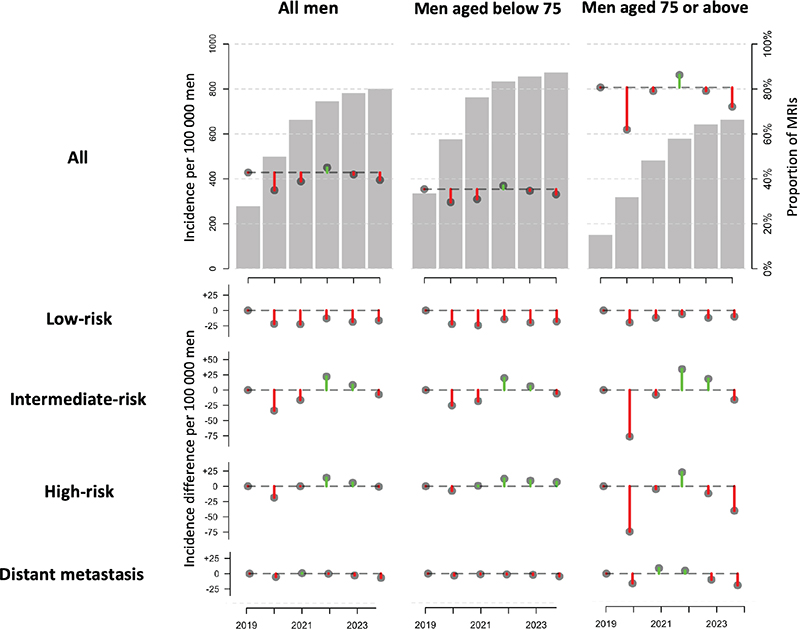
Figure 1. The annual age-standardized incidence proportion of prostate cancer (count per 100,000 men aged ≥ 40, i.e. incidence) and proportion of men in NPCR who had undergone magnetic resonance imaging (MRI) of the prostate before biopsy is represented in the first row.
Then, the difference in annual age-standardized incidence proportion of prostate cancer (count per 100,000 men aged ≥ 40, i.e. incidence) compared to 2019 according to risk category is represented.
In March 2025 the coverage of NPCR compared to The Cancer Register was >99% for men diagnosed 2019-2023 and 91% for men diagnosed 2024, so the incidence in 2024 was multiplied with 99/91=1.088 to account for the undercoverage. The dotted horizontal line shows incidence in 2019 and vertical green and red lines indicate the increase and decrease compared to 2019, respectively.
Risk categories according to a modification of The National Comprehensive Cancer Network (NCCN) risk categories: low-risk (clinical T1-T2 and PSA < 10 ng/ml and Gleason score 6), intermediate-risk (T1-2, Gleason score 7 and/or 10 ≤ PSA < 20 ng/mL), high-risk (T3-4 or Gleason score 8–10 or 20 ≤ PSA < 100 ng/ml) and distant metastasis (PSA ≥ 100 ng/mL or M1).
The overall age-standardized incidence of prostate cancer decreased 18% from 428 per 100,000 in 2019 to 349 per 100,000 in 2020, i.e. at the height of the pandemic. In 2022 the incidence returned to a pre-pandemic level (449 per 100,000 men) (Figure 1). The incidence of low-risk prostate cancer decreased 29% from 75 per 100,000 men in 2019 to 53 per 100,000 in 2020 and remained at a slightly lower level in 2021–2024 (Figure 1). The strongest decrease was observed in men above 75 years, mainly in the intermediate-risk (18%) and high-risk categories (16%) in 2020, with a slight increase thereafter (11 and 12% in 2022, respectively). The incidence of metastatic prostate cancer remained constant in all age groups during the study period.
Discussion
To the best of our knowledge, this is the first nationwide, population-based study of prostate cancer incidence before, during and after the COVID-19 pandemic with comprehensive data on cancer characteristics. After the decrease in incidence of prostate cancer at the height of the COVID-19 pandemic in 2020, incidence essentially returned to pre-pandemic levels in Sweden. Concomitant with the pandemic there was a strong uptake in the use of prostate MRI before biopsy. We therefore included a measure of this trend since increased use of MRI likely caused a decrease in the number of biopsies, a consequent decrease in the number of diagnoses of low-risk prostate cancer and a slight increase in diagnoses of intermediate-risk prostate cancer [4].
Our findings confirm previous observations of a decrease in prostate cancer incidence during the pandemic and a subsequent return to pre-pandemic levels [1–3, 8]. In the United States, the overall incidence for five specific cancers including prostate cancer dropped in 2020 and in 2021 returned to pre-pandemic levels [8]. Another study predicted that there would be more diagnoses in 2021 and 2022 of five cancers including prostate cancer due to a delay in diagnoses caused by the pandemic [9] However, our findings contradict this prediction.
There have been speculations that the reduced number of prostate cancer diagnoses in 2020 would result in a subsequent rebound with an ensuing increase in the proportion of high-risk prostate cancers above pre-pandemic levels, in analogy with the observed increase in metastatic prostate cancers that has been reported in the US after a change in recommendations for prostate cancer screening in 2008 [10]. We found no compensatory rebound in the short term for all risk categories.
To conclude, after the COVID-19 pandemic, incidence of prostate cancer in all risk categories essentially returned to pre-pandemic levels, except for low-risk prostate cancer for which a slight decrease persisted, likely due to a concomitant uptake of MRI before prostate biopsy.
The absence of a full compensatory rebound of intermediate and high-risk prostate cancers among men aged above 75 is a concern as the ‘missed cancers’ may putatively be diagnosed at a more advanced stage in the future. However, given the long disease trajectory of prostate cancer, this putative late compensatory increase is likely to be dispensed over many years and will hence be very difficult to detect.
Data availability statement
Data used in the present study was extracted from the Prostate Cancer Database Sweden (PCBase), which is based on the National Prostate Cancer Register (NPCR) of Sweden and linkage to several national health-data registers. The data cannot be shared publicly because the individual-level data contain potentially identifying and sensitive patient information and cannot be published due to legislation and ethical approval (https://etikprovningsmyndigheten.se). Use of the data from national health-data registers is further restricted by the Swedish Board of Health and Welfare (https://www.socialstyrelsen.se/en/) and Statistics Sweden (https://www.scb.se/en/) which are Govern-ment Agencies providing access to the linked healthcare registers. The data will be shared on reasonable request in an application made to any of the steering groups of NPCR and PCBase (contact npcr@npcr.se). To request data or analytic code from this study, contact the corresponding author. For detailed information, please see www.npcr.se/in-english, where registration forms, manuals and annual reports from NPCR are available alongside a full list of publications from PCBase.
Acknowledgements
This project was made possible by the continuous work of the National Prostate Cancer Register of Sweden (NPCR) steering group: Elin Axén, Johan Styrke, Andreas Josefsson, Camilla Thellenberg, Hampus Nugin, Ingrida Verbiené, Stefan Carlsson, Anna Kristiansen, Mats Andén, Kimia Kohestani, Jon Kindblom, Thomas Jiborn, Olof Ståhl, Olof Akre, Eva Johansson, Magnus Törnblom, Fredrik Jäderling, Marie Hjälm-Eriksson, Lotta Renström Koskela, Erik Thimansson, Johan Stranne, Elin Trägårdh, Viktoria Gaspar, Fredrik Sandin, Petrus Stenson, Lena Pettersson, Mia Brus, Gustaf Hedström, Anna Hedström, Maria Moutran, Nina Hageman and Maria Nyberg and patient representatives Hans Joelsson and Gert Malmberg.
Disclaimer
Rolf Gedeborg is employed by the Medical Products Agency (MPA) in Sweden. The MPA is a Swedish Government Agency. The views expressed in this article may not represent the views of the MPA.
References
- [1] Mostafavi Zadeh SM, Tajik F, Gheytanchi E, Kiani J, Ghods R, Madjd Z. COVID-19 pandemic impact on screening and diagnosis of prostate cancer: a systematic review. BMJ Support Palliat Care. 2023; 14(e2): e1594-e1603 https://doi.org/10.1136/spcare-2023-004310
- [2] Kaufman HW, Chen Z, Niles J, Fesko Y. Changes in the number of US patients with newly identified cancer before and during the coronavirus disease 2019 (COVID-19) pandemic. JAMA Netw Open. 2020;3(8):e2017267. https://doi.org/10.1001/jamanetworkopen.2020.17267
- [3] Fallara G, Sandin F, Styrke J, et al. Prostate cancer diagnosis, staging, and treatment in Sweden during the first phase of the COVID-19 pandemic. Scand J Urol. 2021;55(3):184–191. https://doi.org/10.1080/21681805.2021.1910341
- [4] Robinson D, Abdulkareem R, Nasrollah D, et al. Frequency of biopsy and tumor grade before vs after introduction of prostate magnetic resonance imaging. JAMA Netw Open. 2023;6(8):e2330233. https://doi.org/10.1001/jamanetworkopen.2023.30233
- [5] Stranne J. 2023/2024 update of the national prostate cancer guidelines in Sweden. Scand J Urol. 2024;59:210–211. https://doi.org/10.2340/sju.v59.42656
- [6] Stattin P. How to improve cancer care by use of guidelines and quality registers. Scand J Urol. 2024;59:190–192. https://doi.org/10.2340/sju.v59.42272
- [7] Statistics Sweden. Population by age and sex. Year 2007–2023 [Internet]. 2024 [cited 30-09-2024]. Available from: https://www.statistikdatabasen.scb.se/pxweb/en/ssd/START__BE__BE0101__BE0101A/BefolkningR1860N/
- [8] Howlader N, Chen HS, Noone AM, et al. Impact of COVID-19 on 2021 cancer incidence rates and potential rebound from 2020 decline. J Natl Cancer Inst. 2024;117(3):507–510 https://doi.org/10.1093/jnci/djae180
- [9] Ward ZJ, Walbaum M, Walbaum B, et al. Estimating the impact of the COVID-19 pandemic on diagnosis and survival of five cancers in Chile from 2020 to 2030: a simulation-based analysis. Lancet Oncol. 2021;22(10):1427–1437. https://doi.org/10.1016/S1470-2045(21)00426-5
- [10] Desai MM, Cacciamani GE, Gill K, Zhang J, Liu L, Abreu A, et al. Trends in incidence of metastatic prostate cancer in the US. JAMA Netw Open. 2022;5(3):e222246. https://doi.org/10.1001/jamanetworkopen.2022.2246