ORIGINAL RESEARCH ARTICLE
Healthcare costs in relation to increased use of preoperative renal tumour biopsies
Agnes Linda,b*, Bassam Mazin Hashimc*  , Matilda Hagmana,b, Susanna Holstd, Andreas Karlsson Rosenblade,f,g,h , Börje Ljungbergi , Per-Olof Lundgrenj , Sven Lundstamk , Camilla Nystranda,b , Fanny Goudea,b and Tobias Lauritsena,b
aDepartment of Learning, Informatics, Management and Ethics, Karolinska Institute; bStockholm Center for Health Economics, Center for Health Economics, Informatics and Health Services Research (CHIS), Stockholm Healthcare Services, Stockholm, Sweden; cDepartment of Urology, Region Västmanland – Uppsala University, Center for Clinical Research, Västmanland Hospital, Västerås, Sweden; dDepartment of Radiology, Skånes University Hospital, Malmö, Sweden; eRegional Cancer Centre Stockholm-Gotland, Region Stockholm, Stockholm, Sweden; fDepartment of Statistics, Uppsala University, Uppsala, Sweden; gDepartment of Medical Sciences, Division of Clinical Diabetology and Metabolism, Uppsala University, Uppsala, Sweden; hDepartment of Neurobiology, Care Sciences and Society, Division of Family Medicine and Primary Care, Karolinska Institute, Stockholm, Sweden; iDepartment of Diagnostics and Intervention, Urology and Andrology, Umeå University, Umeå, Sweden; jDepartment of Clinical Science, Intervention and Technology, Karolinska Institute, Stockholm, Sweden; kDepartments of Urology and Oncology, Institute of Clinical Science, Sahlgrenska Academy, University of Gothenburg, Gothenburg, Sweden
Abstract
Objective: To analyse the budget impact of adopting routine renal tumour biopsy (RTB) prior to decision on surgical treatment for clinical T1 renal tumours in Sweden.
Material and methods: This study used data from the National Swedish Kidney Cancer Register including 4,109 T1N0M0 renal tumours surgically treated during the years 2018–2022. We modelled a gradual increase in the proportion of preoperative RTBs over a five-year period, from 15.6 % of surgically removed clinical T1N0M0 renal tumors up to 90 % preoperative RTBs by 2029. Average costs per patient were calculated primarily using the Swedish cost-per-patient database. The analyses were stratified by tumour diameter: ≤40 mm (cT1a) and 41–70 mm (cT1b). The proportion of patients with benign RTB, complication rate and false negative RTBs was estimated from register data and previous research. A healthcare perspective was used and accounted for costs related to biopsy, surgery, follow-up of benign RTBs, complications and re-biopsy in cases of inconclusive RTBs.
Results: For cT1a, increasing preoperative RTBs to 90% of the study population reduced the net annual costs by €691,620, whilst for cT1b, costs increased by €67,630. Overall, an increase in preoperative RTBs to 90% of all patients with cT1 renal tumours was projected to reduce spending by €623,990 annually.
Conclusions: The budget impact analysis of routine preoperative RTBs in suspected renal cell carcinoma indicates net healthcare cost savings in cT1a and potentially for all cT1 tumours.
KEYWORDS: Renal tumour biopsy; economic impact; budget impact; economic evaluation; small renal mass; percutaneous renal biopsy; renal cell carcinoma
Citation: Scandinavian Journal of Urology 2024, VOL. 59, 66–72. https://doi.org/10.2340/sju.v60.43194.
Copyright: © 2025 The Author(s). Published by MJS Publishing on behalf of Acta Chirurgica Scandinavica. This is an Open Access article distributed under the terms of the Creative Commons Attribution 4.0 International License (http://creativecommons.org/licenses/by/4.0/), allowing third parties to copy and redistribute the material in any medium or format and to remix, transform, and build upon the material, with the condition of proper attribution to the original work.
Received: 27 October 2024; Accepted: 13 December 2024; Published: 13 March 2025
CONTACT: Börje Ljungberg borje.ljungberg@umu.se Department of Diagnostics and Intervention, Urology and Andrology, Umeå University, 901 85 Umeå, Umeå, Sweden
Supplemental data for this article can be accessed online at https://doi.org/10.2340/sju.v60.43194
*Contributed equally.
Competing interests and funding: The authors declare that they have no competing interests.
This study was funded by the Health and Medical Care Administration of the Region Stockholm. An economic report of the results has been published in Swedish [23] by the Stockholm Centre of Health Economics.
Introduction
Historically, renal tumours were discovered at a relatively late stage when symptoms arose, leading to larger tumours than those often diagnosed incidentally today [1]. This incidental diagnosis of smaller renal tumours has led to more frequently discovered benign tumours, as the share of benign tumours increases with decreased tumour size [2]. Most renal masses are surgically removed without preoperative histopathologic diagnosis, resulting in an overtreatment of benign renal masses [1, 3]. The European Association of Urology (EAU) guidelines strongly recommend a renal tumour biopsy (RTB) before ablative therapy, as well as for selected patients who are considered for active surveillance. The EAU guidelines also acknowledge evidence that RTBs are associated with reduced overtreatment of benign masses and offer additional information for an informed decision regarding optimal treatment management. However, general recommendations on routine preoperative RTBs in clinical T1 renal tumours are missing in most national guidelines for renal cell carcinoma (RCC) (1). Reasons for omitting RTB in the presurgical work-up vary with logistical challenges, historical practice, personnel and financial requirements. A recently published report from the US estimated the cost of a percutaneous biopsy to almost $2,000 [4]. In addition, RTBs compete with other procedures at the radiological departments, whereby resource allocation may become a challenge. There is also the challenge of false negative RTBs and the risk of missing a malignant tumour despite benign histology in the biopsy. Moreover, RTBs are associated with complications such as haemorrhage and pain [2].
Despite the challenges with RTBs, there is a trend towards a more liberal use of diagnosis-confirming biopsies before definitive treatment, that is surgery or ablative treatments [5]. Before histopathological diagnosis, renal tumours with a diameter of ≤40 mm are generally designated as small renal masses (SRMs). Studies have found that 17%–40% of SRMs, when surgically removed, revealed a benign histology [6, 7]. The fairly large proportion of patients with benign tumours inevitably translates into many patients who would be spared surgery. Retrospective cohorts have demonstrated that centres that routinely perform RTBs before surgical treatments yield a lower proportion of benign tumour histology after surgical treatment [8, 9].
Modifications of treatment algorithms also need to be evaluated from an economical point of view to ensure an optimal allocation of resources. An increased use of RTBs on patients with cT1 tumours will result in additional expenditures for biopsies. On the other hand, there is also a potential for cost offsets through avoiding unnecessary surgeries on patients with benign tumours and risks for complications [10, 11]. Prior attempts to determine the economic value of a preoperative histological diagnosis of renal tumours have suggested an added value of biopsies [10, 11]. However, these studies focused exclusively on a male population aged > 60 years old in a US context, whereas RTBs might be of value to all ages and genders. Furthermore, results from US specific data are to a lesser extent generalisable to a European context, and up-to-date data are necessary to inform recommendations within national care programmes.
In this study, we aimed to analyse the budget impact from a healthcare perspective associated with a shifting paradigm towards routinely performing RTB before deciding on surgical removal of cT1 renal lesions.
Methods and material
A budget impact analysis (BIA) of direct healthcare costs from increasing the rate of preoperative renal biopsies was performed. The current preoperative biopsy rate of 15.6% [12] in Sweden was compared to a scenario where the rate increased to 50% of the study population in the first year and thereafter by 10 percentage points yearly over a 5-year time horizon. The increased rate was suggested in a consensus proposal. The end rate of 90% is not expected to be exceeded, as some patients would not be considered for surgery due to for example comorbidity. The 15.6% of patients currently undergoing preoperative biopsy are not expected to benefit from an increased biopsy rate. To estimate the budget impact of increasing the renal biopsy rate, incremental resource utilisation related to biopsies, surgery, inpatient and outpatient care, radiography, complications from surgery or biopsies and metastatic disease, along with its associated costs, was estimated.
Study population
The study population comprised all RCC patients in Sweden registered in the National Swedish Kidney Cancer Register (NSKCR) during the period 2018–2022 with surgically treated T1N0M0 renal tumours. All tumours registered with surgery or ablation therapy were extracted from the NSKCR. Tumours with missing data on size (n = 101) were distributed across the groups 0–40 mm, 41–70 mm and >70 mm according to the size distribution of all extracted tumours with complete data on size. Thereafter, tumours with missing data on surgery type (n = 186) were distributed according to the distribution of those with complete data on surgery. Tumours >70 mm were excluded from the study. Moreover, cases of ablation therapy were excluded due to the already high rate of biopsies in this group. The total study population (n = 4,109) was categorised into two groups: 0–40 mm (n = 2,604; 63.4%) and 41–70 mm (n = 1,505; 36.6%). Since the number of patients fluctuates annually, we used a yearly average from 2018 to 2022 as a proxy for the number of eligible individuals in the analyses. A flowchart illustrating the extraction of the study population is shown in Supplementary Figure S1.
The analyses included an average of 822 surgically treated RCCs per year (7.8 cases per 100,000 individuals), divided into 521 cases with a tumour size of 0–40 mm and 301 cases with a tumour size of 41–70 mm.
Data
The present study used epidemiological and clinical data from the NSKCR, which collects data on diagnoses, tumour characteristics and treatment of RCC patients in Sweden [13]. The NSKCR has a near complete coverage of malignant tumours, but benign tumours are registered to a lesser degree.
Costs for biopsy, surgery and complications were collected from the Swedish cost-per-patient database maintained by the Swedish Association of Local Authorities and Regions [14]. This database contains aggregated costs per care episode reported by a majority of care providers in Sweden. Costs for metastatic disease were obtained from the scientific literature [15], whilst computed tomography cost was collected from regional pricelists.
Healthcare utilization and unit costs
Only direct healthcare costs were included in the analyses. The unit costs for the price year 2022 are summarised in Table 1. The cost data included observations from the years 2021–2022 of biopsies, surgeries and complications within the admitted period, as well as observations of complications from inpatient and outpatient care for complications arising after hospital discharge, up to 3 months post-surgery. Care episodes that included interventions other than surgery or biopsy were excluded to obtain the most accurate costs for the interventions. Cases of surgery in outpatient care were also excluded.
| Cost categories | Description | Unit cost (€) |
| Radical nephrectomy without complications | Opena | 13,777 |
| Laparoscopica | 10,975 | |
| Laparoscopic, robot-assisteda | 13,421 | |
| Radical nephrectomy with complications | Opena | 17,308 |
| Laparoscopica | 13,094 | |
| Laparoscopic, robot-assisteda | 15,246 | |
| Partial nephrectomy without complications | Opena | 12,130 |
| Laparoscopica | 15,061 | |
| Laparoscopic, robot-assisteda | 12,016 | |
| Partial nephrectomy with complications | Opena | 14,180 |
| Laparoscopica | 16,529 | |
| Laparoscopic, robot-assisteda | 13,013 | |
| Complications | After hospital discharge with readmissiona | 7,441 |
| After hospital discharge without readmissiona | 875 | |
| Biopsy | Outpatient care including any complication requiring observation or intravenous treatmenta | 996 |
| Inpatient care including any complicationa | 2,293 | |
| Additional cost of one care day for observation after biopsy complicationb | 1,251 | |
| Others | Computed tomographyc | 240 |
| Doctors’ appointment, revisitd | 270 | |
| Metastatic disease – annual coste | 72,902 | |
| Notes: Costs in SEK were converted to euro using the exchange rate €1 = 10.64 SEK. References: a [16], b [17], c [18], d [19], e [15]. | ||
Due to the large variation in costs for the same interventions across healthcare regions, the cost for biopsies was weighted from the median cost in each of the six healthcare regions in Sweden and the proportion of reported biopsies from each healthcare region. Costs of complications arising during the admitted period were included in the cost for surgery. Costs for complications arising after discharge were calculated as the average for admitted episodes that included at least one complication and an RCC diagnosis, but no surgical intervention. Costs are presented in €2022. Costs originally estimated in Swedish Krona (SEK) were converted to euros using the exchange rate (€1 = 10.64 SEK) [13]. As recommended for budget impact analyses, discounting was not applied [20].
Budget impact analysis
An incremental cost analysis of an increased preoperative biopsy usage for renal masses was conducted based on the current biopsy practices, projected biopsy rates and current treatment interventions. Flowcharts of care illustrating resources used within healthcare for renal tumours with a diameter of 0–40 mm and 41–70 mm, respectively, are given in Supplementary Figures S2 and S3. The average number of surgical interventions and complications during the years 2021–2022 constituted the baseline for the calculations. Model parameters are summarised in Table 2.
| Categories | Parameter | Value (%) |
| Complications from radical nephrectomy during admitted period | Open, 0–40 mmf/41–70 mmf | 26.1/19.8 |
| Laparoscopic, 0–40 mmf/41–70 mmf | 5.7/5.2 | |
| Laparoscopic, robot-assisted, 0–40 mmf/41–70 mmf | 13.0/13.7 | |
| Complications from partial nephrectomy during admitted period | Open, 0–40 mmf /41–70 mmf | 22.3/37.0 |
| Laparoscopic, 0–40 mmf/41–70 mmf | 15.0/15.0 | |
| Laparoscopic, robot-assisted, 0–40 mmf/41–70 mmf | 14.1/16.9 | |
| Complications from radical nephrectomy after hospital discharge | Open, 0–40 mmf/41–70 mmf | 5.0/8.7 |
| Laparoscopic, 0–40 mmf/41–70 mmf | 5.7/5.6 | |
| Laparoscopic, robot-assisted, 0–40 mmf/41–70 mmf | 7.2/6.7 | |
| Complications from partial nephrectomy after hospital discharge | Open, 0–40 mmf/41–70 mmf | 8.7/8.5 |
| Laparoscopic, 0–40 mmf/41–70 mmf | 3.0/3.0 | |
| Laparoscopic, robot-assisted, 0–40 mmf/41–70 mmf | 7.1/6.2 | |
| Biopsies | Diagnostic sensitivity biopsies, 0–70 mmg | 96.4 |
| Diagnostic specificity biopsies, 0–70 mmg | 93.7 | |
| True negative biopsy result, 0–40 mmf,g/41–70 mmf,g | 21.7/9.7 | |
| Non-diagnostic biopsiesg | 22.6 | |
| Hospitalisations from biopsy complicationsg,h | 2.0 | |
| Others | Proportion of benign tumours, 0–40 mmf/41–70 mmf | 23.2/10.4 |
| Risk of developing metastatic disease after false negative biopsy, 0–40 mmf/41–70 mmf | 4.1/14.7 | |
| Notes: References: f [12], g [21], h [22]. | ||
The proportion of tumours subjected to biopsies at baseline varied between 9.8% and 23.5% for the tumour size 0–40 mm and between 10.0% and 18.7% for the tumour size 41–70 mm, depending on surgical intervention. Calculations were made for a hypothetical increase, agreed with clinical experts, in the proportion of tumours subjected to biopsies relative to the number of surgeries at baseline. A 5-year time horizon was applied, with an assumed increase in the proportion of tumours subjected to biopsies to 50% in the starting year 2025. This proportion was assumed to increase with 10 percentage points each year, thus reaching 90% by the end of 2029. Diagnostic sensitivity and specificity of biopsies were retrieved from a systematic review [21] and were used to calculate the proportion of true and false negative and positive biopsies. To not overestimate the diagnostic accuracy, the lower values of the confidence intervals were used [21]. The reported proportion of benign tumours in the NSKCR during the years 2018–2022 amounted to 18.7% for tumours 0–40 mm. However, since there is no requirement on reporting tumours with benign histology in the register, this figure can be considered a lower bound of benign tumours. The largest hospital verified reporting all tumours regardless of histology and was used as an upper bound (27.7%) in the same size range. A mean value of the upper and lower bound (23.2%) was used in the analyses, with sensitivity analyses incorporating the upper and lower bounds.
All lesions diagnosed as benign after biopsy were predicted to have computed tomography follow-up twice. Non-diagnostic biopsies were expected to undergo re-biopsy, and all re-biopsies were presumed to be diagnostic. The slight increase in risk of metastatic disease due to initially misdiagnosed tumours was calculated as the number of false negative biopsies times the proportion of metastasized cancers in the study population for each tumour size group.
We reviewed medical records of a sub-cohort of patients from the largest participating hospital to evaluate the rate of hospitalisations from biopsy complications. The risk of complications from surgery both during the admitted period and after hospital discharge varied between surgical interventions [12]. Model input parameters are presented in Table 2.
Sensitivity analyses
Due to the large variations in the cost data and uncertainty in the proportion of benign tumours, sensitivity analyses were performed on these variables. As median costs were used, the values for the 10th (p10) and 90th (p90) percentiles were used as measures of variation in the sensitivity analyses instead of standard deviations. Figure 1A and B illustrates the percentual change in net cost compared to base case for sensitivity analyses on the proportion of benign tumours, biopsy cost and surgery cost. Supplementary Tables S1 and S2 provide an overview of the changes in net cost for the sensitivity analyses.
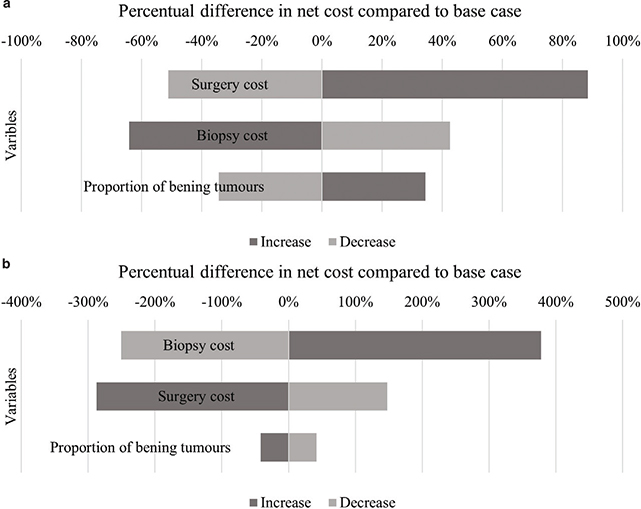
Figure 1. (A) Sensitivity analysis, tumours ≤ 40 mm. Change in net cost compared to base case (0%). Surgery cost increase refers to p90 and surgery cost decrease to p10. Proportion of benign tumours decrease refers to 18.7% and increase to 27.7%. Biopsy cost increase refers to highest regional biopsy cost and biopsy cost decrease to lowest regional biopsy cost. (B) Sensitivity analysis, tumours 41–70 mm. Change in net cost compared to base case (0%). Surgery cost increase refers to p90 and surgery cost decrease to p10. Proportion of benign tumours decrease refers to 9.4% and increase to 11.3%. Biopsy cost increase refers to highest regional biopsy cost and biopsy cost decrease to lowest regional biopsy cost.
Presentation of results
The results are presented both per tumour size group and combined. The number of renal biopsies in the current state vs. a scenario with increased yearly rates is presented per 100,000 individuals. The difference in costs between the current state and the new scenario on an annual basis is presented for biopsies, surgery, metastatic disease and as total net costs. In addition, the net cost per extra tumour undergoing biopsy is presented.
Results
For cT1a tumours, an increased proportion of preoperative RTBs to 90% of the study population would increase the number of tumours, which undergo RTBs from 81 to 468 (from 0.77 to 4.46 per 100,000 individuals) and reduce the number of surgeries from 521 to 425 (from 4.97 to 4.05 per 100,000 individuals). This resulted in an increased cost of RTBs of €527,900, a decreased surgery-related cost of €1,254,100 and an increased cost for acquired metastatic disease of €34,600. Consequentially, the net annual costs are reduced with €691,600. Conversely, for cT1b tumours, the number of tumours that undergo RTB increased from 47 to 271 (from 0.45 to 2.58 per 100,000 individuals), whilst the number of surgeries decreased from 301 to 279 (from 2.87 to 2.66 per 100,000 individuals). RTB costs thereby will increase with €291,900, whilst the costs of acquired metastatic disease increase with €83,000, and surgery-related costs decrease with €308,000, resulting in a total annual net cost increase of €67,600. The budget impact for the total study population would be a cost reduction of €624,000 (Tables 3 and 4).
With an estimated 611 (387 cT1a and 224 cT1b) additional tumours undergoing biopsy at a biopsy rate of 90%, each additional biopsy results in a cost offset of €1,800 for cT1a renal tumours, whilst each additional biopsy results in an increased net cost of €300 for cT1b tumours. This implies a cost reduction of €1,000 for each additional tumour undergoing biopsy for the total study population (cT1 tumours).
Deterministic sensitivity analyses showed an impact on the base case conclusions for cT1b tumours, indicating that the results were robust for cT1a, but not for larger sized tumours. In contrast to the increased costs in the base case analysis in 2029 for cT1b tumours, increasing cost of surgery resulted in a cost offset of €126,730. Similarly, when decreasing the unit cost of biopsies, the results showed cost offsets of €101,920. In the total tumour population, an increase in the unit cost of biopsies resulted in a cost increase in 2029 of €75,350, as opposed to the base case analysis which indicated cost savings. The results from all sensitivity analyses are shown in Supplementary Table S3.
Discussion
This study evaluated the budget impact associated with a shifting paradigm towards a higher ratio of preoperative biopsies. The results indicate that the increased costs associated with routine preoperative biopsies of cT1a tumours can be offset by the reduced costs of surgery, which may potentially lead to net cost-offsets in public spending over a 5-year time horizon. In contrast, for cT1b tumours, increasing the biopsy rate may lead to higher net costs. Except for when applying a higher biopsy cost in the sensitivity analyses, an increase to 90% preoperative biopsy rate indicates an overall cost reduction for the entire study population of cT1 tumours.
Results in perspective
For cT1a, healthcare spending may be decreased if treatment guidelines are shifted towards preoperative RTBs. This is the first economic evaluation of preoperative biopsies for renal masses encompassing a population without restrictions on age or gender. Prior studies have shown preoperative RTBs for cT1a tumours to be cost-effective in comparison to not performing preoperative biopsies. When studying the slightly larger tumours (41–70 mm in diameter), the estimated cost-offsets were uncertain, likely attributable to a higher rate of malignant tumours in this group, which we know from previously published studies [6, 8]. Because of higher rate of malignant tumours in cT1b, RTBs would lead to fewer avoided surgeries in the cT1b-population in relation to cT1a. Thus, the cost-offsets related to avoided surgeries are notably lower in the cT1b-population. Analysing the entire population of cT1 tumours indicates a potential total net cost saving from an increased rate of preoperative RTBs. These results are important when considering equitable care provision, as the upper threshold for cT1a at 40 mm is arbitrary, and patients with slightly larger tumours might benefit equally well as those within the cT1a definition. For equitable resource allocation, a comparison of the net costs to the net health benefit is needed for an estimation of the cost-effectiveness with regard to different subgroups.
The rationale for not performing routine biopsies in cT1a tumours is the heterogenic nature of renal tumours, that is a negative biopsy is difficult to rely on in clinical decision-making. In this analysis, we acknowledge that a negative biopsy of a cT1a tumour does not automatically prompt a discontinuation of further controls but rather leads to a revised control program with radiological follow-ups.
Besides the potential cost-offsets within healthcare included in this study, further gains may include direct supervene costs for patients as rehabilitation after surgery. It is likely that routine RTB showing benign histology will have an impact on sick leave and the need for social care, which means that the total economic impact is underestimated in this study as these parameters have not been included. Neither has any impact on individuals’ health and quality of life from more biopsies, nor impact of fewer surgeries been studied within this paper. Avoided surgeries, subsequent complications, hospitalisation and sick leave could lead to improved health and quality of life for patients, whilst biopsies may potentially have a negative impact due to eventual overriding haemorrhage or pain. Such estimations could, in comparison with the economic implications of increased use of biopsies, be used to inform a cost-effectiveness analysis within a prioritisation effort. Additionally, in terms of prioritisation, it is essential to assess the impact on radiology departments before increasing the use of preoperative renal biopsies. Other factors such as comorbidity and performance status will also adjust the surgical treatment for patients with RCC [22].
Strengths and limitations
Previous publications on this subject have been conducted in a US context with hypothetical study cohorts [10, 11]. In contrast, this study uses real-life data collected from the NSKCR, a quality register including practically all RCC cases in Sweden. Cost data are based on reporting from all healthcare regions in Sweden, and the included healthcare costs are comprehensive, considering costs of complications arising up to 3 months post-surgery. In addition, the conceptual model of care used in this study was validated by clinical experts in the field.
Limitations of this study include uncertainties introduced by necessary assumptions. Cost estimates, based on national reimbursement data, were affected by variations between hospitals and regions, which may have led to either over- or underestimation of the results. Additionally, cost-offsets could have been overstated if the assumed proportion of benign tumours or the diagnostic sensitivity and specificity were too high, or if the risk of developing metastatic disease was underestimated. However, sensitivity analyses of these assumptions suggest that the results are robust, although they should be interpreted with these uncertainties in mind.
Financing of healthcare and reimbursement systems varies globally, as well as clinical routines and traditions does. Our estimates are based on a Swedish context, which may limit the generalisability of the results. Nevertheless, considering the comprehensive healthcare costs included, a major part of the conclusions drawn in this study should be generally applicable.
Conclusions
The BIA of implementing routine preoperative RTBs in suspected RCC indicates net healthcare cost savings from an increase in the rate of biopsies in cT1a and potentially for all cT1 renal tumours.
References
- [1] Ljungberg B, Albiges L, Abu-Ghanem Y, et al. European Association of Urology guidelines on renal cell carcinoma: the 2022 update. Eur Urol. 2022;82(4):399–410. https://doi.org/10.1016/j.eururo.2022.03.006
- [2] Serhal M, Rangwani S, Seedial SM, et al. Safety and diagnostic efficacy of image-guided biopsy of small renal masses. Cancers (Basel). 2024;16(4):835. https://doi.org/10.3390/cancers16040835
- [3] Campbell SC, Clark PE, Chang SS, et al. Renal mass and localized renal cancer: evaluation, management, and follow-up: AUA guideline: Part I. J Urol. 2021;206(2):199–208. https://doi.org/10.1097/JU.0000000000001911
- [4] Chen KY, Lange MJ, Qiu JX, et al. Cost-effectiveness analysis of the clear cell likelihood score against renal mass biopsy for evaluating small renal masses. Urology. 2024;188:111–117. https://doi.org/10.1016/j.urology.2024.04.007
- [5] Couture F, Finelli T, Breau RH, et al. The increasing use of renal tumor biopsy amongst Canadian urologists: when is biopsy most utilized? Urol Oncol. 2021;39(8):499 e15–499 e22. https://doi.org/10.1016/j.urolonc.2021.05.026
- [6] Zhu D, Loloi J, Labagnara K, et al. Clinical risk factors associated with small renal mass malignant histology in a multi-ethnic population undergoing partial nephrectomy. Clin Genitourin Cancer. 2022;20(6):e465–e472. https://doi.org/10.1016/j.clgc.2022.06.004
- [7] Johnson DC, Vukina J, Smith AB, et al. Preoperatively misclassified, surgically removed benign renal masses: a systematic review of surgical series and United States population level burden estimate. J Urol. 2015;193(1):30–35. https://doi.org/10.1016/j.juro.2014.07.102
- [8] Richard PO, Lavallee LT, Pouliot F, et al. Is routine renal tumor biopsy associated with lower rates of benign histology following nephrectomy for small renal masses? J Urol. 2018;200(4):731–736. https://doi.org/10.1016/j.juro.2018.04.015
- [9] Amaral BS, Macek P, Arora A, et al. Renal tumor biopsy: rationale to avoid surgery in small renal masses. Curr Urol Rep. 2021;22(9):46. https://doi.org/10.1007/s11934-021-01064-8
- [10] Heilbrun ME, Yu J, Smith KJ, et al. The cost-effectiveness of immediate treatment, percutaneous biopsy and active surveillance for the diagnosis of the small solid renal mass: evidence from a Markov model. J Urol. 2012;187(1):39–43. https://doi.org/10.1016/j.juro.2011.09.055
- [11] Pandharipande PV, Gervais DA, Hartman RI, et al. Renal mass biopsy to guide treatment decisions for small incidental renal tumors: a cost-effectiveness analysis. Radiology. 2010;256(3):836–846. https://doi.org/10.1148/radiol.10092013
- [12] Nationellt Kvalitetsregister för Njurcancer [Internet]: Stockholm: Regionala Cancercentrum i Samverkan; 2024 [cited 01-03-2024]. Available from: https://cancercentrum.se/samverkan/cancerdiagnoser/njure/kvalitetsregister/
- [13] Riksbank TS. Sök års- och månadsgenomsnitt valutakurser The Swedish Riksbank 2024 [Internet]. Available from: https://www.riksbank.se/sv/statistik/rantor-och-valutakurser/sok-ars--och-manadsgenomsnitt-valutakurser/?a=Y&y=2021&m=V%C3%A4lj+m%C3%A5nad&s=g130-SEKEURPMI&fs=3#result-section [cited 01-08-2024]
- [14] Regions SAoLAa. Swedish Association of Local Authorities and Regions 2024 [Internet]. Available from: https://skr.se/skr/englishpages.411.html [cited 27-09-2023]
- [15] Cholley TT-V, A. Limat, S. Hugues, M. et al. Economic burden of metastatic clear-cell renal cell carcinoma for French patients treated with targeted therapies. Clin Genitourin Cancer. 2019;17(1):e227–e234. https://doi.org/10.1016/j.clgc.2018.10.016
- [16] KPP databasen [Internet]. Stockholm: Sveriges Kommuner och Regioner [cited 03-01-2024]. Available from: https://skr.se/skr/halsasjukvard/ekonomiavgifter/kostnadperpatientkpp/kppdatabas.46722.html
- [17] Akademiska sjukhuset och Lasarettet i Enköping [Internet]. Uppsala Pris- och produktkatalog 2022 Available from https://https://www.sjukvårdsregionmellan.se/samverkan/attachment/uppsala2022.pdf [cited 01-03-2024].
- [18] Vårdgivarguiden [Internet]. Stockholm Medicinsk radiologi 2024 [cited 01-02-2024]. Available from: https://vardgivarguiden.se/administration/verksamhetsadministration/remittering/medicinsk-service/medicinsk-radiologi/
- [19] Södra sjukvårdsregionen [Internet]. Malmö: Regionala priser och ersättningar för Södrasjukvårdsregionen 2024 [cited 01-03-2024]. Available from: https://vardgivare.skane.se/patientadministration/avgifter-och-prislistor/prislistor-sodra-sjukvardsregionen/
- [20] Sullivan SD, Mauskopf JA, Augustovski F, et al. Budget impact analysis-principles of good practice: report of the ISPOR 2012 Budget Impact Analysis Good Practice II Task Force. Value Health. 2014;17(1):5–14. https://doi.org/10.1016/j.jval.2013.08.2291
- [21] Marconi L, Dabestani S, Lam TB, et al. Systematic review and meta-analysis of diagnostic accuracy of percutaneous renal tumour biopsy. Eur Urol. 2016;69(4):660–673. https://doi.org/10.1016/j.eururo.2015.07.072
- [22] Kröger Dahlin BI, Hlodan J, Ghaffarpour R, et al. Multiple factors influence decision making for the surgical treatment in patients with renal cell carcinoma. Scand J Urol. 2024;59:26–30. https://doi.org/10.2340/sju.v59.25517
- [23] Ökad andel biopsier innan behandling av njurtumörer – en analys av budgetpåverkan och effekter på personella reurser. Stockholm centrum för hälsoekonomi, Centrum för hälsoekonomi, informatik och sjukvårdsforskning, Region Stockholm; Stockholm, 2024. Rapport StoCHE 2024:1. Available from: https://www.chis.regionstockholm.se/498c4e/globalassets/verksamheter/chis/stoche/okad-andel-biopsier-innan-behandling-av-njurtumorer---en-analys-av-budgetpaverkan-och-effekter-pa-personella-resurser.pdf