ORIGINAL RESEARCH ARTICLE
Swedish national guidelines on urothelial carcinoma: 2024 update on advanced and metastatic disease
Anders Ulléna,b, Firas Aljaberyc, Pär Dahlmand, Karin Falkmane, Truls Gårdmarkf, Tomas Jerlströmg, Susanna Holsth, Sofia Kjellströmi, Anna-Karin Lindj,k, Dimitrios Papantonioul, Jonas Stenlundm, Viveka Ströckn,o, Karin Söderkvistp, Helena Thulina,b, Elin Trägårdhh,k, Ingrida Verbieneq, Jonas Wallströmr, Elisabeth Öfverholms and Fredrik Liedbergj,k
aDepartment of Pelvic Cancer, Genitourinary Oncology and Urology Unit, Theme Cancer, Karolinska University Hospital, Stockholm, Sweden; bDepartment of Oncology and Pathology, Karolinska Institute, Stockholm, Sweden; cDepartment of Clinical and Experimental Medicine, Division of Urology, Linköping University, Linköping, Sweden; dDepartment of Radiology, Uppsala Akademiska Hospital, Uppsala, Sweden; eDepartment of Urology, Södersjukhuset, Stockholm, Sweden; fDepartment of Clinical Sciences, Danderyd Hospital, Karolinska Institute, Stockholm, Sweden; gDepartment of Urology, School of Medical Sciences, Faculty of Medicine and Health, Örebro University, Örebro, Sweden; hDepartment of Medical Imaging and Physiology, Skåne University Hospital, Malmö, Sweden; iDepartment of Oncology, Skåne University Hospital, Malmö, Sweden; jDepartment of Urology, Skåne University Hospital, Malmö, Sweden; kInstitution of Translational Medicine, Lund University, Malmö, Sweden; lDepartment of Oncology, Ryhov County Hospital, Jönköping, Sweden; mDepartment of Urology, Umeå University, Umeå, Sweden; nDepartment of Urology, Sahlgrenska University Hospital, Göteborg, Sweden; oInstitute of Clinical Sciences, Sahlgrenska Academy, University of Gothenburg, Göteborg, Sweden; pDepartment of Diagnostics and Intervention, Onkology, Umeå University, Umeå, Sweden; qDepartment of Oncology, Uppsala Akademiska Hospital, Uppsala, Sweden; rDepartment of Radiology, Sahlgrenska University Hospital, Göteborg, Sweden; sDepartment of Oncology, Sahlgrenska University Hospital, Göteborg, Sweden
ABSTRACT
Objective: To overview and summarise the Swedish National Guidelines on Urothelial Carcinoma 2024.
Methods: A narrative review of the updated guidelines was performed, highlighting new treatment recommendations for advanced and metastasized disease.
Results: Compared to the previous guideline version, the current update includes recommendations for standardised radiological reporting when urothelial carcinomas are detected at CT-urography (CTU), to early identify locally advanced patients and accelerate the care pathway for these patients. The Swedish guidelines apply a more structured and liberal recommendation for the use of 18F-fluorodeoxyglucose-positron emission tomography/computed tomography in patients with locally advanced urothelial carcinomas compared to the EAU-guidelines and recommend such examinations prior to transurethral resection. Improved outcomes for radical cystectomy in Sweden after centralised cystectomy care have led to a recommendation for performing more than six nephroureterectomies (NUs) per year for upper tract urothelial carcinomas (UTUC)-based associations with decreased use of invasive diagnostic modalities and better survival outcomes. Additionally, updated recommendations regarding adjuvant systemic therapies for muscle-invasive disease have been included. Whilst awaiting national regulatory approval for enfortumab vedotin/pembrolizumab, the present guideline version aligns with EAU-guidelines by endorsing cisplatin-gemcitabine-nivolumab as a new first-line treatment option in cisplatin-fit patients with unresectable or metastatic urothelial carcinoma.
Conclusions: The current version of the Swedish national guidelines on urothelial carcinoma introduces standardised reporting at CTU to facilitate early identification of advanced disease, includes recommendations for centralisation of NU for UTUC and updated recommendations for adjuvant systemic treatment of muscle-invasive disease and endorses cisplatin-gemcitabine-nivolumab as a new first-line treatment option for non-resectable locally advanced and metastatic disease.
KEYWORDS: Bladder cancer; guidelines; advanced; metastatic
Citation: Scandinavian Journal of Urology 2025, VOL. 60, 76–82. https://doi.org/10.2340/sju.v60.43236.
Copyright: © 2025 The Author(s). Published by MJS Publishing on behalf of Acta Chirurgica Scandinavica. This is an Open Access article distributed under the terms of the Creative Commons Attribution 4.0 International License (http://creativecommons.org/licenses/by/4.0/), allowing third parties to copy and redistribute the material in any medium or format and to remix, transform, and build upon the material, with the condition of proper attribution to the original work.
Received: 16 December 2024; Accepted: 18 February 2025; Published: 25 March 2025
CONTACT: Fredrik Liedberg fredrik.liedberg@med.lu.se Department of Urology, Skåne University Hospital, Jan Waldenstraöms gata 5, 205 01 Malmö, Sweden
Competing interests and funding: The authors Fredrik Liedberg, Firas Aljabery, Pär Dahlman, Karin Falkman, Truls Gårdmark, Tomas Jerlström, Susanna Holst, Sofia Kjellström, Dimitrios Papantoniou, Jonas Stenlund, Viveka Ströck, Karin Söderkvist, Elin Trägårdh, Ingrida Verbiene, Jonas Wallström and Elisabeth Öfverholm declare that they have no conflict of interest. Anna-Karin Lind and Helena Thulin received consulting fees from Medac. Anders Ullén has served in consulting or advisory roles for Astellas Pharma, Janssen-Cilag, Merck KGaA, MSD, Pierre Fabre, Pfizer and Roche and has received research funding from Bayer, Merck KGaA and Pierre Fabre.
Introduction
The current fifth version of the Swedish national guidelines on urothelial carcinoma has, since the first version in 2013, evolved and developed in a multitude of recommendations on how to manage the disease. Local and systemic drugs in first line to treat bladder cancer have been similar during four decades, that is, BCG was initially reported in 1976 [1], mitomycin in 1980 [2] and cisplatin-based combination systemic chemotherapy in 1985 [3]. However, in the wake of the introduction of checkpoint-inhibitors for metastatic disease, several other new local and systemic treatment options have emerged with a plethora of new drugs and drug-combinations underway.
This narrative summary of the 2024 update is motivated not only to highlight the most practice-changing new recommendations but also to scientifically discuss and compare to recommendations made by other guidelines. Compared to a previous published summary focusing on non-muscle invasive and upper tract urothelial carcinoma (UTUC) [4], the present focuses on locally advanced and metastasized disease.
Primary diagnosis
Even if the median time from referral to transurethral resection of the tumour (TURB) has decreased after the introduction of standardised care pathways (SCPs) in 2015 in Sweden (Figure 1), the median time to radical cystectomy (RC) is still too long (in 2023 median 97 [inter quartile range {IQR} 75–133] days) according to data online on RODRET (reporting data in real time from the Swedish National Urinary Bladder Cancer Register [SNRUBC] [5]). Nonetheless, a decreased proportion of muscle-invasive disease and a corresponding increase in high-risk non-muscle-invasive disease at bladder cancer diagnosis have been observed since SCP was launched in 2015 [6]. However, to comply with guideline recommendations for timely RC, an unmet need remains to identify individuals harbouring advanced disease early on. Consequently, the current guideline-update recommends that urothelial carcinoma findings at CT-urography (CTU) should report both largest tumour diameter and location, and bladder neck location in females in particular, to consider local staging with MRI prior to TURB. A CTU diagnosing urothelial carcinoma should also as a routine deny or verify if stage T3 or T4-disease is present, given that an 18F-fluorodeoxyglucose (FDG) positron emission tomography/computed tomography (PET/CT) is recommended by the current guidelines prior to TURB or invasive diagnostic modalities in the upper urinary tract in these patients. To avoid false positive FDG-PET-CT-findings due to postoperative inflammatory alterations related to the TURB or invasive diagnostic modalities in the upper urinary tract, the recommendation is to perform the investigation when a structured report at the CTU and/or cystoscopic findings suggest muscle-invasive bladder cancer (MIBC) or advanced UTUC. Thus, a more liberal use of FDG-PET/CT is recommended in the current Swedish guidelines compared to the EAU-guidelines [7], which is motivated by not only the high specificity for node positivity [8] but also the detection of distant metastases (9%) and a second malignancy (4%) in a significant proportion of patients [9].
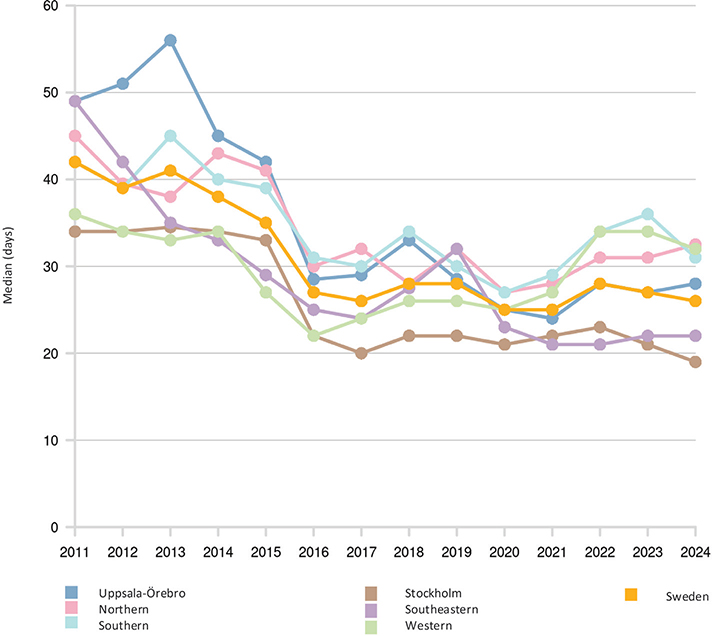
Figure 1. Median time from referral to transurethral resection for primary bladder cancer patients over time in Sweden and stratified by the six health care regions.
To facilitate a structured implementation of a standardised radiological reporting when urothelial carcinomas are detected at CTU, a review of the CTU by the operating urologist is included amongst the items of the checklist, which also is recommended to be used in conjunction with a TURB. Current evidence suggests that such checklist improves both the proportion of TURB-specimens with detrusor and recurrence-free survival [10–12].
In addition to standardised radiological reporting, the current guidelines also recommend an age-stratified protocol for CTU to investigate macroscopic haematuria to reduce the exposure to ionising radiation in younger individuals with a lower risk of urothelial carcinoma at haematuria investigation. Currently, age-stratified protocols are under development, taking findings in a small prospective study showing non-inferiority of a single nephrographic phase for detecting urothelial carcinoma into account [13]. Sweden already in 1999 abandoned diagnostic work-up for patients with asymptomatic microscopic haematuria [14], and, thus, the current recommendation aims to additionally reduce the exposure to ionising radiation in the population.
Treatment of muscle-invasive bladder cancer and advanced UTUC with curative intent
Neoadjuvant and induction chemotherapy
The Swedish national guidelines on urothelial carcinoma recommends with high compliance cisplatin-based neoadjuvant chemotherapy for all cisplatin-fit patients without regional and distant metastases for stage T2-T4a disease prior to RC, where 65% of all patients (irrespective of cisplatin-fit or unfit) below 76 years of age received such treatment in 2023 [5]. Since the guideline-revision in 2015, the concept of induction chemotherapy has been embraced for patients with nodal metastases and/or stage T4b and selected patients with oligometastatic disease, to select responders for consolidating RC or nephroureterectomy (NU). To evaluate response on such definitive chemotherapy with maximally six cycles of cisplatin-based combination chemotherapy, CT or FDG-PET/CT is recommended after two or three courses, given that a complete FDG-PET/CT-response is associated to survival in analyses adjusted for tumour stage and age [15]. For cisplatin-unfit individuals, carboplatin-induction is recommended in this setting with a similar strategy [16]. With the EMA-approval of cisplatin-gemcitabine-nivolumab as the new first-line treatment of adult patients with unresectable or metastatic urothelial carcinoma late spring 2024 [17], and the emerging and even more efficient doublet combination of enfortumab vedotin and pembrolizumab in first-line for platinum-fit patients with metastatic urothelial carcinoma [18], it is likely that the recommendations regarding regimen for induction therapy agents will change in a near future.
Radical cystectomy, nephroureterectomy and segmental ureteric resection
RC is one of the most complex urologic procedures and frequently associated with postoperative complications and even short-term mortality. The risk of postoperative morbidity and mortality increases by age and comorbidity, but despite this, the median age at RC increased from 71 (IQR 65–76) to 73 (IQR 67–77) years, and the proportion of patients with comorbidity (American Society of Anesthesiologists 3 or 4) increased from 32% to 37% after 2017 in Sweden (19). Such shift to operate older and more comorbid patients coincides with the centralisation of the cystectomy care in Sweden in 2017, after which the reoperation rates and 90-day mortality rates decreased from 12% to 8% and 4% to 3%, respectively [19]. Robotic-assisted RC (RARC) is considered oncologically equal to open RC at intermediate follow-up, thus recommended, given other prerequisites for such surgery are fulfilled. In a Swedish population-based comparison, the use of RARC was associated with a decreased risk high-grade complications at 90 days (adjusted odds ratio 0.58, 95% confidence interval 0.47–0.72), mainly due to more wound-related complications amongst patients operated with open RC [20]. On the other hand, patients operated with RARC were more commonly subjected to unplanned readmissions (29%) compared to open RC (25%) [18]. In 2023, 205/369 (56%) of cystectomies for primary bladder cancer were performed as RARC [5].
Similarly, since 2021, the majority of NU are performed robotic assisted [21]; however, for locally advanced disease (clinically stage T3/T4 and/or lymph node metastatic disease), open surgery is recommended by the guidelines based on hypothesis-generating findings, suggesting inferior survival after minimally invasive surgery in these patients [22, 23]. Based on recent data showing that violation of onco-surgical principles in conjunction with NU decreases disease-specific survival [24], and that patients treated in low-volume hospitals more frequently are subjected to preoperative invasive diagnostic modalities [25, 26], a centralisation of NU is recommended in the updated guidelines. Less than six NUs per year have been associated with worse survival outcomes [27], and given that less than 200 NUs are performed in Sweden per year for UTUC [20], this cut off is recommended. Although limited data available for distal ureteric tumours, distal ureterectomy with neocystostomy is a treatment option also for high-risk disease in selected cases [28], when a perioperative lymphadenectomy is recommended in conjunction with surgery. When performing kidney sparing surgery for UTUC, it is likely that the risk of ipsilateral upper urinary tract recurrence is lower after distal ureterectomy [29–31] than after endourology [32], which now is highlighted in the updated guidelines. According to the data from the SNRUBC, the use of segmental ureterectomy for ureteral cancer varied between the 21 regions in Sweden over the years 2015–2023 (Figure 2), showing a differential use of distal ureterectomy between regions.

Figure 2. Use of segmental ureterectomy for ureteral cancer in Sweden between 2015 and 2023. A funnel plot is created by calculating intervals so that the probability is 95% and 99%, for a regions’s proportion to be inside the interval if positive outcome is equally probable at each region (hypergeometric distribution). If a regions’s proportion is outside any of these intervals, this is a signal that the deviation is larger than could be explained by chance. The intervals are arranged from bottom to top in order of increasing region size, and consequently, the intervals are narrower the larger the region is, which creates the characteristic ‘funnel’ shape.
Definitive (chemo)radiotherapy to the bladder
The concept of moderately hypo-fractionated radiotherapy of 2,75 Gy per fraction delivered 5 days a week to a total dose of 55 Gy has been widely accepted as a new current standard [33]. This setup is appealing as it increases the accessibility of curative treatment for patients with MIBC, who deny surgery or are frail, elderly and have multiple comorbidities. The recommendations include the addition of concomitant chemotherapy with either fluorouracil and Mitomycin C or gemcitabine for patient with adequate performance status, with the option of dose reduction of the radiotherapy to 52,25 Gy [34, 35]. The current guideline version includes a method description for the use of daily adaptation of the planning target volume to fit variations in daily bladder-volume and reduce the irradiated normal tissue in the pelvis.
Adjuvant systemic therapy
After radical surgery for UTUC, the implementation of four courses of adjuvant platinum-based has increased over time in Sweden [20], with final updates of the POUT-trial demonstrating an overall survival benefit further supporting this treatment strategy [36]. For patients with cT1 disease subjected to RC with pT2/pT3/pT4 and/or nodal metastases and in cisplatin-fit individuals not receiving neoadjuvant chemotherapy for MIBC and pT3/pT4 and/or nodal metastases in the cystectomy specimen, it is recommended to discuss the option of four courses of cisplatin-based adjuvant chemotherapy, although this treatment principle has a lower level of evidence compared to UTUC. Adjuvant immunotherapy with nivolumab has now formally been introduced into the updated guidelines, although being part of practice patterns for some years based on disease-specific survival outcomes in the CheckMate 274 trial [37]. Thus, for patients with high-risk criteria after RC (pT3, pT4 and/or lymph node metastases in the surgical specimen) and PD-L1 positivity (tumour proportion score ³ 1% using antibody clone 28-8), such therapy is recommended. On the other hand, in patients treated with neoadjuvant chemotherapy, adjuvant nivolumab is recommended for ypT2, ypT3, ypT4a and/or lymph node metastatic disease irrespective of PD-L1-status based on an even larger effect size in this subgroup (hazard ratio (HR) 0.52 (0.38–0.71) (compared to HR 0.56 (0.40–0.80) in the PD-L1 positive subgroup) [34]. Nonetheless, as the current EMA-approval does not include this PD-L1-negative subgroup, the recommendation by the guideline group has not yet been fully embraced by all national regulatory instances, despite recent data supporting such use also in patients with PD-L1-negative MIBC [38, 39].
Palliative systemic treatment for locally advanced and/or metastatic urothelial carcinoma
The median survival for metastatic bladder cancer has increased from 14 to 15 months with modern cisplatin-based chemotherapy [40] to approximately 2 years with avelumab switch maintenance in patients not progressing on first line platinum-based chemotherapy [41]. Awaiting national approval of the doublet combination of enfortumab vedotin and pembrolizumab as the novel first-line treatment option for metastatic urothelial carcinoma [18], the current update of Swedish national guidelines on urothelial carcinoma recommends cisplatin-gemcitabine-nivolumab as the new first-line treatment in cisplatin-fit patients with unresectable or metastatic urothelial carcinoma [17], based on improved median overall survival from 19 to 22 months and a substantial chance for long-term survival for complete responders by adding nivolumab to the cisplatin-gemcitabine combination [17]. Importantly, this triplet increased the proportion of grade 3 toxicity or more from 52% to 62%, and in clinical practice, it will be even more important to accurately select patients who are truly cisplatin-fit for this modality. Compared to the current EAU-guidelines recommending enfortumab vedotin and pembrolizumab in first-line, it is anticipated that the Swedish guidelines on urothelial carcinoma will be updated and adopt to a similar recommendation as soon as national therapy council approvals are in place.
For platinum-unfit patients with PD-L1 positive tumours, pembrolizumab (combined positive score ≥ 10% using antibody clone 22C3) is recommended in first-line as a possible treatment option for cisplatin-unfit patients [42, 43]. However, carboplatin-gemcitabine followed by switch maintenance avelumab in non-progressing patients is favourable in light of efficacy-data from the JAVELIN Bladder 100 study [41]. The previous second-line recommendations at progression after first-line platinum-based chemotherapy remain unchanged, that is, recommending monotherapy with pembrolizumab or vinflunine. Similarly, the third-line recommendation following progression after platinum-based chemotherapy and immunotherapy remains monotherapy with enfortumab vedotin [44].
Nursing care, support and rehabilitation
The recommendation that all patients should be offered a bladder cancer patient navigator at diagnosis of urothelial carcinoma to coordinate patient needs with the healthcare system is firm, as in previous guideline versions. The recently updated Swedish guidelines on cancer-rehabilitation define more general aspects [45], whereas the current urothelial carcinoma guidelines apart from offering on demand access to a stoma therapist, dietician, physiotherapist and/or other key players during the peri- and postoperative period have added recommendations regarding sexual rehabilitation after RC. To structure and facilitate the national checklist for sexual health adapted for men and women, respectively, is promoted in addition to IIEF- and FSFI-6-scores. Recommendations for early erectile rehabilitation also after non-nerve sparing radical cystoprostatectomy [46] in men and daily vaginal dehydroepiandrosterone in females as an alternative to vaginal oestriole after cystectomy in females have been added [47]. To stress the importance of improving the communication of around diagnosis and treatment, the proportion of patients having a digital care plan (target proportion > 70%) and the proportion of patients treated with RC or external beam irradiation that have filled in the national checklist for sexual health (target proportion > 50%) have been added to the previous 12 quality indicators.
Follow-up after curative treatment
The rationale for oncological follow-up after RC is to detect early recurrences, given the current and emerging additional treatment lines for metastatic bladder cancer, with both new FGFR-targeted and antibody-drug conjugates currently being investigated. Previous follow-up guidelines after RC have been abbreviated, as the renography recommended at 6 weeks postoperatively has been removed based on clinical experience, that is, the need for baseline split-function is considered low. The patient care after RC should be focused on eventual bother during daily life with feedback to operating urologist regarding ileal conduit length, stoma location and stoma appliance functionality. Still, the current guideline recommendations for follow-up after treatment for both RC and, to an even larger extent, curative external beam radiation/chemoradiotherapy are based on low level evidence at best (Figure 3). The lack of evidence or low level of evidence is also underlying that the current guidelines open up for risk-adapted follow-up in these patients. This is in line with a recent survey report that one in two hospitals participating already has implemented such a differentiated and personalised strategy [48]. A prospective randomised trial comparing different follow-up protocols would decrease the current evidence gap. Further biochemical monitoring after urinary tract reconstruction regarding renal function, B12-status and metabolic acidosis is also recommended after RC as in previous guidelines. However, routine use of regular PSA monitoring in patients with incidental prostate cancer at cystoprostatectomy is not recommended since there was a very low cumulative incidence of death from prostate cancer at 15 years (2.6%) in a recent study [49].
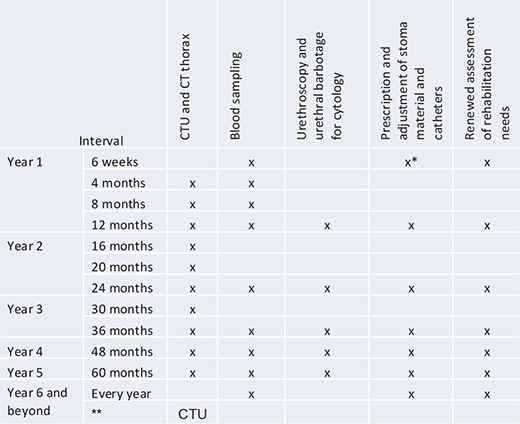
Figure 3. Follow-up schedule after radical cystectomy for bladder cancer. *By a nurse with adequate stoma therapy knowledge in cooperation with operating urologist. **Individualized follow-up depending on decreased renal function, symptoms, comorbidity and predicted survival.
Conclusions
Current update of the Swedish national guidelines for urothelial carcinoma aims to streamline the use of radiologic investigations for macroscopic haematuria and reporting advanced urothelial carcinoma findings at CTU. In the wake of centralised cystectomy care in Sweden since 2017, a recommendation for centralisation of NU for UTUC has been added. Additionally, updated recommendations for adjuvant systemic therapies following curative intended treatment of muscle-invasive disease are included. Whilst awaiting approval for doublet combination with enfortumab vedotin and pembrolizumab, cisplatin-gemcitabine-nivolumab is now recommended as a new first-line treatment option for non-resectable locally advanced and metastatic disease.
Acknowledgements
The following individuals were affiliated with the group and participated during the current update: Christina Kåbjörn Gustafsson, PhD, Department of Pathology, Ryhov County Hospital, Jönköping; Malin Matsson, GP, Primary Care Center Norra Fäladen, Lund; Anders Edsjö, PhD, Department of Clinical Genetics and Pathology, Skåne University Hospital, Lund; Ove Andrén, PhD, Department of Surgery, Skellefteå Hospital, Skellefteå, Sweden; Carl Henrik, MD, Sundin, Sundsvall, Chairman of the Patient Representative Organization Urinblåsecancer Sverige; Regional Cancer Center (RCC) South is the regional cancer centre for urothelial carcinoma in Sweden, with a supportive role for the Swedish National Register of Urinary Bladder Cancer (SNRUBC) and the national guidelines for urothelial carcinoma in Sweden. Under the auspices of RCC, statistician Victor Falini updates the publicly available data from the SNRUBC and has prepared some of the figures for the current manuscript, and Hannie Lundgren is coordinating the updates of the current guidelines.
References
- [1] Morales A, Eidinger D, Bruce AW. Intracavitary Bacillus Calmette-Guerin in the treatment of superficial bladder tumors. J Urol. 1976;116:180–183. https://doi.org/10.1016/S0022-5347(17)58737-6
- [2] DeFuria MD, Bracken RB, Johnson DE, et al. Phase I-II study of mitomycin C topical therapy for low-grade, low stage transitional cell carcinoma of the bladder: an interim report. Cancer Treat Rep. 1980;64:225–230.
- [3] Sternberg CN, Yagoda A, Scher HI, et al. Preliminary results of M-VAC (methotrexate, vinblastine, doxorubicin and cisplatin) for transitional cell carcinoma of the urothelium. J Urol. 1985;133:403–407. https://doi.org/10.1016/S0022-5347(17)48996-8
- [4] Liedberg F, Kjellström S, Lind AK, et al. Swedish National Guidelines on Urothelial Carcinoma: 2021 update on non-muscle invasive bladder cancer and upper tract urothelial carcinoma. Scand J Urol. 2022;56:137–146. https://doi.org/10.1080/21681805.2022.2041086
- [5] Svenska nationella kvalitetsregistret för urinblåse- och urinvägs cancer (SNRUBC). Available from: https://statistik.incanet.se/Urinblasecancer/ [cited 2024-11-27]
- [6] Abuhasanein S, Jahnson S, Kjölhede H. Shortened time to diagnosis for patients suspected of urinary bladder cancer managed in a standardized care pathway was associated with an improvement in tumour characteristics. BJUI Compass. 2023;5:261–268. https://doi.org/10.1002/bco2.301
- [7] Witjes JA, Bruins HM, Carrión A, et al. European Association of Urology Guidelines on muscle-invasive and metastatic bladder cancer: summary of the 2023 guidelines. Eur Urol. 2024;85:17–31. https://doi.org/10.1016/j.eururo.2023.08.016
- [8] Pihl V, Markus M, Abrahamsson J, et al. FDG-PET/CT for lymph node staging prior to radical cystectomy. Eur J Hybrid Imaging. 2023;7:13.
- [9] Liedberg F, Trägårdh E. Positron emission tomography/computed tomography for staging of bladder cancer: a continuing clinical controversy. Eur Urol. 2023;83:e82–e83. https://doi.org/10.1016/j.eururo.2022.11.022
- [10] Suarez-Ibarrola R, Soria F, Abufaraj M, et al. Surgical checklist impact on recurrence-free survival of patients with non-muscle-invasive bladder cancer undergoing transurethral resection of bladder tumour. BJU Int. 2019;123:646–650. https://doi.org/10.1111/bju.14557
- [11] Taoka R, Tsunemori H, Matsuoka Y, et al. Use of surgical checklist during transurethral resection increases detrusor muscle collection rate and improves recurrence-free survival in patients with non-muscle-invasive bladder cancer. Int J Urol. 2021;28:727–732. https://doi.org/10.1111/iju.14548
- [12] Bebane S, Denize J, Goujon A, et al. Perioperative outcomes of transurethral resection for T1 bladder tumors: quality evaluation based on patient, tumor and surgeon criteria. World J Urol. 2021;39:4159–4165.
- [13] Galtung KF, Lauritzen PM, Sandbæk G, et al. Is a single nephrographic phase computed tomography sufficient for detecting urothelial carcinoma in patients with visible haematuria? A prospective paired noninferiority comparison. Eur Urol Open Sci. 2023;55:1–10. https://doi.org/10.1016/j.euros.2023.06.005
- [14] Malmström PU, Gårdmark T. Abandoning testing for asymptomatic microscopic haematuria in Sweden – a long-term follow-up. Scand J Urol. 2023;58:109–114. https://doi.org/10.2340/sju.v58.11142
- [15] Abrahamsson J, Kollberg P, Almquist H, et al. Complete metabolic response with [18 F]fluorodeoxyglucose-positron emission tomography/computed tomography predicts survival following induction chemotherapy and radical cystectomy in clinically lymph node positive bladder cancer. BJU Int. 2022;129:174–181. https://doi.org/10.1111/bju.15374
- [16] von Deimling M, Mertens LS, van Rhijn BWG, et al. Carboplatin induction chemotherapy in clinically lymph node-positive bladder cancer. Eur Urol Open Sci. 2023;51:39–46. https://doi.org/10.1016/j.euros.2023.02.014
- [17] van der Heijden MS, Sonpavde G, Powles T, et al. Nivolumab plus gemcitabine-cisplatin in advanced urothelial carcinoma. N Engl J Med. 2023;389:1778–1789. https://doi.org/10.1056/NEJMoa2309863
- [18] Powles T, Valderrama BP, Gupta S, et al. EV-302 Trial investigators. Enfortumab vedotin and pembrolizumab in untreated advanced urothelial cancer. N Engl J Med. 2024;390:875–888.
- [19] Liedberg F, Hagberg O, Aljabery F, et al. Cystectomy for bladder cancer in Sweden – short-term outcomes after centralization. Scand J Urol. 2024;59:84–89. https://doi.org/10.2340/sju.v59.40120
- [20] Bergengren O, Belozerov A, Bill-Axelson A, et al. Short term outcomes after robot assisted and open cystectomy – a nation-wide population-based study. Eur J Surg Oncol. 2023;49:868–874. https://doi.org/10.1016/j.ejso.2023.01.023
- [21] Liedberg F, Hagberg O, Aljabery F, et al. Diagnostic pathways and treatment strategies in upper tract urothelial carcinoma in Sweden between 2015 and 2021: a population-based survey. Scand J Urol. 2024;59:19–25. https://doi.org/10.2340/sju.v59.16281
- [22] Simone G, Papalia R, Guaglianone S, et al. Laparoscopic versus open nephroureterectomy: perioperative and oncologic outcomes from a randomised prospective study. Eur Urol. 2009;56:520–526.
- [23] Peyronnet B, Seisen T, Dominguez-Escrig JL, et al. Oncological outcomes of laparoscopic nephroureterectomy versus open radical nephroureterectomy for upper tract urothelial carcinoma: an European Association of Urology guidelines systematic review. Eur Urol Focus. 2019;5:205–223. https://doi.org/10.1016/j.euf.2017.10.003
- [24] Patras I, Abrahamsson J, Gerdtsson A, et al. Violation of onco-surgical principles is associated with survival outcomes in upper tract urothelial carcinomas after radical nephroureterectomy. Scand J Urol. 2024;59:131–136. https://doi.org/10.2340/sju.v59.25973
- [25] Liedberg F, Hagberg O, Häggström C, et al. Preoperative upper tract invasive diagnostic modalities are associated with intravesical recurrence following surgery for upper tract urothelial carcinoma: a population-based study. PLoS One. 2023;18:e0281304. https://doi.org/10.1371/journal.pone.0281304
- [26] Parmar K, Hanson M, Mahrous AS, et al. Focused UTUC pathways with a risk-stratified approach to diagnostic ureteroscopy: is it the need of the hour? A retrospective cohort analysis. World J Urol. 2024;42:76.
- [27] Sui W, Wallis CJD, Luckenbaugh AN, et al. The impact of hospital volume on short-term and long-term outcomes for patients undergoing radical nephroureterectomy for upper tract urothelial carcinoma. Urology. 2021;147:135–142. https://doi.org/10.1016/j.urology.2020.07.062
- [28] Masson-Lecomte A, Vaillant V, Roumiguié M, et al. Oncological outcomes of distal ureterectomy for high-risk urothelial carcinoma: a multicenter study by the French Bladder Cancer Committee. Cancers (Basel). 2022;14:5452.
- [29] Abrate A, Sessa F, Sessa M, et al. Segmental ureterectomy versus radical nephroureterectomy in older patients treated for upper tract urothelial carcinoma. Clin Genitourin Cancer. 2022;20:381–387. https://doi.org/10.1016/j.clgc.2022.01.007
- [30] Giannarini G, Schumacher MC, Thalmann GN, et al. Elective management of transitional cell carcinoma of the distal ureter: can kidney-sparing surgery be advised? BJU Int. 2007;100:264–268. https://doi.org/10.1111/j.1464-410X.2007.06993.x
- [31] Silberstein JL, Power NE, Savage C, et al. Renal function and oncologic outcomes of parenchymal sparing ureteral resection versus radical nephroureterectomy for upper tract urothelial carcinoma. J Urol. 2012;187:429–434. https://doi.org/10.1016/j.juro.2011.09.150
- [32] Kawada T, Laukhtina E, Quhal F, et al. Oncologic and safety outcomes for endoscopic surgery versus radical nephroureterectomy for upper tract urothelial carcinoma: an updated systematic review and meta-analysis. Eur Urol Focus. 2023;9:236–240. https://doi.org/10.1016/j.euf.2022.11.016
- [33] Choudhury A, Porta N, Hall E, et al. BC2001 and BCON investigators. Hypofractionated radiotherapy in locally advanced bladder cancer: an individual patient data meta-analysis of the BC2001 and BCON trials. Lancet Oncol. 2021;22:246–255.
- [34] Caffo O, Thompson C, De Santis M, et al. Concurrent gemcitabine and radiotherapy for the treatment of muscle-invasive bladder cancer: a pooled individual data analysis of eight phase I-II trials. Radiother Oncol. 2016;121:193–198. https://doi.org/10.1016/j.radonc.2016.09.006
- [35] James ND, Hussain SA, Hall E, et al. Radiotherapy with or without chemotherapy in muscle-invasive bladder cancer. N Engl J Med. 2012;366:1477–1488.
- [36] Birtle AJ, Jones R, Chester J, et al. Improved disease-free survival with adjuvant chemotherapy after nephroureterectomy for upper tract urothelial cancer: final results of the POUT trial. J Clin Oncol. 2024;42:1466–1471. https://doi.org/10.1200/JCO.23.01659
- [37] Bajorin DF, Witjes JA, Gschwend JE, et al. Adjuvant Nivolumab versus placebo in muscle-invasive urothelial carcinoma. N Engl J Med. 2021;384:2102–2114. https://doi.org/10.1056/NEJMoa2034442
- [38] Galsky MD, Witjes JA, Gschwend JE, et al. Adjuvant Nivolumab in High-Risk Muscle-Invasive Urothelial Carcinoma: Expanded Efficacy From CheckMate 274. J Clin Oncol. 2025;43 :15-21. https://doi.org/10.1200/JCO.24.00340
- [39] Apolo AB, Ballman KV, Sonpavde G, et al. Adjuvant Pembrolizumab versus Observation in Muscle-Invasive Urothelial Carcinoma. N Engl J Med. 2025;392: 45-55. https://doi.org/10.1056/NEJMoa2401726
- [40] von der Maase H, Sengelov L, Roberts JT, et al. Long-term survival results of a randomized trial comparing gemcitabine plus cisplatin, with methotrexate, vinblastine, doxorubicin, plus cisplatin in patients with bladder cancer. J Clin Oncol. 2005;23:4602–4608. https://doi.org/10.1200/JCO.2005.07.757
- [41] Powles T, Park SH, Caserta C, et al. Avelumab first-line maintenance for advanced urothelial carcinoma: results from the JAVELIN bladder 100 trial after ≥2 years of follow-up. J Clin Oncol. 2023;41:3486–3492. https://doi.org/10.1200/JCO.22.01792
- [42] Vuky J, Balar AV, Castellano D, et al. Long-term outcomes in KEYNOTE-052: phase II study investigating first-line pembrolizumab in cisplatin-ineligible patients with locally advanced or metastatic urothelial cancer. J Clin Oncol. 2020;38:2658–2666. https://doi.org/10.1200/JCO.19.01213
- [43] Balar AV, Galsky MD, Rosenberg JE, et al. Atezolizumab as first-line treatment in cisplatin-ineligible patients with locally advanced and metastatic urothelial carcinoma: a single-arm, multicentre, phase 2 trial. Lancet. 2017;389:67–76. https://doi.org/10.1016/S0140-6736(16)32455-2
- [44] Powles T, Rosenberg JE, Sonpavde GP, et al. Enfortumab vedotin in previously treated advanced urothelial carcinoma. N Engl J Med. 2021;384:1125–1135. https://doi.org/10.1056/NEJMoa2035807
- [45] Kunskapsbanken. Nationellt vårdprogram cancerrehabilitering (In Swedish) [Internet]. Version 4.0. The Confederation of Regional Cancer Centres (RCC); 2023 [cited 31-10-2023]. Available from: https://kunskapsbanken.cancercentrum.se/diagnoser/cancerrehabilitering/vardprogram/
- [46] Moussa M, Papatsoris A, Abou Chakra M, et al. Erectile dysfunction post radical cystectomy. The role of early rehabilitation with pharmacotherapy in nerve sparing and non-nerve sparing group: a randomized, clinical trial. Arch Ital Urol Androl. 2021;93:58–64. https://doi.org/10.4081/aiua.2021.1.58
- [47] Febrina F, Triyoga IF, White M, et al. Efficacy of interventions to manage sexual dysfunction in women with cancer: a systematic review. Menopause. 2022;29:609–626. https://doi.org/10.1097/GME.0000000000001953
- [48] Mertens LS, Bruins HM, Contieri R, et al. Consistencies in Follow-up After Radical Cystectomy for Bladder Cancer: A Framework Based on Expert Practices Collaboratively Developed by the European Association of Urology Bladder Cancer Guideline Panels. Eur Urol Oncol. 2025;8: 105-110. https://doi.org/10.1016/j.euo.2024.05.010
- [49] Scilipoti P, Liedberg F, Garmo H, et al. Risk of prostate cancer death in men diagnosed with prostate cancer at cystoprostatectomy. A nationwide population-based study. Scand J Urol. 2024;59:98–103. https://doi.org/10.2340/sju.v59.40001