ORIGINAL RESEARCH ARTICLE
Characterization of treatment patterns and outcomes in muscle-invasive bladder cancer patients in Sweden
Kelvin H.M. Kwoka, Ahmad Abbadia, Sarah Côtéb, Simona Baculeac, Samuel Spigelmand, Markus Alye,f and Frida Schaina
aSchain Research AB, Stockholm Sweden; bGlobal Market Access and Health Policy, Janssen Global Services LLC, Toronto, Canada; cGlobal Market Access and Health Policy, Janssen Global Services LLC, High Wycombe, UK; dGlobal Medical Affairs, Janssen Research and Development LLC, Raritan, NJ, USA; eDepartment of Molecular Medicine and Surgery, Karolinska Institutet, Stockholm, Sweden; fDepartment of Pelvic Cancer, Karolinska University Hospital, Stockholm, Sweden
ABSTRACT
Objective: For patients diagnosed with muscle-invasive bladder cancer (MIBC), prognosis remains poor with high rates of progression and risk for mortality. To better understand the current treatment landscape, this study aims to describe real-world treatment patterns and clinical outcomes for MIBC patients in Sweden.
Materials and methods: Using population-based registers and electronic medical records, patients with MIBC (T2-4aN0M0) were identified between January 2016 and December 2020 in the Skåne region in Sweden. Patients with de novo MIBC and those who progressed from high-risk nonmuscle-invasive bladder cancer were included. Treatment patterns, overall survival (OS), metastatic rate, event-free survival (EFS), and bladder-intact EFS (BI-EFS) were described.
Results: Among the 231 MIBC patients identified, 34% received only best supportive care (BSC) primarily due to age and comorbidity. Of the 153 patients who received curative treatment, 84 (55%) underwent radical cystectomy (RC) and 69 (45%) received bladder-sparing treatment. Patients who received bladder-sparing treatment were older, had poorer health status, and more comorbidities. Among RC-treated patients, 5-year OS and EFS were 74% (95% confidence interval [CI]: 61–83%) and 70% (95% CI: 58–79%), respectively. Among patients who received bladder-sparing treatment, 5-year OS and BI-EFS were 52% (95% CI: 38–64%) and 34% (95% CI: 21–48%), respectively.
Conclusions: Old age and high rates of comorbidities among the MIBC patient population meant many patients were ineligible for recommended RC and instead received bladder-sparing treatment or BSC only. High rates of progression and poor survival were observed in both patients undergoing RC and patients who received bladder-sparing treatment.
KEYWORDS: Bladder-intact event-free survival; bladder-sparing treatment; event-free survival; muscle-invasive bladder cancer; overall survival; radical cystectomy
Citation: Scandinavian Journal of Urology 2025, VOL. 60, 108–114. https://doi.org/10.2340/sju.v60.43875.
Copyright: © 2025 The Author(s). Published by MJS Publishing on behalf of Acta Chirurgica Scandinavica. This is an Open Access article distributed under the terms of the Creative Commons Attribution 4.0 International License (http://creativecommons.org/licenses/by/4.0/), allowing third parties to copy and redistribute the material in any medium or format and to remix, transform, and build upon the material, with the condition of proper attribution to the original work.
Received: 20 November 2024; Accepted: 14 May 2025; Published: 12 June 2025
CONTACT: Kelvin H.M. Kwok kelvin@schainresearch.com Schain Research AB, iOffice, Drottninggatan 33, 111 51 Stockholm, Sweden
Supplemental data for this article can be accessed online at https://doi.org/10.2340/sju.v60.43875
Competing interests and funding: S.C., S.B, and S.S are employees and own stocks in Janssen. K.H.M.K., A.A., and F.S. are employees of Schain Research AB at the time of conducting the research, which was contracted by Janssen to conduct the study. F.S. owns stocks in Schain Research. All other authors declared no conflicts of interest.
This work was supported by Janssen Global Services LLC.
Introduction
Bladder cancer was the ninth most common malignancy worldwide and the fifth most common cancer in men in Sweden in 2022 [1]. Approximately 20% of all new bladder cancer cases are muscle-invasive bladder cancer (MIBC) at diagnosis, and approximately half will ultimately develop metastatic disease [2, 3]. Radical cystectomy (RC) is the gold standard treatment for nonmetastatic MIBC [4, 5]. However, the 5-year overall survival (OS) after RC is only about 50%, and this complex surgery is associated with morbidity, mortality, and an impact on quality of life [6]. More tolerable bladder-sparing alternatives are offered to patients medically unfit or refusing surgery. However, prognosis is often poor for the surgery-ineligible patient group, in part due to the generally poor health status at diagnosis [7].
Swedish guidelines recommend treatment of nonmetastatic MIBC with RC in combination with cisplatin-based neoadjuvant chemotherapy (NAC), dependent on general health status and adequate renal function of the patient [8]. The recommended bladder-sparing treatment is maximal transurethral resection of bladder tumor (TURBT) followed by curative radiotherapy with concomitant chemotherapy, for patients judged medically fit.
For patients with MIBC, high rates of progression and risk for mortality indicate that MIBC remains an area of high unmet medical need. There are a number of clinical trials currently assessing new interventions for MIBC patients, which use endpoints such as OS and bladder-intact event-free survival (BI-EFS) to measure effectiveness [7], and it is of interest to invest-igate these outcomes among patients who receive standard of care in the real-world setting.
In the current study, a detailed characterization of the treat-ment landscape for MIBC patients in the Skåne region of Sweden has been performed. Using population-based registers and electronic medical records (EMRs), patients were followed from MIBC diagnosis with the goal of improved understanding of MIBC patient characteristics, treatment patterns, and outcomes.
Materials and methods
Data sources and study population
Population-based registers held by the National Board of Health and Welfare and patient EMRs from Region Skåne were used to identify and characterize MIBC patients diagnosed in Skåne, Sweden (approximately 15% of the Swedish population). Based on unique Swedish personal identity numbers, linked data were obtained from the Cancer Register, Patient Register, and Cause of Death Register, with additional supplemental diagnosis, treatment, and outcome data extracted from EMRs (Melior).
Patients aged 18 years or above with newly diagnosed nonmetastatic MIBC (C67.0-6,8-9; T2-4aN0M0 stage) in the Skåne region of Sweden between January 1st 2016 and December 31st 2020 were included in the present study. MIBC patients were first identified in the Cancer Register based on the ICD-10 diagnosis code and TNM staging specified above. For subsequent medical chart review, patients who had a bladder cancer diagnosis record at any of the following hospitals in Skåne were identified in the Cancer Register using the variable KLINIK: Kristianstad Hospital (hospital code: 28010), Ängelholm Hospital (28011), Hässleholm Hospital (28012), Simrishamn Hospital (28013), University Hospital of Malmö (30001, 41002), University Hospital of Lund (41001), Landskrona Hospital (41010), Trelleborg Hospital (41011), Helsingborg Hospital (41012), and Ystad Hospital (41013).
In addition to de novo MIBC, patients initially diagnosed with high-risk nonmuscle invasive bladder cancer (HR-NMIBC; T1/TaG3/CIS + N0/x + M/0x stage) but subsequently progressed to MIBC (T2-4aN0M0) during the follow-up period were also included. Evidence of progression to nonmetastatic MIBC was identified via medical chart review as indicated by pathological and/or radiological findings. Patients were followed until February 22nd 2022. The study was approved by the Swedish Ethical Review Authority (Dnr2019-05822 and Dnr2021-04460).
Patient characteristics and treatment
Index date was set to the first date of initiation treatment with curative intent, including RC, radiotherapy, chemoradiation, chemotherapy, and immunotherapy. Clinical and treatment information was extracted, including information from physician notes on treatment intent and refusal. Age-adjusted Charlson comorbidity index (aCCI) was derived from diagnoses in the Patient Register and included a 6-month look-back. Functional disability was retrospectively assessed via clinical notes according to the Eastern Cooperative Oncology Group (ECOG) performance status scale [9]. Patients were stratified based on first-line treatment after diagnosis: RC, bladder-sparing treatment, or best supportive care (BSC). Among treated MIBC patients, detailed information including treatments, sequencing, and outcomes (recurrence: local or distant MIBC, progression: increased TNM staging, metastasis: M1 disease) was derived from EMRs. Adverse events experienced within 90 days post-RC or bladder-sparing treatment were collected, using the Common Terminology Criteria for Adverse Events (CTCAE v5.0) to evaluate severity. Mortality information was derived from the Cause of Death Register.
Statistical analysis
For categories with values lower than 5, data were reported as < 5 to preserve patient anonymity. Among patients who received treatment, OS was defined as time from index date until death from any cause. For patients who underwent RC, EFS was defined as time from index date to nodal or metastatic disease recurrence or death from any cause. For patients who underwent bladder-sparing treatment, BI-EFS was defined as time from index date to MIBC recurrence, progression, metastasis, RC, or death from any cause. The Kaplan‑Meier method was used for survival analyses and estimation of the risk of metastasis since index date. Analyses were performed using STATA (v18.0), and R Studio (v4.3.0) was used to generate treatment sequencing visualizations.
Results
Study population and baseline characteristics
In the Skåne region of Sweden, 231 patients were identified with a nonmetastatic MIBC diagnosis between 2016 and 2020 (Figure S1), including 195 patients (84%) who had a de novo MIBC diagnosis and 36 patients (16%) who progressed from HR-NMIBC. Among all nonmetastatic MIBC patients, 79% were men, and the median age at diagnosis was 77.7 years (interquartile range [IQR] 70.9–84.8) (Table 1). Eighty-four patients (36%) underwent RC as first-line treatment, while 69 patients (30%) received bladder-sparing treatment. Seventy-eight patients (34%) received only BSC following diagnosis.
For patients who received BSC, physician notes indicated the major reason was old age and/or comorbidity (89%). Median age was 85.6 years (IQR 80.1–88.6) (Table 1), and for patients under 80 years of age (n = 19), median aCCI was 4 (IQR 3–7). Other reasons reported for not giving curative treatment to the remaining eight patients included death before scheduled treatment, treatment refusal, or a second primary tumor.
Among the 153 MIBC patients who received curative treatment, 55% underwent first-line RC and 45% received bladder-sparing treatments (Table 1). Patients who received bladder-sparing treatments were older, had higher tumor stage, higher functional disability, and more comorbidities. Median time from MIBC diagnosis to first-line treatment was 3.5 months (IQR 2.5–4.1) for RC, 3.6 months (IQR 2.8–5.0) for radiotherapy, 2.6 months (IQR 2.0–3.0) for chemoradiation, and 2.0 months (IQR 1.4–2.9) for chemotherapy alone.
Radical cystectomy
Among the 84 MIBC patients who underwent first-line RC, 50 patients (60%) received NAC (Table 2), of which almost all (n = 48, 96%) received dose-dense methotrexate-vinblastine-doxorubicin-cisplatin (dd-MVAC). At post-RC pathological staging, absence of disease was observed in 23 of 50 (46%) patients who received NAC and three of 34 (9%) patients who did not. Thirty-two patients (38%) who underwent RC had postoperative complications during the 90-day period after surgery, and for most of these patients (> 80%), postoperative complications were severe (grade 3–4). The most common complication was infection. Among RC patients who received NAC, 25 (50%) experienced adverse events. For 13 NAC-treated patients (26%), reported adverse events were severe, including increased creatine among eight patients (16%).
Median follow-up time for patients who underwent first-line RC was 2.2 years (IQR 1.4–4.0). Among them, 24 (29%) had locoregional recurrence and/or distant metastasis during the follow-up period (Table S1), where median time to event was 16 months (IQR 4.8–22). Second-line treatment was given to 15% of first-line RC patients during the follow-up period, with salvage immunotherapy being the most common (Figure 1A).
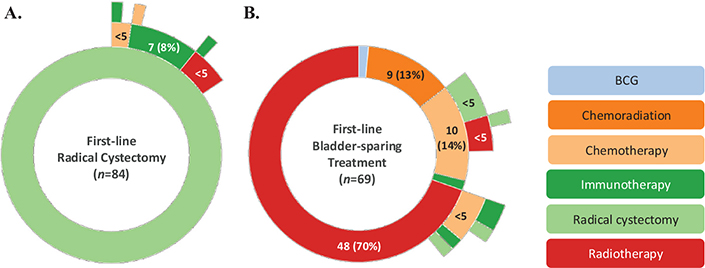
Figure 1. Treatment sequence for newly diagnosed nonmetastatic muscle-invasive bladder cancer patients who received first-line (A) radical cystectomy or (B) bladder-sparing treatments. Sunburst visualization for treatment sequence. Inner ring represents first-line treatment, with each outer segment representing subsequent second- and third-line treatment, respectively.
BCG: bacillus Calmette-Guérin.
The 5-year metastasis rate for patients who underwent first-line RC was 17% (95% CI 8.8–43%) (Table S1). The 1- and 5-year OS rates were 89% (95% CI 80–94%) and 74% (95% CI 62–83%), respectively (Figure 2A and Table S1). The 1- and 5-year EFS rates were 88% (95% CI 78–93%) and 71% (95% CI 59–81%), respectively (Figure 2B and Table S1).
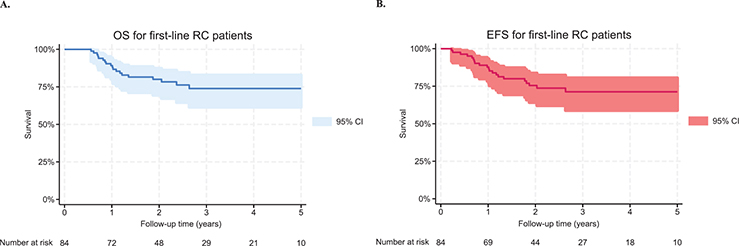
Figure 2. (A) Overall survival and (B) event-free survival among newly diagnosed nonmetastatic muscle-invasive bladder cancer patients who received first-line radical cystectomy.
OS: overall survival; RC: radical cystectomy; CI: confidence interval; EFS: event-free survival.
Bladder-sparing treatments
Sixty-nine patients (45%) who received treatment for MIBC were administered bladder-sparing treatment in the first line. This included seven patients (10%) who had refused RC according to physician notes, while the remaining (90%) were considered medically unfit for RC (Table S2). Patients refusing RC were younger, had a lower tumor stage, and a better performance status than patients considered medically unfit.
Among the 69 patients who received bladder-sparing treatment, 70% were treated with radiotherapy alone, 13% with chemoradiation, and 14% with chemotherapy alone (Table 2). All radiotherapy was external beam, and chemoradiation included FuMi (5-fluorouracil and mitomycin C) with or without dd-MVAC or mitomycin C. Chemotherapy-alone regimens were almost exclusively dd-MVAC (90%). Sixteen patients (33%) among the 48 who received radiotherapy alone experienced adverse events; for the majority of patients (23%), these adverse events were mild/moderate (grade 1–2), and the most prevalent were temporary incontinence and urinary infection.
Median follow-up time for patients who received first-line bladder-sparing treatment was 1.5 years (IQR 0.7–2.4). Locoregional recurrence and/or distant metastasis occurred in 25% of patients who received first-line bladder-sparing treat-ment during the follow-up period (Table S3), where median time to event was 7.7 months (IQR 3.1–14). First-line radiotherapy was most frequently followed by salvage chemotherapy, and first-line chemotherapy was most frequently followed by salvage RC (Figure 1B).
Among patients who received first-line bladder-sparing treatment, the 1- and 5-year OS rates were 73% (95% CI 60–82%) and 52% (95% CI 38–65%), respectively (Figure 3A and Table S3). The 1- and 5-year BI-EFS rates were 61% (IQR 48–71%) and 35% (IQR 20–50%), respectively (Figure 3B and Table S3).
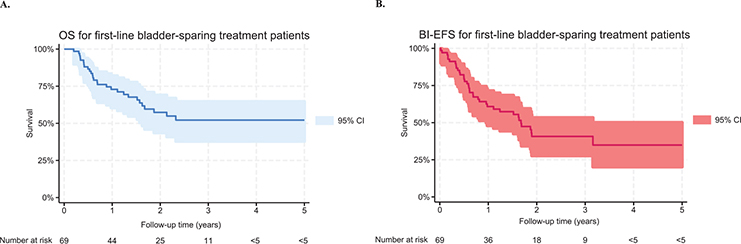
Figure 3. (A) Overall survival and (B) bladder-intact event-free survival among newly diagnosed nonmetastatic muscle-invasive bladder cancer patients who received first-line bladder-sparing treatments.
OS: overall survival; CI: confidence interval; BI-EFS: bladder-intact event-free survival.
Discussion
The present study identified 231 MIBC patients who were diagnosed and treated in Skåne, Sweden, between 2016 and 2020. Approximately a third of all patients did not receive curative treatment but only BSC due to old age and comorbidities. Among patients who were given curative treatment, 55% underwent RC as recommended by guidelines, while the remainder received bladder-sparing treatment including radiotherapy, chemoradiation, and chemotherapy. Survival analyses showed substantial mortality and disease progression in MIBC patients, particularly the older and less medically fit patients who were receiving bladder-sparing treatments.
MIBC is an aggressive disease affecting predominantly an elderly patient population, and the risk‑benefit approach required to select the most appropriate treatment for individual patients – balancing oncological outcomes with tolerability and quality of life – is challenging. The gold standard treatment recommended for nonmetastatic MIBC across international guidelines is RC with pelvic lymph node dissection following NAC for eligible patients [2, 4, 5, 8]. Our results indicate that among the MIBC patients examined, RC is the most common treatment for patients judged medically fit, with little use of chemoradiation as the most aggressive bladder-sparing alternative. NAC usage was also high at 60%, which is higher than rates reported in several other centers [10–12] but similar to reports from Denmark [13]. However, given a minimum cycle number was not specified and that up to 20% of patients may discontinue NAC prematurely [14], our findings are also in line with a marginal increase from the 40% reported previously in Sweden among all cystectomy patients prior to 2020 [14, 15].
Reported survival rates after RC vary across studies [16–19], and our observed 74% 5-year OS is marginally higher than the 68% 5-year OS reported by Stein et al. [19] but in line with previously reported Swedish analyses [20]. Encouragingly, this was also associated with relatively lower rates of complications than previously reported [21], likely due to centralization of RC surgeries at high-volume centers where patient outcomes are better than those in low-volume centers [22]. In the present study, all RC surgeries across the Skåne region were referred to and performed at two university hospitals. The reported postoperative complications associated with RC were predominantly grade 3 and 4 requiring hospitalization. No residual disease post-RC was observed for 46% of patients treated with NAC – a response rate higher than the 30–40% typically reported [23]. However, most patients experienced adverse events with NAC [14, 24]. Besides, concerns over renal function and impact of surgical delay will continue to limit extended NAC uptake [11, 25], and alternatives such as immunotherapy in the neoadjuvant setting remain an ongoing research focus [26–28].
There has been an ongoing interest to understand whether bladder-sparing options could be an effective bladder-preserving alternative to RC. The 5-year OS of 52% observed in this study was well in line with the 5-year OS with radiotherapy of 51% reported in another study using data collected in Sweden between 1997 and 2014 [20]. More recently, a Dutch center also reported a similar 5-year OS (50%) in bladder-sparing patients treated with concurrent chemoradiation, but a higher 5-year BI-EFS (60%) [29] compared to our findings. Comparative effectiveness between RC and bladder-sparing options has been challenging to assess given the underlying selection bias of age and comorbidities, associated with both poorer prognosis and receiving bladder-sparing treatments [30]. Such an effectiveness comparison was not the focus of the current study and would not have been feasible given the differences in baseline characteristics between the two cohorts. However, there is growing evidence that shows comparable effectiveness between RC and trimodal therapy in similar patient populations [31, 32].
In Skåne, tolerability remains a hurdle for improved outcomes in patients who are unfit for RC and are receiving bladder-sparing alternatives today, as well as in one-third of all patients diagnosed with nonmetastatic MIBC who currently received no curative-intent treatment and only BSC. The dire long-term outcomes associated with untreated MIBC were also emphasized by a recent Swedish study [33]. Overall, with more than half of all nonmetastatic MIBC patients identified in this study considered medically unfit to undergo surgery, this remains an area of large unmet need.
The heterogeneity of the patient group receiving bladder-sparing treatments including both the younger, healthier, lower-stage tumor patients refusing RC, and medically unfit patients unable to undergo surgery, made the interpretation of outcomes complicated. Utilizing clinical notes in patient EMRs, we found that 10% of patients who received first-line bladder-sparing treatment were eligible for, but refused, RC. With only seven RC-refusal patients identified, conclusions cannot be drawn regarding treatment outcomes. However, exploratory analysis indicated that the majority of patients treated with chem-oradiation had refused RC and went on to have no bladder-intact outcome events during the follow-up period. Few patients were also identified as receiving curative-intent chemotherapy alone, despite this regimen not being included in Swedish guidelines [8]. However, as it was almost exclusively dd-MVAC, these patients may have initiated chemotherapy as part of an NAC regimen but not proceeded to RC although this could not be confirmed based on the information available in the EMRs.
A limitation of the current study is the relatively low patient number. However, the manual EMR data collection across a whole region adds additional depths to the clinical insights and complements recent important studies conducted using Swedish registers with a nationwide scope [20, 34]. The Swedish national guidelines are prepared by a working group with representation from the whole country, and a standardized national care process (SVF) for bladder cancer supports the relative generalizability of the results to the broader Swedish context. The proportion of bladder cancer patients investigated according to the SVF was 69% in the Skåne region and 73% nationwide, respectively, between 2016 and 2020 [35]. Also, as the Nordic countries typically align with EAU guidelines and implement the Enhanced Recovery After Surgery (ERAS) protocols, the current findings likely also add insights relevant beyond the Nordics [4, 36]. As this is a region-based study, it is possible that some patients were lost to follow-up if they relocated to another region. Another limitation is that primary care information was not included. By including patients diagnosed between 2016 and 2020, the study is also limited by the relatively short follow-up time to identify disease progression and subsequent treatments, as well as assessing longer-term outcomes. This likely also influenced our shorter time-to-metastasis findings, where the observation period favored events that occurred quickly. Finally, misclassification of clinical T staging in the Swedish Cancer Register has been reported in recent studies [37, 38], which may affect the accuracy of patient identification and potentially lead to underestimation of the MIBC population. Therefore, findings in the present study should be interpreted with caution before being applied to other MIBC populations with similar T stage composition.
In conclusion, this descriptive study utilizes the strengths of Swedish registers to identify the region-wide population of nonmetastatic MIBC patients and the clinical detail of EMRs to provide an overview of the treatment landscape for patients over 6 years. Efficacy and safety findings from this study support the strong clinical care provided by clinicians in Sweden but highlight the remaining unmet need for both tolerable and effective treatments in the MIBC setting.
Acknowledgements
We thank Dr. Christina Jones (Schain Research AB) for providing writing support for the manuscript. We acknowledge the Swedish National Board of Health and Welfare and Statistics Sweden for excellent support with register data extraction and KVB Region Skåne for the EMR data for research purpose.
References
- [1] 752-sweden-fact-sheets.pdf. [cited 29-12-2023]. Available from: https://gco.iarc.fr/today/data/factsheets/populations/752-sweden-fact-sheets.pdf
- [2] Lobo N, Brooks NA, Zlotta AR, et al. 100 years of Bacillus Calmette–Guérin immunotherapy: from cattle to COVID-19. Nat Rev Urol. 2021;18(10):611–622. https://doi.org/10.1038/s41585-021-00481-1
- [3] Burger M, Catto JWF, Dalbagni G, et al. Epidemiology and risk factors of urothelial bladder cancer. Eur Urol. 2013;63(2):234–241. https://doi.org/10.1016/j.eururo.2012.07.033
- [4] Witjes JA, Bruins HM, Cathomas R, et al. European Association of Urology Guidelines on Muscle-invasive and Metastatic Bladder Cancer: summary of the 2020 Guidelines. Eur Urol. 2021;79(1):82–104. https://doi.org/10.1016/j.eururo.2020.03.055
- [5] Chang SS, Bochner BH, Chou R, et al. Treatment of non-metastatic muscle-invasive bladder cancer: AUA/ASCO/ASTRO/SUO guideline. J Urol. 2017;198(3):552–559. https://doi.org/10.1016/j.juro.2017.04.086
- [6] Maibom SL, Joensen UN, Poulsen AM, et al. Short-term morbidity and mortality following radical cystectomy: a systematic review. BMJ Open. 2021;11(4):e043266. https://doi.org/10.1136/bmjopen-2020-043266
- [7] Kimura T, Ishikawa H, Kojima T, et al. Bladder preservation therapy for muscle invasive bladder cancer: the past, present and future. Jpn J Clin Oncol. 2020;50(10):1097–1107. https://doi.org/10.1093/jjco/hyaa155
- [8] Nationellt vårdprogram cancer i urinblåsa, njurbäcken, urinledare och urinrör – RCC Kunskapsbanken. [cited 6-3-2024]. Available from:https://kunskapsbanken.cancercentrum.se/diagnoser/urinblase-och-urinvagscancer/vardprogram/
- [9] Oken MM, Creech RH, Tormey DC, et al. Toxicity and response criteria of the Eastern Cooperative Oncology Group. Am J Clin Oncol. 1982;5(6):649–655.
- [10] Carvalho FLF, Zeymo A, Egan J, et al. Determinants of neoadjuvant chemotherapy use in muscle-invasive bladder cancer. Investig Clin Urol. 2020;61(4):390–396. https://doi.org/10.4111/icu.2020.61.4.390
- [11] Cowan NG, Chen Y, Downs TM, et al. Neoadjuvant chemotherapy use in bladder cancer: a survey of current practice and opinions. Adv Urol. 2014;2014:746298. https://doi.org/10.1155/2014/746298
- [12] Schiffmann J, Sun M, Gandaglia G, et al. Use of adjuvant chemotherapy in radical cystectomy patients aged >65 years: a population-based study from the surveillance epidemiology and end results (SEER)-medicare database. Minerva Urol Nefrol. 2017;69(2):173–180. https://doi.org/10.23736/S0393-2249.16.02713-2
- [13] Körner SK, Jensen JB. A population-based retrospective analysis on variation in use of neoadjuvant chemotherapy depending on comorbidity in patients with muscle-invasive bladder cancer undergoing cystectomy in Denmark in the period 2013–2019. Scand J Urol. 2022;56(1):34–38. https://doi.org/10.1080/21681805.2021.2002400
- [14] Eriksson V, Holmlund J, Wiberg E, et al. Adverse events during neoadjuvant chemotherapy for muscle invasive bladder cancer-a Swedish retrospective multicentre study of a clinical database. Transl Androl Urol. 2022;11(8):1105–1115. https://doi.org/10.21037/tau-22-78
- [15] Jerlström T, Chen R, Liedberg F, et al. No increased risk of short-term complications after radical cystectomy for muscle-invasive bladder cancer among patients treated with preoperative chemotherapy: a nation-wide register-based study. World J Urol. 2020;38(2):381–388. https://doi.org/10.1007/s00345-019-02770-2
- [16] Booth CM, Siemens DR, Li G, et al. Perioperative chemotherapy for muscle-invasive bladder cancer: a population-based outcomes study. Cancer. 2014;120(11):1630–1638. https://doi.org/10.1002/cncr.28510
- [17] Sherif A, Holmberg L, Rintala E, et al. Neoadjuvant cisplatinum based combination chemotherapy in patients with invasive bladder cancer: a combined analysis of two Nordic studies. Eur Urol. 2004;45(3):297–303. https://doi.org/10.1016/j.eururo.2003.09.019
- [18] Vlaming M, Kiemeney LALM, van der Heijden AG. Survival after radical cystectomy: progressive versus De novo muscle invasive bladder cancer. Cancer Treat Res Commun. 2020;25:100264. https://doi.org/10.1016/j.ctarc.2020.100264
- [19] Stein JP, Lieskovsky G, Cote R, et al. Radical cystectomy in the treatment of invasive bladder cancer: long-term results in 1,054 patients. J Clin Oncol. 2001;19(3):666–675. https://doi.org/10.1200/JCO.2001.19.3.666
- [20] Häggström C, Garmo H, de Luna X, et al. Survival after radiotherapy versus radical cystectomy for primary muscle-invasive bladder cancer: a Swedish nationwide population-based cohort study. Cancer Med. 2019;8(5):2196–2204. https://doi.org/10.1002/cam4.2126
- [21] Bochner BH, Dalbagni G, Sjoberg DD, et al. Comparing open radical cystectomy and robot-assisted laparoscopic radical cystectomy: a randomized clinical trial. Eur Urol. 2015;67(6):1042–1050. https://doi.org/10.1016/j.eururo.2014.11.043
- [22] Sabir EF, Holmäng S, Liedberg F, et al. Impact of hospital volume on local recurrence and distant metastasis in bladder cancer patients treated with radical cystectomy in Sweden. Scand J Urol. 2013;47(6):483–490. https://doi.org/10.3109/21681805.2013.787118
- [23] Grossman HB, Natale RB, Tangen CM, et al. Neoadjuvant chemotherapy plus cystectomy compared with cystectomy alone for locally advanced bladder cancer. N Engl J Med. 2003;349(9):859–866. https://doi.org/10.1056/NEJMoa022148
- [24] Salminen AP, Koskinen I, Perez IM, et al. Neoadjuvant chemotherapy does not increase the morbidity of radical cystectomy: a 10-year retrospective nationwide study. Eur Urol Oncol. 2018;1(6):525–530. https://doi.org/10.1016/j.euo.2018.06.014
- [25] Russell B, Liedberg F, Khan MS, et al. A systematic review and meta-analysis of delay in radical cystectomy and the effect on survival in bladder cancer patients. Eur Urol Oncol. 2020;3(2):239–249. https://doi.org/10.1016/j.euo.2019.09.008
- [26] Szabados B, Rodriguez-Vida A, Durán I, et al. Toxicity and surgical complication rates of neoadjuvant atezolizumab in patients with muscle-invasive bladder cancer undergoing radical cystectomy: updated safety results from the ABACUS trial. Eur Urol Oncol. 2021;4(3):456–463. https://doi.org/10.1016/j.euo.2020.11.010
- [27] Szabados B, Kockx M, Assaf ZJ, et al. Final results of neoadjuvant atezolizumab in cisplatin-ineligible patients with muscle-invasive urothelial cancer of the bladder. Eur Urol. 2022;82(2):212–222. https://doi.org/10.1016/j.eururo.2022.04.013
- [28] Iacovino ML, Miceli CC, De Felice M, et al. Novel therapeutic opportunities in neoadjuvant setting in urothelial cancers: a new horizon opened by molecular classification and immune checkpoint inhibitors. Int J Mol Sci. 2022;23(3):1133. https://doi.org/10.3390/ijms23031133
- [29] de Ruiter BM, van de Kamp MW, van Steenbergen JPZ, et al. A multicenter retrospective cohort series of muscle-invasive bladder cancer patients treated with definitive concurrent chemoradiotherapy in daily practice. Eur Urol Open Sci. 2022;39:7–13. https://doi.org/10.1016/j.euros.2022.02.010
- [30] Huddart RA, Birtle A, Maynard L, et al. Clinical and patient-reported outcomes of SPARE – a randomised feasibility study of selective bladder preservation versus radical cystectomy. BJU Int. 2017;120(5):639–650. https://doi.org/10.1111/bju.13900
- [31] Fahmy O, Khairul-Asri MG, Schubert T, et al. A systematic review and meta-analysis on the oncological long-term outcomes after trimodality therapy and radical cystectomy with or without neoadjuvant chemotherapy for muscle-invasive bladder cancer. Urol Oncol. 2018;36(2):43–53. https://doi.org/10.1016/j.urolonc.2017.10.002
- [32] Ploussard G, Daneshmand S, Efstathiou JA, et al. Critical analysis of bladder sparing with trimodal therapy in muscle-invasive bladder cancer: a systematic review. Eur Urol. 2014;66(1):120–137. https://doi.org/10.1016/j.eururo.2014.02.038
- [33] Martini A, Sfakianos JP, Renström-Koskela L, et al. The natural history of untreated muscle-invasive bladder cancer. BJU Int. 2020;125(2):270–275. https://doi.org/10.1111/bju.14872
- [34] Häggström C, Hagberg O, Gårdmark T, et al. Cohort profile: Bladder Cancer Data Base Sweden (BladderBaSe) 2.0. BMJ Open. 2022;12(12):e064898. https://doi.org/10.1136/bmjopen-2022-064898
- [35] SNRUBC. [cited 29-10-2024]. Available from: https://statistik.incanet.se/Urinblasecancer/
- [36] Oedorf K, Skaaheim Haug E, Liedberg F, et al. Perioperative management of radical cystectomy in the Nordic countries. Scand J Urol. 2019;53(1):51–55. https://doi.org/10.1080/21681805.2019.1583686
- [37] Wiberg E, Vega A, Eriksson V, et al. A validation study of cT-Categories in the Swedish National Urinary Bladder Cancer Register-Norrland University Hospital. J Pers Med. 2023;13(7):1163. https://doi.org/10.3390/jpm13071163
- [38] Wedholm A, Wiberg E, Styrke J, et al. Validation of clinical T stages and of prognostic negative markers in patients with muscle invasive bladder cancer: data in the Swedish National Bladder Cancer Registry vs. data from a detailed research database. Transl Androl Urol. 2024;13(12):2757770–2752770. https://doi.org/10.21037/tau-24-454