ORIGINAL RESEARCH ARTICLE
Cross-cultural adaptation and psychometric validation of the Finnish version of the Expanded Prostate Cancer Index Composite-26 for patients with localised prostate cancer
Otto Ettalaa, Robin Bergrothb, Jarno Riikonenc,d, Peter Boströma, Juha Koskimäkic,d, Jani Kuismae, Antti Rannikkob, Markku Vaaralae, Martin G Sandaf and Henrikki Santtib
aDepartment of Urology, Turku University and Turku University Hospital, Turku, Finland; bDepartment of Urology, University of Helsinki and Helsinki University Hospital, Helsinki, Finland; cDepartment of Urology, Tays Cancer Centre, Tampere University Hospital, Tampere, Finland; dFaculty of Medicine and Health Technology, Tampere University, Tampere, Finland; eDepartment of Urology, Abdominal Centre, Oulu University Hospital, Finland; fDepartment of Urology, Emory University, Atlanta, GA, USA
ABSTRACT
Objective: The study aimed to culturally adapt the Expanded Prostate Cancer Composite-26 (EPIC-26) questionnaire to Finnish and evaluate its usability in routine clinical practice in Finland.
Material and methods: We translated the EPIC-26 questionnaire into Finnish, reviewed it, back-translated it into English, and reviewed it again. We evaluated the questionnaire in four high-volume university hospitals in Finland. The study included 220 Finnish-speaking patients with untreated, newly diagnosed non-metastatic prostate cancer. Patients completed the EPIC-26 twice before treatment and twice 6 months after treatment. We assessed internal consistency, test-retest reliability, sensitivity to change, and unanswered questions.
Results: The mean age of the patients was 68 years, with 69% diagnosed with low- or intermediate-risk prostate cancer according to the D’Amico classification. The most common treatment was radical prostatectomy (36%), followed by radiation therapy (31%) and active surveillance (25%). The minimum score, i.e. the worst assessment, was observed most frequently in the sexual domain (8%), while the maximum score was in the bowel domain (47%). Irritation/obstruction and hormonal domains showed low internal consistency due to the questions regarding haematuria and breast problems. Patients who underwent radical prostatectomy or radiation therapy had statistically significant changes between pre- and post-treatment scores. Most men (72%) completed the questionnaire. Older patients were more prone to leave questions unanswered, particularly questions with multiple items (odds ratio 0.39; 95% confidence interval 0.20–0.80).
Conclusions: The Finnish version of the EPIC-26 questionnaire can be used in clinical practice. Completing the questionnaire may be more difficult for older patients.
KEYWORDS: Prostate cancer; health-related quality of life; patient-reported outcome measures; PROMs; Expanded Prostate Cancer Index Composite; EPIC-26
Citation: Scandinavian Journal of Urology 2025, VOL. 60, 151–157. https://doi.org/10.2340/sju.v60.44371.
Copyright: © 2025 The Author(s). Published by MJS Publishing on behalf of Acta Chirurgica Scandinavica. This is an Open Access article distributed under the terms of the Creative Commons Attribution 4.0 International License (http://creativecommons.org/licenses/by/4.0/), allowing third parties to copy and redistribute the material in any medium or format and to remix, transform, and build upon the material, with the condition of proper attribution to the original work.
Received: 30 March 2025; Accepted: 8 July 2025; Published: 27 August 2025
CONTACT: Henrikki Santti henrikki.santti@hus.fi Department of Urology, Helsinki University Hospital, P.O. box 900, Helsinki 00029 HUS, Finland
Supplemental data for this article can be accessed online at https://doi.org/10.2340/sju.v60.44371
Competing interests and funding: The authors report no conflicts of interest.
The study received no external funding.
Introduction
The treatment of prostate cancer often leads to functional disabilities, particularly urinary, bowel and sexual dysfunctions, which affect patients’ health-related quality of life (HRQoL). For patients, measuring the HRQoL during the treatment and follow-up is essential for detecting and communicating symptoms and side effects [1]. For healthcare providers and organisations, the HRQoL measurement is necessary for quality assessment and improvement [1–2]. Therefore, several prostate cancer-specific HRQoL questionnaires have been developed over the last 20 years [3–9].
With a multitude of prostate cancer-specific HRQoL question-naires available, the choice of the most suitable instrument for your institution can be challenging. Ideally, the questionnaire should be widely adopted nationally and internationally, easy to complete, and demonstrate reliability and validity. Based on the UCLA-PCI (University of California, Los Angeles - Prostate Cancer Index) and Expanded Prostate Cancer Composite-50 (EPIC-50) questionnaires, Szymanski et al. developed the EPIC-26 questionnaire in 2011 [4]. Despite concerns about its construct validity and significant ceiling effect, the EPIC-26 is reliable and well-validated, with good test-retest reliability [4, 10–12]. The International Consortium of Health Outcomes Measurements (ICHOM) recommends its use in local and advanced prostate cancer patients and the questionnaire has been widely used in clinical practice and research [13–15].
Like many other HRQoL instruments, EPIC-26 was developed for English-speaking patients. It is essential to ensure that the questionnaire performs similarly to the original one to use the same questionnaire in non-English-speaking countries or countries with multinational populations. Therefore, it is not only a matter of simple translation but also an adaptation to language and cultural differences and how different cultures express health problems. To meet this need, Guillemin et al. brought up the concept of cross-cultural adaptation in 1996 [16]. By utilising two sets of translations, first from English to the selected language and then back-translated, consensus meetings with linguists and health care professionals, and testing the translated questionnaire, the adaptation aims to create a culturally valid questionnaire with comparable measures to the original. Currently, the EPIC-26 questionnaire has been translated and validated into seven languages.
The objective of this study was to culturally adapt the EPIC-26 questionnaire to Finnish and to evaluate its usability in routine clinical practice in four high-volume university hospitals in Finland.
Materials and methods
The instrument
The EPIC-26 questionnaire consists of 26 items scored on the Likert scale and summarised either as a total score or as five different domain scores: incontinence (questions 1–3, 4a), obstructive/irritative urinary symptoms (questions 4b–4e), bowel function (questions 6–7), sexual function (questions 8–12), and hormonal function (question 13). The total and domain scores are transformed linearly into a 0–100 scale, with zero denoting the worst and 100 being the best functional score.
Cross-cultural adaptation
To obtain the Finnish version of EPIC-26, the questionnaire was first translated and culturally adapted to Finnish following the protocol initially developed by Guillemin et al. [16]. In short, the protocol consists of five consecutive phases: translation, first committee review, back-translation, second committee review, and testing. Firstly, two native Finnish translators (one with and one without a medical background) translated the questionnaire from English into Finnish. After the translations, the first committee review formed a consensus on the two translations. Then, two native English translators translated the Finnish translation back into English. After the back-translations, the second committee meeting (consisting of all translators and medical and linguistic specialists) reviewed all the translations and developed the linguistically valid Finnish version of the EPIC-26.
Study population and design
The adapted questionnaire was evaluated in four university hospitals in Finland (Helsinki, Tampere, Turku, and Oulu) between February 2017 and August 2018. We included participants who signed written consent, had Finnish as their mother tongue, and were newly diagnosed with treatment-naïve, nonmetastatic prostate cancer. The relevant exclusion criteria were prostate cancer diagnosed more than 3 months before the screening, decisions regarding the treatment modality made before the screening, and men needing assistance to complete the questionnaire.
Participants completed the paper form of EPIC-26 twice (2 weeks apart) at two time points: at baseline shortly after the treatment decision and 6 months after the treatment. The exact time point for the two follow-up questionnaires was calculated as follows: active surveillance, watchful waiting and hormonal monotherapy, 6 months after the treatment decision; radical prostatectomy, 6 months after the procedure; radiation therapy, 6 months after the last dose of radiation.
Clinical data and management of prostate cancer
Shortly after the care conference, the urologist who recruited the patient collected the weight, height, prior usage of 5-ARI medication, cancer information, and the number and type of comorbidities according to the ICHOM recommendations [13]. All patients were treated according to the current EAU guidelines.
Power calculation
To detect a correlation coefficient of 0.20 with a beta of 0.20 and an alpha of 0.05, 192 patients were needed. Estimating that 85% of the patients would complete the questionnaire at baseline and follow-up visits, 226 patients needed to be recruited.
Statistical methods
The internal consistency of the culturally adapted EPIC-26 was analysed at 6 months post-treatment using Cronbach’s alpha coefficients, inter-domain correlations, and inter-total correlations. The test-retest analysis was performed at 6 months post-treatment by comparing the EPIC-26 questionnaires completed 2 weeks apart and analysed with the Pearson test. We did not report the test-retest analysis at baseline due to potential rapid treatment-related effects on quality of life. Sensitivity to change was studied by comparing domain scores after the treatment decision and 6 months post-treatment, using the Pearson test.
All continuous variables are presented as the mean (standard deviation [SD]) and categorical variables as n (%). Factors affecting patients´ ability to complete the EPIC-26 questionnaire were studied using a nominal logistic regression model.
Analyses were conducted using SPSS (IBM Corp. Released 2017. IBM SPSS Statistics for Windows, Version 25.0. Armonk, NY: IBM Corp.)
Ethical issues
The study complied with the current revision of the Declaration of Helsinki guiding physicians and medical research involving human subjects (64th World Medical Association General Assembly, Fortaleza, Brazil 2013). The Ethical Committee of the Helsinki University Hospital approved the study.
Results
Patient selection and characteristics are described in Table 1 and Figure 1. Of the 231 men recruited, 220 did not have any exclusion criteria. The mean age of the 220 men was 68 (8) years. The majority had no or only one comorbid condition (n = 143, 65%), were diagnosed with low- or intermediate-risk prostate cancer (n = 150, 69% according to D’Amico classification; n = 156, 71% according to Cancer of the Prostate Risk Assessment (CAPRA) classification), and did not use 5-ARI at the time of the diagnosis (n = 187, 85%). The most common comorbidities were high blood pressure (n = 116, 53%), chronic heart disease (n = 35, 16%), diabetes (n = 34, 15%), and chronic pulmonary disease (n = 28, 13%). In the majority of patients undergoing radical prostatectomy, a robot-assisted radical prostatectomy was performed (n = 78, 98%). The remaining two patients (2%) underwent open radical prostatectomy. Of those men having radiation therapy, the majority underwent external beam radiation (n = 62, 91%), while one patient (2%) underwent brachytherapy as monotherapy, and five (7%) a combination of brachytherapy and external beam radiation. In 45 (66%) cases, an adjuvant androgen deprivation therapy was added to the radiation therapy.
| Variable | Active surveillance (n = 55) | Watchful waiting(n = 7) | Radical prostatectomy (n = 80) | Radiation therapy(n = 68) | Hormonal therapy(n = 10) | Total(n = 220) | Excluded(n = 11) | P* |
| Age (y) | 68 | 81 | 64 | 72 | 78 | 69 | 70 | 0.434 |
| Comorbidities†, n (%) | 0.256 | |||||||
| 0 | 20 (36) | 1 (14) | 36 (45) | 16 (24) | 1 (10) | 74 (34) | 3 (27) | |
| 1 | 21 (38) | 1 (14) | 25 (31) | 20 (29) | 2 (20) | 69 (31) | 1 (55) | |
| 2 | 11 (20) | 3 (43) | 14 (18) | 24 (35) | 2 (20) | 54 (25) | 2 (18) | |
| ≥ 3 | 3 (6) | 2 (29) | 5 (6) | 8 (12) | 5 (50) | 23 (10) | NA | |
| Missing | 0 (0) | 0 (0) | 0 (0) | 0 (0) | 0 (0) | 0 (0) | NA | |
| D’Amico risk group‡, n (%) | 0.508 | |||||||
| Low | 35 (64) | 2 (29) | 6 (8) | 2 (3) | 0 (0) | 45 (21) | 2 (18) | |
| Intermediate | 18 (33) | 4 (57) | 51 (64) | 31 (46) | 1 (10) | 105 (48) | 4 (36) | |
| High | 2 (4) | 1 (14) | 23 (29) | 35 (52) | 9 (90) | 70 (32) | 5 (46) | |
| Missing | 0 (0) | 0 (0) | 0 (0) | 0 (0) | 0 (0) | 0 (0) | NA | |
| CAPRA risk group§, n (%) | 0.633 | |||||||
| Low | 39 (71) | 0 (0) | 11 (14) | 3 (4) | 0 (0) | 53 (24) | 2 (18) | |
| Intermediate | 15 (27) | 4 (57) | 49 (61) | 34 (50) | 1 (10) | 103 (47) | 4 (36) | |
| High | 0 (0) | 2 (29) | 15 (19) | 18 (27) | 5 (50) | 40 (18) | 2 (18) | |
| Very high | 0 (0) | 0 (0) | 1 (1) | 10 (15) | 4 (40) | 15 (7) | 2 (18) | |
| Missing | 0 (0) | 1 (14) | 4 (5) | 3 (4) | 0 (0) | 9 (4) | 1 (10) | |
| ICHOM: International Consortium of Health Outcomes Measurements. *Comparison of included (total) and excluded patients. †The number of comorbidities according to the ICHOM recommendations (12). ‡Risk stratification according to D’Amico et al. [17] §Risk stratification according to Cooperberg et al. [18] categorises the Cancer of the Prostate Risk Assessment (CAPRA) score into four risk groups: low (0–2 points), intermediate (3–5 points), high (6–7 points), and very high (8–10 points). |
||||||||
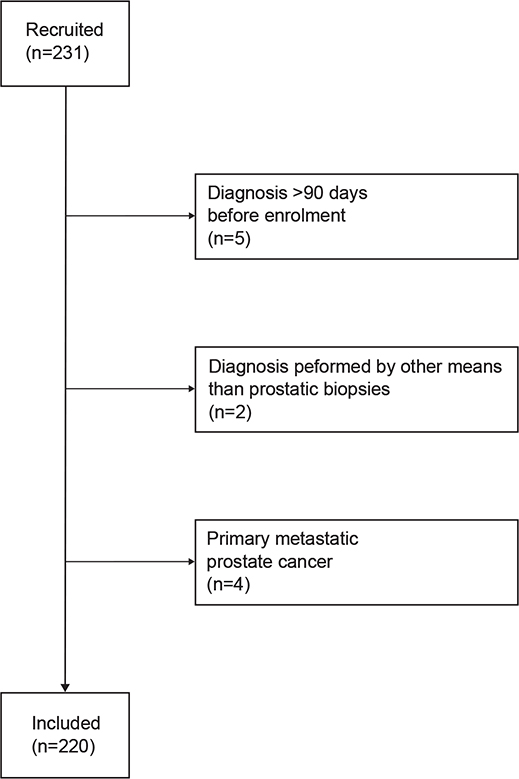
Figure 1. The study flow chart.
Details concerning the reliability of the culturally adapted EPIC-26 questionnaire are described in Supplementary Tables S1, S2, and S3. The minimum score was observed most frequently in the sexual domain (8% of patients) and the maximum in the bowel domain (47% of patients). For internal consistency, all but the irritation/obstruction and hormonal domains yielded Cronbach’s alphas of > 0.80, and in the test-retest, all domains had a Pearson correlation coefficient of > 0.80. Regarding the intercorrelation between domains and item-to-scale correlations, R-values ranged between 0.073–0.482 and –0.028–0.917.
Scores of five EPIC-26 domains, pre- and post-treatment, are depicted in Table 2. At the 6-month follow-up, 203 (93%) men returned the questionnaire. The median (range) times from baseline to the 6-month follow-up questionnaire were 242 (131–593), 393 (179–585), and 186 days (119–426) for patients undergoing radical prostatectomy, radiation therapy and deferred treatment (i.e. active surveillance, watchful waiting, or hormonal monotherapy), respectively. Statistically significant changes between pre- and post-treatment scores were observed in patients who underwent radical prostatectomy or radiation therapy. Patients in the active surveillance group exhibited a trend (p = 0.063) towards declining scores in the sexual domain during the 6-month follow-up.
| Domain | Active surveillance | Watchful waiting | Radical prostatectomy | Radiation therapy | Hormonal therapy | |||||
| Pre | Post | Pre | Post | Pre | Post | Pre | Post | Pre | Post | |
| Incontinence | 100 (9) | 100 (17) | 100 (21) | 92 (56) | 100 (8)* | 73 (49)* | 100 (14) | 100 14) | 93 (14) | 100 (39) |
| Irritation or obstruction | 88 (25) | 88 (9) | 88 (19) | 88 (22) | 88 (23)* | 94 (19)* | 88 (18) | 88 (14) | 91 (19) | 88 (25) |
| Bowel | 100 (5) | 100 (8) | 96 (18) | 100 (37) | 96 (17)* | 100 (8)* | 96 (8)* | 96 (17)* | 96 (20) | 98 (12) |
| Sexual | 67 (41) | 50 (69) | 20 (15) | 36 (37) | 61 (43)* | 17 (29)* | 45 (46)* | 17 (9)* | 20 (18) | 17 (13) |
| Hormonal | 98 (10) | 100 (10) | 95 (16) | 95 (10) | 95 (15) | 90 (20) | 100 (10)* | 87 (20)* | 90 (20) | 78 (18) |
| All values are presented as median (IQR). The comparison between pre- and post-treatment scores was performed with the two-way Wilcoxon test. *P < 0.05. The exact P-values are presented in Supplementary Table S4. | ||||||||||
The majority of men (72%) completed the questionnaire meticulously. Among 61 (28%) men who left questions unanswered, an average of seven questions (median 4, range 1–13) were unanswered. Men most often left unanswered the questions regarding dysuria (n = 196, 85%) and haematuria (n = 196, 85%). Factors affecting the patient’s ability to complete the questionnaire are described in Tables 3 and 4. Older patients were more prone to leaving questions unanswered (OR 0.36; 95%CI 0.17–0.73), especially in questions comprising multiple items (OR 0.39; 95%CI 0.20–0.80).
| Factor | All questions answereda | Simple item questions answeredb | Multiple item questions answeredc | ||||||
| Non (%) | Yesn (%) | P | Non (%) | Yesn (%) | P | Non (%) | Yesn (%) | P | |
| All | 61 (28) | 159 (72) | 16 (7) | 204 (93) | 58 (26) | 162 (74) | |||
| Age | 0.001 | 0.155 | 0.001 | ||||||
| < 70 years | 21 (18) | 99 (82) | 6 (5) | 114 (95) | 21 (18) | 99 (82) | |||
| > 70 years | 37 (37) | 63 (63) | 10 (10) | 90 (90) | 37 (37) | 63 (63) | |||
| BMI | 0.702 | 0.693 | 0.593 | ||||||
| < 30kg/m2 | 53 (27) | 140 (73) | 15 (8) | 178 (92) | 50 (26) | 143 (74) | |||
| > 30kg/m2 | 6 (32) | 13 (68) | 1 (5) | 18 (95) | 6 (32) | 13 (68) | |||
| Comorbiditiesd | 0.510 | 0.352 | 0.482 | ||||||
| 0 | 19 (26) | 55 (74) | 8 (11) | 66 (89) | 17 (23) | 57 (77) | |||
| 1 | 17 (25) | 52 (75) | 4 (6) | 65 (94) | 17 (25) | 72 (75) | |||
| > 2 | 25 (32) | 52 (68) | 4 (5) | 73 (95) | 24 (31) | 53 (69) | |||
| Local status | 0.256 | 0.199 | 0.330 | ||||||
| Local | 47 (26) | 133 (74) | 15 (8) | 165 (92) | 45 (25) | 135 (75) | |||
| Locally advanced | 14 (35) | 26 (65) | 1 (3) | 39 (97) | 13 (33) | 27 (67) | |||
| D’Amico | 0.463 | 0.524 | 0.354 | ||||||
| Low | 14 (31) | 31 (67) | 5 (11) | 40 (89) | 14 (31) | 31 (69) | |||
| Intermediate | 25 (24) | 80 (77) | 7 (7) | 98 (93) | 23 (22) | 82 (78) | |||
| High | 22 (31) | 48 (69) | 4 (6) | 66 (94) | 21 (30) | 49 (70) | |||
| Modality | 0.002 | 0.150 | 0.048 | ||||||
| Radical prostatectomy | 14 (18) | 66 (83) | 4 (5) | 76 (95) | 14 (18) | 66 (82) | |||
| Radiation therapy | 18 (26) | 50 (74) | 3 (4) | 65 (96) | 18 (26) | 50 (74) | |||
| Surveillance | 22 (35) | 49 (65) | 7 (11) | 55 (89) | 21 (34) | 41 (66) | |||
| Hormonal therapy | 7 (70) | 3 (30) | 2 (20) | 8 (80) | 5 (50) | 5 (50) | |||
| BMI, body mass index; ICHOM: International Consortium of Health Outcomes Measurements. aThe proportion of patients who completed all 26 questions. bThe proportion of men who completed all simple item questions (1, 2, 3, 5, 7, 9, 10, 11, 12). cThe proportion of men who completed all multiple-item questions (4, 6, 8, 13). dThe number of comorbidities according to the ICHOM recommendations (13). |
|||||||||
| Factor | All questions answerreda | Multiple questions answeredb | ||
| OR (95%CI) | P | OR (95%CI) | P | |
| Age | 0.050 | 0.010 | ||
| < 70 years | Ref | Ref | ||
| > 70 years | 0.36 (0.17–0.73) | 0.39 (0.20–0.80) | ||
| Modality | 0.048 | 0.276 | ||
| Radical prostatectomy | Ref | Ref | ||
| Radiation therapy | 1.07 (0.73–2.64) | 1.02 (0.41–2.51) | ||
| Surveillance | 0.54 (0.24–1.24) | 0.57 (0.248–1.30) | ||
| Hormonal therapy | 0.19 (0.04–0.88) | 0.42 (0.10–1.80) | ||
| OR: odds ratio; CI: confidence interval. aThe proportion of patients who completed all 26 questions. bThe proportion of men who completed all multiple-item questions (4, 6, 8, 13). |
||||
Discussion
The culturally adapted Finnish version of the EPIC-26 questionnaire was reliable, reproducible, and feasible in 220 patients recruited from routine clinical practice. Multiple-item questions were most frequently incomplete, especially by older men.
After the process described by Guillemin et al., the culturally adapted Finnish version of the EPIC-26, based on the test cohort, had acceptable reliability comparable to the original EPIC-26 by Szymanski et al. in terms of internal consistency by Cronbach’s alpha (alpha > 0.70) and the item-to-scale correlations (r > 0.20), test-retest reliability (r > 0.70), and intercorrelation (r > 0.20) [4, 19]. The only exception was the low internal consistency of irritation/obstruction and hormonal domains due to the questions regarding haematuria and breast problems. The original publication also recognised the low item-to-scale scores of these two questions. Although the low scores imply that they measure constructs differently from those of their respective domains, they were initially selected because of their content. Haematuria is a significant side effect of radiation therapy, and men on androgen deprivation therapy may experience gynecomastia or mastodynia, all of which have a detrimental impact on their quality of life.
The performance of the adapted questionnaire also corresponded well to routine clinical scenarios. Given that the mean age of the men was 68 years, it is understandable that all domains except the sexual domain were normal at baseline. While no changes were observed 6 months after treatment initiation in men selected for deferred treatment, an apparent change in the HRQoL was observed post-treatment in men who underwent either radical prostatectomy or radiation therapy. Radical prostatectomy had detrimental effects, primarily on continence and sexual functions, while radiation therapy affected sexual and hormonal domains. This aligns with the fact that 66% of men who underwent radiation therapy were also treated with adjuvant androgen deprivation therapy. Although there was a decrease in scores in the hormonal domain after treatment in men undergoing androgen deprivation monotherapy, the change was not statistically significant due to a small number of these cases. These findings are consistent with the previous literature [4, 20–25]. Patients in the active surveillance group showed a trend towards a decline in sexual function, possibly due to psychological distress following a recent cancer diagnosis.
Generally, the patients accepted the adapted questionnaire well. Although roughly one-fourth of patients left some questions unanswered, only a mean of seven questions were left unanswered. Interestingly, the questions often left unanswered were those inside the question matrices. The study cannot answer whether this is due to issues related to the layout of the questionnaire. However, the questionnaire might be easier to complete by transforming question matrices into single questions, although this would make the questionnaire longer. We left the layout unchanged, as the adapted questionnaire must resemble the original one. Another interesting observation was that older men were more prone to leave questions unanswered, and this was again primarily observed in the question matrices. Older men may have difficulties outlining the matrices and accidentally leave some questions unanswered. Sletten et al. similarly found that while age at treatment did not significantly affect long-term QoL, there was a notable increase in domain-specific non-responses among older participants [26].
The Finnish version of the EPIC-26 questionnaire developed in this study has been used in previous publications. Talvitie et al. studied comments that patients wrote in the margins of the EPIC-26 questionnaire and found that the lack of suitable answering options caused missing data [27]. Talvitie et al. further investigated missing data and reported that questions in the sexual and hormonal domains were most often skipped [28]. Haapiainen et al. compared the EPIC-26 questionnaire to the Visual Analogue Scale (VAS) and found that the VAS can be used as a simple alternative to the EPIC-26 to evaluate functional outcomes after radical prostatectomy [29]. Anttinen et al. used the EPIC-26 to assess functional status after salvage magnetic resonance imaging-guided transurethral ultrasound ablation for localized radiorecurrent prostate cancer and found a modest degradation in functional status [30].
The test cohort can readily be considered small. However, it should be noted that a power calculation was conducted beforehand, and 192 participants were deemed to be adequate to demonstrate a correlation coefficient of > 0.20. Additionally, at a follow-up visit, 93% of men returned the questionnaire. An apparent strength is that the cohort included not only men undergoing radical treatment but also patients undergoing active surveillance, watchful waiting, and androgen deprivation therapy. A more relevant issue than the sample size is that the study recruited only Finnish-speaking men. Although we did not collect information on the participants’ ethnicity, very few older men whose mother tongue is Finnish belong to an ethnicity other than Caucasian. In addition to Finnish, Swedish is an official language in Finland, and due to immigration, there are several non-Finnish or non-Swedish-speaking prostate cancer patients in Finland at present. With this in mind, cultural adaptations or at least translations of EPIC-26 in several language minorities should be conducted shortly. In the end, the cohort can be considered representative of Finnish-speaking patients with newly diagnosed prostate cancer.
In conclusion, the culturally adapted Finnish version of the EPIC-26 questionnaire can be used in clinical practice. However, completing the paper version of the questionnaire may be more difficult for older patients.
References
- [1] Di Maio M, Basch E, Denis F, et al. The role of patient-reported outcome measures in the continuum of cancer clinical care: ESMO Clinical Practice Guideline. Ann Oncol. 2022;33(9):878–92. https://doi.org/10.1016/j.annonc.2022.04.007
- [2] Stattin P. How to improve cancer care by use of guidelines and quality registers. Scand J Urol. 2024;59:190–2. https://doi.org/10.2340/sju.v59.42272
- [3] Vickers AJ, Savage CJ, Shouery M, et al. Validation study of a web-based assessment of functional recovery after radical prostatectomy. Health Qual Life Outcomes. 2010;8:82. https://doi.org/10.1186/1477-7525-8-82
- [4] Szymanski KM, Wei JT, Dunn RL, et al. Development and validation of an abbreviated version of the expanded prostate cancer index composite instrument for measuring health-related quality of life among prostate cancer survivors. Urology. 2010;76(5):1245–50. https://doi.org/10.1016/j.urology.2010.01.027
- [5] Wei JT, Dunn RL, Litwin MS, et al. Development and validation of the expanded prostate cancer index composite (EPIC) for comprehensive assessment of health-related quality of life in men with prostate cancer. Urology. 2000;56(6):899–905. https://doi.org/10.1016/S0090-4295(00)00858-X
- [6] Litwin MS, Hays RD, Fink A, et al. The UCLA Prostate Cancer Index: development, reliability, and validity of a health-related quality of life measure. Med Care. 1998;36(7):1002–12. https://doi.org/10.1097/00005650-199807000-00007
- [7] Esper P, Mo F, Chodak G, et al. Measuring quality of life in men with prostate cancer using the functional assessment of cancer therapy-prostate instrument. Urology. 1997;50(6):920–8. https://doi.org/10.1016/S0090-4295(97)00459-7
- [8] van Andel G, Bottomley A, Fosså SD, et al. An international field study of the EORTC QLQ-PR25: a questionnaire for assessing the health-related quality of life of patients with prostate cancer. Eur J Cancer. 2008;44(16):2418–24. https://doi.org/10.1016/j.ejca.2008.07.030
- [9] Giesler RB, Miles BJ, Cowen ME, et al. Assessing quality of life in men with clinically localized prostate cancer: development of a new instrument for use in multiple settings. Qual Life Res. 2000;9(6):645–65. https://doi.org/10.1023/A:1008931703884
- [10] Rnic K, Linden W, Tudor I, et al. Measuring symptoms in localized prostate cancer: a systematic review of assessment instruments. Prostate Cancer Prostatic Dis. 2013;16(2):111–22. https://doi.org/10.1038/pcan.2013.1
- [11] Axcrona K, Nilsson R, Brennhovd B, et al. Psychometric properties of the expanded prostate cancer index composite – 26 instrument in a cohort of radical prostatectomy patients: theoretical and practical examinations. BMC Urol. 2017;17(1):111. https://doi.org/10.1186/s12894-017-0302-7
- [12] Crump RT, Peterson A, Charbonneau C, et al. Evaluating the measurement properties of the 26-item Expanded Prostate Cancer Index Composite (EPIC-26) with a multicenter cohort. Can Urol Assoc J. 2020;14(4):111–117. https://doi.org/10.5489/cuaj.5997
- [13] Martin NE, Massey L, Stowell C, et al. Defining a standard set of patient-centered outcomes for men with localized prostate cancer. Eur Urol. 2015;67(3):460–7. https://doi.org/10.1016/j.eururo.2014.08.075
- [14] Morgans AK, van Bommel AC, Stowell C, et al. Development of a standardized set of patient-centered outcomes for advanced prostate cancer: an international effort for a unified approach. Eur Urol. 2015;68(5):891–8. https://doi.org/10.1016/j.eururo.2015.06.007
- [15] Al Hussein Al Awamlh B, Wallis CJD, Penson DF, et al. Functional outcomes after localized prostate cancer treatment. JAMA. 2024;331(4):302–17. https://doi.org/10.1001/jama.2023.26491
- [16] Guillemin F, Bombardier C, Beaton D. Cross-cultural adaptation of health-related quality of life measures: literature review and proposed guidelines. J Clin Epidemiol. 1993;46(12):1417–32. https://doi.org/10.1016/0895-4356(9390142-N)
- [17] D’Amico AV, Whittington R, Malkowicz SB, et al. Biochemical outcome after radical prostatectomy, external beam radiation therapy, or interstitial radiation therapy for clinically localized prostate cancer. JAMA. 1998;280(11):969–74. https://doi.org/10.1001/jama.280.11.969
- [18] Cooperberg MR, Broering JM, Carroll PR. Risk assessment for prostate cancer metastasis and mortality at the time of diagnosis. J Natl Cancer Inst. 2009;101(12):878–87. https://doi.org/10.1093/jnci/djp122
- [19] Protopapa E, van der Meulen J, Moore CM, et al. Patient-reported outcome (PRO) questionnaires for men who have radical surgery for prostate cancer: a conceptual review of existing instruments. BJU Int. 2017;120(4):468–81. https://doi.org/10.1111/bju.13896
- [20] Vigneault É, Savard J, Savard MH, et al. Validation of the French-Canadian version of the Expanded Prostate Cancer Index Composite (EPIC) in a French-Canadian population. Can Urol Assoc J. 2017;11(12):404–10. https://doi.org/10.5489/cuaj.4428
- [21] Forgione M, Sara S, Vincent AD, et al. Satisfaction with care in men with prostate cancer. Eur J Cancer Care. 2019;28(4):e13028. https://doi.org/10.1111/ecc.13028
- [22] Sibert NT, Dieng S, Oesterle A, et al. Psychometric validation of the German version of the EPIC-26 questionnaire for patients with localized and locally advanced prostate cancer. World J Urol. 2021;39(1):11–25. https://doi.org/10.1007/s00345-019-02949-7
- [23] Zamora V, Garin O, Suárez JF, et al. Psychometric validation of the Spanish version of the Expanded Prostate Cancer Index Composite-26. World J Urol. 2023;41(12):3511–18. https://doi.org/10.1007/s00345-023-04691-7
- [24] Jula A, Andreasson A, Logadottir Y, et al. Patients experience with the use of a penile clamp in post-prostatectomy incontinence – a prospective pilot study. Scand J Urol. 2024;59:58–62. https://doi.org/10.2340/sju.v59.9586
- [25] Wedde TB, Smaastuen MC, Vatne K, et al. External beam radiotherapy of prostate cancer with or without high dose-rate brachytherapy: the Norwegian experience with long-term urinary and bowel adverse effects. Scand J Urol. 2023;58:68–75. https://doi.org/10.2340/sju.v58.9571
- [26] Sletten R, Berger Christiansen O, Oldervoll LM, et al. The association between age and long-term quality of life after curative treatment for prostate cancer: a cross-sectional study. Scand J Urol. 2024;59:31–8. https://doi.org/10.2340/sju.v59.18616
- [27] Talvitie AM, Ojala H, Tammela T, et al. The expanded prostate cancer index composite short form (EPIC-26) for measuring health-related quality of life: content analysis of patients’ spontaneous comments written in survey margins. Qual Life Res. 2022;31(3):855–64. https://doi.org/10.1007/s11136-021-02940-z
- [28] Talvitie AM, Helminen M, Ojala H, et al. Missingness in the expanded prostate cancer index short form (EPIC-26) – prevalence, patterns, and explanatory factors. Health Qual Life Outcomes. 2023;21(1):89. https://doi.org/10.1186/s12955-023-02175-1
- [29] Haapiainen H, Valli J, Murtola T, et al. Visual analogue scale (VAS) in the evaluation of functional outcomes after three-dimensional laparoscopic prostatectomy. Urology. 2023;172:121–5. https://doi.org/10.1016/j.urology.2022.12.003
- [30] Anttinen M, Mäkelä P, Viitala A, et al. Salvage magnetic resonance imaging-guided transurethral ultrasound ablation for localized radiorecurrent prostate cancer: 12-month functional and oncological results. Eur Urol Open Sci. 2020;22:79–87. https://doi.org/10.1016/j.euros.2020.10.007