RESEARCH LETTER
Paradigm shift in the treatment of bladder cancer? The Swedish perspective
Per-Uno Malmströma and Eugen Y.H. Wanga,b
aDepartment of Surgical Sciences, Urology, Uppsala University, Uppsala, Sweden; bCenter for Clinical Research, Region Sörmland, Uppsala University, Uppsala, Sweden
KEYWORDS: Bladder Cancer; Mortality and Survival; national registries
Citation: Scandinavian Journal of Urology 2025, VOL. 60, 186–188. https://doi.org/10.2340/sju.v60.44464.
Copyright: © 2025 The Author(s). Published by MJS Publishing on behalf of Acta Chirurgica Scandinavica. This is an Open Access article distributed under the terms of the Creative Commons Attribution 4.0 International License (http://creativecommons.org/licenses/by/4.0/), allowing third parties to copy and redistribute the material in any medium or format and to remix, transform, and build upon the material, with the condition of proper attribution to the original work.
Received: 15 February 2025; Accepted: 18 July 2025; Published: 3 September 2025
CONTACT: Per-Uno Malmström per-uno.malmstrom@uu.se Department of Surgical Sciences, Urology, Uppsala University, 751 85 Uppsala, Sweden
Bladder cancer management in Sweden has evolved through clinical trials and national registries, notably the Swedish National Register of Urinary Bladder Cancer (SNRUBC) and the Bladder Cancer Data Base Sweden (BladderBaSe). These resources facilitate analyses of incidence, treatment outcomes, and survival trends. This report is a follow-up on an article on the status from 2011.
Recent data indicate a decline in bladder cancer mortality, placing Sweden among the European countries with the lowest rates. Survival improvements have been observed across all bladder cancer stages since 2012. For non-muscle-invasive bladder cancer (NMIBC), recurrence rates have significantly decreased in recent years, despite the relatively low adoption of the effective and recommended postoperative single instillation.
For muscle-invasive bladder cancer (MIBC), ongoing debates concern lymph node dissection (LND) extent and neoadjuvant chemotherapy (NAC). Extended dissection has not shown clear survival benefits. NAC improves 5-year survival by 8% and is used in about half of Swedish patients. Robot-assisted cystectomy has surpassed 50% of procedures, whereas continent diversions have decreased.
Advancements in molecular classification, imaging, and staging techniques offer potential prognostic improvements but are not yet standard in clinical practice. Despite progress in Sweden, therapy underutilization persists. Finland, without a national quality registry, has achieved substantial survival improvements, possibly due to its successful FinnBladder trial programs. While management has improved, a true paradigm shift in bladder cancer treatment remains elusive, as fundamental clinical breakthroughs are still awaited.
In the Nordic setting, we have participated in prospective clinical trials of neo- and adjuvant therapies. Later, much of the effort focused on developing national registries to capture real-life scenarios. To monitor the quality of bladder cancer care, the SNRUBC was initiated in 1997. In 2015, to study trends in incidence, treatment outcomes, and survival for men and women with bladder cancer, the SNRUBC was linked to other national healthcare and demographic registers, forming the Bladder Cancer Data Base Sweden (BladderBaSe). The aim of this review is to follow up on our previous article, ‘Bladder Tumours: Time for a Paradigm Shift?’ using these registries [1].
Evaluating progress requires analysing recurrence rates, progression to higher stages, and mortality risk. However, these endpoints are not always clearly defined. We proposed reserving the term ‘recurrence’ for diagnoses made after the first control cystoscopy and using ‘residuals’ for the remainder. This definition remains unchanged in the registries, facilitating trend analysis.
For mortality, using both survival and death rates together provides a comprehensive picture. Mortality highlights the population-level burden and trends, while survival offers insights into clinical improvements and the effectiveness of interventions for individuals with cancer.
Mortality and survival
In previous analyses, we reported that bladder cancer mortality had changed very little over two decades. However, recent data show that mortality has decreased in the past few decades, as illustrated in Figure 1. Sweden now ranks alongside Finland in having the lowest bladder cancer mortality rates in EU [2].
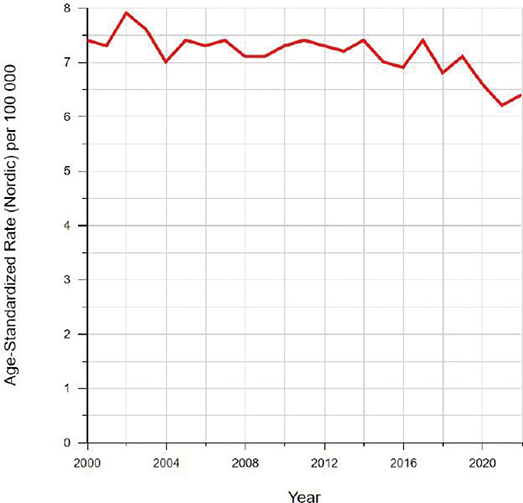
Figure 1. Age-standardized mortality rate per 100 000 during 2000-2022.
Survival analysis revealed that rates remained stable until 2012 but improved significantly thereafter. Trends in survival by stage indicate that these improvements occurred across all categories, regardless of age or gender [3].
Non-muscle-invasive bladder cancer
We specifically analysed the most common form of bladder cancer: low- and intermediate-risk stage Ta. Between 1997 and 2014, 16,599 cases were recorded in Sweden. Times to recurrence and cancer-specific death were analysed, with the data divided into 6-year periods for temporal comparison. Recurrence rates were similar during the first two periods but declined significantly in the most recent period [4].
Postoperative single instillation has proven to reduce recurrence risk by 35% [5]. Despite this, underutilization persists, with fewer than 10% of eligible Swedish patients receiving this therapy. Usage varies widely across the country and instead postoperative irrigation with water is performed in some hospitals [6].
BCG remains the most effective intravesical agent, although its effect on survival is challenging to quantify due to the frequent use of early cystectomy after BCG failure. Analysis of registry data compared patients treated with initial radical cystectomy to those receiving initial BCG therapy for high-risk NMIBC. BCG therapy demonstrated better cancer-specific survival than radical cystectomy, even after controlling for confounding factors using two different statistical methods [7]. It is very likely that somewhat more aggressive cancer are more often treated with radical cystectomy than BCG so it is likely that confounding from unknown factors remain in these observational studies. Unfortunately, no high-level evidence exists, as international attempts to conduct prospective randomized studies have failed.
From 2014 to 2018, the 5-year progression risk for high-risk NMIBC was approximately 6%, compared to over 10% reported in the literature [8].
Muscle-invasive bladder cancer
For muscle-invasive bladder cancer managed by cystectomy, two aspects remain controversial: the extent of LND and the use of NAC. Randomized trials have not consistently demonstrated significant overall survival benefits with extended LND compared to the limited technique. Among patients who underwent radical cystectomy in Sweden in 2023, 53% underwent limited LND, 32% had extended LND, and 12% had no LND.
Since 2008, European guidelines have recommended cisplatin-based NAC before cystectomy. The latest meta-analysis, which included updated results from Nordic I and Nordic II trials, confirmed an 8% absolute improvement in 5-year survival with NAC (number needed to treat = 12.5) [9]. Earlier data showed a decline in the use of NAC in Sweden Figure 2 while later in a more complete dataset, the share of patients under 75 years of age receiving neoadjuvant treatment before surgery is stable at 39–44%, with an increasing trend among those who undergo cystectomy. Reviews on the subject has hypothesised that factors such as older age, higher comorbidity scores, and socioeconomic variables were associated with lower NAC utilization [10]. Poland with an increasing trend highlighted the impact of multidisciplinary collaboration on treatment decisions [11]. This could not be the reason in Sweden, where this is generally used.
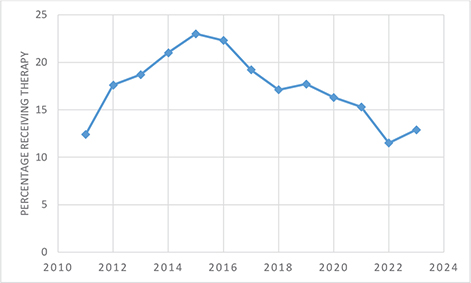
Figure 2. Rate of patients with stage T2-4, 75 years or younger receiving neoadjuvant chemotherapy 2023.
The rapid evolution of immunooncology drugs combined with surgery or in the metastatic setting could be an important part of the new armamentarium.
Robot-assisted cystectomy, with less blood loss and shortened hospital stay, now accounts for over 50% of cystectomies [12]. Continent diversions, once performed in over 10% of cases, have decreased to less than 5%.
Diagnosis and prognostication
Efforts to improve prognostication through molecular classification have yielded promising findings, particularly in predicting therapy response. However, current evidence is insufficient to incorporate molecular variants, immune signatures, or other gene expression markers into patient management, as per European Association of Urology guidelines.
New diagnostic and staging techniques, such as blue light cystoscopy and positron emission tomography, provide additional guidance for treatment. Unfortunately, their use has not been systematically recorded and should be incorporated into future registries.
As described, many positive trends are evident on a national level in Sweden, despite underutilization of proven therapies. The quality registry has facilitated more uniform and evidence-based management in this cancer as well in several others [13]. Another factor may be the early discontinuation of asymptomatic microhematuria testing, with greater emphasis on quality-of-care initiatives [14].
Alternative approaches for improvement are possible. Over a 50-year period (1971–2020), Finland, without a quality register, achieved the best relative 5-year survival improvements among Nordic countries [15]. One factor for this could be the longstanding success of the FinnBladder clinical trial organization.
In conclusion the question of whether a paradigm shift has occurred in bladder cancer management can be answered in multiple ways. Management has evolved, likely due to guideline adoption and quality registries, leading to improved outcomes, including reduced mortality. While our understanding of bladder cancer biology has advanced, clinical breakthroughs are still awaited. In this respect, a true paradigm shift has yet to materialize.
Acknowledgments
The authors would like to thank Truls Gårdmark, as represent for national bladder cancer register, for support.
References
- [1] Malmström PU. Bladder tumours: time for a paradigm shift? BJU Int. 2011 May;107(10):1543–1545. https://doi.org/10.1111/j.1464-410X.2011.10235.x
- [2] Gagliardi J. Bladder cancer mortality rate in Europe 2022, by country and gender [Internet]. Statista; 2022 [cited 2025 Mar 30]. Available from: https://www.statista.com/statistics/1452400/bladder-cancer-mortality-rate-in-europe-by-country-and-gender/
- [3] Malmström PU, Gårdmark T, Sherif A, et al. Incidence, survival and mortality trends of bladder cancer in Sweden 1997–2016. Scand J Urol. 2019 Aug;53(4):193–199. https://doi.org/10.1080/21681805.2019.1632380
- [4] Wang EYH, Pihlström N, Malmström PU, et al. Improved long-term outcome of patients with non-muscle invasive, low and intermediate risk bladder cancer between 1997 and 2014; a Swedish population-based study. Scand J Urol. 2022 Jun;56(3):221–226. https://doi.org/10.1080/21681805.2022.2062046
- [5] Sylvester RJ, Oosterlinck W, Holmang S, et al. Systematic review and individual patient data meta-analysis of randomized trials comparing a single immediate instillation of chemotherapy after transurethral resection with transurethral resection alone in patients with stage pTa-pT1 urothelial carcinoma of the bladder: which patients benefit from the instillation? Eur Urol. 2016 Feb;69(2):231–244. https://doi.org/10.1016/j.eururo.2015.05.050
- [6] Regionala Cancercentrum i Samverkan. National Swedish guidelines on bladder cancer [Internet]. Published YEAR [cited 2025 Jan 15]. Available from: https://cancercentrum.se/samverkan/cancerdiagnoser/urinblasa-urinvagar/
- [7] Wang EY, Larsson U, Gårdmark T, et al. Radical cystectomy compared to intravesical BCG immunotherapy for high-risk non-muscle invasive bladder cancer – is there a long-term survival difference? A Swedish nationwide analysis. Scand J Urol. 2021 Feb;55(1):46–52. https://doi.org/10.1080/21681805.2020.1851763
- [8] Sylvester RJ, van der Heijden AG, Witjes JA, et al. European Association of Urology (EAU) prognostic factor risk groups for non-muscle-invasive bladder cancer (NMIBC) incorporating the WHO 2004/2016 and WHO 1973 classification systems for grade: an update from the EAU NMIBC Guidelines Panel. Eur Urol. 2021;79(4):480–487. https://doi.org/10.1016/j.eururo.2020.12.033
- [9] Yin M, Joshi M, Meeks JJ, et al. Neoadjuvant chemotherapy for muscle-invasive bladder cancer: a systematic review and two-step meta-analysis. Oncologist. 2016;21(6):708–715. https://doi.org/10.1634/theoncologist.2015-0440
- [10] McFerrin C, Davaro F, May A, et al. Trends in utilization of neoadjuvant and adjuvant chemotherapy for muscle-invasive bladder cancer. Investig Clin Urol. 2020 Nov;61(6):565–572. https://doi.org/10.4111/icu.20200132
- [11] Gronostaj K, Czech AK, Fronczek J, et al. Changes in neoadjuvant chemotherapy utilization in muscle-invasive bladder cancer treatment: a tertiary center retrospective study. Cent European J Urol. 2020;73(1):13–18.
- [12] Liedberg F, Hagberg O, Aljabery F, et al. Cystectomy for bladder cancer in Sweden – short-term outcomes after centralization. Scand J Urol. 2023;84(1):84–89. https://doi.org/10.2340/sju.v59.40120
- [13] Stattin P. How to improve cancer care by use of guidelines and quality registers. Scand J Urol. 2024 Dec 12;59:190–192. https://doi.org/10.2340/sju.v59.42272
- [14] Malmström PU, Gårdmark T. Abandoning testing for asymptomatic microscopic haematuria in Sweden – a long-term follow-up. Scand J Urol. 2023 Nov 21;58:109–114. https://doi.org/10.2340/sju.v58.11142
- [15] Tichanek F, Försti A, Hemminki A, et al. Survival in kidney and bladder cancers in four Nordic countries through a half century. Cancers. 2023 May 16;15(10):2782. https://doi.org/10.3390/cancers15102782