ORIGINAL RESEARCH ARTICLE
Suicide risk among urinary bladder cancer patients compared with the standard population: a nationwide study in Sweden
Lewar Haweza, Oskar Bergengrena, Mats Ahlberga, Hans Garmoa,b, Mieke Van Hemelrijckc, Ulla-Karin Nybergd, Truls Gardmarke, Lars Holmberga, Fredrik Liedbergf and Anna Bill-Axelsona
aDepartment of Surgical Sciences, Urology, Uppsala University, Uppsala, Sweden; bRegional Cancer Centre, Uppsala University Hospital, Uppsala, Sweden; cTranslational Oncology and Urology Research (TOUR), King’s College London, London, UK; dDepartment of Clinical Neuroscience, Stockholm Centre for Psychiatric Research and Education, Karolinska Institute, Stockholm, Sweden; eDepartment of Clinical Sciences, Danderyd Hospital, Karolinska Institute, Stockholm, Sweden; fDepartment of Urology, Skåne University Hospital, Malmö, Institution of Translational Medicine, Lund University, Lund, Sweden
ABSTRACT
Objective: To assess the risk of suicide after a diagnosis of urinary bladder cancer (UBC) compared with the standard population and to identify potential risk factors and time dependence associated with suicide in patients with UBC.
Method: We used data from the Bladder Cancer Data Base Sweden 2.0 (BladderBaSe), including all individuals aged 18 years or older, diagnosed with UBC between 1997 and 2019. Suicides were identified using ICD-10 codes X60-X84. We compared the number of suicides identified in BladderBaSe with the expected number in a Swedish standard population of the same age and sex distribution during the same period.
Outcome measurements: The risk of suicide was determined using standardized mortality ratios (SMR) with 95% confidence intervals (CI).
Results: Among 53,298 patients with UBC included in our study, 106 suicides were identified compared with an expected 66 in the standard population (SMR: 1.6; 95% CI: 1.31–1.93). The risk of suicide was highest within the first 4 weeks after diagnosis (SMR: 4.66; 95% CI: 2.48–7.97), in patients with advanced UBC (SMR: 5.64; 95% CI: 2.06–12.3), those receiving palliative treatment (SMR: 5.03; 95% CI: 2.51–9.01), and those living alone (SMR: 2.87; 95% CI: 2.22 - 3.66).
Conclusion: The suicide risk among UBC patients is significantly elevated and shaped by multiple factors, with the highest risk observed in the first 4 weeks from diagnosis. Healthcare providers should maintain heightened vigilance for suicidal ideation, particularly during the critical period immediately following diagnosis, to ensure timely support and intervention.
KEYWORDS: Urinary bladder cancer; urothelial cancer; suicide risk; risk factors
Citation: Scandinavian Journal of Urology 2025, VOL. 60, 204–208. https://doi.org/10.2340/sju.v60.44784.
Copyright: © 2025 The Author(s). Published by MJS Publishing on behalf of Acta Chirurgica Scandinavica. This is an Open Access article distributed under the terms of the Creative Commons Attribution 4.0 International License (http://creativecommons.org/licenses/by/4.0/), allowing third parties to copy and redistribute the material in any medium or format and to remix, transform, and build upon the material, with the condition of proper attribution to the original work.
Received: 14 May 2025; Accepted: 25 Aug 2025; Published: 18 November 2025
CONTACT: Lewar Hawez lewar.hawez@uu.se Entrance 70, Urology, University Hospital of Uppsala, Sjukhusvägen, 751 85, Uppsala, Sweden
Competing interests and funding: The authors declare no conflicts of interest. The research was supported by grants from the Swedish Cancer Society 22,2021, 22,1971, and 23,2807, Hillevi Fries Research Foundation, Johanna Hagstrand and Sigfrid Linnérs Research Foundation, Nyströms America scholarship, and the Swedish Society of Medicine.
Introduction
Patients with urinary bladder cancer (UBC) are at increased risk of suicide. Previous studies have identified increased risk in male patients, those older than 80 years, patients with advanced disease those with poor social support, and during the first 6 months following diagnosis [1, 2].
Identifying high-risk groups and periods of increased vulnerability is important for understanding suicide risk factors among UBC patients. A recent review of risk factors for suicide identified both personal factors, such as genetics and upbringing, and external factors, such as life-changing events [2]. Since healthcare systems vary widely both within and between countries, the identified risk factors may also differ. The Swedish National Guidelines for urothelial carcinoma emphasize the importance of standardized reporting of diagnoses and procedures to ensure consistency and equitable outcomes across treatment centers. A key component of these guidelines is the use of CT urography and cystoscopy for early detection, which is associated with improved survival rates [3]. Additionally, the guidelines advocate for specialized, centralized care, which has been shown to reduce complication rates and enhance patient outcomes [4]. These measures are critical for understanding how healthcare system structures can influence both physical and mental health outcomes in patients with cancer. Despite these differences and the limited availability of population-based data, it remains important for informing preventive measures. We previously conducted a study in men with prostate cancer and found an increased risk of suicide as compared with men without prostate cancer, even among those with low-risk disease [5]. Furthermore, the risk of suicide was highest immediately after the diagnosis, which stresses the time dependency following a diagnosis [6].
Bladder cancer (BC) is a physically and psychologically debilitating disease, causing significant emotional distress such as depression and anxiety. Previous studies, including a systematic review of 1,659 patients, have shown that the prevalence of depression and anxiety is high both prior to diagnosis and during follow-up after treatment [7].
The aim of our study was to investigate the suicide risk and potential risk factors following a UBC diagnosis in Sweden and to explore when suicides most frequently occur in relation to time of diagnosis.
Methods
Data source
The Swedish National Register of Urinary Bladder Cancer (SNRUBC) is a nationwide, population-based register with virtually complete coverage. It contains data on characteristics of the primary tumor at diagnosis; primary treatment; oncological follow-up at 5 years for nonmuscle invasive bladder cancer (NMIBC); pre-, peri-, and postoperative events in conjunction with radical cystectomy; and since 2017 also systemic oncologic treatment [8]. The information is registered by each separate unit where the patient receives the UBC diagnosis.
The SNRUBC has been linked to several other national healthcare registers and demographic databases such as the Patient Register and the Cause of Death Register to create the Bladder Cancer Data Base Sweden (BladderBaSe). Thus, BladderBaSe contains comprehensive information also on additional variables such as socioeconomic status, comorbidities, and cause of death [8, 9].
Study design and statistical analysis
We utilized version 2.0 of BladderBaSe to identify all confirmed suicides among individuals diagnosed with UBC between January 1997 and December 2019. The analysis included all patients aged 18 years or older with a documented date of a UBC diagnosis. Data on suicide as the cause of death were extracted from the Cause of Death Register using ICD-10 codes X60-X84.
The primary outcome was the standardized mortality ratio (SMR), which compares the number of suicides observed in the UBC patients to the number of suicides that would be expected in a similar group from the standard population, matched by age, sex, and calendar period but without a UBC diagnosis.
To calculate the expected suicides in the standard population, we retrieved data from the Swedish Cause of Death Register, which reports suicide rates by age, sex, and calendar year (1-year category). These rates were then adjusted for the size of the population in each category using data from Statistics Sweden [10]. The 95% confidence intervals (CI) were established by assuming that the observed cases were Poisson distributed using Bryar’s normal approximation [11]. All statistical analyses were performed in R Statistical Software. We received ethical approval from the national ethical board (2019/03574).
Patients were categorized by age in 5-year intervals, sex, time from diagnosis to suicide (0–1 months, 2–3 months, 4–6 months, 7–12 months, 1–2 years, 2–5 years, > 5 years), and tumor stage group. Tumor stage was stratified as follows: group I included NMIBC (Ta-T1) without lymph node (N0, Nx) or distant (M0, Mx) metastases, group II included muscle invasive UBC (T2-T4) without metastasis (N0, Nx, M0, Mx), and group III included all metastasized UBCs regardless of T-stage (N+, N1-N3, M1). Treatment groups was stratified by transurethral resection (TUR-B), TUR-B and adjuvant instillations, radical treatment (cystectomy or radiation therapy), and palliative treatment.
Charlson Comorbidity Index (CCI) was assessed from the inpatient register [12].
We categorized the level of education as low (≤ 9 years of education), intermediate (10–12 years), high (≥ 13 years), and marital status as married or not married/widowed.
Results
BladderBaSe includes 53,298 patients (39,751 men and 13,547 women) diagnosed with UBC between January 1, 1997 and December 31, 2019.
In total, there were 106 suicides recorded among patients with UBC, compared with the expected 66 suicides in the standard population (SMR: 1.60; 95% CI: 1.31–1.93) (Table 1).
Time dependency
The highest risk of suicide following a UBC diagnosis was observed within 4 weeks of diagnosis (SMR: 4.66; 95% CI: 2.48–7.97), after which the risk declined steeply (Figure 1). After 1 year and beyond, the risk stabilized at a 30% increase. The first 6 months the risk was more than threefold (SMR: 3.55; 95% CI: 2.46–4.96) with an increased risk in almost all categories, while the risk after 6 months was not statistically significant (SMR: 1.27; 95% CI: 0.99–1.6).
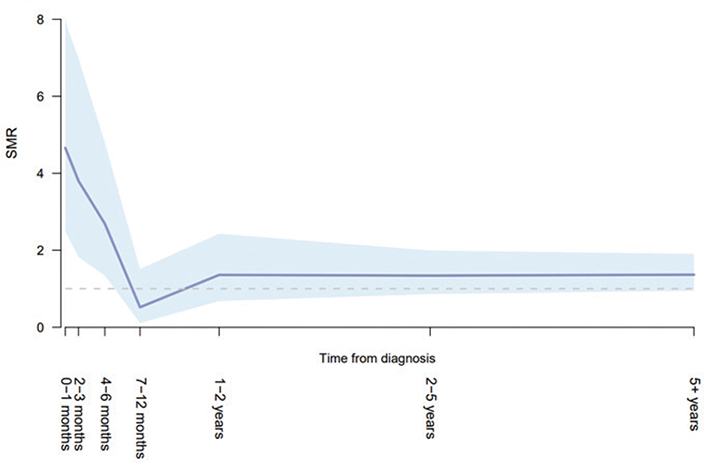
Figure 1. Standardized mortality ratios (SMRs) for suicide over time following diagnosis of urinary bladder cancer in Sweden, 1997–2019. The X-axis shows SMR values; the Y-axis shows time since diagnosis (years).
Gender and age
Compared with the standard population, men with UBC had a 50% increased risk of suicide (SMR: 1.49 95% CI: 1.19–1.83), whereas women had a more than doubled risk (SMR: 2.64 95% CI: 1.54–4.23) (Table 1). There was an increased suicide risk in men less than 70 years (SMR 1.78; 95% CI: 1.22–2.50) and above 80 years of age (SMR 1.98; 95% CI: 1.27–2.95).
Tumor stage and treatment
We found an increased suicide risk for individuals in all tumor stage groups with a stepwise increase compared with the standard population by tumor stage (Table 1). In group I, the increase was 45% (SMR: 1.45; 95% CI: 1.15–1.80) and in group III more than fivefold (SMR: 5.64; 95% CI: 2.06–12.3). Among the treatment categories, the risk was increased for those who received TUR-B only (SMR: 1.47; 95% CI: 1.12–1.90) and those who received palliative treatment (SMR: 5.03; 95% CI: 2.51–9.01).
Comorbidity, educational level, and marital status
The suicide risk was increased for those with CCI 0 (SMR: 1.63; 95% CI: 1.27–2.07) and for those with a low or intermediate education level. Patients who were not married had an increased risk of committing suicide (SMR: 2.87; 95% CI: 2.22–3.66) (Table 1).
Discussion
In this population-based study, we identified an increased and time-dependent risk of suicide among individuals diagnosed with UBC compared with the standard population. Similar to other cancers, UBC patients experience an elevated suicide risk, especially in the early months after diagnosis. Studies show that cancer patients, particularly those with advanced or metastatic disease, face a higher suicide risk due to psychological distress, poor prognosis, and treatment challenges. This is in line with our findings, but our results also suggest that those with localized UBC are at increased risk, highlighting the broad impact cancer has on mental health across different stages. The risk was highest within the first 4 weeks following diagnosis but remained elevated beyond 5 years. Risk of suicide was increased in both younger and older individuals, both men and women and all tumor stages, and the risk was increased in those undergoing only TUR-B treatment and those with palliative treatment. Additionally, the risk was increased in those with low comorbidity and with low and intermediate education. The strongest risk factors identified were time from diagnosis, advanced disease, palliative treatment, and living alone.
Our finding that the risk of suicide is highly time dependent corroborates the findings of Hu et al. who found an increase during the first 6 months and Fang et al., who in a Swedish cohort with mixed types of cancer, found the highest risk of suicide between 1 and 12 weeks after diagnosis [13, 14]. However, we found a very steep increase in the first 4 weeks with a decline in the first 6 months, which indicates that a considerable proportion of suicides are likely due to psychological distress carried out in a time window when patients have little knowledge about prognosis, potential treatment strategies, and the cancer’s impact on quality of life. The risk of suicide remained elevated beyond 5 years after a UBC diagnosis. Previous studies with longer follow-up have shown that the risk remains elevated throughout life compared with the standard population [14, 15].
The overall risk of suicide is associated with gender. Women are more likely to attempt suicide without a deadly outcome and more often receive medical care after their suicide attempts. Men, however, tend to use more violent methods with higher risk of deadly outcome [16]. Male gender has been more strongly associated with an increased suicide risk compared with females gender among UBC patients [15, 17]. However, we found that the suicide risk was elevated in both genders with a greater relative increase among women; therefore, female gender should also be considered a risk factor according to our results. In most studies persons in the older age groups are at a higher risk of suicide. In a meta-analysis by Guo et al., they found an increased risk of suicide after a UBC diagnosis among patients older than 70 years [18]. Similarly, Klaassen et al. found the risk of suicide being highest in those over the age of 80 years [19]. Our results confirm that the highest risk occurs in individuals over 80 years old, but the risk is also elevated among those younger than 70.
The risk of suicide was elevated regardless of tumor stage. However, patients with advanced disease and those with palliative treatment had the highest risk compared with the standard population. This probably reflects both the negative preconceived idea of an advanced disease and the substantially negative clinical impact that a locally advanced or metastasized disease might have on an individual’s quality of life. According to Bergerot et al., 12% of those diagnosed with advanced UBC suffered from psychosocial distress due to the symptoms from their malignancy and/or the diagnosis itself. This has a negative impact on their quality of life [20]. While a higher risk of suicide in those with advanced disease corroborates previous studies [15, 21], there was also an increased risk in those who only underwent TUR-B despite a seemingly favorable prognosis. Thus, patients may not be sufficiently informed about their diagnosis and potential outcomes when the diagnosis is given. Additionally, Guo et al. found that patients with regional cancer have a higher risk than those with localized or metastatic UBC, further emphasizing the importance of understanding the psychological implications of cancer staging [18]. It may also be psychologically challenging to endure regular surveillance cystoscopies, with the prospect of recurrences, potential additional treatments, or other disease-related issues such as macrohematuria or discomfort in conjunction with cystoscopy controls, which contributes to anxiety and pain especially in men [22].
The risk of suicide was only increased in those with CCI 0 and not statistically significant in the higher CCIs, which can be due to low power in the smaller groups. Our findings are in contrast to Ahmedani et al. who explored the correlation between chronic illness and the risk of suicide reporting an increased risk of suicide among those with chronic illness with a statistically significant increase of risk in those with multiple comorbidities, regardless of a cancer diagnosis [23]. Likewise, in the study by Fang et al., the risk of suicide among those with cardiovascular disease or psychiatric illnesses was higher compared with those without comorbidities [13].
We found an increased risk of suicide in patients with low and intermediate educational level. In a study by Klaassen et al. from the US, unmarried persons and those with lower socioeconomic status were at particular risk of suicide after a UBC diagnosis [19]. Financial issues might also contribute to the stress of recovery and the inability to work, which might further contribute to the mental distress [24]. Being single or widowed was a risk factor in our study and in line with previous knowledge. A major risk factor for suicide is the loss of a partner or social isolation, regardless of a cancer diagnosis [25, 26]. A review by Calati et al. demonstrated that widowed and those living alone are at a higher risk for suicide, as well as those who subjectively feel alone and/or live in social isolation [25].
In Sweden, the integration of clinical guidelines with national quality registers has proven effective in improving patient outcomes, particularly in cancer care [3, 4]. The Swedish National Guidelines, along with the comprehensive data from the SNRUBC, have significantly contributed to early detection and effective treatment strategies. However, the elevated suicide risk observed across all tumor stages, especially in the early post-diagnosis period, suggests that these frameworks should further evolve to incorporate routine mental health assessments. Including psychological evaluations within the standard protocols for UBC patients could better address the mental health concerns associated with cancer diagnoses, potentially reducing the observed suicide risk. The integration of clinical guidelines and quality registers in Sweden presents a promising foundation for a more holistic approach to care, one that encompasses both physical and mental health, ultimately improving overall patient outcomes and well-being [27].
Strength and limitations
The strength of the current study is the large population-based cohort with high coverage, as BladderBaSe 2.0 includes virtually all patients with a UBC diagnosis in Sweden. The ability to assess the time between the UBC diagnoses and suicide in detail is also a strength. To attain a high level of validity, we excluded suspected suicides (ICD Y10-Y34), which may have led to an underestimation of suicide risk. However, the same rule was applied to both the UBC and standard population.
A limitation to this population-based study is the low number of suicides in some subgroups, leading to wide CIs. Additionally, we lack information on social support as only marriage is officially registered, and hence we do not know whether those who are not married actually lack social support at home. Furthermore, we could not adjust for known risk factors for suicide such as previous mental health issues, suicide attempts or country of birth due to data unavailability for the standard population. Lastly, smoking is both a risk factor for UBC and associated with several mental health issues linked to suicide, making it a potential confounder that we were unable to account for in our analysis.
Conclusions
The risk of suicide is highest within the first 4 weeks following a UBC diagnosis, underscoring the significant psychological stress associated with receiving a cancer diagnosis. Our findings corroborate established risk factors such as older age, male gender, advanced disease, and living alone while also identifying an elevated risk among women and a heightened vulnerability in younger patients and those undergoing only TUR-B. These results emphasize the importance of healthcare professionals maintaining heightened awareness of potential suicide risks when delivering a UBC diagnosis. Providing clear and thorough information about the diagnosis, prognosis, and available treatment options, alongside strengthening social and psychological support systems during this critical period, could play a vital role in reducing preventable suicides.
References
- [1] Heinrich M, Hofmann L, Baurecht H, et al. Suicide risk and mortality among patients with cancer. Nat Med. 2022;28(4):852–859. https://doi.org/10.1038/s41591-022-01745-y
- [2] Fazel S, Runeson B. Suicide. N Engl J Med. 2020;382(3):266–274. https://doi.org/10.1056/NEJMra1902944
- [3] Ullén A, Aljabery F, Dahlman P, et al. Swedish national guidelines on urothelial carcinoma: 2024 update on advanced and metastatic disease. Scand J Urol. 2025;60:76–82. https://doi.org/10.2340/sju.v60.43236
- [4] Liedberg F, Hagberg O, Aljabery F, et al. Cystectomy for bladder cancer in Sweden – short-term outcomes after centralization. Scand J Urol. 2024;59:84–89. https://doi.org/10.2340/sju.v59.40120
- [5] Bill-Axelson A, Garmo H, Lambe M, et al. Suicide risk in men with prostate-specific antigen–detected early prostate cancer: a nationwide population-based cohort study from PCBaSe Sweden. Eur Urol. 2010;57(3):390–395. https://doi.org/10.1016/j.eururo.2009.10.035
- [6] Carlsson S, Sandin F, Fall K, et al. Risk of suicide in men with low-risk prostate cancer. Eur J Cancer. 2013;49(7):1588–1599. https://doi.org/10.1016/j.ejca.2012.12.018
- [7] Vartolomei L, Vartolomei MD, Shariat SF. Bladder cancer: depression, anxiety, and suicidality among the highest-risk oncology patients. Eur Urol Focus. 2020;6(6):1158–1161. https://doi.org/10.1016/j.euf.2019.10.008
- [8] Häggström C, Liedberg F, Hagberg O, et al. Cohort profile: The Swedish National Register of Urinary Bladder Cancer (SNRUBC) and the Bladder Cancer Data Base Sweden (BladderBaSe). BMJ Open. 2017;7(9):e016606. https://doi.org/10.1136/bmjopen-2017-016606
- [9] Häggström C, Hagberg O, Gårdmark T, et al. Cohort profile: Bladder Cancer Data Base Sweden (BladderBaSe) 2.0. BMJ Open. 2022;12(12):e064898. https://doi.org/10.1136/bmjopen-2022-064898
- [10] Folkmängden efter ålder och kön . År 1860 - 2021. Statistikdatabasen. [cited 2022 Apr 11]. Available from: http://www.statistikdatabasen.scb.se/pxweb/sv/ssd/START__BE__BE0101__BE0101A/BefolkningR1860N/
- [11] Breslow NE, Day NE. Statistical methods in cancer research. Volume II: The design and analysis of cohort studies. Reprinted ed. Lyon: International Agency for Research on Cancer; 1991. (IARC Scientific Publications No. 82).
- [12] Charlson ME, Pompei P, Ales KL, et al. A new method of classifying prognostic comorbidity in longitudinal studies: development and validation. J Chronic Dis. 1987;40(5):373–383. https://doi.org/10.1016/0021-9681(87)90171-8
- [13] Fang F, Valdimarsdóttir U. Suicide and cardiovascular death after a cancer diagnosis. N Engl J Med. 2012;367(3):276–277.
- [14] Hu X, Ma J, Jemal A, et al. Suicide Risk among individuals diagnosed with cancer in the US, 2000–2016. JAMA Netw Open. 2023;6(1): e2251863. https://doi.org/10.1001/jamanetworkopen.2022.51863
- [15] Klaassen Z, Jen RP, DiBianco JM, et al. Factors associated with suicide in patients with genitourinary malignancies: suicide in genitourinary malignancies. Cancer. 2015;121(11):1864–1872. https://doi.org/10.1002/cncr.29274
- [16] Freeman A, Mergl R, Kohls E, et al. A cross-national study on gender differences in suicide intent. BMC Psychiatry. 2017;17(1):234. https://doi.org/10.1186/s12888-017-1398-8
- [17] Jazzar U, Yong S, Klaassen Z, et al. Impact of psychiatric illness on decreased survival in elderly patients with bladder cancer in the United States. Cancer. 2018;124(15):3127–3135. https://doi.org/10.1002/cncr.31404
- [18] Guo Z, Gu C, Li S, et al. Incidence and risk factors of suicide among patients diagnosed with bladder cancer: a systematic review and meta-analysis. Urol Oncol. 2021;39(3):171–179. https://doi.org/10.1016/j.urolonc.2020.11.022
- [19] Klaassen Z, DiBianco JM, Jen RP, et al. The impact of radical cystectomy and urinary diversion on suicidal death in patients with bladder cancer. J Wound Ostomy Continence Nurs. 2016;43(2):152–157. https://doi.org/10.1097/WON.0000000000000188
- [20] Bergerot CD, Philip EJ, Bergerot PG, et al. Distress and quality of life among patients with advanced genitourinary cancers. Eur Urol Focus. 2020;6(6):1150–1154. https://doi.org/10.1016/j.euf.2019.10.014
- [21] Misono S, Weiss NS, Fann JR, et al. Incidence of suicide in persons with cancer. J Clin Oncol. 2008;26(29):4731–4738. https://doi.org/10.1200/JCO.2007.13.8941
- [22] Biardeau X, Lam O, Ba V, et al. Prospective evaluation of anxiety, pain, and embarrassment associated with cystoscopy and urodynamic testing in clinical practice. Can Urol Assoc J. 2017;11(3–4):104. https://doi.org/10.5489/cuaj.4127
- [23] Ahmedani BK, Peterson EL, Hu Y, et al. Major physical health conditions and risk of suicide. Am J Prevent Med. 2017;53(3):308–315. https://doi.org/10.1016/j.amepre.2017.04.001
- [24] Catto JWF, Downing A, Mason S, et al. Quality of life after bladder cancer: a cross-sectional survey of patient-reported outcomes. Eur Urol. 2021;79(5):621–632. https://doi.org/10.1016/j.eururo.2021.01.032
- [25] Calati R, Ferrari C, Brittner M, et al. Suicidal thoughts and behaviors and social isolation: a narrative review of the literature. J Affect Disord. 2019;245:653–667. https://doi.org/10.1016/j.jad.2018.11.022
- [26] Mogensen H, Möller J, Hultin H, et al. Death of a close relative and the risk of suicide in Sweden – a large scale register-based case-crossover study. PLoS One. 2016;11(10):e0164274. https://doi.org/10.1371/journal.pone.0164274
- [27] Stattin P. How to improve cancer care by use of guidelines and quality registers. Scand J Urol. 2024;59:190–192. https://doi.org/10.2340/sju.v59.42272