RESEARCH LETTER
Low risk of ipsilateral recurrence after distal ureterectomy for upper tract urothelial carcinoma
Fredrik Liedberg, Johannes Bobjer, Axel Gerdtsson, Petter Kollberg, Ioannis Patras, Anne Sörenby, Åsa Warnolf and Elin Ståhl
Department of Urology Skåne University Hospital, Malmö, and Institution of Translational Medicine, Lund University, Malmö, Sweden
KEYWORDS: upper urinary tract urothelial carcinoma; ureteral resection; kidney sparing surgery; ipsilateral recurrence
Citation: Scandinavian Journal of Urology 2025, VOL. 60, 209–212. https://doi.org/10.2340/sju.v60.45014.
Copyright: © 2025 The Author(s). Published by MJS Publishing on behalf of Acta Chirurgica Scandinavica. This is an Open Access article distributed under the terms of the Creative Commons Attribution 4.0 International License (http://creativecommons.org/licenses/by/4.0/), allowing third parties to copy and redistribute the material in any medium or format and to remix, transform, and build upon the material, with the condition of proper attribution to the original work.
Received: 18 July 2025; Accepted: 16 October 2025; Published: 10 December 2025
CONTACT: Elin Ståhl elin.stahl@med.lu.se Department of Urology, Skåne University Hospital, Jan Waldenströms gata 5, SE-205 02 Malmö, Sweden
Supplemental data for this article can be accessed online at https://doi.org/10.2340/sju.v60.45014
Competing interests and funding: None of the authors have any disclosures to report.
This work was supported by the Swedish Cancer Society (CAN 2023/2807), Swedish Research Council (2021-00859), Lund Medical Faculty (ALF), Skåne University Hospital Research Funds, the Gyllenstierna Krapperup’s Foundation, The Cancer Research Fund at Malmö General Hospital, Skåne County Council’s Research and Development Foundation (REGSKANE-622351), Gösta Jönsson Research Foundation, the Foundation of Urological Research (Ove and Carin Carlsson bladder cancer donation and Astrid and Roland Bengtsson upper tract urothelial carcinoma donation) and Hillevi Fries Research Foundation. The funding sources had no role in the study design, data analyses, interpretation of the results or writing of the manuscript.
Introduction
Upper tract urothelial carcinoma (UTUC) is rare, and only 40% are located in the ureter [1]. Kidney-sparing surgery (KSS) for ureteric UTUC comprises two approaches: endoscopic treatment or distal ureterectomy (DU). According to the European Association of Urology (EAU) guidelines, either approach is recommended for patients with low-risk disease [2]. DU may also be considered in selected cases of high-risk UTUC [2]. However, long-term ipsilateral recurrence-free survival (IRFS) after endoscopic treatment for UTUC was reported to be 19% in a tertiary referral centre series primarily involving low-risk patients [3], compared to 74% after DU in a recent study predominantly comprising high-risk cases [4]. Due to the contrasting outcomes of these two KSS modalities, we conducted an investigation into IRFS and surgical outcomes following DU in a consecutive single-centre cohort.
Patients and methods
All patients who underwent DU for UTUC at the Department of Urology, Skåne University Hospital in Malmö, between 2004 and 2022 were identified in hospital registries through surgical classification codes for any or a combination of ureteral reconstruction, neoureterocystostomy or DU and the ICD-code for ureteric cancer (C66). Six patients with benign findings, one patient having a prior cystectomy and one patient subjected to a resection of the renal pelvis were excluded, leaving 74 patients for analyses. The indications for DU during the observation period were low-risk tumours in the distal or middle ureter (n = 18) and high-risk tumours in patients with compromised renal function (n = 20) or selected high-risk tumours after shared decision-making with the patient (n = 36). In the latter 36 patients, resectability, surgical margins and adequate bladder volume for neocystostomy were evaluated during the multidisciplinary team meeting. Compromised renal function was defined as a projected remaining estimated Glomerular Filtration Rate (eGFR) of less than 20 mL/min/m2 if nephroureterectomy (NU) were to be performed. All surgeries during the observational period were performed by 10 surgeons. The surgical approach varied in the early years. In the majority of patients, residents performed parts of the surgery. Open DU with bladder cuff resection, psoas hitch and ureteric reimplantation was the standard approach. For tumours in the middle ureter, an extended psoas hitch or Boari-flap was used. The bladder cuff resection was routinely performed by transvesical dissection after closing the ureteric orifice with a suture to avoid tumour contamination in the surgical field. The use of antirefluxing reimplantation (Politano-Leadbetter) was more common during later years, except when ureteric length was insufficient. Over time, robotic-assisted laparoscopic DU was introduced in our institution. A similar approach to open DU was employed, except for the reimplantation, which was performed using an extravesical reimplantation (Lich-Gregoir) technique. No patient received postoperative single-instillation with chemotherapy. Adjuvant instillation therapy was not routinely used with the exception of one patient with positive distal margin who received postoperative Bacillus Calmette-Guérin (BCG).
Information on smoking status, comorbidity as assessed by the Charlson comorbidity index, history of prior urothelial carcinoma, and the presence of a solitary kidney was retrieved from patients’ medical records. The Paris classification system was used to evaluate voided and/or selective urinary cytology findings. Data on preoperative ureteroscopy (URS) and the placement of a nephrostomy tube or double J stent were also obtained from the medical records. Tumour characteristics – including the presence of hydronephrosis, tumour location, number of tumours (solitary vs. multiple), tumour size, clinical TNM Classification of Malignant Tumours (TNM)[AQ1] stage (< T2 vs. ≥ T2) and clinical lymph node involvement – along with date of surgery and perioperative systemic or intravesical chemotherapy were also obtained through review of the medical records. Descriptive data on operating time, intraoperative blood loss, lymphadenectomy, bladder cuff removal (yes/no), surgical approach (open vs. robotic) and whether an antirefluxing neoureterocystostomy was constructed were collected. In addition, data on surgical margins, pathological stage ≥T2, lymph node metastases and tumour grade in the DU-specimen were recorded. Postoperative outcomes – including length of hospital stay, postoperative complications (Clavien-Dindo) and unplanned readmissions within 90 days of surgery – were also obtained from the medical records, along with follow-up data. A high-grade complication was defined as Clavien ≥3.
The primary outcome was IRFS. Secondary outcomes included intravesical recurrence-free survival (IVRFS), progression-free survival (PFS) and disease-specific survival (DSS) during follow-up. Progression was defined as nodal or distant metastases during follow-up. Surveillance during follow-up consisted of cystoscopy, CT-urography (conventional urography in one patient) and voided urinary cytology. The initial follow-up included all three modalities at 3 months, 6 months and every 6 months thereafter for 2 years followed by annual assessments for a minimum of five recurrence-free years. URS was not routinely performed when radiological findings were normal. Follow-up of ipsilateral recurrence was calculated from time of intervention to latest radiology or event. Ipsilateral recurrence was defined as any tumour recurrence in the remaining ipsilateral ureter or renal pelvis. Time to intravesical recurrence was calculated from date of intervention to the most recent cystoscopy or the occurrence of recurrence. Patients were censored at the time of death or at the end of follow-up. Time to progression and time to disease-specific death were calculated from the date of intervention to the respective event or the most recent radiological or clinical assessment. In these two analyses, patients were censored at the time of death from causes unrelated to the disease or at the end of follow-up. Median follow-up was calculated for patients who were event-free of ipsilateral recurrence at the end of follow-up (n = 62). Patients were stratified by risk according to updated EAU-guidelines from 2025 [2].
Baseline characteristics were described as numbers, proportions and medians with interquartile ranges (IQRs). Survival outcomes (IRFS, IVRFS, PFS and DSS) were visualised using Kaplan-Meier curves with 95% confidence intervals (CI). All analyses were performed using STATA 17.
This study was approved by the Research Ethics Board of Lund University, Sweden (EPN 2013/106 and 2017/480).
Results
The median age at surgery for the 74 patients was 74 (IQR 69–80) years, and the median follow-up time was 3.3 (IQR 2.0–5.1) years. A greater proportion of patients underwent surgery during the latter part of the observation period (Table 1). Eighteen (24%) patients were low-risk according to the EAU risk stratification, and 26 patients (35%) met at least one of the strong criteria risk factors [2]. The median clinical tumour size was 18 (IQR 10–25) mm. Patient and tumour characteristics are summarised in Table 1. Perioperative lymphadenectomy was performed in 29/56 (52%) patients with high-risk disease. Postoperative complications within 90 days of surgery occurred in 41 patients, of which 10 (14%) experienced Clavien grade 3 or higher. Description of complication types and severity is given in Supplementary Figure 1. Eleven patients (15%) were readmitted within 90 days of DU for a variety of medical conditions. Perioperative, 90-day complications and adjuvant therapies are presented in Supplementary Table 1. Eleven patients had uncertain (n = 3) or positive (n = 8) surgical margins. Of the eight patients with positive margins, six had lateral positive margins attributable to locally advanced disease, whilst two had positive ureteric margins. Amongst those with positive lateral margins, two received adjuvant treatment in the form of either radiotherapy or systemic chemotherapy (Supplementary Table 1).
| Variable | N (%) |
| Female gender | 25 (34) |
| Smoking status | |
| Never | 33 (45) |
| Previous | 24 (32) |
| Ongoing | 17 (23) |
| Charlson comorbidity score | |
| 0–1 | 0 |
| 2 | 35 (47) |
| 3+ | 39 (53) |
| Previous upper tract urothelial carcinoma | 5 (7) |
| Previous or synchronous bladder cancer | 42 (57) |
| Solitary kidney | 6 (8) |
| Compromised renal function* | 20 (27) |
| Urinary cytology (selective and/or voided) according to the Paris classification 2022 (v2) | |
| 1 | 8 (11) |
| 2 | 31 (42) |
| 3 | 18 (24) |
| 4 | 8 (11) |
| 5 | 9 (12) |
| 6 | 0 |
| Preoperative ureteroscopy | 30 (41) |
| Without biopsy | 4 (5) |
| With biopsy | 26 (35) |
| Nephrostomy tube insertion prior surgery | 18 (24) |
| Preoperative double J stent | 12 (16) |
| Hydronephrosis prior surgery | 33 (45) |
| Tumour location | |
| Distal ureter | 70 (95) |
| Middle ureter | 4 (5) |
| Multiple ureteric tumours (two or more) | 3 (4) |
| Clinical tumour size ≥ 20 mm | 27 (37) |
| Tumour risk group** | |
| Low-risk | 18 (24) |
| High-risk | 56 (76) |
| Strong criteria high-risk | 26 (35) |
| Clinical stage ≥ T2 | 12 (16) |
| Clinically node-positive disease | 3 (4) |
| Year of surgery | |
| 2004–2010 | 6 (8) |
| 2011–2020 | 45 (61) |
| 2021–2022 | 23 (31) |
| *Projected eGFR below 20 mL/min/m2 if nephroureterectomy were to be performed. **According to the European Association of Urology risk stratification. | |
Kaplan-Meier curves displaying IRFS, IVRFS, PFS and DSS are shown in Figure 1A and stratified by EAU risk [2] in Figure 1B. Outcomes at 3 years were IRFS 88% (CI 75–93%), IVFRS 65% (CI 50–76%), PFS 89% (CI 77–95%) and DSS 94% (CI 84–98%). Twelve patients (16%) were diagnosed with ipsilateral recurrence during follow-up, of which 10 were treated with NU (Supplementary Table 2). Of the 12 ipsilateral recurrences, five (42%) were high grade, and four patients were operated without intraoperative frozen section from the proximal ureteral margin. In a sensitivity analysis comprising only clinically node negative patients (n = 71), similar IRFS was observed (Supplementary Figure 2). Eight patients (11%) had disease progression during follow-up (nodal or distant metastases). Two patients with progression had ipsilateral recurrences but were ineligible for NU. All had been classified as high-risk according to EAU risk-stratification, and 5 (62%) were locoregionally advanced at surgery (pT3 or pN+). During follow-up, 6 patients (8%) died from UTUC and 15 patients (20%) from other cause. Twenty-one (28%) patients developed intravesical recurrence and 14 (67%) of them had previous or synchronous bladder cancer. Of the 21 intravesical recurrences, 8 (38%) were high grade. Before surgery, 30 patients underwent URS and a simultaneous biopsy was performed in 26 patients. The pathological findings are described in Supplementary Table 3. At the end of follow-up, intravesicalrecurrence occurred in similar proportions amongst patients having a diagnostic URS or not (27 and 28%, respectively) (Supplementary Figure 3). During clinical follow-up, there were no peritoneal recurrences.
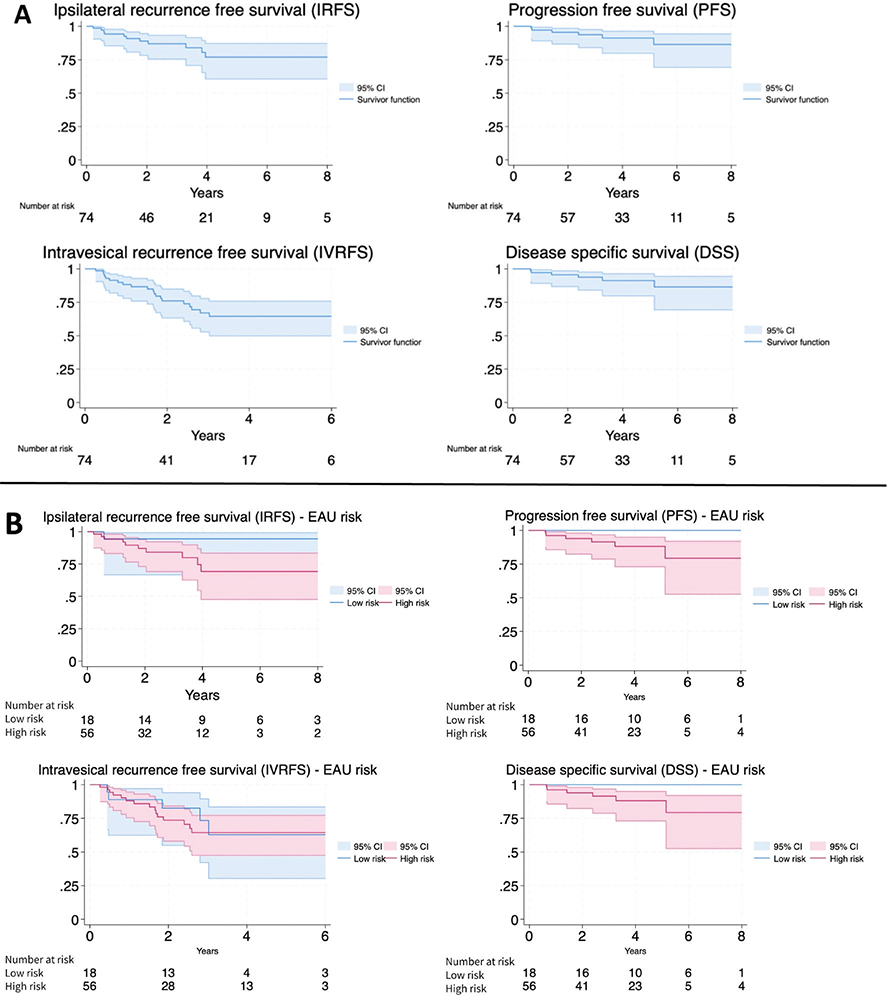
Figure 1. Outcomes in 74 patients after distal ureterectomy for upper tract urothelial carcinoma at Skåne University Hospital between 2004 and 2022. (A) Ipsilateral recurrence-free survival (IRFS), intravesical recurrence-free survival (IVRFS), progression-free survival (PFS) and disease-specific survival (DSS) with 95% confidence intervals (CI). (B) IRFS, IVRFS, PFS and DSS with 95% confidence intervals (CI) – patients stratified according to the European Association of Urology risk stratification.
Discussion
A low proportion of patients (16%) in the current population-based tertial referral-centre series treated with DU for UTUC developed ipsilateral upper tract recurrence during follow-up, despite that three out of four patients were high-risk according to the EAU risk-stratification. An even lower proportion in the subgroup of low-risk patients developed ipsilateral recurrences (2 out of 18 [11%]). However, 10 patients (14%) suffered from high-grade complications after surgery.
To our knowledge, available studies on IRFS after DU constitute of only few and small retrospective series, reporting estimates of IRFS between 89 and 96% [5, 6]. A recent larger multi-centre series with 91% high-risk UTUC reported 82% IRFS and 9% high-grade complications at 30 days after DU [4]. This is comparable to the 84% IRFS and 14% 90-days high-risk complications in the present study with a slightly larger proportion low-risk tumours. In the study by Masson-Lecomte et al, 9% of patients received minimally invasive surgery [4] compared to 1% in the present study.
In comparison, IRFS after endoscopic treatment has been reported at rates of 18-32% [3, 7, 8] in settings where the majority of patients had low-risk disease. High-grade complications after endourology for UTUC vary between 2 and 12% [9].
Limitations of the present study include its retrospective, observational, single-centre design and the small sample size. Moreover, the findings are generalisable only to a setting with similar selection criteria for DU. The majority of patients underwent surgery during the latter part of the observation period, which may have contributed the low observed recurrence rate, despite a median follow-up of 3.3 years. Nonetheless, our findings support the role of DU as an oncologically safe KSS-modality for the treatment of distal ureteric UTUC, in a setting where urinary tract cancer mortality is declining [10]. However, this must be weighed against the 100% IRFS after NU.
Conclusions
DU is an efficient treatment for UTUC in the distal ureter associated with a low risk of ipsilateral recurrences and with low risk of high-grade complications. The lack of adequately designed studies comparing outcomes after KSS in distal ureteric tumours is an unmet need.
References
- [1] Liedberg F, Hagberg O, Aljabery F, et al. Diagnostic pathways and treatment strategies in upper tract urothelial carcinoma in Sweden between 2015 and 2021: a population-based survey. Scand J Urol. 2024;59:19–25. https://doi.org/10.2340/sju.v59.16281
- [2] Masson-Lecomte A, Birtle AJ, Pradere B, et al. European Association of Urology guidelines on upper urinary tract urothelial carcinoma: summary of the 2025 update. Eur Urol. 2025;87(6):697–716. https://doi.org/10.2340/sju.v59.16281
- [3] Figaroa OJA, Hendriks N, Kamphuis GM, et al. Longer is better for endoscopic follow-up of upper tract urothelial carcinoma after ureteroscopic treatment: an evaluation spanning 10 years of data. Eur Urol Oncol. 2024;7(4):853–859. https://doi.org/10.1016/j.euo.2023.11.017
- [4] Masson-Lecomte A, Vaillant V, Roumiguie M, et al. Oncological outcomes of distal ureterectomy for high-risk urothelial carcinoma: a multicenter study by the French Bladder Cancer Committee. Cancers (Basel). 2022;14(21):5452. https://doi.org/10.3390/cancers14215452
- [5] Dalpiaz O, Ehrlich G, Quehenberger F, et al. Distal ureterectomy is a safe surgical option in patients with urothelial carcinoma of the distal ureter. Urol Oncol. 2014;32(1):34 e1–8. https://doi.org/10.1016/j.urolonc.2013.01.001
- [6] Silberstein JL, Power NE, Savage C, et al. Renal function and oncologic outcomes of parenchymal sparing ureteral resection versus radical nephroureterectomy for upper tract urothelial carcinoma. J Urol. 2012;187(2):429–34. https://doi.org/10.1016/j.uro.2011.09.150
- [7] Grasso M, Fishman AI, Cohen J, et al. Ureteroscopic and extirpative treatment of upper urinary tract urothelial carcinoma: a 15-year comprehensive review of 160 consecutive patients. BJU Int. 2012;110(11):1618–26. https://doi.org/10.1111/j.1464-410X.2012.11066.x
- [8] Cutress ML, Stewart GD, Tudor ECG, et al. Endoscopic versus laparoscopic management of noninvasive upper tract urothelial carcinoma: 20-year single center experience. J Urol. 2013;189(6):2054–60. https://doi.org/10.1016/j.juro.2012.12.006
- [9] Kawada T, Laukhtina E, Quhal F, et al. Oncologic and safety outcomes for endoscopic surgery versus radical nephroureterectomy for upper tract urothelial carcinoma: an updated systematic review and meta-analysis. Eur Urol Focus. 2023;9(2):236–40. https://doi.org/10.1016/j.euf.2022.11.016
- [10] Karttunen E, Hervonen P, Hosseinin Aliabad A, et al. Incidence, mortality and relative survival of patients with cancer of the bladder and upper urothelial tract in the Nordic countries between 1990 and 2019. Scand J Urol. 2023;57(1–6):15–21. https://doi.org/10.1080/21681805.2022.2138965