ORIGINAL RESEARCH ARTICLE
National trends in hospital encounters, outpatient consultations and surgeries for urolithiasis in Norway
Patrick Juliebø-Jonesa,b,c, Peder Gjengstøa, Mathias S. Æsøya,b, Bhaskar K. Somanid, Øyvind Ulvika,b and Christian Beislanda,b
aDepartment of Urology, Haukeland University Hospital, Bergen, Norway; bDepartment of Clinical Medicine, University of Bergen, Bergen, Norway; cEAU YAU Urolithiasis Group, Arnhem, The Netherlands; dDepartment of Urology, University Hospital Southampton, Southampton, UK
ABSTRACT
Introduction: There are few studies evaluating the burden of urolithiasis on healthcare systems in Scandinavia. This study aimed to assess national trends in hospital encounters and surgical interventions for urolithiasis in Norway.
Methods: National data on hospital admissions, outpatient consultations, inpatient stays and surgical procedures were obtained from the Norwegian Directorate for Health and the Norwegian Patient Register for 2012–2023 and the operative data for 2019–2024. Variables included age and sex. Poisson regression estimated annual changes.
Results: Between 2012 and 2023, 109,490 unique patients had a hospital encounter for urolithiasis, increasing by 2.9% annually (p < 0.001). The increase was greater in males (3.2% vs. 2.6%, p < 0.001) and in those ≥70 years (6.4% vs. 2.0%, p < 0.0001). Outpatient consultations increased by 3.2% per year, with the steepest rise among older adults. Inpatient days declined annually by 2.45% (p < 0.001), while ambulatory treatments increased by 17.4% (p < 0.0001). Between 2019–2024, ureteroscopy (URS) increased from 68.6% to 80.4% of renal stone procedures and from 99% to 100% for ureteral stones. By 2024, URS accounted for 88% of all stone procedures, while shock wave lithotripsy (SWL) declined to zero for ureteral stones.
Conclusion: Urolithiasis places an increasing burden on the Norwegian healthcare system, particularly among older adults. Surgical management in Norway favours URS, representing one of the highest national proportions reported.
KEYWORDS: Urolithiasis; national; ureteroscopy; SWL; PCNL
Citation: Scandinavian Journal of Urology 2025, VOL. 60, 244–249. https://doi.org/10.2340/sju.v60.45214.
Copyright: © 2025 The Author(s). Published by Medical Journals Sweden on behalf of Acta Chirurgica Scandinavica. This is an Open Access article distributed under the terms of the Creative Commons Attribution 4.0 International License (http://creativecommons.org/licenses/by/4.0/), allowing third parties to copy and redistribute the material in any medium or format and to remix, transform, and build upon the material, with the condition of proper attribution to the original work.
Received: 21 August 2025; Accepted: 20 November 2025; Published: 22 December 2025
CONTACT: Patrick Juliebø-Jones jonesurology@gmail.com Department of Urology, Haukeland University Hospital, Postboks 1400, 5021 Bergen, Norway
Introduction
Urolithiasis is a common condition, affecting an estimated 1–20% of the global population, with recurrence rates reaching up to 50% within 10 years [1]. Overall, the global incidence trends suggest a continued rise, often attributed to lifestyle factors, higher rates of obesity and incidental imaging findings [2–4]. However, data from Western Europe have indicated a plateau in recent years [5]. In addition to the psychological burden on patients, urolithiasis imposes a substantial socio-economic impact [6–8]. Geraghty et al. reported the mean cost of a stone episode to range from £1,277 to £2,887 [9]. In the United States, more than 3 million workdays are lost annually due to this condition [10]. Examining national trends in healthcare utilisation can provide valuable insights into demographic shifts, resource allocation and future planning. The aim of this study was to assess national trends in hospital encounters and surgical interventions related to urolithiasis in Norway.
Materials and methods
Data on key healthcare events related to urolithiasis, including hospital admissions, outpatient consultations and inpatient length of stay, were obtained from the Norwegian Patient Register (NPR) via the Norwegian Directorate for Health who identified patients recorded with an ICD-10 N20.* diagnosis for the period 2012–2023. Extracted variables included patient age and sex. The NPR provides national coverage and contains information on all patients who have received treatment in secondary care, including hospitals and contracted specialists.
Of note, diagnostic codes were assigned based on clinicians’ assessments and not necessarily confirmed by imaging such as computed tomography (CT). Consequently, some cases recorded as urolithiasis may not represent fully confirmed stone disease, for example when renal colic was managed conservatively without imaging confirmation.
In our study, the term ‘hospital encounters’ denotes the combined total of inpatient admissions, day-case treatments and specialist outpatient visits.
Data on surgical procedures performed between 2019 and 2024 were obtained from the Norwegian Institute of Public Health, using the relevant procedural codes in Chapter K (urinary organs, male genitalia and retroperitoneum) of the Norwegian version of the Nordic Medico-Statistical Committee (NOMESCO) classification system. Norway, which had a population of 5,488,984 by the end of 2023, operates a public and universal healthcare system.
Statistical analysis and ethical considerations
Poisson regression analysis was used to estimate annual changes. Covariates (e.g. gender and 10-year age group) were applied selectively and where appropriate. When rates per 1,000 persons were analysed, annual population figures from Statistics Norway were used to adjust for changes in population size over time [11]. Future projections for 2030 were calculated by extrapolating the Poisson regression model based on observed annual trends between 2012 and 2023. Except for purely descriptive numbers such as crude rates per 1,000 persons and simple counts for which no p-values were calculated, all p-values provided come from Poisson regression models.
Statistical significance was determined at p < 0.05, and analyses were performed in IBM SPSS Statistics 29.0. Figures were then generated in R (R Foundation for Statistical Computing, Vienna, Austria). As all data were anonymised at source, ethical approval was not required.
Results
Hospital encounters
Between 2012 and 2023, 109,490 unique patients in Norway were recorded in a hospital encounter for urolithiasis. The annual number of patients in this category increased on average by 2.9% per year (p < 0.001) (Table 1). This was higher in males compared to females (3.2% vs. 2.6%, p < 0.001). The increase was also higher in patients ≥ 70 years compared to all ages < 70 years (6.4% vs. 2.0%, p < 0.0001).
| 2012 | 2023 | Annual change between 2012 and 2023 | Key finding | Projection for 2030 | |
| Hospital encounters | 7,569 | 10,817 | +2.9%* | Increase the highest in patients ≥ 70 years | 13,048 |
| Hospital encounters per 1,000 persons | 1.5 | 2.0 | +2.2%* | The fastest growing rate was among 70–79 years olds (+6.9%*) and ≥80 years (+4.7%*). | 2.3 |
| Overnight stay in hospital | 5,740 | 5,179 | −1.9%* | Decrease across all age groups except for patients ≥70 years | 4,526 |
| Outpatient consultations | 9,719 | 13,609 | +3.2%* | The fastest growing rate among 70–79 years olds (+7.0%*) and the ≥80 years (+5.0%*). | 16,165 |
| Consultations per patient | 1.8 | 1.6 | −0.7% | The highest ratio was among 0–9-year-olds. | 1.5 |
| Days in hospital | 12,034 | 10,040 | −2.5%* | Decrease across all age groups except for patients ≥70 years | 8,713 |
| Ambulatory treatments | 292 | 2,746 | +17%* | The majority (58%) performed in patients under 60 years | 10,097 |
| *p < 0.05. | |||||
At the start of the study period, the male-to-female ratio was 1.7:1. It remained largely stable and only widened slightly to 1.8:1 by 2023. During this time, the rate per 1,000 persons in Norway increased from 1.5 to 2.0 for patients having a hospital encounter for urolithiasis. The annual change increased by 2.2% (p <0.001). There was no significant difference in change per rate between males and females (2.5% vs. 1.7%, p = 0.9). The fastest growing rate was among 70–79 years olds (+6.9%) and ≥ 80 years (+4.7%).
Outpatient consultations
From 2012 to 2023, a total of 131,131 outpatient consultations for urolithiasis were recorded, corresponding to 80,976 unique patients. There was an annual increase of 3.2% consultations per year (p < 0.001). The fastest growing rate was among 70–79 years olds (+7.0%) and the ≥80 years (+5.0%). The annual rate of consultations per patient decreased by 0.7% (p = 0.9). In 2023, this rate was 1.6. The highest rate was among 0–9-year-olds, with a mean rate of 1.8. In 2014, the ratio of patients with hospital admission to outpatient clinic visit was 1.03 but declined to 0.61 by 2023.
Days in hospital
The total number of hospital inpatient days decreased annually by 2.5% (p < 0.001). It decreased across all age groups except for 70–79-year-olds, where it increased by 1.1% annually (p < 0.001).
Hospital overnight stays
Overall, the rate decreased by 1.9% per year (p < 0.0001). There was a decrease across all age groups, except for 70–79-year-olds and ≥80 years, where the rates increased annually by 3.8% (p < 0.0001) and 3.2% (p < 0.0001), respectively.
Ambulatory treatments
There was an overall increase by 17% annually (p < 0.0001). While the majority (58%) of these patients were 20–59 years (n = 10,955), it was the 70–79-year-old group that had the greatest annual increase (21%, p < 0.0001). In 2023, ambulatory treatments accounted for 38% of all urolithiasis surgeries.
Projections for 2030
Extrapolations suggest that by 2030, hospital encounters for urolithiasis will reach about 13,000, and outpatient consultations will exceed 16,000 annually. The rate per 1000 persons is projected to rise to 2.3, while overnight stays and days in hospital are expected to decline. Ambulatory treatments are projected to surpass 10,000 (Table 1).
Operative procedures (2019–2024)
Renal stones
In 2019, procedures for renal stones were distributed as follows: ureteroscopy (URS) 68.6% (n = 1,754), shockwave lithotripsy (SWL) 17.3% (n = 443) and percutaneous nephrolithotomy (PCNL) 14.1% (n = 360). The mean annual increase for URS was +6% (p < 0.001), and by 2024, it accounted for 80.4% of all renal stone procedures. For SWL, this decreased by 13.2% annually (p < 0.001), and in 2024, it accounted for 7.6% of all renal stone procedures. Finally, PCNL decreased by 0.6% annually (p = 0.67), and in 2024, it accounted for 11.9% of all renal stone procedures (Figure 1).
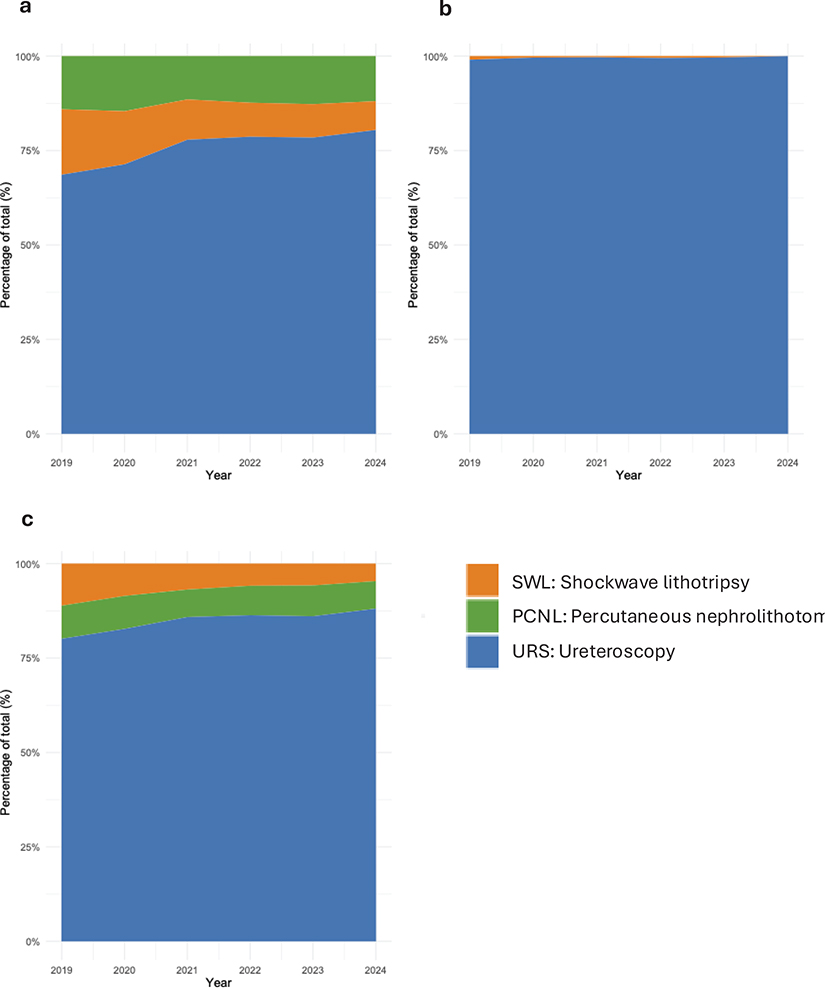
Figure 1. Panels show the proportion of each procedure type as a percentage of total cases from 2019 to 2024: (a) kidney stones only, (b) ureteral stones only and (c) renal and ureteral stones combined.
Ureteral stones
In 2019, URS accounted for 99% (n = 1,538) of all procedures for ureteral stones, with SWL accounting for only 1% (n = 15). The number of URS procedures increased by +4.4% per year (p < 0.001), and by 2024, URS accounted for 100% of all procedures for ureteral stones. SWL decreased by 13.6% per year (p < 0.001). By 2024 and for the first time, there were zero SWL procedures recorded nationally.
By 2024, URS accounted for 88% (n = 4,206) of all procedures for urolithiasis (ureteral and renal stones combined).
Discussion
The findings of this study highlight the substantial and growing burden that urolithiasis places on healthcare resources, affecting both outpatient services and inpatient care. While previous studies have suggested a narrowing gender gap in urolithiasis incidence, our data indicate a subtle widening of this disparity in Norway [12, 13]. Another notable shift is the increasing proportion of older adults requiring healthcare services for urolithiasis, likely reflecting demographic shifts within Norway’s population. Between 2012 and 2023, the proportions of individuals aged 67–79, 80–90 and ≥ 90 years increased by 38%, 18% and 7.9%, respectively [14]. Although day-surgery procedures have increased significantly, the projected figure for 2030 appears unrealistic, as demand is not expected to reach this level, and the necessary infrastructure is not currently in place. The expansion of day-surgery pathways, along with the implementation of renal colic management pathways aimed at avoiding unnecessary overnight admissions, has likely contributed to the patterns observed in this study [15–17]. Furthermore, advances in medical care have facilitated the use of surgical intervention in older patients with multiple comorbidities, whereas previously such cases may have been managed conservatively [18, 19].
The predominance of URS has been recorded in many countries [20, 21]. Monga et al. recorded that this modality accounted for two-thirds of all stone treatments in the United States [22]. Ordon et al. reported the rate to be 73.5% for URS in Canada [23]. To our knowledge, the proportion of URS observed in Norway is, among the highest reported internationally and represents the first national-level report of zero SWL procedures performed for ureteric stones during a calendar year. In a country with a relatively small population dispersed over a large geographical area, patients may opt, together with their local urologist, to undergo multiple URS sessions at their nearest hospital rather than travel long distances for a single-session PCNL. The learning curve for URS is considerably shorter than for PCNL, and urologists in smaller centres may feel more confident performing URS within their routine practice [24]. Furthermore, advances in energy sources and suction devices have expanded the feasibility of URS, enabling its use for larger stone burdens than was previously considered feasible [25–28].
Although novel technologies such as burst wave lithotripsy have the potential to advance SWL, their use remains limited to only a small number of centres worldwide [29]. SWL continues to feature prominently in the EAU Guidelines, but successful implementation requires a centre to have both the necessary infrastructure and personnel with sufficient experience [30]. The considerable upfront investment required for a fixed lithotripter can be a barrier. In such cases, a mobile or visiting SWL service can represent a viable alternative [31, 32]. However, in countries with challenging geography, such as Norway, smaller and more remote hospitals may therefore choose to invest in URS and newer laser systems, rather than maintain or establish a SWL service.
Changes in diagnostic pathways across Nordic countries may partly explain the rise in stone surgeries observed in our study. A prospective study in Norway by Galtung et al. determined that a single nephrographic-phase CT is sufficient to detect urinary stones in patients with visible haematuria [33]. In Sweden, Utter et al. found that acute CT for patients with flank pain reduced the time to surgery and ultimately, stone-free status. However, this trend may have also increased the number of interventions for stones likely to have passed spontaneously [34]. Together, these shifts may suggest that increased CT imaging may be contributing to the growing treatment burden we observed.
Limitations and strengths
There are several limitations to this study. First, data were anonymised at the source and not linked to individual patients, preventing identification of repeat treatments as well as accurate estimation of cumulative lifetime incidence. Second, a separate category for emergency hospital admissions was unavailable. Although a strength of the study is that stone events were based on formal clinical coding rather than patient self-reporting such as the National Health and Nutrition Examination Survey (NHANES), diagnostic coding of urolithiasis itself is not without limitation because it reflects clinical judgement and may not always be supported by CT or other imaging confirmation [35]. Moreover, the national data sources used have not been formally validated for urolithiasis.
Notwithstanding this, our study findings are sourced from a nationwide and public health service in which private stone surgery is not available, and all procedures are performed as part of a universal healthcare model. Consequently, unlike in other healthcare systems, an individual’s level of medical insurance does not influence the treatment options offered [36]. By contrast, data from other countries are often extrapolated from insurance claims databases that do not have nationwide coverage [37, 38].
Conclusion
Urolithiasis places an increasing burden on the Norwegian healthcare system, with rising numbers of hospital encounters, particularly among older adults. Surgical management continues to be dominated by URS, which accounted for nine out of 10 urolithiasis procedures by 2024.
Disclosure statement
MSÆ and ØU have previously acted as educational consultants for Olympus. PJJ has received funding from the Norwegian Institute of Urology. There are no other potential conflicts to declare.
Use of AI
In accordance with the journal’s policy and in the interest of transparency, ChatGPT 4-0 was employed during the preparation of this manuscript, primarily to enhance language and readability. The authors independently verified the accuracy and validity of all content.
References
- [1] Lombardo R, Tzelves L, Geraghty R, et al. Follow-up of urolithiasis patients after treatment: an algorithm from the EAU urolithiasis panel. World J Urol. 2024;42(1):202. https://doi.org/10.1007/s00345-024-04872-y
- [2] Borumandnia N, Fattahi P, Talebi A, et al. Longitudinal trend of urolithiasis incidence rates among world countries during past decades. BMC Urol. 2023;23(1):166. https://doi.org/10.1186/s12894-023-01336-0
- [3] Li S, Huang X, Liu J, et al. Trends in the incidence and DALYs of urolithiasis from 1990 to 2019: results from the global burden of disease study 2019. Front Public Health. 2022;10:825541. https://doi.org/10.3389/fpubh.2022.825541
- [4] Jones P, Karim Sulaiman S, Gamage KN, Tokas T, Jamnadass E, Somani BK. Do lifestyle factors including smoking, alcohol, and exercise impact your risk of developing kidney stone disease? Outcomes of a systematic review. J Endourol. 2021;35(1):1–7. https://doi.org/10.1089/end.2020.0378
- [5] Heers H, Stay D, Wiesmann T, Hofmann R. Urolithiasis in Germany: trends from the National DRG Database. Urol Int. 2022;106(6):589–595. https://doi.org/10.1159/000520372
- [6] Cabo J, Gelikman DG, Hsi RS. The financial burden of nephrolithiasis and predictors of disease-specific financial toxicity. Urology. 2023;171:57–63. https://doi.org/10.1016/j.urology.2022.08.053
- [7] Pietropaolo A, Keller EX, Sener TE, et al. Economic burden of imaging and interventions in endourology: a worldwide cost analysis from European Association of Urology Young Academic Urology Endourology and Urolithiasis Working Party. J Endourol. 2025;39(4):389–398. https://doi.org/10.1089/end.2024.0673
- [8] Wymer KM, Boddu SP, Choudry M, et al. Access to care and health care utilization among patients with nephrolithiasis. Urology. 2024;187:8–14.
- [9] Geraghty RM, Cook P, Walker V, Somani BK. Evaluation of the economic burden of kidney stone disease in the UK: a retrospective cohort study with a mean follow-up of 19 years. BJU Int. 2020;125(4):586–594. https://doi.org/10.1111/bju.14991
- [10] Canvasser NE, Alken P, Lipkin M, et al. The economics of stone disease. World J Urol. 2017;35(9):1321–1329. https://doi.org/10.1007/s00345-017-2003-y
- [11] Norway S. Population statistics 2024. Available from: www.ssb.no/befolkning [1.8.2025]
- [12] Gillams K, Juliebo-Jones P, Juliebo SO, Somani BK. Gender differences in Kidney Stone Disease (KSD): findings from a systematic review. Curr Urol Rep. 2021;22(10):50. https://doi.org/10.1007/s11934-021-01066-6
- [13] Abufaraj M, Xu T, Cao C, et al. Prevalence and trends in kidney stone among adults in the USA: analyses of national health and nutrition examination survey 2007–2018 data. Eur Urol Focus. 2021;7(6): 1468–1475. https://doi.org/10.1016/j.euf.2020.08.011
- [14] Juliebø-Jones P, Roth I, Moen CA, Gjengstø P, Beisland C. National trends in medication prescriptions for male lower urinary tract symptoms and erectile dysfunction: findings from the Norwegian Prescription Database. Eur Urol Open Sci. 2025;75:89–93. https://doi.org/10.1016/j.euros.2025.03.013
- [15] Chen T, Fuertes R, Sáez O, et al. Efficacy of a fast-track pathway for managing uncomplicated renal or ureteral colic in a hospital emergency department: the STONE randomized clinical trial of Sonography and Testing of a Nephrolithiasis Episode. Emergencias. 2021;33:23–28.
- [16] Raskolnikov D, Hall MK, Ngo SD, et al. Strategies to optimize nephrolithiasis emergency care (STONE): prospective evaluation of an emergency department clinical pathway. Urology. 2022;160:60–68. https://doi.org/10.1016/j.urology.2021.09.028
- [17] Mitroi GF, Drăgoescu PO, Mitroi MR, et al. Clinical outcomes and safety assessment of flexible ureteroscopy as an outpatient procedure: a retrospective single-center study. Life. 2024;14(9):1131.
- [18] Juliebø-Jones P, Moen CA, Haugland JN, Gjengstø P, Æsøy MS, Beisland C, Ulvik Ø. Ureteroscopy for Stone Disease in Extremely Elderly Patients (≥85 Years): Outcomes and Lessons Learned. J Endourol. 2023 Mar;37(3):245-250. https://doi.org/10.1089/end.2022.0665. Epub 2022 Dec 29. PMID: 36458461.
- [19] Tzelves L, Geraghty RM, Hughes T, Juliebø-Jones P, Somani BK. Innovations in Kidney Stone Removal. Res Rep Urol. 2023 Apr 11;15:131-139. https://doi.org/10.2147/RRU.S386844. PMID: 37069942; PMCID: PMC10105588.
- [20] Arora B, Chung E. A 15-year longitudinal analysis of the trends in the surgical management of renal and ureteric stones in Australia. J Clin Urolo. 2025;18(2):96–101. https://doi.org/10.1177/20514158221135683
- [21] Serrell E, Antar AS, Buinevicius E, et al. Surgical stone trends from 2013 to 2021 in the US medicare population: before and after the COVID-19 pandemic. J Endourol. 2024;38(9):902–907. https://doi.org/10.1089/end.2024.0063
- [22] Monga M, Murphy M, Paranjpe R, Cutone B, Eisner B. Prevalence of stone disease and procedure trends in the United States. Urology. 2023;176:63–68.
- [23] Ordon M, Lantz Powers A, Chew BH, et al. Incidence and trends in the treatment of kidney stones in Canada A population-based cohort study. Can Urol Assoc J. 2024;18(6):158–164. https://doi.org/10.5489/cuaj.8596
- [24] Silva THCd, Passerotti CC, Pontes J, Maximiano LF, Otoch JP, Cruz JASd. The learning curve for retrograde intrarenal surgery: a prospective analysis. Revista do Colégio Brasileiro de Cirurgiões. 2022;49:e20223264.
- [25] Corsini C, Robesti D, Villa L, Montorsi F, Pietropaolo A, Panthier F, Sierra A, Juliebø-Jones P, Kwok JL, Tsaturyan A, Contreras P, Fossati N, Gallina A, Xavier Keller E, Knoll T, Kartalas Goumas I, Somani BK, Traxer O, Salonia A, Ventimiglia E. Is Pulse Modulation the Future of Laser Technology in Endourology: Evidence from a Literature Review - Section of EAU Endourology. Eur Urol Focus. 2025 Mar;11(2):347-355. https://doi.org/10.1016/j.euf.2024.10.009. Epub 2024 Nov 13. PMID: 39542788.
- [26] Juliebø-Jones P, Keller EX, Haugland JN, et al. Advances in ureteroscopy: new technologies and current innovations in the era of Tailored Endourological Stone Treatment (TEST). Journal of Clinical Urology, 2023, 16.3: 190-198.
- [27] Gul T, Laymon M, Alrayashi M, Abdelkareem M, Salah M. Successful treatment of staghorn stones with flexible ureteroscopy and thulium fiber laser (TFL) lithotripsy: initial experience with 32 cases. Urolithiasis. 2024;52(1):102. https://doi.org/10.1007/s00240-024-01598-9
- [28] Tzelves L, Geraghty R, Juliebo-Jones P, et al. Suction use in ureterorenoscopy: a systematic review and meta-analysis of comparative studies. BJUI Compass. 2024;5(10):895–912.
- [29] Yuen SKK, Gauhar V, Chai CA, et al. Burst wave lithotripsy – a paradigm shift: inferences from a scoping review. World J Urol. 2025;43(1):1–9. https://doi.org/10.1007/s00345-025-05645-x
- [30] Skolarikos ANA, Petřík A, Somani B, et al. EAU Guidelines. Edn. Presented at the EAU Annual Congress Amsterdam 2022. Arnhem, The Netherlands: EAU Guidelines Office; 2022. Available from: http://uroweborg/guidelines/compilations-of-all-guidelines/
- [31] Abdel-Fattah N, Khadhouri S, Johnston A, et al. Transitioning from a mobile to on-site extracorporeal shockwave lithotripsy service: is it worth it? J Clin Urol. 2023;18(5):20514158231222062. https://doi.org/10.1177/20514158231222062
- [32] Tabei SS, Yaghoubian A, Scotland KB. Shockwave Lithotripsy for Urolithiasis: Is It Still Alive? Urol Clin North Am. 2025 Aug;52(3):407-418. https://doi.org/10.1016/j.ucl.2025.04.006. Epub 2025 May 17. PMID: 40610086.
- [33] Galtung KF, Lauritzen PM, Sandbaek G, Bay D, Baco E, Rud E. Urinary stone assessment in a single-phase may replace the unenhanced and multiphase computed tomography protocol in painless visible haematuria. Scand J Urol. 2024;59:147–155. https://doi.org/10.2340/sju.v59.40679
- [34] Utter M, Altmark F, Popiolek M, et al. Impact of emergency computed tomography on treatment and time to treatment for renal colic. Scand J Urol. 2025;60:29–35. https://doi.org/10.2340/sju.v60.42593
- [35] Alibrahim H, Swed S, Sawaf B, et al. Kidney stone prevalence among US population: updated estimation from NHANES data set. JU Open Plus. 2024;2(11):e00115. https://doi.org/10.1097/JU9.0000000000000217
- [36] Bayne D, Hicks CR, Srirangapatanam S, et al. Underinsurance and multiple surgical treatments for kidney stones. Urology. 2023;172:61–68. https://doi.org/10.1016/j.urology.2022.09.004
- [37] van Oosten MJM, Logtenberg SJJ, Edens MA, et al. Health claims databases used for kidney research around the world. Clin Kidney J. 2021;14(1):84–97. https://doi.org/10.1093/ckj/sfaa076
- [38] Haas CR, Li S, Knoedler MA, Penniston KL, Nakada SY. Ureteroscopy and shock wave lithotripsy trends from 2012 to 2019 within the US Medicare dataset: sharp growth in ureteroscopy utilization. J Endourol. 2023;37(2):219–224. https://doi.org/10.1089/end.2022.0402