ORIGINAL RESEARCH ARTICLE
Validation of the Stockholm3 test for prostate cancer detection in a nationwide Finnish private primary care cohort
Henrikki Santtia,b  , Mika Matikainenb and Kristina Hotakainena,c
aMehiläinen Oy, Helsinki, Finland; bDepartment of Urology, University of Helsinki and Helsinki University Hospital, Helsinki, Finland; cDepartment of Clinical Chemistry and Haematology, University of Helsinki, Helsinki, Finland
ABSTRACT
Objective: The Stockholm3 test combines clinical variables and biomarkers to improve the diagnosis of clinically significant prostate cancer (csPCa). We aimed to validate and compare its performance to prostate-specific antigen (PSA)-based decision-making.
Material and methods: We conducted a prospective observational cohort study at a nationwide Finnish private primary care provider between July 2017 and February 2018. We included 1,379 men scheduled for PSA tests, excluding 74 men with missing PSA results or previously diagnosed prostate cancer. The clinical assessment was based on the PSA value and other clinical parameters, with clinicians unaware of the Stockholm3 result. We compared PSA-based decision-making with counterfactual Stockholm3 reflex testing.
Results: Among the 1,305 men, the median age was 58 (interquartile range [IQR]: 51–64). PSA was ≥3 ng/mL in 209/1,305 (16%) men and above the age-specific reference limit in 119/1,305 (9%) men. Among men with PSA ≥1.5 ng/mL, a Stockholm3 Risk Score ≥15% would have selected 44% fewer men for further diagnostic evaluation than PSA ≥3 ng/mL (117/469 vs. 209/469). Over 6 years of registry-based follow-up, men with a Stockholm3 Risk Score ≥15% despite PSA below the age-specific reference limit represented a clinically relevant subgroup with subsequent csPCa diagnoses. The main limitation of this study was its observational design.
Conclusions: The hypothetical clinical implementation of Stockholm3 reflex testing would have reduced referrals, helped standardise decision-making, and identified a different group of men for further diagnostic evaluation.
KEYWORDS: Biomarker; diagnostic test; prostate cancer; prostate cancer screening; prostate-specific antigen; Stockholm3
Citation: Scandinavian Journal of Urology 2026, VOL. 61, 195–201. https://doi.org/10.2340/sju.v61.46418.
Copyright: © 2026 The Author(s). Published by MJS Publishing on behalf of Acta Chirurgica Scandinavica. This is an Open Access article distributed under the terms of the Creative Commons Attribution 4.0 International License (http://creativecommons.org/licenses/by/4.0/), allowing third parties to copy and redistribute the material in any medium or format and to remix, transform, and build upon the material, with the condition of proper attribution to the original work.
Received: 30 November 2026; Accepted: 15 June 2026; Published: 20 July 2026
CONTACT: Henrikki Santti henrikki.santti@hus.fi Department of Urology, Helsinki University Hospital, P.O. box 900, 00029 HUS, Finland
Supplemental data for this article can be accessed online at https://doi.org/10.2340/sju.v61.46418
Competing interests and funding: The authors report no conflicts of interest. Mehiläinen Oy covered the logistical costs of Stockholm3 testing, and Karolinska Institutet covered the costs of the laboratory analyses.
Introduction
Prostate cancer accounted for approximately 14% of new cancer diagnoses among men globally in the year 2020 [1]. Finland is among the countries with the highest incidence and mortality rates for prostate cancer. According to the Cancer Registry of Finland, over 5,000 new cases were diagnosed, and 928 men died from prostate cancer in 2020 [2]. The health burden and costs for the healthcare system are substantial, with over 58,000 prevalent cases in the country [2].
The use of prostate-specific antigen (PSA) for early diagnosis of prostate cancer reduces the risk of metastatic disease and death from prostate cancer. However, it causes overdiagnosis and treatment-related complications, which may be reduced by active surveillance [3–5]. The Council of the European Union recommends evaluating organised screening programmes due to the preliminary evidence and widespread opportunistic screening [6, 7]. No organised screening programmes exist in Finland, but a randomised screening trial is being conducted in certain parts of the country [8].
As a screening tool at a test threshold of 4 ng/mL, the PSA test has a sensitivity of 72% and a specificity of 30–35% [9]. However, many countries have adopted a lower threshold (3 ng/mL, resulting in higher sensitivity but lower specificity [10, 11]. Therefore, there is a need for new blood- and urine-based tests that, when combined with clinical parameters, would provide more accurate risk stratification than PSA alone [12].
The Stockholm3 test combines clinical variables and previously identified biomarkers, including PSA, to provide a percentage risk of clinically significant prostate cancer (csPCa) defined as the International Society of Uropathology Grade Group 2 or higher [13]. The Stockholm3 test was first evaluated in the STHLM3 trial in 2012–2015. The study results showed that at the same sensitivity level as the PSA test, using a cut-off of ≥ 3 ng/mL to diagnose csPCa, the Stockholm3 test could reduce the number of biopsies by 32% and avoid 44% of benign biopsies. The STHLM3-MRI trial, conducted from 2018–2020, studied the Stockholm3 test in combination with magnetic resonance imaging (MRI) and targeted biopsies [14]. The study showed that, compared with PSA ≥ 3 ng/mL and systematic biopsies, the Stockholm3 test, combined with MRI and targeted biopsy, could have reduced the number of biopsies by 53% and the number of benign biopsies by 78%.
The FIN3 study aimed (1) to characterise PSA and Stockholm3 test result distribution in a Finnish primary care cohort, (2) to compare Stockholm3-based risk estimation with PSA-based clinical decision-making, and (3) to evaluate the long-term rates of MRI/biopsy referral and csPCa detection.
Patients and methods
This prospective, observational validation study was conducted at selected Mehiläinen’s healthcare facilities in Finland between July 2017 and February 2018. The Helsinki and Uusimaa Hospital District Coordinating Ethics Committee approved the study, and all patients provided informed consent. The ethical committee´s approval number is HUS/1777/2017.
Patient population
The study population comprised consecutive primary care patients referred by a general practitioner, occupational health doctor or urologist for a PSA test, typically due to urinary symptoms or early detection of prostate cancer. The patients provided 8 mL of blood in two ethylenediaminetetraacetic acid tubes. Their age was recorded, and the laboratory nurse recorded yes/no answers to questions on prostate cancer diagnosis, previous biopsy, family history (first-degree relatives), and use of 5-alpha-reductase inhibitors. The referral for MRI or biopsy and follow-up was decided by the clinician based on PSA value and other clinical parameters, and neither clinicians nor patients had access to the Stockholm3 result.
Laboratory tests
PSA was measured at the Mehiläinen Laboratory (Helsinki, Finland) using a Siemens ADVIA Centaur XPT analyser, with nationally used age-specific reference limits: <50 years, 2.5 ng/mL; 50–59 years, 3.5 ng/mL; 60–69 years, 4.5 ng/mL; and >70 years, 6.5 ng/mL [15]. Blood samples from men with PSA ≥1.5 ng/mL were analysed using the Stockholm3 test at A3P Lab in Uppsala, Sweden, and the Stockholm3 Risk Score was calculated as described by Grönberg et al. [13].
Statistical analysis
Baseline characteristics of the study population were summarised using descriptive statistics. Categorical variables are presented as frequencies and percentages (%), while continuous variables are reported as medians with interquartile ranges (IQR). For the follow-up analysis, we included all men with an initial PSA ≥1.5 ng/mL, because Stockholm3 testing was performed only above this reflex threshold. Clinical outcomes were retrieved from the National Patient Data Repository, which all healthcare providers are required to use, until December 2024. Survival analysis was performed using the Kaplan–Meier method to estimate time-to-event distributions. Follow-up started on the date of the initial PSA test and was censored at the first prostate MRI or biopsy, prostate cancer diagnosis, death from any cause, or 6 years after the initial PSA test, as applicable to the analysed outcome. The analysed outcomes were (1) the first occurrence of MRI or biopsy and (2) csPCa diagnosis. We used PSA ≥3 ng/mL, PSA above age-specific reference limit, and Stockholm3 Risk Score ≥15% for stratification of exposure. Cox proportional hazards regression analysis was used to calculate hazard ratios (HR) with 95% confidence intervals (CI). The Cox models were univariable and exploratory without covariates. Time from the initial PSA test to PCa diagnosis was compared using the Mann–Whitney U-test. All statistical analyses were performed using IBM SPSS version 29 (IBM Corporation, Armonk, NY, USA).
Results
Baseline characteristics
We recruited 1,379 men into the study (Figure 1). We excluded 48 men due to missing PSA test results and 26 men due to previously diagnosed prostate cancer. Table 1 shows the characteristics of the 1,305 eligible men. The median age was 58 (IQR: 51–64) years for all men, 62 (IQR: 57–67) years for men with PSA ≥1.5 ng/mL, 63 (IQR: 58–68) years for men with PSA ≥3.0 ng/mL, and 60 (IQR: 56–65) years for men with PSA above the age-specific reference range. Additionally, 950/1,305 (73%) men were aged 50–69, 110/1,305 (8.4%) were younger than 45, and 47/1,305 (3.6%) were older than 75. The median PSA was 1.08 ng/mL (IQR: 0.70–2.07), and 836/1,305 (64%) men had a PSA of <1.5 ng/mL. PSA values ranged from 2 to 9.9 ng/mL in 326/1,305 (25%) men. The relationship between PSA values and Stockholm3 Risk Scores is shown in Figure 2.
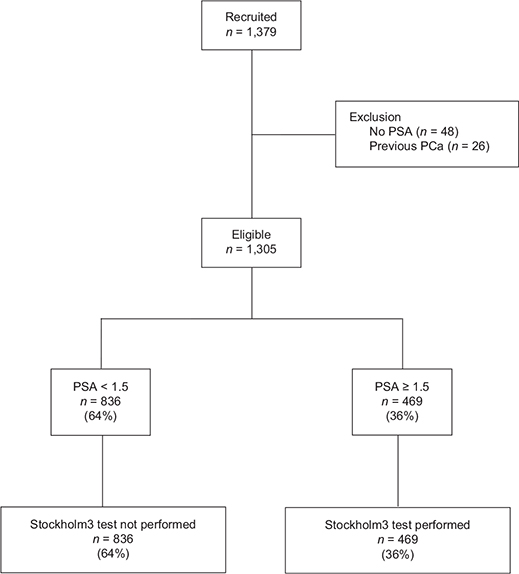
Figure 1. Flowchart of the included patients. PSA, prostate-specific antigen; PCa, prostate cancer.
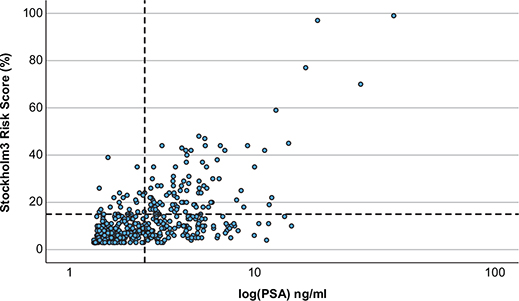
Figure 2. Scatter plot of prostate-specific antigen (PSA) (ng/mL; logarithmic x-axis) versus Stockholm3 Risk Score (%) among men with PSA ≥ 1.5 ng/mL (n = 469). Each point represents a participant. The vertical dashed line marks PSA = 3 ng/mL, and the horizontal dashed line marks Stockholm3 Risk Score = 15%. Stockholm3 Risk Score was measured only in men with PSA ≥ 1.5 ng/mL, as per the protocol.
Comparison of referral criteria
Among the 469 men with PSA ≥1.5 ng/mL, 209/469 (45%) had PSA ≥3 ng/mL, while 117/469 (25%) had a Stockholm3 Risk Score ≥15% (Figure 3A). Using a Stockholm3 Risk Score ≥15% as a threshold for further diagnostic evaluation would have selected 44% fewer men than PSA ≥3 ng/mL (117 vs. 209). PSA ≥3 ng/mL and Stockholm3 Risk Score ≥15% showed discordant results in 142/469 (30%) men.
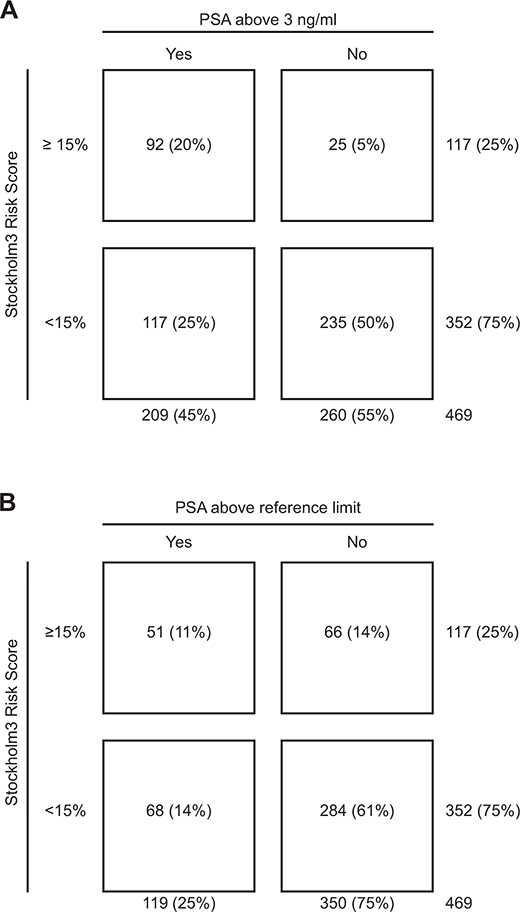
Figure 3. Distribution of men according to prostate-specific antigen (PSA) thresholds and Stockholm3 Risk Scores. Men are shown according to (A) PSA below or above the cut-off value of 3 ng/mL and (B) PSA below or above age-specific reference limits. Only men with PSA above 1.5 ng/mL are included, as the Stockholm3 test was not performed in men with PSA below 1.5 ng/mL.
Among the 469 men with PSA ≥1.5 ng/mL, 119/469 (25%) had PSA above the age-specific reference limit, and 117/469 (25%) had a Stockholm3 Risk Score ≥15% (Figure 3B). Using a Stockholm3 Risk Score ≥15% as a threshold for further diagnostic evaluation would have selected a similar number of men as PSA above the age-specific reference limit (117 vs. 119). Results were discordant in 134/469 (29%) men when comparing PSA above the age-specific reference limit with a Stockholm3 Risk Score ≥15%.
Out of 119 men with PSA above the age-specific reference limit, 25/119 (21%) men were referred for MRI or biopsy in routine clinical practice within 6 months after the PSA test (Supplementary Figure 1). In routine clinical practice, 9/68 (13%) men with a Stockholm3 Risk Score <15% and PSA above the reference limit were referred for MRI or biopsy. The MRI and biopsy results are shown in Supplementary Table 1. Furthermore, 35/51 (69%) men with a Stockholm3 Risk Score ≥15% and PSA above the reference limit were not referred for MRI or biopsy in routine clinical practice.
Long-term outcomes
Over the 6-year follow-up period following the initial PSA test, 119/469 (25%) men with an initial PSA ≥1.5 ng/mL were referred for MRI or biopsy. Cumulative incidences of referral for MRI or biopsy and csPCa diagnosis stratified according to initial PSA ≥3.0 ng/mL, initial PSA above the age-specific reference limit, and Stockholm3 Risk Score ≥15% are shown in Figure 4. In the comparison between men with Stockholm3 Risk Score ≥15% and initial PSA <3.0 ng/mL versus those with Stockholm3 Risk Score <15% and initial PSA ≥3.0 ng/mL, the former group showed numerically lower, although not statistically significant referral rates (5/25 vs. 43/117; HR: 0.48, 95% CI: 0.19–1.22) and higher csPCa risk (5/25 vs. 15/117; HR: 1.65, 95% CI: 0.60–4.53). When comparing men with Stockholm3 Risk Score ≥15% and initial PSA below the age-specific limit to those with Stockholm3 Risk Score <15% and initial PSA above the limit, the former group had a statistically significant 61% lower risk of referral (18/66 vs. 37/68; HR: 0.39, 95% CI: 0.22–0.69). However, despite fewer referrals, the risk of csPCa was similar (13/66 vs. 12/68; HR: 1.17, 95% CI: 0.53–2.56), and the median time from the initial PSA test to diagnosis did not differ significantly (3.2 vs. 4.1 years; P = 0.769) between the two groups. Supplementary Table 2 shows the numbers of prostate MRI examinations and biopsies performed during follow-up until prostate cancer diagnosis, death from any cause, or 6 years after the initial PSA test, together with median PSA values preceding the first MRI, first biopsy, and first MRI or biopsy.
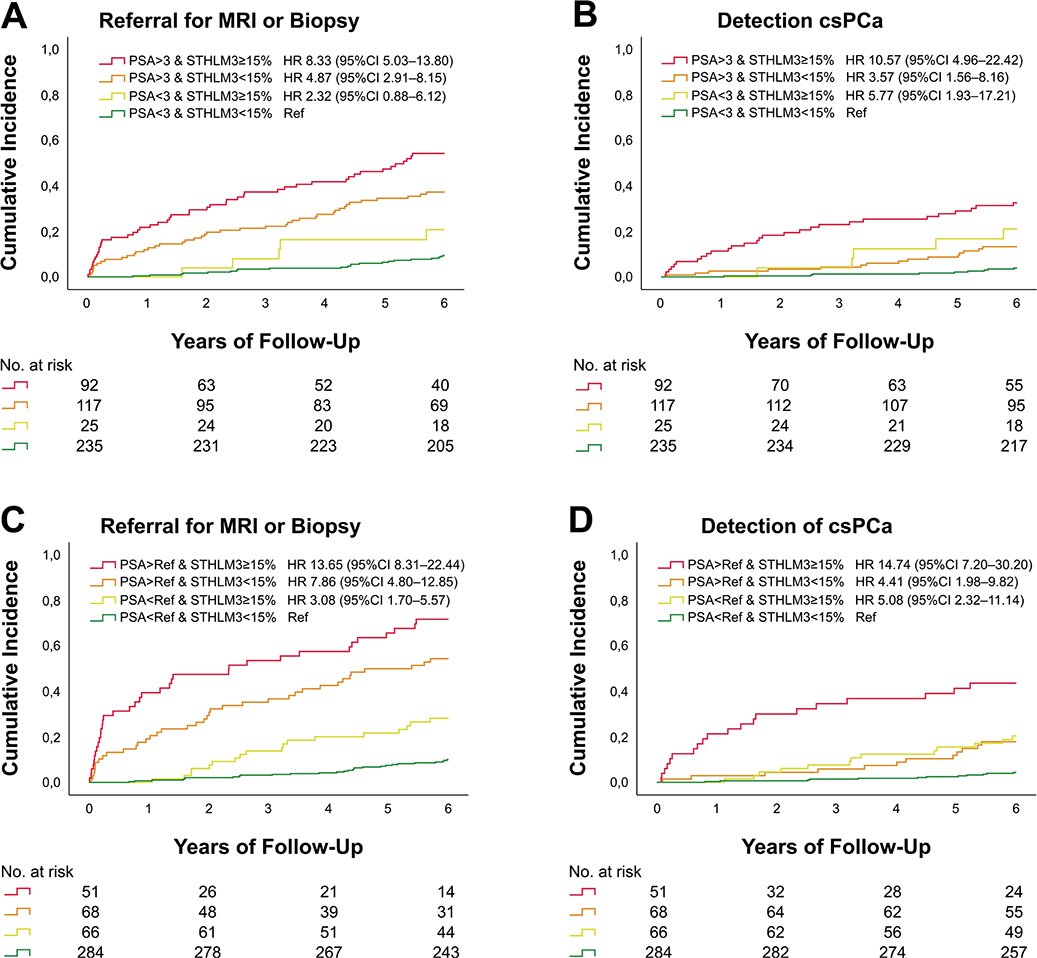
Figure 4. Referral for magnetic resonance imaging or biopsy or detection of clinically significant prostate cancer within six years after an initial prostate-specific antigen (PSA) of 1.5 ng/mL or higher. MRI indicates magnetic resonance imaging; csPCa, clinically significant prostate cancer; HR, hazard ratio; and STHLM3, Stockholm3 Risk Score.
Discussion
This observational study, based on a nationwide Finnish clinical cohort, suggests that, in a counterfactual comparison, the Stockholm3 test used as a reflex test would have selected fewer men for follow-up MRI or biopsy than a PSA cut-off of 3 ng/mL. Reducing the number of men referred for MRI or biopsy remains relevant because, although prebiopsy MRI and the transperineal biopsy approach can reduce biopsy-related infections, both procedures involve costs, cause patient discomfort, and require specialised expertise. Compared with age-specific PSA reference limits, the overall number of men selected for further evaluation was similar, but the selected men differed substantially. In a 6-year registry-based follow-up, men with a Stockholm3 Risk Score ≥15% despite PSA below the age-specific reference limit appeared to represent a clinically relevant subgroup. However, because clinical decisions were not guided by the Stockholm3 test, the effect of a Stockholm3-based pathway on csPCa detection cannot be determined directly. The ages of men in most previous studies using the Stockholm3 test ranged from 50 to 69 years [13, 16–17] or 50 to 74 years [14], depending on the study design. Our study population consisted of men who were consecutively scheduled for PSA testing at a nationwide private primary healthcare provider, resulting in a broader age range. The proportion of men in the core age group of 50 to 69 years was 73%, similar to findings from other studies with clinical cohorts [18].
PSA was above 3 ng/mL in 16% of the men in our study, which is lower than the 19–35% observed in previous studies based on clinical cohorts [17–19]. Similarly, the proportion of men with a Stockholm3 Risk Score ≥15% was lower at 10% compared with 14–19% in other clinical cohorts [18].
We estimated that a Stockholm3 Risk Score ≥15% would have selected 44% fewer men for further MRI or biopsy than PSA ≥3 ng/mL. The reduction in follow-up examinations in our study was comparable to the 26–44% decrease seen in other studies with clinical cohorts [17, 18] and the 35% decrease observed in studies involving screening cohorts [14], despite differences in the criteria used to perform the Stockholm3 test. The Stockholm3 test was developed in Sweden, a country with which Finland shares a long history. However, Finns are more genetically distinct from Swedes than Swedes are from many other nationalities [20]. As a result, our study provides further evidence of the test’s performance across genetically diverse European populations.
We observed that 56% of men with PSA ≥3 ng/mL could have avoided further examinations, although a small number of csPCa might be present in the group with PSA ≥3 ng/mL and Stockholm3 Risk Score <15%. The number of avoided MRIs or biopsies in men with PSA ≥3 ng/mL was similar to that found in a previous screening study [13] but higher than the 32–38% reduction observed in men referred for biopsy [21–23].
Age-specific reference limits were initially developed to improve the specificity of the PSA test in older men and increase its sensitivity in younger men [15]. Age-specific PSA reference limits are reported in Finland, and current Finnish prostate cancer guidelines recommend PSA values above the age-specific reference limit as a trigger for further investigation [24]. We observed that the Stockholm3 test would have led to a similar number of MRIs or biopsies compared with the age-specific reference limits. However, the men referred for further examination would have differed in 29% of cases. Only 43% of men with PSA levels above the age-specific reference limits would have undergone further diagnostic evaluation if the Stockholm3 test had been used. Furthermore, if PSA levels above the reference limits had been used, 56% of men with a Stockholm3 Risk Score ≥15% would not have been referred for MRI or biopsy. Men with a Stockholm3 Risk Score ≥15% and PSA below the reference limits were diagnosed with a comparable number of csPCa within 6 years following the initial PSA test, despite undergoing significantly fewer MRIs or biopsies than those with a Stockholm3 Risk Score <15% and PSA above the reference limit. This may reflect risk enrichment by the Stockholm3 test. However, we cannot rule out lead-time effects or delayed diagnosis, despite the time from initial PSA test to PCa diagnosis not being significantly different between the groups. After reviewing patient outcomes from the National Patient Data Repository, we found that only a small proportion of men with a PSA ≥3.0 ng/mL were referred for an MRI or biopsy within 6 months of the PSA test. In our study, clinicians were unaware of the Stockholm3 test results, which could have influenced their decision-making. According to patient records, most men with a Stockholm3 Risk Score ≥15% had not been referred for further diagnostic tests within 6 months. Similar findings were reported in a Swedish study, which showed that relying solely on the PSA test would have led to better patient selection for biopsy, and that incorporating the Stockholm3 test would further enhance decision-making [25]. They estimated that 40% of the improvement resulted from better clinical decisions and 60% from the new information provided by the Stockholm3 test.
Men were not referred for an MRI or biopsy for several reasons. Firstly, some men might have recently undergone an MRI or biopsy and may be reluctant to undergo further tests. Secondly, the clinician could be aware of other factors, such as prostate size and stable or declining PSA levels, which may influence their decision not to refer for additional examinations. Third, the clinician might rely on age-specific reference limits, although only a small number of men with PSA above these limits would actually be referred. Fourth, since our study was conducted in private healthcare, MRI or biopsy procedures may incur additional costs. However, the patient can still be referred to a public healthcare facility. Fifth, despite the PSA measurement, the clinician and patient may decide that further tests are not in the patient’s best interests due to poor health. Lastly, the clinician may find it challenging to integrate the available information to assess the risk of csPCa and to communicate this effectively to the patient.
Besides PSA alone or biomarker-based tests, risk calculators and PSA density have been evaluated for prostate cancer risk stratification [26, 27]. Although they provide convenient options, the effectiveness of risk calculators varies across study populations. Their performance also depends on the quality of referrals from primary care providers. Accurate measurement of PSA density requires transrectal ultrasound, which primary care providers may not readily have access to. Although we did not conduct a cost-effectiveness analysis, previous studies have shown that the Stockholm3 test as a reflex test after PSA may be a cost-effective alternative [28].
The main limitation of our study was its observational design. Decisions were made by clinicians based on PSA values and other clinical information, not on Stockholm3 test results. Clinicians’ adherence to the age-specific PSA thresholds recommended by national guidelines was low. Therefore, we can only estimate the effect of the Stockholm3 test results on decision-making. The observed reduction in MRI or biopsy procedures aligns with studies from other countries, suggesting similar results across populations. This study was conducted in private healthcare, where costs are covered by patients, employers, or voluntary insurance, potentially leading to a selective group of participants with higher socioeconomic status. In Finland, many working-age adults access primary care through private providers, whereas retired individuals more commonly use public primary care. Therefore, early detection may be a more common indication for the PSA test in private healthcare than in the public sector. Access to prostate MRI in the private sector may vary across the country and may not always be covered by occupational health contracts, and prostate biopsies are often performed in public sector hospitals. Thus, although the index PSA tests in our study were performed in a private primary care setting, further diagnostic evaluation was at least partly conducted in the public sector. The conclusions based on follow-up of up to 6 years are limited because the follow-up was not based on a standardised protocol. Subsequent PSA testing, MRI, biopsy, and referral decisions were made by treating clinicians as part of routine care. Also, the Stockholm3 test was rarely repeated. In contrast, the PSA test was usually performed before referral for MRI or biopsy. The repeat screening conducted after 2–3 years has been examined in a secondary analysis of the STHLM3-MRI trial [29]. Furthermore, the long-term clinical benefits of potential earlier diagnosis of csPCa through the Stockholm3 test remain uncertain.
In conclusion, we demonstrated that nationwide logistical implementation of the Stockholm3 test was feasible in a Finnish private primary care setting. However, because clinicians and patients did not receive the Stockholm3 results, the clinical implementation was hypothetical. In a counterfactual clinical pathway, Stockholm3 reflex testing would have identified a different group of men for further diagnostic evaluation than PSA-based thresholds and would have selected fewer men for MRI or biopsy than PSA ≥3 ng/mL. Therefore, the effect of a Stockholm3-guided pathway on csPCa detection cannot be determined directly from this observational study. The results also suggest that decision-making based on PSA is currently inconsistent. A significant proportion of men with an elevated PSA did not undergo further investigations, potentially leading to missed or delayed diagnoses of csPCa. Consequently, a structured test with clear guidance may help to standardise and improve decision-making.
Acknowledgements
The authors would like to thank Carin Cavalli-Björkman, Britt-Marie Hune, and Astrid Björklund at Karolinska Institutet for helping with the study’s logistics and data handling. We thank Juha Könönen at Mehiläinen Oy for his valuable comments on the manuscript.
References
[1] Sung H, Ferlay J, Siegel RL, et al. Global Cancer Statistics 2020: GLOBOCAN estimates of incidence and mortality worldwide for 36 cancers in 185 countries. CA Cancer J Clin. 2021;71:209–249. https://doi.org/10.3322/caac.21660
[2] Finnish Cancer Registry. Cancer in Finland 2020 [Internet]; 2022 [cited 2025 Nov 18]. Available from: https://cancerregistry.fi/
[3] Grossman DC, Curry SJ, Owens DK, et al; US Preventive Services Task Force. Screening for prostate cancer: US preventive services task force recommendation statement. JAMA. 2018;319:1901–1913. https://doi.org/10.1001/jama.2018.3710
[4] Loeb S, Bjurlin MA, Nicholson J, et al. Overdiagnosis and overtreatment of prostate cancer. Eur Urol. 2014;65:1046–1055. https://doi.org/10.1016/j.eururo.2013.12.062
[5] Kerro O, Kalalahti I, Lokman U, et al. Erectile and urinary function in patients on active surveillance for prostate cancer: results from the Finnish arm of the PRIAS trial. Scand J Urol. 2025;60:213–217. https://doi.org/10.2340/sju.v60.45022
[6] EUR-Lex. Official Journal of the European Union, Council Recommendation of 9 December 2022 on strengthening prevention through early detection: a new EU approach on cancer screening replacing Council Recommendation 2003/878/EC [Internet]. 2022 [cited 2025 Nov 18]. Available from: https://eur-lex.europa.eu/legal-content/EN/TXT/?uri=OJ:C:2022:473:TOC
[7] Enblad AP, Bergengren O, Andrén O, et al. PSA testing patterns in a large Swedish cohort before the implementation of organized PSA testing. Scand J Urol. 2020;54:376–381. https://doi.org/10.1080/21681805.2020.1797871
[8] Auvinen A, Tammela TLJ, Mirtti T, et al; ProScreen trial investigators. Prostate cancer screening with PSA, Kallikrein panel, and MRI: the ProScreen randomized trial. JAMA. 2024;331:1452–1459. https://doi.org/10.1001/jama.2024.3841
[9] Mistry K, Cable G. Meta-analysis of prostate-specific antigen and digital rectal examination as screening tests for prostate carcinoma. J Am Board Fam Pract. 2003;16:95–101. https://doi.org/10.3122/jabfm.16.2.95
[10] Sanghera S, Coast J, Martin RM, et al. Cost-effectiveness of prostate cancer screening: a systematic review of decision-analytical models. BMC Cancer. 2018;18:84. https://doi.org/10.1186/s12885-017-3974-1
[11] Bratt O, Butt ST, Carlsson C, et al. Swedish regional population-based organised prostate cancer testing: why, what and how? Scand J Urol. 2025;60:97–104. https://doi.org/10.2340/sju.v60.43809
[12] Brøchner Pedersen T, Hvid Poulsen M, Lund M, et al. Prospective validation study of a combined urine and plasma test for predicting high-grade prostate cancer in biopsy naïve men. Scand J Urol. 2025;60:8–13. https://doi.org/10.2340/sju.v60.42752
[13] Grönberg H, Adolfsson J, Aly M, et al. Prostate cancer screening in men aged 50–69 years (STHLM3): a prospective population-based diagnostic study. Lancet Oncol. 2015;16:1667–1676. https://doi.org/10.1016/S1470-2045(15)00361-7
[14] Nordström T, Discacciati A, Bergman M, et al; STHLM3 study group. Prostate cancer screening using a combination of risk-prediction, MRI, and targeted prostate biopsies (STHLM3-MRI): a prospective, population-based, randomised, open-label, non-inferiority trial. Lancet Oncol. 2021;22:1240–1249. https://doi.org/10.1016/S1470-2045(21)00348-X
[15] Oesterling JE, Jacobsen SJ, Chute CG, et al. Serum prostate-specific antigen in a community-based population of healthy men. Establishment of age-specific reference ranges. JAMA. 1993;270:860–864. https://doi.org/10.1001/jama.1993.03510070082041
[16] Waldén M, Aldrimer M, Lagerlöf JH, et al. A head-to-head comparison of prostate cancer diagnostic strategies using the Stockholm3 test, magnetic resonance imaging, and swedish national guidelines: results from a prospective population-based screening study. Eur Urol Open Sci. 2022;38:32–39. https://doi.org/10.1016/j.euros.2022.01.010
[17] Fredsøe J, Sandahl M, Vedsted P, et al; PRIMA Study Group. Results from the PRIMA Trial: comparison of the STHLM3 test and prostate-specific antigen in general practice for detection of prostate cancer in a biopsy-naïve population. Eur Urol Oncol. 2023;6:484–492. https://doi.org/10.1016/j.euo.2023.07.006
[18] Palsdottir T, Söderbäck H, Jäderling F, et al. The Capio prostate cancer center model for prostate cancer diagnostics-real-world evidence from 2018 to 2022. Eur Urol Open Sci. 2024;61:29–36. https://doi.org/10.1016/j.euros.2024.01.012
[19] Viste E, Vinje CA, Lid TG, et al. Effects of replacing PSA with Stockholm3 for diagnosis of clinically significant prostate cancer in a healthcare system – the Stavanger experience. Scand J Prim Health Care. 2020;38:315–322. https://doi.org/10.1080/02813432.2020.1802139
[20] Nelis M, Esko T, Mägi R, et al. Genetic structure of Europeans: a view from the North-East. PLoS One. 2009;4:e5472. https://doi.org/10.1371/journal.pone.0005472
[21] Elyan A, Saba K, Sigle A, et al. Prospective multicenter validation of the Stockholm3 test in a central European Cohort. Eur Urol Focus. 2024;10:620–626. https://doi.org/10.1016/j.euf.2023.09.016
[22] Vigneswaran HT, Eklund M, Discacciati A, et al; SEPTA STHLM3 Study Group. Stockholm3 in a multiethnic cohort for prostate cancer detection (SEPTA): a prospective multicentered trial. J Clin Oncol. 2024;42:3806–3816. https://doi.org/10.1200/JCO.24.00152
[23] Tilki D, Rejek N, Nohe F, et al. External validation of Stockholm3 in a retrospective german clinical cohort. Eur Urol Focus. 2025;11:82–87. https://doi.org/10.1016/j.euf.2024.07.009
[24] Käypä hoito. Prostate cancer. Current Care Guidelines [Internet]. Working group set up by the Finnish Medical Society Duodecim and the Finnish Urological Association. Helsinki: The Finnish Medical Society Duodecim; 2023 [cited 2025 Nov 18]. Available from: https://www.kaypahoito.fi/
[25] Eklund M, Nordström T, Aly M, et al. The Stockholm-3 (STHLM3) model can improve prostate cancer diagnostics in men aged 50-69 yr compared with current prostate cancer testing. Eur Urol Focus. 2018;4:707–710. https://doi.org/10.1016/j.euf.2016.10.009
[26] Soeterik TFW, Wu X, Van den Bergh RCN, et al; EAU-YAU Prostate Cancer Working Party. Personalised prostate cancer diagnosis: evaluating biomarker-based approaches to reduce unnecessary magnetic resonance imaging and biopsy procedures. Eur Urol Open Sci. 2025;75:106–119. https://doi.org/10.1016/j.euros.2025.03.006
[27] Bratt O, Lilja H. Modern prostate cancer diagnostics reduce overdiagnosis – will they open up for population-based screening? Scand J Urol. 2021;55:491–492. https://doi.org/10.1080/21681805.2021.1980608
[28] McLeod OD, Palsdottir T, Walz J, et al. Cost analysis of prostate cancer care using a biomarker-enhanced diagnostic strategy with Stockholm3. Eur Urol Open Sci. 2024;66:26–32. https://doi.org/10.1016/j.euros.2024.05.010
[29] Discacciati A, Abbadi A, Clements MS, et al. Repeat prostate cancer screening using blood-based risk prediction or prostate-specific antigen in the era of magnetic resonance imaging-guided biopsies: a secondary analysis of the STHLM3-MRI randomized clinical trial. Eur Urol Oncol. 2025;8:1466–1473.