ORIGINAL RESEARCH ARTICLE
Nationwide trends in urolithiasis and stone procedures in Iceland
Bragi Aðalsteinssona  , Edward Rumbaa and Jóhann Páll Ingimarssona,b
aFaculty of Medicine, School of Health Sciences, University of Iceland, Reykjavík, Iceland; bDepartment of Urology, Landspítali University Hospital, Reykjavík, Iceland
ABSTRACT
Objective: This study aimed to assess nationwide trends in registered upper urinary tract stone disease and stone-related procedures in Iceland.
Material and methods: We performed a nationwide retrospective population-based study of adults aged 18 years or older with International Classification of Diseases, 10th revision codes N20, N22 or N23 in national hospital and specialist-care data from 2010 to 2024. Crude and age-standardised incidence rates were calculated per 100,000 adults. Stone-related procedures from 2013 to 2024 were identified using Nordic Classification of Surgical Procedures codes. Temporal trends were analysed using negative binomial regression with population offsets.
Results: The cohort included 9,492 adults. Registered incidence ranged from 221 to 260 per 100,000 adults and remained stable (95% confidence interval −0.6% to 0.6%; p = 0.914); age standardisation and alternative case definitions gave the same conclusion. Among patients first registered from 2013 onward, 2,432/7,766 (31%) underwent a stone-related procedure. The procedure rate increased from 124.3 to 236.5 per 100,000 adults, corresponding to a 6% annual increase. Ureteroscopy accounted for 10% of procedure registrations in 2013–2016 and 30% in 2021–2024, while shock wave lithotripsy remained the most common procedure.
Conclusions: Registered upper urinary tract stone incidence remained stable, but treatment activity increased substantially. Ureteroscopy use rose rapidly, although shock wave lithotripsy remained the predominant procedure.
KEYWORDS: Urolithiasis; upper urinary tract stones; incidence; stone procedures; ureteroscopy; shock wave lithotripsy
Citation: Scandinavian Journal of Urology 2026, VOL. 61, 210–215. https://doi.org/10.2340/sju.v61.46753.
Copyright: © 2026 The Author(s). Published by MJS Publishing on behalf of Acta Chirurgica Scandinavica. This is an Open Access article distributed under the terms of the Creative Commons Attribution 4.0 International License (http://creativecommons.org/licenses/by/4.0/), allowing third parties to copy and redistribute the material in any medium or format and to remix, transform, and build upon the material, with the condition of proper attribution to the original work.
Received: 13 May 2026; Accepted: 11 August 2026; Published: 31 August 2026
CONTACT: Bragi Aðalsteinsson bragi.adalsteinsson@gmail.com Faculty of Medicine, University of Iceland, Vatnsmýrarvegur 16, 101 Reykjavík, Iceland
Competing interests and funding: The authors report no conflicts of interest.
This study received no specific funding.
Introduction
Urolithiasis is a common urological condition and a frequent cause of acute healthcare use, imaging and surgical intervention [1]. Recurrence is common after a first symptomatic stone episode [2], and repeated investigations, lost productivity and procedure-related costs create considerable demand on healthcare systems and a substantial burden for patients [3, 4].
The epidemiology of urolithiasis has changed over recent decades, but the direction and magnitude of change vary between populations. Global Burden of Disease data from 204 countries and territories showed marked geographical variation from 2000 to 2021, with increasing absolute burden in several regions despite non-uniform changes in incidence [5]. This distinction is clinically important: even when population rates are stable, population growth and demographic change may increase the number of patients requiring acute care and urological treatment [6].
Surgical management has also evolved. Shock wave lithotripsy (SWL), ureteroscopy (URS) and percutaneous nephrolithotomy (PCNL) remain the principal procedural modalities, but contemporary guidelines emphasise individualised treatment based on stone size, location, anatomy, patient factors and local expertise [7, 8]. Population-based studies from Germany, the United States and Canada have reported increasing use of URS and changes in the relative use of SWL [9–11].
Recent Nordic data highlight the same trend. A Norwegian nationwide study published in Scandinavian Journal of Urology reported increasing hospital encounters, outpatient consultations and surgical treatment for urolithiasis, with URS accounting for most procedures by 2024 [12]. However, Scandinavian healthcare systems differ in geography, access to imaging, surgical capacity and treatment traditions, and national data from smaller complete-population settings remain limited.
In Iceland, a previous population-based study reported an increase in the overall incidence of kidney stone disease from 1985 to 2008, but the increase was mainly driven by greater detection of asymptomatic stones [13]. No nationwide study has assessed the subsequent period or examined registered incidence and stone-related procedures together. The aim of this study was therefore to evaluate nationwide trends in registered upper urinary tract stone disease and stone-related procedures in Iceland from 2010 to 2024.
Material and methods
Study design and population
This was a nationwide retrospective population-based study of adults aged 18 years or older in Iceland from 1 January 2010 to 31 December 2024. The study included individuals with registered diagnoses consistent with upper urinary tract stone disease or renal colic in national hospital and specialist-care data. Procedure analyses were restricted to 2013–2024 because procedure registration for 2010–2012 was considered incomplete.
The study was approved by the National Bioethics Committee of Iceland (VSN2512037), the Landspítali University Hospital Science Committee and the Icelandic Directorate of Health. One designated team member responsible for data handling had access to direct identifiers to pseudonymise the dataset; all subsequent data management and analyses used the pseudonymised dataset.
Healthcare setting
Stone procedures were performed at Landspítali University Hospital in Reykjavík (97%) and Akureyri Hospital (3%). Urology clinics were available in Reykjavík, Akranes, Akureyri, Neskaupstaður and Selfoss; computed tomography (CT) was available in those locations and in Keflavík, Ísafjörður and Vestmannaeyjar. Local specialist access varied, but 93% and 99% of the population live within 1 and 3 h driving time of a CT scanner, respectively.
Data sources
Data were obtained from the Icelandic Directorate of Health hospital discharge registry, a national registry containing information on hospital admissions and hospital outpatient encounters, including diagnoses and surgical procedures [14]. The registry has nationwide inpatient coverage from 1999 and hospital outpatient coverage from 2010 [15]. Urolithiasis-specific code validity has not been established, although an Icelandic validation study found high accuracy for diagnoses of several chronic diseases [16]. Population denominators by calendar year, age and sex were obtained from Statistics Iceland [17].
Case definition
Patients were identified using International Classification of Diseases, 10th revision (ICD-10) codes N20, N22 and N23, representing kidney and ureteric stones, urinary stones in diseases classified elsewhere and unspecified renal colic, respectively [18]. Code N21 was excluded because lower urinary tract stones differ in aetiology and treatment, and bladder-stone procedures were not included in the procedural outcomes. Patients with N21 without a qualifying N20, N22 or N23 record were examined descriptively as a separate lower urinary tract stone cohort. Because the included codes identify registered stone disease or renal colic rather than imaging-confirmed stones in every case, the primary outcome is described as registered upper urinary tract stone disease.
Records within 90 days of each other were grouped as one registered episode to reduce double counting of repeat visits, imaging or short-term follow-up related to the same clinical event [12]. Registered incidence used each individual’s first qualifying record during the study period; this may not represent the patient’s first lifetime stone event because records before 2010 were not included. Patients with more than one episode were classified as having repeated registered episodes. Sensitivity analyses used 30- and 180-day episode windows, excluded unspecified renal colic (N23), and restricted the definition to kidney and ureteric stones (N20) alone.
Procedure definition
Stone-related procedures were identified using Nordic Classification of Surgical Procedures (NCSP) codes for SWL, URS and PCNL ([19]. Annual counts and rates included every procedure registration.
To estimate distinct treatment episodes, registrations for the same procedure type within 6 months were grouped. Three- and 12-month windows were examined in sensitivity analyses. The annual proportion treated was defined as the proportion undergoing a procedure within 1 year of the first registered episode among patients first registered in 2013–2023. SWL retreatment was defined as at least two SWL sessions within 6 months. The interval from the first registered episode to the first stone-related procedure was also calculated.
Variables
Variables included age at first registered episode, sex, calendar year, residence by healthcare region, episode dates, diagnosis codes and procedure type. Age was categorised as 18–29, 30–39, 40–49, 50–59, 60–69 and 70 years or older. Residence was grouped into Icelandic healthcare regions.
Statistical analysis
Crude annual incidence and procedure rates were calculated per 100,000 adults aged 18 years or older. Descriptive statistics are presented as counts and percentages, means with standard deviations (SDs), or medians with interquartile ranges (IQRs), as appropriate. Incidence was directly standardised to the 2013 European Standard Population using six age groups; ages 18–19 contributed two-fifths of the 15–19-year standard band. Confidence intervals (CI) for age-standardised rates were calculated using the Dobson method [20].
Negative binomial regression was used to assess temporal trends because the annual counts were overdispersed. Calendar year was modelled as a continuous variable and the logarithm of the relevant population was used as an offset. Logistic regression was used for the proportion treated within 1 year and SWL retreatment. Results are reported as incidence rate ratios (IRRs) or odds ratios (ORs) with 95% CIs, with annual percentage changes used in the text for readability. A two-sided p-value below 0.05 was considered statistically significant. Analyses were performed using R version 4.5.2 and RStudio version 2026.01.2 [21, 22].
Results
Study population
A total of 9,492 adults had a first qualifying registered episode during 2010–2024. Of these, 5,820 were men (61%), 3,666 were women (39%) and sex was unknown for six patients (<1%). The male-to-female ratio was 1.59. Median age at the first registered episode was 46 years (IQR: 33–60), and mean age was 47.5 years (SD: 17.2). Men were older than women at the first registered episode, with mean ages of 49.5 and 44.4 years, respectively.
Most patients resided in the capital region (n = 5,972, 63%), followed by North Iceland (n = 974, 10%) and South Iceland (n = 698, 7%). The largest age group was 30–39 years (n = 1,919, 20%) (Table 1). At the first qualifying record, 97% had code N20, 3% had N23 and fewer than 1% had N22.
Separately, 781 patients had lower urinary tract stones (N21) without a qualifying upper urinary tract stone code. This group was predominantly male, with a male-to-female ratio of approximately 5:1, and 41% were aged 70 years or older. Its distinct demographic profile supported exclusion from the primary upper-tract cohort.
Incidence trends
Annual registered incidence ranged from 221 to 260 per 100,000 adults. Incidence was 230 per 100,000 in 2010 and 256 per 100,000 in 2024. Despite year-to-year variation, there was no significant upward or downward trend (annual change 0.03%, 95% CI: −0.56 to 0.63; p = 0.914) (Figure 1).
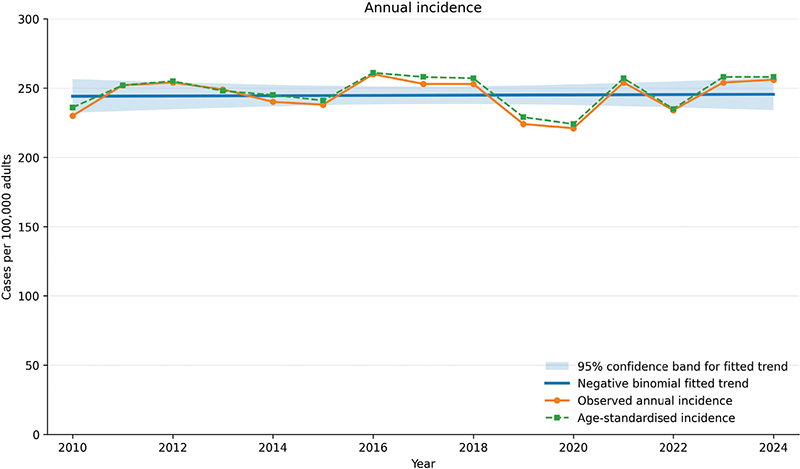
Figure 1. Registered upper urinary tract stone incidence in Iceland, 2010–2024. Circles show the observed annual incidence per 100,000 adults and squares the age-standardised incidence. The solid line shows the negative binomial fitted annual trend and the shaded band the 95% confidence interval for the annual trend. Observed annual incidence ranged from 221 to 260 per 100,000 adults, and the model showed no temporal change (annual change 0.03%, 95% confidence interval −0.56 to 0.63; p = 0.914).
Age-standardised incidence was 236 per 100,000 (95% CI: 216–257) in 2010 and 258 per 100,000 (95% CI: 240–278) in 2024, with no temporal trend (p = 0.977). The conclusion was unchanged after excluding unspecified renal colic (N23; p = 0.833) or restricting the cohort to kidney and ureteric stones (N20; p = 0.800). Incidence also remained stable in men (276 to 294 per 100,000; p = 0.96) and women (184 to 217 per 100,000; p = 0.98).
Repeated registered episodes
Using the primary 90-day definition, 27% of patients had two or more registered episodes during the study period. The corresponding proportions were 36% with a 30-day window and 23% with a 180-day window. These figures describe repeated episodes recorded during available follow-up and should not be interpreted as lifetime clinical recurrence.
Procedure trends
Procedure analyses included 7,766 patients first registered from 2013 onward. Of these, 2,432 (31%) underwent at least one stone-related procedure. A total of 5,626 procedure registrations were identified during 2013–2024.
The proportion treated within 1 year increased from 21% among patients first registered in 2013 to 32% among those first registered in 2023 (OR: 1.06 per year, 95% CI: 1.04–1.08; p < 0.001).
Annual procedure registrations increased from 294 in 2013 to 707 in 2024. The crude procedure rate increased from 124.3 to 236.5 per 100,000 adults, corresponding to a 6% annual increase (IRR: 1.06, 95% CI: 1.05–1.08; p < 0.001) (Table 2; Figure 2A).
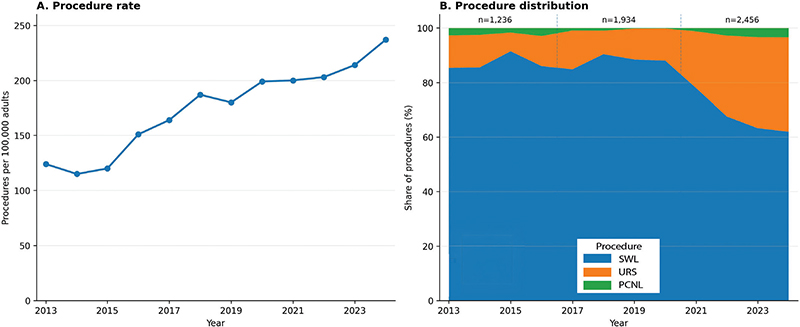
Figure 2. Stone-related treatment activity in Iceland, 2013–2024. (A) Annual crude procedure rate per 100,000 adults. (B) Annual distribution of procedure registrations by procedure type. Total registrations were 1,236 in 2013–2016, 1,934 in 2017–2020 and 2,456 in 2021–2024. SWL, shock wave lithotripsy; URS, ureteroscopy; PCNL, percutaneous nephrolithotomy.
The distribution of procedures changed substantially (Figure 2B). In 2013–2016, SWL accounted for 87% of registrations, URS for 10% and PCNL for 3%. In 2021–2024, the corresponding proportions were 67%, 30% and 3%. URS increased by 20% per year (IRR 1.20, 95% CI: 1.15–1.26; p < 0.001), compared with 3% for SWL (IRR: 1.03, 95% CI: 1.01–1.06; p = 0.004). PCNL did not show a significant temporal trend (IRR: 1.09, 95% CI: 0.97–1.22; p = 0.149).
Grouping same-modality registrations within 6 months yielded 3,913 treatment episodes. The increase in URS remained evident, rising from 14% of treatment episodes in 2013–2016 to 37% in 2021–2024; findings were similar with 3- and 12-month windows. Across 2,815 SWL episodes, the mean number of sessions was 1.57. The proportion receiving repeat SWL was 36% at the beginning and end of the study period and showed no temporal change (OR: 1.00, 95% CI: 0.98–1.03; p = 0.915).
Among 2,192 patients undergoing a procedure, the median interval from the first registered episode to the first procedure was 16 days (IQR: 0–41). One third (34%) were treated on the same day, and 12% had an interval longer than 90 days. Median intervals were 15 days for SWL, 24 days for URS and 82 days for PCNL; the corresponding proportions longer than 90 days were 10%, 18% and 48% (Table 2).
Discussion
In this nationwide population-based study, registered incidence of upper urinary tract stone disease in Iceland remained stable from 2010 to 2024. In contrast, treatment activity increased substantially: the population-based procedure rate rose by 6% per year, the proportion treated within 1 year increased, and URS became a much larger part of contemporary practice. SWL nevertheless remained the most common procedure.
The stable incidence finding was consistent across several analyses. Age standardisation produced the same conclusion, as did exclusion of unspecified renal colic and restriction to kidney and ureteric stones alone. Incidence also remained stable in both men and women. These findings are compatible with contemporary data showing that changes in stone incidence are not uniform across populations and may be influenced by differences in detection, coding and healthcare use [5, 23, 24].
The increase in procedural activity is likely to have several components. Firstly, population growth increased the absolute number of patients and procedures, but cannot explain the increase in the population-based procedure rate from 124.3 to 236.5 per 100,000 adults. Secondly, treatment intensity increased: the proportion of patients treated within 1 year rose from 21% to 32%, while repeat SWL use remained stable. Thirdly, changes in referral pathways, coding or registration, imaging availability, procedural capacity, patient selection and expectations regarding stone clearance may also have contributed. These influences could not be separated in the registry data. The findings therefore demonstrate increased treatment activity beyond population growth, but do not identify a single underlying cause.
The marked increase in URS is consistent with international treatment trends. National data from Germany, the United States and Canada have shown increasing use of URS and a declining relative role for SWL [9–11]. Contemporary guidelines support either URS or SWL in selected patients, with treatment choice reflecting stone size and location, patient preference, invasiveness, retreatment risk and expected stone-free rates [7, 8, 25, 26].
The closest Nordic comparison is the recent Norwegian nationwide study, which reported increasing healthcare encounters and a treatment pattern dominated by URS by 2024 [12]. Iceland followed the same overall direction but at a slower pace: SWL still accounted for approximately two-thirds of procedure registrations in 2021–2024. This difference may reflect variation in referral pathways, equipment, surgical capacity and treatment traditions. It also illustrates the continuing role of SWL in selected patients and healthcare settings [27].
The findings extend the earlier Icelandic study by Edvardsson et al., which described an increase in kidney stone disease from 1985 to 2008, mainly because of greater detection of asymptomatic stones [13]. Although the studies used different ascertainment methods, the present data suggest that the earlier increase did not continue during 2010–2024. The principal change during this study period was instead in treatment activity and procedure selection.
The main strengths of this study are its nationwide design, long study period and combined analysis of registered diagnoses and procedures. Excluding lower urinary tract stones aligned the diagnostic cohort with the upper-tract procedures examined. The excluded N21-only group was predominantly older and male, supporting its separation from the primary cohort, although the registry did not contain information on the causes of lower urinary tract stones. The use of population denominators also allowed procedure activity to be distinguished from growth in absolute procedure numbers.
Several limitations should be acknowledged. Registry diagnoses were not verified against imaging or individual medical records, and urolithiasis-specific code validity is unknown. Episodes managed exclusively in primary care may have been missed. Repeated registered episodes are not equivalent to clinical recurrence, although the overall pattern was similar with different episode windows. The interval from first registration to procedure is not a referral-to-treatment waiting time; one third of procedures occurred on the day of first registration, including acute same-admission treatment. Data on stone size, location, laterality, composition, imaging findings, comorbidities, medication exposure, treatment success, stone-free status, operating time, bed-days, costs and reinterventions were unavailable.
In conclusion, registered upper urinary tract stone incidence in Iceland remained stable, while treatment activity increased substantially. URS use rose rapidly, but SWL remained the predominant procedure. These findings provide a national Nordic comparison and show that stable registered incidence can coexist with marked changes in procedural practice.
Acknowledgements
In accordance with the journal’s policy and in the interest of transparency, the authors report that GPT-5 was used during preparation of the manuscript, primarily for language editing and improving readability. All content, analyses, interpretations and references were critically reviewed and independently verified by the authors, who take full responsibility for the final manuscript.
Data availability statement
The data underlying this study are derived from national health registries and are not publicly available because of Icelandic data protection regulations and the conditions of ethical approval.
Ethical approval
The study was approved by the National Bioethics Committee of Iceland (VSN2512037), the Landspítali University Hospital Science Committee and the Icelandic Directorate of Health. Data were pseudonymised before analysis.
References
[1] Sorokin I, Mamoulakis C, Miyazawa K, et al. Epidemiology of stone disease across the world. World J Urol. 2017;35(9):1301–1320. https://doi.org/10.1007/s00345-017-2008-6
[2] Vaughan LE, Enders FT, Lieske JC, et al. Predictors of symptomatic kidney stone recurrence after the first and subsequent episodes. Mayo Clin Proc. 2019;94(2):202–210. https://doi.org/10.1016/j.mayocp.2018.09.016
[3] Hyams ES, Matlaga BR. Economic impact of urinary stones. Transl Androl Urol. 2014;3(3):278–283. https://doi.org/10.3978/j.issn.2223-4683.2014.07.02
[4] Pietropaolo A, Keller EX, Sener TE, et al. Economic burden of imaging and interventions in endourology: a worldwide cost analysis from European Association of Urology Young Academic Urology Endourology and Urolithiasis Working Party. J Endourol. 2025;39(4):389–398. https://doi.org/10.1089/end.2024.0673
[5] GBD 2021 Urolithiasis Collaborators. The global, regional, and national burden of urolithiasis in 204 countries and territories, 2000–2021: a systematic analysis for the Global Burden of Disease Study 2021. EClinicalMedicine. 2024;78:102924. https://doi.org/10.1016/j.eclinm.2024.102924
[6] Raheem OA, Khandwala YS, Sur RL, et al. Burden of urolithiasis: trends in prevalence, treatments, and costs. Eur Urol Focus. 2017;3(1):18–26. https://doi.org/10.1016/j.euf.2017.04.001
[7] European Association of Urology. EAU guidelines on urolithiasis [Internet]. Arnhem: EAU Guidelines Office; 2025 [cited 2026 Jul 29]. Available from: https://uroweb.org/guidelines/urolithiasis
[8] Assimos D, Krambeck A, Miller NL, et al. Surgical management of stones: American Urological Association/Endourological Society guideline, part I. J Urol. 2016;196(4):1153–1160. https://doi.org/10.1016/j.juro.2016.05.090
[9] Herout R, Baunacke M, Groeben C, et al. Contemporary treatment trends for upper urinary tract stones in a total population analysis in Germany from 2006 to 2019: will shock wave lithotripsy become extinct? World J Urol. 2022;40(1):185–191. https://doi.org/10.1007/s00345-021-03818-y
[10] Monga M, Murphy M, Paranjpe R, et al. Prevalence of stone disease and procedure trends in the United States. Urology. 2023;176:63–68. https://doi.org/10.1016/j.urology.2023.03.040
[11] Ordon M, Lantz Powers A, Chew BH, et al. Incidence and trends in the treatment of kidney stones in Canada: a population-based cohort study. Can Urol Assoc J. 2024;18(6):158–164. https://doi.org/10.5489/cuaj.8596
[12] Juliebø-Jones P, Gjengstø P, Æsøy MS, et al. National trends in hospital encounters, outpatient consultations and surgeries for urolithiasis in Norway. Scand J Urol. 2025;60:244–249. https://doi.org/10.2340/sju.v60.45214
[13] Edvardsson VO, Indridason OS, Haraldsson G, et al. Temporal trends in the incidence of kidney stone disease. Kidney Int. 2013;83(1):146–152. https://doi.org/10.1038/ki.2012.320
[14] Icelandic Directorate of Health. National health registries [Internet]. Reykjavík: Icelandic Directorate of Health; [cited 2026 Jul 29]. Available from: https://island.is/s/landlaeknir/gagnasofn-embaettis-landlaeknis
[15] Laugesen K, Ludvigsson JF, Schmidt M, et al. Nordic health registry-based research: a review of health care systems and key registries. Clin Epidemiol. 2021;13:533–554. https://doi.org/10.2147/CLEP.S314959
[16] Rögnvaldsson S, Long TE, Thorsteinsdottir S, et al. Validity of chronic disease diagnoses in Icelandic healthcare registries. Scand J Public Health. 2023;51(2):173–178. https://doi.org/10.1177/14034948211059974
[17] Statistics Iceland. Population by sex and age [Internet]. Reykjavík: Statistics Iceland; [cited 2026 Jul 29]. Available from: https://px.hagstofa.is
[18] World Health Organization. International statistical classification of diseases and related health problems, 10th revision (ICD-10) [Internet]. Geneva: World Health Organization; 2019 [cited 2026 Jul 29]. Available from: https://icd.who.int/browse10/2019/en
[19] Nordic Medico-Statistical Committee. NOMESCO Classification of Surgical Procedures (NCSP), version 1.16. Copenhagen: Nordic Medico-Statistical Committee; 2011.
[20] Dobson AJ, Kuulasmaa K, Eberle E, et al. Confidence intervals for weighted suwms of Poisson parameters. Stat Med. 1991;10(3):457–462. https://doi.org/10.1002/sim.4780100317
[21] R Core Team. R: a language and environment for statistical computing [Internet]. Vienna: R Foundation for Statistical Computing; 2025 [cited 2026 Jul 29]. Available from: https://www.R-project.org/
[22] Posit Team. RStudio: integrated development environment for R [Internet]. Boston, MA: Posit Software, PBC; 2025 [cited 2026 Jul 29]. Available from: https://posit.co/
[23] Lieske JC, Peña de la Vega LS, Slezak JM, et al. Renal stone epidemiology in Rochester, Minnesota: an update. Kidney Int. 2006;69(4):760–764. https://doi.org/10.1038/sj.ki.5000150
[24] Kittanamongkolchai W, Vaughan LE, Enders FT, et al. The changing incidence and presentation of urinary stones over 3 decades. Mayo Clin Proc. 2018;93(3):291–299. https://doi.org/10.1016/j.mayocp.2017.11.018
[25] Dasgupta R, Cameron S, Aucott L, et al. Shockwave lithotripsy versus ureteroscopic treatment as therapeutic interventions for stones of the ureter (TISU): a multicentre randomised controlled non-inferiority trial. Eur Urol. 2021;80(1):46–54. https://doi.org/10.1016/j.eururo.2021.02.044
[26] Geraghty RM, Jones P, Herrmann TRW, et al. Ureteroscopy is more cost effective than shock wave lithotripsy for stone treatment: systematic review and meta-analysis. World J Urol. 2018;36(11):1783–1793. https://doi.org/10.1007/s00345-018-2320-9
[27] Juliebø-Jones P, Keller EX, Tailly T, et al. The art of shockwave lithotripsy is an endangered species and is worth saving: the perspective of the European Association of Urology Young Academic Urology Urolithiasis group. World J Urol. 2022;40(5):1265–1266. https://doi.org/10.1007/s00345-021-03883-3