ORIGINAL RESEARCH ARTICLE
No urethral recurrences in complete responders after neoadjuvant chemotherapy and cystectomy for muscle-invasive bladder cancer
Sofia Lingefelta, Viktor Nystranda, Farhood Alamdarib  , Johan Svenssonc and Amir Sherifa
aDepartment of Diagnostics and Intervention, Urology and Andrology, Umeå University, Umeå, Sweden; bDepartment of Urology, Västmanland Hospital, Västerås, Sweden; cDepartment of Statistics, Umeå School of Business, Economics and Statistics, Umeå University, Umeå, Sweden
ABSTRACT
Objective: The Gold standard treatment for muscle-invasive bladder cancer (MIBC) in medically fit patients is neoadjuvant chemotherapy (NAC), followed by radical cystectomy (RC), usually urethra-sparing. Swedish guidelines recommend yearly urethroscopies for 5 years post-RC to detect urethral recurrences (URs). Evidence is limited regarding optimal urethral surveillance in the NAC-era for patients with MIBC. The goal was to evaluate UR-frequency across NAC-response groups: complete response (CR), i.e. pT0N0M0, and Non-CR-responses (partial response, stable disease, and progressive disease), compared with cystectomy-only controls.
Materials and methods: A multicenter retrospective cohort study including 241 patients with ≥T2 disease in clinical and/or pathological staging (post-RC), urothelial or mixed urothelial histology, and undergoing urethra-sparing cystectomy between 2010 and 2024. Data were retrieved from medical records and transferred into an ethically approved database. UR was biopsy-confirmed; time to UR was analyzed using Aalen–Johansen cumulative incidence functions with the Gray’s test.
Results: 40% (50/123) of the NAC-patients were complete responders. Nine UR-events occurred (3.7%) in the total material. UR was observed in 3/123 (2.4%) NAC-treated and 6/118 (5.1%) in No-NAC patients (Gray’s, p = 0.291). No UR occurred among complete responders to NAC (0/50) versus 3/73 in non-complete responders (Gray’s, p = 0.150). Four UR-cases (44.4%) were symptom-detected (urethral bleeding).
Conclusions: The total absence of urethral recurrences in NAC- and RC-treated MIBC-patients with complete responses suggests that the current Swedish recommendation of yearly urethroscopies could be reviewed since a more individualized surveillance strategy based on NAC-response may reduce unnecessary procedures.
KEYWORDS: Urinary bladder neoplasms; urethral neoplasm; endoscopy urethra
Citation: Scandinavian Journal of Urology 2026, VOL. 61, 230–238. https://doi.org/10.2340/sju.v61.46892.
Copyright: © 2026 The Author(s). Published by MJS Publishing on behalf of Acta Chirurgica Scandinavica. This is an Open Access article distributed under the terms of the Creative Commons Attribution 4.0 International License (http://creativecommons.org/licenses/by/4.0/), allowing third parties to copy and redistribute the material in any medium or format and to remix, transform, and build upon the material, with the condition of proper attribution to the original work.
Received: 7 June 2026; Accepted: 7 September 2026; Published: 29 September 2026
CONTACT: Amir Sherif amir.sherif@umu.se Department of Diagnostics and Intervention, Urology and Andrology, Umeå University, Umeå, Sweden
Competing interests and funding: Disclosure of interest: The authors report no conflicts of interest. Funding: This research was funded by the Swedish Research Council funding for Clinical Research in Medicine (ALF) in Västerbotten, VLL, Sweden (to A.S.) (No. Bas-ALF/VLL RV-848051).
Introduction
Epidemiology
Bladder cancer is a common cancer that occurs more frequently in men. Globally, it ranks as the seventh most common cancer in men and the tenth most common cancer when both men and women are considered together [1]. In Sweden, the incidence rate in 2024 (per 100,000 person-years) was 42.3 for men and 15.2 for women. In the same year, the Swedish mortality rate (per 100,000 person-years) was 9.0 for men and 3.8 for women [2].
Treatment of bladder cancer
The gold standard treatment for muscle-invasive bladder cancer (MIBC) (cT2a-T4aN0M0) is neoadjuvant chemotherapy (NAC) in medically fit patients, followed by surgical removal of the urinary bladder and cystectomy (RC), which usually preserves the urethra. Patients’ age, histological classification, and comorbidities are considered when deciding treatment for patients with MIBC [3]. NAC is associated with survival benefits; however, it is administered preoperatively only to patients who are medically fit for the treatment. NAC may consist of different chemotherapy regimens, most commonly cisplatin-based combination therapy. To qualify for these regimens in Sweden, patients must meet specific NAC eligibility criteria. For cisplatin-based NAC, eligibility requires a glomerular filtration rate (GFR) of >50 mL/min and a performance status of 0–1 [4]. The most common cisplatin-based NAC is methotrexate, vinblastine, doxorubicin, and cisplatin (MVAC), and other types of cisplatin-based NAC are methotrexate, vinblastine, epirubicin, and cisplatin (MVEC) or gemcitabine-cisplatin (GC). For patients unfit for cisplatin, patient can receive non-cisplatin-based NAC, such as carboplatin. Optimal number of NAC is three or more cycles, administered every other week before cystectomy [5]. In Umeå, Sweden, 71% of eligible MIBC patients received NAC in 2021 compared with only 17% in 2009 [6].
NAC is associated with improved 5-year overall survival (OS), cancer-specific survival, relapse-free survival, and fewer distant recurrences, while locoregional recurrences are similar between NAC and No-NAC groups [7]. A combination analysis of two randomized Nordic studies followed by a post-hoc analysis of that study showed that NAC improved survival outcomes with a 5-year OS rate of 56% compared to 48% in controls and a reduced risk of death (hazard ratio 0.80, confidence interval (CI) 95%, 0.64–0.99). Furthermore, NAC increased downstaging rates, particularly in cT3 tumors, and if complete response (CR) is due to NAC, it resulted in a 31.1% absolute risk reduction of death (ARR) compared with patients having complete downstaging in the No-NAC cohort. The authors suggested that chemo-induced downstaging, especially CR, can be considered a surrogate marker for treatment efficacy in micro-metastatic dissemination, translating into survival benefits [8, 9].
NAC-response and definition of downstaging
Downstaging refers to the tumor response to NAC treatment. It is determined by comparing the clinical tumor-, nodal-, and metastasis-stages (TNM), assessed before cystectomy and mainly based on histopathology of transurethral resection of the bladder, imaging, and clinical examination (cTNM) with the pathological TNM post-RC (pTNM). The pathological TNM is obtained from the final cystectomy with regional lymph node dissection. Patients’ response to NAC in post-operative dissection of the bladder can be categorized into four groups. CR, i.e. pT0N0M0, was confirmed by the absence of remaining tumor detected in the post-operative histopathology report. Non-CR was confirmed by all the other types of response to NAC; partial response (PR): pTa/pTis/pT1 N0M0, the tumor persists but is no longer muscle invasive. Stable disease (SD): pT2–pT4aN0M0, the tumor has neither progressed nor regressed compared to the clinical stage. Progressive disease (PD): defined as pT(any) with N+ and/or M+ or pT4b regardless of pN or pM status, indicating disease progression beyond organ boundaries. PR, SD, and PD were all grouped together as ‘Non-CR’ within the NAC-treated group [9].
Risk factors and clinical characteristics of urethral recurrence
Urethral recurrence (UR) is a type of tumor relapse that can occur after surgical removal of the urinary bladder in MIBC patients if leaving an intact urethra. Fahmy et al. estimate that UR post-RC occurs in 4.4% of the cases [10]. Common symptoms of UR are urethral bleeding and urethral secretions [11]. Several risk factors have been identified for the development of UR. During cystectomy, urinary diversion may be performed either through the urethra or with an external non-continent intestinal stoma. Orthotopic diversion reconstructs the bladder from the intestine, allowing normal urination through the urethra. Li et al. showed that patients with orthotopic diversion were associated with a lower risk of UR compared to patients with cutaneous diversion. Other factors associated with higher UR risk include advanced pathological stage, male sex, prostatic involvement, positive urethral margins, bladder neck involvement, CIS, and multifocal bladder cancer [12]. Giannarini et al. reported that half of the recurrences after cystectomy were detected by routine follow-up, and half were detected due to symptoms. The detection of any asymptomatic recurrences during routine follow-up has been associated with improved survival [13–18] with a 5-year OS rate of 46% compared to 22% for symptom-detected. Treatment of UR is primarily surgical removal of the remaining urethra, urethrectomy. Li et al. demonstrated that a majority were treated with urethrectomy, while others received urethra-sparing treatments (chemotherapy, radiation, or intravesical therapy) and transurethral resection [12].
Current follow-up recommendations to detect UR
Current Swedish guidelines, updated 2025, recommend annual urethroscopies for 5 years in MIBC patients who have undergone urethra-sparing cystectomy [19]. This recommendation is based on a systematic review by the European Association of Urology, which summarized available studies to formulate surveillance guidelines. The review suggests that, while routine cytology and/or urethroscopy may benefit patients at high risk of UR, evidence is limited on how to optimally follow-up on the urethra and highlights the need for further studies to address these gaps. Yet, there is no concurrence between the Swedish versus the EAU guidelines on the matter of annual urethroscopies. Most studies evaluating UR and surveillance strategies were conducted in the pre-NAC era or do not report NAC-status [20]. The number of urethroscopies is a recommendation only, and the final follow-up strategy, which may include various surveillance methods, is something which, however, is finally determined by the treating physician.
Aims
This study aims to analyze UR in MIBC patients after NAC and RC. The primary outcome was to investigate the occurrence of UR among patients receiving NAC and undergoing urethra-sparing cystectomies with the different outcomes: CR, PR, SD, and PD are compared with a control group treated with cystectomy-only and not receiving NAC.
The secondary outcome was to investigate whether the patients with UR are detected during follow-ups or due to symptoms.
Materials and methods
Study design and data collection
This retrospective study included data on 568 MIBC patients from three regions in Sweden: Umeå (Västerbotten), Sundsvall/Härnösand (Västernorrland), and Västerås (Västmanland) (Figure 1). Data were retrieved from patient medical records and transferred into an ethically approved database. The inclusion criteria for final analysis were patients with cTa, cTis, or cT1–T4aN0M0 who underwent consecutive cystectomies between the years 2010 and 2024, with urothelial or urothelial mixed histopathology. Patients with cTa, cTis, or cT1 were required to have a pT2 or higher on pathological staging post-cystectomy to be included. Patients who did not demonstrate muscle-invasive disease on either clinical or pathological stage were excluded from analysis (Figure 1). All diversions were Bricker conduits, and no orthotopic bladder substitutes were performed in this cohort. Data on several variables were collected, such as age, sex, age-adjusted Charlson Comorbidity Index (CACI), NAC-status, clinical TNM, and pathological TNM (Table 1). Included cases were reviewed to determine the number of UR for the different response groups to NAC: CR, PR, SD, and PD were compared to patients who were not given NAC (No-NAC).
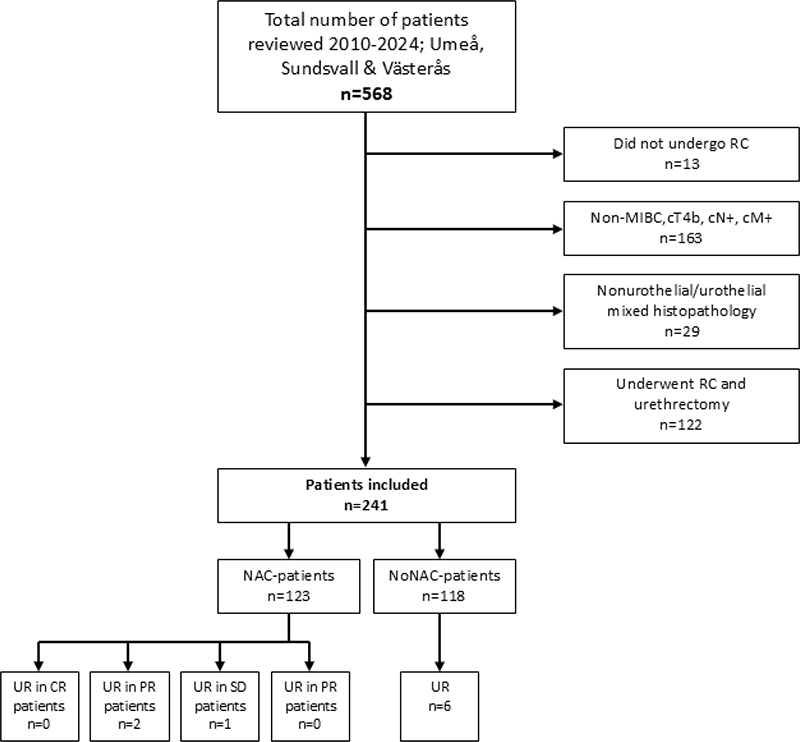
Figure 1. Flowchart of patient inclusion. Illustrating all reviewed patients including numbers of included and excluded at each stage. Non-MIBC: non-muscle-invasive bladder cancer; cT4b: clinical stage T4b of the primary tumor; cN: clinical staging of regional lymph nodes, N+ meaning presence of nodal metastases; cM: clinical staging of distant metastases, M+ meaning presence of nodal metastases; UR: urethral recurrence; NAC: neoadjuvant chemotherapy.
The NAC group
All patients receiving NAC were included regardless of the number of cycles administered. Thus, all patients classified as ‘NAC’ were required to, at least, have received one cycle of NAC before cystectomy. Details regarding specific regimes or reduced dosages were not taken into consideration when analyzed and categorized regarding downstaging and UR.
Ethics
The processing of personal data was conducted in accordance with the General Data Protection Regulation (GDPR). Since this is a retrospective study, patient outcomes were not affected by the research. Etikprövningsmyndigheten (The Swedish Ethical Review Authority) has approved this project: Etikprövningsnämnden Umeå, dnr 2013-463-31M (decision date 2014-06-03) and amendment: 2023-07236-02 (decision date: 2023-12-01). Etikprövningsmyndigheten has concluded in its final decision that patient consent is not mandatory for this study.
Statistical analysis
Statistical analyses were performed using IBM SPSS Statistics version 30.0. Competing‑risks analyses were performed in R (R Foundation for Statistical Computing). Baseline characteristics were summarized using standard descriptive statistics. Comparisons between groups were performed using the Mann–Whitney U test for continuous variables and the Fisher’s exact test for categorical variables.
Two time‑to‑event outcomes were analyzed from the date of RC: (1) time to UR and (2) OS. UR was defined as biopsy‑confirmed recurrence. Because death may preclude observation of UR, time to UR was analyzed in a competing‑risks framework. Cumulative incidence functions (CIFs) were estimated using the Aalen–Johansen method with death treated as the competing event. Group differences in CIFs were assessed using the Gray’s test. CIF analyses were performed for (1) NAC versus No-NAC in the full cohort and (2) CR versus Non‑CR within the NAC‑treated cohort.
OS was analyzed using Kaplan–Meier curves for three groups (CR, Non‑CR, and No-NAC). Differences between groups were assessed using the global log‑rank test (three‑group comparison). In addition, pairwise log‑rank comparisons were performed, and p‑values were adjusted using the Bonferroni method to account for multiple testing.
For both CIF and OS analyses, follow‑up was administratively censored at 60 months. All tests were two‑sided, and a significance level of 0.05 was used.
Study population and baseline characteristics
A total of 241 patients were included in the study (Figure 1). Baseline characteristics are presented in Table 1. The mean age was 70.4 years (SD 7.9), and 91.7% were men. The median age was 75 years in the No-NAC group and 69 years in the NAC group. Comorbidity, assessed using the age-adjusted CACI, was higher in the No-NAC group (median 6.0 vs 5.0).
Results
Frequency and characteristics of urethral recurrence
Nine UR cases were identified, corresponding to 3.7% (9/241) of the cohort. As shown in Table 2, eight of the nine UR cases occurred in men, and one in a woman. Six patients were identified in Sundsvall and three in Umeå. Among patients with UR, the mean time from cystectomy to biopsy-confirmed recurrence was 22.8 months (SD 16.4; range 6–54). For time-to-event analyses of UR, follow-up was administratively censored at 60 months. The mean number of post-RC urethroscopies among patients with UR was 1.63 (range 1–5; calculated among patients with available urethroscopy data).
Urethral recurrence according to NAC-status and response
40% (50/123) of the NAC-patients were complete responders. Of the nine UR events, six occurred in the No-NAC group and three in the NAC group. UR was observed in 6/118 (5.1%) No-NAC patients and 3/123 (2.4%) NAC patients. No cases of UR occurred among patients in the CR group (Table 3). Among the three patients who developed UR after receiving NAC, two were classified as PR and one as SD. All three patients had completed three cycles of NAC.
Recurrence analyses during follow-up
Competing-risks analyses of time to UR are shown as CIFs with death treated as a competing event. In the full cohort, CIFs did not differ between patients who received NAC (n = 123) and those who did not (No-NAC, n = 118) (Figure 2; Gray’s test, p = 0.291). Within the NAC-treated cohort, no UR events occurred in the CR group (0/50), whereas three UR events occurred in the Non-CR group (3/73); the difference in CIFs was not statistically significant (Figure 3; Gray’s test, p = 0.150).
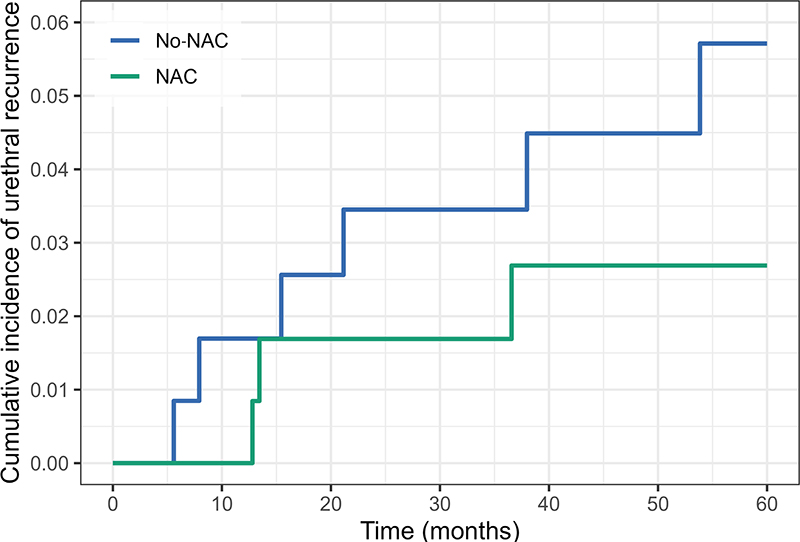
Figure 2. Aalen–Johansen CIFs for UR by NAC administration in the full cohort (NAC, n = 123; No-NAC, n = 118). Death was treated as a competing event. Follow-up limited to 60 months. Gray’s test: p = 0.291. UR events: NAC 3/123; No-NAC 6/118. UR: urethral recurrence; NAC: neoadjuvant chemotherapy; CIF: cumulative incidence function.
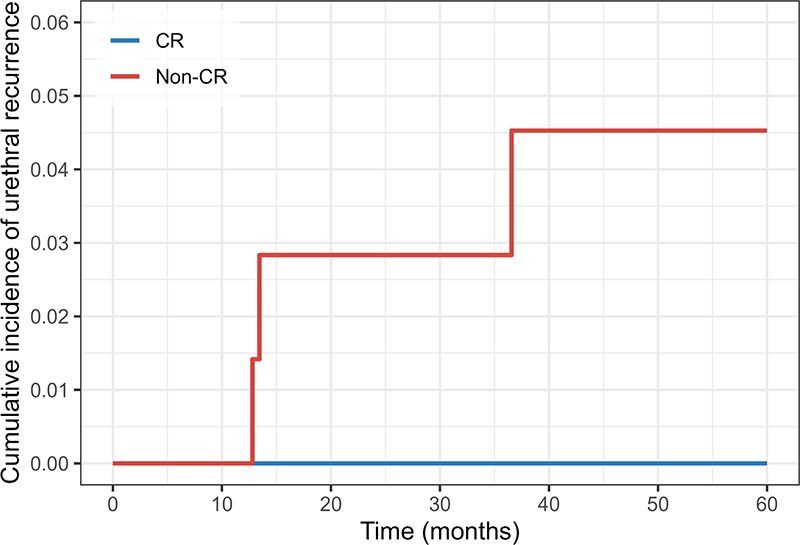
Figure 3. Aalen–Johansen CIFs for UR by NAC response within the NAC-treated cohort (CR, n = 50; Non-CR, n = 73). Death was treated as a competing event. Follow-up limited to 60 months. Gray’s test: p = 0.150. UR events: CR 0/50; Non-CR 3/73. UR: urethral recurrence; NAC: neoadjuvant chemotherapy; CR: complete response; CIF: cumulative incidence function.
Symptomatic versus asymptomatic detection
Four UR cases (44.4%) were identified in patients who sought medical attention due to urethral bleeding; in all four cases, the diagnosis was subsequently confirmed by urethroscopy with histopathological analysis (PAD) (Table 2). The remaining five patients with UR were diagnosed during follow-up routine: one by radiologic imaging and four by urethroscopy.
Treatment of urethral recurrence
Of the nine detected UR cases, the majority (66.7%) were treated with surgical removal of the remaining urethra, urethrectomy (Table 2). One patient received both radiation and urethrectomy, and one patient received radiation only. One patient did not receive any treatment due to poor general condition and died 6 months after the recurrence was detected.
Overall survival by NAC-status and response
OS by NAC-status and response is shown in Figure 4. Kaplan–Meier curves are presented for three groups (CR, Non-CR, and No-NAC). The global log-rank test indicated a difference in OS between groups (p < 0.001). Pairwise log-rank comparisons with Bonferroni-adjusted p-values were as follows: CR vs Non-CR, p = 0.058; CR vs No-NAC, p < 0.001; and Non-CR vs No-NAC, p = 0.266.
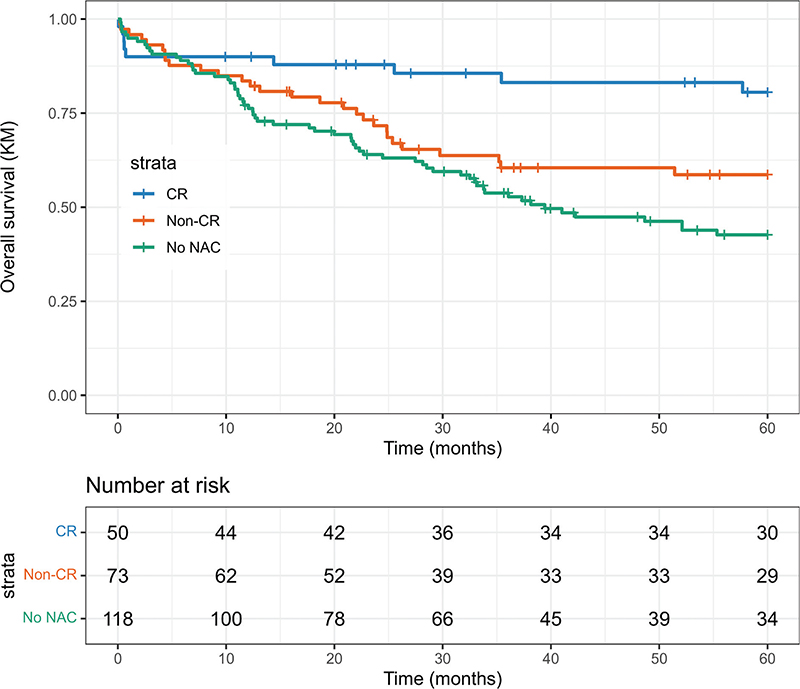
Figure 4. Kaplan–Meier OS by NAC-status and response (CR, n = 50; Non-CR, n = 73; No-NAC, n = 118). Follow-up limited to 60 months. Global log-rank test (3 groups): p < 0.001. Pairwise log-rank comparisons (Bonferroni adjusted): CR vs Non-CR, p = 0.058; CR vs No-NAC, p < 0.001; Non-CR vs No-NAC, p = 0.266. OS: overall survival; NAC: neoadjuvant chemotherapy; CR: complete response.
Discussion
In this multicenter retrospective study including 241 patients who undergone urethra-sparing cystectomy for MIBC, the total frequency of UR was 3.7%, which is consistent with the previously reported rate of 4.4% [10]. To the best of our knowledge, this is the first published retrospective investigation, which systematically investigates a MIBC-NAC-cohort with reference to UR and with a distribution over NAC-response categories.
Our main finding was that no cases of UR were observed in patients achieving a CR after NAC, and that this could motivate a reassessment of the Swedish national guidelines to reevaluate the necessity of follow-up urethroscopies for this group. Most of the existing literature on UR and on optimal surveillance is based on studies conducted before implementation of NAC. Consequently, the Swedish national recommendations are based on data from the pre-NAC era or from studies that do not evaluate NAC-status. This study provides updated evidence on recurrence patterns after receiving the modern gold standard treatment with NAC and RC in patients with MIBC.
Of the nine UR events, three occurred in NAC-treated patients, and six occurred in No-NAC patients. The corresponding proportions with UR were 2.4% (3/123) in NAC-treated patients and 5.1% (6/118) in No-NAC patients; however, the small number of events limits inference.
The reduced risk of local recurrence observed in NAC-treated patients may be explained by a lower burden of micro-metastatic disease and downstaging of the primary tumor due to the chemotherapy, contributing to a lower risk of recurrence [3]. Other aspects that could be further investigated in forthcoming studies would be the correlations between UR, regional recurrences, and distant metastases – all in relation to NAC and NAC-Responses. Zhou et al showed in their survival analysis that 5-year cancer-specific survival was significantly higher in patients with UR alone (83.3%), compared with patients with other recurrences, including pelvic/abdomen recurrence and distant metastasis (26.8%) [21].
Currently, the guidelines recommend five follow-up urethroscopies (once a year in total 5 years) for all MIBC-patients post-cystectomy. The procedure has the intent to detect recurrences [19]. At the same time, it should be considered that urethroscopies are costly, and invasive procedures are associated with patient discomfort. Altogether, reducing routine urethroscopies for NAC-patients with CR-staging may reduce patient discomfort and healthcare costs without compromising oncological safety. It should be noted that the NAC-CR subgroup constitutes 40% of all NAC-patients; thus, it is not a small or negligible fraction of the total.
Bladder cancer research needs to expand beyond restricted data in national registries in order to reach results beyond guideline recommendations. When it comes to patients cystectomized with or without urethrectomy, studies would need to be envisaged specifically addressing quality of life aspects as well as aspects on physical function and recovery post-RC [22, 23].
Our study has some strengths and limitations. One strength is the inclusion of patients from different health regions over many years. However, including patients from only three hospitals may introduce center-related bias and limit the generalizability. In addition, discrepancies in diagnostic coding were identified. A further limitation is that UR is a rare event, limiting the statistical power in this study. Nevertheless, given the rarity of UR, the small sample size still provides valuable descriptive insights even though definitive conclusions cannot be drawn. Yet, the fairly low number of patients and very few events might make the statistical power of the study uncertain, especially when dividing patients into smaller subgroups. Another limitation is that there might have been cases of UR unnoticed due to lack of routine urethroscopy visits – what has not been investigated remains unknown.
As expected, No-NAC patients were older and had a higher age-adjusted CACI than NAC-treated patients (Table 1). These baseline differences reflect treatment selection and may confound the association between NAC-status and UR. However, with few UR-events, we could not adjust for covariates in a reliable manner. Competing mortality may also affect the observed incidence of UR by reducing the number of patients at risk for UR. Therefore, comparisons of UR between the NAC- and No-NAC groups should be interpreted cautiously, and we have intentionally abstained from that.
Importantly, UR may become an increasing concern as survival rates post-cystectomy continue to improve [24], highlighting the importance of further investigation of an optimal surveillance scheme. Future studies are encouraged to validate the findings in this study in a larger study population to enable an updated urethral surveillance protocol and to clarify the independent effect of NAC on UR risk.
The study population was too small to reach any conclusions on long-term survival, so we abstained from that. Yet, for the sake of clarity, we have included our calculated survival projections in the results section and hope that any forthcoming studies with larger study populations can investigate that endpoint too.
In conclusion, patients with a CR after NAC had no cases of UR, indicating that the current Swedish guidelines of five routine urethroscopies, in 5 years post-RC, could be reevaluated as being unnecessary in that specific subgroup. A broader discussion on surveillance strategies would need to be conducted regarding patients in the PR- and SD-groups and is beyond the scope of this study. A more individualized surveillance strategy based on NAC treatment responses could reduce unnecessary procedures and patient-discomfort and optimize healthcare resources, but those specific matters would also need to be evaluated in forthcoming studies before any conclusions can be made.
Acknowledgments
The authors would like to acknowledge the contributions of all individuals involved in this study. A.S, S.L, and V.N contributed to the conceptual development of the work. Methodological design, validation, and formal analysis were supported by A.S, J.S, and A.P. Software development, data curation, visualization, project administration, and funding acquisition were carried out by A.S. The investigation was conducted with the contributions of S.L and F.A. The manuscript was drafted by S.L, A.S, V.N, and J.S and subsequently reviewed and edited by S.L, A.S, V.N, J.S, and F.A. Supervision of the project was provided by A.S and J.S. The authors also show appreciation to dr Markus Johansson, Sundsvall/Härnösand County Hospital, for facilitating the local gathering of information and data for the project.
References
[1] EAU guidelines on muscle-invasive and metastatic bladder cancer – Uroweb [Internet]. [cited 2026 May 5]. Available from: https://uroweb.org/guidelines/muscle-invasive-and-metastatic-bladder-cancer/chapter/epidemiology-aetiology-and-pathology
[2] Socialstyrelsen. Statistikdatabas [Internet]. 2025 [cited 2026 May 5]. Available from: https://www.socialstyrelsen.se/statistik-och-data/statistik/statistikdatabasen/
[3] Primär behandling [Internet]. [cited 2026 May 4]. Available from: https://kunskapsbanken.cancercentrum.se/diagnoser/urinblase-och-urinvagscancer/vardprogram/primar-behandling/#chapter-11-1-1-Icke-muskelinvasiv-blascancer
[4] Nationellt vårdprogram cancer i urinblåsa, njurbäcken, urinledare och urinrör [Internet]. [cited 2026 May 5]. Available from: https://kunskapsbanken.cancercentrum.se/diagnoser/urinblase-och-urinvagscancer/vardprogram/
[5] Primär behandling [Internet]. [cited 2026 May 5]. Available from: https://kunskapsbanken.cancercentrum.se/diagnoser/urinblase-och-urinvagscancer/vardprogram/primar-behandling/
[6] Rydell H, Ericson A, Eriksson V, et al. Thromboembolic events in patients undergoing neoadjuvant chemotherapy and radical cystectomy for muscle-invasive bladder cancer: a study of renal impairment in relation to potential thromboprophylaxis. J Pers Med. 2022;12(12):1961. https://doi.org/10.3390/jpm12121961
[7] Gopalakrishnan D, Elsayed AS, Hussein AA, et al. Impact of neoadjuvant chemotherapy on survival and recurrence patterns after robot-assisted radical cystectomy for muscle-invasive bladder cancer: results from the International Robotic Cystectomy Consortium. Int J Urol. 2022;29(3):197–205. https://doi.org/10.1111/iju.14749
[8] Sherif A, Holmberg L, Rintala E, et al. Neoadjuvant cisplatinum based combination chemotherapy in patients with invasive bladder cancer: a combined analysis of two Nordic studies. Eur Urol. 2004;45(3):297–303. https://doi.org/10.1016/j.eururo.2003.09.019
[9] Rosenblatt R, Sherif A, Rintala E, et al. Pathologic downstaging is a surrogate marker for efficacy and increased survival following neoadjuvant chemotherapy and radical cystectomy for muscle-invasive urothelial bladder cancer. Eur Urol. 2012;61(6):1229–1238. https://doi.org/10.1016/j.eururo.2011.12.010
[10] Fahmy O, Khairul-Asri MG, Schubert T, et al. Urethral recurrence after radical cystectomy for urothelial carcinoma: a systematic review and meta-analysis. Urol Oncol. 2018;36(2):54–59. https://doi.org/10.1016/j.urolonc.2017.11.007
[11] Boorjian SA, Kim SP, Weight CJ, et al. Risk factors and outcomes of urethral recurrence following radical cystectomy. Eur Urol. 2011;60(6):1266–1272. https://doi.org/10.1016/j.eururo.2011.08.030
[12] Li X, Wang W, Zhu G, et al. Risk factors, follow-up, and treatment of urethral recurrence following radical cystectomy and urinary diversion for bladder cancer: a meta-analysis of 9498 patients. Oncotarget. 2018;9(2):2782–2796. https://doi.org/10.18632/oncotarget.23451
[13] Boorjian SA, Tollefson MK, Cheville JC, et al. Detection of asymptomatic recurrence during routine oncological followup after radical cystectomy is associated with improved patient survival. J Urol. 2011;186(5):1796–1802. https://doi.org/10.1016/j.juro.2011.07.005
[14] Giannarini G, Kessler TM, Thoeny HC, et al. Do patients benefit from routine follow-up to detect recurrences after radical cystectomy and ileal orthotopic bladder substitution? Eur Urol. 2010;58(4):486–494. https://doi.org/10.1016/j.eururo.2010.05.041
[15] Kusaka A, Hatakeyama S, Hosogoe S, et al. Detecting asymptomatic recurrence after radical cystectomy contributes to better prognosis in patients with muscle-invasive bladder cancer. Med Oncol. 2017;34(5):90. https://doi.org/10.1007/s12032-017-0955-9
[16] Nieuwenhuijzen JA, de Vries RR, van Tinteren H, et al. Follow-up after cystectomy: regularly scheduled, risk adjusted, or symptom guided? Patterns of recurrence, relapse presentation, and survival after cystectomy. Eur J Surg Oncol. 2014;40(12):1677–1685. https://doi.org/10.1016/j.ejso.2013.12.017
[17] Alimi Q, Verhoest G, Kammerer-Jacquet SF, et al. Role of routine computed tomography scan in the oncological follow up of patients treated by radical cystectomy for bladder cancer. Int J Urol. 2016;23(10):840–846. https://doi.org/10.1111/iju.13164
[18] Osterman CK, Alanzi J, Lewis JD, et al. Association between symptomatic versus asymptomatic recurrence and survival in bladder cancer. Clin Genitourin Cancer. 2018;16(3):235–239. https://doi.org/10.1016/j.clgc.2017.11.001
[19] Uppföljning [Internet]. [cited 2026 May 5]. Available from: https://kunskapsbanken.cancercentrum.se/diagnoser/urinblase-och-urinvagscancer/vardprogram/uppfoljning/
[20] Laukhtina E, Moschini M, Soria F, et al. Follow-up of the urethra and management of urethral recurrence after radical cystectomy: a systematic review and proposal of management algorithm by the European Association of Urology-Young Academic Urologists: Urothelial Carcinoma Working Group. Eur Urol Focus. 2022;8(6):1635–1642. https://doi.org/10.1016/j.euf.2022.03.004
[21] Zhou X, Ji H, Zhang H, et al. Treatment and outcomes of urethral recurrence after orthotopic neobladder replacement in patients with bladder cancer – practice in a single centre. J Int Med Res. 2018;46(9):3928–3937. https://doi.org/10.1177/0300060518782015
[22] Milling RV, Nielsen NK, Graugaard-Jensen C, et al. Long-term effect of treatment for non-muscle invasive bladder cancer on quality of life: a cross-sectional study. Scand J Urol. 2025;60:141–147. https://doi.org/10.2340/sju.v60.44187
[23] Torikka Suua S, Porserud A, Nygren-Bonnier M, et al. Association between physical function before radical cystectomy for urinary bladder cancer and recovery after discharge from hospital. Scand J Urol. 2025;60:135–140. https://doi.org/10.2340/sju.v60.43992
[24] Sherwood JB, Sagalowsky AI. The diagnosis and treatment of urethral recurrence after radical cystectomy. Urol Oncol. 2006;24(4):356–361. https://doi.org/10.1016/j.urolonc.2005.11.027