ORIGINAL RESEARCH ARTICLE
Uptake of doublet therapy for de novo metastatic castration sensitive prostate cancer: a population-based drug utilisation study in Sweden
Rolf Gedeborga , Fredrik Sandinb, Camilla Thellenberg-Karlssonc, Johan Styrked, Ingela Franck Lissbrante, Hans Garmoa,f and Pär Stattina
aDepartment of Surgical Sciences, Uppsala University, Uppsala, Sweden; bRegional Cancer Centre, Midsweden, Uppsala University Hospital, Uppsala, Sweden; cDepartment of Radiation Sciences, Oncology, Umeå University, Umeå, Sweden; dDepartment of Surgical and Perioperative Sciences, Urology and Andrology, Umeå University, Umeå, Sweden; eDepartment of Oncology, Institute of Clinical Sciences, The Sahlgrenska Academy, University of Gothenburg, Sweden; fTranslational Oncology and Urology Research (TOUR), King’s College London, Guy’s Hospital, London, United Kingdom
ABSTRACT
Background: Randomised controlled trials have demonstrated prolonged survival with new upfront treatments in addition to standard androgen deprivation therapy (ADT) in men with de novo metastatic castration-sensitive prostate cancer. We describe patient characteristics, time trends and regional differences in uptake of these new treatment strategies in clinical practice.
Material and methods: This descriptive study consisted of men registered in the National Prostate Cancer Register of Sweden from 1 January 2018 to 31 March 2022 with de novo metastatic castration-sensitive prostate cancer defined by the presence of metastases on imaging at the time of diagnosis. Life expectancy was calculated based on age, Charlson Comorbidity Index and a Drug Comorbidity Index.
Results: Within 6 months from diagnosis, 57% (1,677/2,959) of men with de novo metastatic castration-sensitive prostate cancer and more than 3 years of life expectancy had received docetaxel, abiraterone, enzalutamide, apalutamide and/or radiotherapy. Over time, there was a 2-fold increase in uptake of any added treatment, mainly driven by a 6-fold increase in use of abiraterone, enzalutamide or apalutamide, with little change in use of other treatments.
Conclusions: Slightly more than half of men diagnosed with de novo metastatic castration-sensitive prostate cancer and a life expectancy of at least 3 years received additions to standard ADT as recommended by national guidelines in 2019–2022 in Sweden. There was a 2-fold increase in use of these treatments during the study period; however, efforts to further increase adherence to guidelines are warranted.
KEYWORDS: Prostate cancer; castration sensitive prostate cancer; abiraterone; enzalutamide; apalutamide; docetaxel; radiotherapy
Citation: Scandinavian Journal of Urology 2023, VOL. 58, 92–100. https://doi.org/10.2340/sju.v58.9572.
Copyright: © 2023 The Author(s). Published by MJS Publishing on behalf of Acta Chirurgica Scandinavica. This is an Open Access article distributed under the terms of the Creative Commons Attribution-NonCommercial 4.0 International License (https://creativecommons.org/licenses/by-nc/4.0/), allowing third parties to copy and redistribute the material in any medium or format and to remix, transform, and build upon the material for non-commercial purposes, provided proper attribution to the original work.
Received: 10 February 2023; Accepted: 28 September 2023; Published: 9 November 2023
Supplemental data for this article can be accessed online at https://doi.org/10.2340/sju.v58.9572
*CONTACT Rolf Gedeborg rolf.gedeborg@surgsci.uu.se Department of Surgical Sciences, Uppsala University, SE-751 85 Uppsala, Sweden
Competing interests and funding: The public healthcare administration for Region Uppsala in Sweden has, on behalf of the National Prostate Cancer Register, agreements on subscriptions for quarterly reports from Patient-overview Prostate Cancer with Astellas, Janssen and Bayer, as well as research projects with Astellas, Bayer and Janssen. All remaining authors have declared no conflicts of interest.
This work was supported by the Swedish Cancer Society [2019-0030] and Region Uppsala. The funding sources had no impact on the design, conduct or interpretation of this study.
Introduction
Median survival for men with de novo metastatic castration sensitive prostate cancer (mCSPC) was estimated to be around 3 years in 2015 in a nationwide population-based study in Sweden [1]. Recently, several new treatments have been shown to increase survival in men with mCSPC when combined with standard androgen deprivation therapy (ADT), that is, doublet therapy. In randomised clinical trials, chemotherapy with docetaxel as well as the use of abiraterone, enzalutamide and apalutamide in addition to ADT improved survival with approximately 1 year in men with de novo mCSPC [2–9]. Furthermore, local radiotherapy in men with low-volume mCSPC improved time to progression and/or survival in recent randomized trials [10,11]. The results of these trials have been the basis for changes in European guidelines for prostate cancer treatment, which now recommend the upfront use of doublet therapy in men with mCSPC unless there is a clear contraindication [12]. However, little is known about the adherence to these recommendations in clinical practice [13].
The Swedish national clinical guidance follows the European guideline concerning treatment of men with de novo mCSPC [14,15]. It is not expected that cost should be a barrier for the individual patient since the Swedish healthcare system automatically covers fees for all legal residents with the patient paying only a small fraction of the fee for examination and daily hospital charges. This also applies to medications where patient only pays the cost for prescription medicines, reimbursed by the government, up to a threshold of currently 2 400 SEK (approximately 205 Euros). Such reimbursement for the indication de novo mCSPC was approved by the Swedish health technology assessment agency (The Dental and Pharmaceutical Benefits Agency, TLV) for abiraterone in June 2018, apalutamide in May 2021 and enzalutamide in January 2022. This study aimed to assess uptake of upfront treatment in addition to standard ADT in men with de novo mCSPC as recommended by guidelines and describe patient characteristics, time trends, as well as regional differences in uptake.
Methods
Study design and participants
We selected men with de novo mCSPC registered in National Prostate Cancer Register (NPCR) from 1 January 2018 to 31 March 2022 as study population. De novo mCSPC was defined by the presence of bone metastases and/or visceral metastases on imaging at the time of diagnosis. A dichotomous variable on the number of metastatic foci on bone imaging (1–3 foci or ≥4 foci) is available in NPCR since September 2018. High risk mCSPC was defined as having at least two of these three risk factors: Gleason score 8–10, ≥4 bone metastases or visceral metastases [16]. In order to accommodate a clinical assessment of the utility of an additional treatment based on life expectancy, we characterised a subgroup of men with a life expectancy above 3 years based on the result from our previous study on survival of men with de novo mCSPC. A majority of men (2 959/3 697, 80%) in this study group had a life expectancy of at least 3 years.
The National Board of Health and Welfare provides a service that enables researchers with data from a clinical disease register to submit data on individuals to be linked with national health registers, and aggregated data are then returned to the researcher. Approval by the Swedish Ethical Review Authority was obtained for such linkage as well as for a validation of docetaxel registration in NPCR by a structured review of healthcare records. A dataset with information on prostate cancer characteristics and region from NPCR was linked at the Board of Health and Welfare to the National Patient Register and the Prescribed Drug Register using the unique Swedish personal identity number [17]. Aggregated and tabulated information on the number of men in the different therapeutic groups, stratified by covariate categories, was returned to the research team. Cells with few observations were masked by the Board of Health and Welfare.
Data sources
Since 1998, the NPCR captures 98% of all cases of prostate cancer in Sweden compared to the Cancer Register to which reporting is mandated by law. The primary registration in NPCR contains comprehensive data on diagnostic procedures, cancer characteristics and primary cancer treatment [18]. There is, however, no information in NPCR on progression to metastatic disease or progression to castration resistance other than in a subregister – the Patient-overview Prostate Cancer (PPC) in which longitudinal data are registered [19].
The National Prescribed Drug Register is a compulsory, nationwide register maintained by the Swedish Board of Health and Welfare [20]. It contains detailed and comprehensive individual-level information on all prescribed and dispensed drugs in Sweden since 1 July 2005. This register does not hold information on drugs administered in-hospital. Data are available for analysis 1 month after a prescription has been filled.
The National Patient Register is a compulsory and nationwide register that is maintained by the Swedish Board of Health and Welfare [21]. It collects information on all in-hospital care and out-patient specialist care, but not primary care. The information includes dates for admissions and discharges, department and hospital identifier, hospital discharge diagnoses and surgical procedure codes. This register captures in-patient care since 1987 and specialised out-patient care since 2001 [21]. Hospital discharge diagnoses are coded according to the Swedish clinical modification of the 10th revision of the International Statistical Classification of Diseases and Related Health Problems (ICD-10-SE) since 1997. Coding accuracy is diagnosis dependent [22,23].
The regional proportion of men younger than 80 years and with high-risk cancer who were subjected to multidisciplinary care planning was extracted from the NPCR [24]. Regional population counts were provided by Statistics Sweden.
Definitions of treatment exposure
Most men in Sweden diagnosed with mCSPC will receive ADT at their urological department and will subsequently be referred for assessment of eligibility for additional treatment either at a multidisciplinary conference as per guidelines or referred to a consultation at an oncological department.
Exposure to local radiotherapy was captured from registration in NPCR as primary tumour-directed local radiotherapy, excluding lower dose radiotherapy for palliation of local symptoms.
Docetaxel as upfront treatment of men with a diagnosis of prostate cancer was determined from the primary registration in NPCR, available for docetaxel since March 2017. Use of docetaxel was validated as described below.
Exposure to abiraterone (ATC code L02BX03), enzalutamide (L02BB04), apalutamide (L02BB05), bicalutamide (L02BB03) and gonadotropin-releasing hormone (GnRH) agonists (L02AE) was defined as one or more filled prescriptions in The Prescribed Drug Register during a 6-month period after the date of the prostate cancer diagnosis. Five out of 21 healthcare regions in Sweden provide GnRH directly to the patient, without prescription. The Prescribed Drug Register therefore captures GnRH treatment accurately for 16 regions, but other medications are accurately captured in all 21 regions. The GnRH antagonist Degarelix (L02BX02) is used in a very small number of men usually in need of rapid onset of treatment effect due to severe disease symptoms. Degarelix is usually administered in-hospital without a prescription and could therefore not be captured in our study.
Patient characteristics for stratified descriptive analyses
The Charlson Comorbidity Index (CCI) was calculated from hospital discharge diagnoses registered in the in-patient part of the National Patient Register during the 10-year period prior to start of follow-up [25,26]. Our newly created Drug Comorbidity Index (DCI), based on the history of filled prescriptions 1 year prior to diagnosis, was also applied [27,28]. This DCI had better ability than the CCI to identify comorbidity with an impact on risk of death in men with advanced prostate cancer [29]. Life expectancy was calculated based on age, CCI and DCI as described previously [30].
Validation of docetaxel registration in NPCR
A structured review of healthcare records was performed for 500 randomly selected men from NPCR being <80 years old and diagnosed with mCSPC during 2018–2020. The age limit was applied since few men aged above 80 with mCSPC receive docetaxel (data on file). Information on treatment with docetaxel (yes/no), date for first administration, number of treatment cycles and if abiraterone was provided in case of prematurely discontinued treatment with docetaxel was extracted by research nurses using a structured electronic report form at 20 hospitals.
Statistical analysis
Since only descriptive analyses were performed in the presentation of drug utilisation, missing values were not imputed. The scatterplots showing time trends in proportion of given treatment were smoothed using locally weighted polynomial regression. Associations between continuous variables were visualised with linear regression.
Life expectancy was calculated based on the follow-up of 12,836 men in NPCR diagnosed with de novo metastatic prostate cancer during the period 2007-01-01 to 2019-12-30. The median duration of follow-up was 6.4 years, and life expectancy was estimated as the area under the simulated survival function, where the simulation accounted not only for age, CCI and DCI at the start of follow-up but also for annual changes in age, CCI and DCI [30].
In the validation of the docetaxel registration, diagnostic test statistics with exact confidence intervals (CI) were calculated using the R EpiR package (version 2.0.39).
Results
Overall proportion receiving additional treatment
During the 45-month study period, there were 3,697 men in NPCR diagnosed with de novo mCSPC. An additional treatment with docetaxel, abiraterone, enzalutamide, apalutamide and/or radiotherapy was provided to 46% of these men (1,683/3,697) within 6 months from date of diagnosis. In the subgroup of men with a life expectancy ≥3 years, the overall proportion receiving additional treatment was 57% (1,677/2,959).
Characteristics of men who received any treatment in addition to ADT
Men who received additional treatment were younger and had a substantially lower burden of comorbidity, compared to men who did not receive added treatment (Table 1). The proportion of men below age 60 who received additional treatment was 4-fold higher that men above 80 (74% vs. 18%), and 72% of men who received additional treatment had CCI = 0, compared to 52% amongst men who did not receive additional treatment. The corresponding proportions with CCI = 0 amongst men with life expectancy ≥3 years were 94% vs 67%. Differences in cancer characteristics were less pronounced than for comorbidity with the caveat that a larger proportion of men who only received standard ADT had missing information for metastatic burden and Gleason score compared to men who received additional treatment (Table 1).
| Patient characteristics | Any added treatmenta N = 1,788 | Any drug treatment addedb N = 1,492 | Radiotherapy added N = 483 | No added treatment N = 1,909 | Total N = 3,697 | |||||
| n | % | n | % | n | % | n | % | n | % | |
| Age (year) | ||||||||||
| <60 | 151 | 8.4 | 136 | 9.1 | 38 | 7.9 | 52 | 2.7 | 203 | 5.5 |
| 60–69 | 532 | 29.8 | 453 | 30.4 | 154 | 31.9 | 272 | 14.2 | 804 | 21.7 |
| 70–79 | 919 | 51.4 | 747 | 50.1 | 254 | 52.6 | 730 | 38.2 | 1,649 | 44.6 |
| ≥80 | 186 | 10.4 | 156 | 10.5 | 37 | 7.7 | 855 | 44.8 | 1,041 | 28.2 |
| Charlson comorbidity index | ||||||||||
| 0 | 1,293 | 72.3 | 1,094 | 73.3 | 339 | 70.2 | 985 | 51.6 | 2,278 | 61.6 |
| 1 | 228 | 12.8 | 187 | 12.5 | 63 | 13.0 | 315 | 16.5 | 543 | 14.7 |
| 2 | 135 | 7.6 | 104 | 7.0 | 43 | 8.9 | 255 | 13.4 | 390 | 10.5 |
| ≥3 | 132 | 7.4 | 107 | 7.2 | 38 | 7.9 | 354 | 18.5 | 486 | 13.1 |
| Drug comorbidity indexc | ||||||||||
| Quartile 1 | 561 | 31.4 | 462 | 31.0 | 170 | 35.2 | 361 | 60.8 | 922 | 24.9 |
| Quartile 2 | 512 | 28.6 | 437 | 29.3 | 133 | 27.5 | 414 | 55.3 | 926 | 25.0 |
| Quartile 3 | 433 | 24.2 | 353 | 23.7 | 118 | 24.4 | 491 | 46.9 | 924 | 25.0 |
| Quartile 4 | 282 | 15.8 | 240 | 16.1 | 62 | 12.8 | 643 | 30.5 | 925 | 25.0 |
| Life expectancy (years)d | ||||||||||
| <3 | 111 | 6.2 | 95 | 6.4 | 20 | 4.1 | 627 | 32.8 | 738 | 20.0 |
| ≥3 | 1,677 | 93.8 | 1,397 | 93.6 | 463 | 95.9 | 1,282 | 67.2 | 2,959 | 80.0 |
| Number of bone metastases | ||||||||||
| 1–3 | 453 | 25.3 | 273 | 18.3 | 274 | 56.7 | 490 | 25.7 | 943 | 25.5 |
| ≥4 | 813 | 45.5 | 780 | 52.3 | 82 | 17.0 | 694 | 36.4 | 1,507 | 40.8 |
| Missing | 522 | 29.2 | 439 | 29.4 | 127 | 26.3 | 725 | 38.0 | 1,247 | 33.7 |
| Visceral metastases | ||||||||||
| Yes | 277 | 15.5 | 238 | 16.0 | 61 | 12.6 | 292 | 15.3 | 569 | 15.4 |
| No | 1,400 | 78.3 | 1,153 | 77.3 | 402 | 83.2 | 1,455 | 76.2 | 2,855 | 77.2 |
| Missing | 111 | 6.2 | 101 | 6.8 | 20 | 4.1 | 162 | 8.5 | 273 | 7.4 |
| Gleason score | ||||||||||
| <8 | 302 | 16.9 | 227 | 15.2 | 115 | 23.8 | 342 | 17.9 | 644 | 17.4 |
| 8–10 | 1,377 | 77.0 | 1,169 | 78.4 | 348 | 72.0 | 1,226 | 64.2 | 2,603 | 70.4 |
| Missing | 109 | 6.1 | 96 | 6.4 | 20 | 4.1 | 341 | 17.9 | 450 | 12.2 |
| High-risk mCSPCe | ||||||||||
| Yes | 777 | 43.5 | 728 | 48.8 | 96 | 19.9 | 584 | 30.6 | 1,361 | 36.8 |
| No | 1,011 | 56.5 | 764 | 51.2 | 387 | 80.1 | 1,325 | 69.4 | 2,336 | 63.2 |
| Standard ADT within 6 months of diagnosisf | ||||||||||
| GnRH analogueg | 1,441 | 98.4 | 1,206 | 98.4 | 380 | 99.2 | 1,305 | 83.8 | 2,746 | 90.9 |
| Bicalutamideh | 1,417 | 79.3 | 1,137 | 76.2 | 447 | 92.5 | 1,434 | 75.1 | 2,851 | 77.1 |
| Ablatio testis | 29 | 1.6 | 27 | 1.8 | 4 | 0.8 | 64 | 3.4 | 93 | 2.5 |
| aDocetaxel, abiraterone, enzalutamide, apalutamide or radiotherapy; bDocetaxel, abiraterone, enzalutamide or apalutamide; cA comorbidity measure based on drug prescriptions filled the year before the index date [27]. Quartile 1 contains men with the lowest baseline mortality risk from comorbidity, and quartile 4 contains those with the highest comorbidity burden; dLife expectancy for metastatic prostate cancer was calculated based on age, CCI and DCI as described previously [30]; eHigh risk mCSPC was defined as having at least two of these three risk factors: Gleason score 8–10, ≥4 bone metastases or visceral metastases [16]; fNot mutually exclusive categories; gFive out of 21 healthcare regions in Sweden provide GnRH directly to the patient, without prescription. This treatment is therefore not captured in the Prescribed Drug Register. In this row, men from these 5 regions have therefore been removed from the denominator to reduce bias in the estimated proportions; hBicalutamide as monotherapy, as flare protection with GnRH analogue during 1 month, or combined with GnRH analogue for maximal androgen blockade. | ||||||||||
| mCSPC: metastasised castration-sensitive prostate cancer; ADT: androgen deprivation therapy. | ||||||||||
Characteristics of men who received radiotherapy in addition to ADT
Radiotherapy to the prostate was provided to 13% of men (483/3,697) within 6 months of diagnosis, and 39% of these men (187/483) also received an additional drug treatment within 6 months from the date of diagnosis. The absolute majority of treatment doses were hypofractioned >2.5 Gy to a biologically effective dose of at least 36 Gy.
The characteristics of these men were largely similar to those for men who received any added treatment regarding age, comorbidity and life expectancy, but they had a lower burden of metastases (Table 1). The radiotherapy for men diagnosed with de novo mCSPC was started within 6 months in 51%, within 9 months in 83% and within 1 year in 93%.
Characteristics of men who received drug treatment in addition to ADT
Men treated with docetaxel were younger, had a lower burden of comorbidity and consequently had a longer life expectancy compared to those treated with any of abiraterone, enzalutamide or apalutamide, whereas the burden of metastases was similar.
During the 6-month period following diagnosis, 17% of men receiving additional drug treatment (238/1,365) received more than one drug, which includes abiraterone, enzalutamide, apalutamide and/or docetaxel.
Time trends in frequency of added treatment
The overall proportion of men who received any additional treatment increased almost 2-fold during the study period (Figure 1). This increase was mainly driven by the increased use of abiraterone, enzalutamide or apalutamide that increased more than 6-fold from around 5% to more than 30%. During the initial phase of the COVID-19 pandemic in 2020, there was a decrease in the use of docetaxel.
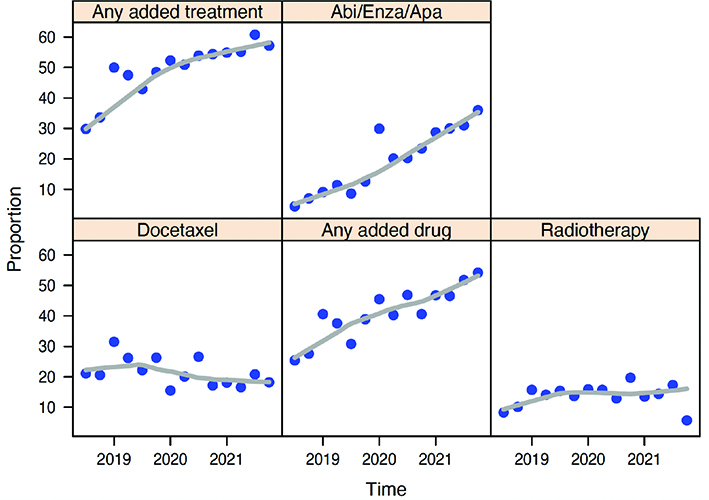
Figure 1. Calendar time-trends in the proportion of men with de novo mCSPC who received treatment in addition to standard ADT within 6 months after diagnosis amongst 3,697 men with metastatic castration sensitive prostate cancer at diagnosis. Treatment with abiraterone, enzalutamide and/or apalutamide has been aggregated to one common category (Abi/Enza/Apa).
Regional differences in the proportion of men who received added treatment
To reduce potential impact from differences in case mix between regions, we restricted these analyses to men with a life expectancy ≥3 years. Amongst these men, use of any additional treatment varied substantially between regions, from 46% to 93% between the regions with the lowest and highest use (Figure 2). The regional proportion of men who received any added treatment did not increase with the proportion of patients discussed in multidisciplinary conference and did not appear related to patient volume in the region or regional population (Figure S1).
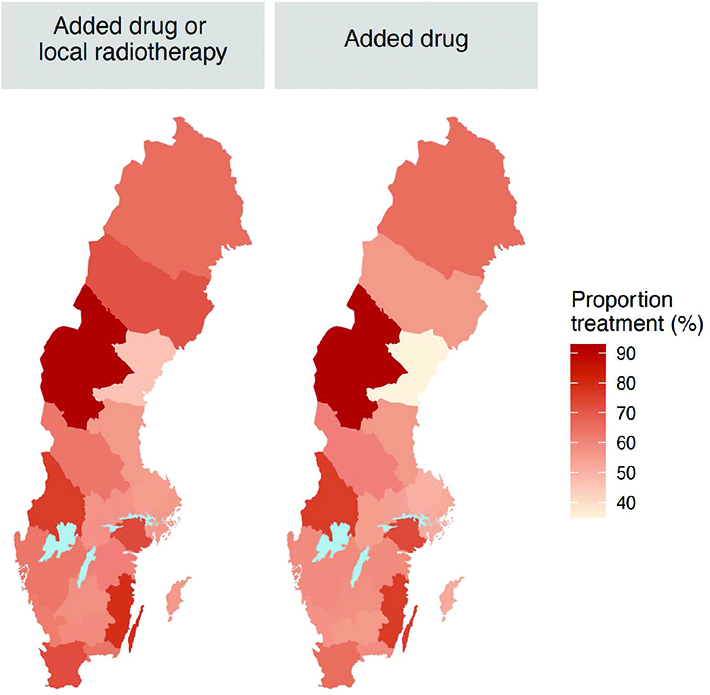
Figure 2. Proportion per region in 2,959 men with de novo mCSPC and ≥ 3 years life expectancy in Sweden, who received added drug or local radiotherapy along with standard ADT (left panel) or added drug treatment along with standard ADT (right panel).
There were even bigger differences in the use of specific treatments, with the use of any of abiraterone, enzalutamide or apalutamide ranging from 5% to 50%, docetaxel from 9% to 56% and use of radiotherapy from 1% to 23% (Figure 3). The corresponding proportions for the full study population, without restriction for life expectancy, are displayed in Figure S2 and S3.
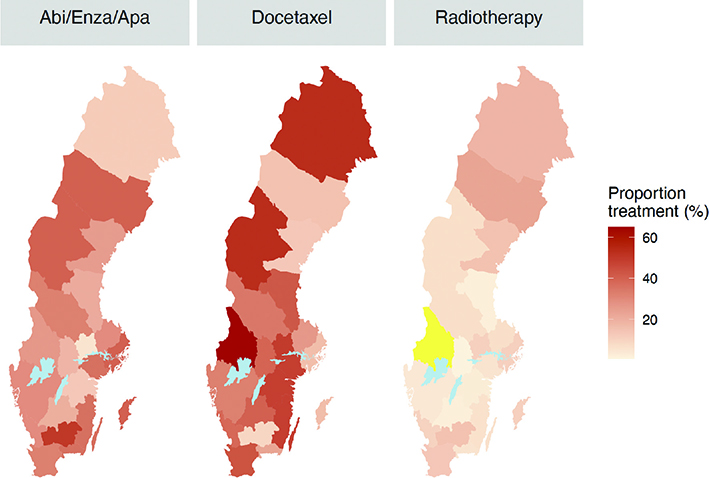
Figure 3. Proportion per region in 2,959 men with de novo mCSPC and ≥ 3 years life expectancy in Sweden, who received additional treatment with any of abiraterone, enzalutamide or apalutamide (Abi/Enza/Apa; left panel), docetaxel (middle panel) or radiotherapy (right panel). Yellow indicates that the result was masked for that region by the Board of Health and Welfare due to few observations.
Validation of docetaxel registration in NPCR
Healthcare records of 500 men with mCSPC from 24 hospitals were reviewed, and 216 men who had been treated with docetaxel were identified, whereas in NPCR, 166 of these men were registered as treated with docetaxel. This corresponds to 84% (95% CI: 80% to 87%) being correctly classified. The sensitivity for docetaxel registration in NPCR was 0.70 (95% CI: 0.63 to 0.76), and the specificity was 0.95 (95% CI: 0.91 to 0.97). The positive predictive value was 0.91 (95% CI: 0.86 to 0.95), and the negative predictive value was 0.81 (95% CI: 0.76 to 0.85) (Table S1 and Table S2).
Discussion
In this population-based drug utilization study of men in Sweden with de novo mCSPC, 57% of men with a life expectancy of at least 3 years received upfront treatment as recommended by national guidelines with docetaxel; any of abiraterone, enzalutamide or apalutamide; and/or radiotherapy in addition to standard ADT. There was a 2-fold increase in use of these treatments during the study period, likely indicating a continued gradual process of implementation.
The specific reason for the low adherence and the large differences between regions in our study cannot be deduced from our data. Differences between healthcare providers have been observed previously both regarding implementation of treatments and outcome of cancer care [31,32], and hospital-level variability in guideline adherence has translated into effects on overall survival [33,34]. Some factors that have previously been associated with non-adherence to treatment guidelines are access to cancer specialists [31], facility patient volume [35], social determinants [36] and cost of care [37]. We argue that assessments in the regions of cost/benefit ratio had a strong impact on adherence since the cost for doublet therapy is carried by each region.
Surprisingly, more frequent use of multidisciplinary conferences was not associated with higher adherence in our study. We argue that the key component to reduce differences in healthcare is to publicly report quality process indicators to benchmark the performance of each healthcare provider [38]. This is a useful basis for a discussion between stakeholders such as department leadership, administration, patient organisations and politicians.
Comorbid conditions may explain why these additional treatments are not provided to all men [35], not even for all men with a life expectancy of 3 years or more, and it is not possible to pinpoint the exact proportion of these men for whom there was a valid indication for additional treatment. Whilst we have calculated life expectancy based on a statistical model combining age and two measures of comorbidity [30], this estimation may be more difficult on the individual man in clinical practice. An underestimation of life expectancy by the clinician could contribute to the results seen in this study [39].
There was a two-fold range in uptake of any additional treatment between the 21 administrative regions in Sweden in men with at least 3 years life expectancy, and for specific treatments for mCSPC, the range in uptake was even larger, with a 10-fold difference between regions with highest vs lowest uptake of any of abiraterone, enzalutamide or apalutamide, and use of local radiotherapy. We have previously observed similar differences between regions in uptake of chemotherapy, abiraterone and enzalutamide in Sweden [40–42]. Taken together, these results indicate that other factors than those measured in this study strongly affect treatment decisions. It is notable that this regional variability is seen even though treatment decisions are made after multi-disciplinary team meetings in overall 90% of men <80 years old with de novo metastatic prostate cancer, with regional proportions varying between 76% and 100% [43].
Local radiotherapy to the prostate was only provided to 13% of men within 6 months of diagnosis. The low proportion and slow increase over time are notable. According to a systematic review and The European Association of Urology guidelines, local radiotherapy of the prostate should be considered in men with low-volume metastatic disease [12,40]. There is, however, uncertainty regarding the optimal definition of low metastatic burden (oligometastatic) prostate cancer, and our data had limited ability to characterise metastatic burden. Perceived guideline clarity has been implicated as an important driver of physician behaviour [41].
Our restriction to capture radiotherapy only during the first 6 months after primary diagnosis was intended to limit our analysis to de novo/synchronous metastatic disease but may have resulted in a too conservative estimate. The low proportion of men who received primary local radiotherapy may therefore to some extent be due to limitations in our data and warrants further evaluation of the potential for improvement.
Another consideration in the interpretation of these results is the impact of the COVID-19 pandemic on prostate cancer care. During the latter part of the study period coinciding with the pandemic, there were likely incentives to limit use of healthcare resources potentially resulting in reduced use of docetaxel and radiotherapy. Data for the early phase of the pandemic in the first quarter in 2020 indicate an increased use of abiraterone, enzalutamide or apalutamide, and a corresponding decrease in use of docetaxel.
The main strength of this drug utilization study is the use of registers with nationwide, population-based coverage with rapid and near complete capture of data. NPCR provided data on the diagnosis of de novo mCSPC, cancer characteristics and use of docetaxel and radiotherapy. The Prescribed Drug Register, which was used both to define exposure to abiraterone, enzalutamide and apalutamide and to measure comorbidity by use of a drug comorbidity index, has a virtually complete capture of all filled prescriptions [27,28].
The estimation of life expectancy in the current study was based on men diagnosed with de novo metastatic prostate cancer, and not men free of prostate cancer. It is therefore expected to result in a conservative selection of men with at least 3 years of life expectancy, and consequently also providing a conservative estimate of the proportion of men without additional treatment in this subgroup.
There are some limitations in our study that should be acknowledged. Only aggregated and tabulated information on the number of men in the different therapeutic groups, stratified by covariate categories, was available to the research team. Cells with few observations were masked for legal reasons. To comply with this mandated restriction, the number of covariates had to be limited. Information on, for example, nodal metastases and specific indications for bicalutamide was therefore not included, and the ability to perform sensitivity analyses is limited. Since the times of approval of reimbursement for the indication de novo mCSPC have substantial impact on the pattern of utilization of these drugs, including off-label use of enzalutamide for mCSPC, subgroup analyses for these individual treatments are not meaningful.
The validity of docetaxel exposure data was assessed by a patient record review, and for approximately 20% of men who had received docetaxel according to the patient records, there was no registration in NPCR. However, since docetaxel only contributed with 20% to ‘any added drug’, this underreporting did not materially affect the main outcome. Furthermore, neither NPCR nor the Patient Register hold data on performance status such as the Eastern Cooperative Oncology Group/WHO Health organization Performance status (ECOG), meaning that we lacked data on patient characteristics not captured by our comorbidity indices, which may affect treatment decisions and hence potentially contributed to unmeasured differences in case mix between regions. There is also some delay in reporting to NPCR, and capture reaches 80% at 6 months and 95% around 9 months after the date of diagnosis, which is clearly illustrated by the low proportion of radiotherapy during the last study period. Since the study data were extracted in June 2022, data for the first quarter in 2022 should be interpreted with caution.
To assess generalisability of the results to other countries and healthcare systems, it is essential to understand the set-up of healthcare in Sweden. In the Swedish healthcare system, 21 independent regions provide universal low-cost care to all residents, and the NPCR captures 98% of all cases of prostate cancer in Sweden. Thus, our study is population based, and there is little concern for bias due to selection mechanisms related to access to care. This improves the generalisability of our results.
In conclusion, slightly more than half of men in Sweden diagnosed with de novo mCSPC between January 2018 and March 2022 and who had a life expectancy of at least 3 years received upfront docetaxel, abiraterone, enzalutamide, apalutamide and/or radiotherapy in addition to standard hormonal treatment as recommended by current guidelines. There was a 2-fold increase in use of these treatments during the study period. Our results indicate that further efforts are needed to increase adherence to guidelines.
Acknowledgements
This project was made possible by the continuous work of the National Prostate Cancer Register of Sweden (NPCR) steering group: David Robinson, Ingela Franck Lissbrant, Johan Styrke, Johan Stranne, Jon Kindblom, Camilla Thellenberg, Andreas Josefsson, Ingrida Verbiene, Hampus Nugin, Stefan Carlsson, Anna Kristiansen, Mats Andén, Thomas Jiborn, Olof Ståhl, Olof Akre, Per Fransson, Eva Johansson, Magnus Törnblom, Fredrik Jäderling, Marie Hjälm Eriksson, Lotta Renström, Jonas Hugosson, Ola Bratt, Maria Nyberg, Fredrik Sandin, Camilla Byström, Mia Brus, Mats Lambe, Anna Hedström, Nina Hageman, Christofer Lagerros, Hans Joelsson and Gert Malmberg.
Disclaimer
Rolf Gedeborg is also employed by the Medical Products Agency (MPA) in Sweden. The MPA is a Swedish Government Agency. The views expressed in this article may not represent the views of the MPA.
Data availability statement
Data used in the present study were extracted from the Prostate Cancer Database Sweden (PCBaSe), which is based on the National Prostate Cancer Register (NPCR) of Sweden. The data cannot be shared publicly because the individual-level data contain potentially identifying and sensitive patient information and cannot be published due to legislation and ethical approval (https://etikprovningsmyndigheten.se). Use of data from national health-data registers is further restricted by the Swedish Board of Health and Welfare (https://www.socialstyrelsen.se/en/) and Statistics Sweden (https://www.scb.se/en/), which are Government Agencies providing access to the linked healthcare registers. The data will be shared on reasonable request in an application made to the steering group of PCBaSe. For detailed information, please see www.npcr.se/in-english, where registration forms, manuals and annual reports from NPCR are available alongside a full list of publications from PCBaSe. The statistical program code used for the present study analyses can be provided on request (contact: rolf.gedeborg@surgsci.uu.se).
Authors’ contributions
Conceptualization: Pär Stattin; Methodology: Fredrik Sandin, Hans Garmo, Rolf Gedeborg; Formal analysis and investigation: Fredrik Sandin, Rolf Gedeborg; Writing – original draft preparation: Rolf Gedeborg; Writing – review and editing: Pär Stattin, Rolf Gedeborg, Camilla Thellenberg-Karlsson, Johan Styrke, Ingela Franck Lissbrant, Hans Garmo; Funding acquisition: Pär Stattin; Resources: Pär Stattin; Supervision: Pär Stattin.
Ethics approval
Approved by the Swedish Ethical Review Authority: Dnr 2020-03889.
Consent to participate
The requirement for informed consent was waived by the Ethical Review Authority.
ORCID
Rolf Gedeborg https://orcid.org/0000-0002-8850-7863
Camilla Thellenberg-Karlsson https://orcid.org/0000-0002-7061-7255
Johan Styrke https://orcid.org/0000-0001-8455-2010
Ingela Franck Lissbrant https://orcid.org/0000-0001-8612-9814
Hans Garmo https://orcid.org/0000-0001-7181-7083
Pär Stattin https://orcid.org/0000-0002-8306-0687
References
- [1] Westerberg M, Franck Lissbrant I, Damber JE, et al. Temporal changes in survival in men with de novo metastatic prostate cancer: nationwide population-based study. Acta Oncol. 2020;59(1):106–111. https://doi.org/10.1080/0284186X.2019.1662084
- [2] European Medicines Agency – Committee for Medicinal Products for Human Use (CHMP). Xtandi – European Public Asessment Report – variation. European Medicines Agency. Amsterdam. 2021.
- [3] European Medicines Agency – Committee for Medicinal Products for Human Use (CHMP). Erleada – European Public Asessment Report – variation. European Medicines Agency. Amsterdam. 2019.
- [4] Woods BS, Sideris E, Sydes MR, et al. Addition of docetaxel to first-line long-term hormone therapy in prostate cancer (STAMPEDE): modelling to estimate long-term survival, quality-adjusted survival, and cost-effectiveness. Eur Urol Oncol. 2018;1(6):449458. https://doi.org/10.1016/j.euo.2018.06.004
- [5] James ND, de Bono JS, Spears MR, et al. Abiraterone for prostate cancer not previously treated with hormone therapy. N Engl J Med. 2017;377(4):338–351. https://doi.org/10.1056/NEJMoa1702900
- [6] European Medicines Agency – Committee for Medicinal Products for Human Use (CHMP). Zytiga – European Public Asessment Report – variation. European Medicines Agency. London 2017.
- [7] James ND, Sydes MR, Clarke NW, et al. Addition of docetaxel, zoledronic acid, or both to first-line long-term hormone therapy in prostate cancer (STAMPEDE): survival results from an adaptive, multiarm, multistage, platform randomised controlled trial. Lancet. 2016;387(10024):1163–1177. https://doi.org/10.1016/S0140-6736(15)01037-5
- [8] Fizazi K, Foulon S, Carles J, et al. Abiraterone plus prednisone added to androgen deprivation therapy and docetaxel in de novo metastatic castration-sensitive prostate cancer (PEACE-1): a multicentre, open-label, randomised, phase 3 study with a 2 × 2 factorial design. Lancet. 2022;399(10336):1695–1707. https://doi.org/10.1016/S0140-6736(22)00367-1
- [9] Smith MR, Hussain M, Saad F, et al. Darolutamide and survival in metastatic, hormone-sensitive prostate cancer. N Engl J Med. 2022;386(12):1132–1142. https://doi.org/10.1056/NEJMoa2119115
- [10] Boevé LMS, Hulshof M, Vis AN, et al. Effect on survival of androgen deprivation therapy alone compared to androgen deprivation therapy combined with concurrent radiation therapy to the prostate in patients with primary bone metastatic prostate cancer in a prospective randomised clinical trial: Data from the HORRAD trial. Eur Urol. 2019;75(3):410–418. https://doi.org/10.1016/j.eururo.2018.09.008
- [11] Parker CC, James ND, Brawley CD, et al. Radiotherapy to the primary tumour for newly diagnosed, metastatic prostate cancer (STAMPEDE): a randomised controlled phase 3 trial. Lancet. 2018;392(10162):2353–2566.
- [12] Cornford P, van den Bergh RCN, Briers E, et al. EAU-EANM-ESTRO-ESUR-SIOG guidelines on prostate cancer. Part II-2020 update: Treatment of relapsing and metastatic prostate cancer. Eur Urol. 2021;79(2):263–282. https://doi.org/10.1016/j.eururo.2020.09.046
- [13] Gedeborg R, Garmo H, Thellenberg-Karlsson C, et al. Time on treatment with abiraterone in men with de novo metastatic castration sensitive prostate cancer: a drug utilization study. Acta Oncol. 2022;61(3):328–332.
- [14] Stattin P. Editorial comment to ‘Swedish National Guidelines on prostate cancer part I and II’ by Bratt et al. Scand J Urol. 2022;56(4):285–286.
- [15] Bratt O, Carlsson S, Fransson P, et al. The Swedish national guidelines on prostate cancer, part 2: recurrent, metastatic and castration resistant disease. Scand J Urol. 2022;56(4):278–284. https://doi.org/10.1080/21681805.2022.2093396
- [16] Fizazi K, Tran N, Fein L, et al. Abiraterone plus prednisone in metastatic, castration-sensitive prostate cancer. N Engl J Med. 2017;377(4):352–360. https://doi.org/10.1056/NEJMoa1704174
- [17] Ludvigsson JF, Otterblad-Olausson P, Pettersson BU, et al. The Swedish personal identity number: possibilities and pitfalls in healthcare and medical research. Eur J Epidemiol. 2009;24(11):659–667. https://doi.org/10.1007/s10654-009-9350-y
- [18] Van Hemelrijck M, Garmo H, Wigertz A, et al. Cohort profile update: The national prostate cancer register of Sweden and prostate cancer data base – a refined prostate cancer trajectory. Int J Epidemiol. 2016;45(1):73–82. https://doi.org/10.1093/ije/dyv305
- [19] Franck Lissbrant I, Hjälm Eriksson M, Lambe M, et al. Set-up and preliminary results from the Patient-overview Prostate Cancer. Longitudinal registration of treatment of advanced prostate cancer in the National Prostate Cancer Register of Sweden. Scand J Urol. 2020;54(3):227–234. https://doi.org/10.1080/21681805.2020.1756402
- [20] Wallerstedt SM, Wettermark B, Hoffmann M. The first decade with the Swedish prescribed drug register – a systematic review of the output in the scientific literature. Basic Clin Pharmacol Toxicol. 2016;119(5):464–469. https://doi.org/10.1111/bcpt.12613
- [21] Ludvigsson JF, Andersson E, Ekbom A, et al. External review and validation of the Swedish national inpatient register. BMC Public Health. 2011;11:450. https://doi.org/10.1186/1471-2458-11-450
- [22] Bergstrom MF, Byberg L, Melhus H, et al. Extent and consequences of misclassified injury diagnoses in a national hospital discharge registry. Inj Prev. 2010;17(2):108–113. https://doi.org/10.1136/ip.2010.028951
- [23] Gedeborg R, Furebring M, Michaelsson K. Diagnosis-dependent misclassification of infections using administrative data variably affected incidence and mortality estimates in ICU patients. J Clin Epidemiol. 2007;60(2):155–162. https://doi.org/10.1016/j.jclinepi.2006.05.013
- [24] Nationella prostatacancerregistret (NPCR). RATTEN 2022 [Internet]. [cited 06-04-2022]. Available from: https://statistik.incanet.se/npcr/
- [25] Quan H, Sundararajan V, Halfon P, et al. Coding algorithms for defining comorbidities in ICD-9-CM and ICD-10 administrative data. Med Care. 2005;43(11):1130–1139. https://doi.org/10.1097/01.mlr.0000182534.19832.83
- [26] Charlson ME, Pompei P, Ales KL, et al. A new method of classifying prognostic comorbidity in longitudinal studies: development and validation. J Chronic Dis. 1987;40(5):373–383. https://doi.org/10.1016/0021-9681(87)90171-8
- [27] Gedeborg R, Sund M, Lambe M, et al. An aggregated comorbidity measure based on history of filled drug prescriptions: development and evaluation in two separate cohorts. Epidemiology. 2021;32(4):607–615. https://doi.org/10.1097/EDE.0000000000001358
- [28] Gedeborg R, Garmo H, Robinson D, et al. Prescription-based prediction of baseline mortality risk among older men. PLoS One. 2020;15(10):e0241439. https://doi.org/10.1371/journal.pone.0241439
- [29] Fallara G, Gedeborg R, Bill-Axelson A, et al. A drug comorbidity index to predict mortality in men with castration resistant prostate cancer. PLoS One. 2021;16(7):e0255239. https://doi.org/10.1371/journal.pone.0255239
- [30] Van Hemelrijck M, Ventimiglia E, Robinson D, et al. Population-based estimates of age and comorbidity specific life expectancy: a first application in Swedish males. BMC Med Inform Decis Mak. 2022;22(1):35. https://doi.org/10.1186/s12911-022-01766-0
- [31] Starkweather A, Cohen B, Gray TF, et al. Cancer-specific health equity metrics in the United States of America: A scoping review. Cancer Med. 2023;12(10):11889–906. https://doi.org/10.1002/cam4.5881
- [32] MacLennan S, Azevedo N, Duncan E, et al. Mapping European Association of Urology guideline practice across Europe: An audit of androgen deprivation therapy use before prostate cancer surgery in 6598 cases in 187 hospitals across 31 European countries. Eur Urol. 2023;83(5):393–401.
- [33] Nguyen DD, Labban M, Briggs L, et al. Access to definitive treatment and survival for intermediate-risk and high-risk prostate cancer at hospital systems serving health disparity populations. Urol Oncol. 2023;41(5):252.e9–252.e17. https://doi.org/10.1016/j.urolonc.2023.01.011
- [34] Murimwa GZ, Karalis JD, Meier J, et al. Hospital designations and their impact on guideline-concordant care and survival in pancreatic cancer. Do they matter? J Ann Surg Oncol. 2023;30(7):4377–4387. https://doi.org/10.1245/s10434-023-13308-7
- [35] Tchelebi LT, Shen B, Wang M, et al. Nonadherence to multimodality cancer treatment guidelines in the United States. Adv Radiat Oncol. 2022;7(5):100938. https://doi.org/10.1016/j.adro.2022.100938
- [36] Vince RA Jr., Jiang R, Bank M, et al. Evaluation of social determinants of health and prostate cancer outcomes among Black and White patients: a systematic review and meta-analysis. JAMA Netw Open. 2023;6(1):e2250416. https://doi.org/10.1001/jamanetworkopen.2022.50416
- [37] Ragavan MV, Borno HT. The costs and inequities of precision medicine for patients with prostate cancer: A call to action. Urol Oncol. 2023. https://doi.org/10.1016/j.urolonc.2023.04.012
- [38] Stattin P, Sandin F, Sandbäck T, et al. Dashboard report on performance on select quality indicators to cancer care providers. Scand J Urol. 2016;50(1):21–28. https://doi.org/10.3109/21681805.2015.1063083
- [39] Bratt O, Folkvaljon Y, Hjälm Eriksson M, et al. Undertreatment of men in their seventies with high-risk nonmetastatic prostate cancer. Eur Urol. 2015;68(1):53–58. https://doi.org/10.1016/j.eururo.2014.12.026
- [40] Lissbrant IF, Garmo H, Widmark A, et al. Population-based study on use of chemotherapy in men with castration resistant prostate cancer. Acta Oncol. 2013;52(8):1593–1601. https://doi.org/10.3109/0284186X.2013.770164
- [41] Franck Lissbrant I, Ventimiglia E, Robinson D, et al. Nationwide population-based study on the use of novel antiandrogens in men with prostate cancer in Sweden. Scand J Urol. 2018;52(2):143–150. https://doi.org/10.1080/21681805.2018.1426039
- [42] Fallara G, Lissbrant IF, Styrke J, et al. Rapid ascertainment of uptake of a new indication for abiraterone by use of three nationwide health care registries in Sweden. Acta Oncol. 2021;60(1):56–60. https://doi.org/10.1080/0284186X.2020.1847321
- [43] National Prostate Cancer Register. Prostatacancer – Nationell kvalitetsrapport för 2021 [Prostate cancer – National quality report 2021]. Regional Cancer Center Mid-Sweden. Uppsala 2022.