ORIGINAL REPORT
Risk Factors that Impact Treatment with Oral Janus Kinase Inhibitors Among Adult Patients with Atopic Dermatitis: A Nationwide Registry Study
Ida VITTRUP, David THEIN, Simon FRANCIS THOMSEN, Alexander EGEBERG and Jacob P. THYSSEN
Department of Dermatology, Copenhagen University Hospital – Bispebjerg and Frederiksberg, Copenhagen, Denmark
The European Medicines Agency recently limited the use of oral Janus kinase inhibitors in certain patient populations, including those with atopic dermatitis. This cross-sectional study used the Danish national registers and Danish Skin Cohort to assess the prevalence of risk factors that potentially impact choice of treatment with oral Janus kinase inhibitors in adult patients with atopic dermatitis. From the Danish national registers and Danish Skin Cohort, 18,618 and 3,573 adults with atopic dermatitis, respectively, were identified. Half of the patients (49.5%) had, at some point, been registered to have at least 1 risk factor that could impact treatment with oral Janus kinase inhibitors. Non-modifiable risk factors recorded were cancer (5.6%), major adverse cardiovascular events (2.6%), venous thromboembolism (2.0%), smoking history (15.6%), and age ≥ 65 years (12.4%). Among patients ≥ 65 years of age, the mean (standard deviation) number of risk factors were 3 (1.4), and almost half of these patients had, at some point, been registered to have 1 or more non-modifiable risk factors in addition to their age. In conclusion, risk factors that may impact treatment with oral Janus kinase inhibitors were frequent in Danish adults with atopic dermatitis, especially among older individuals. Dermatologists need support and continuously updated long-term safety data when risk-evaluating patients with atopic dermatitis prior to initiation of advanced systemic medication.
SIGNIFICANCE
Janus kinase inhibitors are effective treatments for chronic inflammatory diseases, but recently, the European Medicines Agency restricted the use of most oral Janus kinase inhibitors in patients with cardiovascular or malignancy risk factors. This study used several Danish registers to describe the prevalence of risk factors, and found that risk factors that may impact treatment with oral Janus kinase inhibitors were frequent in Danish adults with atopic dermatitis, especially among older individuals. This study emphasizes the importance of careful risk assessment in patients before initiation of therapy with Janus kinase inhibitors.
Key words: atopic dermatitis; cardiovascular; JAK inhibitor; malignancy; prevalence; risk factor.
Citation: Acta Derm Venereol 2024; 104: adv18638. DOI: https://doi.org/10.2340/actadv.v104.18638.
Copyright: © Published by Medical Journals Sweden, on behalf of the Society for Publication of Acta Dermato-Venereologica. This is an Open Access article distributed under the terms of the Creative Commons Attribution-NonCommercial 4.0 International License (https://creativecommons.org/licenses/by-nc/4.0/)
Submitted: Sep 4, 2023. Accepted after review: Nov 28, 2023. Published: Jan 22, 2024
Corr: Ida Vittrup, Department of Dermatology and Venereology, Copenhagen University Hospital – Bispebjerg and Frederiksberg, Copenhagen, Denmark. E-mail: ida.vittrup.nielsen.01@regionh.dk
Competing interests and funding: IV has received research support from Sanofi/Regeneron Pharmaceuticals, Pfizer, Eli Lilly, and AbbVie, and personal honoraria for lecturing from Pfizer and AbbVie and has been a sub-investigator for Leo Pharma. DTH has unrelated to the manuscript received funding from Ebba Celinders Legat and Else og Mogens Wedell-Wedellsborgs Fond. With no relation to the current paper, SFT has been a speaker or has served on advisory boards for Sanofi, AbbVie, LEO Pharma, Pfizer, Eli Lilly, Novartis, UCB Pharma, Union Therapeutics, Almirall, and Janssen Pharmaceuticals, and has received research support from Sanofi, AbbVie, LEO Pharma, Novartis, UCB Pharma, and Janssen Pharmaceuticals. AE has received research funding from Pfizer, Eli Lilly, Novartis, Bristol-Myers Squibb, AbbVie, Janssen Pharmaceuticals, Boehringer Ingelheim, the Danish National Psoriasis Foundation, the Simon Spies Foundation, and the Kgl Hofbundtmager Aage Bang Foundation, and honoraria as consultant and/or speaker from Amgen, AbbVie, Almirall, Leo Pharma, Zuellig Pharma Ltd, Galápagos NV, Sun Pharmaceuticals, Samsung Bioepis Co., Ltd., Pfizer, Eli Lilly and Company, Novartis, Union Therapeutics, Galderma, Dermavant, UCB, Mylan, Bristol-Myers Squibb, McNeil Consumer Healthcare, Horizon Therapeutics, Boehringer Ingelheim, and Janssen Pharmaceuticals. JTP is an advisor for AbbVie, Almirall, Arena Pharmaceuticals, OM Pharma, Aslan Pharmaceuticals, Union Therapeutics, Eli Lilly & Co, LEO Pharma, Pfizer, Regeneron, and Sanofi-Genzyme, a speaker for AbbVie, Almirall, Eli Lilly & Co, LEO Pharma, Pfizer, Regeneron, and Sanofi-Genzyme, and received research grants from Pfizer, Regeneron, and Sanofi-Genzyme. JPT is a full-time employee at LEO Pharma.
INTRODUCTION
Since the approval of the first oral Janus kinase inhibitor (JAKi) in 2012, numerous systemic JAKis have been approved for the treatment of chronic inflammatory diseases including skin disorders. By blocking the activity of 1 or more of the JAK family of enzymes, the JAKis interfere with the JAK-STAT signalling pathway, which is important for inflammation. Currently 3 oral JAKis are approved in Europe for treatment of atopic dermatitis (AD): baricitinib, abrocitinib, and upadacitinib.
After the US Food and Drug Administration (FDA) approval of the pan-JAKi, tofacitinib, concerns on a potential increased risk of serious infections, cardiovascular events, and cancers were raised (1). This prompted the FDA to require a post-marketing head-to-head safety trial (ORALSURV) comparing the risk of major adverse cardiovascular events (MACE) and cancers between tofacitinib 5 and 10 mg twice a day, and the tumour necrosis factor (TNF) inhibitor, adalimumab, in patients with rheumatoid arthritis aged ≥ 50 years and with at least 1 cardiovascular risk factor (2).
Findings from the ORALSURV study, in 2021 caused the FDA to require boxed warnings for tofacitinib, baricitinib and upadacitinib to include risk information on serious heart-related events, cancer, blood clots, and death (3). In the European Medicines Agency (EMA), the study results, together with preliminary results from an observational study on baricitinib (4) and advice from an expert group, caused restrictions in the use of most oral JAKis to specific patient populations in early 2023, including those aged ≥ 65 years, those with increased risk of major cardiovascular problems or cancer, smokers, or previous long-term smokers (5). Furthermore, the EMA recommended to use oral JAKis with caution and, when possible, to reduce doses in patients at risk of venous thromboembolism (VTE), cancer or major cardiovascular problems.
To inform and support physicians in the risk assessment that precedes oral JAKi prescription, this study evaluated the prevalence of risk factors that could impact the use of systemic JAKi in adult patients with AD.
MATERIALS AND METHODS
Data sources and patient populations
Data from the Danish national registers were used, in addition to data from the Danish Skin Cohort (DSC) (6).
Two AD populations were identified:
- From the Danish National Patient Register, all adult patients with a hospital diagnostic code for AD registered between 1 January 1995 and 31 December 2021 were identified. Patients should be alive and resident in Denmark on 31 December 2021.
- From the DSC, a nested cohort in the Danish National Patient Register that was established in 2018, adult patients with active dermatologist-verified AD were included. Information used in this study, was obtained through a standardized telephone interview or an online survey conducted in May–July 2018 (6).
Study design
This was a cross-sectional study with index date on 31 December 2021. For the 2 populations, the occurrence of several cardiovascular or malignancy risk factors before the index date was identified.
Variables
For population 1, AD was defined as a hospital diagnostic code of AD registered after 1 January 1995, and before 31 December 2021. For the DSC population the patients with AD included those with a dermatologist-verified hospital diagnostic code of AD after 1 January 1995, and before survey completion date, who also reported active AD in the questionnaire.
Risk factors included registration, at some point, of diabetes, hypertension, hypercholesterolaemia, smoking, obesity, cancer, VTE, and MACE, use of hormonal contraceptives in the past year, and age ≥ 65 years. All applied administrative codes from registries are shown in Table SI. Diabetes was defined as a diagnostic code of diabetes or a prescription of a glucose-lowering drug (7). Hypertension was defined as a hospital diagnostic code of hypertension or prescription of at least 2 different classes of antihypertensive drugs (8). For the register population, smoking status was defined as a smoking-related diagnostic code, or pharmacological treatment or other interventions for smoking cessation (9). For the DSC population, smoking was self-reported and, for previous smokers, dependent on registration of at least 10 pack-years. Obesity was defined as a body mass index (BMI) ≥ 30 kg/m2. Hormonal contraceptives were defined as a prescription of hormonal contraceptives increasing the risk of VTE (10) among women aged 15–49 years. Cancer definition was based on diagnostic codes and divided into any cancer (except non-melanoma skin cancer (NMSC)) and NMSC, respectively. VTE and MACE were defined by relevant diagnostic codes (see Table SI). Concerns have been raised regarding JAKi use and the occurrence of opportunistic infections. The study defined tuberculosis, human immunodeficiency virus (HIV) infection, and hepatitis B and C based on hospital diagnostic codes. For the definition of herpes zoster (HZ) a described previously algorithm was used (11). Patient age was categorized into 3 groups: 18– < 50, ≤ 50– < 65, and ≥ 65 years. AD severity in the DSC was divided into 3 groups: mild (Patient-Oriented SCORing for Atopic Dermatitis (PO-SCORAD) 1–25), moderate (PO-SCORAD 25–50) and severe (PO-SCORAD > 50).
Risk factors were categorized as “non-modifiable” or “modifiable”. “Non-modifiable” risk factors included risk factors, which would probably be a concern for the physician independently of how recent the event was: ever registration of smoking, cancer, VTE, MACE, and age ≥ 65 years. “Modifiable” risk factors were characterized by being potentially treatable and where the risk assessment would depend on timing or disease control. These included ever registration of diabetes, hypertension, hypercholesterolaemia, and obesity, and hormonal contraception in the previous year. To provide physicians with a more nuanced clinical description of the patient population, based on the EMA recommendations and clinical discussion, the study further constructed 3 JAKi treatment risk profiles: favourable, moderate, and unfavourable. The favourable profile included those aged < 65 years and with no registration of diabetes, hypertension, hormonal contraception, or hypercholesteraemia in the past year, and no ever registration of smoking, obesity cancer, VTE, or MACE. The moderate profile comprised patients < 65 years with an ever registration of obesity or a recent (past year) registration of hypertension, diabetes, hormonal contraception, or hypercholesterolaemia and no ever registration of smoking, cancer, VTE, or MACE. The unfavourable profile was defined as age ≥ 65 years or ever registration of smoking, cancer, VTE, or MACE.
Statistical analysis
Date of last registration of a risk factor was recorded and prevalence of risk factors presented as: (i) within the last year of the index date, (ii) any time prior to index date (but after 1995). The proportion of patients having 1, 2, 3, 4, and 5 + risk factors was examined. The study further reported the proportion of patients in each of 3 risk profiles.
Summary statistics were generated and results expressed as mean and standard deviation (SD) and median and interquartile ranges (IQR) for continuous variables, and numbers and frequencies for categorical variables. Results were stratified according to sex, age group and AD disease severity.
Data management was performed using SAS software version 9.4 (SAS Institute, Cary, NC, USA).
RESULTS
From the Danish national registers, 18,618 adults with AD were identified. The majority (64.0%) were women, and the mean age (SD) was 46.8 years (15.1) (Table SII). From the DSC 3,573 patients with active AD were included. Most (69.3%) were women, and the mean age was 51.8 years (14.3). The majority (59.5%) had mild disease and 4.0% had severe AD (Table SIII).
The most common risk factor was hypertension at any time prior to index, which was found in 22.9% and 27.0% of patients in the register and DSC population, respectively (Tables SII and SIII). Likewise, obesity (16.3% and 16.5%), smoking (14.6% and 27.4%) and hypercholesterolaemia (14.2% and 18.0%) were common, while less than 4% had ever had MACE (2.6% and 3.1%) or VTE (2.0% and 2.0%). Risk factors were generally equally common in the 2 sexes, except men more frequently than women had hypercholesterolaemia (18.4% vs 11.9%), obesity (19.5% vs 15.6%), and MACE (4.1% vs 1.8%), and also had a higher prevalence of age ≥ 65 years (15.1% vs 10.9%).
The prevalence of risk factors increased with increasing age group (18– < 50, ≤ 50– < 65, and ≥ 65 years) (e.g. hypercholesterolaemia (3.6% vs 21.2% vs 51.2%), smoking (9.8% vs 22.7% vs 28.4%), and MACE (0.5% vs 3.2% vs 12.0%)), except the use of hormonal contraceptives in the previous year that decreased with age group (13.6% vs 1.0% vs 0.0%) and the prevalence of obesity, that was highest in the middle-aged group (15.2% vs 20.2% vs 17.4%) (Fig. 1 and Table SII).
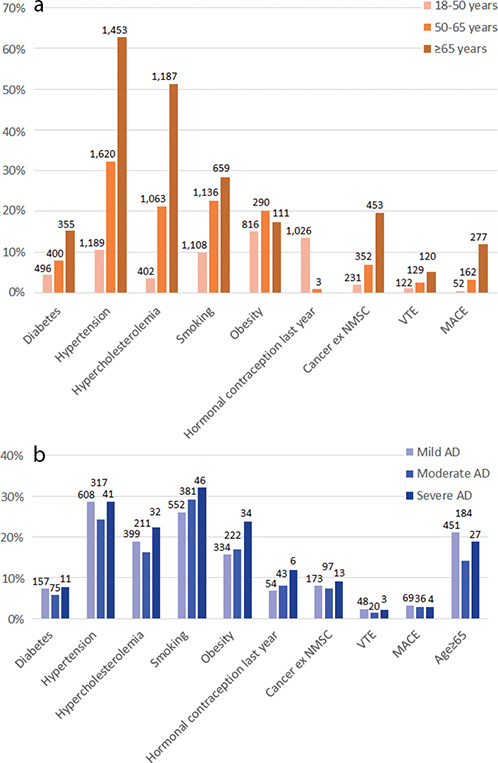
Fig. 1. Prevalence of risk factors in Danish adult patients with atopic dermatitis (AD), according to (a) age and (b) AD severity group. Risk factors were identified in the Danish national registers or in the Danish Skin Cohort and were based on diagnostic codes, prescription data, and smoking, height and weight information. AD severity was divided into 3 groups: mild (PO-SCORAD 1–25), moderate (PO-SCORAD 25–50) and severe (PO-SCORAD > 50) AD. MACE: major cardiovascular events; NMSC: non-melanoma skin cancer; VTE: venous thromboembolism.
The majority of risk factors was most common in the severe AD group, but the prevalence was only marginally higher than in the mild severity group (Fig. 1 and Table SIII). The moderate severity group generally had the lowest occurrence of risk factors. The prevalence of self-reported smoking and obesity increased with AD severity group.
Half of patients (49.5%) at some point had at least one risk factor (any), while 38.0% at some point had a modifiable risk factor and 28.4% at some point had a non-modifiable risk factor (Table SIV). The mean number (SD) of risk factors (any) was approximately 1 for both men and women, while it increased from 0.5 (0.8) in the youngest age group to 3.0 (1.4) in the oldest age group. The majority (64.4%) of the younger patients had no risk factors, while for the oldest participants, most (60.3%) had 3 or more risk factors (Fig. 2). Non-modifiable risk factors were uncommon in patients under 65 years and most (81.8%) had no non-modifiable risk factors (Table SIV). Of patients over 65 years, 48.6%, at some point, had at least 1 non-modifiable risk factor besides their age, increasing to 59.3% among elderly patients with severe AD.
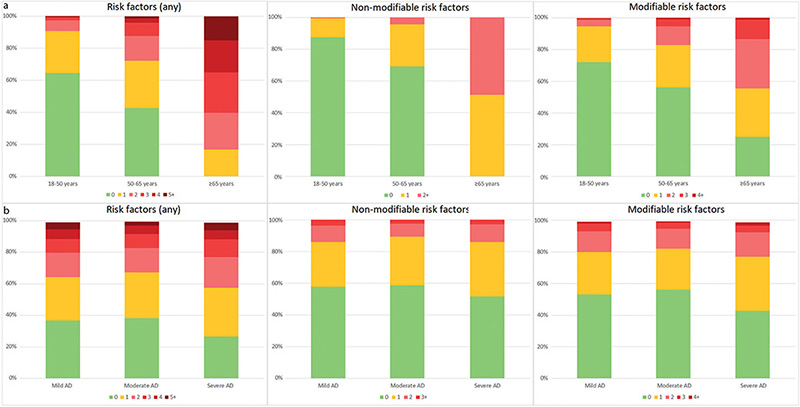
Fig. 2. Total number of risk factors, non-modifiable and modifiable risk factors in adult Danish patients with atopic dermatitis (AD) according to (a) age and (b) AD severity group. Risk factors, all, included: ever diabetes, hypertension, hypercholesterolaemia, smoking, obesity, cancer, venous thromboembolism, major cardiovascular events, and hormonal contraception in the past year, and age ≥ 65 years. Non-modifiable risk factors included: ever cancer, venous thromboembolism, major cardiovascular events, smoking and age ≥ 65 years. Modifiable risk factors included: ever diabetes, hypertension, hypercholesterolaemia, obesity, and hormonal contraception in the past year. AD severity was divided into 3 groups: mild (PO-SCORAD 1–25), moderate (PO-SCORAD 25–50) and severe (PO-SCORAD > 50) AD.
The mean number of risk factors was equal across AD severity groups (Table SIV).
The risk profile of 55.3% of patients was favourable, while and 16.3% and 28.4%, respectively, had a moderate and unfavourable risk profile (Fig. 3). The proportion of patients with an unfavourable risk profile increased with age group.

Fig. 3. Janus kinase inhibitor treatment risk profiles in adult Danish patients with atopic dermatitis overall and according to age group. Green (favourable): age < 65 years and no registration of diabetes, hypertension, hormonal contraception, or hypercholesteraemia in the past year, no ever registration of smoking, obesity cancer, venous thromboembolism, or major cardiovascular events. Yellow (moderate): age < 65 years and an ever registration of obesity or a recent (past year) registration of hypertension, diabetes, hormonal contraception, or hypercholesterolaemia and no ever registration of smoking, cancer, venous thromboembolism, or major cardiovascular events. Red (unfavourable): ever registration of smoking, cancer, venous thromboembolism, or major cardiovascular events, or age ≥ 65 years. Right panel of the ≥ 65 years bar illustrates the risk profile distribution among those ≥ 65 years if advanced age is not considered a risk factor.
A history of tuberculosis (0.1%), HIV (0.2%) or hepatitis B and C (0.4%) was rare, while 4% at some point had had HZ (Table SV).
DISCUSSION
Main findings
This study showed that risk factors that may impact treatment with oral JAKi were common in Danish adult patients with AD, and that half of patients had at least 1 risk factor. The number of risk factors increased with patient age, and the oldest participants held 3 risk factors on average, and almost half had been registered with at least 1 potential non-modifiable risk factor besides their age. Although, half of all patients would be able to start oral JAKi treatment without restrictions, in approximately 16% of patients appropriate lifestyle or treatment changes may be necessary for the patient to be eligible for systemic JAKi. Almost 30% of patients would probably only be candidates for oral JAKi if no other suitable treatment alternatives were available.
Interpretation
Though little is known about the prevalence of risk factors that could impact treatment with oral JAKi in patients with AD, previous data demonstrated that patients with AD have increased occurrence of active smoking, hypertension, and obesity (12–14), whereas data on an association between AD and diabetes are mixed (15, 16). Recently, AD has been associated with a very modest, if any, increased risk for cardiovascular events in Europeans, seemingly increasing with AD severity (17–19). No association has been found between AD and risk of VTE (20). The risk of specific cancers (lymphoma, skin cancer, keratinocyte cancer) is also increased in patients with AD (15, 16).
The current study showed that approximately half of adult patients with AD at some point had at least 1 risk factor that could potentially impact treatment with oral JAKi, and that physicians need to acquire further information about this before prescribing JAKi. Notably, not all risk factors are stable, and some risk factors may be considered negligible if they are either not active, mild in nature, well-controlled or occurred several years ago. This study, therefore, divided the risk factors into “modifiable” or “non-modifiable”. Non-modifiable risk factors were considered to be continuously relevant and to cause the physician to consider other treatment options first, or to lower the treatment dose if a JAKi is prescribed. Although smoking cessation may decrease the risk of cardiovascular disease, smoking, including previous long-term smoking, together with advanced age, are specific points of attention in the EMA statement, since the excess malignancy risk seen in the ORALSURV study was mainly driven by smoking and age ≥ 65 years (1, 21, 22). Importantly, in the ORALSURV study, never-smokers aged < 65 years with at least 1 cardiovascular risk factor did not have a risk increase compared with TNFi with up to 6 years of follow-up (23). We considered modifiable risk factors to include ever diabetes, hypertension, hypercholesterolaemia, and obesity, and hormonal contraception in the previous year. Having diabetes, hypertension, or hypercholesterolaemia should probably not exclude the patient from oral JAKi treatment, if the conditions are well-controlled. Similarly, discontinued use of hormonal contraception should probably not restrict use of oral JAKi in women without other risk factors; at least based on insight from JAKi use in rheumatoid arthritis where the risk of VTE was not increased in hormonal contraceptive users (24). Most women of childbearing age had used oral contraceptives, but only approximately 1 in 8 had used it in the previous year. History of obesity should probably not cause physicians to avoid using oral JAKi, but, since the occurrence of VTE with baricitinib treatment has been associated with obesity, the dose may be reduced to the lowest possible (25, 26). The benefit-risk profile of different treatments should always be assessed at an individual level and evaluation of disease status could be relevant with fixed intervals.
This study created 3 risk profiles: favourable, moderate, and unfavourable, and showed that most patients (55.3%) would be able to start oral JAKi treatment without any concern in relation to described risk factors. A moderate risk profile was present in 16.3% of patients, and, for these patients, systemic JAKi therapy would be an option under certain conditions, probably using the lowest dose possible. An unfavourable risk profile was present in 28.4% of patients, which may restrict treatment with oral JAKi as first line treatment.
Identifying Danish patients with hospital-managed AD in the registers allowed us to identify the risk profile of patients who present to the clinic. The current study population is non-selected, and disease and prescription data are from high-quality nationwide sources. A Danish general population-based study (27) measuring height and weight in 9,656 Danish adults found an obesity prevalence similar to that in the current study. In addition, a study measuring blood pressure in a representative sample (n = 7,767) of the Danish population aged 20–89 years, as in this study, found that 22.3% was hypertensive, but also that 28% were not aware of their diagnosis (28, 29). Likewise, in a Danish population-base of 13,016 randomly sampled individuals, 70% of men with screen-detected diabetes were not aware of their disease (30). This suggests that it is not sufficient for dermatologists evaluating a patient for oral JAKi treatment to ask the patient about disease status. A full evaluation will require a thorough, time-consuming, investigation, including blood pressure measurement, blood tests, anthropometric measurements, and a journal and medicine review. It may be difficult for dermatologists to keep themselves updated on correct assessment and evaluation of risk factors and consultation time is limited. Correctly assessing the risk profile of a patient with AD before treatment with oral JAKi will compete with assessment of treatable comorbidities, such as allergic respiratory disease, mental health issues, and eye conditions.
Importantly, the Danish population can probably be considered a rather low-risk population. The World Health Organization (WHO) estimated the obesity rate in Danish adults to be 21.3% in 2016, while the rate was higher in, for example, Germany (25.7%), the UK (29.5%) and the USA (37.3%) (31, 32). Similarly, the rate of adult smokers is lower in Denmark (17.5%) compared with worldwide (23%) (33). Hence, risk factor prevalences are not readily translatable to other countries or regions. In the same way, this study is limited to AD patients, and risk profiles will probably differ in other patient populations (rheumatoid arthritis, alopecia areata, etc.).
A priori, we expected the severity of AD to be more decisive of risk profile than the data revealed. This was based on results from the literature associating the risk of several risk factors with AD severity (13, 14, 17, 18). However, we observed only marginally higher prevalence of risk factors in the severe AD group than in the mild AD group. These results might partly be explained by the mild group being slightly older (53.2 vs 50.9 years). Also, the moderate AD severity group seemed to have the lowest prevalence of risk factors, except regarding lifestyle factors. This group was younger and has previously been shown to have a higher proportion of patients with a socioeconomic position above average than the severe group (34). Nevertheless, AD is a highly fluctuating disease, and patients who are not candidates for oral JAKi based on disease severity may be candidates for treatment in the future. Therefore, an understanding of risk profiles across disease severity strata is important.
Few patients with AD had previously had opportunistic infections. Still, due to the possibility of recurrence/reactivation of infection, screening for tuberculosis (especially in endemic areas), hepatitis B and C, and HIV (in patients at risk) should be performed before initiation of treatment.
Study strengths and limitations
This study has several strengths, including the nationwide morbidity and prescription data used to assess the occurrence of JAKi-relevant risk factors in a non-selected AD-population, as well as the linkage to DSC, which allowed us to stratify a subset of the population according to AD severity.
The algorithm for smoking in this study was based on interventions for smoking cessation and diagnoses of smoking, tobacco use, chronic obstructive pulmonary disease, and lung cancer, suggesting significant or long-term use. This allowed us to categorize this risk factor as “non-modifiable”. Data on obesity were calculated based on anthropometric measurements, which may not be collected systematically and, even though the current study used the most recent registrations, these may not necessarily describe current BMI. Clinical data regarding the risk factor disease control status were not available.
Conlusion
Risk factors that may impact treatment with oral JAKi were common in Danish adult patients with AD and increased with age. Dermatologists should carefully assess risk in their patients before initiating treatment with JAKis.
ACKNOWLEDGEMENTS
The research project was approved by the Danish Data Protection Agency (journal number VD-2018-286). Approval by the National Committee on Health Research Ethics was not required as the study does not include research on biological material.
REFERENCES
- Winthrop KL, Cohen SB. Oral surveillance and JAK inhibitor safety: the theory of relativity. Nat Rev Rheumatol 2022; 18: 301–304.
- Ytterberg SR, Bhatt DL, Mikuls TR, Koch GG, Fleischmann R, Rivas JL, et al. Cardiovascular and cancer risk with tofacitinib in rheumatoid arthritis. N Engl J Med 2022; 386: 316–326.
- FDA requires warnings about increased risk of serious heart-related events, cancer, blood clots, and death for JAK inhibitors that treat certain chronic inflammatory conditions. 2021. [Accessed Feb 13, 2023] Available from: https://www.fda.gov/drugs/drug-safety-and-availability/fda-requires-warnings-about-increased-risk-serious-heart-related-events-cancer-blood-clots-and-death.
- Salinas CA, Louder A, Polinski J, Zhang TC, Bower H, Phillips S, et al. Evaluation of VTE, MACE, and serious infections among patients with RA treated with baricitinib compared to TNFi: a multi-database study of patients in routine care using disease registries and claims databases. Rheumatol Ther 2023; 10: 201–223.
- EMA confirms measures to minimise risk of serious side effects with Janus kinase inhibitors for chronic inflammatory disorders. 2023. [Accessed Feb 13, 2023] Available from: https://www.ema.europa.eu/en/medicines/human/referrals/janus-kinase-inhibitors-jaki.
- Egeberg A, Andersen YMF, Thyssen JP. Prevalence and characteristics of psoriasis in Denmark: findings from the Danish skin cohort. BMJ Open 2019; 9: e028116.
- Haugaard JH, Dreyer L, Ottosen MB, Gislason G, Kofoed K, Egeberg A. Use of hydroxychloroquine and risk of major adverse cardiovascular events in patients with lupus erythematosus: a Danish nationwide cohort study. J Am Acad Dermatol 2021; 84: 930–937.
- Olesen JB, Lip GYH, Hansen ML, Hansen PR, Tolstrup JS, Lindhardsen J, et al. Validation of risk stratification schemes for predicting stroke and thromboembolism in patients with atrial fibrillation: nationwide cohort study. BMJ 2011; 342: 1–9.
- Egeberg A, Mallbris L, Gislason GH, Skov L, Hansen PR. Risk of multiple sclerosis in patients with psoriasis: a Danish nationwide cohort study. J Invest Dermatol 2016; 136: 93–98.
- Canning M, Jørgensen S, Noer M, Nørholk L, Lidegaard O, Petersen K. Danish Society of Obstetrics and Gynaecology’s guideline. In: hormonal contraception and thromboembolic disease. [in Danish] 2020.
- Schmidt SAJ, Vestergaard M, Baggesen LM, Pedersen L, Schønheyder HC, Sørensen HT. Prevaccination epidemiology of herpes zoster in Denmark: quantification of occurrence and risk factors. Vaccine 2017; 35: 5589–5596.
- Kantor R, Kim A, Thyssen JP, Silverberg JI. Association of atopic dermatitis with smoking: a systematic review and meta-analysis. J Am Acad Dermatol 2016; 75: 1119–1125.e1.
- Yousaf M, Ayasse M, Ahmed A, Gwillim EC, Janmohamed SR, Yousaf A, et al. Association between atopic dermatitis and hypertension: a systematic review and meta-analysis. Br J Dermatol 2022; 186: 227–235.
- Zhang A, Silverberg JI. Association of atopic dermatitis with being overweight and obese: a systematic review and metaanalysis. J Am Acad Dermatol 2015; 72: 606–616.e4.
- Paller A, Jaworski JC, Simpson EL, Boguniewicz M, Russell JJ, Block JK, et al. Major comorbidities of atopic dermatitis: beyond allergic disorders. Am J Clin Dermatol 2018; 19: 821–838.
- Thyssen JP, Halling AS, Schmid-Grendelmeier P, Guttman-Yassky E, Silverberg JI. Comorbidities of atopic dermatitis – what does the evidence say? J Allergy Clin Immunol 2023; 151: 1155–1162
- Yuan M, Cao WF, Xie XF, Zhou HY, Wu XM. Relationship of atopic dermatitis with stroke and myocardial infarction: a meta-analysis. Medicine (Baltimore) 2018; 97: e13512.
- Ascott A, Mulick A, Yu AM, Prieto-Merino D, Schmidt M, Abuabara K, et al. Atopic eczema and major cardiovascular outcomes: a systematic review and meta-analysis of population-based studies. J Allergy Clin Immunol 2019; 143: 1821–1829.
- Thyssen JP, Halling-Overgaard AS, Andersen YMF, Gislason G, Skov L, Egeberg A. The association with cardiovascular disease and type 2 diabetes in adults with atopic dermatitis: a systematic review and meta-analysis. Br J Dermatol 2018; 178: 1272–1279.
- Chen TL, Lee LL, Huang HK, Chen LY, Loh CH, Chi CC. Association of risk of incident venous thromboembolism with atopic dermatitis and treatment with Janus kinase inhibitors: a systematic review and meta-analysis. JAMA Dermatol 2022; 158: 1254–1261.
- Curtis JR, Yamaoka K, Chen YH, Bhatt DL, Gunay LM, Sugiyama N, et al. Malignancy risk with tofacitinib versus TNF inhibitors in rheumatoid arthritis: results from the open-label, randomised controlled ORAL Surveillance trial. Ann Rheum Dis 2022; 82: 331–343.
- Wu AD, Lindson N, Hartmann-Boyce J, Wahedi A, Hajizadeh A, Theodoulou A, et al. Smoking cessation for secondary prevention of cardiovascular disease. Cochrane Database Syst Rev 2022; 8: CD014936.
- Kristensen LE, Danese S, Yndestad A, Wang C, Nagy E, Modesto I, et al. Identification of two tofacitinib subpopulations with different relative risk versus TNF inhibitors : an analysis of the open label, randomised controlled study ORAL Surveillance. Ann Rheum Dis 2023; 82: 901–910.
- Bieber T, Feist E, Irvine AD, Harigai M, Haladyj E, Ball S, et al. A review of safety outcomes from clinical trials of baricitinib in rheumatology, dermatology and COVID-19. Adv Ther 2022; 39: 4910–4960.
- Taylor PC, Bieber T, Alten R, Witte T, Galloway J, Deberdt W, et al. Baricitinib safety for events of special interest in populations at risk: analysis from randomised trial data across rheumatologic and dermatologic indications. Adv Ther 2023; 40: 1867–1883.
- Taylor PC, Weinblatt ME, Burmester GR, Rooney TP, Witt S, Walls CD, et al. Cardiovascular safety during treatment with baricitinib in rheumatoid arthritis. Arthritis Rheumatol 2019; 71: 1042–1055.
- Andersen YMF, Egeberg A, Hamann CR, Skov L, Gislason GH, Skaaby T, et al. Poor agreement in questionnaire-based diagnostic criteria for adult atopic dermatitis is a challenge when examining cardiovascular comorbidity. Allergy 2018; 73: 923–931.
- Kronborg CN, Hallas J, Jacobsen IA. Prevalence, awareness, and control of arterial hypertension in Denmark. J Am Soc Hypertens 2009; 3: 19–24.e2.
- Hoffmann-Petersen N, Lauritzen T, Bech JN, Pedersen EB. High prevalence of hypertension in a Danish population telemedical home measurement of blood pressure in citizens aged 55–64 years in Holstebro county. Am J Hypertens 2016; 29: 439–447.
- Glumer C, Jørgensen T, Borch-Johnsen K, Study I. Prevalences of diabetes and impaired glucose regulation in a Danish population: the Inter99 study. Diabetes Careare 2003; 26: 2335–2340.
- Bentham J, Di Cesare M, Bilano V, Bixby H, Zhou B, Stevens GA, et al. Worldwide trends in body-mass index, underweight, overweight, and obesity from 1975 to 2016: a pooled analysis of 2416 population-based measurement studies in 128·9 million children, adolescents, and adults. Lancet 2017; 390: 2627–2642.
- Ritchie H, Roser M. Our World In Data. [Accessed Mar 23, 2023] Available from: https://ourworldindata.org/obesity.
- Ritchie H, Roser M. Our World In Data. [Accessed Mar 10, 2023] Available from: https://ourworldindata.org/smoking.
- Egeberg A, Griffiths CEM, Williams HC, Andersen YMF, Thyssen JP. Clinical characteristics, symptoms and burden of psoriasis and atopic dermatitis in adults. Br J Dermatol 2020; 183: 128–138.