ORIGINAL REPORT
Correlation between Dermatology Life Quality Index and Psoriasis Area and Severity Index in Patients with Psoriasis: A Cross-sectional Global Healthcare Study on Psoriasis
Julia-Tatjana MAUL1,2, Lara V. MAUL1–3, Johannes A. DIDASKALU1, Fernando VALENZUELA4, Ricardo ROMITI5, Hannah PETERSON6, Edwin KOROURI7, Farah NOVOA8, Hazel H. OON9, Min ZHENG10, Jashin J. WU11, Jacob P. THYSSEN12, Alexander EGEBERG12,13, April W. ARMSTRONG14 and Mia-Louise NIELSEN13
1Faculty of Medicine, University of Zurich, 2Department of Dermatology, University Hospital Zurich, Zurich, 3Department of Dermatology, University Hospital Basel, Basel, Switzerland, 4Department of Dermatology, University of Chile, Santiago, Chile, 5Department of Dermatology, University of São Paulo, School of Medicine, São Paulo, Brazil, 6Loma Linda University School of Medicine, Loma Linda, CA, USA, 7Rosalind Franklin University of Medicine and Science, Chicago Medical School, North Chicago, IL, USA, 8Department of Dermatology, Jockey Salud Medical Center, Lima, Peru, 9Department of Dermatology, National Skin Centre, Singapore, 10Dermatology Department, Second Affiliated Hospital, Zhejiang University, School of Medicine, Zhejiang, China, 11Department of Dermatology, University of Miami Miller School of Medicine, Miami, FL, USA, 12Department of Clinical Medicine, University of Copenhagen, 13Department of Dermatology, Bispebjerg Hospital, University of Copenhagen, Copenhagen, Denmark and 14Keck School of Medicine, University of Southern California, Los Angeles, CA, USA
Quality of life impairment in dermatology patients and severity of psoriasis are quantified by the Dermatology Life Quality Index (DLQI) and the Psoriasis Area and Severity Index (PASI), respectively. The aim of this study is to compare the correlation between PASI and DLQI in patients from different geographical areas and to identify predictors of high DLQI across geographical regions. Correlations between PASI and DLQI were evaluated using Spearman’s rank correlation tests and quantile regression. The study included 1,158 patients with psoriasis, with a median (interquartile range) PASI and DLQI of 6.0 (3.0–12.0) and 8.0 (4.0–15.0), respectively. Correlations were demonstrated between PASI and DLQI, both overall and stratified by geographical region. Quantile (median) regression yielded coefficients of 0.75 (95% confidence interval (95% CI) 0.62, 0.88) for Switzerland, 0.50 (95% CI 0.42, 0.58) for Latin America, 0.34 (95% CI 0.16, 0.51) for Asia, and 0.31 (95% CI 0.08, 0.53) for the USA. Current age, age at diagnosis, sex, body mass index, and psoriasis arthritis affected DLQI in Latin America, while education had an impact among patients treated in Switzerland. Few countries were included within each continent; hence, more data from different countries are necessary for generalizability. The study showed correlations between PASI and DLQI among patients in all included geographical regions. The patients’ characteristics affecting DLQI vary worldwide.
Key words: correlation; cross-sectional study; DLQI; GHSP; PASI; psoriasis.
SIGNIFICANCE
This study evaluates the correlation between Psoriasis Area and Severity Index and Dermatology Life Quality Index scores on a global scale. Multiple covariates were significantly associated with Dermatology Life Quality Index among patients in Switzerland and Latin America, and a correlation was found between Dermatology Life Quality Index and Psoriasis Area and Severity Index in all countries. This indicates that treatment guidelines should possibly vary with geographical region, in order to best improve patients’ quality of life.
Citation: Acta Derm Venereol 2024; 104: adv20329. DOI https://doi.org/10.2340/actadv.v104.20329.
Copyright: © Published by Medical Journals Sweden, on behalf of the Society for Publication of Acta Dermato-Venereologica. This is an Open Access article distributed under the terms of the Creative Commons Attribution-NonCommercial 4.0 International License (https://creativecommons.org/licenses/by-nc/4.0/)
Submitted: Oct 5, 2023; Accepted: Dec 26, 2023; Published: Mar 12, 2024
Corr: Julia-Tatjana Maul, Department of Dermatology, University Hospital of Zurich, Zurich, Switzerland. E-mail: Julia-Tatjana.maul@usz.ch
Competing interests and funding: With no relation to the current manuscript J-TM has served as advisor and/or received speaking fees and/or participated in clinical trials sponsored by AbbVie, Almirall, Amgen, BMS, Celgene, Eli Lilly, LEO Pharma, Janssen-Cilag, MSD, Novartis, Pfizer, Pierre Fabre, Roche, Sanofi, UCB. With no relation to the current manuscript FV has served as advisor and/or received speaking fees and/or participated in clinical trials sponsored by AbbVie, Amgen, BMS, Eli Lilly, LEO Pharma, Janssen-Cilag, MSD, Novartis, Pfizer and Sanofi. With no relation to the current manuscript RR has served as a scientific consultant, speaker, or clinical study investigator for AbbVie, Boehringer Ingelheim, Galderma, Janssen-Cilag, Eli-Lilly, Leo-Pharma, Novartis, Pfizer, Sanofi, TEVA, and UCB. With no relation to the current manuscript HHO has served as an advisory board member and/or received speaking fees and/or participated in research sponsored by AbbVie, Boehringer Ingleheim, Eli Lilly, LEO Pharma, Janssen, Novartis, and Pfizer. With no relation to the current manuscript MZ has served as advisor and/or received speaking fees and/or participated in clinical trials sponsored by AbbVie, Boehinger Ingelheim, BMS, Xian-Janssen, Lilly, LEO Pharma China, Novartis, Pfizer, Sun Pharma and Sanofi. With no relation to the current manuscript JPT is a full-time employee at LEO Pharma, and is an advisor for AbbVie, Almirall, Arena Pharmaceuticals, Coloplast, OM Pharma, Aslan Pharmaceuticals, Union Therapeutics, Eli Lilly & Co, LEO Pharma, Pfizer, Regeneron, and Sanofi-Genzyme, a speaker for AbbVie, Almirall, Eli Lilly & Co, LEO Pharma, Pfizer, Regeneron, and Sanofi-Genzyme, and received research grants from Pfizer, Regeneron, and Sanofi-Genzyme. With no relation to the current manuscript AE has received research funding from Pfizer, Eli Lilly, Novartis, Bristol-Myers Squibb, Boehringer Ingelheim, AbbVie, Janssen Pharmaceuticals, the Danish National Psoriasis Foundation, the Simon Spies Foundation, and the Kgl Hofbundtmager Aage Bang Foundation, and honoraria as consultant and/or speaker from AbbVie, Almirall, Leo Pharma, Zuellig Pharma Ltd, Galápagos NV, Sun Pharmaceuticals, Samsung Bioepis Co., Ltd, Pfizer, Eli Lilly and Co., Novartis, Galderma, Dermavant, UCB, Mylan, Bristol-Myers Squibb, McNeil Consumer Healthcare, Horizon Therapeutics, Boehringer Ingelheim, and Janssen Pharmaceuticals. With no relation to the current manuscript AWA has served as a research investigator and/or scientific advisor to AbbVie, Almirall, Arcutis, ASLAN, Beiersdorf, BI, BMS, EPI, Incyte, Leo, UCB, Janssen, Lilly, Nimbus, Novartis, Ortho Dermatologics, Sun, Dermavant, Dermira, Sanofi, Regeneron, and Pfizer. With no relation to the current manuscript, JJW is or has been an investigator for AbbVie, Amgen, Eli Lilly, Incyte, Janssen, Novartis, Pfizer; a consultant for AbbVie, Almirall, Amgen, Arcutis, Aristea Therapeutics, Bausch Health, Bayer, Boehringer Ingelheim, Bristol-Myers Squibb, Codex Labs, Dermavant, DermTech, Dr. Reddy’s Laboratories, Eli Lilly, EPI Health, Galderma, Janssen, LEO Pharma, Mindera, Novartis, Regeneron, Samsung Bioepis, Sanofi Genzyme, Solius, Sun Pharmaceutical, UCB, and Zerigo Health; and a speaker for AbbVie, Amgen, Bausch Health, EPI Health, Novartis, Regeneron, Sanofi Genzyme, Sun Pharmaceutical, UCB. JAD, M-LN, HS, EK, FN have nothing to declare.
The University Hospital of Zürich (USZ) and University of Zürich (UZH) has partly financially supported the Global Healthcare Study on Psoriasis (GHSP).
The study was approved by the local ethics committee (EK2020–00002) and was conducted in compliance with the Declaration of Helsinki and Good Clinical Practice rules.
INTRODUCTION
Psoriasis is a chronic inflammatory skin disease with a approximate prevalence ranging between < 1% and 10%, depending on the geographical region (1). The prevalence is especially high in regions with older populations and in high-income countries, such as western/central Europe and North America (2).
Psoriatic arthritis (PsA) affects approximately 20% of patients with psoriasis (3), but other comorbidities, such as diabetes, cardiovascular diseases, and depression, are also associated with psoriasis (4, 5). Impairment of life quality among patients with PsA is often severe (6, 7), and improvements in the severity of psoriasis are associated with better general well-being (8, 9).
There are several treatment options for psoriasis, which depend on the severity burden (impairment) of the disease and are selected according to guidelines (10–13). In recent years, several different biologics have been developed with high efficacies and favourable safety profiles. Many patients achieve full or almost full skin clearance when treated with biologics, which often leads to considerable improvement in their quality of life (14). However, access to modern treatment, and impairment due to comorbidities, vary enormously worldwide (15). The availability of treatment resources is especially limited in low-income countries and for people with low socio-economic status.
The Psoriasis Area and Severity Index (PASI) is the most widely used measure of the objective severity of psoriasis symptoms. Both the body surface area (BSA) that is affected by psoriasis, as well as degrees of redness, swelling, and scaliness, contribute to a higher score. The PASI score ranges from 0 to 72, with a score higher than 10 corresponding to moderate-to-severe psoriasis.
The Dermatology Life Quality Index (DLQI) (16) is a subjective measure of the psychological burden, i.e. the impairment of quality of life related to psoriasis and other dermatological diseases. The DLQI is determined by a 10-item questionnaire. The index ranges from 0 to 30, with values above 10 corresponding to a large effect on the patient’s quality of life. The questionnaire includ-es questions about feelings, ability to perform daily activities, leisure, work/school, personal relationships, and treatment.
The correlation between PASI and DLQI is non-linear and, hence, the use of effective treatment options, such as biologics, can greatly improve the quality of life of patients (10, 14, 17–20). However, the relationship between PASI and DLQI for patients treated with multiple psoriasis treatments across different geographical areas remains unexplored. Therefore, cultural differences may influence how the severity of the disease affects the quality of life of patients.
Knowledge about the area-specific relationship between the psychological burden of disease and the severity of psoriasis signs and symptoms may be useful in the development of treatment guidelines across geographical regions.
This study investigated and compared the correlation between the objective severity of psoriasis assessed by dermatologists (using the PASI) and the psychological disease burden experienced by patients (using DLQI) from different geographical regions worldwide. In addition, the study investigated the influence of various predictor variables, such as age and sex, on the life quality of patients with psoriasis.
MATERIALS AND METHODS
Data sources
The Global Healthcare Study on Psoriasis (GHSP) is a multi-country, multi-centre, longitudinal observational study that collects cross-sectional data. This research project is an ongoing international, global survey performed since January 2020 in multiple countries across several continents (15, 21). Socio-demographic and psoriasis-related disease and treatment data were obtained from 2 specialized dermatology centres in Europe (Switzerland), 31 in Latin America (Brazil and Chile), 4 in Asia (China and Singapore), and 1 in North America (USA). Adult patients with a dermatologist-verified diagnosis of psoriasis were included in the GHPS data set if they agreed to participate.
The GHSP survey questions were comparable to those in European registries, such as the Swiss Dermatology Network for Targeted therapies (SDNTT), the British Association of Dermatologists Biologics and Immunomodulators Register (BADBIR), and the German Psoriasis Registry (PsoBest).
General patient demographics, such as sex, current age, age at diagnosis, educational background, ethnicity, status of concomitant PsA, and body mass index (BMI) were included. Furthermore, the severity of psoriasis was documented based on PASI, DLQI, and BSA as assessed by dermatologists or other healthcare professionals. Previous and current treatments were recorded in the categories “topical”, “phototherapy”, “non-biologic systemics”, and “biologics”.
The survey comprised 48 items resulting in binary variables (e.g. sex and status of concomitant PsA), categorical variables with multiple categories (e.g. previous/current treatment and educational background), and continuous variables (e.g. age and BMI). This study included all data available in the GHPS at the time of analysis.
Statistical analysis
Descriptive statistics are shown as numbers and percentages for categorical variables and median and interquartile ranges (IQR) for continuous variables.
Correlations between PASI and DLQI were assessed with Spearman’s rank correlation tests. Results were reported as correlation coefficients and p-values, indicating the strength and significance of the correlation, respectively. This analysis was performed both overall on the entire dataset, and stratified by geographical region.
Furthermore, quantile regression was performed with DLQI as the dependent variable and PASI as the independent variable, investigating the effect of PASI on DLQI. The model was applied overall, and for each geographical region separately. Crude results were obtained in addition to results based on models with several covariates included. Patient- and disease-specific variables were included unless they correlated highly with other variables (e.g. BSA was excluded because of the collinearity with PASI).
Regression coefficients were estimated and presented with 95% confidence intervals (95% CIs) for the 0.25, 0.5, and 0.75 quantiles, to investigate the effect of PASI on DLQI for patients with low, median, and high DLQI scores. The quantile regressions were visualized with regression lines for the 0.5 and 0.75 quantiles. For the model including multiple covariates, p-values were also reported. A significance level of 0.05 was used and p-values were adjusted for multiple testing using the Benjamini-Hochberg procedure.
Moreover, the regression coefficients were visualized for a range of different quantiles of the DLQI distribution and compared across geographical areas.
Data analysis was performed in Python version 3.7.6 including relevant libraries (22–24).
RESULTS
A total of 1,158 psoriasis patients were included (54.7% males, 19.4% with concomitant PsA) (397 from Switzerland, 580 from Latin America, 130 from Asia, and 51 from the USA). The median and interquartile ranges (IQR) of ages at diagnosis and at the time of visit were 31.0 (20.0–44.0) years and 48.0 (36.0–59.0), respectively. Median (IQR) PASI and DLQI scores were 6.0 (3.0–12.0) and 8.0 (4.0–15.0), respectively. Most patients were treated with topicals (90.8%) and non-biologic systemics (66.8%), while slightly less than half of the patients were treated with phototherapy (46.4%) and biologics (41.2%) (Table I).
Overall, the coefficient based on a Spearman’s correlation test was 0.53 (p < 0.001), indicating a moderate correlation between DLQI and PASI. When stratifying by geographical region, the coefficients obtained were 0.54 (p < 0.001) for Latin America, 0.47 (p < 0.001) for Switzerland, 0.45 (p < 0.001) for Asia, and 0.41 (p = 0.004) for the USA (Table II).
Quantile regression with PASI as independent variable yielded coefficients and 95% CIs (Table II). For median regression (a quantile of 0.5) the coefficient for Switzerland was larger than for all other included geographical areas (0.75 (95% CI 0.62, 0.88) compared with 0.50 (95% CI 0.42, 0.58) for Latin America, 0.34 (95% CI 0.16, 0.51) for Asia, and 0.31 (95% CI 0.08, 0.53) for the USA). This indicates a stronger effect of PASI on the median DLQI in Switzerland compared with the other regions.
Similarly, the coefficient obtained from performing 0.75 quantile regression was larger for Switzerland compared with both Latin America and Asia (0.84 (95% CI 0.67, 1.02) compared with 0.50 (95% CI 0.41, 0.59) for Latin America and 0.40 (95% CI 0.20, 0.61) for Asia), indicating that PASI affects the 0.75 quantile of DLQI more strongly in Switzerland compared with Latin America and Asia (Table II).
The p-values obtained from the quantile regression with multiple covariates indicated a statistically significant positive correlation between PASI and median DLQI for all geographical regions (Table III). In addition, education had a significant negative effect on DLQI in Switzerland, but not in any other region. Among patients in Latin America, current age had a statistically significant negative effect on DLQI, while age at diagnosis and BMI had positive effects on DLQI. Being male and having PsA are negatively and positively associated with DLQI, respectively. No covariates affected DLQI among patients treated in Asia and the USA.
Regression lines are shown for median and the 0.75 quantile regression models, where the slope of the lines represents the regression coefficients for each geographical region (Fig. 1). Furthermore, the regression coefficients as a function of a wider range of quantiles of the DLQI distribution were estimated and visualized (Fig. 2). In general, the coefficients are higher for larger quantiles, indicating a non-linear relationship between PASI and DLQI. Hence, an increase in PASI results in a greater increase in DLQI for patients with an already high value of DLQI. Patients from Switzerland with a DLQI above the 0.25 quantile seems to be more affected by increases in PASI compared with all other geographical regions.
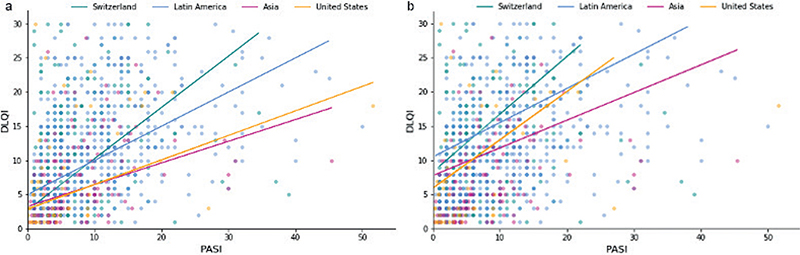
Fig. 1. Regression lines for (a) median regression and (b) 0.75 quantile regression for each geographical region. PASI: Psoriasis Area and Severity Index; DLQI: Dermatology Life Quality Index. All quantities on the axes on the figures are either indexes or coefficients, and are therefore unitless.
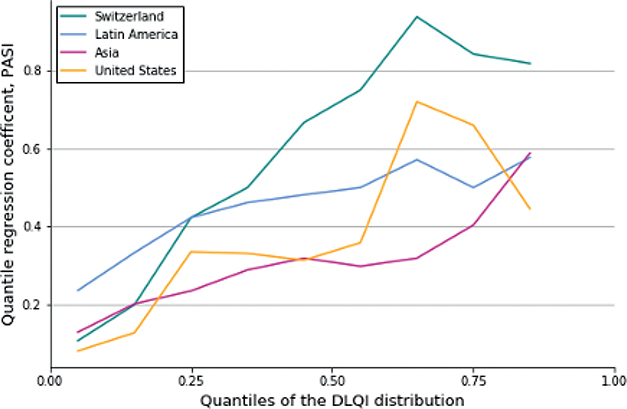
Fig. 2. Visualization of the quantile regression coefficients for Psoriasis Area and Severity Index (PASI) as a function of the quantiles of the Dermatology Life Quality Index (DLQI) distribution. The value of DLQI increases along the x-axis. A larger coefficient indicates a stronger effect of PASI on DLQI.
DISCUSSION
This study investigated and compared the correlation between PASI and DLQI across multiple geographical regions based on the GHSP data. Moderate correlations were observed between PASI and DLQI, both overall and individually for each geographical region (Switzerland, Latin America, Asia, and the USA). Furthermore, the study identified important covariates associated with DLQI within patient groups. Education had a significant negative effect on DLQI among patients in Switzerland, whereas BMI, current age, age at diagnosis, sex, and PsA were significantly associated with the median DLQI for patients in Latin America.
Depending on the country of residence and the availability of healthcare resources in the patient’s country the sense of quality of life may differ. This includes how psoriasis affects patients’ daily lives globally depending on the severity of psoriasis. Increases in PASI had a greater effect on the DLQI for patients from Switzerland compared with all other geographical regions. Across all regions, the effects of a change in PASI on DLQI seems to be greater for patients whose DLQI is already high. The cultural environment may be an influential factor; cultural standards could affect a patient’s openness to share their quality of life, feelings, and psychological comorbidities with medical professionals (25, 26). This may explain why patients with psoriasis from different countries demonstrate varying reactions to the DLQI.
It is notable that the study found only moderate correlations between PASI and DLQI, in accordance with the results from a pooled analysis of phase 3 clinical trials (20). This suggests that the quality of life of some patients is severely affected, even though their PASI, as assessed by a dermatologist, is low, while the quality of life of other patients is only mildly impaired even though their PASI is high. Despite the fact that skin clearance with different psoriasis treatments often seems to be associated with greater quality of life (18), a better understanding of regional differences in disease-specific quality of life worldwide is needed to optimize treatment in a personalized way. Better access to appropriate treatment in some geographical regions (21) may improve the burden of disease globally.
The regression coefficients are larger for higher quantiles, indicating that a reduction in PASI could result in a considerable improvement in the quality of life of patients. This observation applies especially to patients with severely impaired quality of life, but also to patients with only mildly impaired quality of life. Hence, it would be beneficial for patients to treat their psoriasis with the goal of achieving clear or almost clear skin. This finding is in agreement with the results from a meta-analysis (18) and several other studies (27, 28) revealing that patients with moderate-to-severe psoriasis with a PASI90 response achieve a superior quality of life compared with patients with a PASI75 response (29).
The observed non-linear relationship between PASI and DLQI is in accordance with previous research (30). The non-linearity might result from the DLQI being composed of multiple questions, each ranging between 0 and 3. Therefore, no component in the DLQI questionnaire can contribute more than 3 to the final score, regardless of the severity of the disease.
The current gold standard for effective treatment of moderate-to-severe psoriasis is achieving clear or almost clear skin with a PASI90 response and a DLQI of 0 or 1 (11). However, achieving these treatment objectives on a global scale proves difficult, attributable largely to the disparities in cultural contexts, as well as the non-uniform availability and allocation of treatment resources across different nations. The differences in treatments across geographical regions were probably partly explained by the differences in approval processes and access to specific medication worldwide. Hence, these processes may affect the correlation between PASI and DLQI across counties.
The data collection for the GHSP is an ongoing, and therefore, the dataset will be extended with information from other continents and other countries in the currently included continents.
Strengths and limitations
The main strength of the study is the international nature of the data, which allows for comparison of the effect of disease severity on psychological burden across multiple geographical regions. This is the most comprehensive investigation of the relationship between psoriasis severity and quality of life worldwide utilizing the GHSP dataset.
The analyses of data from the USA are limited by a modest number of patients from this region. As the number of included countries per continent is low, the data may not be well generalizable to the whole continent. However, since the data collection is ongoing, the generalizability can be improved in future research. Since the data are obtained from specialized psoriasis centres, PASI and DLQI values may be slightly higher compared with the general populations of patients with psoriasis in the respective geographical regions.
Conclusion
PASI and DLQI are correlated across geographical areas, and an increase in PASI affects the quality of life more severely in patients from Europe and patients whose quality of life is already highly affected. Different patient characteristics are associated with DLQI across regions. The aim is to use effective treatment regimens in the future, possibly depending on geographical region, in order to improve patient’s quality of life and reduce the severity of disease globally.
ACKNOWLEDGEMENTS
The authors thank all the global collaborators, without whom this project would not have been possible, and the dermatologists and patients who participated in this study. The authors acknowledge and are grateful for the collaboration with the Global Psoriasis Atlas (GPA), the International Psoriasis Council, the International Federation of Psoriasis Associations (IFPA) and the International League of Dermatological Societies (ILDA). The GPA’s collaborating organizations in the establishment and organization of the GPA are: the International Psoriasis Council (IPC), the International Federation of Psoriasis Associations (IFPA) and the International League of Dermatological Societies (ILDS). The authors are grateful for the enthusiastic collaboration of all of the members of the GPA Board of Governors, Steering Committee and regional and national coordinators. The University Hospital of Zürich (USZ) and University of Zürich (UZH) financially supported the Global Health Care Study on Psoriasis (GHSP).
REFERENCES
- Parisi R, Symmons DPM, Griffiths CEM, Ashcroft DM. Global epidemiology of psoriasis: a systematic review of incidence and prevalence. J Invest Dermatol 2013; 133: 377–385.
- Parisi R, Iskandar IYK, Kontopantelis E, Augustin M, Griffiths CEM, Ashcroft DM, et al. National, regional, and worldwide epidemiology of psoriasis: systematic analysis and modelling study. BMJ 2020; 369: m1590–m1590.
- Alinaghi F, Calov M, Kristensen LE, Gladman DD, Coates LC, Jullien D, et al. Prevalence of psoriatic arthritis in patients with psoriasis: a systematic review and meta-analysis of observational and clinical studies. J Am Acad Dermatol 2019; 80: 251–265.e19.
- Iskandar IYK, Ashcroft DM, Warren RB, Yiu ZZN, McElhone K, Lunt M, et al. Demographics and disease characteristics of patients with psoriasis enrolled in the British Association of Dermatologists Biologic Interventions Register. Br J Dermatol 2015; 173: 510–518.
- Gelfand JM, Neimann AL, Shin DB, Wang X, Margolis DJ, Troxel AB. Risk of myocardial infarction in patients with psoriasis. JAMA 2006; 296: 1735–1741.
- Rapp SR, Feldman SR, Exum ML, Fleischer AB, Reboussin DM. Psoriasis causes as much disability as other major medical diseases. J Am Acad Dermatol 1999; 41: 401–407.
- Maul J-T, Navarini AA, Sommer R, Anzengruber F, Sorbe C, Mrowietz U, et al. Gender and age significantly determine patient needs and treatment goals in psoriasis – a lesson for practice. J Eur Acad Dermatol Venereol 2019; 33: 700–708.
- Maul J-T, Augustin M, Sorbe C, Conrad C, Anzengruber F, Mrowietz U, et al. Association of sex and systemic therapy treatment outcomes in psoriasis: a two-country, multicentre, prospective, noninterventional registry study. Br J Dermatol 2021; 185: 1160–1168.
- Blome C, Gosau R, Radtke MA, Reich K, Rustenbach SJ, Spehr C, et al. Patient-relevant treatment goals in psoriasis. Arch Dermatol Res 2016; 308: 69–78.
- de Ruiter CC, Rustemeyer T. Biologics can significantly improve Dermatology Life Quality Index (DLQI) in psoriatic patients: a systematic review. Psoriasis (Auckland, NZ). 2022; 12: 99–112.
- Nast A, Smith C, Spuls PI, Avila Valle G, Bata-Csörgö Z, Boonen H, et al. EuroGuiDerm Guideline on the systemic treatment of Psoriasis vulgaris – Part 1: treatment and monitoring recommendations. J Eur Acad Dermatol Venereol 2020; 34: 2461–2498.
- Nast A, Smith C, Spuls PI, Avila Valle G, Bata-Csörgö Z, Boonen H, et al. EuroGuiDerm Guideline on the systemic treatment of Psoriasis vulgaris – Part 2: specific clinical and comorbid situations. J Eur Acad Dermatol Venereol 2021; 35: 281–317.
- Strober B, Ryan C, van de Kerkhof P, van der Walt J, Kimball AB, Barker J, et al. Recategorization of psoriasis severity: Delphi consensus from the International Psoriasis Council. J Am Acad Dermatol 2020; 82: 117–122.
- Mattei PL, Corey KC, Kimball AB. Psoriasis Area Severity Index (PASI) and the Dermatology Life Quality Index (DLQI): the correlation between disease severity and psychological burden in patients treated with biological therapies. J Eur Acad Dermatol Venereol 2014; 28: 333–337.
- Valenzuela F, De La Cruz C, Lecaros C, Fernández J, Hevia G, Maul LV, et al. Comorbidities in Chilean patients with psoriasis: a Global Healthcare Study on Psoriasis. Clin Exp Dermatol 2022; 47: 2234–2241.
- Finlay AY, Khan GK. Dermatology Life Quality Index (DLQI) – a simple practical measure for routine clinical use. Clin Exp Dermatol 1994; 19: 210–216.
- Norris D, Photiou L, Tacey M, Dolianitis C, Varigos G, Foley P, et al. Biologics and dermatology life quality index (DLQI) in the Australasian psoriasis population. J Dermatolog Treat 2017; 28: 731–736.
- Puig L, Thom H, Mollon P, Tian H, Ramakrishna GS. Clear or almost clear skin improves the quality of life in patients with moderate-to-severe psoriasis: a systematic review and meta-analysis. J Eur Acad Dermatol Venereol 2017; 31: 213–220.
- Muslimani MA, Bolcato V, de Silvestri A, Brazzelli V. Psoriatic patients undergoing long-term therapy with biologics: impact of residual localization of psoriasis on quality of life in an Italian clinical setting. Dermatol Ther 2020; 33: e14337.
- Houghton K, Patil D, Gomez B, Feldman SR. Correlation between change in Psoriasis Area and Severity Index and Dermatology Life Quality Index in patients with psoriasis: pooled analysis from four phase 3 clinical trials of secukinumab. Dermatol Ther (Heidelb) 2021; 11: 1373–1384.
- Maul J-T, Fröhlich F, Maul LV, Stunnenberg R, Valenzuela F, De La Cruz C, et al. Access to psoriasis treatment in Brazil and Chile: a cross-sectional multicentre Global Healthcare Study on Psoriasis. Br J Dermatol 2023; 188: 533–441.
- Virtanen P, Gommers R, Oliphant TE, Haberland M, Reddy T, Cournapeau D, et al. SciPy 1.0-Fundamental Algorithms for Scientific Computing in Python. CoRR 2019; abs/1907.1. Available from: http://arxiv.org/abs/1907.10121
- Seabold S, Perktold J. statsmodels: Econometric and statistical modeling with python. In: 9th Python in Science Conference. 2010.
- Hunter JD. Matplotlib: A 2D Graphics Environment. Comput Sci Eng 2007; 9: 90–95.
- Damiani G, Bragazzi NL, Karimkhani Aksut C, Wu D, Alicandro G, McGonagle D, et al. The Global, regional, and national burden of psoriasis: results and insights from the Global Burden of Disease 2019 Study. Front Med 2021; 8: 743180.
- Nijsten T, Meads DM, de Korte J, Sampogna F, Gelfand JM, Ongenae K, et al. Cross-cultural inequivalence of dermatology-specific health-related quality of life instruments in psoriasis patients. J Invest Dermatol 2007; 127: 2315–2322.
- Chicharro P, Llamas-Velasco M, Armesto S, Herrera-Acosta E, Vidal D, Vilarrasa E, et al. Fast and sustained improvement of patient-reported outcomes in psoriatic patients treated with secukinumab in a daily practice setting. Dermatol Ther 2022; 35: e15653.
- Ruiz-Villaverde R, Vasquez-Chinchay F, Rodriguez-Fernandez-Freire L, C Armario-Hita J, Pérez-Gil A, Galán-Gutiérrez M. Super-responders in moderate-severe psoriasis under guselkumab treatment: myths, realities and future perspectives. Life (Basel) 2022; 12: 1412.
- Strober B, Papp KA, Lebwohl M, Reich K, Paul C, Blauvelt A, et al. Clinical meaningfulness of complete skin clearance in psoriasis. J Am Acad Dermatol 2016; 75: 77–82.e7.
- Loft ND, Egeberg A, Rasmussen MK, Bryld LE, Gniadecki R, Dam TN, et al. Patient-reported outcomes during treatment in patients with moderate-to-severe psoriasis: a Danish nationwide study. Acta Derm Venereol 2019; 99: 1224–1230.