Early-stage mycosis fungoides is a rare cutaneous T-cell lymphoma with a good prognosis. Data regarding patients’ illness perception of mycosis fungoides are accumulating. However, investigating the dermatologists’ viewpoint is also essential, as it shapes the therapeutic relationship and doctor–patient communication. The aim of this study was to investigate the aspects of dermatologists’ illness perception towards early-stage mycosis fungoides and the way they present it to patients. Twenty-five dermatology residents and 55 attending physicians from all Israeli dermatology departments and the community completed the study questionnaires online. Dermatologists viewed mycosis fungoides as a chronic disease, causing a moderate emotional burden. In contrast to previously published data regarding patients’ illness perception, dermatologists demonstrated dominancy in the notion that patients were able to control their disease. Most dermatologists thought that patients perceived mycosis fungoides as an indolent lymphoma that causes anxiety. Dermatologists used a high diversity of themes when presenting mycosis fungoides to patients. The differences between the residents’ and attending physicians’ perceptions were minimal. Dermatologists have a kaleidoscope of views regarding the way they perceive mycosis fungoides, the way they think patients perceive it, and the way they communicate with patients. Maintaining patient-centred communication enables dermatologists to identify these gaps and view mycosis fungoides from their patients’ perspective.
Key words: mycosis fungoides; illness perception; psychodermatology.
Accepted Aug 16, 2022; Epub ahead of print Aug 16, 2022
Acta Derm Venereol 2022; 102: adv00784.
DOI: 10.2340/actadv.v102.2046
Corr: Oz Segal, Department of Dermatology, The Chaim Sheba Medical Center, Tel Hashomer, Ramat Gan, Israel. E-mail: oz.segal@sheba.health.gov.il
SIGNIFICANCE
Early-stage mycosis fungoides is a rare cutaneous lymphoma that does not represent the daily practice of most dermatologists. Owing to its special characteristics, it is of interest to understand dermatologists’ viewpoint of this disease. Physicians’ perception of diseases can affect various important aspects, such as their reactions and communication with patients. In addition, gaps in perception between patients and physicians might compromise patient care, and should therefore be identified. Further studies focusing on physicians’ perceptions are needed to understand their viewpoint and to enhance patient-centred care.
INTRODUCTION
Mycosis fungoides (MF) is a cutaneous T-cell lymphoma (CTCL). Although rare, it accounts for approximately 50% of all cases of CTCL. Advanced stages of MF have characteristics similar to those of systemic lymphoma, involving the lymph nodes, peripheral blood, and visceral organs, requiring systemic therapy, and having a poor prognosis. Early-stage MF (stages IA–IIA) is considered indolent and usually skin-limited, treated with skin-directed therapies, and has an excellent prognosis. Stages IA–IB disease includes only cutaneous involvement and stage IIA disease has some nodal involvement. The 5-year disease-specific survival rate for early-stage MF is 84–100% and the 5-year overall survival rates is 75–96% (1, 2). The disease in these early stages responds well to skin-directed therapies, including topical agents (i.e. corticosteroids, mechlorethamine (HN2), retinoids, and imiquimod), phototherapy, and local radiation, and in some cases, a “wait and see” approach is initiated (3).
Managing early-stage MF can be difficult, and it is usually performed by dermatologists. As a rare disease, managing MF, as well as other cutaneous lymphomas, does not represent the daily practice of most dermatologists. In addition, despite the favourable prognosis, MF can still be medically challenging in terms of choosing the appropriate therapeutic approach and facing a potentially dangerous medical condition (3). These special characteristics may have an impact on dermatologists’ attitudes towards MF and may increase the challenge of discussing MF with patients (4).
The common approach is to investigate patients’ ideas and thoughts (illness perception) regarding their medical condition. For example, previously published data showed that patients view MF as a chronic condition and strongly believe that their treatment is efficient in controlling the disease. It was also found that illness perception in patients is related to the way they cope with MF and their quality of life (5, 6). However, investigating the way healthcare practitioners perceive diseases is also essential and has not been performed by dermatologists treating early-stage MF. Doctors’ illness perception shapes their therapeutic relationship, decision-making processes, and doctor–patient communication (7). With time, there can be reciprocal influence cross-modifying the illness perception of both physicians and patients, which can alter therapeutic strategies, compliance, and patient satisfaction (8–10). Moreover, investigating physicians’ perspectives can shed light on the differences in perspectives between patients and physicians. These discrepancies might compromise patient–physician communication and various patient outcomes, leading to impaired well-being (10, 11).
Therefore, the aim of this study was to investigate dermatologists’ illness perception of early-stage MF, how they think patients perceive their condition, and how they present MF to their patients. The study also investigated the differences in these aspects between residents and attending physicians.
MATERIALS AND METHODS
Ethics statements
This multicentre cross-sectional questionnaire-based study assessed both quantitative and qualitative data. The study was approved by the Helsinki Board of the Sheba Medical Center (3925-17-SMC). Data were collected anonymously; hence informed consent was not required.
Participants
An online survey was conducted comprising all study questionnaires described below. From September 2020 to July 2021 an anonymous link was distributed to dermatology residents and attending physicians at all 7 dermatology departments in Israel. The department directors were contacted several times and asked to encourage their staff to participate in the study. Dermatologists working in the community listed on the department contact lists and the Israeli Dermatologists Association were also contacted. There were no exclusion criteria.
Quantitative data evaluated
Demographic data. Age, sex, years of experience, seniority (resident/specialist), subspecialty (for specialists), and place of work (hospital: at least 40 hours per month, community, both) were collected.
Illness perception of dermatologists. The revised Illness Perception Questionnaire was used for healthcare professionals to assess dermatologists’ views of patients with early-stage MF (12). The questionnaire consists of several subscales: consequences, the influences of MF on daily life (6 items); timeline-acute/chronic and cyclical, is MF long-lasting (6 items) or unpredictable (4 items)?; personal and treatment control, can MF be treated by the patient (6 items) or by medical treatment (5 items)?; coherence, how well patients understand MF (5 items); and emotional representation (4 items), the negative emotional impact of MF. A 5-point Likert scale was used for each item (1, strongly disagree; 5, strongly agree). The mean score for each subscale was calculated. Treatment control and timeline-cyclical were omitted because of an unsatisfactory Cronbach’s alpha (0.48–50); the rest of the subscales had a Cronbach’s alpha of 0.68–88.
Dermatologists’ view of patients’ illness perception. A 6-item scale was created. Three items were used to assess how dermatologists think patients frame MF as a medical condition (a chronic inflammatory condition, such as atopic dermatitis and psoriasis, indolent lymphoma, or cancer that necessitates surveillance and treatment), and 3 items were used to assess how dermatologists think patients feel about it (depressed, anxious, and impaired quality of life). The same Likert scale was used, as mentioned above.
Qualitative data evaluated
Presenting MF. Participants were asked to write in their own words how they explained early-stage MF to their patients.
Data and statistical analyses
Descriptive statistics were calculated for all the study variables. Categorical variables are reported as numbers and percentages. To have a wider understanding and attach meaning to the continuous variables (illness perception and dermatologists’ perception of patients) mean ± standard deviation (SD) were calculated. Prior to subsequent analyses it was confirmed that all continuous variables only minimally deviated from a normal distribution (skewness ranged between –0.62 and –0.18 and kurtosis ranged between –0.80 and 0.73). To examine the differences between residents and experts, multivariate analysis of variance (MANOVA) were used to analyse continuous variables in all scales. To evaluate qualitative data (how dermatologists present early-stage MF to their patients), the first and second authors classified the text of the dermatologists’ descriptions into 5 categories. Two minor disagreements regarding the classification were discussed with the third author. The categories were: MF is malignant, MF resembles inflammatory dermatoses, MF is a chronic condition, MF is a process of multiplication of abnormal cells, and MF has a good prognosis. The frequency of the categories was reported (every category alone and a combination of categories if used together in 1 participant). Pearson’s correlation coefficients were calculated between the illness perception subscales and the items of the scale used to assess what dermatologists thought about patients’ illness perception.
All tests were 2-sided, and a p-value < 0.05 was considered statistically significant. Statistical analysis was performed using SPSS software, version 25 (IBM Corp., Armonk, NY, USA).
RESULTS
Demographics
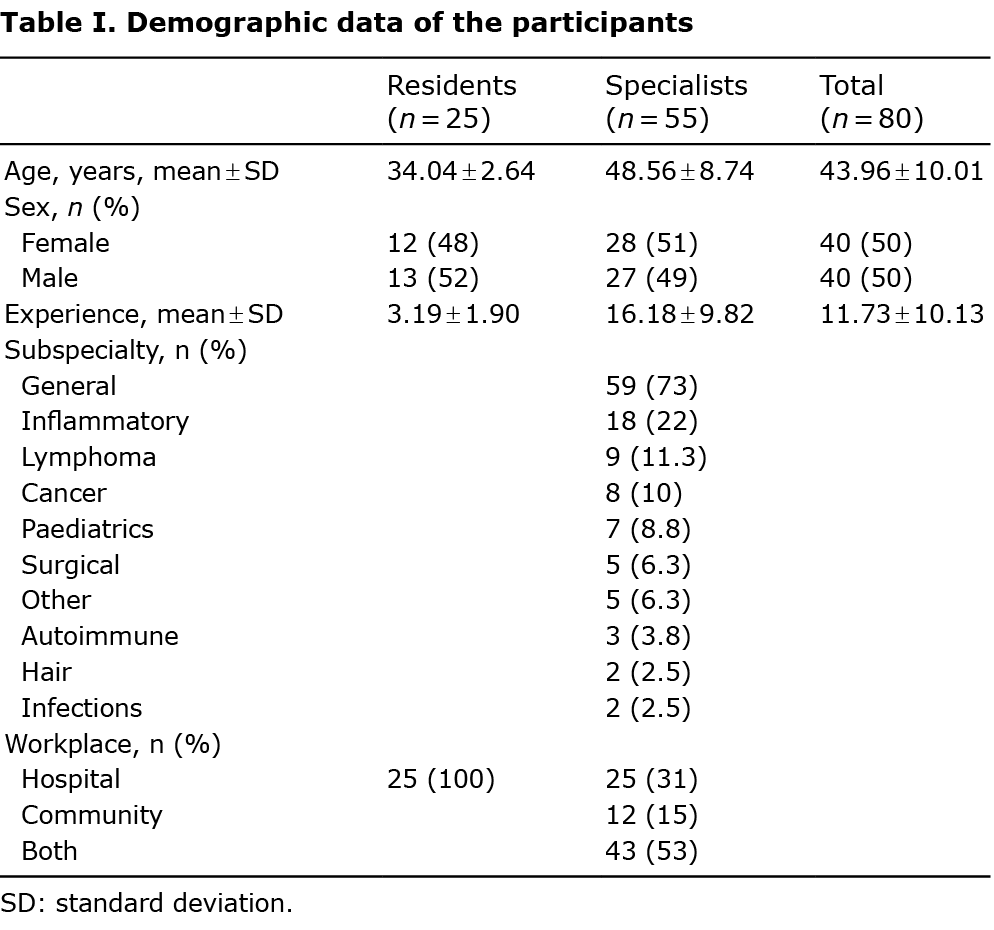
Ninety-one dermatologists responded (60% response rate). Participants with low response rates (n = 11) were excluded. There were no missing values of the responders who were included. The study population comprised 80 physicians (40 women, 40 men), mean ± SD age 43.96 ± 10.01 years. Fifty-five were board-certified dermatologists (specialists), of whom 9 (16.3%) held a subspecialty in cutaneous lymphomas, and the remaining 25 were dermatology residents. Demographic data are shown in Table I.
Illness perception: how dermatologists perceive mycosis fungoides
MF as a chronic disease was the dominant perception among the participants. It was moderately considered to cause an emotional burden (emotional representation); however, it was not considered to have a major effect on patients’ lives (consequences). MANOVA, including all scales, revealed significant statistical differences between residents and specialists (Wilks’ lambda 0.79, F(7,68)=2.61, p < 0.019). According to the univariate statistics, the only significant difference between residents and specialists was the consequences (F(1,74)=3.84, p < 0.001). The data are shown in Table II.

How dermatologists think patients perceive mycosis fungoides
Repeated measures analysis with indolent lymphoma as the comparison level revealed a statistically significant difference between responses of “indolent lymphoma” and “it is cancer that necessitates surveillance and treatment” (F(1,75)=11.74, p < 0.001) and “it is a chronic inflammatory condition” (F(1,75)=19.41, p < 0.0001). Repeated measures analysis with anxiety as the comparison level revealed a statistically significant difference between responses of “depressed” (F(1,75)=60.21, p < 0.0001) and “it impairs quality of life” (F(1,75)=19.50, p < 0.0001). The MANOVA of all items did not reveal significant statistical differences between residents and specialists (Wilks’ lambda 0.95, F(6,69)=0.60, p < 0.73). The data are shown in Table III.
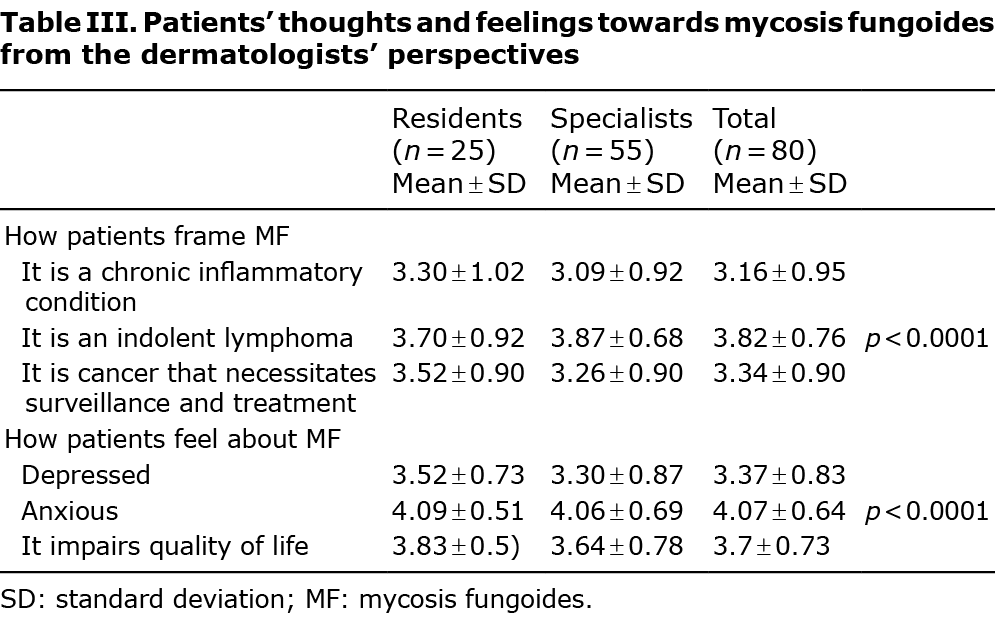
The study of correlations between illness perception components of the participants and how they viewed the patients’ thoughts and feelings demonstrated the following statistically significant correlations (all, p ≤ 0.01): the more they relate higher consequences to MF, the more they think the patients’ quality of life is impaired; and the more they relate higher emotional burden to MF, the more they think patients frame MF as a cancer that necessitates surveillance and treatment, the less they think patients frame MF as an indolent lymphoma, and the more they think the patients’ quality of life is impaired.
How dermatologists present mycosis fungoides to their patients
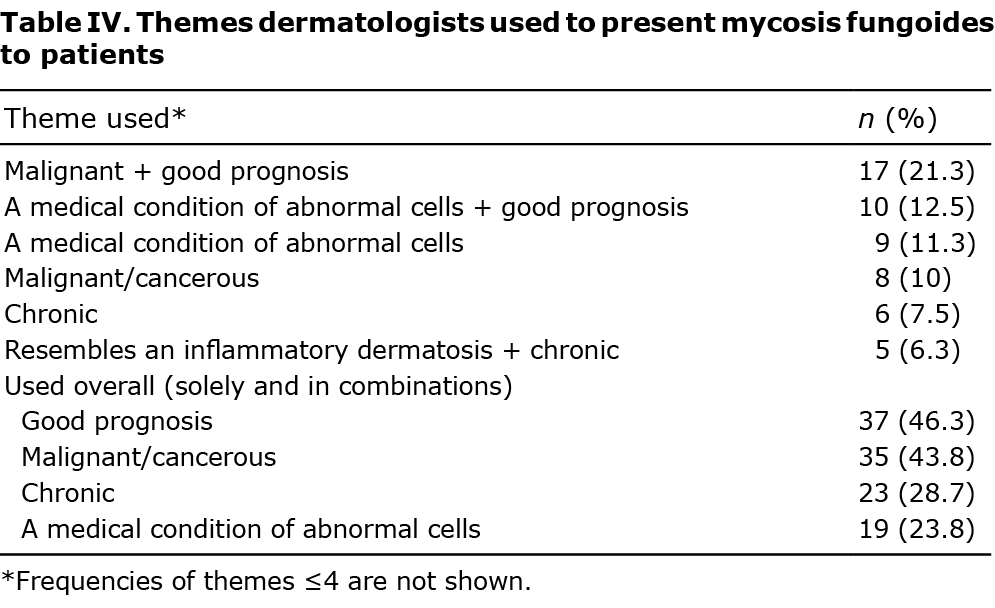
Examining each theme (used on its own as well as part of a combination) revealed that the most commonly used themes were “good prognosis” and “malignant/cancerous”. The latter was the most common combination. No statistically significant changes were found between residents and specialists. The data are shown in Table IV.
DISCUSSION
The aim of this study was to understand dermatologists’ point of view towards early-stage MF and the ideas of their patients. The main finding was that dermatologists have a kaleidoscope of views regarding the way they perceive MF, the way they think patients perceive MF, and the way they communicate with patients, all of which reflect the unique nature of MF.
Most participants were board-certified dermatologists working in hospitals, and 71% of them stated that they treat patients with MF. It is reasonable to assume that specialists serve as case managers of patients with MF, even if the treating physician is a resident.
Most dermatologists viewed early-stage MF as a chronic disease, which causes a moderate negative emotional burden but has little impact on the daily lives of patients. This was in agreement with the patients’ illness perception reported previously (5, 6) and is a realistic view of MF. Regarding personal control (the idea that patients can cure/control MF), we found higher levels among dermatologists (mean score 3.52) in comparison with patients in previously published data. For example, Segal et al. reported a mean score of 2.86 for patients and low levels of self-control were also reported (6, 13). Gaps in perceptions between patients and physicians are common, as physicians are unaware of their patients’ health beliefs, and these gaps can compromise medical care (14–16). Specifically, discrepancies between ideas about disease controllability were also found for patients with systemic sclerosis and their doctors, and might be relevant here. In rare diseases, such as systemic sclerosis and MF, physicians are unaware of their patients’ experience. This gap in perceptions might impair patient education regarding self-management of the disease and coping with its symptoms, leading to an increased disease burden and a reduced sense of controllability (10). It is important to note that patient education of people diagnosed with all types of cancer helps increase health-related quality of life and support, lower levels of depression and anxiety, improve clinical behaviours (i.e. cooperation and compliance), and strengthen the patients’ perception of control over the disease, and therefore should be enhanced (17).
Most dermatologists thought that patients frame MF as an “indolent lymphoma that causes anxiety.” It is encouraging to discover that they acknowledge the emotional influence of MF. Interestingly, previous studies have reported low anxiety levels in patients (5, 18, 19). However, concerns were raised regarding the adequacy of the scales used to assess anxiety in these patients, and it is possible that patients with more advanced stages indeed are more anxious. Furthermore, dermatologists who perceived MF as a disease causing substantial negative emotional burden tended to think that patients frame MF more negatively as “a cancer that necessitates surveillance and treatment,” and that it impairs quality of life. In other words, not only is there a difference between how patients and dermatologists view the emotional burden caused by MF, but there is also a difference between how doctors think patients perceive MF and how they perceive it. Conflicts of standpoints between patients and physicians should be identified and discussed to achieve shared decision-making, build partnerships, and promote satisfaction. This patient-centred partnership enables addressing patients’ individual views from their viewpoint, and not from the doctors’ viewpoint (20).
High diversity was found in the way dermatologists present MF to their patients. Overall, no single theme was used in >50% of dermatologists’ descriptions. The most common themes were “good prognosis” and “malignant/cancerous”, and this was the most frequent combination of themes. Although “chronic” was the most dominant aspect in doctors’ illness perception, it was only the third used theme. It seems that dermatologists try to align what they tell their patients with the way they think patients perceive the illness, and it is somewhat different from their own views. There are several explanations for this observation. Doctors want to deliver a message of hope to their patients (“indolent” and “good prognosis”) and avoid conveying a discouraging message that MF is chronic. However, withholding data and adopting a selective-information-giving strategy to patients with cancer to protect them might intensify the negative emotional burden of the disease, interoperated as deception, and should be avoided (4). Data investigating communication between oncologists and their patients show that the former tend to talk more about cure than care (7). Talking about treatment modalities and positive responses is indeed important (cure), but also talking about the necessary long-term follow-ups and living with MF (care) is equally important, although it might be difficult for both sides. The least-used theme was picturing MF as an inflammatory disease, such as psoriasis and atopic dermatitis, and this might represent attempts to “downgrade” the severity of MF, or “sweeten the pill”. Adopting an adequate way to present MF is the responsibility of dermatologists and should be considered by treating physicians.
Residents and specialists showed only small differences in their perceptions. Specialists significantly attributed less impact to MF on patients’ daily lives (consequence). This realistic view suits most early-stage MF cases, and reflects attending doctors’ positive familiarity with MF as well as the residents’ lack of experience (21). It is not clear why no other changes were observed. According to hierarchy theory, physicians share an unwritten agreement on the ranking of diseases according to prestige. According to this agreement, some diseases are considered more “prestigious,” influencing doctor–patient communication and therapeutic decisions (22). Young doctors acquire this agreement quickly and easily recognize prestigious medical conditions, and this insight has remained static over the years (23, 24). In light of the unique characteristics of MF, including its rarity and the lack of experience of young doctors, it is possible that MF is considered “prestigious”; hence young doctors try to fill the void and readily absorb the attitudes and perceptions of experienced staff.
Limitations
The limitations of this study include selection bias resulting from the difficulty in recruiting participants. The generalizability is limited because the study population comprised only Israeli dermatologists.
Conclusion
Dermatologists should acknowledge that there are gaps between them and their patients in the way they view some aspects of MF. It should be remembered that these gaps might compromise patient care, making life with MF more difficult for patients. Maintaining patient-centred communication enables dermatologists to view MF from their patients’ perspective and identify these gaps. There are also gaps among dermatologists in the way they talk with patients about MF. In order to find adequate ways to present this unique condition to patients, further long-term research, also performed in other populations of dermatologists, is required. It is also essential to investigate how this doctors–patient communication reflects on patients’ emotions, behaviour and coping.
The authors have no conflicts of interest to declare.
REFERENCES
- Agar NS, Wedgeworth E, Crichton S, Mitchell TJ, Cox M, Ferreira S, et al. Survival outcomes and prognostic factors in mycosis fungoides/Sézary syndrome: validation of the revised International Society for Cutaneous Lymphomas/European Organisation for Research and Treatment of Cancer staging proposal. J Clin Oncol 2010; 28: 4730–4739.
- Kim YH, Liu HL, Mraz-Gernhard S, Varghese A, Hoppe RT. Long-term outcome of 525 patients with mycosis fungoides and Sézary syndrome: clinical prognostic factors and risk for disease progression. Arch Dermatol 2003; 139: 857–866.
- Quaglino P, Prince HM, Cowan R, Vermeer M, Papadavid E, Bagot M, et al. Treatment of early-stage mycosis fungoides: results from the PROspective Cutaneous Lymphoma International Prognostic Index (PROCLIPI) study. Br J Dermatol 2021; 184: 722–730.
- Hack TF, Degner LF, Parker PA, Baile W, Brundage M, Bultz B, et al. The communication goals and needs of cancer patients: a review. Psychooncology 2005; 14: 831–847.
- Segal O, Trumper N, Pavlotsky F, Goldzweig G, Barzilai A. Illness perception, coping, and quality of life in early-stage mycosis fungoides. An Bras Dermatol 2021; 96: 27–33.
- Eder J, Kammerstätter M, Erhart F, Mairhofer-Muri D, Trautinger F. Illness perception in primary cutaneous T-cell lymphomas: what patients believe about their disease. Acta Derm Venereol 2016; 96: 381–385.
- Ong LML, Visser MRM, Lammes FB, de Haes JCJM. Doctor-patient communication and cancer patients’ quality of life and satisfaction. Patient Educ Couns 2000; 41: 145–156.
- van Duijn H, Kuyvenhoven M, Welschen I, den Ouden H, Slootweg A, Verheij T. Patients’ and doctors’ views on respiratory tract symptoms. Scand J Prim Health Care 2002; 20: 201–202.
- Scheuer E, Steurer J, Buddeberg C. Predictors of differences in symptom perception of older patients and their doctors. Fam Pract 2002; 19: 357–361.
- Arat S, Lenaerts JL, de Langhe E, Verschueren P, Moons P, Vandenberghe J, et al. Illness representations of systemic lupus erythematosus and systemic sclerosis: a comparison of patients, their rheumatologists and their general practitioners. Lupus Sci Med 2017; 4: 1–8.
- Whitehead K, Reuber M. Illness perceptions of neurologists and psychiatrists in relation to epilepsy and nonepileptic attack disorder. Seizure 2012; 21: 104–109.
- Arat S, van den Zegel A, van Rillaer M, Moons P, Vandenberghe J, de Langhe E, et al. Development and preliminary evaluation of the validity and reliability of a revised illness perception questionnaire for healthcare professionals. BMC Nurs 2016; 15: 34.
- Porkert S, Lehner-Baumgartner E, Valencak J, Knobler R, Riedl E, Jonak C. Patients’ illness perception as a tool to improve individual disease management in primary cutaneous lymphomas. Acta Derm Venereol 2018; 98: 240–245.
- Kremenchutzky M, Walt L. Perceptions of health status in multiple sclerosis patients and their doctors. Can J Neurol Sci 2013; 40: 210–218.
- Jung HP, Wensing M, Grol R. What makes a good general practitioner: do patients and doctors have different views? Bri J Gen Pract 1997; 47: 805–809.
- Sacristán JA, Dilla T, Díaz-Cerezo S, Gabás-Rivera C, Aceituno S, Lizán L. Patient-physician discrepancy in the perception of immune-mediated inflammatory diseases: rheumatoid arthritis, psoriatic arthritis and psoriasis. A qualitative systematic review of the literature. PLoS One 2020; 15: 1–16.
- Husson O, Thong MSY, Mols F, Smilde TJ, Creemers GJ, van de Poll-Franse LV. Information provision and patient reported outcomes in patients with metastasized colorectal cancer: results from the profiles registry. J Palliat Med 2013; 16: 281–288.
- Engin B, Keçici AS, Uzun AÖ, Yalçın M. Psychiatric comorbidity, depression, and anxiety levels and quality of life of the patients with mycosis fungoides. Dermatol Ther 2020; 33: e13922.
- Graier T, Fink-Puches R, Porkert S, Lang R, Pöchlauer S, Ratzinger G, et al. Quality of life, anxiety, and depression in patients with early-stage mycosis fungoides and the effect of oral psoralen plus UV-A (PUVA) photochemotherapy on it. Front Med 2020; 7: 1–8.
- Zanini C, Sarzi-Puttini P, Atzeni F, di Franco M, Rubinelli S. Doctors’ insights into the patient perspective: a qualitative study in the field of chronic pain. BioMed Res Int 2014;2014: 514230.
- Resnick S, Morrison RS. Physicians’ perceptions of procedural pain and discomfort. J Palliat Med 2004; 7: 646–651.
- Haldar M, Engebretsen E, Album D. Legitimating the illegitimate: how doctors manage their knowledge of the prestige of diseases. Health (London) 2016; 20: 559–577.
- Album D, Westin S. Do diseases have a prestige hierarchy? A survey among physicians and medical students. Soc Sci Med 2008; 66: 182–188.
- Album D, Johannessen LEF, Rasmussen EB. Stability and change in disease prestige: a comparative analysis of three surveys spanning a quarter of a century. Soc Sci Med 2017; 180: 45–51.