Women with cardiovascular disease are underdiagnosed, undertreated and under-represented in research. Even though the increased risk of cardiovascular disease among patients with psoriasis is well established, only a few studies have examined women with psoriasis. This study examined the prevalence of cardiovascular risk factors and cardiovascular disease among women with psoriasis. Using the Copenhagen City Heart Study and the Copenhagen General Population Study, 66,420 women were included in a cross-sectional design. Of these, 374 (0.56%) women had hospital-diagnosed psoriasis. Women with vs without hospital-diagnosed psoriasis had higher odds ratios of having traditional cardiovascular risk factors, including hypertriglyceridaemia, smoking, obesity, type 2 diabetes, and low physical activity, and of having non-traditional cardiovascular risk factors, including low level of education, high level of psychosocial stress, and low-grade inflammation. Compared with women from the general population, the multivariable adjusted odds ratio of heart failure and ischaemic cerebrovascular disease in women with hospital-diagnosed psoriasis was 2.51 (95% confidence interval 1.33–4.73) and 2.06 (1.27–3.35). In conclusion, women with hospital-diagnosed psoriasis have a higher prevalence of traditional and non- traditional cardiovascular risk factors, and increased risk of heart failure and ischaemic cerebrovascular disease, even after adjusting for these cardiovascular risk factors.
Key words: inflammatory skin disease; sex-specific; comorbidities; heart failure; myocardial infarction; cerebrovascular disease.
Accepted Sep 19, 2022; Epub ahead of print Sep 19, 2022
Acta Derm Venereol 2022; 102: adv00789.
DOI: 10.2340/actadv.v102.2244
Corr: Charlotte Näslund-Koch, Department of Dermatology and Allergy, Copenhagen University Hospital – Herlev and Gentofte, Gentofte Hospitalsvej 15, DK-2900 Hellerup, Denmark. E-mail: charlotte.sigrid.erika.naeslund.koch@regionh.dk
SIGNIFICANCE
Patients with psoriasis have increased risk of cardiovascular disease; however, little is known about women with psoriasis. Therefore, this study examined the prevalence of cardiovascular risk factors and risk of cardiovascular disease among women with psoriasis. Women with hospital-diagnosed psoriasis, compared with women without, had increased prevalence of both traditional and non- traditional cardiovascular risk factors. Furthermore, women with hospital-diagnosed psoriasis had increased risk of heart failure and stroke. This new information is important in order to optimize prevention and treatment of cardiovascular risk factors and disease among women with psoriasis.
INTRODUCTION
Psoriasis is a common chronic immune-mediated inflammatory skin disease affecting 125 million people worldwide (1). Although traditionally thought to only involve the skin, psoriasis is currently classified as a systemic inflammatory disease with extensive comorbidities (2, 3). Evidence from clinical and epidemiological studies suggests that individuals with psoriasis have increased risk of cardiovascular disease (3–6) and, mainly due to this increased risk, reduced life expectancy (7). Interestingly, when compared with individuals without psoriasis, those with psoriasis also have a higher prevalence of traditional cardiovascular risk factors (6, 8, 9), such as type 2 diabetes mellitus, smoking, hypertension, dyslipidaemia, and obesity, which could explain their higher risk of cardiovascular diseases. Psoriasis might also be an independent risk factor for cardiovascular disease (4, 5, 10), presumably through activation of inflammatory pathways exerting systemic effects (11). Furthermore, the inflammatory cells involved in the pathogenesis of psoriasis resemble those involved in the formation of the atherosclerotic plaque, and there are similarities in the immunoinflammatory mechanisms driving both diseases (12, 13).
The increased risk of cardiovascular disease in patients with psoriasis is well established, but studies focusing only on women with psoriasis are scarce (14, 15). In addition, women with cardiovascular disease are, in general, underdiagnosed, undertreated, and under-represented in research (16), even though cardiovascular disease remains a leading cause of death among women (17). Furthermore, some risk factors are particularly important in the development of cardiovascular disease in women compared with men (17). For psoriasis, this might also play a role, e.g. Lindegard (18) showed that diabetes and obesity were only associated with psoriasis in women, but not in men. More recently, sex differences in the risk of metabolic syndrome among patients with psoriasis have been reported (19, 20), and a study of young, hospitalized patients reported stronger associations between psoriasis and cardiovascular disease in women than in men (15). The association between psoriasis and cardiovascular disease in women of all ages and from the general population remains unclear, as does how adjusting for both traditional and non-traditional cardiovascular risk factors impacts the association. To examine this, this study hypothesized that women with hospital-diagnosed psoriasis have increased prevalence of traditional and non-traditional cardiovascular risk factors compared with women from the general population. Furthermore, the study hypothesized that women with psoriasis have higher risk of cardiovascular disease compared with women from the general population, even in analyses adjusted for cardiovascular risk factors. To investigate this, a cross-sectional design was used, including data from > 60,000 women from two large Danish population-based cohorts; the Copenhagen City Heart Study and the Copenhagen General Population Study (21).
MATERIALS AND METHODS
Copenhagen City Heart Study and Copenhagen General Population Study
The Copenhagen City Heart Study (CCHS) (21) is a cohort study of the general population initiated in 1976–78, with follow-up examinations in 1981–83, 1991–94, and 2001–03. Individuals aged 20–100 years and of Danish descent, living in Copenhagen, were randomly selected to best reflect the Danish general population. At each examination, participants completed a self-administered questionnaire concerning lifestyle and health status, which was subsequently reviewed with an investigator. Furthermore, physical examination was performed and blood samples were drawn for biochemical analyses. Participation rate was 44%. For the current study, 6,365 women from the CCHS were included; 2,788 from the 1991–94 examination and 3,577 from the 2001–03 examination.
The Copenhagen General Population Study (CGPS) (21) is a cohort study of the general population with a similar recruitment strategy to the CCHS. Individuals from Greater Copenhagen were recruited from 2003 to 2014 and, as in the CCHS, individuals completed a questionnaire, underwent a physical examination, and blood samples were drawn for biochemical analyses. Participation rate was 43%. From the CGPS, 60,055 women were included.
The CCHS and CGPS were conducted according to the Declaration of Helsinki and approved by the Danish ethics committees (KF-100.2039/91; KF-01-144/01; H-KF-01-144/01). All participants provided written informed consent.
Hospital-diagnosed psoriasis
At birth or immigration, all individuals in Denmark receive a unique personal identification number, which can be linked to nationwide health registers in Denmark (22). Thus, we linked individuals to the Danish National Patient Registry, which contains diagnoses according to the World Health Organization International Classification of Diseases (WHO ICD) codes for all inpatients and outpatients in Danish hospitals since 1977 (23). Diagnoses from 1978 to 1993 can be found in the eighth revision of ICD (ICD-8) and from 1994, in the tenth revision (ICD-10). Patients with psoriasis were identified by hospitalization (in- or outpatient) for psoriasis (ICD-8 696.09, 696.10, 696.19; ICD-10 L40), corresponding to moderate to severe psoriasis (5). In sensitivity analyses, a more stringent definition of psoriasis was used, with ICD-8 code 696.19 and ICD-10 codes L40.0 and L40.9. Psoriatic arthritis was identified using ICD-10 codes M07.0-M07.3 and M09.0 (24).
Covariates
Hypertension was defined as systolic blood pressure ≥ 140 mmHg, and/or diastolic blood pressure ≥ 90 mmHg, or self-reported use of antihypertensive treatment. Type 2 diabetes mellitus was defined as self-reported type 2 diabetes mellitus or a non-fasting plasma glucose > 11 mmol/l. Body mass index (BMI) was calculated from weight (kg) divided by height squared (m2). Information on smoking habits, alcohol consumption, physical activity, income, education, and psychosocial stress were self-reported. Former and current smokers were categorized as ever-smokers and the cumulative tobacco consumption in pack-years, defined as 20 cigarettes a day/year or equivalent, was calculated only in ever-smokers. Excessive alcohol consumption was defined as alcohol consumption > 84 g/week. Low physical activity was defined as less than 2 h of light physical activity per week. Psychosocial stress was an affirmative answer to the question “Do you often feel nervous and stressed?”. Low education was defined as less than 3 years of education following the mandatory primary school. An income below the mean income in Denmark at baseline was used to define low income.
Plasma levels of non-fasting glucose, high sensitive C-reactive protein (hs-CRP), fibrinogen, creatinine, whole blood leukocyte count, whole blood haemoglobin, whole blood thrombocytes, non-fasting total cholesterol, non-fasting triglycerides, non-fasting high-density lipoprotein (HDL) cholesterol, and non-fasting low-density lipoprotein (LDL) cholesterol were measured using standard hospital assays. Dyslipidaemia was defined as LDL-cholesterol ≥ 3 mmol/l (115 mg/dl), and/or total-cholesterol ≥ 5 mmol/l (190 mg/dl), and/or self-reported use of statins. Hypertriglyceridaemia was defined as triglycerides ≥ 2 mmol/l (175 mg/dl) (25). Hs-CRP ≥ 2 mg/l was used as marker of low-grade inflammation (26).
Cardiovascular disease
Information on prevalent cardiovascular disease was obtained from the Danish National Patient Registry. Ischaemic heart disease was identified using the ICD-8 codes 410-414 and the ICD-10 codes I20-I25. Myocardial infarction was non-fatal or fatal using ICD-8 code 410 and ICD-10 codes I21–I22. Heart failure was identified using ICD-8 codes 427.09, 427.10, and 427.11 and ICD-10 codes I50.0, I50.1, and I50.9. For ischaemic cerebrovascular disease we used ICD-8 codes 433-435 and ICD-10 codes I63-I64 and G45. Peripheral arterial disease was defined as ICD-8 codes 440.20, 440.29, 440.30, 443.89, 443.99, 445.00, 445.09, and 445.90 and ICD-10 codes I70.2, I70.2A, I73.9, and I73.9A–C. Any cardiovascular disease was any of the above-mentioned cardiovascular diagnoses.
Statistical analyses
Statistical analyses were performed using Stata/SE 17.0 (StataCorp, College Station, TX, USA). A 2-sided p-value less than 0.05 was considered statistically significant. For comparisons of cardiovascular risk factors between women with and without hospital-diagnosed psoriasis, Wilcoxon rank-sum test was used for continuous variables and Pearson’s χ2 test and Kruskal–Wallis test by ranks for categorical variables. Logistic regression was used to assess the odds ratios (ORs) of having cardiovascular risk factors and prevalent cardiovascular disease in unadjusted, age alone, age- and BMI-adjusted, and multivariable adjusted analyses, which additionally included hypertension (yes/no), dyslipidaemia (yes/no), smoking (yes/no), excessive alcohol consumption (yes/no), obesity by abdominal fat (yes/no), low physical activity (yes/no), type 2 diabetes mellitus (yes/no), low education (yes/no), cohort study (CGPS/CCHS), and psoriatic arthritis (yes/no).
Data on covariates were 98.7% complete. Missing values were imputed according to age for which no values were missing. Multivariable regression was used for continuous variables and chained equation for categorical values. However, models only including women with full information on covariates gave similar results to those reported.
RESULTS
Baseline characteristics
In total, 66,420 women from the two cohorts CGPS and CCHS were included, of whom 374 (0.56%) had hospital-diagnosed psoriasis at the time of study enrollment. The median age was 60 years (interquartile range (IQR) 51–69 years) among women with hospital-diagnosed psoriasis and 58 years (IQR 48–68 years) among women without hospital-diagnosed psoriasis (Table I). No differences were found between the groups regarding total cholesterol, LDL-cholesterol, and systolic and diastolic blood pressure (Table I). Women with hospital-diagnosed psoriasis had higher prevalence of several traditional cardiovascular risk factors; low level of HDL-cholesterol, use of statins, high level of triglycerides, hypertension, use of antihypertensive drugs, smoking, high non-fasting plasma glucose, type 2 diabetes mellitus, obesity, and low physical activity (Table I). Fourteen percent of the women with hospital-diagnosed psoriasis also had hospital-diagnosed psoriatic arthritis.

Prevalence of non-traditional cardiovascular risk factors in women with hospital-diagnosed psoriasis compared with women without hospital-diagnosed psoriasis were also higher (Table II). Women with hospital-diagnosed psoriasis had higher prevalence of low education, low income, high psychosocial stress, high levels of hs-CRP, fibrinogen, whole blood leukocyte count, whole blood thrombocytes, neutrophil-to-lymphocyte ratio, and creatinine. A higher percentage of women with hospital-diagnosed psoriasis were postmenopausal and a lower percentage had breastfed their children compared with women without hospital-diagnosed psoriasis. No differences were found between the groups regarding alcohol consumption, haemoglobin, age at birth of first child, number of births, and number of miscarriages (Table II).

Cardiovascular risk factors
When compared with women without hospital-diagnosed psoriasis, women with hospital-diagnosed psoriasis had increased ORs of having several traditional cardiovascular risk factors (Fig. 1). In women with hospital-diagnosed psoriasis vs women without, the study found unadjusted ORs of 1.31 (95% confidence interval (95% CI) 1.00–1.70) for dyslipidaemia, 1.48 (1.21–1.82) for hypertriglyceridaemia, 1.24 (1.01–1.52) for hypertension, 2.28 (1.81–2.88) for smoking, 1.73 (1.41–2.12) for obesity defined by waist circumference > 88 cm, 2.02 (1.60–2.54) for obesity defined by BMI ≥ 30, 2.45 (1.50–4.01) for type 2 diabetes mellitus, and 1.87 (1.36–2.56) for low physical activity. Adjusting the analyses for age and BMI attenuated the results; however, ORs for hypertriglyceridaemia, smoking, type 2 diabetes mellitus, and low physical activity remained significant. Obesity by waist circumference > 88 cm and obesity by BMI ≥ 30 kg/m2 also remained significant when adjusting for age.

Furthermore, women with hospital-diagnosed psoriasis vs women without had increased ORs of having non-traditional cardiovascular risk factors with unadjusted ORs of 1.44 (1.16–1.79) for low education, 1.43 (1.16–1.76) for high psychosocial stress, and 1.71 (1.39–2.10) for low-grade inflammation. Results remained significant when adjusting for age and BMI. ORs for excessive alcohol consumption were 1.19 (0.97–1.45) in the unadjusted model, and 1.17 (0.95–1.44) in the age- and BMI-adjusted model.
Prevalent cardiovascular disease
Compared with women without hospital-diagnosed psoriasis, women with hospital-diagnosed psoriasis had increased risk of any cardiovascular disease, with a multivariable adjusted OR of 1.47 (1.07–2.03) (Fig. 2). Risk of heart failure and ischaemic cerebrovascular disease were both significantly increased in the age-adjusted and multivariable adjusted model with ORs of 3.19 (1.72–5.92) and 2.51 (1.33–4.73) for heart failure, and 2.24 (1.38–3.64) and 2.06 (1.27–3.35) for ischaemic cerebrovascular disease. When including psoriatic arthritis in the multivariable model, the results were similar.
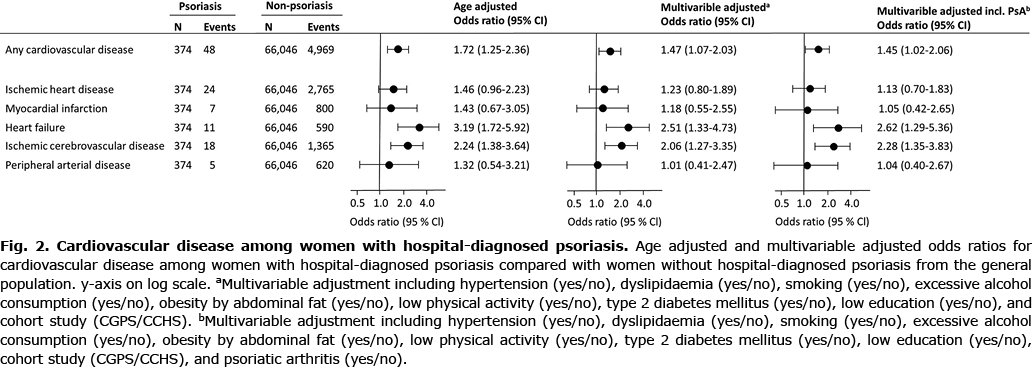
No increased risk of ischaemic heart disease, myocardial infarction, or peripheral arterial disease was found.
Sensitivity analyses using a more stringent definition of hospital-diagnosed psoriasis gave similar results with a multivariable adjusted OR of 2.31 (1.06–5.02) for heart failure and 2.19 (1.26–3.79) for ischaemic cerebrovascular disease (Fig. S1). No increased risk of any cardiovascular disease, ischaemic heart disease, myocardial infarction, or peripheral arterial disease were found.
DISCUSSION
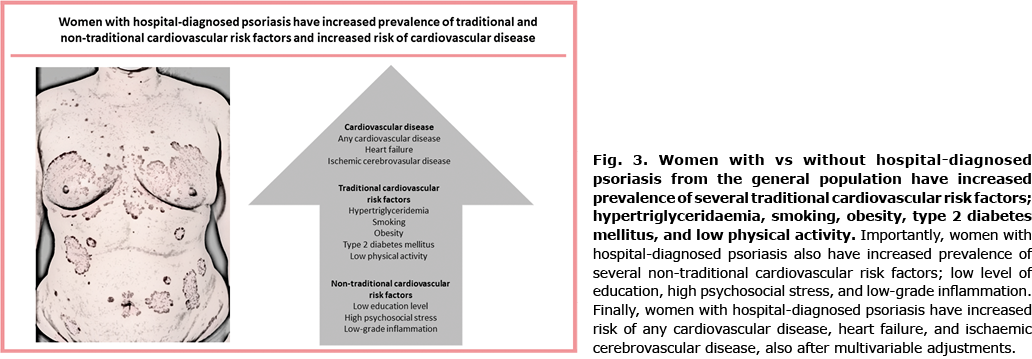
This study of more than 60,000 women from the Danish general population found that women with hospital-diagnosed psoriasis had increased ORs of having both traditional and non-traditional cardiovascular risk factors compared with women without hospital-diagnosed psoriasis. Furthermore, it was found that women with hospital-diagnosed psoriasis had a higher risk of any cardiovascular disease, heart failure, and ischaemic cerebrovascular disease in analyses adjusted for these cardiovascular risk factors, and thus the study indicates that psoriasis is an independent risk factor for cardiovascular disease in women (Fig. 3).
Mechanistically, the chronic inflammation in patients with psoriasis might be what causally links psoriasis with cardiovascular disease and has been termed the “psoriatic march”. Roughly simplified, the “psoriatic march” postulates that systemic pro-inflammatory cytokines and adipokines cause insulin resistance, which, in turn, triggers endothelial cell dysfunction and subsequently causes atherosclerosis and, finally, cardiovascular disease (11). Several studies support this hypothesis; some showing elevated levels of inflammatory biomarkers (27, 28) and insulin resistance (29–31) among patients with psoriasis, and others find evidence for endothelial cell dysfunction among patients (32–34). More studies are needed to determine this potential causal link between psoriasis and cardiovascular disease.
To our knowledge, the current study is the most comprehensive study to date to investigate a broad panel of cardiovascular risk factors and to assess risk of cardiovascular disease when adjusting for these risk factors in women with psoriasis. Of the included non-traditional cardiovascular risk factors, women with hospital-based psoriasis had increased ORs of low education, high psychosocial stress, and low-grade inflammation compared with women without hospital-diagnosed psoriasis. Low-grade inflammation was defined according to hs-CRP, however women with hospital-diagnosed psoriasis also had higher levels of fibrinogen, whole blood leukocytes, and neutrophil-to-lymphocyte ratio, supporting the theory that the inflammatory state in women with psoriasis is broadly affected. Of the traditional risk factors for cardiovascular disease, this study found increased ORs of having hypertriglyceridaemia, smoking, low physical activity, type 2 diabetes mellitus, and obesity; the latter regardless of which obesity definition was used. Obesity is the most frequent component of the metabolic syndrome found in women with psoriasis (19) and in the Nurses’ Health Study II, obesity was a risk factor for incident psoriasis (35). Obesity is closely linked to type 2 diabetes mellitus (36) and physical activity (37). The high frequency of type 2 diabetes mellitus among women with hospital-diagnosed psoriasis seen in the current study is also consistent with previous studies (20, 38). We also find that women with hospital-diagnosed psoriasis exercise much less than women without hospital-diagnosed psoriasis, and as a previous study of 116,430 US women found that vigorous physical activity was associated with reduced risk of incident psoriasis (39), the current results support the hypothesis that prevention of, and treatment for, obesity are a priority in women with psoriasis.
Previous studies have indicated insufficient treatment of several traditional cardiovascular risk factors in patients with moderate to severe psoriasis (40, 41). Although education and stress may be better defined as social determinants of health and no specific treatment targets low-grade inflammation, the current study highlights the importance of assessing both traditional and non-traditional cardiovascular risk factors, as these are important in the overall assessment of cardiovascular risk in women with psoriasis.
The current study found that women with hospital-diagnosed psoriasis had increased risk of any cardiovascular disease, heart failure, and ischaemic cerebrovascular disease. A previous Danish nationwide cohort study including 66,389 psoriasis patients (men and women combined) also reported increased risk of heart failure, with a hazard ratio of 1.5 (1.3–1.7) in patients with severe psoriasis (42); however, the study presents no stratified analyses according to sex. The current results suggest an even higher risk of heart failure in women with hospital-diagnosed psoriasis. As sex differences in prevalence, subtypes, and clinical outcome of heart failure exist in the general population (43), this probably also applies to patients with psoriasis. The current study did not find an increased risk of diagnosed myocardial infarction in women with hospital-diagnosed psoriasis and this is in contrast to previous studies that found increased risk in both women and men (4). Nevertheless, in line with the current findings Garshick et al. (15) did not find higher risk of myocardial infarction in young, hospitalized women with psoriasis compared with matched women without psoriasis. Although speculative, the higher risk of heart failure in women with hospital-diagnosed psoriasis, but not of myocardial infarction, might be a reflection of the fact that ischaemic heart disease frequently remains undiagnosed in women (16, 44) until they present with heart failure, and that this probably also applies to women with psoriasis. Future studies could investigate whether women with psoriasis could be particularly benefitted by intensified intervention addressing risk of heart failure. The disconnect between risk factor prevalence and prevalent myocardial infarction in the current study could also be a result of effective treatment and intervention strategies in the Danish healthcare system, which is free of charge with equal access for all citizens. Thus, results from the current study may not necessarily apply to other populations.
Finally, this study found an increased risk of ischaemic cerebrovascular disease among women with hospital-diagnosed psoriasis. Previous studies of psoriasis and ischaemic cerebrovascular disease have shown conflicting results; Garshick et al. reported an increased risk among young hospitalized women with psoriasis compared with matched women without psoriasis (15), but results from Nurses’ Health Study II were insignificant (14). In the general population, women have a higher lifetime stroke risk than men (17) and a potential sex difference in the risk of cerebrovascular disease in patients with psoriasis is plausible.
The current study included only women with psoriasis, and, thus, we cannot conclude on possible differences with the male population. Although it is outside the scope of this paper, possible sex differences in cardiovascular disease in individuals with psoriasis could exist as a result of both complex inflammatory pathways interacting with sex hormones, but also of cultural and environmental factors (45). Future studies on cardiovascular disease in individuals with psoriasis should stratify analyses according to sex, in order to elucidate possible differences.
Higher risks of major cardiovascular events in patients with psoriasis and inflammatory arthritis compared with patients without inflammatory arthritis have been reported previously by Parisi et al. (46). When psoriatic arthritis was included in the multivariable adjusted analyses, risk of any cardiovascular, heart failure, and ischaemic cerebrovascular disease remained high in women with psoriasis. The link between psoriatic arthritis and cardiovascular disease might be explained by psoriatic arthritis as a marker of severity in psoriasis (3), and hereby also a higher inflammatory burden in these patients. However, our findings support psoriasis as an independent risk factor also after adjusting for psoriatic arthritis.
Study strengths and limitations
Strengths of the current study include the sample size, with > 60,000 women from the general population. Moreover, extensive data were included for each participant, enabling thorough investigation and adjustment for confounders in the association between psoriasis and cardiovascular disease. Although we cannot account for factors not registered in the studies, we have extensive data on lifestyle and health status, physical examinations, and several blood tests on every participant, as well as information on prevalent cardiovascular disease. This is in contrast to many other studies investigating the association between psoriasis and cardiovascular disease.
A limitation of this study is that we have included only psoriasis diagnosed in a hospital, which mainly applies to patients with moderate to severe psoriasis, requiring systemic treatment even though socioeconomic factors may also contribute to the need for inpatient care. Therefore, women with mild psoriasis might have been included in the reference group; however, this would tend to bias the results toward the null hypothesis and thus cannot explain the findings. Finally, the current study is an observational cross-sectional study and therefore it is not possible to draw conclusions about causality.
Conclusion
Women with hospital-diagnosed psoriasis had increased prevalence of several traditional and non-traditional cardiovascular risk factors. Furthermore, women with hospital-diagnosed psoriasis had a higher risk of any cardiovascular disease, heart failure, and ischaemic cerebrovascular disease in analyses adjusted for these cardiovascular risk factors. Thus, this study indicates that psoriasis is an independent risk factor for cardiovascular disease in women with psoriasis. These results underline the importance of targeted prevention and treatment of cardiovascular disease in women with psoriasis.
ACKNOWLEDGEMENTS
The authors are grateful for the important contributions of the staff and participants of the Copenhagen City Heart Study and the Copenhagen General Population Study.
This study was funded by the Kgl Hofbundtmager Aage Bang Foundation, the research fund of Herlev and Gentofte Hospital, the Danish National Psoriasis Foundation, and Else and Mogens Wedell Wedellsborgs Fund. The sponsors of the study had no role in study design, data collection, data analysis, data interpretation or writing of the paper.
Conflicts of interest. CN-K has served as an investigator for Galderma, Abbvie, LEO Pharma, and CSL Behring. LS has received research funding from Novartis, Bristol-Myers Squibb, AbbVie, Janssen Pharmaceuticals, the Danish National Psoriasis Foundation, the LEO Foundation and the Kgl Hofbundtmager Aage Bang Foundation and honoraria as consultant and/or speaker for AbbVie, Eli Lilly, Novartis, Pfizer, and LEO Pharma, Janssen Cilag, UCB, Almirall, Bristol-Myers Squibb, and Sanofi. She has served as an investigator for AbbVie, Pfizer, Sanofi, Janssen Cilag, Boehringer Ingelheim, AstraZeneca, Eli Lilly, Novartis, Regeneron, Galderma and LEO Pharma. SV-K, and SEB have no conflicts of interest to declare.
REFERENCES
- Get the facts about psoriasis and psoriatic arthritis:: National Psoriasis Foundation. [Accessed on July 6, 2021] Available from: https://www.psoriasis.org/psoriasis-statistics/
- Yeung H, Takeshita J, Mehta NN, Kimmel SE, Ogdie A, Margolis DJ, et al. Psoriasis severity and the prevalence of major medical comorbidity: a population-based study. JAMA Dermatol 2013; 149: 1173–1179.
- Takeshita J, Grewal S, Langan SM, Mehta NN, Ogdie A, Van Voorhees AS, et al. Psoriasis and comorbid diseases: epidemiology. J Am Acad Dermatol 2017; 76: 377–390.
- Gelfand JM, Neimann AL, Shin DB, Wang X, Margolis DJ, Troxel AB. Risk of myocardial infarction in patients with psoriasis. J Am Med Assoc 2006; 296: 1735–1741.
- Ahlehoff O, Gislason GH, Charlot M, Jørgensen CH, Lindhardsen J, Olesen JB, et al. Psoriasis is associated with clinically significant cardiovascular risk: a Danish nationwide cohort study. J Intern Med 2011; 270: 147–157.
- Miller IM, Ellervik C, Yazdanyar S, Jemec GBE. Meta-analysis of psoriasis, cardiovascular disease, and associated risk factors. J Am Acad Dermatol 2013; 69: 1014–1024.
- Abuabara K, Azfar RS, Shin DB, Neimann AL, Troxel AB, Gelfand JM. Cause-specific mortality in patients with severe psoriasis: a population-based cohort study in the U.K. Br J Dermatol 2010; 163: 586–592.
- Armstrong AW, Harskamp CT, Armstrong EJ. Psoriasis and the risk of diabetes mellitus: a systematic review and meta-analysis. JAMA Dermatol 2013; 149: 84–91.
- Armstrong AW, Harskamp CT, Dhillon JS, Armstrong EJ. Psoriasis and smoking: a systematic review and meta-analysis. Br J Dermatol 2014; 19: 304–314.
- Lai YC, Yew YW. Psoriasis as an independent risk factor for cardiovascular disease: an epidemiologic analysis using a national database. J Cutan Med Surg 2016; 20: 327–333.
- Boehncke W-H, Boehncke S, Tobin A-M, Kirby B. The “psoriatic march”: a concept of how severe psoriasis may drive cardiovascular comorbidity. Exp Dermatol 2011; 20: 303–307.
- Hansson GK, Hermansson A. The immune system in atherosclerosis. Nat Immunol 2011; 12: 204–212.
- Armstrong AW, Voyles S V., Armstrong EJ, Fuller EN, Rutledge JC. A tale of two plaques: convergent mechanisms of T-cell-mediated inflammation in psoriasis and atherosclerosis. Exp Dermatol 2011; 20: 544–549.
- Li WQ, Han JL, Manson JE, Rimm EB, Rexrode KM, Curhan GC, et al. Psoriasis and risk of nonfatal cardiovascular disease in U.S. women: a cohort study. Br J Dermatol 2012; 166: 811–818.
- Garshick MS, Vaidean G, Nikain CA, Chen Y, Smilowitz NR, Berger JS. Sex differences in the prevalence of vascular disease and risk factors in young hospitalized patients with psoriasis. Int J Womens Dermatol 2019; 5: 251–255.
- Mehta LS, Beckie TM, DeVon HA, Grines CL, Krumholz HM, Johnson MN, et al. Acute myocardial infarction in women. Circulation 2016; 133: 916–947.
- Vogel B, Acevedo M, Appelman Y, Bairey Merz CN, Chieffo A, Figtree GA, et al. The Lancet women and cardiovascular disease commission: reducing the global burden by 2030. Lancet 2021; 397: 2385–2438.
- Lindegard B. Diseases associated with psoriasis in a general population of 159,200 middle-aged, urban, native Swedes. Dermatologica 1986; 172: 298–304.
- Danielsen K, Wilsgaard T, Olsen AO, Eggen AE, Olsen K, Cassano PA, et al. Elevated odds of metabolic syndrome in psoriasis: a population-based study of age and sex differences. Br J Dermatol 2015; 172: 419–427.
- Sondermann W, Djeudeu Deudjui DA, Körber A, Slomiany U, Brinker TJ, Erbel R, et al. Psoriasis, cardiovascular risk factors and metabolic disorders: sex-specific findings of a population-based study. J Eur Acad Dermatol Venereol 2020; 34: 779–786.
- Madsen CM, Varbo A, Nordestgaard BG. Extreme high high-density lipoprotein cholesterol is paradoxically associated with high mortality in men and women: two prospective cohort studies. Eur Heart J 2017; 38: 2478–2486.
- Schmidt M, Pedersen L, Sørensen HT. The Danish Civil Registration System as a tool in epidemiology. Eur J Epidemiol 2014; 29: 541–549.
- Schmidt M, Schmidt SAJ, Sandegaard JL, Ehrenstein V, Pedersen L, Sørensen HT. The Danish National Patient Registry: a review of content, data quality, and research potential. Clin Epidemiol 2015; 7: 449–490.
- Egeberg A, Kristensen LE, Thyssen JP, Gislason GH, Gottlieb AB, Coates LC, et al. Incidence and prevalence of psoriatic arthritis in Denmark: a nationwide register linkage study. Ann Rheum Dis 2017; 76: 1591–1597.
- Nordestgaard BG, Varbo A. Triglycerides and cardiovascular disease. Lancet 2014; 384: 626–635.
- Ridker PM, Everett BM, Thuren T, MacFadyen JG, Chang WH, Ballantyne C, et al. Antiinflammatory therapy with canakinumab for atherosclerotic disease. N Engl J Med 2017; 377: 1119–1131.
- Coimbra S, Oliveira H, Reis F, Belo L, Rocha S, Quintanilha A, et al. C-reactive protein and leucocyte activation in psoriasis vulgaris according to severity and therapy. J Eur Acad Dermatol Venereol 2010; 24: 789–796.
- Vachatova S, Andrys C, Krejsek J, Salavec M, Ettler K, Rehacek V, et al. Metabolic syndrome and selective inflammatory markers in psoriatic patients. J Immunol Res 2016; 2016: 1–8.
- Ucak S, Ekmekci TR, Basat O, Koslu A, Altuntas Y. Comparison of various insulin sensitivity indices in psoriatic patients and their relationship with type of psoriasis. J Eur Acad Dermatol Venereol 2006; 20: 517–522.
- Boehncke S, Thaci D, Beschmann H, Ludwig RJ, Ackermann H, Badenhoop K, et al. Psoriasis patients show signs of insulin resistance. Br J Dermatol 2007; 157: 1249–1251.
- Gyldenløve M, Storgaard H, Holst JJ, Vilsbøll T, Knop FK, Skov L. Patients with psoriasis are insulin resistant. J Am Acad Dermatol 2015; 72: 599–605.
- Gisondi P, Fantin F, Del Giglio M, Valbusa F, Marino F, Zamboni M, et al. Chronic plaque psoriasis is associated with increased arterial stiffness. Dermatology 2009; 218: 110–113.
- Karadag AS, Yavuz B, Ertugrul DT, Akin KO, Yalcin AA, Deveci OS, et al. Is psoriasis a pre-atherosclerotic disease? Increased insulin resistance and impaired endothelial function in patients with psoriasis. Int J Dermatol 2010; 49: 642–646.
- Garshick MS, Barrett TJ, Wechter T, Azarchi S, Scher JU, Neimann A, et al. Inflammasome signaling and impaired vascular health in psoriasis. Arterioscler Thromb Vasc Biol 2019; 39: 787–798.
- Setty AR, Curhan G, Choi HK. Obesity, waist circumference, weight change, and the risk of psoriasis in women: nurses’ health study II. Arch Intern Med 2007; 167: 1670–1675.
- La Sala L, Pontiroli AE. Prevention of diabetes and cardiovascular disease in obesity. Int J Mol Sci 2020; 21: 8178.
- Kolb H, Martin S. Environmental/lifestyle factors in the pathogenesis and prevention of type 2 diabetes. BMC Med 2017; 15: 131.
- Qureshi AA, Choi HK, Setty AR, Curhan GC. Psoriasis and the risk of diabetes and hypertension: a prospective study of us female nurses. Arch Dermatol 2009; 145: 379–382.
- Frankel HC, Han J, Li T, Qureshi AA. The association between physical activity and the risk of incident psoriasis. Arch Dermatol 2012; 148: 918–924.
- Ahlehoff O, Skov L, Gislason G, Lindhardsen J, Kristensen SL, Iversen L, et al. Pharmacological undertreatment of coronary risk factors in patients with psoriasis: observational study of the Danish nationwide registries. PLoS One 2012; 7:e36342.
- Kimball AB, Szapary P, Mrowietz U, Reich K, Langley RG, You Y, et al. Underdiagnosis and undertreatment of cardiovascular risk factors in patients with moderate to severe psoriasis. J Am Acad Dermatol 2012; 67: 76–85.
- Khalid U, Ahlehoff O, Gislason GH, Kristensen SL, Skov L, Torp-Pedersen C, et al. Psoriasis and risk of heart failure: a nationwide cohort study. Eur J Heart Fail 2014; 16: 743–748.
- Regitz-Zagrosek V, Kararigas G. Mechanistic pathways of sex differences in cardiovascular disease. Physiol Rev 2017; 97: 1–37.
- Bergami M, Scarpone M, Bugiardini R, Cenko E, Manfrini O. Sex beyond cardiovascular risk factors and clinical biomarkers of cardiovascular disease. Rev Cardiovasc Med 2022; 23: 19.
- Tur E, Maibach HI. Gender and dermatology. Springer; 2018: p. 63–73.
- Parisi R, Rutter MK, Lunt M, Young HS, Symmons DPM, Griffiths CEM, et al. Psoriasis and the risk of major cardiovascular events: cohort study using the clinical practice research datalink. J Invest Dermatol 2015; 135: 2189–2197.