SHORT COMMUNICATION
Patient-reported Outcomes and Burden of Disease in Paediatric Patients with Psoriasis: Real-world Data from EU5 and US
Marieke M. B. SEYGER1, Amy S. PALLER2, Michael STICHERLING3, Teresa BACHHUBER4, Nicolas THOMAS4, James HETHERINGTON5, James LUCAS5, Craig RICHARDSON4 and Matthias AUGUSTIN6
1Department of Dermatology, Radboud University Nijmegen Medical Centre, NL-6500 HB Nijmegen, The Netherlands, 2Departments of Dermatology and Paediatrics, Northwestern University Feinberg School of Medicine, Chicago, IL, USA, 3Department of Dermatology, Universitaetsklinikum Erlangen, Deutsches Zentrum Immuntherapie Erlangen, Germany, 4Novartis Pharma AG, Basel, Switzerland, 5Adelphi Real World, Bollington, UK and 6Institute for Health Services Research in Dermatology and Nursing, University Medical Centre Hamburg-Eppendorf, Hamburg, Germany. E-mail: Marieke.Seyger@radboudumc.nl
Citation: Acta Derm Venereol 2023; 103: adv2544. DOI: https://doi.org/10.2340/actadv.v103.2544.
Copyright: © Published by Medical Journals Sweden, on behalf of the Society for Publication of Acta Dermato-Venereologica. This is an Open Access article distributed under the terms of the Creative Commons Attribution-NonCommercial 4.0 International License (https://creativecommons.org/licenses/by-nc/4.0/)
Accepted: Jan 17, 2023; Published: Apr 19, 2023
Competing interests and funding: MSe: consultant and/or investigator and/or institutional funding from: Abbvie, Amgen, Celgene, Eli Lilly, Janssen, Leo Pharma, Novartis, Pfizer and UCB; fees were paid directly to the institution. AP: consultant and/or institutional funding from: AbbVie, Almirall, Anaptysbio, Arcutis, Bristol Myer Squibb, Eli Lilly, Exicure, Leo, Janssen, Pfizer, UCB. MSt: advisor and/or speaker and/or investigator and/or institutional funding from: AbbVie, Amgen, Boehringer Ingelheim, Biogen, Celgene, Eli Lilly, Galderma, GSK, Janssen-Cilag, LEO Pharma, MSD, Mundipharma, Novartis, Pfizer, Regeneron, Sanofi, UCB Pharma. TB, CR and NT are employed by Novartis. JL and JH are employed by Adelphi Real World. MA: consultant and/or speaker for: AbbVie, Almirall, Amgen, Biogen, Bristol Myer Squibb, Boehringer Ingelheim, Celgene, Centocor, Eli Lilly, Fresenius, GSK, Janssen-Cilag, Leo, Medac, Merck, MSD, Mylan, Novartis, Pfizer, UCB, and Xenoport.
INTRODUCTION
Psoriasis (PsO) is a chronic, systemic, inflammatory skin disorder, characterized by red, scaly plaques (1). PsO affects approximately 2–4% of individuals in western countries (2). Approximately one-quarter of patients with PsO experience disease onset before adulthood (3). Paediatric PsO (onset < 18 years) is associated with a substantial negative effect on quality of life (QoL) and patients have a greater risk of developing psychosocial disorders compared with those without PsO (4–6). Furthermore, due to the visibility of psoriatic plaques, paediatric patients with PsO experience social discomfort, bullying and stigma (6–9). Previously we have described physician-reported clinical unmet needs and treatment patterns in a real-world population of >2,000 paediatric patients with PsO (10).
The aim of the current study was to describe patient-reported outcomes (PROs) and disease burden among a paediatric PsO population across the United States, and EU5 (UK, France, Germany, Spain, and Italy).
METHODS AND RESULTS
Methods of this retrospective analysis of a cross-sectional survey have been reported previously (10). In brief, dermatologists, general practitioners or primary care practitioners (GP/PCP), and paediatricians actively managing paediatric patients with PsO were included. All physicians completed a patient record form (PRF) for the subsequent 10 paediatric patients with PsO attending their practice (PRF details published previously (10)). Each patient was invited by their physician to complete a voluntary self-completion questionnaire. Patient self-completion questionnaires (PSC) were completed by patients aged 12–17 years; carer self-completion questionnaires (CSC) were completed by carers of patients < 12 years on their behalf. Matched physician-reported outcomes (via PRFs) were included.
Data are based on disease severity categorization at survey sampling. Disease severity categories (mild, moderate, severe) were based on physician judgement; no clinical definition was applied. Further methodological information is shown in Appendix S1.
Data were collected from 324 treating-physicians (58% (187/324) dermatologists; 22% (71/324) GPs/PCPs; 20% (66/324) paediatricians). Overall, physicians completed 2,877 PRFs, each representing 1 paediatric patient with PsO. To ensure adequate time with treatment response, patients with a treatment time < 4 weeks for topical therapy and/or < 12 weeks for conventional systemic and/or biologic therapy were excluded, leaving a total analysable population of 2,379. The mean ± standard deviation (SD) age was 12.9 ± 3.4 years and 53% (1258/2379) were male. Demographics and disease characteristics were published previously (10).
Patient-reported data were collected for 42.7% (1017/2379) of the analysed population, 666/1017 (65.5%) via the PSC and 351/1017 (34.5%) via the CSC. For the present analysis, physician-reported data (via PRFs) were included only for those patients with corresponding patient-reported data (i.e. a matched dataset, n = 1,017). Within the matched dataset, physicians reported that 79.8% of all patients had mild disease, 18.2% had moderate disease, and 2.0% had severe disease (Fig. S1).
At sampling, patients reported the impact of disease on QoL, with a mean Children’s Dermatology Life Quality Index (CDLQI) of 4.7 ± 5.1 (PSC) and 5.2 ± 5.1 (CSC) (Fig. 1); the impact on QoL was greater in patients with more severe disease (Fig. 1A). The effect of paediatric PsO on daily activities, itch severity and skin pain severity are illustrated in Fig. 1B–D, respectively. Patients with a moderate to severe disease experienced the greatest impact on QoL.
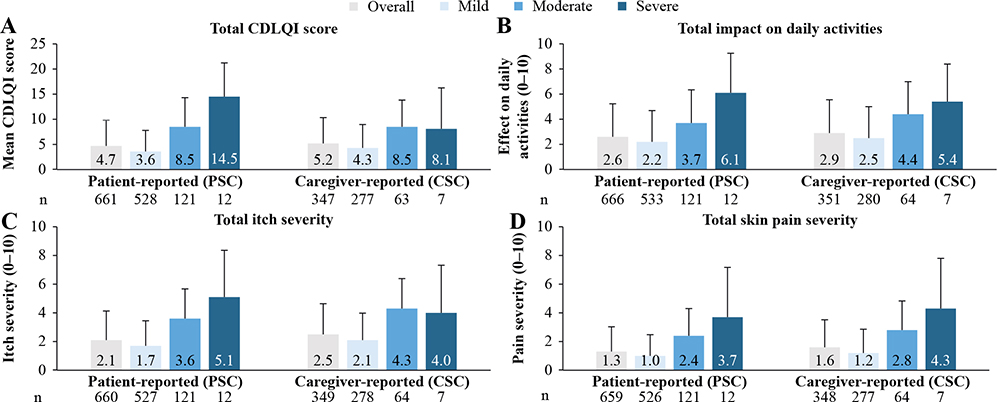
Fig. 1. Effect of paediatric psoriasis (PsO) on quality of life overall and by physician-judged disease severity at the time of sampling. Bar charts demonstrating: (A) mean Children’s Dermatology Life Quality Index (CDLQI) scores; (B) impact of disease on daily activities; (C) itch severity; and (D) skin pain severity, in the EU5 (UK, France, Germany, Spain, and Italy) and USA combined. Parts (B–D) are based on a numerical scale of 0–10, where 0 represents no impact/itch/pain and 10 represents worst impact/itch/pain. CSC: carer self-completion questionnaire; n: number of patients with available data; PSC: patient self-completion questionnaire. Numbers within each bar are data labels and correspond to the mean number of each score per group. Error bars represent the standard deviation.
When asked about the frequency of PsO-related itching, overall, 27.4% and 34.6% of patients and carers, respectively, reported patients being affected “sometimes, usually, or all of the time” in the previous week (Table SI). The proportion of patients affected by itch “sometimes, usually, or all of the time” was substantially greater in patients with a moderate (63.6% PSC; 64.1% CSC) or severe (75.0% PSC; 57.1% CSC) disease. Itch had an impact on school/work, sleep, physical activities, and social activities. A large proportion of patients with moderate or severe PsO reported that itch impacted their sleep “quite a bit, a lot, or a huge amount” (moderate: 29.6% PSC, 35.0% CSC; severe: 72.7% CSC, 66.7% CSC) (Table SI).
The mean CDLQI in patients with an itch severity score ≤ 5 was 4.3 ± 4.5, compared with 10.9 ± 6.5 in patients with an itch severity score of 6–10 (p < 0.0001, Student’s t-test). A strong positive correlation was observed between itch severity and CDLQI, overall (Fig. S2A; Spearman’s rho [ρ] = 0.67), and split by PSC (Fig. S2B; ρ = 0.68) and CSC (Fig. S2C; ρ = 0.65).
PsO also had an effect on the QoL of family members (Fig. S3). Furthermore, the effect of PsO on QoL of patients was generally greater in patients from the EU5 compared with those from the US (Fig. S4) (see Appendix S2 for additional details).
Overall, levels of treatment dissatisfaction were moderate and similarly reported between physicians, patients, and carers (22.6%, 25.5%, and 33.6%, respectively) (Fig. S5A). Patients with mild disease displayed the highest level of treatment satisfaction. Of interest, 11.9%, 18.1%, and 24.8% of physician-, patient- and carer-reported patients with mild disease were dissatisfied with their current treatment, respectively (Fig. S5B). Furthermore, greater proportions of patients with either moderate or severe disease were dissatisfied with their treatment and believed that better disease control could be achieved (Fig. S5C–D). Patients/carers of patients receiving biologic therapy at sampling reported higher levels of treatment satisfaction vs those not currently receiving a biologic (Fig. S5E–F).
The most frequently reported reason for treatment dissatisfaction across physicians, patients, and carers was “complete skin clearance was not achieved”; the reported frequency was substantially higher as reported by patients/carers vs physicians (Table SII). Patients/carers expressed that “people can still see my/my child’s psoriasis” as a key reason for dissatisfaction. The most commonly recorded treatment goal was “’relieves itching”, which was answered most frequently by carers of patients (Table SIII). Of interest, “clears 100% of skin” was reported as an important treatment goal by 61.4% and 60.1% of patients and carers, respectively, compared with only 35.4% of physicians.
Treatment dissatisfaction was relatively similar between the EU5 and US populations (see Appendix S2 for more details).
DISCUSSION
PROs and patient perspectives, such as impact of disease on QoL, treatment satisfaction, and treatment goals, provide essential information that can be used to inform holistic management of paediatric PsO. This study included matched physician- and patient-/carer-reported data for >1,000 paediatric patients with PsO in 6 countries across 2 continents. Overall, PsO had a substantial impact on patients’ lives. Mean CDLQI scores were ~5, despite ~80% of patients reporting mild disease. Scores were substantially higher in patients with moderate or severe disease. The current study showed that patients frequently experienced itch, with greater severity of itching in patients with more severe PsO. Furthermore, itch impacted school, sleep, and physical and social activities, and itch severity correlated with CDLQI. The most frequently answered treatment goal amongst patients and carers was “relieves itch”. This supports a Dutch study in which “’no itch” was an important treatment goal among paediatric and adolescent patients (11).
In the current study, satisfaction with treatment was relatively high in the overall population; this is in contrast with studies in adult PsO which report lower treatment satisfaction (12–14). This is probably due to the predominance of patients with mild PsO, since patients with moderate and severe PsO report dissatisfaction levels in agreement with adult studies. The main reason for dis-satisfaction was aligned between physicians, patients, and carers (lack of clear skin) and patients and carers more frequently reported “clears 100% of skin” and “works quickly” as key treatment goals. This is consistent with a recent paediatric PsO study in which preventing or reducing new psoriatic lesions were listed as the most important treatment goals (11).
Potential limitations of this study include the subjective, physician-judged severity assessment applied and the use of self-reported data. Recall bias may have affected the responses of physicians to the questionnaires, and completion of the CSC by carers may also have influenced outcomes.
In conclusion, management of paediatric PsO should consider the impact of disease on health-related QoL, patient perceptions on treatment satisfaction, and treatment goals.
ACKNOWLEDGEMENTS
The authors thank Trudy McGarry, PhD, from Novartis Ltd, Ireland, and Rosalind Bonomally, MSc, from Novartis Ltd, UK, for providing medical writing support, in accordance with Good Publication Practice (GPP 2022) guidelines (https://www.ismpp.org/gpp-2022), which was funded by Novartis Pharma AG, Basel, Switzerland.
Data availability: Data collection was undertaken by Adelphi Real World as part of an independent survey, entitled the Adelphi Paediatric Psoriasis Disease Specific Programme, subscribed to by multiple pharmaceutical companies, of which, one was Novartis Pharma AG.
This study was funded by Novartis Pharma AG, Basel, Switzerland. Novartis Pharma AG did not influence the original survey, either through contribution to the design of questionnaires or data collection. All data that support the findings of this study are the intellectual property of Adelphi Real World. All requests for access should be addressed directly to James Lucas at james.lucas@adelphigroup.com.
The survey was performed in compliance with the European Pharmaceutical Market Research Association (EphMRA) and in full accordance with the US Health Insurance Portability and Accountability Act (HIPAA) 1996. Ethics approval was granted by the Western Copernicus Group Institutional Review Board (WCG-IRB).
REFERENCES
- Zeichner JA, Armstrong A. The role of IL-17 in the pathogenesis and treatment of psoriasis. J Clin Aesthet Dermatol 2016; 9: S3–S6.
- Parisi R, Iskandar IYK, Kontopantelis E, Augustin M, Griffiths CEM, Ashcroft DM, et al. National, regional, and worldwide epidemiology of psoriasis: systematic analysis and modelling study. BMJ 2020; 369: m1590.
- Silverberg NB. Pediatric psoriasis: an update. Ther Clin Risk Manag 2009; 5: 849–856.
- Kara T, Topkarci Z, Yilmaz S, Akaltun I, Erdogan B. Pediatric patients with psoriasis and psychiatric disorders: premorbidity and comorbidity in a case-control study. J Dermatolog Treat 2019; 30: 129–134.
- Kimball AB, Wu EQ, Guerin A, Yu AP, Tsaneva M, Gupta SR, et al. Risks of developing psychiatric disorders in pediatric patients with psoriasis. J Am Acad Dermatol 2012; 67: 651–657.e1-2.
- de Jager ME, De Jong EM, Evers AW, Van De Kerkhof PC, Seyger MM. The burden of childhood psoriasis. Pediatr Dermatol 2011; 28: 736–737.
- Alpsoy E, Polat M, Yavuz IH, Kartal P, Didar Balci D, Karadag AS, et al. Internalized stigma in pediatric psoriasis: a comparative multicenter study. Ann Dermatol 2020; 32: 181–188.
- Gonzalez J, Cunningham K, Perlmutter J, Gottlieb A. Systematic review of health-related quality of life in adolescents with psoriasis. Dermatology 2016; 232: 541–549.
- Caroppo F, Zacchino M, Milazzo E, Fontana E, Nobile F, Marogna C, et al. Quality of life in children with psoriasis: results from a monocentric study. Ital J Dermatol Venerol 2021; 156: 374–377.
- Seyger MMB, Augustin M, Sticherling M, Bachhuber T, Fang J, Hetherington J, et al. Physician-reported clinical unmet needs, burden and treatment patterns of paediatric psoriasis patients: a US and EU real-world evidence study. Acta Derm Venereol 2022; 102: adv00660.
- Schaap MJ, Broekhuis SCE, Spillekom-van Koulil S, Groenewoud HMM, de Jong E, Seyger MMB. Treatment goals and preferences of pediatric psoriasis patients, young adults, and parents. J Dermatolog Treat 2022; 33: 2527–2533.
- Armstrong AW, Robertson AD, Wu J, Schupp C, Lebwohl MG. Undertreatment, treatment trends, and treatment dissatisfaction among patients with psoriasis and psoriatic arthritis in the United States: findings from the National Psoriasis Foundation surveys, 2003–2011. JAMA Dermatol 2013; 149: 1180–1185.
- Radtke MA, Langenbruch A, Jacobi A, Schaarschmidt ML, Augustin M. Patient benefits in the treatment of psoriasis: long-term outcomes in German routine care 2007–2014. J Eur Acad Dermatol Venereol 2016; 30: 1829–1833.
- Poulin Y, Papp KA, Wasel NR, Andrew R, Fraquelli E, Bernstein G, et al. A Canadian online survey to evaluate awareness and treatment satisfaction in individuals with moderate to severe plaque psoriasis. Int J Dermatol 2010; 49: 1368–1375.