ORIGINAL REPORT
Model of Chronic Itch in Aged Mice: Beneficial Effects of Drugs Affecting Descending Modulatory Systems
Go KOJIMA1,2, Eriko KOMIYA1,3, Kotaro HONDA1, Takahide KANEKO2, Yasushi SUGA2, Mitsutoshi TOMINAGA1 and Kenji TAKAMORI1,2
1Juntendo Itch Research Center (JIRC), Institute for Environmental and Gender-Specific Medicine, Juntendo University Graduate School of Medicine, Chiba, 2Department of Dermatology, Juntendo University Urayasu Hospital, Chiba, Japan and 3Laboratory of Functional Morphology, Juntendo University Faculty of Pharmacy, Chiba, Japan
Pruritus in the elderly, particularly those cases without skin dryness or other identifiable causes, makes treatment challenging due to the lack of evidence regarding the therapeutic effects of antipruritics. This study proposes an age-related alloknesis mouse model for an evaluation system for such cases, and aimed to investigate the effectiveness and mechanisms of action of several drugs commonly used as antipruritics in Japan, utilizing this model. Mice 69–80 weeks old were used as aged mice, and the level of mechanical alloknesis was counted as the number of scratching behaviours in response to innocuous stimuli. Bepotastine, neurotropin, pregabalin, baricitinib, and abrocitinib were used as antipruritics, and yohimbine and methysergide as inhibitors of the descending inhibitory pathway. The findings suggest that mechanical alloknesis in aged mice is a suitable animal model for assessing pruritus in the elderly without xerosis, and pregabalin, neurotropin, baricitinib, and abrocitinib may be effective antipruritics in the elderly through activating both the noradrenergic and serotonergic descending inhibitory pathways. These findings may be useful for the selection of antipruritics for pruritus in the elderly without skin lesions or dryness.
Key words: pruritus in the elderly; mechanical alloknesis; descending inhibitory system.
SIGNIFICANCE
Many elderly people suffer from itch, and the cause and appropriate treatment are unknown, especially for those without redness or dryness. We aimed to find better medications for such clinical cases and to clarify how these work. We employed the phenomenon called “mechanical alloknesis”, the itch hypersensitivity by innocuous mechanical stimuli, using a mouse model, tested several drugs and found that some of them are effective via activating neural pathways from the brain to the spinal cord, which is called “the descending inhibitory system”. Our findings could improve the quality of life of elderly patients suffering from itch.
Citation: Acta Derm Venereol 2024; 104: adv39950. DOI https://doi.org/10.2340/actadv.v104.39950.
Copyright: © 2024 The Author(s). Published by MJS Publishing, on behalf of the Society for Publication of Acta Dermato-Venereologica. This is an Open Access article distributed under the terms of the Creative Commons Attribution-NonCommercial 4.0 International License (https://creativecommons.org/licenses/by-nc/4.0/).
Submitted: Jan 23, 2024; Accepted: Apr, 2024; Published: May 15, 2024
Corr: Kenji Takamori, MD, PhD, Department of Dermatology, Juntendo University Urayasu Hospital, 2-1-1 Tomioka, Urayasu, Chiba 279-0021, Japan. E-mail: ktakamor@juntendo.ac.jp
Competing interests and funding: K. Takamori received research support from Nippon Zoki Pharmaceutical Company.
This work was supported by JSPS KAKENHI grant numbers 20H03568 (KT), 20K08680 (EK), 23K18407 (EK), 22H02956 (MT), 24K02265 (EK) a grant from Lydia O’Leary Memorial Pias Dermatological Foundation 2022 (EK) and research support from Nippon Zoki Pharmaceutical Company.
INTRODUCTION
Pruritus is a common symptom that can affect individuals of all races and ages. However, it is more frequently observed in the elderly (1, 2). Pruritus in the elderly can be defined as idiopathic chronic itching in a person aged over 65 years old (1). Its reported prevalence ranges from approximately 11% to 64% among elderly individuals (3–5). This condition can manifest with or without concomitant visible skin changes (2, 6), and often has a significant impact on the quality of life and sleep (1, 6). Although the pathophysiology remains largely unclear, it is believed to be associated with age-related factors such as (i) epidermal barrier disorders, (ii) changes in the immune system characterized by a shift towards an allergic phenotype (Th2 dominance), or (iii) central or peripheral neurodegenerative diseases (2, 6).
The most common cause of pruritus in the elderly is senile xerosis (6, 7). Studies have reported that dry skin is prevalent in 38–85% of elderly individuals (8–10). However, in addition to cases caused by factors other than xerosis, instances of senile pruritus without primary skin rash and without the presence of xerosis or other identifiable causes have been documented (1, 7). Given the wide array of potential causes and the absence of a definitive cure, treatment of this condition remains a challenge (1, 2, 6).
Various antipruritic treatments have been used for pruritus in the elderly. However, data regarding their therapeutic efficacy are not always complete, as some are limited, and some are effective for pruritus other than that in the elderly (1, 6). Recently, it was reported that aged mice without skin lesions displayed mechanical alloknesis, which is itch hypersensitivity caused by normally innocuous mechanical stimuli, with no increase in spontaneous scratching behaviour (11, 12).
In this study, we utilized this mechanical alloknesis phenomenon as a model for senile pruritus with no rash or xerosis to investigate the effectiveness and mechanisms of the actions of several drugs currently used for pruritus treatment in Japan (7). Here we describe the effects of neuraxial blockers on mechanical alloknesis in aged mice.
MATERIALS AND METHODS
Animals
C57BL/6 mice (Oriental Yeast Co., Ltd., Tokyo, Japan) were bred in-house and used for behavioural analysis. Male mice aged 69 to 80 weeks were designated as aged mice, and those aged 8 to 12 weeks as young. Mice were housed under controlled temperature (23–25°C) and light (12 h of light, 08:00 a.m.–08:00 p.m.) conditions. Food and water were provided ad libitum. The animal experiments were approved by Juntendo University Animal Ethics Committee (numbers 2021102, 2022068, and 2023106).
Drugs
Bepotastine besilate, a selective histamine H1-receptor antagonist (FUJIFILM Wako Pure Chemical Corporation, Osaka, Japan); neurotropin, an extract from inflamed rabbit skin following vaccination with vaccinia virus (Nippon Zoki Co. Ltd, Oosaka, Japan); baricitinib, the JAK1/2 inhibitor (MedChem Express, Monmouth Junction, NJ, USA); pregabalin methyl ester, an antagonist of the voltage-dependent calcium channel α2δ subunit (Cayman Chemical, Ann Arbor, MI, USA and FUJIFILM Wako Pure Chemical Corporation), abrocitinib, the JAK1 selective inhibitor (Selleckchem, Houston, TX, USA) and AZ960, the JAK2 selective inhibitor (Selleckchem) were used as antipruritics. Yohimbine hydrochloride, an α1/α2 adrenergic receptors antagonist (Cayman Chemical) and methysergide maleate, a 5-HT1 receptor agonist /5-HT2 and 5-HT7 receptors antagonist (FUJIFILM Wako Pure Chemical Corporation) were used to inhibit the descending inhibitory pathways.
Preparation and administration of drugs and inhibitors
Antipruritics except for neurotropin were administered orally. Each concentration (bepotastine 3 mg/kg, baricitinib 3 mg/kg, pregabalin 0.3 g/kg, abrocitinib 15 mg/kg, and AZ960 1.58 mg/kg) was based on previous reports and interview forms (13, 14), ensuring equally effective concentrations as indicated by their IC50 values. These drugs were dissolved in dimethyl sulfoxide (DMSO, Sigma-Aldrich, St Louis, MO, USA) and suspended with 0.5 w/v% methylcellulose (FUJIFILM Wako Pure Chemical Corporation) to 5%. As the vehicle control of oral administration, DMSO in methylcellulose and adjusted 5% concentration was used. They were administered to the mice at a dosage of 10 mL/kg via sondes. The mechanical alloknesis assay was initiated 1 h after the administration of bepotastine (according to the pharmacokinetic information), or 30 min after the administration of baricitinib, pregabalin, abrocitinib, or AZ960. Neurotropin was dissolved in saline to a concentration of 200 neurotropin units (NU)/kg (15). Neurotropin or vehicle control saline was administered as a single intraperitoneal injection, and 30 min later the mechanical alloknesis assay was performed.
Intrathecal administration was performed to inhibit the descending inhibitory pathways with modification of the previous procedure (16). Briefly, a 33-gauge needle (Nipro, Osaka, Japan) and a 25 µl Hamilton microsyringe (Hamilton Company, Reno, NV, USA) were connected using approximately 30–40 cm of polyethylene guide cannula (PE10; Fisher Scientific, Pittsburgh, PA, USA) half-filled with water. The needle tip was dipped into the drug solution, and 5 µl of the solution containing either yohimbine or methysergide was drawn into the cannula by withdrawing the same volume of water using the Hamilton microsyringe. Under sevoflurane anaesthesia, 5 µl of the drug solution or vehicle control saline was injected into the shaved lumbar region, specifically in the groove between the lumber vertebrae, by expelling water from the microsyringe. Five min after the intrathecal injection, an antipruritic was administered and mechanical alloknesis assays were performed.
Behavioural tests
Mechanical alloknesis assay. Mechanical stimulation was performed using von Frey filaments (Bioseb, Chaville, France). Unless stated otherwise, we utilized filaments with bending forces of 0.07 g and 0.16 g. Only data from the 0.16 g filament were presented. The experimental procedure has previously been described (17). Briefly, the rostral back of each mouse was shaved at least 2 days prior to the assay. On the day of the assay each mouse was placed in a new cage to acclimatize for at least 1 h. Subsequently, they received 3 innocuous mechanical stimuli to the rostral back using the aforementioned filaments at approximately equivalent durations and time intervals (about 20 s, at least 5 s or more). This sequence was repeated 10 times, totalling 30 stimulations. Mechanical alloknesis scores were determined as the total number of scratching responses to these stimuli.
Scratch bouts counting assay. The SCLABA system (NOVERTEC, Kobe, Japan) was employed to analyse scratching frequency on the rostral dorsum of mice without the presence of observers. Up to 4 mice were analysed simultaneously using a single system. Scratching behaviour was defined as scratching occurring between the initiation and cessation of hindlimb scratching.
Statistical analysis
Data were expressed as mean and standard error of the mean (SEM) and analysed by 2-tailed Student t-test for two group comparisons and by ANOVA for multiple comparisons followed by Dunnett post hoc test with p ≤ 0.05 deemed statistically significant. Analysis was performed using GraphPad Prism 9 (GraphPad Software Inc, San Diego, CA, USA).
RESULTS
Characterization of itch in aged mice
We initially assessed the level of mechanical alloknesis and spontaneous itch in aged mice. To quantify mechanical alloknesis, we counted the frequency of hindlimb scratching evoked by von Frey filaments with varying bending forces (0.008 g to 1.0 g), which was recorded as the mechanical alloknesis score (Fig. 1a). Mechanical alloknesis scores elicited by 0.04 g to 0.16 g and 1.0 g von Frey filaments were significantly higher in aged mice than young mice (Fig. 1b). Similar trends were observed at other bending forces tested (0.008 g, 0.02 g, 0.4 g and 0.6 g), albeit differences were not statistically significant (Fig. 1b). In contrast, spontaneous scratching without mechanical stimulation was significantly less in aged mice (Fig. 1c), suggesting it was not spontaneous itch but mechanical alloknesis that was exacerbated with ageing.
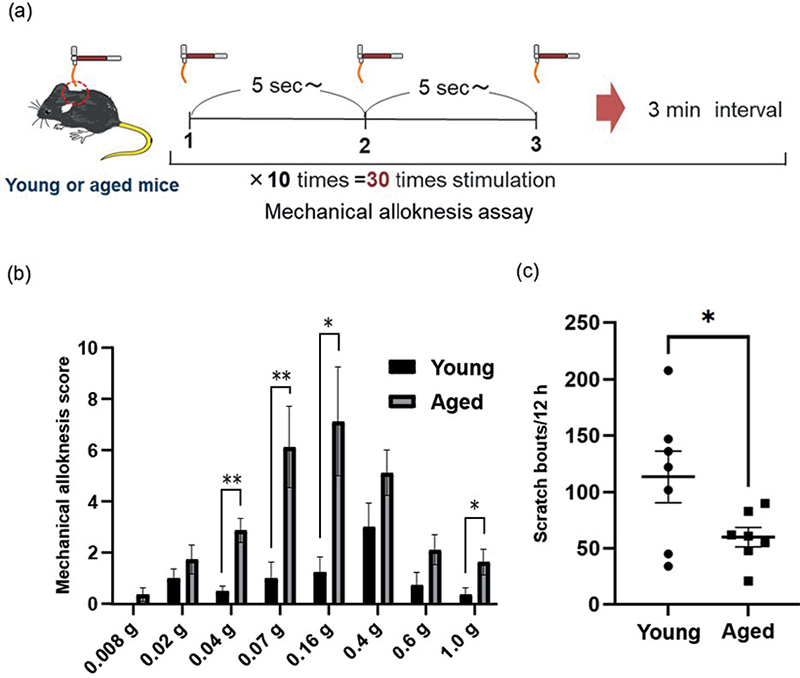
Fig. 1. Quantitative evaluation of itch in aged and young mice. (a) Schematic diagram of the mechanical alloknesis assay. (b) Alloknesis scores by bending forces from 0.008 g to 1.0 g in aged (n = 8) and young mice (n = 8). (c) Numbers of scratching behaviours during 12 h without stimulation in aged (n = 7) and young (n = 7) mice. Each dot represents an individual value, and the horizontal line in the middle of scattergrams indicates the mean value. Error bars indicate standard error of the mean (SEM). *p < 0.05, **p < 0.01 (2-tailed t-test).
We next investigated the skin condition in mice. Increased stratum corneum (SC) hydration (Fig. S1a) and transepithelial water loss (TEWL) (Fig. S1b) were observed in aged mice, suggesting that although ageing was associated with a little decline in skin barrier function, it was not associated with a decline in skin moisture content. The locomotor activity of aged mice was significantly less than that of young mice (Fig. S2).
Evaluation of the effectiveness of antipruritic drugs for pruritus in the elderly
We next examined the therapeutic effect on mechanical alloknesis in aged mice using various antipruritics: bepotastine, neurotropin, pregabalin, and baricitinib (Fig. 2). After appropriate time intervals for each agent, the mice were subjected to mechanical alloknesis assay (Fig. 2a). Pregabalin, neurotropin, and baricitinib significantly suppressed mechanical alloknesis in aged mice (Fig. 2c–e), whereas bepotastine did not (Fig. 2b). Since the JAK1/2 inhibitor baricitinib suppressed mechanical alloknesis, we investigated the therapeutic effects of JAK1 selective inhibitor abrocitinib and JAK2 selective inhibitor AZ960 in aged mice by oral injection (Fig. 3a). Abrocitinib but not AZ960 significantly suppressed mechanical alloknesis (Fig. 3b).
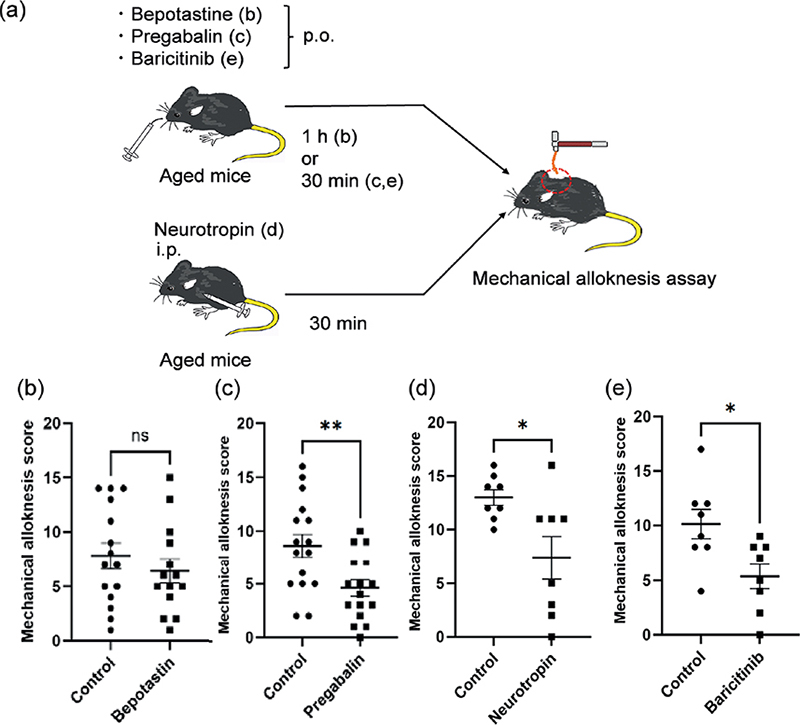
Fig. 2. Effects of various antipruritic drugs on mechanical alloknesis in aged mice. (a) Schematic procedure for assessing the efficacies of antipruritics on mechanical alloknesis in aged mice. Bepotastine, pregabalin, and baricitinib were administered orally, while neurotropin was delivered via intraperitoneal injection in mice. (b) to (d) Effects of bepotastine (b, n = 15 for vehicle control, 14 for bepotastine), pregabalin (c, n = 16, 16), neurotropin (d, n = 8, 8) and baricitinib (e, n = 8, 8) on mechanical alloknesis scores. Each dot represents an individual value, and the horizontal line in the middle of scattergrams indicates the mean value. Error bars indicate SEM. p.o.: per os, i.p.: intra-abdominal, *p < 0.05, **p < 0.01, ns: not significant (2-tailed t-test).
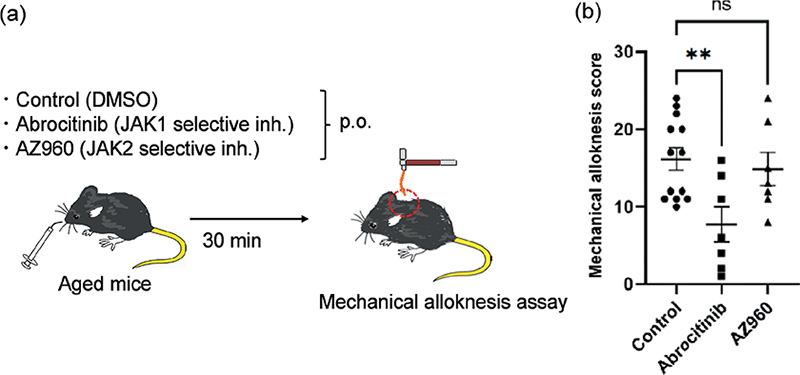
Fig. 3. Effects of JAK1 and JAK2 selective inhibitors on mechanical alloknesis in aged mice. (a) Schematic procedure for the mechanical alloknesis assay following 2 oral JAK inhibitors: JAK1 selective inhibitor (abrocitinib) and JAK2 selective inhibitor (AZ960) in aged mice. (b) Effects of abrocitinib (n = 7) and AZ960 (n = 7) on mechanical alloknesis in aged mice. DMSO was used as a vehicle control (n = 13). Each dot represents an individual value, and the horizontal line in the middle of scattergrams indicates the mean value. Error bars indicate SEM. **p < 0.01, ns: not significant (Dunnett's multiple comparison test).
Involvement of the descending inhibitory system in age-related mechanical alloknesis
It was reported that pregabalin and neurotropin exert analgesic effects via the descending inhibitory system (18, 19), which includes noradrenergic and serotonergic pathways. We hypothesized that the antipruritics which showed therapeutic effects in this assay (Figs 2, 3) inhibit mechanical alloknesis by activating these descending inhibitory pathways. To demonstrate this, we investigated the inhibitory effect of noradrenergic and serotonergic descending inhibitory pathways on the anti-mechanical alloknesis activity of these antipruritics on age-related mechanical alloknesis by administering either yohimbine, an α2-adrenergic receptor antagonist, or methysergide, a mixed 5-HT1receptor agonist/5-HT2 and 5-HT7 receptor antagonists. Yohimbine or methysergide was administered intrathecally to aged mice 5 min before administration of the antipruritic. After the appropriate time interval for each antipruritic, mechanical alloknesis assays were performed (Fig. 4a). We found yohimbine (Fig. 4b–e) and methysergide (Fig. 4f–i), respectively, inhibited the anti-mechanical alloknesis activity of pregabalin, neurotropin, baricitinib, and abrocitinib, whereas pre-treatment by vehicle solution with antipruritics significantly inhibited mechanical alloknesis in aged mice. Furthermore, when yohimbine or methysergide was administered intrathecally to aged mice in a single administration, no significant difference was observed compared with the vehicle-administered group, whereas a slight increase in mechanical alloknesis score was observed (Fig. 5).
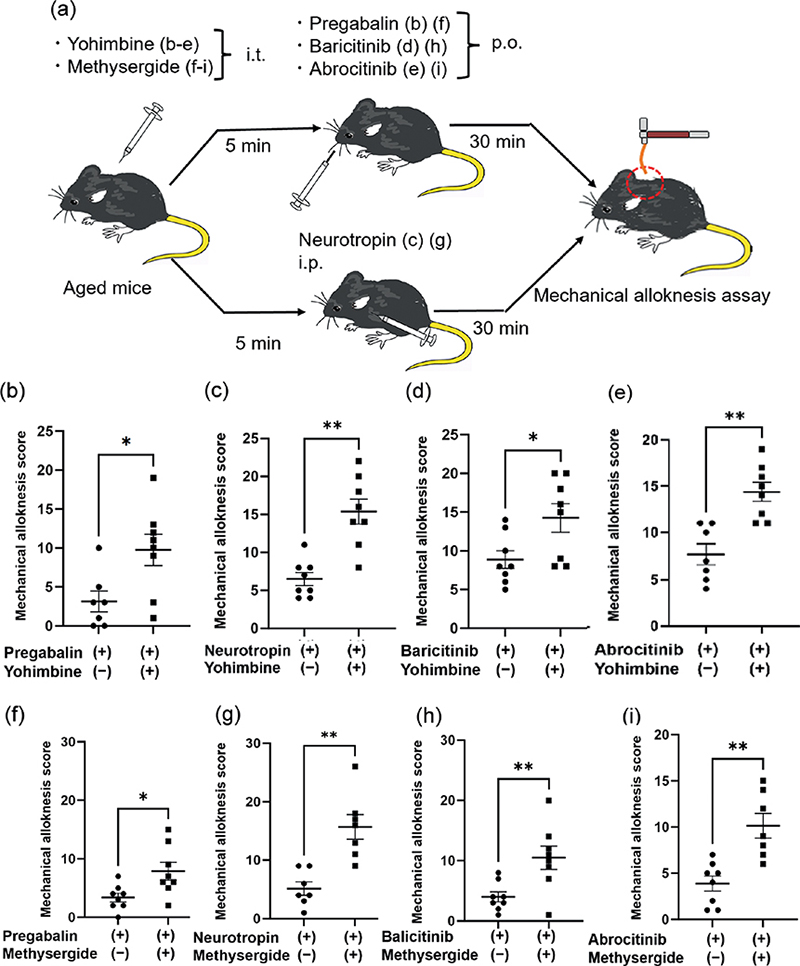
Fig. 4. Effect of the noradrenergic and serotonergic inhibitory pathway on mechanical alloknesis in aged mice. (a) Schematic procedure for the mechanical alloknesis assay following various antipruritics, with pre-treatment of an α2 adrenergic receptor antagonist (yohimbine) or a mixed 5-HT1 and 5-HT2 receptors antagonist (methysergide). (b) to (e) Effects of yohimbine on anti-mechanical alloknesis activity induced by pregabalin (b, n = 7 for vehicle control, 7 for pregabalin), neurotropin (c, n = 8, 8), baricitinib (d, n = 8, 8), and abrocitinib (e, n = 7, 8) in aged mice. (f) to (i) Effect of methysergide on anti-mechanical alloknesis activity induced by pregabalin (f, n = 8 for vehicle control, 8 for pregabalin), neurotropin (g, n = 7, 7), baricitinib (h, n = 8, 8), and abrocitinib (i, n = 8, 7) in aged mice. Each dot represents an individual value, and the horizontal line in the middle of scattergrams indicates the mean value. Error bars indicate SEM. i.t.: intrathecal, *p < 0.05, **p < 0.01 (2-tailed t-test).
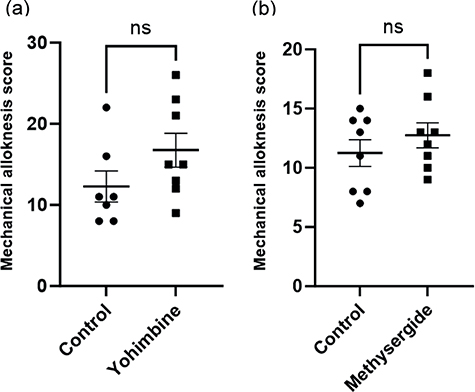
Fig. 5. Effects of yohimbine and methysergide on mechanical alloknesis in aged naïve mice. (a, b) Effect of yohimbine (a, n = 7 for vehicle control, 8 for yohimbine) and methysergide (b, n = 8 for vehicle control, 8 for methysergide) on mechanical alloknesis in aged naive mice. In the scatterplots, each dot represents an individual value, and the horizontal line indicates the mean value. Error bars indicate SEM. ns: not significant (2-tailed t-test).
DISCUSSION
In the present study, we re-characterized two types of itch and skin condition of aged mice, and we clarified several antipruritics that are thought to be effective against pruritus in the elderly, and their mechanism of action, at least in part, using the age-related mechanical alloknesis model.
There have been several reports regarding itch in aged mice (11, 12). Similar to these reports our study demonstrated that mechanical alloknesis is more frequent in aged mice than in young mice (Fig. 1b). Conversely, spontaneous scratching behaviour under non-mechanical stimulus was significantly lower in aged mice than in young mice (Fig. 1c). This result contrasts with the findings by Feng et al., that itch induced by histamine or chloroquine (i.e. chemical itch) showed no significant difference between young and aged mice (11), and is consistent with the data of Braz et al., who reported that scratching behaviour induced by these compounds was lower in aged mice (12). Thus, although the reason for the decline in spontaneous scratching could not be identified in this study, it might be explained by our observation that young mice were in a more active state than aged mice (Fig. S2).
We also evaluated the skin condition in aged mice. Typically, an increase in TEWL and a decrease in SC hydration are observed when the skin is dry (20). However, in this study, both TEWL and SC hydration values were significantly increased (Fig. S1). These findings suggest that not all aged mice that have a predisposition to dryness exhibit features of dry skin when temperature and humidity condition are strictly controlled. This parallels the situation in humans, where the skin of elderly people is generally dry, but not all elderly individuals suffer from senile xerosis. In fact, there are reports suggesting that when a dry skin model was created, the number of scratching behaviours in aged mice was more frequent than in young mice (21, 22), supporting the idea that a suitable model for senile xerosis can be developed using aged mice.
These data suggest that aged mice are sensitive only to mechanical stimuli, likely due to a distinct cause from their skin dryness. Therefore, this age-related mechanical alloknesis may serve as a valuable model for evaluating the effectiveness of antipruritics for pruritus in the elderly and understanding the mechanisms of action of these agents.
In this study, we selected bepotastine, pregabalin, neurotropin, and baricitinib as test drugs to evaluate their effectiveness for pruritus in the elderly using the age-related mechanical alloknesis model. These drugs are commonly used to treat various types of pruritus in Japan (7). Among them, bepotastine, a selective H1-receptor antagonist and one of the most well-known antipruritics, had no effect on the mechanical alloknesis in aged mice (Fig. 2b). It is known that dermal pruritus with no skin lesions is generally less responsive to antihistamines (7), which may explain these results.
In terms of pharmacological behaviour, we also found that neurotropin and pregabalin improved mechanical alloknesis in aged mice (Fig. 2c, d). Pregabalin is a drug officially indicated for neuropathic pain and pain associated with fibromyalgia, but not for itching in Japan (7). This agent is thought to act on the voltage-dependent calcium channels in the central and peripheral nervous system, inhibiting the secretion of neurotransmitters such as glutamate, substance P, and CGRP in a state of neural hyperexcitability. This, in turn, raises the threshold for itch (23). Neurotropin is a drug commonly used in Japan and China. Its injectable form is officially prescribed to treat conditions like low back pain, cervicobrachial syndrome, symptomatic neuralgia, and itching associated with skin diseases (such as eczema, dermatitis, urticaria). It is also employed for allergic rhinitis and to manage after-effect SMON symptoms like cold sensations, abnormal sensations, and pain (24). It was reported that neurotropin suppresses itch-related behaviour in NC/Nga mice with atopic dermatitis (AD)-like symptoms (15). Moreover, clinical studies have reported that the administration of pregabalin and neurotropin successfully alleviated itching in conditions like dialysis-induced pruritus and neuropathic itch, such as post-herpetic pruritus (25–27). Therefore, our data strongly suggest that these drugs are promising candidates to treat pruritus in the elderly.
Notably, baricitinib, an orally administered selective JAK1/2 inhibitor, improved mechanical alloknesis in aged mice (Fig. 2e). Further analysis revealed that the JAK1-specific inhibitor abrocitinib, but not AZ960, the JAK2-specific inhibitor, also had a significant effect on age-related mechanical alloknesis (Fig. 3b). Baricitinib and abrocitinib are approved in many countries for the treatment of moderate-to-severe AD in adults (28, 29), but not for dermal pruritus without skin lesions, at least in Japan (7). It is believed that JAK inhibitors are effective for AD primarily by suppressing Th2 inflammation via inhibiting JAK-STAT signalling (30). However, it was reported that JAK1 is enriched with pruriceptive neurons, and the specific deletion of JAK1 in sensory neurons reduces itch in AD models (31). This indicates that JAK1 signalling in sensory nerves plays a pivotal role in itch transduction. This report supports our findings that the anti-mechanical alloknesis activity of baricitinib and abrocitinib are suppressed by inhibiting descending inhibitory pathways, which are among the most well-known neural pathways (Fig. 4d, e, h, and i).
Not only baricitinib and abrocitinib, but also pregabalin and neurotropin demonstrated a reduction in their therapeutic effects on mechanical alloknesis by inhibiting the descending inhibitory system (Fig. 4b, c, f, and g). The descending inhibitory system can be categorized into 2 main pathways: the noradrenergic pathway, which involves the projection of noradrenalin from the locus coeruleus to the dorsal horn of the spinal cord, and the serotonergic pathway, which projects serotonin from the hypothalamus through the raphe nuclei to the dorsal horn of the spinal cord (32). Within these pathways, there are various receptor types that play a role in their function. Adrenaline receptors (which respond to noradrenalin) are broadly classified into 3 types (α1, α2 and β), while 5-HT receptors (which respond to serotonin) are classified into 7 types (HT1 to HT7), each with subtypes. It was reported that α1 and α2 receptors (33) and 5-HT1A, 5-HT1B, 5-HT1D, 5-HT2A, 5-HT3 and 5-HT4 receptors (34) are expressed in the spinal cord and contribute to the operation of the descending inhibitory system. Historically, the noradrenergic and serotonergic pathways were known to alleviate thermal, mechanical, and neuropathic pain in animal models (32). However, recent research has indicated their involvement in acute (35) and chronic itch (36). A study by Koga et al. (37) suggested that descending noradrenergic signalling inhibits acute and chronic itch, supporting our findings that yohimbine, an α1/α2 receptor antagonist, suppressed the anti-alloknesis activity of antipruritics. Regarding 5-HT receptors, we found that the anti-mechanical alloknesis effect of our antipruritic candidates was suppressed by methysergide, a chemical drug with both 5-HT1 receptor agonist and nonselective 5-HT2 and 5-HT7 serotonin receptor antagonist activities (38, 39). It has also been reported that depletion of spinal 5-HT1A-expressing neurons has been shown to reduce itch, and intraperitoneal injection of 5-HT precursor facilitates itch, suggesting that descending 5-HT1A spinal neurons works as a facilitative pathway rather than an inhibitory pathway (40). This activation of the 5HT1 A-mediated itch-facilitative pathway may be responsible for the slight increase in scratching behaviour observed in aged mice when methysergide was administered alone (Fig. 5). However, as no significant difference was observed in this case, there is a strong possibility that methysergide also acts on the descending inhibitory system mediated by a 5HT2 receptor (or possibly a 5HT7 receptor whose expression has not been confirmed) in the spinal cord, which may be the action points of these antipruritics. The fact that 2 descending inhibitory pathways may be involved in the mechanism of the anti-mechanical alloknesis activity of antipruritics strongly suggests that age-related mechanical alloknesis may be primarily influenced by the modulation of the central nervous system rather than epidermal barrier disorders or changes in the immune system.
In conclusion, the findings from this study suggest that mechanical alloknesis in elderly mice serves as a suitable animal model for evaluating pruritus in the elderly, particularly in cases without initial rashes or xerosis. Pregabalin, neurotropin, baricitinib, and abrocitinib appear to have potential as effective antipruritic agents in the elderly, as they may activate both the noradrenergic and serotonergic descending inhibitory pathways, either directly or indirectly (Fig. 6). These results provide valuable insights that can inform the selection and development of antipruritics for managing pruritus in the elderly population, particularly when skin lesions and dryness are not present.
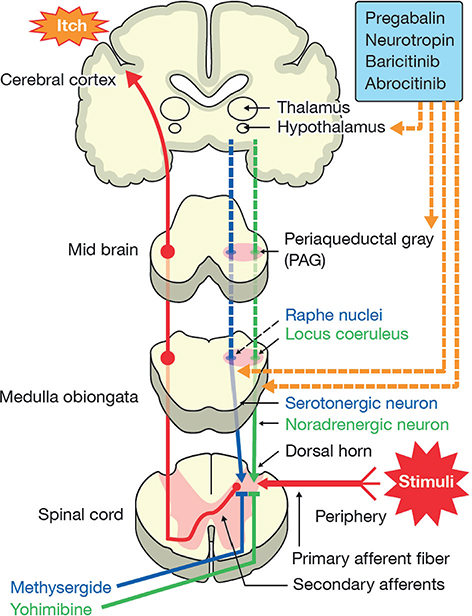
Fig. 6. A model of the descending inhibitory system and the possible points of action for anti-mechanical alloknesis. When a mechanical stimulus is received at the periphery, primary afferents are excited. This excitement reaches the cerebral cortex where it is perceived as itch, through the dorsal horn of the spinal cord, secondary afferents, and thalamus (itch-transaction pathway: red line). The descending inhibitory system is a system that descends from the periaqueductal gray (PAG) to the dorsal horn of the spinal cord, and inhibits synaptic transmission between primary and secondary afferents in the itch-transaction pathway. This system consists of noradrenaline (green line) and serotonin (blue line) pathways, which release noradrenaline or serotonin in the spinal cord via the locus coeruleus and raphe magnum, respectively. As yohimbine and methysergide inhibited the anti-mechanical alloknesis effect of pregabalin, neurotropin, baricitinib, and abrocitinib at the spinal cord, these antipruritics may suppress mechanical alloknesis by activating both of the descending inhibitory pathways directly, or indirectly by activating their upstream pathway (such as hypothalamus or thalamus, possible points of action: orange lines).
ACKNOWLEDGEMENTS
The authors would like to thank Dr Y. Kamata, Dr M. Kurosawa, and Mr R. Kosuge for technical support. They thank Nippon Zoki Pharmaceutical Company for providing neurotropin, and David Price from English Services for Scientists for proofreading the manuscript.
REFERENCES
- Chung BY, Um JY, Kim JC, Kang SY, Park CW, Kim HO. Pathophysiology and treatment of pruritus in elderly. Int J Mol Sci 2020; 22.
- Berger TG, Steinhoff M. Pruritus in elderly patients: eruptions of senescence. Semin Cutan Med Surg 2011; 30: 113–117.
- Yalçin B, Tamer E, Toy GG, Oztaş P, Hayran M, Alli N. The prevalence of skin diseases in the elderly: analysis of 4099 geriatric patients. Int J Dermatol 2006; 45: 672–676.
- Valdes-Rodriguez R, Mollanazar NK, González-Muro J, Nattkemper L, Torres-Alvarez B, López-Esqueda FJ, et al. Itch prevalence and characteristics in a Hispanic geriatric population: a comprehensive study using a standardized itch questionnaire. Acta Derm Venereol 2015; 95: 417–421.
- Norman RA. Xerosis and pruritus in the elderly: recognition and management. Dermatol Ther 2003; 16: 254–259.
- Valdes-Rodriguez R, Stull C, Yosipovitch G. Chronic pruritus in the elderly: pathophysiology, diagnosis and management. Drugs Aging 2015; 32: 201–215.
- Satoh T, Yokozeki H, Murota H, Tokura Y, Kabashima K, Takamori K, et al. 2020 guidelines for the diagnosis and treatment of cutaneous pruritus. J Dermatol 2021; 48: e399–e413.
- Beauregard S, Gilchrest BA. A survey of skin problems and skin care regimens in the elderly. Arch Dermatol 1987; 123: 1638–1643.
- Polat M, Yalçin B, Calişkan D, Alli N. Complete dermatological examination in the elderly: an exploratory study from an outpatient clinic in Turkey. Gerontology 2009; 55: 58–63.
- White-Chu EF, Reddy M. Dry skin in the elderly: complexities of a common problem. Clin Dermatol 2011; 29: 37–42.
- Feng J, Luo J, Yang P, Du J, Kim BS, Hu H. Piezo2 channel-Merkel cell signaling modulates the conversion of touch to itch. Science 2018; 360: 530–533.
- Braz JM, Hamel K, Craik V, Rodriguez-Rosado S, Bhardwaj K, Jewell M, et al. Pain and itch processing in aged mice. J Pain 2023; 10.1016/j.jpain.2023.07.018.
- Takahashi N, Tominaga M, Kosaka R, Kamata Y, Umehara Y, Matsuda H, et al. Involvement of µ-opioid receptors and κ-opioid receptors in itch-related scratching behaviour of imiquimod-induced psoriasis-like dermatitis in mice. Acta Derm Venereol 2017; 97: 928–933.
- Tsukumo Y, Matsumoto Y, Miura H, Yano H, Manabe H. Gabapentin and pregabalin inhibit the itch-associated response induced by the repeated application of oxazolone in mice. J Pharmacol Sci 2011; 115: 27–35.
- Kamo A, Tominaga M, Matsuda H, Kina K, Kamata Y, Umehara Y, et al. Neurotropin suppresses itch-related behavior in NC/Nga mice with atopic dermatitis-like symptoms. J Dermatol Sci 2016; 81: 212–215.
- Hylden JL, Wilcox GL. Intrathecal morphine in mice: a new technique. Eur J Pharmacol 1980; 67: 313–316.
- Komiya E, Tominaga M, Hatano R, Kamikubo Y, Toyama S, Sakairi H, et al. Peripheral endomorphins drive mechanical alloknesis under the enzymatic control of CD26/DPPIV. J Allergy Clin Immunol 2022; 149: 1085–1096.
- Takeuchi Y, Takasu K, Ono H, Tanabe M. Pregabalin, S-(+)-3-isobutylgaba, activates the descending noradrenergic system to alleviate neuropathic pain in the mouse partial sciatic nerve ligation model. Neuropharmacology 2007; 53: 842–853.
- Kawamura M, Ohara H, Go K, Koga Y, Ienaga K. Neurotropin induces antinociceptive effect by enhancing descending pain inhibitory systems involving 5-HT3 and noradrenergic alpha2 receptors in spinal dorsal horn. Life Sci 1998; 62: 2181–2190.
- Moniaga CS, Tominaga M, Takamori K. Mechanisms and management of itch in dry skin. Acta Derm Venereol 2020; 100: adv00024.
- Zhao N, Gu M, Yang W, Zhang M, Tian Q, Ru L, et al. Increased ZAP70 is involved in dry skin pruritus in aged mice. Biomed Res Int 2016; 2016: 6029538.
- Fan JJ, Gao B, Song AQ, Zhu YJ, Zhou J, Li WZ, et al. Spinal cord NLRP1 inflammasome contributes to dry skin induced chronic itch in mice. J Neuroinflammation 2020; 17: 122.
- Matsuda KM, Sharma D, Schonfeld AR, Kwatra SG. Gabapentin and pregabalin for the treatment of chronic pruritus. J Am Acad Dermatol 2016; 75: 619–625.e616.
- Hata T, Kita T, Itoh E, Oyama R, Kawabata A. Mechanism of the analgesic effect of neurotropin. Jpn J Pharmacol 1988; 48: 165–173.
- Yue J, Jiao S, Xiao Y, Ren W, Zhao T, Meng J. Comparison of pregabalin with ondansetron in treatment of uraemic pruritus in dialysis patients: a prospective, randomized, double-blind study. Int Urol Nephrol 2015; 47: 161–167.
- Shimada N, Niwa Y, Hotta K, Igarashi T, Takeuchi M. Pregabalin for postherpetic itch: a case report. JA Clin Rep 2020; 6: 24.
- Kaku H, Fujita Y, Yago H, Naka F, Kawakubo H, Nakano K, et al. Study on pruritus in hemodialysis patients and the antipruritic effect of neurotropin: plasma levels of substance P, somatostatin, IgE, PTH and histamine. Nihon Jinzo Gakkai Shi 1990; 32: 319–326.
- Torrelo A, Rewerska B, Galimberti M, Paller A, Yang CY, Prakash A, et al. Efficacy and safety of baricitinib in combination with topical corticosteroids in paediatric patients with moderate-to-severe atopic dermatitis with an inadequate response to topical corticosteroids: results from a phase III, randomized, double-blind, placebo-controlled study (BREEZE-AD PEDS). Br J Dermatol 2023; 189: 23–32.
- Perche PO, Cook MK, Feldman SR. Abrocitinib: a new FDA-approved drug for moderate-to-severe atopic dermatitis. Ann Pharmacother 2023; 57: 86–98.
- Huang IH, Chung WH, Wu PC, Chen CB. JAK-STAT signaling pathway in the pathogenesis of atopic dermatitis: an updated review. Front Immunol 2022; 13: 1068260.
- Oetjen LK, Mack MR, Feng J, Whelan TM, Niu H, Guo CJ, et al. Sensory neurons co-opt classical immune signaling pathways to mediate chronic itch. Cell 2017; 171: 217–228.e213.
- Ossipov MH, Dussor GO, Porreca F. Central modulation of pain. J Clin Invest 2010; 120: 3779–3787.
- Pertovaara A. Noradrenergic pain modulation. Prog Neurobiol 2006; 80: 53–83.
- Liu QQ, Yao XX, Gao SH, Li R, Li BJ, Yang W, et al. Role of 5-HT receptors in neuropathic pain: potential therapeutic implications. Pharmacol Res 2020; 159: 104949.
- Miyahara Y, Funahashi H, Naono-Nakayama R, Haruta-Tsukamoto A, Nishimori T, Ishida Y. Role of serotonin and noradrenaline in the acute itch processing in mice. Eur J Pharmacol 2019; 850: 118–125.
- Miyahara Y, Funahashi H, Naono-Nakayama R, Haruta-Tsukamoto A, Muroi C, Kogoh Y, et al. Serotonin and noradrenaline modulate chronic itch processing in mice. Eur J Pharmacol 2020; 883: 173319.
- Koga K, Shiraishi Y, Yamagata R, Tozaki-Saitoh H, Shiratori-Hayashi M, Tsuda M. Intrinsic braking role of descending locus coeruleus noradrenergic neurons in acute and chronic itch in mice. Mol Brain 2020; 13: 144.
- Colpaert FC, Niemegeers CJ, Janssen PA. In vivo evidence of partial agonist activity exerted by purported 5-hydroxytryptamine antagonists. Eur J Pharmacol 1979; 58: 505–509.
- Knight AR, Misra A, Quirk K, Benwell K, Revell D, Kennett G, et al. Pharmacological characterisation of the agonist radioligand binding site of 5-HT(2A), 5-HT(2B) and 5-HT(2C) receptors. Naunyn Schmiedebergs Arch Pharmacol 2004; 370: 114–123.
- Zhao ZQ, Liu XY, Jeffry J, Karunarathne WK, Li JL, Munanairi A, et al. Descending control of itch transmission by the serotonergic system via 5-HT1A-facilitated GRP-GRPR signaling. Neuron 2014; 84: 821–834.