SHORT COMMUNICATION
Successful Therapy of Severe and Refractory Cutaneous Sarcoidosis with Baricitinib
Giuseppe RUSSO and Emmanuel LAFFITTE
Department of Dermatology, University Hospital of Geneva, Geneva, Switzerland. E-mail: Giuseppe.russo@hcuge.ch
Citation: Acta Derm Venereol 2024; 104: adv39970. DOI https://doi.org/10.2340/actadv.v104.39970.
Copyright: © Published by Medical Journals Sweden, on behalf of the Society for Publication of Acta Dermato-Venereologica. This is an Open Access article distributed under the terms of the Creative Commons Attribution-NonCommercial 4.0 International License (https://creativecommons.org/licenses/by-nc/4.0/)
Submitted: Jan 25, 2024; Accepted: Mar 7, 2024; Published: Apr 2, 2024
Competing interests and funding: The authors have no conflict of interest to declare.
INTRODUCTION
Sarcoidosis is a multisystem inflammatory disease characterized by the presence of non-caseating granulomas. Skin manifestations in sarcoidosis occur in about 25% of patients and are usually an early manifestation of the disease. Classically, skin manifestations are divided into specific lesions including nodules, papules, plaques, and lupus pernio with histopathologically evident non-caseating granulomas and reactive nonspecific lesions that can exhibit a wide variety of morphologies such as erythema nodosum. Because of these different morphologies, cutaneous sarcoidosis is known as one of the great imitators in dermatology (1).
The aetiology of sarcoidosis is not yet well known; an interaction between extrinsic antigens and an individual’s immunogenetic response is thought to trigger the development and progression of the disease.
The immune response is a Th1 type (production of IL-2, interferon γ and TNF-α) that results in a predominantly CD4+ T cell immune response to an unknown antigen presented by host monocytes/macrophages. The pathophysiological key is the development and accumulation of granulomas in organs involved such as the skin. Many inflammatory mediators like TNF-α and GM-CSF are involved in granuloma formation (2).
The treatment of cutaneous sarcoidosis is a challenge for clinicians. There are no therapies approved and options are limited. We report the case of a long-standing recalcitrant lymph nodes and cutaneous sarcoidosis successfully managed by baricitinib, a JAK 1–2 inhibitor approved for the treatment of rheumatoid arthritis, atopic dermatitis, and alopecia areata.
CASE REPORT
A 59-year-old man was referred to our university clinic for worsening of cutaneous sarcoidosis that had occurred in the early 2000s. Skin examination showed erythematous scaly papules and well-defined plaques of neck and head, with non-scarring scalp alopecia (Figs 1a and 2a). A CT scan showed supraclavicular and mediastinal peri-centimetric lymph nodes and a typical pulmonary micronodular pattern. Pulmonary function tests were normal and a cardiac MRI showed no myocardial involvement.
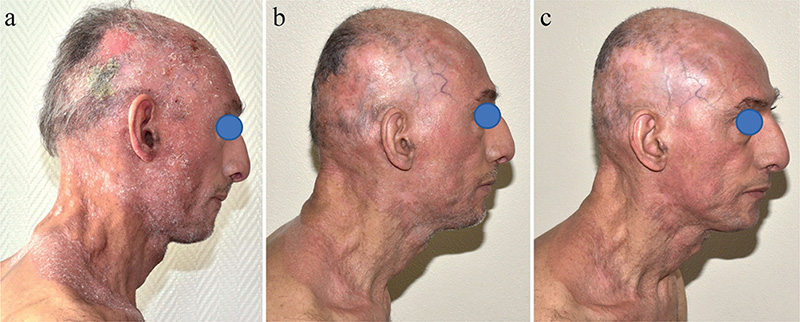
Fig. 1. (a) Erythematous scaly papules and plaques of neck and head. Improve+ment (b) after 3 months and (c) 6 months of treatment. Written permission is given to publish these photos.
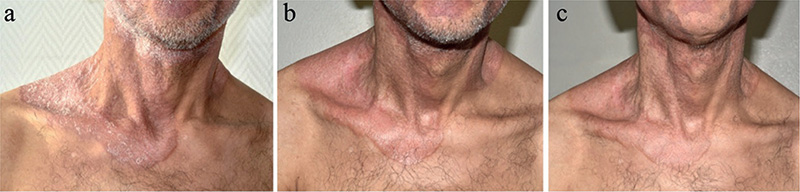
Fig. 2. (a) Erythematous arcuate plaques of neck and supraclavicular fossa. Improvement (b) after 3 months and (c) 6 months of treatment.
Initial treatment with methotrexate 15 mg/week and topical daily clobetasol propionate was administered for 6 months without improvement.
Treatment with baricitinib 4 mg/day was then initiated. An improvement in skin lesions was observed after three weeks. After 3 months of treatment, facial and scalp involvement had almost cleared and neck lesions had significantly improved. After 6 months of treatment, all skin lesions had almost regressed (Figs 1c and 2c).
At one-year follow-up, the patient had no skin recurrence. A thoracic CT scan was also performed, showing stable lymph node and pulmonary involvement. Treatment was well tolerated by the patient without any adverse effect.
DISCUSSION
The treatment of cutaneous sarcoidosis is mostly based on clinical experience and small series. Dermocorticoids are the agents most frequently employed. When skin involvement is extensive, other drugs may be used such as hydroxychloroquine, methotrexate, azathioprine, tetracyclines, or thalidomide. Moreover, tumour necrosis factor alpha (TNF-α) inhibitors as well as, more recently, Janus kinase inhibitors (JAKi) have been investigated as interesting potential steroid-sparing treatments for both systemic and cutaneous sarcoidosis (3).
JAKi represent a very interesting treatment for refractory sarcoidosis. The JAK/STAT pathway role in granulomatous inflammation pathogenesis has been well demonstrated (4). The activation of macrophages that form granulomas in sarcoidosis is driven by IFN-γ secretion whose signalling is partly dependent on the JAK/STAT pathway. Other cytokines such as IL-2 and IL-12 also rely on the JAK/STAT pathway and have been implicated in the pathogenesis of sarcoidosis (5). In addition, a gene expression study showed that the JAK/STAT signalling pathway is highly represented in sarcoidosis and it is linked to the severity of disease (4).
Literature concerning the potential use of JAK inhibitors in cutaneous sarcoidosis is promising; several cases have been successfully treated with tofacitinib, a JAKi type 1 and 3. Two cases of efficacy of ruxolitinib, a JAKi 1–2, are also currently reported (3).
We present the first case of cutaneous sarcoidosis successfully treated by baricitinib, an oral selective JAKi 1–2 widely used in dermatological diseases such as atopic dermatitis and alopecia areata, where it showed a good safety profile (6).
Further studies are needed to establish the role of JAKi in the treatment of sarcoidosis.
REFERENCES
- Karadağ AS, Parish LC. Sarcoidosis: a great imitator. Clin Dermatol 2019; 37: 240–254.
- Bergeron A, Bonay M, Kambouchner M, Lecossier D, Riquet M, Soler P, et al. Cytokine patterns in tuberculous and sarcoid granulomas: correlations with histopathologic features of the granulomatous response. J Immunol 1997; 159: 3034–3043.
- Toriola SL, Satnarine T, Zohara Z, Adelekun A, Seffah KD, Salib K, et al. Recent clinical studies on the effects of tumor necrosis factor-alpha (TNF-α) and Janus kinase/signal transducers and activators of transcription (JAK/STAT) antibody therapies in refractory cutaneous sarcoidosis: a systematic review. Cureus 2023; 15: e44901.
- Zhou T, Casanova N, Pouladi N, Wang T, Lussier Y, Knox KS, et al. Identification of Jak-STAT signaling involvement in sarcoidosis severity via a novel microRNA-regulated peripheral blood mononuclear cell gene signature. Sci Rep 2017; 7: 4237.
- Moller DR, Forman JD, Liu MC, Noble PW, Greenlee BM, Vyas P, et al. Enhanced expression of IL-12 associated with Th1 cytokine profiles in active pulmonary sarcoidosis. J Immunol 1996; 156: 4952–4960.
- Reich K, Kabashima K, Peris K, Silverberg JI, Eichenfield LF, Bieber T, et al. Efficacy and safety of baricitinib combined with topical corticosteroids for treatment of moderate to severe atopic dermatitis: a randomized clinical trial. JAMA Dermatol 2020; 156: 1333–1343.