QUIZ SECTION
Fragmented Facial Flushing: A Quiz
Alexis B. LYONS, Mardeen S. KARIM and Tasneem F. MOHAMMAD
Department of Dermatology, Henry Ford Health, 3031 W. Grand Blvd, Suite 800, Detroit, MI 48202, USA. E-mail: tmohamm2@hfhs.org
Citation: Acta Derm Venereol 2024; 104: adv40665. DOI: https://doi.org/10.2340/actadv.v104.40665.
Copyright: 2024 © The Author(s). Published by MJS Publishing, on behalf of the Society for Publication of Acta Dermato-Venereologica. This is an Open Access article distributed under the terms of the Creative Commons Attribution-NonCommercial 4.0 International License (https://creativecommons.org/licenses/by-nc/4.0/).
Published: Jun 7, 2024
Competing interests and funding: ABL is a sub-investigator for Galderma. TFM and MSK have no relevant disclosures.
A 33-year-old white female with no significant past medical history underwent abobotulinumtoxin A injections for dynamic rhytids to the forehead (10 units) and glabellar complex (12 units). Eight days after injection, the patient went for a run. Immediately after the run, the patient noticed the normal expected flushing of the face, but with sparing of the areas injected with abobotulinumtoxin A (Fig. 1). The areas were asymptomatic.
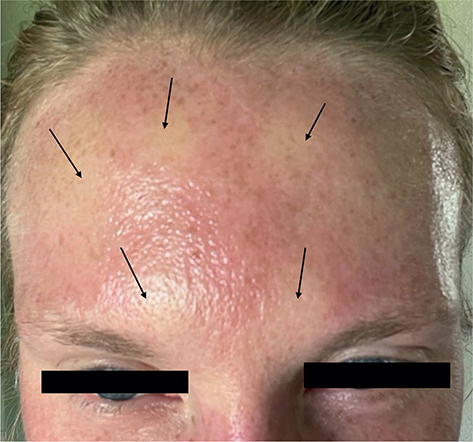
Fig. 1. A 33-year-old white female 8 days after abobotulinumtoxin A injections with diffuse facial erythema after running with sparing of injection sites (indicated by the arrows). Written consent was obtained from the patient for the publication of photos.
What is your diagnosis?
Differential diagnosis 1: Localized blanching after botulinum toxin injections
Differential diagnosis 2: Injection site reaction
Differential diagnosis 3: Rosacea
Differential diagnosis 4: Sodium nitrite-induced flushing
See next page for answer.
ANSWERS TO QUIZ
Fragmented Facial Flushing: A Commentary
Diagnosis: Localized blanching after botulinum toxin injections
Abobotulinumtoxin A, a type of botulinum toxin, is frequently used for treatment of dynamic rhytides of the face for cosmetic purposes. The procedure is generally well tolerated, with the most common adverse events including pain, erythema, headache, and ptosis. Here, we report a case of a woman who experienced an unusual adverse effect of facial blanching after abobotulinumtoxin A injections.
Abobotulinumtoxin A works by inhibiting acetylcholine release from the presynaptic neuron, which inhibits target muscle or gland activity and is frequently used to treat facial rhytids and hyperhidrosis, respectively (1, 2). The popularity of botulinum toxin treatments has risen steadily over the years given the relatively quick onset of action, little to no downtime, and favourable results. The most common adverse effects reported include injection site reactions like pain, redness, and bruising as well as headache and ptosis (1, 2).
In addition to the more common adverse effects reported, blanching after botulinum toxin injections has also been reported as a rare adverse effect of the medication with an unclear mechanism of action (1–5). Although controversial, it has been hypothesised that botulinum toxin blocks the vasodilatory effect of acetylcholine, other neurotransmitters, or co-transmitters including prostaglandins, endothelium-derived hyperpolarising factor, and nitric oxide, thereby inhibiting physiologic flushing with exercise and leading to the perceived visualized blanching noted at injection sites (3–5).
Along these same lines, botulinum toxin has been used in the treatment of Frey syndrome to prevent gustatory facial flushing and hyperhidrosis secondary to autonomic dysfunction seen in these patients (1, 2). Botulinum toxin has also been used successfully to treat flushing in patients with persistent idiopathic facial, neck, and anterior chest wall flushing (4).
Here, we present a case of facial blanching seen after botulinum toxin injection. Further studies are needed to elucidate the exact role of botulinum toxin on the various neurotransmitters involved in vasodilation and flushing. Although rare, patients should be warned of this potential cosmetic adverse outcome, particularly if they have a history of flushing after exercise. Reassurance can be provided to the patient that other than cosmetic distress, this phenomenon is asymptomatic and otherwise innocuous.
REFERENCES
- Khan TT, Herne K, Dayan SH, Woodward JA. Facial blanching due to neurotoxins: proposed mechanisms. Dermatol Surg 2013; 39: 24–29.
- de Almeida H, Jr, Henkin C, Milman L, Bernardotti I. Localized flushing absence after abobotulinum toxin A cosmetic treatment. Eur J Dermatol 2013; 23: 714–715.
- Warren D, Woody M, Vickers J. Facial blanching after cosmetic botulinum toxin injection: case series. Skinmed 2016; 14: 239–240.
- Sharova A, Lysikova V. Facial blanching: an unusual side effect after botulinum toxin injection. J Dermatology Cosmetology 2018; 2: 5–7.
- Mitri F, Kälber KA, Enk AH, Toberer F. Persistent facial blanching after botulinum toxin injection. Case Rep Dermatol 2022; 14: 253–257.