SHORT COMMUNICATION
Depression, Anxiety and Suicidal Ideation in Prurigo Nodularis: A Systematic Review and Meta-analysis
Wei JIANG1#, Jianru CHEN2#, Nan LI1, Xueyong WANG1* and Chunying LI2*
1Department of Dermatology, The 78th Group Army Hospital of Chinese PLA, Mudanjiang, 157000, and 2Department of Dermatology, Xijing Hospital, Forth Military Medical University, Xi’an 710032, China. *E-mails: 13946365018m@sina.cn; lichying@fmmu.edu.cn
#These authors contributed equally.
Citation: Acta Derm Venereol 2024; 104: adv40677. DOI https://doi.org/10.2340/actadv.v104.40677.
Copyright: © 2024 The Author(s). Published by MJS Publishing, on behalf of the Society for Publication of Acta Dermato-Venereologica. This is an Open Access article distributed under the terms of the Creative Commons Attribution-NonCommercial 4.0 International License (https://creativecommons.org/licenses/by-nc/4.0/).
Submitted: Apr 29, 2024; Accepted: Jul 3, 2024; Published: Aug 5, 2024
INTRODUCTION
Prurigo nodularis (PN) is a chronic inflammatory pruritic skin disease (1). The dysfunction of the immune system and immune-neurologic network reportedly play a key role in the pathogenesis of PN (2). Of note, the link between PN and mental health conditions such as anxiety and depression cannot be ignored. PN is significantly associated with psychiatric comorbidities, such as depression, anxiety, and self-harm/suicidal ideation according to previous reports (3). Self-harm/suicidal ideation was also found to be more common in patients with PN than in the general population (4). However, it is not specified whether these are psychiatric comorbidities or whether they are related to PN as an underlying factor. Apart from this, to the best of our knowledge the exact magnitude of the association between PN and depression, anxiety, and suicidal ideation/self-harm has not been comprehensively outlined. Thus, we conducted a systematic review and meta-analysis to analyse the pooled estimate of the prevalence and odds of depression, anxiety disorders, and suicidal ideation/ self-harm in patients with PN.
MATERIALS AND METHODS
The systematic review and meta-analysis are available at PROSPERO (CRD42023388129) and follow PRISMA guidelines.
Databases, including MEDLINE, EMBASE, PsychINFO, Science Direct, and Web of Science from inception to August 2023, were consulted with no language restriction. Our search aimed to identify research studies that investigated the association between PN and the odds of depression, anxiety disorders, and suicidal ideation/self-harm (see Table SI for the full search strategy).
The inclusion criteria for the study were: (1) observational study; (2) investigation into the prevalence rates of psychiatric comorbidity in PN patients; (3) study consisting of at least 10 PN subjects. Studies lacking sufficient data to calculate prevalence or odds ratios were excluded. The data collected were sociodemographic, medical, and methodological. The Newcastle-Ottawa Scale (NOS) was used for methodological quality assessing in the included studies (9 for high-quality, 7–8 for medium-quality, and < 6 for low-quality literature).
We employed Review Manager (RevMan, version 5.41 for Windows; The Cochrane Collaboration, Copenhagen, Denmark) to pool data for the outcomes of interest (forest plots, heterogeneity test). STATA SE (version 15.1; StataCorp LLC, College Station, TX, USA) was employed to conduct the statistical analyses (funnel plot plus Egger’s test and Begg’s test).
RESULTS
A total of 14 articles with over 24,000 patients with PN were included in the meta-analysis (Fig. S1). Characteristics of the studies included are summarized in Table SII.
Association of depression and prurigo nodularis
In total, 12 studies (n = 13,460) reported the frequency of depression in patients with PN, among which 8 studies (n = 10,569) evaluating OR were selected for meta-analysis (Fig. 1A). There was a very wide heterogeneity (I2 = 81%, p < 0.00001). Consequently, we used random-effects models to perform the pooled analysis of all the studies included. The meta-analysis showed a high prevalence of any type of depressive disorder in patients with PN (19.3%, 95% CI 18.6–20.1%). In comparison, the prevalence of depression in the general population was 19.1% (95% CI 18.4–19.9%), while in hospital-based studies (n = 2), the prevalence was even higher at 34.2% (95% CI 26.1–43.3%). The association between PN and depression was significant (p < 0.00001) with an odds ratio of 2.53 (95% CI 2.40–2.66).
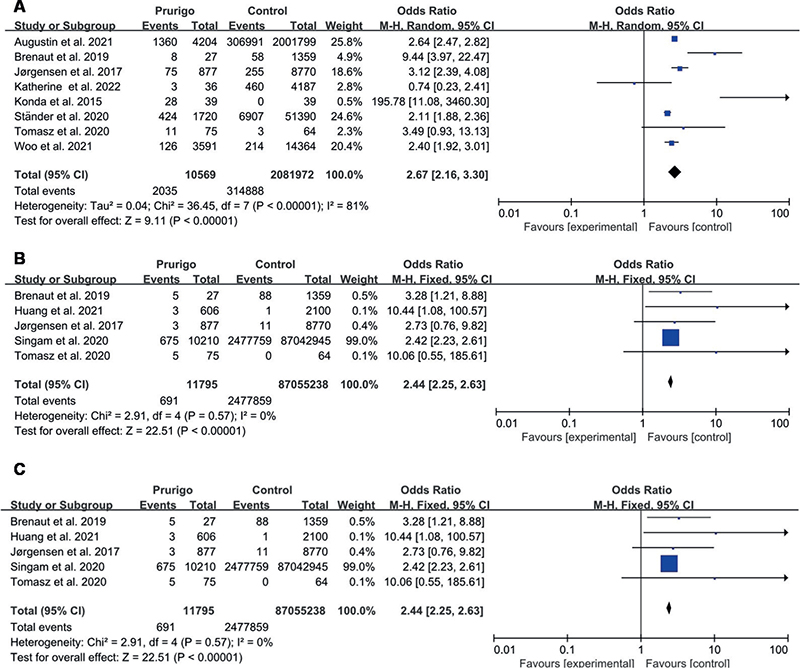
Fig 1. Forest plot of the proportion of depression (A), anxiety (B) and suicidal ideation/self-harm (C) in persons with vs without PN. 95% confidence intervals (CIs) (squares), and pooled proportions (diamonds) are presented.
Association of anxiety and prurigo nodularis
After selection, 10 studies (n = 18,277) assessed anxiety prevalence, and 6 (n = 15,386) were retained for the meta-analysis (Fig. 1B). It was evident that heterogeneity across studies was present (I2 = 57%, p < 0.0001) and the overall random-effects prevalence of any anxiety was 25.7 (95% CI 25.0–26.4%). The link between PN and anxiety was significant (p < 0.00001) with an odds ratio of 3.31 (95% CI 2.50–4.39). Of note, anxiety affected 4.1% (95% CI 3.6–4.7%) of the general population (n = 4), while anxiety had a prevalence of 36.3% (95% CI 35.4–37.2%) in studies based on a hospital-based population (n = 2).
Association of suicidal ideation/self-harm and prurigo nodularis
After conducting a screening process, 6 studies (n = 11,966) assessed the prevalence of suicidal ideation/self-harm, and 5 (n = 11,795) were retained for the meta-analysis (Fig. 1C). Cases reporting suicidal ideation and self-harm were found to account for 5.9% (95% CI 5.5–6.3%). Regarding the incidence of suicidal ideation/self-harm in patients with PN, meta-analytic pooling under a fixed-effects model (I2 = 0%) showed a significantly (p < 0.00001) higher risk with an OR of 2.44 (95% CI 2.25–2.63). In different settings, the prevalence of suicidal ideation/self-harm in the general population (n = 3) was 0.7% (95% CI 0.4–1.3%), whereas in studies of a hospital-based population (n = 2), the prevalence of depression was 6.6% (95% CI 6.2–7.1%).
Sensitivity analysis and publication bias
No publication bias existed according to the funnel plot plus Egger’s test and Begg’s test (Figs S2 and S3). Sensitivity analysis was carried out by the one-by-one elimination method (Fig. S4).
DISCUSSION
To the best of our knowledge, this is the first meta-analysis to include all available observational studies assessing the prevalence rates and odds ratios (OR) for depression, anxiety, or suicidal ideation/self-harm in patients with PN. Patients with PN were 1.3, 1.9, and 2 times more susceptible to symptoms of depression, anxiety, or suicidal ideation/self-harm than healthy controls. The same conclusion can be drawn when compared with inpatients who do not have the disease. Rationally, patients with severe PN also had lower mean DLQI scores, indicating a worse quality of life than those with a moderate condition (5).
Our study discovered that the incidence of depression, anxiety, or suicidal ideation/self-harm was considerably more frequent in inpatient PN patients than in outpatients. The explanation might be that individuals experiencing severe symptoms of PN are more inclined to both suffer and develop psychiatric conditions and seek medical treatment and be hospitalized.
Our meta-analysis revealed that patients with PN are more susceptible to depression. As for the causal relationship, it might be rational that the chronic and intense itch disturbs patients’ daily lives and causes depression (6). Besides, the fact that using dupilumab to alleviate PN also mitigates depression substantiates this point (7). Regarding the underlying mechanisms, inflammatory factors might be implicated, though the causal relationship between them remained unveiled. Specifically, PN is distinguished by higher IL-6 and more severe depression symptoms compared with healthy controls (8). Therefore, more studies are needed to explain the interplay between PN and depression.
The present study found that patients with PN were more likely to suffer from anxiety. Anxiety disorders appear to be associated with the presence of inflammatory cytokines such as IL-13 and TGF-β (9). These cytokines play a key role in PN via the skin-–brain axis (1). Moreover, the IL-4 receptor antagonist dupilumab resulted in improvements in quality of life (DLQI) and a reduction in depressive symptoms and anxiety (HADS) in patients with PN (10), thus IL-4 might be implicated in PN and/or anxiety.
The present study found higher odds of suicidal ideation/self-harm in PN patients. Suicidal ideation/self-harm may lead to increased pruritus of PN through repeated scratching and picking of the skin. Conversely, skin-picking disorders, in which the patient disturbs the skin (including scratching) in the absence of pruritic stimuli, have psychiatric aetiologies and may cause PN (3). The causal relationship between PN and suicidal ideation/self-harm therefore needs to be further explored.
In summary, patients with PN are at higher risk of depression, anxiety, and suicidal ideation/self-harm. We hope that these data will increase awareness of the psychiatric comorbidity of PN among healthcare providers and payers. Further longitudinal studies are needed to determine the complex relationship between PN and these psychiatric conditions and the optimal preventive and therapeutic strategies.
REFERENCES
- Wong LS, Yen YT. Chronic nodular prurigo: an update on the pathogenesis and treatment. Int J Mol Sci 2022; 23: 12390. https://doi.org/10.3390/ijms232012390
- Williams KA, Huang AH, Belzberg M, Kwatra SG. Prurigo nodularis: pathogenesis and management. J Am Acad Dermatol 2020; 83: 1567–1575. https://doi.org/10.1016/j.jaad.2020.04.182
- Kwatra SG. Breaking the itch-scratch cycle in prurigo nodularis. N Engl J Med 2020; 382: 757–758. https://doi.org/10.1056/NEJMe1916733
- Singam V, Patel KR, Silverberg JI. Association of prurigo nodularis and lichen simplex chronicus with hospitalization for mental health disorders in US adults. Arch Dermatol Res 2020; 312: 587–593. https://doi.org/10.1007/s00403-020-02046-5
- Janmohamed SR, Gwillim EC, Yousaf M, Patel KR, Silverberg JI. The impact of prurigo nodularis on quality of life: a systematic review and meta-analysis. Arch Dermatol Res 2021; 313: 669–677. https://doi.org/10.1007/s00403-020-02148-0
- Jalenques I, Ciortianu L, Pereira B, D’Incan M, Lauron S, Rondepierre F. The prevalence and odds of anxiety and depression in children and adults with hidradenitis suppurativa: systematic review and meta-analysis. J Am Acad Dermatol 2020; 83: 542–553. https://doi.org/10.1016/j.jaad.2020.03.041
- Lonndahl L, Lundqvist M, Bradley M, Johansson EK. Dupilumab significantly reduces symptoms of prurigo nodularis and depression: a case series. Acta Derm Venereol 2022; 102: adv00754. https://doi.org/10.2340/actadv.v102.2151
- Konda D, Chandrashekar L, Rajappa M, Kattimani S, Thappa DM, Ananthanarayanan PH. Serotonin and interleukin-6: association with pruritus severity, sleep quality and depression severity in prurigo nodularis. Asian J Psychiatr 2015; 17: 24–28. https://doi.org/10.1016/j.ajp.2015.07.010
- Mar K, Rivers JK. The mind body connection in dermatologic conditions: a literature review. J Cutan Med Surg 2023; 27: 628-640. https://doi.org/10.1177/12034754231204295
- Wei L, Yin M, Yang X, Chen J, Wu R, Yang H, et al. Effectiveness of dupilumab for chronic prurigo in Chinese patients: a real-world case series study. Clin Drug Investig 2023; 43: 799–805. https://doi.org/10.1007/s40261-023-01307-1