QUIZ SECTION
Spontaneous Mucocutaneous Ulcerations: A Quiz
Jakob L. DRIVENES1,2,* and Anette BYGUM1,3,4
1Skin Clinic Kolding, Buen 3, DK-6000 Kolding, Denmark, 2Department of Dermatology, Haukeland University Hospital, Bergen, Norway, 3Clinical Institute, University of Southern Denmark, 4Department of Clinical Genetics, Odense University Hospital, Odense, Denmark. *E-mail: jakobdrivenes@hotmail.com
Citation: Acta Derm Venereol 2024; 104: adv41006. DOI: https://doi.org/10.2340/actadv.v104.41006.
Copyright: © 2024 The Author(s). Published by MJS Publishing, on behalf of the Society for Publication of Acta Dermato-Venereologica. This is an Open Access article distributed under the terms of the Creative Commons Attribution-NonCommercial 4.0 International License (https://creativecommons.org/licenses/by-nc/4.0/).
Published: Aug 5, 2024
Competing interests and funding: The authors have no conflicts of interest to declare.
A woman in her 70s was referred to the dermatology clinic with spontaneous skin and vulvar ulcerations during the past 4 months. Her medical comorbidities included diabetes mellitus type 2 treated with insulin and metformin as well as ischaemic heart disease treated with clopidogrel, isosorbide mononitrate, ivabradine, losartan, nicorandil, and nitroglycerin on demand. Three years earlier, she had been treated surgically with fundoplication and anterior gastropexy due to gastro-oesophageal reflux disease and hiatal hernia. Shortly after, the procedure had been complicated by gastric ulceration and a gastrocutaneous fistula from the stomach to abdominal skin (Fig. 1).
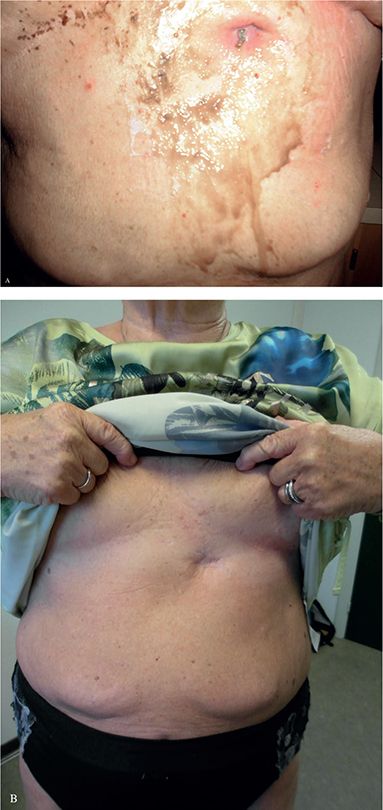
Fig. 1. (A) Gastrocutaneous fistula. (B) Abdominal scar following treatment for gastrocutaneous fistula.
The physical examination revealed a well-demarcated fleshy ulcer on her right labium majus (Fig. 2), in addition to several smaller granulating ulcerations on her left shin (Fig. 3). She denied any history of trauma or previous skin conditions in the affected areas.
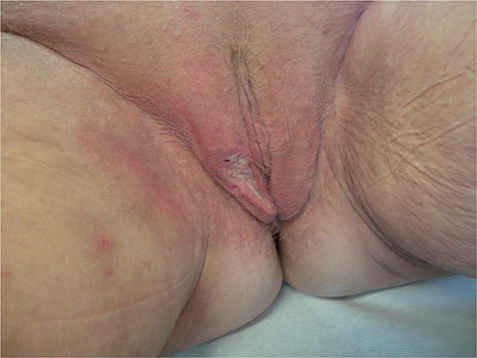
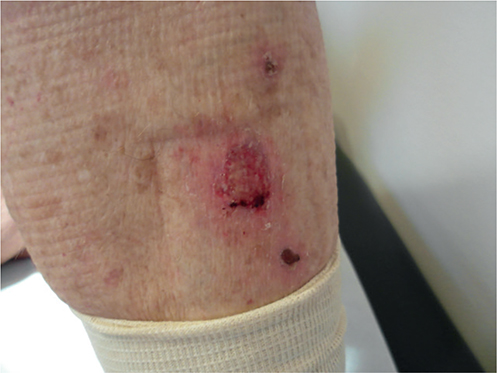
Fig. 3. Several granulating ulcers on the left shin.
What is your diagnosis?
Differential diagnosis 1: Syphilis
Differential diagnosis 2: Pyoderma gangrenosum
Differential diagnosis 3: Crohn’s disease
Differential diagnosis 4: Drug-induced skin ulcers
See next page for answer.
ANSWERS TO QUIZ
Spontaneous Mucocutaneous Ulcerations: A Commentary
Diagnosis: Drug-induced skin ulcers
The patient had been prescribed nicorandil 40 mg twice daily (maximum recommended daily dose 80 mg) as an adjunct to her existing anti-anginal therapy and had been taking this medication for approximately 6 years before presenting to the dermatology clinic with complaints of painful ulcerations. The atypical presentation, coupled with the administration of multiple medication, led to the suspicion of drug-induced ulcers. In collaboration with a cardiologist, nicorandil was discontinued and alternative anti-anginal therapy was instituted to manage the patient’s underlying cardiac condition. Within 1 month all ulcerations healed spontaneously and no further ulcerations have occurred in the following 3 years.
Nicorandil, a potassium channel opener, is used in severe cases of ischaemic heart disease and has been available since 1984 (1). It exerts its vasodilatory effect by activating ATP-sensitive potassium channels in smooth muscle cells, leading to relaxation of arterial and venous vessels. Although generally well tolerated, nicorandil has been associated with various adverse effects, including gastrointestinal disturbances and headache (2). The first reported cases of nicorandil-induced ulcerations (NIC) were published in 1996, and in the following years a growing number of incidents have been documented, involving cutaneous, gastrointestinal, genital, and parastomal NICs, in addition to NIC at sites of previous surgical trauma (3–6). A French study from 2018 reported 148 cases of NICs from the French pharmacovigilance network with a mean delay of 41 months regarding onset of ulcers and a mean diagnostic delay of 7.8 months (7). In most of their cases reported in their study, and in the literature in general, the ulcerations healed within 2–3 months after discontinuing nicorandil, without the need for additional treatment. However, it is important to mention that, prior to diagnosing NIC, many patients underwent various treatments (such as anti-infectives for oral ulcers, skin grafts for leg ulcers, surgery for gastrointestinal ulcers, etc.).
The patient in this case report had previously undergone an extensive surgical course with prolonged hospitalization due to gastric ulceration with fistula formation following an elective surgical procedure for gastro-oesophageal reflux disease and hiatal hernia, which is regarded as a very rare complication (8). A mucosal biopsy from gastric tissue showed nonspecific inflammation, which is characteristic of NICs (4). The patient had been taking nicorandil for 36 months before undergoing the first surgery. We highly suspect that this complication was also related to treatment with nicorandil.
In 2015, the Danish Medicine Agency issued a warning to all healthcare professionals not to use nicorandil as the first choice for the treatment of angina pectoris due to the risk of ulcerations (9). Nevertheless, according to the Danish Health Data Authority, there were 980 Danish patients taking nicorandil in 2023 (10).
The exact pathogenesis of NICs remains unclear, but the most compelling theory involves the build-up of nicorandil’s primary hepatic metabolites, nicotinic acid, and nicotinamide. Under normal conditions, these metabolites integrate into the physiological nicotinamide adenine dinucleotide pool (NAD/NADP). However, if this pool becomes saturated, the metabolites may build up in certain tissues, leading to ulcer formation (7). Management of NICs primarily involves discontinuation of the drug and implementation of wound care measures. Topical dressings, such as hydrocolloids or foam dressings, may be used to promote healing and prevent infection. In severe cases, surgical procedures, such as debridement or skin grafting, may become necessary.
In conclusion, this case report highlights the association of nicorandil and mucocutaneous ulcerations and fistula. Although nicorandil is generally well tolerated, dermatologists should be aware of the potential for these adverse effects, especially in patients presenting with non-healing ulcers. Prompt recognition, permanently discontinuing the drug, and appropriate wound care are crucial in managing these ulcers effectively.
REFERENCES
- Roland E. Safety profile of an anti-anginal agent with potassium channel opening activity: an overview. Eur Heart J 1993; 14: 48–52. https://doi.org/10.1093/eurheartj/14.suppl_B.48
- Goel H, Carey M, Elshaikh A, Krinock M, Goyal D, Nadar SK. Cardioprotective and antianginal efficacy of nicorandil: a comprehensive review. J Cardiovasc Pharmacol 2023; 82: 69-85. https://doi.org/10.1097/FJC.0000000000001436
- Reichert S, Antunes A, Trechot P. Major aphthous stomatitis induced by nicorandil. Eur J Dermatol 1997; 7: 132-133.
- Watson A, Al-Ozairi O, Fraser A, Loudon M, O’Kelly T. Nicorandil associated anal ulceration. Lancet 2022; 360: 546-547. https://doi.org/10.1016/S0140-6736(02)09710-6
- Egred M, Andron M, Morrison WL. Nicorandil may be associated with gastrointestinal ulceration. BMJ 2006; 332: 889. https://doi.org/10.1136/bmj.332.7546.889
- Trechot P, Jouzeau J-Y, Brouillard C, Scala-Bertola J, Petitpain N, Cuny J-F, et al. Role of nicotinic acid and nicotinamide in nicorandil-induced ulcerations: from hypothesis to demonstration: nicotinic acid and nicotinamide in nicorandil-induced ulcerations. Int Wound J 2015; 12: 527-530. https://doi.org/10.1111/iwj.12147
- Babic V, Petitpain N, Guy C, Trechot P, Bursztejn AC, Faillie JL, et al. Nicorandil-induced ulcerations: a 10-year observational study of all cases spontaneously reported to the French pharmacovigilance network. Int Wound J 2018; 15: 508-518. https://doi.org/10.1111/iwj.12845
- Andrea-Ferreira P, Pedersen JB, Antonsen Hk. Gastrocutaneous fistula and gastrointestinal bleeding due to left superior epigastric artery haemorrhage as a rare complication of anterior gastropexy. BMJ Case Rep 2022; 15: e247184. https://doi.org/10.1136/bcr-2021-247184
- Danish Medicine Agency. Nicorandil (Angiocor): Anvend ikke nicorandil som førstevalg til behandling af angina pectoris; risiko for ulceration og udvikling af komplikationer - seponer nicorandilbehandling, hvis ulceration opstår. [Cited 2024 June 16]. Available from: https://laegemiddelstyrelsen.dk/da/bivirkninger/direkte-sikkerhedsinformation/udsendte-meddelelser/~/media/3E142BF8B8194366B1BF605AF4BD0ECF.ashx.
- Danish Health Data Authority (Internet). [Cited 2024 June 16]. Available from: www.medstat.dk