SHORT COMMUNICATION
Is the Increase in Tumour Markers and Hashimoto’s Thyroiditis an Incidental Event During Dupilumab Treatment? A Case Report
Kesheng LIN1#, Weijie SHEN1#, Nailiang LIN2#, Sijia LI1 and Liming WU3*
1Department of Dermatology, Zhejiang Chinese Medical University, Hangzhou, 2Department of Pharmacy, Pingyang Traditional Chinese Medicine Hospital of Zhejiang University of Traditional Chinese Medicine, Wenzhou, and 3Department of Dermatology, Affiliated Hangzhou First People’s Hospital, West Lake University School of Medicine, No. 261, Huansha Road, Hangzhou, P.R. China. *E-mail: limingwu1973@163.com
#These authors contributed equally to this work and share first authorship.
Citation: Acta Derm Venereol 2025; 105: adv41250. DOI: https://doi.org/10.2340/actadv.v105.41250.
Copyright: © 2025 The Author(s). Published by MJS Publishing, on behalf of the Society for Publication of Acta Dermato-Venereologica. This is an Open Access article distributed under the terms of the Creative Commons Attribution-NonCommercial 4.0 International License (https://creativecommons.org/licenses/by-nc/4.0/).
Submitted: Jul 28, 2024. Accepted after revision: Oct 4, 2024. Published: Feb 5, 2025.
Competing interests and funding: The authors have no conflicts of interest to declare.
INTRODUCTION
Dupilumab, the first fully human monoclonal antibody approved for atopic dermatitis (AD), has emerged as a crucial option for patients resistant to conventional therapies, and it has been observed that dupilumab therapy does not correlate with short-term tumour progression (1). Despite its generally favourable safety profile and its use in AD patients with concurrent tumours, we report the first documented case of elevated tumour biomarkers and concurrent autoimmune disease following dupilumab treatment.
CASE REPORT
A 46-year-old woman initially presented with predominantly dry, pruritic skin on the limbs and trunk, having been diagnosed with moderate AD (SCORAD 36, EASI 10), and was treated with topical 0.1% tacrolimus (Protopic) and oral compound glycyrrhizin tablets (Meineng). After a year, her condition worsened (SCORAD 56.5, EASI 29), prompting initiation of dupilumab treatment (loading dose 600 mg, followed by 300 mg every 2 weeks). At the same time, she received a physical examination before starting the medication. The report indicated that all indicators were normal, and the thyroid ultrasound did not show any visible nodules. While her skin improved significantly after receiving treatment with dupilumab, she developed neck discomfort during the fourth treatment session. Therefore, she underwent a routine physical examination, and the report revealed elevated tumour markers (CA199 493U/ml, reference range 0–37 U/mL; CA125 53.2 U/mL, reference range 0–47 U/mL; CA50 83.1I U/mL, reference range 0–25 IU/mL), and thyroglobulin antibodies (Ab 30.38 IU/mL, reference range 0–4.11 IU/mL). Ultrasound revealed significant glandular hyperplasia, calcification at the glandular margin, and low echoic areas with visible vascular tails (Fig. 1), diagnosed as Hashimoto’s thyroiditis (HT). After discussion, the patient chose to discontinue dupilumab and opted for observational management of HT, resulting in normalized tumour markers and reduced thyroglobulin antibodies (TGAb 13.46IU/mL) 1 month post-treatment cessation.
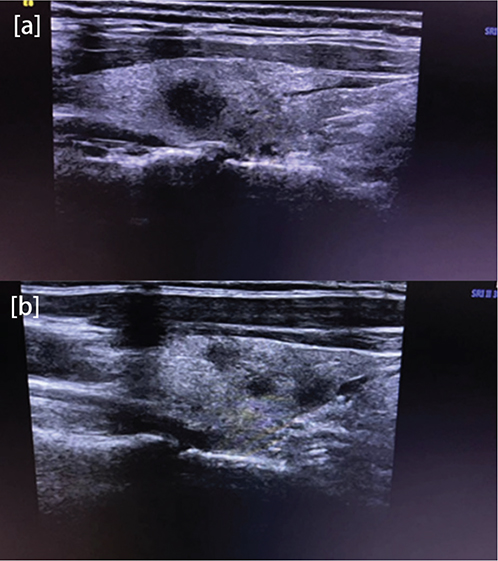
Fig. 1. (A) A hypoechoic nodule with a diameter of approximately 0.9 cm is observed, solid in nature, with irregular margins, normal aspect ratio, and punctate calcifications within it. (B) Three hypoechoic nodules, each approximately 0.5 cm in diameter, are visible, with indistinct and irregular margins relative to the thyroid gland echogenicity.
DISCUSSION
At present, continuous treatment with dupilumab has shown long-term safety and effectiveness in patients with moderate to severe AD. However, there is still controversy regarding the association between dupilumab and tumour occurrence. Despite current literature indicating no correlation between dupilumab and tumours (1), individual cases of tumours occurring during this treatment regimen are still noteworthy. For example, Siliquini et al. (2) reported a case of bladder cancer in a patient receiving dupilumab, while two other cases presented with testicular tumours. Through a literature search, it is suggested that the abnormal markers and symptoms observed in this case may be related to dupilumab. Dupilumab, as a fully human IgG4 monoclonal antibody targeting the IL-4 receptor α chain (IL-4 R α), blocks both type 1 (IL-4 R α/γc) and type 2 (IL-4 R α/IL-13 R α1) heterodimeric receptor structures, thereby inhibiting downstream TH2 cell-mediated inflammatory allergic reactions (3). IL-13 binds to two receptors, IL-13Rα1 and IL-13Rα2. Dupilumab can block the IL-13Rα1 pathway and promote the binding of IL-13 to IL-13Rα2. It is reported that IL-13Rα2 is significantly upregulated in various tumours such as ovarian cancer, Kaposi’s sarcoma, pancreatic cancer, adrenal cortical carcinoma, and colorectal cancer, such as the MEK/ERK/NOX1/ROS pathway in intestine epithelial cells, and the ERK/AP-1 pathway in pancreatic cancer and ovarian cancer (4). As regards this patient, elevated CA125 is associated with ovarian cancer, while elevated CA50 and CA199 are associated with gastrointestinal tumours. Additionally, the patient developed Hashimoto’s thyroiditis (HT) during treatment. This pathogenic mechanism may be related to the characteristics of dupilumab. As type 1 and type 2 inflammation are in dynamic balance (5), dupilumab inhibits the IL-4 and IL-13 pathways, indirectly suppressing type 2 immune responses, leading to a shift in the body’s immune system towards type 1 inflammation. Interestingly, in HT, type 1 inflammatory responses dominate (6). This reflects the phenomenon of immune drift caused by blocking the type 2 immune response pathway, consistent with the occurrence of psoriasis in some patients following treatment with dupilumab, being the same mechanism (7). This reasonably explains the elevation of tumour markers and the occurrence of Hashimoto’s thyroiditis in the patient after receiving dupilumab treatment, with the gradual disappearance of markers and symptoms after treatment cessation. Therefore, the use of dupilumab may increase the incidence of thyroiditis (or other autoimmune diseases) and also carry the risk of tumour development, which deserves our attention.
However, dupilumab is still considered a long-term safe treatment option for atopic dermatitis, and its complications mostly manifest as injection site reactions and conjunctivitis. Long-term safety data on dupilumab use is insufficient, and further research is needed on the correlation between dupilumab and tumour development. Additionally, we should strengthen follow-up and monitoring of AD patients receiving dupilumab treatment.
REFERENCES
- Owji S, Ungar B, Dubin DP, Poplausky D, Young JN, Ghalili S, et al. No association between dupilumab use and short-term cancer development in atopic dermatitis patients. J Allergy Clin Immunol Pract 2023; 11: 1548–1551. https://doi.org/10.1016/j.jaip.2022.12.018
- Siliquini N, Viola R, Giura MT, Fierro MT, Ribero S, Ortoncelli M. Case of bladder cancer during dupilumab therapy: just an incidental event? Dermatol Ther 2020; 33: e13854. https://doi.org/10.1111/dth.13854
- Harb H, Chatila TA. Mechanisms of dupilumab. Clin Exp Allergy 2020; 50: 5–14. https://doi.org/10.1111/cea.13491
- Jiang L, Cheng Q, Zhang B, Zhang M. IL-13 induces the expression of 11βHSD2 in IL-13Rα2 dependent manner and promotes the malignancy of colorectal cancer. Am J Transl Res 2016; 8: 1064–1072.
- Moriyama M, Nakamura S. Th1/Th2 immune balance and other T helper subsets in IgG4-related disease. Curr Top Microbiol Immunol 2017; 401: 75–83. https://doi.org/10.1007/82_2016_40
- Mazziotti G, Sorvillo F, Naclerio C, Farzati A, Cioffi M, Perna R, et al. Type-1 response in peripheral CD4+ and CD8+ T cells from patients with Hashimoto’s thyroiditis. Eur J Endocrinol 2003; 148: 383–388. https://doi.org/10.1530/eje.0.1480383
- Matsuda T, Yamada H, Hida N, NakaizumiT, Yamada E, Satoh H, et al. An asthmatic case of psoriasiform eruption caused by administration of dupilumab. Allergol Int 2020; 69: 478–479. https://doi.org/10.1016/j.alit.2020.02.004