ORIGINAL REPORT
Scratch Scoring by a Sheet-shaped Body Vibrometer in Nocturnal Sleep: A Pilot Study Compared with Infrared Video Recording
Saori TOYOTA1, Takamasa KOGURE1, Eitaro KONDO1, Ken-ichi YASUDA2, Yozo ISHIUJI2 and Toshiya EBATA2,3
1Paramount Bed Sleep Research Laboratory, PARAMOUNT BED CO., LTD., Tokyo, 2Department of Dermatology, The Jikei University School of Medicine, Tokyo, and 3Chitofuna Dermatology Clinic, Tokyo, Japan
Itching tends to worsen at night in patients with itchy skin diseases, such as atopic dermatitis. Unconscious scratching during sleep can exacerbate symptoms, cause sleep disturbances, or reduce quality of life. Therefore, evaluating nocturnal scratching behaviour is important for better patient care. However, no report exists on the specific detection of overnight scratching behaviour of patients with atopic dermatitis using a non-wearable sensor. A novel algorithm was developed to specifically detect scratching behaviour using a non-wearable sheet-shaped body vibrometer placed under the mattress. To evaluate the algorithm, the sleep of 7 patients with atopic dermatitis and 3 healthy participants was simultaneously measured using an infrared camera and the sheet-shaped body vibrometer. Scratching time was then used as the gold standard, which was determined visually from the infrared video. The proposed method of detecting vibration was compared with the conventional method using the activity score measured by a sheet-shaped body vibrometer. Spearman’s correlation coefficients of the conventional and proposed methods were 0.72 and 0.89, respectively. The Bland–Altman plot results confirmed that the proposed method avoided overestimation of scratching time in patients with short scratching times because it excluded activities other than scratching behaviour, such as turning over.
SIGNIFICANCE
We developed an algorithm that specifically detects scratching behaviour using a non-wearable sheet-shaped sleep-monitoring device. This algorithm detects vibrations caused by scratching more specifically than a conventional method that simply evaluates the scratching time based on the activity score. The sheet-shaped body vibrometer causes only very limited burden (subtle change of sleeping comfort) for the individual.
Key words: actigraphy; atopic dermatitis; itching; nocturnal scratching; sleep.
Citation: Acta Derm Venereol 2025; 105: adv41414. DOI: https://doi.org/10.2340/actadv.v105.41414.
Copyright: 2025 © The Author(s). Published by MJS Publishing, on behalf of the Society for Publication of Acta Dermato-Venereologica. This is an Open Access article distributed under the terms of the Creative Commons Attribution-NonCommercial 4.0 International License (https://creativecommons.org/licenses/by-nc/4.0/).
Submitted: Aug 27, 2024; Accepted after revision: Dec 18, 2024; Published: Jan 26, 2025.
Corr: Takamasa Kogure, Paramount Bed Sleep Research Laboratory, PARAMOUNT BED CO., LTD., 14-5 Higashisuna 2-chome, Koto-ku, Tokyo 136-8670, Japan. E-mail: t.kogure@paramount.co.jp
Competing interests and funding: KY and YI received funding from PARAMOUNT BED CO., LTD. ST, TK, and EK are employees of PARAMOUNT BED CO., LTD. TE declares no conflicts of interest.
This study was supported by PARAMOUNT BED CO., LTD.
INTRODUCTION
In itchy skin disorders, such as atopic dermatitis (AD) (1, 2), itching worsens at night and causes sleep disturbances and decreases quality of life (3–6). Unconscious scratching during sleep contributes to skin inflammation, resulting in a vicious cycle of itching and scratching known as the itch–scratch cycle. Evaluation of nocturnal scratching during sleep may be useful in physician assessment, patient adherence, and clinical research.
Various methods have been developed to objectively assess the amount of scratching during sleep, including the use of an infrared video camera (7), direct use of activity scores calculated from wrist actigraphy (WA) (8, 9), and wearable devices specifically designed to detect scratching behaviour, such as smartwatches or stick-on-type sensors (10–12). Similarly, methods using devices with non-wearable sensors have been developed, including those employing piezoelectric ceramic sensing devices placed under the legs of a bed (13) and those using a sheet-shaped body vibrometer (SBV) placed under the mattress (14). Although it has been reported that SBV can measure activity scores similar to WA and that activity scores represent restlessness (15), a method that specifically detects scratching behaviour has not been reported. Piezoelectric ceramic sensing devices placed under the legs of a bed can specifically detect scratching behaviour; however, they have only been tested for scratching behaviour simulated by healthy individuals. Consequently, there are no reports on the specific detection of overnight scratching behaviour of patients with AD using a non-wearable sensor.
When a person sleeps on a bed with an SBV placed under the mattress, the SBV records body vibration waveforms. It includes respiratory movement, heartbeat information, and body movements, such as rolling over or scratching on the bed. When people quickly move their hands such as in scratching behaviour, characteristic vibrations are observed that are different from those of breathing movements, heart rate information, and turning over in bed. This study reports the development of an algorithm to detect scratching behaviour from body vibration data measured using an SBV.
MATERIALS AND METHODS
First, we describe the SBV device used in this study, the algorithm for detecting scratching behaviour using SBV, and the validation method of the proposed algorithm. In this study, we focused on the scratching behaviour with the hands. A scratching behaviour detection algorithm was developed based on the results of scratching behaviour simulated by healthy participants, and validation was conducted using nocturnal data from 10 research participants, including 7 patients with AD. For validation, we used data recorded simultaneously using an infrared video camera and the SBV. We applied the algorithm to the overnight data to estimate the scratching time per hour. The estimated scratching time was compared with the recorded infrared video data using Bland–Altman plots (16) and correlation analyses. Similarly, a conventional method using an activity score was applied to the overnight data and compared with the proposed method using the SBV.
SBV (Nemuri SCAN)
A Nemuri SCAN (NN-1310; PARAMOUNT BED CO., LTD., Tokyo, Japan) was used in this study. The Nemuri SCAN is an SBV equipped with 2 highly sensitive pressure sensors placed under a mattress, continuously recording the body vibrations of individuals lying on the bed. SBV measures 780 mm in width, 245 mm in length, and 10–18 mm in height, weighs 1.0 kg, and is foldable. The device is covered with a waterproof and chemical resistant sheet; hence, it can be disinfected and is easy to clean. It measures sleep/wake states (17), and the agreement rate, sensitivity, and specificity of the SBV sleep/wake scoring compared with those of WA are 96%, 98%, and 76%, respectively. The corresponding values compared with those of polysomnography are 92%, 97%, and 34%, respectively. The Nemuri SCAN can also measure respiratory and heart rates (18). Validation studies of obstructive sleep apnoea screening have also been reported (19).
The activity score was calculated by counting the number of body movements at 16 Hz. Therefore, for the conventional method, the scratching time was determined by dividing the activity score by 16.
Proposed algorithm for estimating scratching time
Fig. 1A shows the waveform measured by the SBV when a person simulates scratching behaviour. The first half of the waveform includes respiratory movement and heartbeat information observed while at rest. Regarding scratching behaviour, characteristic vibrations similar to those in the second half of the waveform are observed when people quickly move their hands from side to side or back and forth. These vibrations exhibit a higher frequency than those of respiratory vibrations at rest (≥ 0.5 Hz) and a higher amplitude than those of heartbeat vibrations.
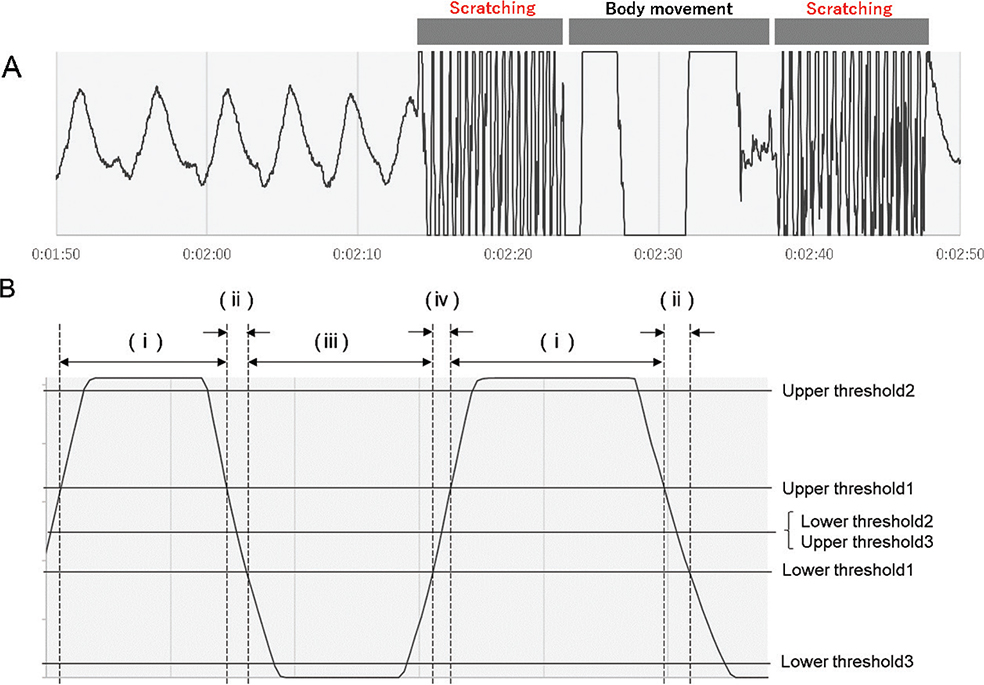
Fig. 1. Waveforms measured by a sheet-shaped body vibrometer (SBV) and algorithm description. (A) Waveforms by SBV including scratching movements. (B) Three threshold patterns and 4 judgement phases in our algorithm (the description of the judgement phase is based on the upper threshold of 1 and lower threshold of 1): (i) from the time it exceeds the upper threshold until it falls below the upper threshold, (ii) from the time it falls below the upper threshold until it falls below the lower threshold, (iii) from the time it falls below the lower threshold until it exceeds the lower threshold, (iv) from the time it exceeds the lower threshold until it exceeds the upper threshold.
We developed an algorithm specifically designed to detect where the scratching vibrations are observed. Upper and lower threshold parameters were set to detect the specific frequencies and amplitudes mentioned above. For example, these parameters were adjusted to cover a range that constituted 20% of the total, centred on the median of the measurement range shown in Fig. 1B, with thresholds of 1. Four judgement phases were set for these upper and lower threshold parameters as follows: (i) from the time it exceeded the upper threshold until it fell below the upper threshold, (ii) from the time it fell below the upper threshold until it fell below the lower threshold, (iii) from the time it fell below the lower threshold until it exceeded the lower threshold, (iv) from the time it exceeded the lower threshold until it exceeded the upper threshold. These judgement phases were repeated in cycles, and time limits were set for each judgement phase. When the time required to continuously satisfy these judgement cycles for the input waveform data within the time limit became more than 1 s, the input body vibration data were determined as scratch movements. The judgement ended when any of the 4 judgement phases no longer met the time limit, and the total judgement time was calculated. Our method used 3 threshold patterns, as shown in Fig. 1B, and scratches were determined when one of the 3 threshold patterns was judged.
To assess the performance of the developed algorithm, we verified the scratching time using the dataset described in the following section.
Dataset, experiments, and participants
This dataset was acquired with approvals from the Ethical Review Committee of Aiyukai Kanazawa–Bunko Hospital (approval 15 November 2019) and Jikei University School of Medicine (approval number 9741). All procedures were conducted in compliance with the ethical standards established by the Institutional or National Research Committee in accordance with the 1964 Declaration of Helsinki and its subsequent amendments or equivalent ethical standards. Informed consent was obtained from all participants.
Participants were enrolled if they (i) were adults aged 20–75 years diagnosed with atopic dermatitis, (ii) were exhibiting moderate to severe (eczema area and severity index [EASI]: 10 or higher and itch numerical rating scale [NRS]: 5 or higher), and (iii) were able to provide written consent and understand and cooperate with the study instructions, visits, and procedures. The exclusion criteria were as follows: (i) individuals diagnosed with sleep apnoea or other sleep-related disorders, (ii) shift workers or those scheduled to travel across 2 or more time zones within 2 weeks prior to the study commencement, (iii) individuals taking sedatives or psychotropic drugs, (iv) individuals with body mass index exceeding 35, (v) individuals with a history of anaphylaxis with a documented reaction occurring within the past 6 months, (vi) individuals participating in another clinical trial involving a drug or medical device within 30 days prior to the planned study date or currently enrolled in such a trial, (vii) females who are pregnant or breastfeeding, and (viii) any other conditions deemed by the doctor to be inappropriate for study participation.
The experimental setup is illustrated in Fig. 2. The SBV was placed under the mattress, and the infrared camera (Handycam®, FDR-AX55; Sony Corporation, Minato City, Tokyo, Japan) was placed at the head of the bed.
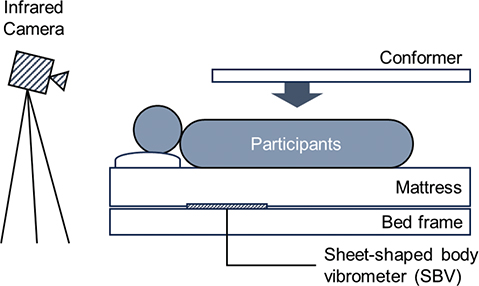
Fig. 2. Experimental environment for measuring nocturnal scratching. The subjects lie down on a bed with the sheet-shaped body vibrometer (SBV) placed under the mattress and sleep using a conformer in the experimental room. The SBV records the subjects’ body vibration data throughout the night. An infrared camera is set up on the head side of the bed to record the subject’s scratching behaviour.
The dataset involved 10 participants, including 7 patients with AD (3 women, age: 36.4 ± 8.0 years, mean ± standard deviation) and 3 healthy male participants without AD (age: 37 ± 7.5 years). The mean EASI score for patients with AD in this study was 20.3 ± 8.4; the NRS and Pittsburgh sleep quality index (20) scores are 6.0 ± 1.3 and 5.4 ± 2.4, respectively. The participants’ overnight sleep was recorded in the experimental environment described above. The time in bed (TIB) for patients with AD and healthy participants was 468 ± 17.1 min and 467 ± 49.1 min, respectively. The details are presented in Table I.
Statistical analysis
We defined the scratching behaviour rated by an observer as recorded on the infrared video as the ground truth. Scratching behaviours with scratching time of less than 1 s were excluded from the study. The TIB was divided into hourly intervals from bedtime, and data less than 1 h before wake-up time were excluded. We defined these 1 h data as 1 epoch and used these data for comparison. The pairs of scratching times per hour were calculated from the ground truth and the proposed method and then evaluated using correlation coefficient and the Bland–Altman plot. Additionally, the scratching time per hour was calculated using the conventional activity score (14) and compared with the proposed method.
RESULTS
The number of evaluation pairs was 73 (equivalent to 4,380 min), including 51 epochs (equivalent to 3,060 min) from patients with AD. The mean ground-truth scratching time per hour for patients with AD was 160.7 ± 207.7 s, and the corresponding time for healthy participants was 0 s. The scratching times estimated using the activity score and the proposed method were 251.5 ± 217.1 s and 130.9 ± 148.0 s, respectively. For healthy participants, the corresponding time was 104.1 ± 84.3 s for the conventional method and 9.4 ± 11.5 s for the proposed method. Fig. 3A shows a scatter diagram of the ground-truth scratching time and the scratching time estimated using the conventional method. Fig. 3B shows a scatter diagram of the ground-truth scratching time and the scratching time estimated using the proposed method. Since the normality of the distribution was rejected, we used Spearman’s correlation coefficient for the evaluations. The Spearman’s correlation coefficients with the ground truth using the 2 methods were 0.72 (p < 0.001) and 0.89 (p < 0.001), respectively (Pearson’s correlation coefficients are 0.86 and 0.91 as reference). Fig. 4 presents a Bland–Altman plot comparing the ground truth and estimated scratching times for the 2 methods. The Bland–Altman plot is a method used to evaluate the agreement between 2 measurement methods. In Fig. 4, one point is plotted for each epoch. In this graph, the x-axis represents the average scratch time of the proposed method (or the conventional method) measured by SBV and the ground truth measured by the infrared camera, whereas the y-axis represents the difference between these scratch times. A smaller average value on the y-axis and narrower 95% limits of agreement ( ± 1.96 SD) indicate better agreement between the measurement methods. The average difference between the ground truth and the conventional activity score method was –94.9, and the range of limits of agreement was –301.6 to 111.9, as shown in Fig. 4A. Similarly, the average difference between the ground truth and the proposed method, which detects waveforms, was 17.9, and the range of limits of agreement was –149.0 to 184.9, as shown in Fig. 4B.
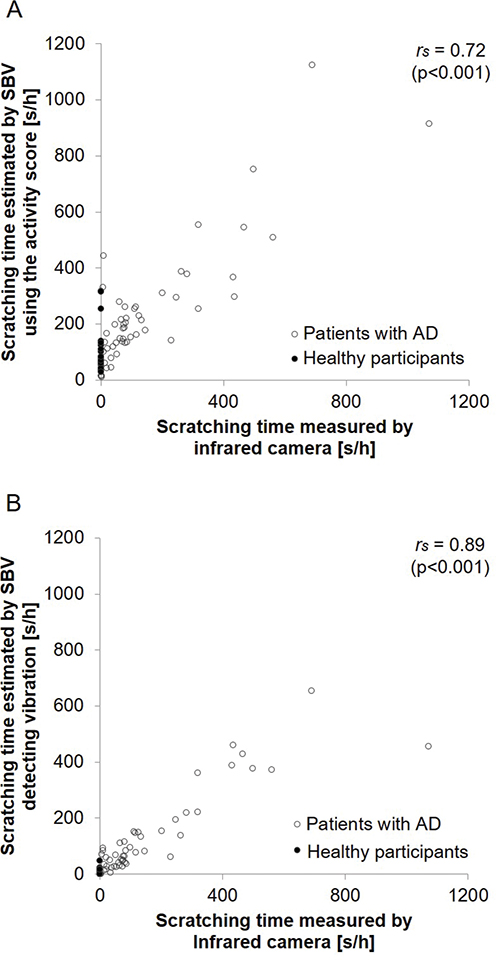
Fig. 3. Scatter diagrams comparing the sheet-shaped body vibrometer (SBV) with infrared camera. (A) Scatter diagram of the scratching time measured by infrared camera and scratching time estimated by SBV using the activity score. (B) Scatter diagram of the scratching time measured by infrared camera and scratching time estimated by SBV detecting vibration. AD: atopic dermatitis.
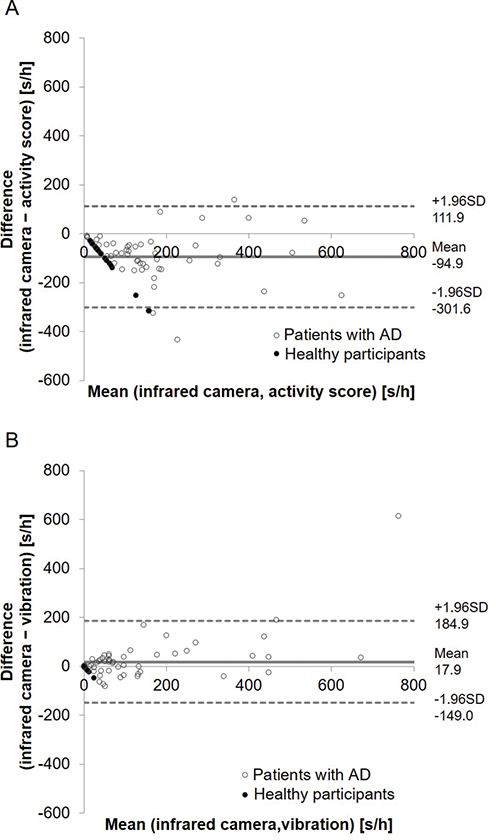
Fig. 4. Bland–Altman plot comparing the sheet-shaped body vibrometer (SBV) with infrared camera. (A) Bland–Altman plot of the scratching time measured by infrared camera and the scratching time estimated by SBV using the activity score. (B) Bland–Altman plot of the scratching time measured by infrared camera and the scratching time estimated by SBV detecting vibration. AD: atopic dermatitis; SD: standard deviation.
For 7 AD patients, we evaluated the Spearman’s correlation coefficient between EASI, NRS, nocturnal scratching time by infrared camera, activity score by SBV, and vibration detection by SBV. The correlation coefficient between EASI and NRS was 0.42 (p = 0.35). The correlations of EASI with scratching time by infrared camera, activity score by SBV, and vibration detection by SBV were 0.50 (p = 0.267), 0 (p = 1), and 0.50 (p = 0.267), respectively. For NRS, correlations with scratching time by infrared camera, activity score by SBV, and vibration detection by SBV were 0.42 (p = 0.35), 0.18 (p = 0.701), and 0.42 (p = 0.35), respectively. Correlations of scratching time by infrared camera with activity score by SBV and vibration detection by SBV were 0.71 (p = 0.0881) and 1 (p = 0.000397). The correlation between activity score by SBV and vibration detection by SBV was 0.71 (p = 0.0881) (Fig. S1).
DISCUSSION
Previous studies using activity score have assessed the accuracy of the scratching measurement device, and have reported high Pearson’s correlation coefficients (8, 14). However, a limitation of these studies is that they included only patients with AD, excluding healthy individuals without scratching behaviour. When we evaluated scratching behaviour using activity scores, we thought that these scores would increase due to body movements related to awakening, even if scratching behaviour did not occur. This could lead to an overestimation for individuals with low itch intensity. In this study, we aimed to evaluate the agreement of measurements by including healthy individuals, and we analysed using correlation analysis and Bland–Altman plots.
Fig. 3 demonstrates that the proposed method reduces overestimation of scratching time, compared with conventional methods that estimate it using the activity score, particularly in epochs with short scratching times (≤ 150 s/h). Furthermore, when comparing the average difference and limits of agreement from the Bland– Altman plot in Fig. 4, the error was reduced in the proposed method compared with the conventional method. This was particularly noticeable among healthy participants who did not exhibit any scratching behaviour. Table II shows that the proposed method reduced this overestimation to 10 s, whereas the conventional method overestimated the time by 100 s for healthy participants with a ground-truth scratching time of 0 s. These results indicate that the proposed method can reduce the degree of overestimation of scratching time, compared with the conventional method. This is because the conventional method calculates scratching time using all activity scores without distinguishing scratching behaviour from other activities, such as rolling over.
On the other hand, Table II shows that the proposed method underestimated the scratching time in patients with AD by an average of 30 s, compared with the ground truth. One of the reasons for this is that scratching behaviour involving body movements cannot be detected. For example, although there was only 1 epoch in this study, the scratching time was underestimated in the epochs in which the scratching time was longer (> 800) (data not shown). This is because the scratching behaviour intensifies or transforms into larger body movements as scratching continues for a long time. Consequently, the amplitude of the waveform associated with these substantial body movements surpasses that of the scratching waveform, causing the scratching waveform to become unobservable in the SBV. Similarly, the estimated time for a single scratch may be shorter, compared with the ground truth, when body movements occur before and after scratching, such as while changing sleeping positions. Consequently, the overall scratching time estimated using the proposed method is shorter. This aspect requires further examination and is an area for improvement.
In a previous study (10), a smartwatch was used to estimate scratching time during nocturnal sleep in patients with AD. The scratching time was calculated approximately every hour using the 2 methods for nocturnal data, and the correlation coefficients between the 2 were compared: the scratching time rated by an observer as recorded by the infrared video and that estimated using a smart watch. The previous study differed from ours in that they excluded scratching behaviours lasting less than 3 s and observers judged the intensity of scratching. In the previous study, the Pearson’s correlation coefficient was 0.901 when comparing the scratching time of moderate or higher intensity with that of the hand wearing the smartwatch; this correlation coefficient was almost the same as that of our method.
However, the Pearson’s correlation coefficient was 0.851 when comparing the scratching time, including scratching at all intensities, with that of both hands including the hand not wearing the smartwatch. The SBV, which does not require a device to be attached to the arm, may have an advantage in that scratching can be detected regardless of which hand is used for scratching. We could not fully investigate this because the previous studies had no epochs with long scratching times; however, a smartwatch that directly detects hand movements may have the advantage of detecting scratching including body movement. It is assumed that the advantages and disadvantages depend on the characteristics of the device used.
Limitations
A limitation of this study is that the results were derived from a dataset of 10 participants, comprising 7 patients with AD and 3 healthy participants. The evaluation should be done with more samples including children and older adults to enhance the accuracy of the results. It is also necessary to verify whether this algorithm is applicable to measuring scratching behaviour in patients with itchy skin diseases other than AD. The algorithm used in this study detects the characteristic high-frequency vibrations; hence, tremors, convulsions, and other high frequency body movements may cause false positives. In addition, we focused on scratching with the hands, and scratching with other body parts was not considered. Although detection performance is unclear, accurately detecting scratching with the feet for example may be challenging.
For SBV measurement, it is required that 1 person sleep in their bed. The SBV has been widely used on the single beds in nursing homes in Japan for sleep monitoring and providing care based on sleep status, and older residents may exhibit scratching behaviour for reasons other than AD (21). In particular, self-harm is a problem in patients with dementia who cannot control their scratching behaviour (22). If the SBV could also detect these scratching behaviours, it would be beneficial in nursing homes in the future.
Conclusion
We developed an algorithm to detect scratching waveforms using a non-wearable device. The scratching time per hour was estimated from the overnight sleep data of patients with AD and healthy participants using a proposed method and compared with the scratching time estimated by the conventional activity score method using a Bland–Altman plot. The results indicate that the proposed method has fewer errors than the conventional method, enabling a more accurate estimation of the scratching time.
ACKNOWLEDGMENTS
IRB approval status: The study protocol was approved by the Ethics Committee of Kanazawabunko Hospital (approval 15 November 2019) and Jikei University School of Medicine (approval number 9741).
REFERENCES
- Bieber T. Atopic dermatitis. N Engl J Med 2008; 358: 1483–1494. https://doi.org/10.1056/NEJMra074081
- Thomsen SF. Atopic dermatitis: natural history, diagnosis, and treatment. ISRN Allergy 2014; 2014: 354250. https://doi.org/10.1155/2014/354250
- Patel T, Ishiuji Y, Yosipovitch G. Nocturnal itch: why do we itch at night? Acta Derm Venereol 2007; 87: 295–298. https://doi.org/10.2340/00015555-0280
- Yosipovitch G, Papoiu AD. What causes itch in atopic dermatitis? Curr Allergy Asthma Rep 2008; 8: 306–311. https://doi.org/10.1007/s11882-008-0049-z
- Thorburn PT, Riha RL. Skin disorders and sleep in adults: where is the evidence? Sleep Med Rev 2010; 14: 351–358. https://doi.org/10.1016/j.smrv.2009.12.001
- Silverberg JI, Gelfand JM, Margolis DJ, Boguniewicz M, Fonacier L, Grayson MH, et al. Patient burden and quality of life in atopic dermatitis in US adults: a population-based cross-sectional study. Ann Allergy Asthma Immunol 2018; 121: 340–347. https://doi.org/10.1016/j.anai.2018.07.006
- Ebata T, Aizawa H, Kamide R, Niimura M. The characteristics of nocturnal scratching in adults with atopic dermatitis. Br J Dermatol 1999; 141: 82–86. https://doi.org/10.1046/j.1365-2133.1999.02924.x
- Ebata T, Iwasaki S, Kamide R, Niimura M. Use of a wrist activity monitor for the measurement of nocturnal scratching in patients with atopic dermatitis. Br J Dermatol 2001; 144: 305–309. https://doi.org/10.1046/j.1365-2133.2001.04019.x
- Hon KL, Lam MC, Leung TF, Kam WY, Lee KC, Li MC, et al. Nocturnal wrist movements are correlated with objective clinical scores and plasma chemokine levels in children with atopic dermatitis. Br J Dermatol 2006; 154: 629–635. https://doi.org/10.1111/j.1365-2133.2006.07213.x
- Ikoma A, Ebata T, Chantalat L, Takemura K, Mizzi F, Poncet M, et al. Measurement of nocturnal scratching in patients with pruritus using a smartwatch: initial clinical studies with the itch tracker app. Acta Derm Venereol 2019; 99: 268–273. https://doi.org/10.2340/00015555-3105
- Chun KS, Kang YJ, Lee JY, Nguyen M, Lee B, Lee R, et al. A skin-conformable wireless sensor to objectively quantify symptoms of pruritus. Sci Adv 2021; 7: eabf9405. https://doi.org/10.1126/sciadv.abf9405
- Yasuda K, Ishiuji Y, Ebata T, Kogure T, Kondo E, Ota A, et al. Monitoring sleep and scratch improves quality of life in patients with atopic dermatitis. Acta Derm Venereol 2023; 103: adv11922. https://doi.org/10.2340/actadv.v103.11922
- Kurihara Y, Kaburagi T, Watanabe K, Tanaka H. Development of vibration sensing system with wide dynamic range: monitoring of scratching and turning over motions during sleep. Artif Life Robotics 2015; 20: 372–378. https://doi.org/10.1007/s10015-015-0241-x
- Kogure T, Ebata T. Activity during sleep measured by a sheet-shaped body vibrometer and the severity of atopic dermatitis in adults: a comparison with wrist actigraphy. J Clin Sleep Med 2018; 14: 199–204. https://doi.org/10.5664/jcsm.6932
- Otani H, Yokomichi N, Imai K, Toyota S, Yamauchi T, Miwa S, et al. A novel objective measure for terminal delirium: activity scores measured by a sheet-type sensor. J Pain Symptom Manage 2024; 68: 246–254. https://doi.org/10.1016/j.jpainsymman.2024.05.024
- Bland JM, Altman DG, Statical methods for assessing agreement between two methods of clinical measurement. Lancet 1986; 1: 307–310. https://doi.org/10.1016/S0140-6736(86)90837-8
- Kogure T, Shirakawa S, Shimokawa M, Hosokawa Y, Automatic sleep/wake scoring from body motion in bed: validation of a newly developed sensor placed under a mattress. J Physiol Anthropol 2011; 30: 103–109. https://doi.org/10.2114/jpa2.30.103
- Kogure T, Shiino T, Sugi T, Shirakawa S. Validation of a sheet-shaped body vibrometer for heart rate and respiratory rate measurements. Sleep Biol Rhythm 2018; 16: 479.
- Kogure T, Kobayashi M, Okawa T, Nakajima T, Inoue Y. Validation of a sheet-shaped body vibrometer for screening of obstructive sleep apnea. Drug Discov Ther 2017; 11: 126–132. https://doi.org/10.5582/ddt.2017.01015
- Doi Y, Minowa M, Uchiyama M, Okawa M, Kim K, Shibui K, et al. Psychometric assessment of subjective sleep quality using the Japanese version of the Pittsburgh Sleep Quality Index (PSQI-J) in psychiatric disordered and control subjects. Psychiatry Res 2000; 97: 165–172. https://doi.org/10.1016/S0165-1781(00)00232-8
- Fourzali KM, Yosipovitch G. Management of itch in the elderly: a review. Dermatol Ther 2019; 9: 639–653. https://doi.org/10.1007/s13555-019-00326-1
- Ikoma A, Ebata T, Fukuda R, Takase Y, Taniguchi N, Takemura K, et al. Prevalence of pruritus in the elderly with dementia: a multicenter survey of Japanese patients. Acta Derm Venereol 2020; 100: adv00210. https://doi.org/10.2340/00015555-3572