ORIGINAL REPORT
Long-term Outcomes of New Systemic Agents in Atopic Dermatitis: Drug Survival Analyses and Treatment Patterns in Daily Practice
Anne R. SCHLÖSSER  , Lars NIJMAN, Renske SCHAPPIN , Tamar E. C. NIJSTEN and Dirkjan HIJNEN
Department of Dermatology, Erasmus University Medical Center, Rotterdam, The Netherlands
In recent years, several new systemic agents (biologics and Janus kinase inhibitors [JAKi]) have been registered for the treatment of moderate-to-severe atopic dermatitis (AD). However, comparisons of real-world drug survival data and insights into treatment patterns of these advanced systemics are limited. Data from a prospective observational single-centre registry were collected from 549 adult AD patients (759 treatment courses) receiving biologics (dupilumab, tralokinumab) or JAKi (abrocitinib, baricitinib, upadacitinib) and analysed using Kaplan–Meier survival curves. Cox regression analyses were used to evaluate predictors of survival. Frequencies and percentages summarized data on the initial and subsequent treatments received, with a Sankey diagram illustrating the switching patterns. The 18-month overall drug survival rates for dupilumab, abrocitinib, upadacitinib, tralokinumab, and baricitinib were 70.0%, 51.5%, 48.4%, 39.4%, and 20.4%, respectively. No significant predictors for drug survival were identified. Dupilumab was the predominant initial treatment (87.2%) and upadacitinib the most frequently used second and third treatment. In the total cohort, 57.9% of patients remained on their initial treatment and 26.8% switched to other treatments. In conclusion, dupilumab showed superior survival rates while baricitinib had the lowest survival rate. Frequent switching highlights the need for biomarkers that predict response to advanced systemic treatments to improve attrition rates.
SIGNIFICANCE
This study looked at how effective different new treatments for eczema were over time, which treatments were chosen, and how often people switched from one treatment to another. Dupilumab was the most prescribed initial treatment and showed the best treatment results, with 70% of patients still using dupilumab after 18 months, while baricitinib was used by only >20% patients at 18 months. It is important to note that dupilumab was the first and only advanced treatment available for several years. Almost 27% of patients switched to second treatments, highlighting the need for more personalized treatment strategies.
Key words: analysis; survival; atopic dermatitis; biologics; Janus kinases.
Citation: Acta Derm Venereol 2025; 105: adv41504. DOI: https://doi.org/10.2340/actadv.v105.41504.
Copyright: © 2025 The Author(s). Published by MJS Publishing, on behalf of the Society for Publication of Acta Dermato-Venereologica. This is an Open Access article distributed under the terms of the Creative Commons Attribution-NonCommercial 4.0 International License (https://creativecommons.org/licenses/by-nc/4.0/).
Submitted: Sep 5, 2024. Accepted after revision: Jan 28, 2025. Published: Mar 9, 2025.
Corr: DirkJan Hijnen, Department of Dermatology, Erasmus University Medical Center, Dr. Molewaterplein 40, 3015 GD, Rotterdam, The Netherlands. E-mail: d.hijnen@erasmusmc.nl
Competing interests and funding: AS: none, LN: none, RS: none, TN: none, DJH: investigator for AbbVie, Almirall, LEO Pharma, AstraZeneca, Galderma, Novartis, Sanofi; consultancies for Abbvie, AstraZeneca, Janssen, LEO Pharma, Lilly, Novartis, Pfizer, Sanofi.
INTRODUCTION
Approximately 15% of patients diagnosed with atopic dermatitis (AD) are classified as having moderate-to-severe disease. These patients often require conventional systemic immunosuppressants to achieve disease control. In the Dutch healthcare system, patients can be treated with new systemic agents if conventional systemics fail (1). Currently 2 biologics and 3 Janus kinase inhibitors (JAKi) are approved and reimbursed for treatment of moderate to severe AD in the Netherlands. Dupilumab selectively inhibits the IL-4 receptor alpha chain, whereas tralokinumab specifically binds to IL-13. JAKi target the JAK-STAT pathway, a key regulator of various inflammatory pathways. Baricitinib inhibits both the JAK1 and JAK2 pathways, whereas upadacitinib and abrocitinib specifically target the JAK1 pathway. Several clinical trials have demonstrated the efficacy and safety of these biologics and JAKi for the treatment of AD (2–6).
Despite expanding therapeutic options, it is crucial to evaluate the effectiveness and safety of biologics and JAKi in daily practice. While real-world drug survival studies, including those for dupilumab, have been published (7, 8), limited data are available for the other new systemic agents and comparisons of their long-term drug survival. Drug survival analyses provide valuable insights into the timing and reasons for treatment discontinuation, such as inadequate disease control or adverse events (AEs). In addition, drug survival analyses enable comparisons between different treatments without comparative RCTs, shedding light on potential differences in treatment durability beyond the conventional duration of clinical studies. This information may help clinicians and patients in making well-informed decisions, understanding the associated benefits and risks of each treatment.
Although several advanced systemics are available, there remains an unmet need for patients with AD shown by the variability in treatment response, and a subset of patients not achieving adequate disease control (9–13). Treatment patterns can provide information on first and subsequent treatments received, switching patterns, non-switching, and discontinuation. This study presents real-world data on drug survival of dupilumab, tralokinumab, abrocitinib, baricitinib, and upadacitinib in AD patients. Additionally, we investigated predictors of drug survival and evaluated treatment patterns in AD patients initiating biologic or JAKi treatment in daily practice.
MATERIALS AND METHODS
Design
Data were collected from the Erasmus MC IMID Quality of Care Registry, a prospective, single-centre, observational cohort study of AD patients. The study was conducted at the Department of Dermatology, Erasmus University Medical Center, Rotterdam, the Netherlands. All AD patients ≥ 18 years who started a new systemic treatment, biologics (dupilumab, tralokinumab) or JAKi (abrocitinib, baricitinib, upadacitinib), in the context of standard care between January 2017 and February 2023 were included (14) . This study was approved by the institutional review board of Erasmus MC (MED-2017-1123).
Patient and treatment characteristics
The following patient characteristics were extracted from the electronic health records: sex, age at start of treatment, age of onset of disease, atopic comorbidities, Fitzpatrick skin types, BMI, and previously used conventional immunosuppressants. Patients treated with dupilumab or tralokinumab received a loading dose of 600 mg and started on a treatment regimen of 300 mg every 2 weeks. Patients receiving abrocitinib, baricitinib, or upadacitinib were treated with 50–100–200 mg, 2–4 mg, or 15–30 mg daily, respectively (15). Treatment type, discontinuation, duration of treatment at discontinuation, reason for discontinuation, dose reduction, and systemic concomitant treatment were recorded. After starting treatment with biologics and JAKi, concomitant conventional immunosuppressants were either discontinued within 3 months or tapered and continued at a low dose. Follow-up started at the initiation of treatment and ended when the drug was either discontinued or switched to a new treatment. Interruption of treatment with a biological or JAKi for less than 90 days or less than 14 days, respectively, was coded as treatment continuation. Only the initial course of each treatment was included in the analysis, ensuring that each patient was represented only once within each treatment group. Treatment courses were analysed independently, permitting patients to be included in multiple treatment groups if they transitioned between treatments during the study period.
Statistical analysis
Patient characteristics were reported as median and interquartile range (IQR) for continuous variables, and categorical data were reported as the number of patients and percentage (n, %). Missing data were reported and excluded from the analyses. Kaplan–Meier survival curves were used to analyse the overall survival for each treatment and survival at 6 and 18 months was reported. Additional drug survival curves were analysed separately for discontinuation due to AEs and ineffectiveness. Discontinuation of treatment due to both AEs and ineffectiveness was reported as an event in the analyses of overall drug survival, ineffectiveness, and adverse events. Patients were censored if they were still receiving treatment at the time of data lock or if they were lost to follow up. Because in daily practice doses are frequently increased or decreased, analyses for different dosages were not performed. Cox proportional hazards regression analyses were conducted to evaluate the impact of predictors on the overall drug survival (Appendix S1). We evaluated frequencies and percentages on the initial and subsequent treatments received. Initial treatment refers to the first administration of a new systemic agent (biological or JAKi). Sankey diagrams were used to show patterns of switching between treatments and were generated using the R statistical software (version 4.3.2; R Foundation for Statistical Computing, Vienna, Austria). Statistical analyses were performed with the R statistical software and IBM SPSS Statistics for Windows, version 28.0.1.0 (IBM Corp, Armonk, NY, USA). Figures were created using GraphPad Prism (version 9; https://www.graphpad.com/) (Appendix S1).
RESULTS
Baseline characteristics
A total of 549 AD patients (759 treatment courses) with a median age of 37 years (IQR 29–54) were analysed. 46.8% were female and the age of onset of disease was 0–12 years in most patients (72.3%). Most patients (97.6%) had previously received traditional systemic immunosuppressants, with 39.3% having received 3 or more systemic immunosuppressants, indicating a cohort with (moderate-to-) severe AD patients. Baseline characteristics of each treatment course are presented in Table I, including 492 (64.8%) dupilumab, 51 (6.7%) tralokinumab, 43 (5.7%) abrocitinib, 62 (8.2%) baricitinib, and 111 (14.6%) upadacitinib courses. Notable differences between the treatment groups included a higher median age in the baricitinib group (42 years, [29–60]). See Fig. S1 for treatment prescriptions over time and dates of treatment add-on.
Treatment characteristics
Table II lists the treatment characteristics of each treatment. Overall median treatment follow-up was 10 months (IQR 4–28) and median treatment duration at discontinuation was 6 months (IQR 3–14). In total, 24.2% of treatment courses were discontinued due to ineffectiveness. Biologic and JAKi dose reductions were successful in 19.6% of treatment courses, including 26.2% of dupilumab courses. In 42.7% of treatment courses, patients used concomitant immunosuppressive treatments when starting biologics, but in most cases concomitant immunosuppressants were discontinued in the first 3 months.
| Biologics | JAK inhibitors | |||||
| Total (n = 759) |
Dupilumab (n = 492) |
Tralokinumab (n = 51) |
Abrocitinib (n = 43) |
Baricitinib (n = 62) |
Upadacitinib (n = 111) |
|
| Treatment duration (months), when continued, median [IQR] | 16 [6.0–36.8] | 27 [13.0–47.0] | 5.5 [3.0–12.8] | 6.5 [6.0–9.0] | 12 [5.3–20.5] | 7 [3.0–14.0] |
| Treatment discontinued, n (%) | 323 (42.6) | 197 (40.0) | 23 (45.1) | 19 (44.2) | 44 (71.0) | 40 (36.0) |
| Treatment duration in months when discontinued, median (IQR) | 6 (3.0–14.0) | 10 (4.0–24.5) | 4 (2.0–7.0) | 3 (2.0–5.0) | 4 (2.0–7.8) | 5 (1.3–7.0) |
| Reason for discontinuation | ||||||
| - Ineffectiveness, n (%) | 184 (24.2) | 94 (19.1) | 17 (33.3) | 9 (20.9) | 37 (59.7) | 27 (24.3) |
| - Adverse events, n (%) | 119 (15.7) | 83 (16.8) | 6 (11.8) | 7 (16.3) | 11 (17.7) | 28 (25.2) |
| - Remission, n (%) | 16 (2.1) | 11 (2.2) | 0 | 0 | 2 (3.2) | 3 (2.7) |
| - Reproductive planning, n (%) | 15 (2.0) | 15 (3.0) | 0 | 0 | 0 | 0 |
| - Loss to follow-up, n (%) | 26 (3.4) | 22 (4.5) | 1 (2.0) | 0 | 1 (1.6) | 2 (1.8) |
| - Other, n (%) | 20 (2.6) | 12 (2.4) | 0 | 6 (14.0) | 1 (1.6) | 1 (0.9) |
| - Missing, n (%) | 1 (0.1) | 1 (0.2) | 0 | 0 | 0 | 0 |
| Dose reduction | ||||||
| - Yes, n (%) | 149 (19.6) | 129 (26.2) | 4 (7.8) | 5 (11.6) | 4 (6.5) | 7 (6.3) |
| - Missing, n (%) | 7 (0.9) | 4 (0.8) | 0 | 2 (4.7) | 0 | 1 (0.9) |
| Concomitant therapy | ||||||
| - Yes, n (%) | 324 (42.7) | 292 (59.3) | 10 (19.6) | 3 (7.0) | 10 (16.1) | 9 (8.1) |
| - Cyclosporine Aa, n (%) | 152 (20.0) | 148 (30.1) | 2 (3.9) | 0 | 1 (1.6) | 1 (0.9) |
| - Cyclosporine Ab, n (%) | 17 (2.2) | 15 (3.0) | 1 (2.0) | 0 | 0 | 0 |
| - Methotrexatea, n (%) | 30 (4.0) | 26 (5.3) | 1 (2.0) | 0 | 1 (1.6) | 2 (1.8) |
| - Methotrexateb, n (%) | 16 (2.1) | 11 (2.2) | 1 (2.0) | 0 | 3 (4.6) | 1 (0.9) |
| - Azathioprinea, n (%) | 11 (1.4) | 11 (2.2) | 0 | 0 | 0 | 0 |
| - Azathioprineb, n (%) | 0 | 0 | 0 | 0 | 0 | 0 |
| - Mycophenolic acida, n (%) | 36 (4.7) | 36 (7.3) | 0 | 0 | 0 | 0 |
| - Mycophenolic acidb, n (%) | 0 | 0 | 0 | 0 | 0 | 0 |
| - Systemic steroidsa, n (%) | 79 (10.4) | 63 (12.8) | 4 (7.8) | 3 (7.0) | 5 (8.1) | 4 (3.6) |
| - Systemic steroidb, n (%) | 2 (0.3) | 2 (0.4) | 0 | 0 | 0 | 0 |
| - Missing | 3 (0.4) | 1 (0.2) | 0 | 2 (4.7) | 0 | 0 |
| Patients may have received multiple different treatments over time, resulting in representation across several treatments in the Table (e.g., dupilumab, tralokinumab). Only the initial course of each treatment was included in the analysis, ensuring that each patient was represented only once within each treatment group. aDose of conventional systemic is gradually reduced until discontinuation in the first 3 months of treatment with an advanced systemic. bDose of conventional systemic is reduced during treatment with advanced systemic, but not discontinued. n: number of treatment courses; AD: atopic dermatitis; IQR: interquartile range. |
||||||
Drug survival
Dupilumab (n = 492) shows the most favourable drug survival with a median overall drug survival of 19 months (IQR 7–38) and an overall drug survival at 6 and 18 months of 86.8% and 70.0% respectively (Fig. 1A). In patients who discontinued dupilumab due to ineffectiveness, the overall survival rates were 92.3% and 83.1% at 6 and 18 months respectively (Fig. 1B). For patients who discontinued dupilumab due to AEs (n = 83), drug survival rates were 93.3% and 86.3% at 6 and 18 months, respectively (Fig. 1C). In contrast, tralokinumab (n = 51) showed a median overall drug survival of 5 months (IQR 2–7) with lower survival rates at 6 and 18 months of 62.9% and 39.4%, respectively (Fig. 1A). For discontinuation due to ineffectiveness (n = 17), drug survival rates of tralokinumab were 74.1% and 46.5% at 6 and 18 months, respectively (Fig. 1B). The drug survival rates for AEs were higher at 85.7% at both 6 and 18 months (n = 6) compared with the drug survival rates split for ineffectiveness (Fig. 1C).
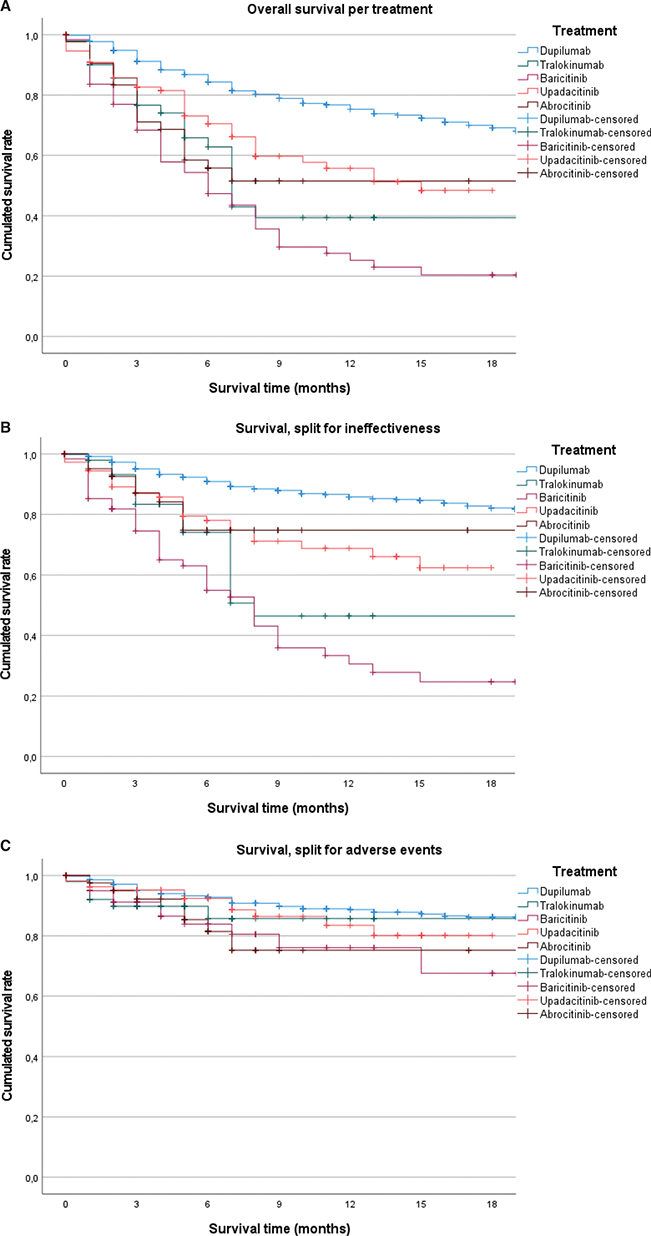
Fig. 1. Kaplan–Meier survival curves with the cumulative survival per treatment: (A) Overall survival, (B) split for ineffectiveness, (C) split for adverse events. (A): 18-month drug survival of dupilumab, tralokinumab, baricitinib, upadacitinib, and abrocitinib in 549 AD patients. n = 759 treatment courses. Event = overall discontinuation of treatment. Dupilumab shows the most favourable drug survival. Baricitinib has the lowest overall drug survival rate. (B) 18-month drug survival, split for ineffectiveness, of dupilumab, tralokinumab, baricitinib, upadacitinib, and abrocitinib in 549 AD patients. n = 759 treatment courses. Event = discontinuation of treatment due to ineffectiveness. Dupilumab shows the most favourable drug survival months. Baricitinib has the lowest drug survival rate. (C) 18-month drug survival, split for adverse events, of dupilumab, tralokinumab, baricitinib, upadacitinib, and abrocitinib in 549 AD patients. n = 759 treatment courses. Event = discontinuation of treatment due to adverse events. There is a trend towards better drug survival with the biologics (dupilumab and tralokinumab) compared with the JAK inhibitors (upadacitinib, abrocitinib, baricitinib).
In addition to dupilumab, upadacitinib and abrocitinib also showed good drug survival rates. The median overall drug survival rate for upadacitinib treatment (n = 111) was 6 months (IQR 6–11). Drug survival rates at 6 and 18 months were 73.1% and 48.4%, respectively (Fig. 1A). Drug survival rates for ineffectiveness (n = 27) were 78.0% and 62.4% at 6 and 18 months, respectively (Fig. 1B). When comparing biologics versus JAKi, we found that discontinuation due to AEs was lower for biologics compared with JAKis. For AEs (n = 28), the drug survival rates of upadacitinib were 92.4% and 80.1% (Fig. 1C). Abrocitinib (n = 43) shows slightly lower survival rates compared with upadacitinib. The median overall drug survival was 6 months (IQR 3–7) with overall drug survival rates at 6 and 18 months of 55.8% and 51.5%, respectively (Fig. 1A). Overall drug survival rates for ineffectiveness (n = 9) were 74.8% at both 6 and 18 months (Fig. 1B) and overall drug survival rates for AEs (n = 7) were 81.5% and 75.2% (Fig. 1C) at both time points.
Baricitinib treatment (n = 62) showed the lowest drug survival rates, with a median overall drug survival of 5.5 months (IQR 2–9). At 6 and 18 months drug survival was 54.4% and 20.4%, respectively (Fig. 1A). Drug survival rates due to ineffectiveness were notably lower compared with AEs. For ineffectiveness (n = 37), the drug survival rates were 63.0% and 24.7% at 6 and 18 months (Fig. 1B), whereas for AEs (n = 28), drug survival was 83.9% and 67.6%, respectively (Fig. 1C).
Discontinuation of treatment
In total, 197/492 dupilumab treatment courses (40.0%) were discontinued, including 19.1% due to ineffectiveness and 16.8% due to AEs. For tralokinumab, 23/51 treatment courses (45.1%) were discontinued, mainly due to ineffectiveness (33.3%) (Table II). The most common AEs reported for dupilumab discontinuation were conjunctivitis (53.8%) and head and neck dermatitis (15.2%). Notably, conjunctivitis was less frequently reported as a reason for discontinuation in tralokinumab patients compared with dupilumab patients (66.7% vs 85.6%).
For JAKi, 40/111 upadacitinib courses (44.4%) and 19/43 abrocitinib courses (44.2%) were discontinued, including 24.3% and 20.9% due to ineffectiveness, respectively. For AEs, 25.3% of upadacitinib and 16.3% of abrocitinib courses were discontinued, most commonly due to upper respiratory tract infection, acne, and headache (Table II). Baricitinib was discontinued in 44/62 cases (71.0%), primarily due to ineffectiveness (59.7%). See Table SI for AEs leading to discontinuation by treatment group.
Predictors of treatment discontinuation
Age of treatment initiation, gender, Fitzpatrick skin types, and a history of using 3 or more immunosuppressive treatments were investigated as potential predictors of drug survival. This study did not identify any significant predictors of treatment discontinuation. Detailed results are provided in Appendix S2.
The AD treatment landscape
As itemized in Table III, 147/549 (26.8%) patients switched from a first to a second advanced systemic, 50 (9.1%) from a second to a third, and 10 (1.8%) to a fourth. Dupilumab was the most frequently prescribed initial treatment (n = 479, 87.2%). Among patients who switched treatments, 71.3% switched to a JAKi as a second treatment, with upadacitinib being the most frequent second (n = 50, 34.0%) and third (n = 28, 56.0%) treatment. Fig. S2 shows initial to second treatment patterns, indicating that patients starting on baricitinib had the highest switching rate (73.0%).
A Sankey diagram (Fig. 2) visually represents treatment trajectories over time, showing that 57.9% of patients remained on their initial treatment during follow-up, 15.3% discontinued their initial treatment (defined as discontinuation of a treatment and not restarting any systemic treatment during follow-up), and 26.8% switched to a second advanced systemic treatment. The diagram highlights that while dupilumab is the preferred initial treatment, many patients switch to alternative treatments over time. The decreasing number across successful treatment stages suggest that most patients eventually find an effective treatment.

Fig. 2. Treatment patterns of the new systemic treatments. Treatment sequence indicates the order of treatment. The Sankey diagram shows that dupilumab is the predominant regimen in first-line treatment. Upadacitinib is the most common second and third treatment.
DISCUSSION
In this study, we aimed to explore real-world therapeutic responses to new systemic treatments for AD by conducting drug survival analyses and studying treatment patterns. Dupilumab treatment was shown to have the highest survival rate in terms of both effectiveness and safety, whereas baricitinib had the lowest survival rate and treatment was mostly discontinued due to ineffectiveness. Dupilumab was the first biologic registered in the Netherlands (15). In the current cohort, most patients started dupilumab as their initial advanced systemic, potentially resulting in bias as patients who have previously been treated with other new systemics may have more difficult-to-treat AD. This may have a negative impact on the drug survival outcomes of treatments started after dupilumab. In addition, previous systemic treatment has been identified as a predictor for lower drug survival in studies of biologics for AD and psoriasis (8, 16). Furthermore, in the Netherlands, there are no strict guidelines for switching to alternative treatments, such as achieving an Eczema Area and Severity Index (EASI) 50 after a specific treatment period. As a result, patients may continue treatment for fear of switching to potentially more effective treatments, a phenomenon known as conservatism bias (17). This may affect the drug survival outcomes in our cohort. However, our cohort provides insights into real-world treatment patterns, which may be similar across countries due to harmonized drug approval dates.
In our study, overall drug survival after 18 months of treatment with dupilumab was 70.3%, slightly lower than recent studies reporting 2-year survival rates between 85.9% and 89.0% (8, 18). In these studies, the lack of alternative new systemic treatments and therefore the unavailability of switching options may explain higher survival rates compared with our study. Baricitinib was found to have the lowest drug survival of all JAKi and had the highest rate of switchers. Baricitinib treatment was mostly discontinued due to its lack of efficacy. The high rate of transitioning from baricitinib to the other JAKi and lower drug survival may be explained by meta-analyses that suggest better efficacy of upadacitinib and abrocitinib compared with baricitinib (19).
Although adherence to the initial advanced systemic was 57.9%, 27% of patients switched to another treatment with most patients switching from a biologic to a JAKi. This shows that there is an important unmet need in predicting response to advanced systemics. Some 26.8% of the patients in this cohort are exposed to (expensive) drugs that prove to be unsuccessful after a median treatment period ranging from 3 to 10 months. In these patients, switching from biologics to JAKi and vice versa can be successful. We did not identify any predictors for treatment discontinuation in this study. In future studies, predictors such as disease severity scores, and serum or tissue biomarkers, may be useful predictors of treatment (dis)continuation. It is important to note patients were included between 2017 and 2023, a period in which several new treatments for AD became available (Fig. S1). Factors such as the time of registration of new treatments, and physicians’ experience with these new treatments, may have influenced the results described in this study.
The introduction of biologics and JAKi for AD and many other diseases has large effects on healthcare costs. Reduction of costs by increasing the interval of biologics may help to control these costs (20). In our cohort, we found that in 26.2% of dupilumab courses, dose reduction by extending the interval between doses was successful. This is consistent with previous findings demonstrating the success of dose reduction by using patient-centred dosing regimens in controlled AD (21). Future research should explore tralokinumab and JAKi dosing regimens and conduct economic evaluations to enhance patient access to these new systemic treatments for AD.
Ocular AEs were the most frequently reported AEs leading to discontinuation of dupilumab treatment in this study. Interestingly, ocular AEs are less common in patients treated with tralokinumab. This is consistent with findings reported in previous clinical trials and daily practice studies with incidence rates of up to 62.0% with dupilumab and up to 24.0% with tralokinumab treatment (2, 10, 13, 22–32). Ensuring effective management of ocular AEs during dupilumab and tralokinumab treatment may have influence on the overall drug survival (33). Furthermore, survival analyses show a lower survival rate for AEs with JAKi compared with biologics in this study. Commonly reported AEs of JAKi include upper respiratory tract infection, nasopharyngitis, headache, herpes simplex, and acne. This is in line with previous studies (6, 34, 35). Safety concerns, including the risk of major adverse cardiovascular events (MACE), have recently emerged from studies of tofacitinib in rheumatoid arthritis (RA) patients, prompting a boxed warning from the Food and Drug Administration (FDA) in 2019 (36). No cases of MACE were reported in our study, possibly due to a different patient population profile (younger patients and with fewer comorbidities and fewer comedications compared with RA patients).
The strengths of this study include the relatively large number of patients included from our prospective registry. However, several limitations should be considered. This study was performed in a large academic hospital in the Netherlands. Different regulations (e.g., reimbursement regulations) may apply in different countries resulting in different treatment patterns. In our centre, there has been no preference (due to, e.g., lower costs) for a specific advanced treatment, which is unique compared with most other centres and countries.
In addition to these potential limitations, dupilumab was the first and only treatment available for several years. The majority of dupilumab treatments (61.2%) in this study were initiated between 2017 and 2020. In these initial years it was therefore not possible to switch to other new systemics, potentially leading to higher drug survival rates for dupilumab compared with the other advanced systemics. In addition, differences in sample sizes for the different treatments may have influenced the observed variations in treatment survival. However, the introduction of several new drugs in a relatively short period of time may also have encouraged clinicians and patients to switch treatments. Another limitation is that a subset of patients continued low doses of conventional systemic immunosuppressants while on biologic treatment, which may lead to a slight overestimation of drug survival for these drugs. However, this reflects real-world treatment.
In conclusion, dupilumab appears to have the most favourable drug survival in terms of effectiveness and safety and was the most frequently prescribed initial treatment. The high frequency of switching between new advance systemics highlights the importance of identifying predictors of treatment response.
ACKNOWLEDGEMENTS
The authors would like to thank all the patients who participated and extend special thanks to Catherine Chia for her helpful contributions to the statistical analysis of this manuscript.
IRB approval status: This study was approved by the Institutional Review Board of Erasmus Medical Center (MED-2017-1123).
REFERENCES
- Emerson RM, Williams HC, Allen BR. Severity distribution of atopic dermatitis in the community and its relationship to secondary referral. Br J Dermatol 1998; 139: 73–76. https://doi.org/10.1046/j.1365-2133.1998.02316.x
- Blauvelt A, de Bruin-Weller M, Gooderham M, Cather JC, Weisman J, Pariser D, et al. Long-term management of moderate-to-severe atopic dermatitis with dupilumab and concomitant topical corticosteroids (LIBERTY AD CHRONOS): a 1-year, randomised, double-blinded, placebo-controlled, phase 3 trial. Lancet 2017; 389: 2287–2303. https://doi.org/10.1016/S0140-6736(17)31191-1
- Gutermuth J, Pink AE, Worm M, Soldbro L, Bjerregård Øland C, Weidinger S. Tralokinumab plus topical corticosteroids in adults with severe atopic dermatitis and inadequate response to or intolerance of ciclosporin A: a placebo-controlled, randomized, phase III clinical trial (ECZTRA 7). Br J Dermatol 2022; 186: 440–452. https://doi.org/10.1111/bjd.20832
- Reich K, Kabashima K, Peris K, Silverberg JI, Eichenfield LF, Bieber T, et al. Efficacy and safety of baricitinib combined with topical corticosteroids for treatment of moderate to severe atopic dermatitis: a randomized clinical trial. JAMA Dermatol 2020; 156: 1333–1343. https://doi.org/10.1001/jamadermatol.2020.3260
- Reich K, Teixeira HD, de Bruin-Weller M, Bieber T, Soong W, Kabashima K, et al. Safety and efficacy of upadacitinib in combination with topical corticosteroids in adolescents and adults with moderate-to-severe atopic dermatitis (AD Up): results from a randomised, double-blind, placebo-controlled, phase 3 trial. Lancet 2021; 397: 2169–2181. https://doi.org/10.1016/S0140-6736(21)00589-4
- Silverberg JI, Simpson EL, Thyssen JP, Gooderham M, Chan G, Feeney C, et al. Efficacy and safety of abrocitinib in patients with moderate-to-severe atopic dermatitis: a randomized clinical trial. JAMA Dermatol 2020; 156: 863–873. https://doi.org/10.1001/jamadermatol.2020.1406
- Stölzl D, Sander N, Heratizadeh A, Haufe E, Harder I, Abraham S, et al. Real-world data on the effectiveness, safety and drug survival of dupilumab: an analysis from the TREATgermany registry. Br J Dermatol 2022; 187: 1022–1024. https://doi.org/10.1111/bjd.21794
- Spekhorst LS, de Graaf M, Zuithoff NPA, van den Reek J, Kamsteeg M, Boesjes CM, et al. Dupilumab drug survival and associated predictors in patients with moderate to severe atopic dermatitis: long-term results from the daily practice BioDay Registry. JAMA Dermatol 2022; 158: 1048–1056. https://doi.org/10.1001/jamadermatol.2022.3014
- de Wijs L, Schreurs C, Schlösser A, Nijsten T, Hijnen DJ. Baricitinib for atopic dermatitis patients who responded inadequately to dupilumab treatment: first daily practice results. JEADV Clinical Practice 2022; 1: 364–371. https://doi.org/10.1002/jvc2.64
- de Wijs LEM, Bosma AL, Erler NS, Hollestein LM, Gerbens LAA, Middelkamp-Hup MA, et al. Effectiveness of dupilumab treatment in 95 patients with atopic dermatitis: daily practice data. Br J Dermatol 2020; 182: 418–426. https://doi.org/10.1111/bjd.18179
- Olydam JI, Schlösser AR, Custurone P, Nijsten TEC, Hijnen D. Real-world effectiveness of abrocitinib treatment in patients with difficult-to-treat atopic dermatitis. J Eur Acad Dermatol Venereol 2023; 37: 2537–2542. https://doi.org/10.1111/jdv.19378
- Schlösser AR, Boeijink N, Olydam J, Nijsten TEC, Hijnen D. Upadacitinib treatment in a real-world difficult-to-treat atopic dermatitis patient cohort. J Eur Acad Dermatol Venereol 2024; 38: 384–392. https://doi.org/10.1111/jdv.19581
- Schlösser AR, Shareef M, Olydam J, Nijsten TEC, Hijnen DJ. Tralokinumab treatment for patients with moderate-to-severe atopic dermatitis in daily practice. Clin Exp Dermatol 2023; 48: 510–517. https://doi.org/10.1093/ced/llad038
- Looijen AEM, van Linschoten RCA, Brugma JD, Hijnen DJ, de Jong PHP, van der Kuy PHM, et al. Digital outcome measurement to improve care for patients with immune-mediated inflammatory diseases: protocol for the IMID Registry. JMIR Res Protoc 2023; 12: e43230. https://doi.org/10.2196/43230
- NVDV. Conventionele systemische immunosuppressieve therapie CE. NVDV, 2019. Available from https://richtlijnendatabase.nl/richtlijn/constitutioneel_eczeem/conventionele_systemische_immunosuppressieve_therapie_ce.html
- Yiu ZZN, Becher G, Kirby B, Laws P, Reynolds NJ, Smith CH, et al. Drug survival associated with effectiveness and safety of treatment with guselkumab, ixekizumab, secukinumab, ustekinumab, and adalimumab in patients with psoriasis. JAMA Dermatol 2022; 158: 1131–1141. https://doi.org/10.1001/jamadermatol.2022.2909
- Edwards, W. (1968). Conservatism in human information processing. In B. Kleinmuntz (Ed.) Formal representation of human judgment (pp. 17–52). New York: Wiley.
- Khosravi H, Zhang S, Anderson AM, Ferris LK, Choudhary S, Patton T. Dupilumab drug survival, treatment failures, and insurance approval at a tertiary care center in the United States. J Am Acad Dermatol 2020; 82: 1023–1024. https://doi.org/10.1016/j.jaad.2019.12.034
- Wan H, Jia H, Xia T, Zhang D. Comparative efficacy and safety of abrocitinib, baricitinib, and upadacitinib for moderate-to-severe atopic dermatitis: a network meta-analysis. Dermatol Ther 2022; 35: e15636. https://doi.org/10.1111/dth.15636
- Siegels D, Heratizadeh A, Abraham S, Binnmyr J, Brockow K, Irvine AD, et al. Systemic treatments in the management of atopic dermatitis: a systematic review and meta-analysis. Allergy 2021; 76: 1053–1076. https://doi.org/10.1111/all.14631
- Spekhorst LS, Bakker D, Drylewicz J, Rispens T, Loeff F, Boesjes CM, et al. Patient-centered dupilumab dosing regimen leads to successful dose reduction in persistently controlled atopic dermatitis. Allergy 2022; 77: 3398–3407. https://doi.org/10.1111/all.15439
- Beck LA, Thaçi D, Hamilton JD, Graham NM, Bieber T, Rocklin R, et al. Dupilumab treatment in adults with moderate-to-severe atopic dermatitis. N Engl J Med 2014; 371: 130–139. https://doi.org/10.1056/NEJMoa1314768
- de Bruin-Weller M, Thaçi D, Smith CH, Reich K, Cork MJ, Radin A, et al. Dupilumab with concomitant topical corticosteroid treatment in adults with atopic dermatitis with an inadequate response or intolerance to ciclosporin A or when this treatment is medically inadvisable: a placebo-controlled, randomized phase III clinical trial (LIBERTY AD CAFÉ). Br J Dermatol 2018; 178: 1083–1101. https://doi.org/10.1111/bjd.16156
- Hussein YM, Ahmad AS, Ibrahem MM, Elsherbeny HM, Shalaby SM, El-Shal AS, et al. Interleukin 13 receptors as biochemical markers in atopic patients. J Investig Allergol Clin Immunol 2011; 21: 101–107.
- Paller AS, Siegfried EC, Thaçi D, Wollenberg A, Cork MJ, Arkwright PD, et al. Efficacy and safety of dupilumab with concomitant topical corticosteroids in children 6 to 11 years old with severe atopic dermatitis: a randomized, double-blinded, placebo-controlled phase 3 trial. J Am Acad Dermatol 2020; 83: 1282–1293. https://doi.org/10.1016/j.jaad.2020.06.054
- Popovic B, Breed J, Rees DG, Gardener MJ, Vinall LM, Kemp B, et al. Structural characterisation reveals mechanism of il-13-neutralising monoclonal antibody tralokinumab as inhibition of binding to IL-13Rα1 and IL-13Rα2. J Mol Biol 2017; 429: 208–219. https://doi.org/10.1016/j.jmb.2016.12.005
- Simpson EL, Bieber T, Guttman-Yassky E, Beck LA, Blauvelt A, Cork MJ, et al. Two phase 3 trials of dupilumab versus placebo in atopic dermatitis. N Engl J Med 2016; 375: 2335–2348. https://doi.org/10.1056/NEJMoa1610020
- Simpson EL, Paller AS, Siegfried EC, Boguniewicz M, Sher L, Gooderham MJ, et al. Efficacy and safety of dupilumab in adolescents with uncontrolled moderate to severe atopic dermatitis: a phase 3 randomized clinical trial. JAMA Dermatol 2020; 156: 44–56. https://doi.org/10.1001/jamadermatol.2019.3336
- Worm M, Simpson EL, Thaçi D, Bissonnette R, Lacour JP, Beissert S, et al. Efficacy and safety of multiple dupilumab dose regimens after initial successful treatment in patients with atopic dermatitis: a randomized clinical trial. JAMA Dermatol 2020; 156: 131–143. https://doi.org/10.1001/jamadermatol.2019.3617
- Zhao Y, Wu L, Lu Q, Gao X, Zhu X, Yao X, et al. The efficacy and safety of dupilumab in Chinese patients with moderate-to-severe atopic dermatitis: a randomized, double-blind, placebo-controlled study. Br J Dermatol 2022; 186: 633–641. https://doi.org/10.1111/bjd.20690
- De Greef A, Ghislain PD, Bulinckx A, Coster A, de Halleux C, Damsin T, et al. Real-life experience of tralokinumab for the treatment of adult patients with severe atopic dermatitis: a multicentric prospective study. Clin Drug Investig 2023; 43: 299–306. https://doi.org/10.1007/s40261-023-01258-7
- Spekhorst LS, de Graaf M, Loeff F, Zuithoff NPA, Bakker D, Boesjes CM, et al. Association of serum dupilumab levels at 16 weeks with treatment response and adverse effects in patients with atopic dermatitis: a prospective clinical cohort study from the BioDay Registry. JAMA Dermatol 2022; 158: 1409–1413. https://doi.org/10.1001/jamadermatol.2022.4639
- Schlösser AR, Bult L, Thelen JC, Thiadens A, Schappin R, Nijsten TEC, et al. Higher prevalence of dupilumab-induced ocular adverse events in atopic dermatitis compared to asthma: a daily practice analysis. Clin Transl Allergy 2024; 14: e12386. https://doi.org/10.1002/clt2.12386
- Simpson EL, Sinclair R, Forman S, Wollenberg A, Aschoff R, Cork M, et al. Efficacy and safety of abrocitinib in adults and adolescents with moderate-to-severe atopic dermatitis (JADE MONO-1): a multicentre, double-blind, randomised, placebo-controlled, phase 3 trial. Lancet 2020; 396: 255–266. https://doi.org/10.1016/S0140-6736(20)30732-7
- Guttman-Yassky E, Teixeira HD, Simpson EL, Papp KA, Pangan AL, Blauvelt A, et al. Once-daily upadacitinib versus placebo in adolescents and adults with moderate-to-severe atopic dermatitis (Measure Up 1 and Measure Up 2): results from two replicate double-blind, randomised controlled phase 3 trials. Lancet 2021; 397: 2151–2168. https://doi.org/10.1016/S0140-6736(21)00588-2
- Ytterberg SR, Bhatt DL, Mikuls TR, Koch GG, Fleischmann R, Rivas JL, et al. Cardiovascular and cancer risk with tofacitinib in rheumatoid arthritis. N Engl J Med 2022; 386: 316–326. https://doi.org/10.1056/NEJMoa2109927
- Agency EM. European Medicines Agency [cited 2024 Nov 1]. Available from: https://www.ema.europa.eu/en/homepage.