SHORT COMMUNICATION
Seasonal Changes in the Severity of Atopic Dermatitis by Birth Season: A Pilot Prospective Cohort Study
Yu-ting ZHANG1#, Hong-min LI2#, Yi-jin ZHANG1, Cheng TAN2* and Bo XIE 1*
1*
1Department of Dermatology, Hangzhou Third People’s Hospital, Hangzhou Third Hospital Affiliated to Zhejiang Chinese Medical University, Hangzhou, 310009, and 2Department of Dermatology, Affiliated Hospital of Nanjing University of Chinese Medicine, Jiangsu Province Hospital of Chinese Medicine, 155 Hanzhong Rd, Nanjing 210029, China. E-mail: wavethanks@zju.edu.cn; tancheng@yeah.net
#These authors contributed equally to this work.
Citation: Acta Derm Venereol 2025; 105: adv41987. DOI: https://doi.org/10.2340/actadv.v105.41987.
Copyright: © 2025 The Author(s). Published by MJS Publishing, on behalf of the Society for Publication of Acta Dermato-Venereologica. This is an Open Access article distributed under the terms of the Creative Commons Attribution-NonCommercial 4.0 International License (https://creativecommons.org/licenses/by-nc/4.0/).
Submitted: Sep 11, 2024. Accepted after revision: Feb 6, 2025. Published: Mar 3, 2025.
Competing interests and funding: The authors have no conflicts of interest to declare.
INTRODUCTION
Atopic dermatitis (AD) is an inflammatory chronic skin disease characterized by dry skin, itchy rash, heightened sensitivity, and disseminated eczematous lesions (1). About 80% of AD occurs in children, with a point prevalence ranging from 2.7% to 20.1% across countries (2, 3). AD is a highly burdensome disease for individuals, families, and society. AD accounted for the highest global disease burden among all skin diseases in disability-adjusted life-years (DALYs) between 1990 and 2017 (4).
Based on whether skin symptoms worsen in the summer or winter, AD is classified into 2 types: the summer type and the winter type (5). Previous studies demonstrated seasonal changes in AD, yet with inconsistent evidence. A systematic review in the Northern Hemisphere revealed a higher prevalence of AD in children born in the autumn and winter (6). A study in Japan showed a higher risk of AD in infants born in autumn (7). A study in Korea found that the prevalence of AD was positively correlated with temperature (8), while a study in China showed a negative association between AD and temperature (9).
However, it is unclear which group of AD patients becomes worse in which season, and there is a lack of research to explore the association dynamically. Given these limitations, we conducted a pilot study in a sample of children and adults to explore seasonal changes in AD severity in people born in different seasons. This pilot study provides preliminary evidence on the seasonal changes in the severity of atopic dermatitis by birth season, which may guide further large-scale studies and inform future intervention efforts.
MATERIALS AND METHODS
The pilot prospective cohort study was conducted at the outpatient unit of the Department of Dermatology at the Jiangsu Hospital of Traditional Chinese Medicine, China. A total of 50 children and adults aged between 3 and 51 with a confirmed diagnosis of AD by 2 senior dermatologists were recruited for this study. The study was approved by the ethical review committee of Nanjing University of Chinese Medicine (No. 2017NL-056-02). Individuals were recruited between 10 March 2020 (the first observation) and 3 March 2021 (the last follow-up) and followed up every 3 months for 1 year. Written informed consent was obtained from participants or their legal guardians (for children under 18 years old), who then completed a structured paper-based questionnaire at each visit to collect demographic (e.g., age and gender) and clinical (e.g., delivery mode and family history) information. The severity of AD and itch were evaluated by a trained investigator at baseline and each follow-up using the Scoring Atopic Dermatitis (SCORAD) index (10) and visual analogue scale (VAS) (11), respectively.
The VAS is a combination index of (A) extent, (B) intensity, and (C) subjective symptoms using the following formula: A/5+7B/2+C. The SCORAD index score ranges from 0 to 83, with a higher score indicating more severity of AD. The VAS uses a straight line with continuous numbers to estimate the magnitude of the itch, with the ends representing extreme itch experiences. Group comparisons were conducted using χ2 tests, Fisher’s exact tests, multivariate analyses of variance (MANOVA) with repeated measures, and the Kruskal–Wallis H test. Moreover, post hoc pairwise comparisons were performed using t-tests when significant seasonal differences were detected.
RESULTS
At baseline, participants’ average age was 14.09 ± 10.36 years, and their AD symptoms started at a mean age of 11.21 ± 9.91 years, with a mean duration of 43.70 ± 58.76 months (Table SI). Ten (20%) participants were born in the spring, 12 (24%) in the summer, 17 (34%) in the autumn, and 11 (22%) in the winter. All 50 participants completed the second visit, while 8% and 34% were lost to follow-up at the third and fourth visit, respectively. No significant differences were found in the loss-to-follow-up rates between those born in summer and in winter, or in the baseline characteristics between those who completed the 4 visits and those who were lost to follow-up.
There were 31 visits in spring, 46 visits in summer, 76 visits in autumn, and 51 visits in winter during the baseline and follow-up periods. Patients born in spring have higher SCORAD scores in spring, patients born in summer have higher SCORAD scores in summer, and patients born in winter have higher SCORAD scores in winter, but those born in autumn show no obvious patterns (Fig. 1). The SCORAD score showed no significant seasonal difference in the total group (F = 0.23, p = 0.88). However, subgroup analysis by sociodemographic and clinical characteristics showed significant seasonal differences in those with an AD duration < 12 months (F = 3.00, p < 0.01) and those who were born in summer (F = 4.90, p < 0.01) (Table SII). Table I shows the multiple comparisons of the SCORAD score between 4 seasons among those born in summer. The SCORAD score was significantly higher in summer than in autumn (63.54 ± 9.13 vs 43.72 ± 13.44, p < 0.001) and in winter (63.54 ± 9.13 vs 47.04 ± 16.44, p < 0.01).
| Comparison (season A vs season B) | Severity by SCORAD Season A | Severity by SCORAD Season B | t | p-value |
| Spring vs summer | 51.30 ± 17.19 | 63.54 ± 9.13 | –2.04 | 0.06 |
| Spring vs autumn | 51.30 ± 17.19 | 43.72 ± 13.44 | 1.29 | 0.21 |
| Spring vs winter | 51.30 ± 17.19 | 47.04 ± 16.44 | 0.57 | 0.58 |
| Summer vs autumn | 63.54 ± 9.13 | 43.72 ± 13.44 | 4.35 | < 0.001* |
| Summer vs winter | 63.54 ± 9.13 | 47.04 ± 16.44 | 2.91 | < 0.01* |
| Autumn vs winter | 43.72 ± 13.44 | 47.04 ± 16.44 | –0.61 | 0.55 |
| SCORAD: scoring atopic dermatitis; *difference is statistically significant. | ||||
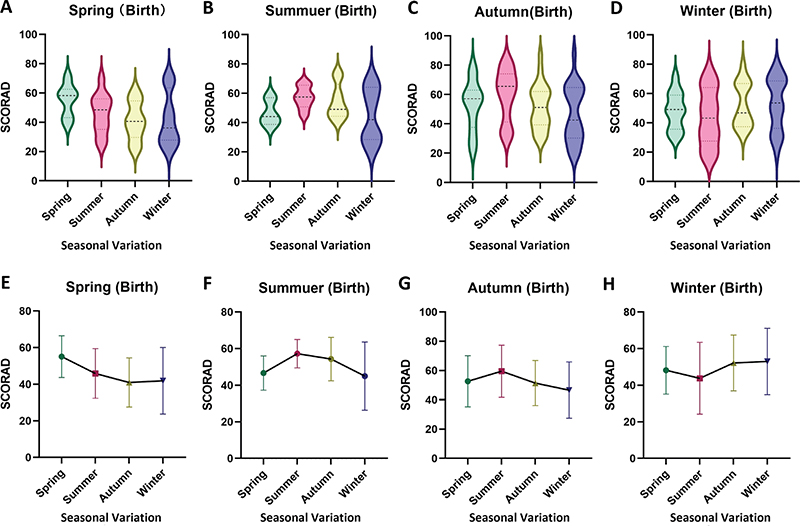
Fig. 1. Season of birth and seasonal variations in the severity of atopic dermatitis (AD). (A–D): Violin plot of SCORing Atopic Dermatitis (SCORAD) distribution for patients born in spring, summer, autumn, and winter when they seek medical treatment in different seasons. The thick dotted line represents the median SCORAD, and the thin dotted line represents the quartiles (25% and 75%). The width of the violin plot represents the density of the data distribution. The larger the width, the more data in the range and the greater the density. (E–H): Line chart of changing trends in SCORAD for patients born in spring, summer, autumn, and winter when they seek medical treatment in different seasons.
Similarly, the VAS score showed significant seasonal differences in those born in summer (F = 3.99, p = 0.01) (Table SIII). Table II indicates the multiple comparisons of the VAS score between 4 seasons among those born in summer. Statistically significant differences were observed in the spring vs summer (5.33 ± 2.06 vs 7.09 ± 1.38, p = 0.04), summer vs autumn (7.09 ± 1.38 vs 4.85 ± 1.60, p = 0.001), and summer vs winter groups (7.09 ± 1.38 vs 5.09 ± 2.21, p = 0.02).
| Comparison (season A vs season B) | Severity by itch Season A | Severity by itch Season B | t | p-value |
| Spring vs summer | 5.33 ± 2.06 | 7.09 ± 1.38 | –2.28 | 0.04* |
| Spring vs autumn | 5.33 ± 2.06 | 4.85 ± 1.60 | 0.69 | 0.50 |
| Spring vs winter | 5.33 ± 2.06 | 5.09 ± 2.21 | 0.25 | 0.80 |
| Summer vs autumn | 7.09 ± 1.38 | 4.85 ± 1.60 | 3.91 | 0.001* |
| Summer vs winter | 7.09 ± 1.38 | 5.09 ± 2.21 | 2.55 | 0.02* |
| Autumn vs winter | 4.85 ± 1.60 | 5.09 ± 2.21 | –0.35 | 0.73 |
| *Difference is statistically significant. | ||||
DISCUSSION
In this study, we examined the seasonal changes in AD exacerbation among patients born in different seasons. We found that AD patients born in the summer experienced the most severe symptoms and itch in the summer, but AD patients born in other seasons showed no seasonality. Previous studies showed that birth seasons may affect the progression of AD, with a higher prevalence of AD observed in children born in the autumn or winter (6, 7, 12). Our study added further evidence by clarifying the impact of birth season on the seasonal changes in AD severity.
The exacerbation of AD in summer can be attributed to high temperatures, low humidity, sweating, grass-pollen exposure, and ultraviolet radiation (13–15). In this study, patients born in the summer had the most severe symptoms and itch in the summer, which may be related to high temperature and sweat stimulation. The exacerbation of AD in the winter might be related to low temperatures and the deterioration of the skin barrier due to decreased epidermal lipids, skin hydration, and skin natural moisturizing factor (NMF) components (13).
The study has several limitations. First, this was a pilot study with a small sample recruited from a single location, and the findings can serve only as preliminary evidence suggesting the potential seasonal changes in AD severity. Second, 34% of individuals were lost to follow-up, though their baseline characteristics were comparable to those who completed the study. Third, we evaluated AD severity only once every 3 months, which may not capture any changes during those 3 months. Finally, we followed up with the participants for only a short 1-year period.
In conclusion, this pilot study suggests that AD patients born in the summer have the most severe AD and itch in the summer. This provides preliminary evidence of the patterns of seasonal changes in AD symptoms in specific populations. Our next step is to conduct a formal large-scale study to validate the findings further and design preventive intervention programmes accordingly.
ACKNOWLEDGEMENTS
All authors contributed to the conception and design of the study. Data were collected by Yu-ting Zhang, Hong-min Li. Yi-jin Zhang, Bo Xie, and Cheng Tan performed the data analysis and figure visualization. Yu-ting Zhang wrote the first draft of the manuscript, and all authors commented on the previous version of the manuscript. All authors have read and approved the final manuscript. The article was published as a preprint on research square, doi: 10.21203/rs.3.rs-4382810/v1.
Funding sources: This work was supported by the National Natural Science Foundation of China [82303998, 82474360], the Medical Science and Technology Project of Zhejiang Province [2023KY189], and Jiangsu Province Hospital of Chinese Medicine Foundation [y2021rc25 and y2021rc32].
IRB approval status: The study was approved by the ethical review committee of Nanjing University of Chinese Medicine (No. 2017NL-056-02).
REFERENCES
- Bieber T. Atopic dermatitis: an expanding therapeutic pipeline for a complex disease. Nat Rev Drug Discov 2022; 21: 21–40. https://doi.org/10.1038/s41573-021-00266-6
- Silverberg JI, Barbarot S, Gadkari A, Simpson EL, Mina-Osorio P, Weidinger S, et al. Atopic dermatitis in the pediatric population: a cross-sectional, international epidemiologic study. Ann Allergy Asthma Immunol 2021; 126: 417–428. https://doi.org/10.1016/j.anai.2020.12.020
- Barbarot S, Auziere S, Gadkari A, Girolomoni G, Puig L, Simpson EL, et al. Epidemiology of atopic dermatitis in adults: results from an international survey. Allergy 2018; 73: 1284–1293. https://doi.org/10.1111/all.13401
- Laughter MR, Maymone MBC, Mashayekhi S, Arents BWM, Karimkhani C, Langan SM, et al. The global burden of atopic dermatitis: lessons from the Global Burden of Disease Study 1990–2017. Br J Dermatol 2021; 184: 304–309. https://doi.org/10.1111/bjd.19580
- Kramer U, Weidinger S, Darsow U, Mohrenschlager M, Ring J, Behrendt H. Seasonality in symptom severity influenced by temperature or grass pollen: results of a panel study in children with eczema. J Invest Dermatol 2005; 124: 514–523. https://doi.org/10.1111/j.0022-202X.2005.23625.x
- Calov M, Alinaghi F, Hamann CR, Silverberg J, Egeberg A, Thyssen JP. The association between season of birth and atopic dermatitis in the northern hemisphere: a systematic review and meta-analysis. J Aller Cl ImmPract 2020; 8: 674–680. https://doi.org/10.1016/j.jaip.2019.10.007
- Tsuchida A, Itazawa T, Matsumura K, Yokomichi H, Yamagata Z, Adachi Y, et al. Season of birth and atopic dermatitis in early infancy: results from the Japan Environment and Children’s Study. BMC Pediatr 2023; 23: 78. https://doi.org/10.1186/s12887-023-03878-6
- Lee YC, Ju HJ, Kwon JW, Bae JM. Seasonality of allergic diseases: real-world evidence from a nationwide population-based study. Immun Inflamm Dis 2020; 8: 360–362. https://doi.org/10.1002/iid3.316
- Hu Y, Jiang F, Tan J, Liu S, Li S, Wu M, et al. Environmental exposure and childhood atopic dermatitis in Shanghai: a season-stratified time-series analysis. Dermatology 2022; 238: 101–108. https://doi.org/10.1159/000514685
- Severity scoring of atopic dermatitis: the SCORAD index. Consensus Report of the European Task Force on Atopic Dermatitis. Dermatology 1993; 186: 23–31. https://doi.org/10.1159/000247298
- Beecher SM, Hill R, Kearney L, Dorairaj J, Kumar A, Clover AJ. The pruritus severity scale: a novel tool to assess itch in burns patients. Int J Burns Trauma 2021; 11: 156.
- Kuo CL, Chen TL, Liao CC, Yeh CC, Chou CL, Lee WR, et al. Birth month and risk of atopic dermatitis: a nationwide population-based study. Allergy 2016; 71: 1626–1631. https://doi.org/10.1111/all.12954
- Wang F, Shi C, Dong J, Nie H. Association between ambient temperature and atopic dermatitis in Lanzhou, China: a time series analysis. Environ Sci Pollut R 2021; 28: 67487–67495. https://doi.org/10.1007/s11356-021-15198-2
- Yokomichi H, Mochizuki M, Tsuchida A, Kojima R, Horiuchi S, Ooka T, et al. Association of the incidence of atopic dermatitis until 3 years old with birth month and with sunshine duration and humidity in the first 6 months of life: Japan Environment and Children’s Study. BMJ Open 2021; 11: e047226. https://doi.org/10.1136/bmjopen-2020-047226
- Murota H, Koike Y, Morisaki H, Matsumoto M, Takenaka M. Exacerbating factors and disease burden in patients with atopic dermatitis. Allergol Int 2022; 71: 25–30. https://doi.org/10.1016/j.alit.2021.10.002