SHORT COMMUNICATION
Generalized Pustular Psoriasis with Breast Cancer Successfully Treated with Spesolimab Causing Neutrophilia: A Case Report
Rina OBATA, Mika YAMANAKA-TAKAICHI, Hisayoshi IMANISHI, Tomoko OSHIMO and Daisuke TSURUTA
Department of Dermatology, Graduate School of Medicine, Osaka Metropolitan University, 1-4-3, Asahimachi, Abeno-ku, Osaka 545-8585, Japan. E-mail: rntnk1018@gmail.com
Citation: Acta Derm Venereol 2025; 105: adv42368. DOI: https://doi.org/10.2340/actadv.v105.42368.
Copyright: © 2025 The Author(s). Published by MJS Publishing, on behalf of the Society for Publication of Acta Dermato-Venereologica. This is an Open Access article distributed under the terms of the Creative Commons Attribution-NonCommercial 4.0 International License (https://creativecommons.org/licenses/by-nc/4.0/).
Submitted: Oct 30, 2024. Accepted after revision: Mar 17, 2025. Published: Mar 27, 2025.
Generalized pustular psoriasis (GPP) is a rare, severe inflammatory disease characterized by multiple sterile pustules on flushed skin with flares, usually accompanied by fever and general malaise (1). The interleukin (IL) -36 signalling pathway has been shown to play an important role in the pathogenesis of GPP. Spesolimab, an anti-IL 36 receptor antibody, has been demonstrated to contribute to rapid pustular and skin clearance in patients with GPP flare (2). Although the number of patients with psoriasis treated with biologic agents is increasing, the potential link between psoriasis and cancer is known (3). Here we present a unique case of GPP in a patient with breast cancer who was successfully treated with spesolimab and showed transient neutrophilia after administration.
CASE REPORT
A 45-year-old female who had a history of breast cancer with lung, liver, and bone metastases presented to her previous physician with fever (38.7°C) and widespread erythematous plaques with pustules on her face and trunk for 2 days. The patient had no history of allergy. She had no family history or previous history of psoriasis. She had been diagnosed with breast cancer 2 years earlier, and underwent surgery 16 months ago after neoadjuvant chemotherapy. She had been taking anastrozole for 2 months and abemaciclib for 1 month before her first visit as adjuvant chemotherapy, and administration of both drugs was discontinued due to suspected acute generalized exanthematous pustulosis (AGEP).
Treatment with prednisolone (PSL) at a dose of 20 mg/day was started and the dose was increased to 30 mg/day, but she was referred to our department due to lack of improvement 9 days after the onset of symptoms (Fig. 1a–d). A skin biopsy was performed and showed Kogoj’s spongiform pustules consistent with the diagnosis of GPP (Fig. 2). Leukocytosis (16,600/µL), neutrophilia (13,446/µL), elevated C-reactive protein (6.16 mg/dL), and low albumin level (3.1 g/dL) were revealed. A simple computed tomography scan showed metastatic lesions of breast cancer and a sclerotic image of the sacroiliac joint that suggested arthritis. Culture examination of the pustular area was negative. Based on the course of prolonged symptoms even after discontinuation of administration of the suspect drug, GPP was suspected rather than AGEP. The GPP/AGEP scoring system developed by Takaichi et al. indicated a diagnosis of GPP (total score of one point; score ≥0 favours GPP, <0 favours AGEP) (4). Generalized pustular psoriasis physician global assessment (GPPGA) was 3.67 and generalized pustular psoriasis area and severity index (GPPASI) was 32.6 out of 72. No genetic analysis has been performed.
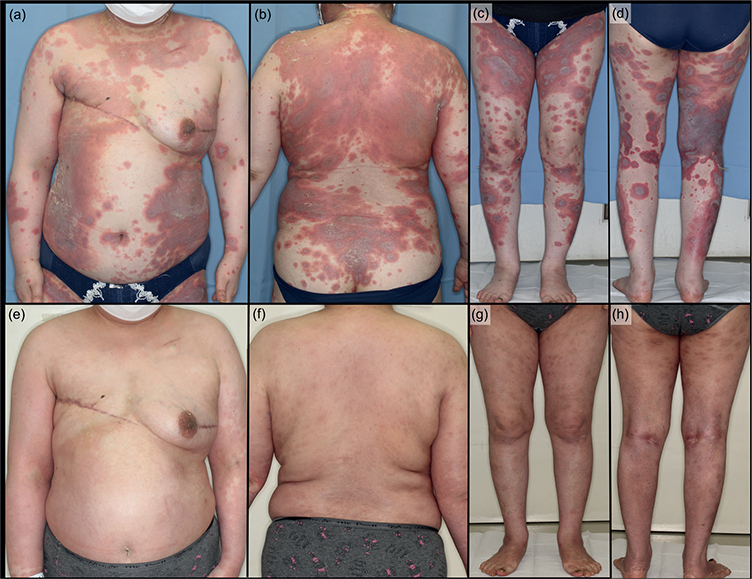
Fig. 1. Cutaneous manifestation. (a–d) At baseline, multiple erythematous plaques studded with pustules were observed on the (a), (b) trunk, upper extremities, and (c, d) lower extremities. (e–h) Six days after the second administration of spesolimab. The erythema and pustules on the (e, f) trunk, upper extremities, and (g, h) lower extremities had almost cleared with some hyperpigmentation remaining.
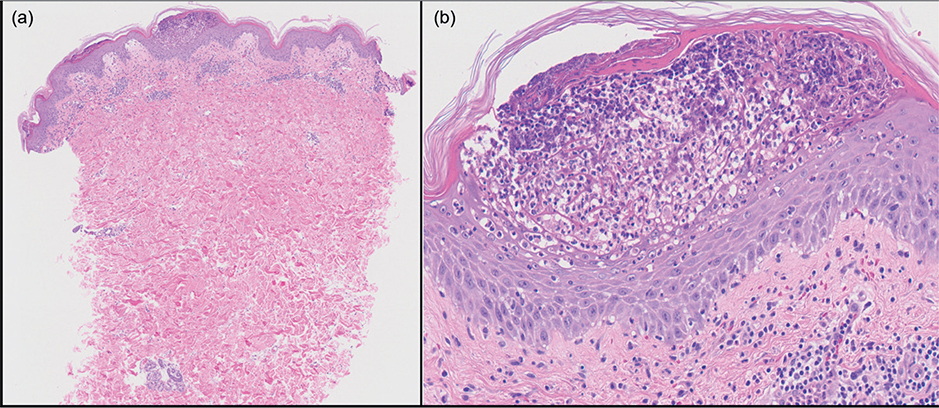
Fig. 2. Histopathological findings. Haematoxylin and eosin staining showed subcorneal mild hyperkeratosis, focal subcorneal pustules with aggregations of abundant neutrophils and Kogoj’s spongiform pustules. (a) magnification x35, (b) magnification x200.
The patient was admitted and the first dose of spesolimab (900 mg) was administered. Fever resolved the day after administration, and most of the pustules cleared within a few days. However, another dose was administered 1 week after the initial dose due to persistent erythema. Increased neutrophil counts were seen on the day after the first administration and on day 5 of the second administration, and the counts decreased within a few days. Although there was concern about GPP flare-ups, erythema and pustules were markedly improved and there were no other symptoms, leaving the neutrophilia to be monitored without any intervention (Fig. 1e–h). PSL was tapered off and the patient was discharged on day 16 of hospitalization (Fig. 3). Both anastrozole and abemaciclib were discontinued due to the possibility of drug-induced GPP.

Fig. 3. Clinical course. Fever resolved the day after administration, and most of the pustules cleared within a few days. Increased neutrophil counts were seen on the day after the first administration and on day 5 of the second administration, and the counts decreased within a few days. PSL was tapered off as shown. PSL: prednisolone; GPPGA: generalized pustular psoriasis physician global assessment; CRP: C-reactive protein.
DISCUSSION
Spesolimab is a humanized IgG1 monoclonal antibody that binds specifically to IL-36 R with high affinity and inhibits signalling by IL-36 agonists (2). Safety evidence for the use of biologics in psoriasis patients with a history of ongoing malignancy is scarce, and Japanese and British guidelines recommend the avoidance of biologics use in patients with a history of malignancy within the past 5 years (5, 6). On the other hand, biologics can provide adequate control of paradoxical psoriasis following immune-enhancing checkpoint inhibitor therapy for cancer (7), thus allowing prosecution of oncologic treatment without impairing its efficacy. Regarding the use of biologics for psoriasis in cancer patients, in an 8-year retrospective real-life study, only 1 patient had progression of oesophageal cancer, but no further serious adverse events and none associated with biologics were reported (3). To the best of our knowledge, there is only 1 case of GPP in a patient with malignancy treated with spesolimab that was reported prior to our case. In the previous case, spesolimab was safely used in a GPP patient with metastatic colon cancer who was receiving chemotherapy, with successful resolution of symptoms (8). Taken together, the results indicate that spesolimab could be a favourable treatment option for patients with a previous or current history or treatment history of malignancies.
In our case, a unique presentation of neutrophilia was seen for a few days following the administration of spesolimab. Although spesolimab has been reported to decrease neutrophil counts in patients with an elevated baseline level (9), transient neutrophilia was observed within a few days after the start of spesolimab administration despite the improvement of symptoms in our case. IL-36 binds to the IL-36 receptor on keratinocytes, induces the production and secretion of neutrophil chemokines including CXCL1, CXCL2, CXCL6, and CXCL8 (IL-8), and increases the attraction of neutrophils to the skin (2). Neutrophils originate in bone marrow, circulate in the blood, and transmigrate out of blood vessels into tissue upon encountering proinflammatory signals, and the remaining neutrophils reversely migrate into blood and go to bone marrow, the spleen, and the liver for degradation (10). Although it is not definite that spesolimab is associated with an increase in neutrophils, it is possible that blockade of the IL-36 pathway inhibited the migration of neutrophils from blood vessels to tissues or that neutrophils that had accumulated in the skin tissue returned to blood vessels after spesolimab administration, resulting in a transient increase in the number of neutrophils in the blood. Additionally, the systemic corticosteroid may also have contributed to the neutrophilia in this case. Because neutrophil counts are considered to reflect the disease severity of GPP, physicians should be aware that neutrophils may transiently increase during treatment with spesolimab. Further studies are needed to better understand the safety of spesolimab use in cancer patients and neutrophilia as a possible side effect of spesolimab.
REFERENCES
- Puig L, Choon SE, Gottlieb AB, Marrakchi S, Prinz JC, Romiti R, et al. Generalized pustular psoriasis: a global Delphi consensus on clinical course, diagnosis, treatment goals and disease management. J Eur Acad Dermatol Venereol 2023; 37: 737–752. https://doi.org/10.1111/jdv.18851
- Hawkes JE, Visvanathan S, Krueger JG. The role of the interleukin-36 axis in generalized pustular psoriasis: a review of the mechanism of action of spesolimab. Front Immunol 2023; 14: 1292941. https://doi.org/10.3389/fimmu.2023.1292941
- Battista T, Gallo L, Martora F, Fattore D, Potestio L, Cacciapuoti S, et al. Biological therapy for psoriasis in cancer patients: an 8-year retrospective real-life study. J Clin Med 2024; 13: 1940. https://doi.org/10.3390/jcm13071940
- Yamanaka-Takaichi M, Watanabe M, Comfere NI, Sokumbi O, Akpala CO, Todd A, et al. Differentiating generalized pustular psoriasis from acute generalized exanthematous pustulosis. J Am Acad Dermatol 2024; 90: 1289–1291. https://doi.org/10.1016/j.jaad.2024.01.080
- Smith CH, Yiu ZZN, Bale T, Burden AD, Coates LC, Edwards W, et al. British Association of Dermatologists guidelines for biologic therapy for psoriasis 2020: a rapid update. Br J Dermatol 2020; 183: 628–637. https://doi.org/10.1111/bjd.19039
- Saeki H, Terui T, Morita A, Sano S, Imafuku S, Asahina A, et al. Japanese guidance for use of biologics for psoriasis (the 2019 version). J Dermatol 2020; 47: 201–222. https://doi.org/10.1111/1346-8138.15196
- Pach J, Valido K, Belzer A, Leventhal JS. The use of biologic agents for the treatment of cutaneous immune-related adverse events from immune checkpoint inhibitors: a review of reported cases. Am J Clin Dermatol 2024; 25: 595–607. https://doi.org/10.1007/s40257-024-00866-z
- Guy DR, DeVore S, Kirtani V, Duffy N. Generalized pustular psoriasis successfully treated with spesolimab in the setting of metastatic colon cancer. JAAD Case Rep 2024; 50: 6–8. https://doi.org/10.1016/j.jdcr.2024.05.016
- Morita A, Tsai TF, Yee EYW, Okubo Y, Imafuku S, Zheng M, et al. Efficacy and safety of spesolimab in Asian patients with a generalized pustular psoriasis flare: results from the randomized, double-blind, placebo-controlled Effisayil™ 1 study. J Dermatol 2023; 50: 183–194. https://doi.org/10.1111/1346-8138.16609
- Chakraborty S, Tabrizi Z, Bhatt NN, Franciosa SA, Bracko O. A brief overview of neutrophils in neurological diseases. Biomolecules 2023; 13: 743. https://doi.org/10.3390/biom13050743