ORIGINAL REPORT
Journey of Patients with Psoriasis in an Italian Tertiary Centre, an 11-year Retrospective Analysis
Elena IPPOLITI1,2#, Gennaro MARCO FALCO1,2#, Nicoletta DI GIORGI3, Jacopo LENKOWICZ3, Andrea CHIRICOZZI1,2, Maria VITTORIA CANNIZZARO1,2, Laura QUATTRINI1,2, Giacomo CALDAROLA1,2, Clara DE SIMONE1,2, Alessandra D’AMORE1,2 and Ketty PERIS1,2
1Dermatologia, Dipartimento Universitario di Medicina e Chirurgia Traslazionale, Università Cattolica del Sacro Cuore, Rome, 2Dermatologia, Dipartimento di Scienze Mediche e Chirurgiche, Fondazione Policlinico Universitario A. Gemelli IRCCS, Rome, and 3Real World Data Facility, Gemelli Generator, Fondazione Policlinico Universitario Agostino Gemelli IRCCS, Rome, Italy
#These authors contributed equally to this work.
Despite the improvement of psoriasis treatment achieved with the use of biological therapies, some patients still require hospitalization. A retrospective study was conducted including patients affected by psoriasis hospitalized at Fondazione Policlinico Agostino Gemelli IRCCS in Rome, from 1 January 2012 to 1 August 2023, to describe the psoriasis patient journey. Of the 2.223 patients with psoriasis, 1,500 had it as the primary diagnosis. Some 93.2% (2,071/2,223) of patients were affected by plaque psoriasis, 4.8% (108/2,223) presented with erythrodermic psoriasis, and 2.0% (44/2,223) had generalized pustular psoriasis. 1,455/2,223 (65.5%) reported in their medical history psoriatic arthritis, and 771/2,223 (34.7%) hypertension; 328/2,223 (14.8%) psoriatic patients accessed the emergency department (ED), 291 of whom (13.1%) were subsequently hospitalized in different inpatient clinics, while 37 (1.6%) were then discharged. Inpatient clinic admission after ED was required more frequently in generalized pustular or erythrodermic psoriasis (47.7% and 38% respectively) compared with plaque psoriasis (11%). Patients admitted to an inpatient clinic after ED had a longer recovery compared with those admitted electively to an inpatient clinic (13.6 days vs 7.7 days, p < 0.001). Only 490/2,223 (20.9%) patients were admitted to a dermatology service. This study showed a shift in patient management rather than a reduction in hospitalizations.
SIGNIFICANCE
Psoriasis is an inflammatory skin condition associated with multiple comorbidities that often require hospitalization in different settings. To date few data are available regarding the journey of psoriasis patients. With this study, we highlighted that a not negligible proportion of patients with severe forms of psoriasis still access the emergency department and require hospitalization despite the advances achieved in treatment with the introduction of biologics. We also found that patients with psoriasis who were admitted to the emergency department had a longer hospital recovery compared with those admitted as scheduled patients in inpatient clinics.
Key words: hospitalization; patient journey; psoriasis.
Citation: Acta Derm Venereol 2025; 105: adv42503. DOI: https://doi.org/10.2340/actadv.v105.42503.
Copyright: © 2025 The Author(s). Published by MJS Publishing, on behalf of the Society for Publication of Acta Dermato-Venereologica. This is an Open Access article distributed under the terms of the Creative Commons Attribution-NonCommercial 4.0 International License (https://creativecommons.org/licenses/by-nc/4.0/).
Submitted: Nov 17, 2024. Accepted after revision: Mar 18, 2025. Published: Apr 8, 2025.
Corr: Ketty Peris, Università Cattolica del Sacro Cuore, Dermatologia, Rome, Italy, Fondazione Policlinico Universitario A. Gemelli IRCCS, Largo A. Gemelli 8, IT-00168 Rome, Italy. E-mail: ketty.peris@unicatt.it
Competing interests and funding: AC has served as an advisory board member and consultant and has received fees and speaker’s honoraria or has participated in clinical trials for AbbVie, Almirall, Bristol Myers Squibb, Boehringer-Ingelheim, Galderma, Leo Pharma, Lilly, Janssen, Novartis, Sanofi Genzyme, and UCB Pharma. GC has received consulting fees, honoraria, and support for attending meetings from AbbVie, Lilly, Almirall, Janssen, UCB, Novartis, and Leo Pharma. CDS has received consulting fees, honoraria, and support for attending meetings from AbbVie, Lilly, Janssen, UCB, Novartis, Leo Pharma, Sanofi, and Almirall. KP has served on an advisory board, received honoraria for lectures, and/or research grants for AbbVie, Almirall, Lilly, Galderma, Leo Pharma, Pierre Fabre, Novartis, Sanofi, Sun Pharma, and Janssen. The other authors have no conflicts of interests to declare.
INTRODUCTION
Psoriasis is a chronic, immune-mediated inflammatory disease affecting 2–3% of adults in Western countries (1) and is associated with a high impact in terms of physical and psychological well-being (2, 3). Treatment of psoriasis has significantly improved over the last few decades, with a large number of biologic therapies available that provide good clinical benefit and long-term maintenance of therapeutic response in a high proportion of patients (4, 5). However, hospitalization and healthcare expenditure related to disease management still represent a significant economic burden (6). Although hospital admissions for psoriasis are now on a downward trend in the USA (7), patients affected by both psoriasis and its comorbidities are more likely to access hospitals, particularly the emergency department (ED) (8). Of note, erythrodermic and pustular psoriasis are closely associated with systemic complications such as sepsis and electrolyte disturbance, requiring further hospital admissions and consequently increased costs (9). A few studies conducted in Asia and the United States described the characteristics of patients hospitalized for psoriasis compared with patients who were hospitalized for other diseases (e.g., cardiovascular, metabolic) but who also reported a medical history of psoriasis (10, 11).
To define the patient journey of psoriasis patients in a tertiary hospital and to characterize the medical needs of psoriasis patients during hospitalization, either as day care, emergency, or regular inpatient clinic admissions, we conducted a retrospective study based on the medical records of a large cohort of patients hospitalized for psoriasis over an 11-year period and captured in the data warehouse of our tertiary hospital.
Materials and methods
Study design
This retrospective, observational study included psoriasis patients hospitalized at the Fondazione Policlinico Agostino Gemelli (FPG)-IRCCS, Rome, Italy, from 1 January 2012 to 31 August 2023. The study population was identified from medical records of patients who met 2 main inclusion criteria: hospitalized patients with a diagnosis of psoriasis (primary or secondary diagnosis, according to the International Classification of Diseases 9, ICD-9, codes on discharge included in 696.0 | 696.1 | 694.3, collected from a structured data source), and patients with psoriasis who entered our hospital identified through dermatological consultations or through information reported in the medical history and documents included in each patient’s chart, selected using clinically validated text-mining techniques from an unstructured data source. Type of hospital admission was defined as the first hospital admission per patient in which psoriasis appeared. All data were collected using data-extraction strategies.
The study protocol conforms to the ethical guidelines on the 1975 Helsinki Declaration and was approved by the Ethics Committee of the Fondazione Policlinico Gemelli Hospital (Prot ID: 5784). The study used anonymous data and, according to national and European regulations, the requirement for informed consent of patients was waived.
Privacy issues were analysed with the Data Protection Officer of our Institution to design an approach fully compliant with the Italian and European General Data Protection Regulation (GDPR) guidelines and regulations (EU Directive 2016/679 and Italian Laws: Decreto Legislativo 196/2003, Decreto Legislativo 101/2018, Autorizzazione Generale Garante 9/2016). These principles of ethics and governance are clearly stated in a legally relevant public document, the Generator Real World Data Facility Umbrella Protocol.
Data-extraction methodology
Real-world data (RWD) collected from everyday clinical practice in the FPG Hospital Data Warehouse (DWH) were extracted within the Gemelli Generator Real World Data framework (12). The methodology is based on the design and implementation of a patient-centric data repository that extracts and integrates all relevant data sources for patient characteristics and hospital admission. Specifically, the repository collects demographic information, emergency and hospitalization details, laboratory and clinical parameters, comorbidities, and risk factors. For each information subset, structured and unstructured data sources are identified within the hospital information system (HIS), which provides variable of interest, as detailed in Table SI. Structured data are characterized by a high level of standardization and encoding, fulfilling specific ontologies and common data formats (e.g., International Classification of Diseases, 9th Revision – Clinical Modification, ICD9-CM). Conversely, unstructured data refer to information from medical reports in free-text format, which requires further processing for subsequent analysis. Specific extract, transform, and load (ETL) procedures are implemented to automatically retrieve data from heterogeneous data sources: direct extraction from structured data sources and clinically validated text-mining techniques from unstructured data sources. Text-analysis techniques are used to extract concepts (such as clinical variants of psoriasis or specific comorbidities) using pre-defined keywords of interest and distance-based rules to filter out negations and expressions referring to confounding concepts. Specifically, clinical variants of psoriasis are defined as plaque, generalized pustular, or erythrodermic psoriasis (13) and obtained from clinical reports collected within ±60 days from hospital admission (i.e., consultations and medical histories for emergency admission, clinical diaries, and discharge summaries). Extracted variables were initially validated by the technical team and later independently by clinicians. Evaluation reports on extracted concepts assist to iteratively define and optimize text-mining rules. Final validation on a subset of 10% of clinical reports provided a mean accuracy of 0.93 (0.99, 0.97, and 0.82 for plaque, generalized pustular, and erythrodermic psoriasis respectively). SAS® v. 9.04 (SAS Institute, Cary, NC, USA) was used as a middleware for ETL tasks from HIS, as a data repository including tables in dedicated storage areas (SAS VIYA Caslibs), and as a text-mining tool for extracting clinical concepts (Table SI).
Statistical analysis
Clinical characteristics were presented as means±standard deviations (SD) for continuous variables and as numbers and relative percentages for categorical variables. For descriptive purpose, the study population was stratified according to the clinical variant of psoriasis (plaque, generalized pustular, or erythrodermic psoriasis), the type of hospital admission in which the diagnosis of psoriasis was made (patients admitted to the ED; patients first admitted to the ED and subsequently to an inpatient clinic; patients who were electively admitted to an inpatient clinic; and patients who accessed hospital in a day hospital setting), and numbers/type of subsequent hospital admission.
Continuous variables were compared between groups using a one-way ANOVA test. Otherwise, categorical variables were compared between groups using the χ2 test. All statistical tests were two-tailed and performed at the 5% significance level, unless otherwise stated. Data were analysed using R software (version 4.2.1; R Foundation for Clinical Computing, Vienna, Austria).
Results
Psoriasis patient cohort selected within the Gemelli Generator Real World Data framework
We retrieved 2,223 patients, 1,195 (53.8%) males and 1,028 (46.2%) females with psoriasis who have been hospitalized in our tertiary hospital with access to the ED or with a scheduled inpatient clinic admission, during 1 January 2012–31 August 2023. Psoriasis was the primary diagnosis in 1,500 of 2,223 (67%) patients while psoriasis was reported in the patients’ medical history in 723/2,223 (32.5%) cases but not as main diagnosis.
At the time of first hospital admission, 93.2% (2,071/2,223) of patients were affected by plaque psoriasis, 4.8% (108/2,223) presented with erythrodermic psoriasis, and 2% (44/2,223) had generalized pustular psoriasis ( Table I). Patients with erythrodermic psoriasis had a higher mean age (60.53 years) compared with patients with plaque (55.96 years) or generalized pustular psoriasis (50.93 years) (p = 0.003), while a higher percentage of patients with a generalized pustular (31.8%) or erythrodermic psoriasis (31.5%) were smokers compared with patients affected by plaque psoriasis (19.9%) (Table I).
We also analysed the type of hospital admission: 14.8% (328/2,223) of patients accessed the ED, with 11.3% (37/328) who were discharged after ED hospitalization, while 88.7% (291/328) were subsequently hospitalized as inpatient clinic admissions. In addition, 26.5% (590/2,223) patients accessed hospital by scheduled inpatient clinic admissions and 58.7% (1,305/2,223) patients were managed in a day hospital setting (Table I).
Patients who entered the ED and were discharged soon after included 21/37 (56.8%) with plaque psoriasis, 10/37 (27%) suffering from erythrodermic psoriasis, and 6/37 (16.2%) who had generalized pustular psoriasis. In total, 291/2,223 (13.1%) patients entered the ED and were subsequently admitted to the inpatient clinic, 229 of whom (78.7%) suffered from plaque psoriasis, 41 (14.1%) were affected with erythrodermic psoriasis, while 21 patients (7.2%) had generalized pustular psoriasis (Table I). The mean age of patients who accessed the ED and were discharged soon after was lower (53.3 years) than that of patients who were admitted to the inpatient clinic after the ED (60.3 years) (p < 0.001) (Table SII).
Clinical profile related to comorbid conditions differed across the different types of hospital admission
Once patients had been categorized by the type of hospital admission (ED followed by discharge, ED followed by subsequent inpatient clinic admission, scheduled day hospital, and scheduled inpatient clinic admission after 1 visit to the outpatient clinic), distinct patients’ clinical features and associated comorbidities were identified. In detail, 1,455/2,223 (65.5%) suffered from psoriatic arthritis, 771/2,223 (34.7%) had hypertension, 380/2,223 (17.1%) patients were diabetics, 274/2223 (12.3%) were affected by other cardiovascular diseases (CVDs), and 142/2,223 (6.4%) by heart failure (Table I). Well-known cardiovascular (CV) risk factors were also investigated: 461/2,223 (20.7%) reported smoking habits, 327/2,223 (14.7%) dyslipidaemia, and 125/2,223 (5.6%) hypercholesterolemia (Table I). Other comorbidities are summarized in Table SII.
Dividing patients into 3 categories: patients without comorbidities, patients with 1 comorbidity, and patients with more than 1 comorbidity, we detected more days of hospitalization for patients with more than 1 comorbidity (mean 5.06 days p < 0.001) compared with patients with 1 and no comorbidities (mean 2.68 and 3.91 days p < 0.001 respectively). Moreover, patients with more than 1 comorbidity needed more laboratory tests (with a mean of 18.97, p < 0.001) compared with patients with 1 or no comorbidities (mean 4.20 and 3.71 respectively) ( Table II). Among those patients who accessed the ED, 21/37 (56.7%) had multiple comorbidities, and 245/291 (84.1%) who accessed the inpatient clinics after ED reported more than 1 comorbidity (Table II).
Patient journey of psoriasis patients differs according to the clinical variant of psoriasis and the type of hospital admission
We noted that patients who entered the ED with a diagnosis of generalized pustular or erythrodermic psoriasis required subsequent admission to the inpatient clinics in a higher percentage of cases (47.7% and 38%, respectively), compared with patients with plaque psoriasis (11.1%), who were mostly managed in a day hospital setting (Table I).
All clinics involved in the management of psoriasis patients were also identified: only 490/2,223 (20.9%) patients had been admitted to the dermatology inpatient clinic or dermatological day hospital. Other departments included rheumatology (44.4%), geriatrics (5.7%), gastroenterology (4.7%), cardiology (2.1%), and infectious disease (1.6%) clinics.
We analysed the number of hospital admissions, focusing on their distribution over time, the number of laboratory tests required, and the characteristics of the patients. Of 2,223 patients, 1,282 (57.7%) had at least 2 hospital admissions and 844 (38%) had more than 2 hospital admissions, considering the whole timeframe. Specific focus was placed out on the period following the first admission: 1,001/2,223 patients (45%) had at least 1 or more hospital admission. In detail, 426/1,001 patients (19.2%) had a single admission, and 575 (25.9%) had > 1 admissions ( Table IIIA). For 621/1,001 (62%) patients at least 1 hospital admission was needed in the 12 months after the first hospitalization (399 patients had a single hospital admission, 222 patients had ≥2 hospital admissions during the following 12 months) ( Table IIIB).
For patients with more than 1 hospital admission, the mean time from the first to the last hospital admission was 3.8 years (min 0, max 11.6 years). The mean patient follow-up time is 5.1 years (min 0, max 11.6 years). The number of hospital admissions increased with patients’ age: patients with 1 hospital admission had a mean age of 56.4 years, patients with more than 1 admission had a mean age of 58.1 (Table IIIA).
During the whole observation period, patients with 1 admission required an average number of 12.5 (p < 0.001) laboratory tests, while patients with more than 1 admission needed a mean of 31.9 laboratory tests (p < 0.001) (Table IIIA). After the first admission, patients were managed through different clinical pathways (Fig. 1): 1,222/2,223 (55%) patients did not have further admissions to hospital, while 612/1,001 (61.2%) patients had a single type of hospital admission, considering both single and multiple access. Conversely, 389/1,001 (38.8%) patients had different types of hospital admission (Fig. 1).
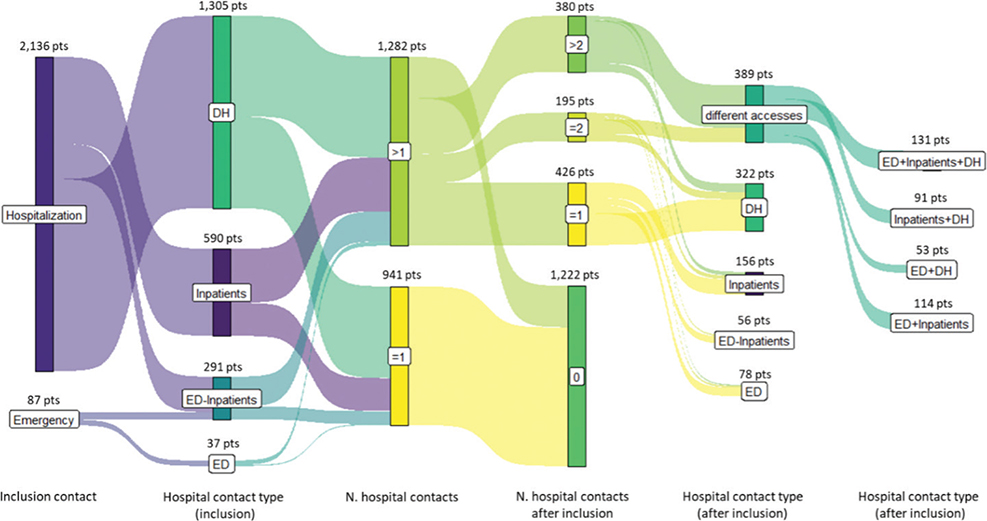
Fig. 1. Sankey diagrams illustrating the journey of psoriasis patients. Types and numbers of hospital contacts are considered to highlight different care pathways of psoriasis patients in the hospital. ED: emergency department; DH: day hospital.
DISCUSSION
This retrospective study analysed the psoriasis patient journey in a tertiary University Hospital at Fondazione Policlinico Agostino Gemelli IRCCS in Rome. Because of the introduction of the first biologic drugs for the treatment of psoriasis, in the years following 2004, the trend for hospitalizations has declined steadily in some European countries (14), while in some Asian countries no such trend has been observed (10).
In our study, we reported fewer patients admitted to the ED and to the inpatient clinic following an ED visit compared with the number of patients managed in a day hospital setting and electively admitted to an inpatient clinic during the 11-year observation (January 2012–August 2023) (Fig. S1), especially for patients affected with plaque psoriasis compared with generalized pustular and erythrodermic psoriasis patients.
Patients were admitted to the dermatology inpatient clinic in 20.9% of cases, while the majority were admitted to other departments such as rheumatology, gastroenterology, or infectious disease clinics, underlining the need for multidisciplinary management (15). The reasons for this observation are unknown; however, as 723/2,223 (32.5%) reported psoriasis not as the primary diagnosis, it could be assumed they needed to be admitted to inpatient clinics other than dermatology. Moreover 1,455/2,223 (65.5%) of patients suffered from psoriatic arthritis and this could explain the high percentage of patients (44.4%) admitted to rheumatology. A further hypothesis could be attributable to the small number of inpatient beds in the dermatology inpatient clinic department of our institution.
Raising awareness of psoriasis among specialists is of primary importance. A prompt dermatological consultation could be useful for psoriasis patients hospitalized for other medical conditions. This approach ensures comprehensive patient management to start a targeted therapy promptly when necessary. This could be especially valuable for the most vulnerable patients, who often need to consult multiple specialists when selecting a biological therapy, thereby optimizing time.
The opportunity for valid therapeutic intervention for moderate-to-severe forms of plaque psoriasis using innovative drugs such as biologics reduced hospitalization during flares and rebound, favouring domestic disease management (14). Our study highlighted an unmet need related to the management of acute flares occurring in very severe forms of psoriasis such as generalized pustular or erythrodermic psoriasis, or the management of fragile elderly patients. Fragile patients with multiple comorbidities still require a multidisciplinary approach, which might prove challenging and not feasible in an outpatient-domestic setting, as already described by Kovalchin et al. (11).
In line with the literature, in our study patients with multiple hospitalizations reported in their medical history more comorbidities compared with patients with a single hospitalization (11). The presence of comorbidities such as obesity, hypertension, and dyslipidaemia is known to be commonly associated with severe psoriasis, as well as with the patient’s age and other comorbidities, especially cardiovascular, metabolic, and psychiatric conditions such as mood and psychotic disorders (16–18). In line with previous reports, in our study, 34.6% of patients had hypertension, 15.2% were obese, and 14.7% had dyslipidaemia. We demonstrated that the impact of comorbidities associated with psoriasis is non-negligible in terms of ED admissions and increases average length of hospitalization. Psoriasis patients are more often affected by CVDs requiring hospitalization and ED admissions than non-psoriasis patients (19).
Kovalchin et al. (11) described the frequently occurring readmission of patients entering hospital in approximately one-third of cases, and often these patients presented with more comorbidities compared with patients with a single admission and a longer length of stay. In line with the literature our study revealed that 1,001/2,223 (45%) required an additional hospital admission during their time under observation, mainly in the first 12 months. Moreover, we found a correlation between the number of hospital admissions and the number of laboratory investigations. Generalized pustular and erythrodermic forms seem to be related to longer length of recovery (20). In our study population, patients affected by such variants of psoriasis accounted for 6.8% of patients (108 erythrodermic, 44 generalized pustular). This percentage represents a consistent cohort of patients who needed access to hospital, also reporting a longer length of hospitalization compared with patients affected by plaque psoriasis. These patients required a longer length of recovery, probably due to the severity of these forms of psoriasis, characterized by systemic involvement that could be life-threatening, with laboratory anomalies and a relapsing clinical course (21). Moreover, generalized pustular and erythrodermic psoriasis patients were found to be smokers in a higher percentage compared with plaque psoriasis patients (31.8%, 31.5%, and 19.9% respectively) (Table I). This, as reported in the literature, may be due to the role of smoking as a trigger for disease exacerbation (21), with the production of free radicals and high levels of IL 12 induced by nicotine (22). In addition, a dose- and duration-dependent effect was found with disease severity (23), emphasizing the need to raise patient awareness regarding smoking cessation.
Our study has some strengths that included a very large cohort of psoriasis patients and a long period of observation. Data regarding psoriasis patients’ journey in Italy are to date lacking; however, due to the high prevalence of the disease (1), it is essential that we prioritize this issue. The retrospective investigation of the different types of hospitalization highlighted the evolution in the management of psoriasis throughout the last decade. Certainly, analysis of the independent factors of hospitalization and length of stay together with adjustment for sex, age, and comorbidities could provide valuable insights for future work. Our study suggested how in the last 11 years the early identification of comorbid conditions modified patient management in our tertiary university hospital, with most patients hospitalized in day hospital settings and through scheduled inpatient admissions. By analysing the different journey of patients affected by different forms of psoriasis, our study aims to guide clinicians in the management of such complex patients.
ACKNOWLEDGEMENTS
IRB approval status: The study protocol conforms to the ethical guidelines on the 1975 Helsinki Declaration and was approved by the Ethics Committee of the Fondazione Policlinico Gemelli Hospital (Prot ID: 5784).
REFERENCES
- Parisi R, Symmons DP, Griffiths CE, Ashcroft DM. Identification and Management of Psoriasis and Associated ComorbidiTy (IMPACT) project team. Global epidemiology of psoriasis: a systematic review of incidence and prevalence. J Invest Dermatol 2013; 133: 377–385. https://doi.org/10.1038/jid.2012.339
- Vanderpuye-Orgle J, Zhao Y, Lu J, Shrestha A, Sexton A, Seabury S, et al. The economic burden of psoriasis in the United States. J Am Acad Dermatol 2015; 72: 961–7.e5. https://doi.org/10.1016/j.jaad.2015.02.1099
- Mustonen A, Leino M, Mattila K, Koulu L, Tuominen R. Treatment costs of psoriasis in a tertiary-level clinic. BMC Health Serv Res 2014; 14: 344. https://doi.org/10.1186/1472-6963-14-344
- Ion A, Dorobanțu AM, Popa LG, Mihai MM, Orzan OA. Risks of biologic therapy and the importance of multidisciplinary approach for an accurate management of patients with moderate-severe psoriasis and concomitant diseases. Biology (Basel) 2022; 11: 808. https://doi.org/10.3390/biology11060808
- Wride AM, Chen GF, Spaulding SL, Tkachenko E, Cohen JM. Biologics for psoriasis. Dermatol Clin 2024; 42: 339–355. https://doi.org/10.1016/j.det.2024.02.001
- Raho G, Koleva DM, Garattini L, Naldi L. The burden of moderate to severe psoriasis: an overview. Pharmacoeconomics 2012; 30: 1005–13. https://doi.org/10.2165/11591580-000000000-00000
- Stern RS. PUVA follow-up study. Inpatient hospital care for psoriasis: a vanishing practice in the United States. J Am Acad Dermatol 2003; 49: 445–450. https://doi.org/10.1067/S0190-9622(03)00858-2
- Feldman SR, Tian H, Gilloteau I, Mollon P, Shu M. Economic burden of comorbidities in psoriasis patients in the United States: results from a retrospective U.S. database. BMC Health Serv Res 2017; 17: 337. https://doi.org/10.1186/s12913-017-2278-0
- Rivera-Díaz R, Daudén E, Carrascosa JM, Cueva P, Puig L. Generalized pustular psoriasis: a review on clinical characteristics, diagnosis, and treatment. Dermatol Ther (Heidelb) 2023; 13: 673–688. https://doi.org/10.1007/s13555-022-00881-0
- Chaiyabutr C, Silpa-Archa N, Wongpraprarut C, Likittanasombat S, Phumariyapong P, Chularojanamontri L. An analysis of psoriasis hospitalisation in Thailand. Arch Dermatol Res 2023; 315: 779–786. https://doi.org/10.1007/s00403-022-02429-w
- Kovalchin CE, Kaffenberger J, Trinidad J, Gilkey TW, Minta A, Gudjonsson J, et al. Characterizing risk factors for hospitalization for psoriasis patients. Arch Dermatol Res 2023; 315: 1541–1546. https://doi.org/10.1007/s00403-023-02533-5
- Damiani A, Masciocchi C, Lenkowicz J, Capocchiano ND, Boldrini L, Tagliaferri L, et al. Building an artificial intelligence laboratory based on real world data: the experience of Gemelli generator. Frontiers in Computer Science 3 (2021): 768266. https://doi.org/10.3389/fcomp.2021.768266
- Armstrong AW, Read C. Pathophysiology, clinical presentation, and treatment of psoriasis: a review. JAMA 2020; 323: 1945–1960. https://doi.org/10.1001/jama.2020.4006
- Rodriguez-Jato Q, Pereira AR, Batalla A, Abalde MT, Salgado-Boquete L, Martinez-Reglero C, et al. Hospitalization in patients with psoriasis: impact of biological therapies on temporal evolution. J Drugs Dermatol 2021; 20: 208–214. https://doi.org/10.36849/JDD.4931
- Ion A, Dorobanțu AM, Popa LG, Mihai MM, Orzan OA. Risks of biologic therapy and the importance of multidisciplinary approach for an accurate management of patients with moderate-severe psoriasis and concomitant diseases. Biology (Basel) 2022; 11: 808. https://doi.org/10.3390/biology11060808
- Takeshita J, Grewal S, Langan SM, Mehta NN, Ogdie A, Van Voorhees AS, et al. Psoriasis and comorbid diseases: epidemiology. J Am Acad Dermatol 2017; 76: 377–390. https://doi.org/10.1016/j.jaad.2016.07.064
- Yu S, Wu X, Shi Z, Huynh M, Jena PK, Sheng L, et al. Diet-induced obesity exacerbates imiquimod-mediated psoriasiform dermatitis in anti-PD-1 antibody-treated mice: implications for patients being treated with checkpoint inhibitors for cancer. J Dermatol Sci 2020; 97: 194–200. https://doi.org/10.1016/j.jdermsci.2020.01.011
- Yu S, Yu CL, Huang YC, Tu HP, Lan CE. Risk of developing psoriasis in patients with schizophrenia: a nationwide retrospective cohort study. J Eur Acad Dermatol Venereol 2017; 31: 1497–1504. https://doi.org/10.1111/jdv.14303
- Feldman SR, Zhao Y, Shi L, Tran MH. Economic and comorbidity burden among patients with moderate-to-severe psoriasis. J Manag Care Spec Pharm 2015; 21: 874–888. https://doi.org/10.18553/jmcp.2015.21.10.874
- Wang Q, Jin L, Hu K, Tan M, Lu Y, Zhao Y, et al. The length of stay and inpatient burden in inpatients with different psoriasis subtypes. Int J Med Sci 2022; 19: 1519–1524. https://doi.org/10.7150/ijms.67083
- Griffiths CEM, Armstrong AW, Gudjonsson JE, Barker JNWN. Psoriasis. Lancet. 2021; 397: 1301–1315. https://doi.org/10.1016/S0140-6736(20)32549-6
- Musumeci ML, Nasca MR, Boscaglia S, Micali G. The role of lifestyle and nutrition in psoriasis: current status of knowledge and interventions. Dermatol Ther 2022; 35: e15685. https://doi.org/10.1111/dth.15685
- Armstrong AW, Harskamp CT, Dhillon JS, Armstrong EJ. Psoriasis and smoking: a systematic review and meta-analysis. Br J Dermatol 2014; 170: 304–314. https://doi.org/10.1111/bjd.12670