SHORT COMMUNICATION
Pthirus pubis Infestation of an Ear
Stefano VERALDI1* and Gianluca NAZZARO2
1Dermatological Centre in Milan, Milan, and 2Department of Pathophysiology and Transplantation, Università degli Studi, IRCCS Foundation, Ca’ Granda Ospedale Maggiore Policlinico, Milan, Italy. *E-mail: stefano.veraldi@dcim.it
Citation: Acta Derm Venereol 2025; 105: adv42571. DOI: https://doi.org/10.2340/actadv.v105.42571.
Copyright: © 2025 The Author(s). Published by MJS Publishing, on behalf of the Society for Publication of Acta Dermato-Venereologica. This is an Open Access article distributed under the terms of the Creative Commons Attribution-NonCommercial 4.0 International License (https://creativecommons.org/licenses/by-nc/4.0/).
Submitted: Nov 25, 2024. Accepted after revision: Jan 9, 2025. Published: Jan 24, 2025.
INTRODUCTION
Pthirus pubis Linnaeus, 1758 (Diptera: Anoplura), popularly known as crab louse, usually infests the pubis, groin, buttocks, intergluteal fold, and perianal region. However, it can also infest, in particular in hairy males and/or in chronic infestations, the thighs, abdomen, chest, axillae, and face. The involvement of eyelashes and eyebrows is more common in children (1,2). Involvement of the scalp is very rare (3, 4). We report a case of pthiriasis of an ear: to our knowledge, no similar cases have been published in the international literature.
CASE REPORT
A 46-year-old Caucasian man was admitted with a clinical diagnosis of chronic itching. The patient stated that he was in good general health and that he was not on therapy with systemic drugs. He also declared that he had been suffering from widespread itching for about 3 months. He had been unsuccessfully treated at other centres with topical corticosteroids and oral antihistamines.
Dermatological examination revealed the presence of several widespread scratch marks. Furthermore, tens of specimens of Pthirus pubis were located on the pubis, abdomen, chest, and axillae. No other areas, such as the scalp, face, and buttocks, were involved. However, the patient stated that a bothersome itching was present in his right external auditory canal. Otoscopy revealed the presence of two pubic lice (Figs 1–2). The same diagnostic method was negative at the left external auditory canal. Otorhinolaryngological examination revealed no hearing abnormalities. Laboratory examinations were within normal ranges. Bacteriological culture of the skin was negative.
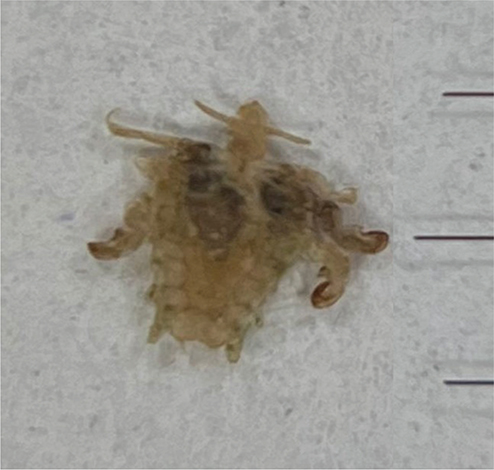
Fig. 1. Female of Pthirus pubis (dermoscopy image, Heine Delta20 plus).

Fig. 2. Hypertrichosis of the concha of the patient.
The patient was successfully treated with a foam containing 0.165% pyrethrins and 1.65% piperonyl butoxide (1 application/day for 2 consecutive days), and hydroxyzine (25 mg/day for 2 weeks). The treatment with the foam was repeated 7 days later. Follow up (4 months) was negative.
DISCUSSION
In 1983, Mahzoon et al. (5) published the case of a 33-year-old woman with elephantiasis of the ears associated with chronic pediculosis capitis. In 2017, other Indian authors reported a 44-year-old woman with massive lice involvement of her right external auditory canal. However, in this case, the authors did not specify if the causative agents were head or pubic lice (6). In our patient, it is possible that the involvement of the ear was caused by the long duration of the infestation (3 months), the wrong therapy (topical corticosteroids and oral antihistamines), and the presence of hypertrichosis at the concha of the auricle (Fig. 2). As previously mentioned, we have not found similar cases in the literature.
REFERENCES
- Veraldi S, Nazzaro G. A cystic-like lesion on an eyelash: a quiz. Acta Derm Venereol 2019; 99: 1061–1062. https://doi.org/10.2340/00015555-3255
- Veraldi S, Nazzaro G, Esposito L, Genovese G, Pontini P, Gelmetti C. Pthiriasis of the eyelashes. G Ital Dermatol Venereol 2020; 155: 198–201. https://doi.org/10.23736/S0392-0488.19.06350-8
- Veraldi S, Pontini P, Nazzaro G. Phthirus pubis infestation of the scalp: a case report and review of the literature. Korean J Parasitol 2018; 56: 487–489. https://doi.org/10.3347/kjp.2018.56.5.487
- Veraldi S, Scanni G, Nazzaro G. “Eczema” of the nape: a marker of pthiriasis capitis. Parasitol Int 2020; 75: 102026. https://doi.org/10.1016/j.parint.2019.102026
- Mahzoon S, Azadeh B. Elephantiasis of external ears: a rare manifestation of pediculosis capitis. Acta Derm Venereol 1983; 63: 363–365. https://doi.org/10.2340/0001555563363365
- Gupta V, Singh J, Singh Yadav S, Sahana P. Primary pediculosis ear: a case report. Indian J Clin Exp Dermatol 2017; 3: 132–133.