ORIGINAL REPORT
Rates of Infections, Malignancies, Cardiovascular Outcomes, and Death in Individuals with Hospital-treated Alopecia Areata: A Registry-based Cohort Study in Denmark
Sissel Brandt Toft SØRENSEN1, Prethibha GEORGE2*, Oladayo JAGUN2*, Robert WOLK3, Lynne NAPATALUNG2,4, Samuel H. ZWILLICH3*, Lars IVERSEN5 and Vera EHRENSTEIN6
1Department of Rheumatology, Aarhus University Hospital, Aarhus, Denmark, 2Pfizer Inc, New York, NY, USA, 3Pfizer Inc, Groton, CT, USA, 4Department of Dermatology, Icahn School of Medicine at Mount Sinai, New York, NY, USA, 5Department of Dermatology, Aarhus University Hospital and Aarhus University, Aarhus N, Denmark, and 6Department of Clinical Epidemiology and Department of Clinical Medicine, Aarhus University and Aarhus University Hospital, Aarhus, Denmark
* Affiliation at the time of the study.
The emergence of new systemic treatments for alopecia areata underscores the importance of estimating rates of potential treatment safety events among individuals with alopecia areata. In this population-based cohort study, data linked across Danish population-based registries were used to examine the rates of the following safety events of interest before approval of Janus kinase inhibitor treatments by the European Medicines Agency: serious infections, herpes zoster infections, malignancies, arterial and venous cardiovascular events, and all-cause death in an alopecia areata cohort, defined as individuals ≥ 12 years old with hospital-treated alopecia areata, including its sub-types alopecia totalis and alopecia universalis. Incidence rates of the safety events of interest were computed and their associations with alopecia areata were estimated as standardized incidence ratios computed with regard to the age- and sex-matched general Danish population. The alopecia areata cohort included 2,778 individuals (472 with alopecia totalis/alopecia universalis) with a first-recorded diagnosis of alopecia areata in 1995–2016, followed through to the end of 2016, during a hospital admission or treatment at an outpatient clinic. Hospital-treated alopecia areata was associated with serious infections (standardized incidence ratio [95% confidence interval], 1.89 [1.72–2.06]), herpes zoster infections (1.83 [1.63–2.05]), lymphoma (3.44 [1.88–5.77]), arterial and venous cardiovascular outcomes (1.41 [1.12–1.75]), and death (1.16 [1.00–1.34]).
SIGNIFICANCE
Alopecia areata is an autoimmune disease manifesting as partial or complete hair loss. As new systemic alopecia areata treatments become available, contextualizing the rates of treatment safety events of interest that may be associated with alopecia areata is important for assessing the benefit/risk profiles of these treatments. This nationwide cohort study provides estimates of the incidence rates of infections, malignancies, arterial and venous cardiovascular events, and all-cause mortality among individuals with hospital-treated alopecia areata in Denmark before the introduction of new systemic treatments in the population.
Key words: alopecia areata; cardiovascular; cohort study; Denmark; infections; neoplasms.
Citation: Acta Derm Venereol 2025; 105: adv42646. DOI: https://doi.org/10.2340/actadv.v105.42646.
Copyright: © 2025 The Author(s). Published by MJS Publishing, on behalf of the Society for Publication of Acta Dermato-Venereologica. This is an Open Access article distributed under the terms of the Creative Commons Attribution-NonCommercial 4.0 International License (https://creativecommons.org/licenses/by-nc/4.0/).
Submitted: Dec 4, 2024. Accepted after revision: Apr 8, 2025. Published: May 15, 2025
Corr: Professor Vera Ehrenstein, MPH, DSc, Department of Clinical Medicine and Department of Clinical Epidemiology, Center for Population Medicine, Aarhus University, Olof Palmes Allé 43-45, DK-8200 Aarhus N, Denmark. E-mail: ve@clin.au.dk
Competing interests and funding: SBTS, LI, and VE are salaried employees of their respective institutions. LI is also an employee at MC2 Therapeutics A/S. PG, OJ, and SZ were employees of Pfizer Inc at the time of this study and may hold stock or stock options in Pfizer Inc. RW and LN are employees of and may hold stock or stock options in Pfizer Inc.
Pfizer sponsored this study via institutional research collaboration with Aarhus University, which administered the study.
INTRODUCTION
Alopecia areata (AA), an autoimmune disease, manifests as non-scarring hair loss. Hair loss may range from patches to complete scalp hair loss (alopecia totalis [AT]) to complete scalp, face, and body hair loss (alopecia universalis [AU]) (1). AA accounts for approximately 18% of non-scarring alopecia types (2). AA negatively affects many aspects of life, including personal relationships, education, and career choices (3). Beyond family history, few risk factors are known for AA, but individuals with AA have a higher prevalence of vitamin D deficiency, thyroid disorders, and other autoimmune diseases than the general population (4).
To date, 2 systemic treatments for AA have been approved by the European Medicines Agency: baricitinib and ritlecitinib. Baricitinib is a Janus kinase (JAK) 1/2 inhibitor approved in 2022 for adults (5), and ritlecitinib is a JAK3/TEC family kinase inhibitor approved in 2023 for patients aged ≥ 12 years (6). Both agents are indicated for severe AA, and current evidence, primarily from randomized clinical trials, indicates their favorable safety profiles in AA (7–10). Other systemic treatments for AA currently under investigation include JAK inhibitors and monoclonal antibodies (11).
In indications other than AA, JAK inhibition has been associated with elevated risks of infections, malignancy, and cardiovascular (CV) outcomes (12–14). Current epidemiological evidence regarding the occurrence of these outcomes among individuals with AA is limited (15). Estimating country- and database-specific rates of potential treatment-associated safety events in population-based cohorts of individuals with AA before treatment availability is important to contextualize the safety profiles of new and emerging AA treatments during the post-marketing monitoring of long-term safety of these agents.
The aims of this study were to estimate the incidence rates (IRs) of potential safety events associated with JAK inhibitor treatment in individuals with AA before the approval of the JAK inhibitor treatments for AA indications and to compare the observed rates with those expected in the general population. These aims were addressed in a cohort of hospital-treated individuals with AA identified from routinely collected data in Danish nationwide population-based health registries.
METHODS
Setting, design, and data sources
The population, design, and setting of this study have been described previously (16). Briefly, this cohort study was conducted in Denmark, a country with universal, tax-funded healthcare (17); major health events and services are routinely recorded in population-based registries, including complete follow-up for migration and death. Data were linked across the Danish Civil Registration System (containing identifiers for linkage, and dates of birth, death, and migration [18]), the Danish National Patient Registry (containing administrative data on diagnoses from all Danish hospitalizations [since 1977] and outpatient specialist clinic visits [since 1995] [19]), the Danish Cancer Registry (containing data on incident primary malignancies, with mandatory reporting since 1987 [20]), the Danish Cause of Death Registry (21), and the Danish National Health Services Prescription Database (records the dispensing of reimbursed prescription drugs at community pharmacies since 2004 [22]).
The alopecia areata cohort
The AA cohort included individuals who (i) were registered in the Danish National Patient Registry with a first-recorded hospital inpatient or outpatient clinic diagnosis of AA between 1995 and 2016; (ii) were residents of Denmark at any time between 1995 and 2016; (iii) were ≥ 12 years of age at the first-recorded hospital AA diagnosis; and (iv) had resided in Denmark without interruption in the 12 months before the cohort entry date. The cohort entry date was the date of the first-recorded hospital AA diagnosis. The age restriction was applied to focus on the patient populations included in studies of novel systemic treatments (23). AA and its subtypes were defined according to the International Classification of Diseases, 10th Revision (ICD-10) codes recorded on the AA cohort entry date (Table SI). Individuals with codes qualifying for more than 1 AA subtype were classified as having AT/AU AA if they had the respective code and were otherwise classified as having non-AT/AU AA. Individuals with other alopecia aetiologies (e.g., traction and scarring alopecia, other non-scarring hair loss, or cicatricial alopecia [scarring hair loss]) were excluded. Individuals with a hospital diagnosis of AA before 1995 and since the start of the record, in 1977, were excluded from the AA cohort and computations of IRs.
Alopecia areata cohort characteristics and potential safety outcomes of interest
Demographic and clinical characteristics were reported as of the cohort entry date and were measured using the maximum available time period in each database: since 1977 for diagnoses and since 2004 for medications. The safety events of interest were infections (serious infections or herpes zoster [HZ] infections), malignancy (any primary malignancy except nonmelanoma skin cancer [NMSC], NMSC [basal cell carcinoma (BCC) and squamous cell carcinoma (SCC)], cervical carcinoma in situ, malignant melanoma, lymphoma, or female breast cancer), CV outcomes (major adverse cardiovascular events [MACE], venous thromboembolism [deep vein thrombosis and/or pulmonary embolism], or arterial thromboembolism [ATE]), and all-cause death. Serious infections were defined as diagnosis codes recorded in the primary position during a hospitalization with at least 1 overnight stay (24). MACE was defined as a composite outcome of CV death, acute myocardial infarction (MI), unstable angina, any stroke, hospitalization due to heart failure, or coronary revascularization (percutaneous intervention [PCI] or coronary artery bypass grafting [CABG]) (25). For a given potential safety event of interest, we excluded individuals with any recordings of the respective condition that occurred before the cohort entry date and since the record start, in 1977. For a full list of codes used to identify cohort characteristics and safety outcomes of interest see Table SII.
Statistical analysis
Follow-up started on the date of cohort entry and ended on the earliest of the date of a given safety event of interest, death (for non-fatal endpoints), emigration, or administrative censoring by the end of data, on December 31, 2016. For CV death and the MACE endpoints, the administrative censoring date was December 31, 2011, as this was the date to which cause of death data were updated at the time of analysis. The IR per 1,000 person-years (PY) of each safety event of interest was calculated by dividing the total number of incident events observed in the study cohort during follow-up by the total person-time at risk accrued during follow-up.
We used standardized incidence ratios (SIRs) as an estimate of risk ratios to estimate the association of AA with each safety event of interest. SIRs were computed by indirect standardization as the ratios of observed to expected events for each outcome (26). The expected number of each safety outcome of interest in the general Danish population was based on diagnoses recorded in the Danish National Patient Registry, by sex and age in 5-year intervals, and by calendar year of diagnosis in 1-year intervals.
The IRs and SIRs were reported with 95% confidence intervals (CIs) and were stratified by AA subtype (AT/AU and non-AT/AU AA).
In compliance with the Danish data protection regulations, to avoid identification of individuals, cell counts between 1 and 4 were masked by replacement of the relevant entries with “< 5” or “masked”. Masking was also implemented if counts between 1 and 4 could be recomputed from the surrounding data.
This study was registered with the Danish Data Protection Agency via Aarhus University (nr. 2016-051-000001/605).
RESULTS
Alopecia areata cohort characteristics
Between 1995 and 2016, 2,778 patients were eligible for inclusion in the AA cohort (Fig. 1). The cohort consisted of 472 individuals (17%) with AT/AU and 2,306 individuals (83%) with non-AT/AU AA. The median age at cohort entry date was 39 years, and 63% of the cohort was female. No appreciable differences in the prevalence of comorbidities or prior medication use were observed according to AA subtype (Table I).
| All AA (n = 2,778) | AT/AU (n = 472) | Non-AT/AU (n = 2,306) | |
| Calendar period of diagnosis, n (%) | |||
| 1995–1999 | 463 (16.7) | 96 (20.3) | 367 (15.9) |
| 2000–2004 | 492 (17.7) | 93 (19.7) | 399 (17.3) |
| 2005–2009 | 601 (21.6) | 111 (23.5) | 490 (21.2) |
| 2010–2014 | 845 (30.4) | 125 (26.5) | 720 (31.2) |
| 2015–2016 | 377 (15.6) | 47 (10.0) | 330 (14.3) |
| Sex, n (%) | |||
| Female | 1,753 (63.1) | 271 (57.4) | 1482 (64.3) |
| Male | 1,025 (36.9) | 201 (42.6) | 824 (35.7) |
| Age at first-recorded hospital diagnosis, years | |||
| Median (IQR) | 39 (27, 52) | 42 (28, 56) | 39 (27, 51) |
| Age at first-recorded hospital diagnosis, n (%) | |||
| 12–17 years | 302 (10.9) | 46 (9.7) | 256 (11.1) |
| 18–50 years | 1,679 (60.4) | 261 (55.3) | 1418 (61.5) |
| > 50 years | 797 (28.7) | 165 (35.0) | 632 (27.4) |
| Comorbidities (prevalent conditions that may pre-dispose to key safety events), n (%) | |||
| Autoimmune thyroiditis | 18 (0.7) | < 5 | Masked |
| Atopic dermatitis | 142 (5.1) | 26 (5.5) | 116 (5.0) |
| Systemic lupus erythematosus | 36 (1.3) | 0 | 36 (1.6) |
| Psoriasis | 66 (2.4) | 9 (1.9) | 57 (2.5) |
| Vitiligo | 44 (1.6) | 7 (1.5) | 37 (1.6) |
| Rheumatoid arthritis | 41 (1.5) | 11 (2.3) | 30 (1.3) |
| Coeliac disease | 13 (0.5) | < 5 | Masked |
| Ulcerative colitis | 48 (1.7) | 7 (1.5) | 41 (1.8) |
| Crohn’s disease | 37 (1.3) | < 5 | Masked |
| Psoriatic arthritis | 10 (0.4) | < 5 | Masked |
| Asthma | 189 (6.8) | 31 (6.6) | 158 (6.8) |
| Multiple sclerosis | 9 (0.3) | < 5 | Masked |
| Chronic obstructive pulmonary disease | 54 (1.9) | 10 (2.1) | 44 (1.9) |
| Diabetes (type 1 and type 2) | 108 (3.9) | 16 (3.4) | 92 (4.0) |
| Hearing loss (at hospital encounter) | 88 (3.2) | 25 (5.3) | 63 (2.7) |
| Hyperlipidaemia | 46 (1.7) | < 5 | Masked |
| Hypertension | 156 (5.6) | 21 (4.4) | 135 (5.9) |
| Pregnancy | 544 (19.6) | 82 (17.4) | 462 (20.0) |
| Substance use | 68 (2.4) | 11 (2.3) | 57 (2.5) |
| Any cancer (except basal cell carcinoma/squamous cell carcinoma) | 140 (5.0) | 29 (6.1) | 111 (4.8) |
| Basal cell carcinoma | 38 (1.4) | < 5 | Masked |
| Squamous cell carcinoma | 41 (1.5) | < 5 | Masked |
| Malignant melanoma | 10 (0.4) | < 5 | Masked |
| Lymphoma | 10 (0.4) | < 5 | Masked |
| Breast cancer | 47 (1.7) | 11 (2.3) | 36 (1.6) |
| Cervical carcinoma in situ | 16 (0.6) | < 5 | Masked |
| Acute myocardial infarction | 24 (0.9) | < 5 | Masked |
| Any ischaemic heart disease | 70 (2.5) | 12 (2.5) | 58 (2.5) |
| Haemorrhagic stroke | 7 (0.3) | 0 (0.0) | 7 (0.3) |
| Ischaemic stroke | 30 (1.1) | 8 (1.7) | 22 (1.0) |
| Hospitalization due to heart failure | 31 (1.1) | < 5 | Masked |
| Unstable angina | 6 (0.2) | 0 (0.0) | 6 (0.3) |
| Deep vein thrombosis, pulmonary embolism, or arterial thromboembolism | 43 (1.5) | < 5 | Masked |
| Medication use, n (%) | |||
| Antidiabetic agents | 91 (3.3) | 12 (2.5) | 79 (3.4) |
| Antihypertensive agents | 474 (17.1) | 87 (18.4) | 387 (16.8) |
| Drugs used in dermatology | 31 (1.1) | < 5 | Masked |
| Hormone replacement therapy | 97 (3.5) | 13 (2.8) | 84 (3.6) |
| Immunosuppressants | 121 (4.4) | 15 (3.2) | 106 (4.6) |
| Janus kinase inhibitors (any indication) | < 5 | < 5 | 0 (0.0) |
| Lipid-modifying agents | 166 (6.0) | 19 (4.0) | 147 (6.4) |
| Systemic steroids | 408 (14.7) | 64 (13.6) | 344 (14.9) |
| a In compliance with the Danish data protection regulations for preventing identification of individuals, cell counts between 1 and 4 were masked by replacing relevant entries with “< 5” or “masked”. Masking was also implemented for counts between 1 and 4 that could be recomputed from the surrounding data. AT: alopecia totalis; AU: alopecia universalis. |
|||
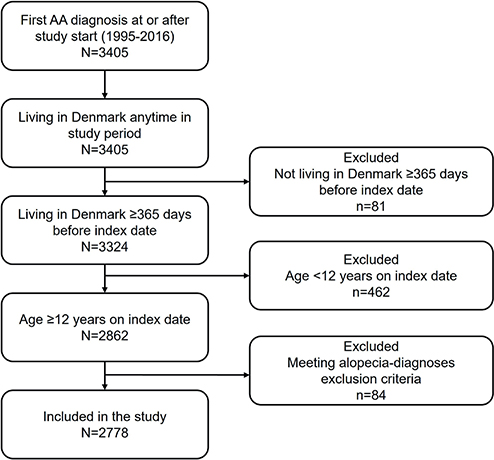
Fig. 1. Identification of the cohort with incident alopecia areata (AA), 1995–2016.
IRs and SIRs for the safety events of interest
Infections. The IRs (95% CI) per 1,000 PY for serious infections and HZ infections were 22.1 (20.2–24.2) and 13.2 (11.7–14.8), respectively, and were higher for the AT/AU than the non-AT/AU subtype (Table II). The SIRs (95% CI) in the AA cohort, compared with the general population of the same sex and similar age, were 1.89 (1.72–2.06) for serious infections and 1.83 (1.63–2.05) for HZ infections (Fig. 2A and Table II).
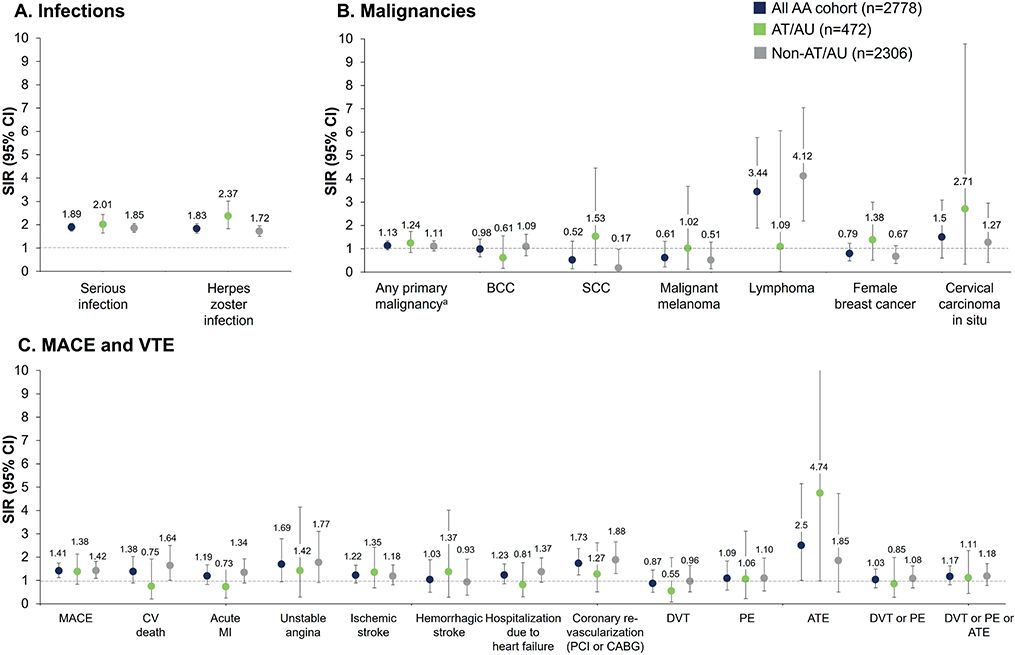
Fig. 2. Standardized incidence ratios (SIRs) for (A) infections, (B) malignancies, and (C) cardiovascular outcomes. AA: alopecia areata; AT: alopecia totalis; ATE: arterial thromboembolism; AU: alopecia universalis; BCC: basal cell carcinoma; CABG: coronary artery bypass grafting; CV: cardiovascular; DVT: deep vein thrombosis; MACE: major adverse cardiovascular events; MI: myocardial infarction; PCI: percutaneous coronary intervention; PE: pulmonary embolism; SCC: squamous cell carcinoma; VTE: venous thromboembolic event. aExcluding non-melanoma skin cancer.
Malignancies. The IRs (95% CI) per 1,000 PY for any primary malignancy except NMSC and for breast cancer were 5.9 (4.9–7.0) and 1.4 (0.8–2.1), respectively, and were higher for the AT/AU than the non-AT/AU AA subtype (Table III). The SIRs (95% CI) in the AA cohort compared with the general population were 1.13 (0.95–1.34) for any primary malignancy excluding NMSC, 3.44 (1.88–5.77) for lymphoma, 1.50 (0.60–3.09) for cervical carcinoma in situ, 0.52 (0.14–1.33) for SCC, and 0.61 (0.22–1.32) for malignant melanoma (Fig. 2B and Table III). The SIR for SCC was 1.53 (0.31–4.46) for the AT/AU subtype but 0.17 (0.00–0.97) for the non-AT/AU subtype.
| Event | Individuals | Observed | Person-years | IR (95% CI) per 1,000 person-years | Expected | SIR (observed/expected) (95% CI) |
| Primary malignancy (excluding nonmelanoma skin cancer) | ||||||
| Any AA | 2,639 | 134 | 22,808 | 5.88 (4.92–6.96) | 118 | 1.13 (0.95–1.34) |
| AT/AU | 443 | 32 | 4,249 | 7.53 (5.15–10.63) | 26 | 1.24 (0.84–1.74) |
| Non-AT/AU | 2,196 | 102 | 18,558 | 5.50 (4.48–6.67) | 92 | 1.11 (0.90–1.34) |
| Basal cell carcinoma | ||||||
| Any AA | 2,745 | 28 | 23,924 | 1.17 (0.78–1.69) | 29 | 0.98 (0.65–1.41) |
| AT/AU | 468 | Masked | Masked | 0.89 (0.24–2.29) | Masked | 0.61 (0.16–1.55) |
| Non-AT/AU | 2,277 | Masked | Masked | 1.23 (0.79–1.84) | Masked | 1.09 (0.70–1.62) |
| Squamous cell carcinoma | ||||||
| Any AA | 2,778 | Masked | Masked | 0.16 (0.04–0.42) | Masked | 0.52 (0.14–1.33) |
| AT/AU | 472 | Masked | Masked | 0.66 (0.14–1.94) | Masked | 1.53 (0.31–4.46) |
| Non-AT/AU | 2,306 | Masked | Masked | 0.05 (0.00–0.28) | Masked | 0.17 (0.00–0.97) |
| Malignant melanoma | ||||||
| Any AA | 2,768 | Masked | Masked | 0.25 (0.09–0.54) | Masked | 0.61 (0.22–1.32) |
| AT/AU | 469 | Masked | Masked | 0.44 (0.05–1.60) | Masked | 1.02 (0.12–3.68) |
| Non-AT/AU | 2,299 | Masked | Masked | 0.20 (0.06–0.52) | Masked | 0.51 (0.14–1.29) |
| Lymphoma | ||||||
| Any AA | 2,771 | 14 | 24,158 | 0.58 (0.32–0.97) | 4 | 3.44 (1.88–5.77) |
| AT/AU | 471 | Masked | Masked | 0.22 (0.01–1.23) | Masked | 1.09 (0.03–6.06) |
| Non-AT/AU | 2,300 | Masked | Masked | 0.66 (0.35–1.13) | Masked | 4.12 (2.19–7.05) |
| Female breast cancer | ||||||
| Any AA | 1,708 | 20 | 14,689 | 1.36 (0.83–2.10) | 25 | 0.79 (0.48–1.23) |
| AT/AU | 261 | Masked | Masked | 2.52 (0.92–5.47) | Masked | 1.38 (0.50–3.00) |
| Non-AT/AU | 1,447 | Masked | Masked | 1.14 (0.62–1.91) | Masked | 0.67 (0.37–1.13) |
| Cervical carcinoma in situ | ||||||
| Any AA | 1,737 | Masked | Masked | 0.47 (0.19–0.97) | Masked | 1.50 (0.60–3.09) |
| AT/AU | 267 | Masked | Masked | 0.83 (0.10–3.01) | Masked | 2.71 (0.33–9.79) |
| Non-AT/AU | 1,470 | Masked | Masked | 0.40 (0.13–0.94) | Masked | 1.27 (0.41–2.96) |
| a In compliance with the Danish data protection regulations for preventing identification of individuals, cell counts between 1 and 4 were masked by replacing relevant entries with “< 5” or “masked”. Masking was also implemented for counts between 1 and 4 that could be recomputed from surrounding data. AT: alopecia totalis; AU: alopecia universalis; CI: confidence interval; IR: incidence rate; SIR: standardized incidence ratio. |
||||||
Arterial and venous cardiovascular outcomes and all-cause death. The IR (95% CI) per 1,000 PY for MACE was 6.4 (5.1–7.9), and the IRs for the MACE components ranged from 0.41 to 1.84 per 1000 PY. The IRs for DVT, PE, and ATE were 0.6 (0.3–1.0), 0.6 (0.4–1.0), and 0.3 (0.1–0.6), respectively. The SIRs (95% CI) in the overall AA cohort compared with the general population were 1.41 (1.12–1.75) for MACE, 1.73 (1.23–2.37) for coronary revascularization (PCI or CABG), and 2.50 (1.00–5.15) for ATE (Fig. 2C and Table IV). The IR (95% CI) per 1,000 PY for all-cause death was 7.3 (6.3–8.5) in the AA cohort, 11.0 (8.2–14.5) in the AT/AU cohort, and 6.5 (5.4–7.7) in the non-AT/AU cohort (Table IV). The SIR (95% CI) for all-cause death compared with the general population was 1.16 (1.00–1.34) in the AA cohort.
| Event | Individuals | Observed | Person-years | IR (95% CI) per 1,000 person-years | Expected | SIR (observed/expected) (95% CI) |
| MACE | ||||||
| Any AA | 1,808 | 83 | 13,055 | 6.36 (5.06–7.88) | 59 | 1.41 (1.12–1.75) |
| AT/AU | 341 | 20 | 2,514 | 7.96 (4.86–12.29) | 15 | 1.38 (0.84–2.13) |
| Non-AT/AU | 1,467 | 63 | 10,541 | 5.98 (4.59–7.65) | 44 | 1.42 (1.09–1.82) |
| Cardiovascular death | ||||||
| Any AA | 1,860 | 25 | 13,615 | 1.84 (1.19–2.71) | 18 | 1.38 (0.89–2.03) |
| AT/AU | 352 | Masked | Masked | 1.49 (0.41–3.82) | Masked | 0.75 (0.20–1.92) |
| Non-AT/AU | 1,508 | Masked | Masked | 1.92 (1.19–2.94) | Masked | 1.64 (1.01–2.50) |
| Acute MI | ||||||
| Any AA | 2,759 | 33 | 23,999 | 1.38 (0.95–1.93) | 28 | 1.19 (0.82–1.67) |
| AT/AU | 469 | Masked | Masked | 1.12 (0.36–2.61) | Masked | 0.73 (0.24–1.70) |
| Non-AT/AU | 2,290 | Masked | Masked | 1.43 (0.95–2.07) | Masked | 1.34 (0.89–1.93) |
| Unstable angina | ||||||
| Any AA | 2,774 | 15 | 24,207 | 0.62 (0.35–1.02) | 9 | 1.69 (0.94–2.79) |
| AT/AU | 472 | Masked | Masked | 0.66 (0.14–1.93) | Masked | 1.42 (0.29–4.15) |
| Non-AT/AU | 2,302 | Masked | Masked | 0.61 (0.32–1.07) | Masked | 1.77 (0.91–3.10) |
| Ischaemic stroke | ||||||
| Any AA | 2,752 | 43 | 23,921 | 1.80 (1.30–2.42) | 35 | 1.22 (0.89–1.65) |
| AT/AU | 464 | 11 | 4,378 | 2.51 (1.25–4.50) | 8 | 1.35 (0.68–2.42) |
| Non-AT/AU | 2,288 | 32 | 19,543 | 1.64 (1.12–2.31) | 27 | 1.18 (0.81–1.67) |
| Haemorrhagic stroke | ||||||
| Any AA | 2,771 | 10 | 24,208 | 0.41 (0.20–0.76) | 10 | 1.03 (0.49–1.89) |
| AT/AU | 472 | Masked | Masked | 0.66 (0.14–1.93) | Masked | 1.37 (0.28–4.01) |
| Non-AT/AU | 2,299 | Masked | Masked | 0.36 (0.14–0.73) | Masked | 0.93 (0.37–1.91) |
| Hospitalization for heart failure | ||||||
| Any AA | 2,755 | 35 | 24,036 | 1.46 (1.01–2.03) | 29 | 1.23 (0.85–1.71) |
| AT/AU | 470 | 6 | 4,499 | 1.33 (0.49–2.90) | 7 | 0.81 (0.30–1.76) |
| Non-AT/AU | 2,285 | 29 | 19,537 | 1.33 (0.49–2.90) | 21 | 1.37 (0.92–1.97) |
| Coronary revascularization with PCI or CABG | ||||||
| Any AA | 2,764 | 39 | 23,959 | 1.63 (1.16–2.23) | 23 | 1.73 (1.23–2.37) |
| AT/AU | 472 | 7 | 4,465 | 1.57 (0.63–3.23) | 6 | 1.27 (0.51–2.62) |
| Non-AT/AU | 2,292 | Masked | Masked | 1.64 (1.12–2.32) | Masked | 1.88 (1.29–2.66) |
| DVT | ||||||
| Any AA | 2,751 | 15 | 24,113 | 0.62 (0.35–1.03) | 17 | 0.87 (0.49–1.44) |
| AT/AU | 472 | Masked | Masked | 0.44 (0.05–1.59) | Masked | 0.55 (0.07–1.98) |
| Non-AT/AU | 2,279 | Masked | Masked | 0.66 (0.35–1.14) | Masked | 0.96 (0.51–1.64) |
| PE | ||||||
| Any AA | 2,769 | 14 | 24,199 | 0.58 (0.32–0.97) | 13 | 1.09 (0.59–1.83) |
| AT/AU | 471 | Masked | Masked | 0.66 (0.14–1.93) | Masked | 1.06 (0.22–3.11) |
| Non-AT/AU | 2,298 | Masked | Masked | 0.56 (0.28–1.00) | Masked | 1.10 (0.55–1.96) |
| ATE | ||||||
| Any AA | 2,771 | Masked | Masked | 0.29 (0.12–0.60) | Masked | 2.50 (1.00–5.15) |
| AT/AU | 470 | Masked | Masked | 0.67 (0.14–1.94) | Masked | 4.74 (0.98–13.9) |
| Non-AT/AU | 2,301 | Masked | Masked | 0.20 (0.06–0.52) | Masked | 1.85 (0.50–4.73) |
| DVT or PE | ||||||
| Any AA | 2,745 | 28 | 24,024 | 1.17 (0.77–1.68) | 27 | 1.03 (0.68–1.49) |
| AT/AU | 471 | Masked | Masked | 1.10 (0.36–2.57) | Masked | 0.85 (0.28–1.98) |
| Non-AT/AU | 2,274 | Masked | Masked | 1.18 (0.75–1.77) | Masked | 1.08 (0.68–1.62) |
| DVT, PE, or ATE | ||||||
| Any AA | 2,735 | 34 | 23,911 | 1.42 (0.98–1.99) | 29 | 1.17 (0.81–1.63) |
| AT/AU | 468 | Masked | Masked | 1.56 (0.63–3.21) | Masked | 1.11 (0.44–2.28) |
| Non-AT/AU | 2,267 | 27 | 19,413 | 1.39 (0.92–2.02) | 23 | 1.18 (0.78–1.72) |
| All-cause death | ||||||
| Any AA | 2,778 | 178 | 24,309 | 7.32 (6.29–8.48) | 153 | 1.16 (1.00–1.34) |
| AT/AU | 472 | 50 | 4,542 | 11.0 (8.17–14.5) | 39 | 1.30 (0.96–1.71) |
| Non-AT/AU | 2,306 | 128 | 19,766 | 6.48 (5.40–7.70) | 115 | 1.12 (0.93–1.33) |
| a In compliance with the Danish data protection regulations for preventing identification of individuals, cell counts between 1 and 4 were masked by replacing relevant entries with “< 5” or “masked”. Masking was also implemented for counts that could be recomputed from surrounding data. AT: alopecia totalis; ATE: arterial thromboembolism; AU: alopecia universalis; CABG: coronary artery bypass grafting; CI: confidence interval: DVT: deep vein thrombosis; MACE: major adverse cardiovascular events; MI: myocardial infarction; PE: pulmonary embolism; PCI: percutaneous coronary intervention. |
||||||
Though many event counts had to be masked for reporting, the inferential results – rates and SIRs – are based on the observed event counts.
DISCUSSION
This cohort study of 2,778 individuals with a first-time hospital diagnosis of AA in Denmark provides estimates of the IRs of selected safety events of interest potentially associated with systemic AA treatment before the introduction of new systemic treatments. IRs of all safety events of interest were generally low. Compared with the general population, individuals with hospital-treated AA had higher risks of serious and HZ infections, lymphoma, MACE, and all-cause death, with SIRs ranging between 1.2 and 3.4. Our findings can help in the interpretation of potential signals from spontaneous reports and post-marketing monitoring of the safety of newer agents.
Prior safety studies for the 2 currently EMA-approved systemic AA treatments were conducted in clinical trial populations generally similar to the population in the current study, with some exceptions (7, 8). In the clinical trial populations, participants had ≥ 50% scalp hair loss (≥ 25% in 1 of 4 studies in the ritlecitinib analysis). The integrated safety analysis of ritlecitinib trials excluded participants with present/past malignancies, and approximately 44% of participants had AT/AU, compared with approximately 17% in the current study; the integrated safety analysis of baricitinib trials excluded participants with any history of VTE or cardiovascular disease.
The observed associations can be better understood in the context of various reported mechanisms, as AA is associated with other autoimmune diseases (4). Systemic inflammatory markers in the blood, including interleukin-6and C-reactive protein, are elevated in patients with AA (27), underscoring the link between AA and inflammatory comorbidities. Further evidence of systemic inflammation in AA has been reported in studies examining marks of inflammation and cardiovascular risk in the blood and serum. Individuals with AA, compared with healthy individuals, have differential expression of innate immunity, Th1, Th2, Th17, and cardiovascular-risk/atherosclerosis-related proteins, thus suggesting systemic immune, cardiovascular, and atherosclerosis biomarker dysregulation in AA (4, 28). These findings highlight the potential shared mechanisms between AA and some of its comorbidities.
Our findings contribute further data to existing literature regarding the occurrence of selected potential treatment-related safety events in individuals with AA. In our Danish AA cohort, the rates of serious infections were consistent with those reported and similarly defined in a US claims-based cohort study in individuals with AA, whereas the rate of HZ in our study was higher than that in the US study (29). In contrast to our findings, AA was not associated with infections in the US data; this difference might potentially be attributable to the lack of restriction of the US study population to individuals with hospital-treated AA and to the US AA cohort requiring 2 AA diagnosis codes. The rate of any primary malignancy in the present study was lower than that in the US claims-based AA cohort, thus potentially reflecting differences in the underlying populations or that malignancies in the Danish AA cohort were sourced from confirmed diagnosis from the Danish Cancer Registry (20). AT/AU was associated with a high-er SIR for SCC than non-AT/AU AA. The higher risk for those with AT/AU might potentially be attributable to sun exposure on skin areas usually protected by hair; however, in this study, the locations of any SCCs were unknown. The association between AA and lymphoma risk observed in this study was consistent with findings in the USA and in Taiwan (29, 30). AA was associated with a lower risk of malignant melanoma than observed in the general population, in agreement with most (30–32) but not all (29) previously reported evidence. The elevated SIRs observed for AT/AU in relation to cervical carcinoma in situ are based on a small number of cases within the AT/AU population. Larger studies showed either a null or inverse association between any AA and cervical cancer (30, 33), potentially suggesting that the current (imprecise) estimate may have arisen by chance.
Our findings in relation to CV outcomes were broadly consistent with those from an earlier US claims-based study (34) and an analysis from Taiwan (15). The rates of MACE (and most MACE components) were lower in the present study than previously reported in the US; however, in contrast to two US-claims based studies, AA was associated with most MACE components (29, 35) This difference might be due to the use of propensity score matching in the US study, whereas the current study controlled for confounding by only age, sex, and calendar year. Furthermore, the use of composite MACE outcomes has been criticized for potentially masking associations (4). The rates of serious infections, MACE, and primary malignancies excluding NMSC previously reported in randomized trials of baricitinib and ritlecitinib (7, 8) were broadly similar to those in the current study.
This study examined data routinely collected by governmental authorities in a universal healthcare setting, with complete follow-up and exact person-level linkage of records across data sources. This approach has several limitations. The definitions of most safety events of interest have been validated in this data source, including CV diagnoses and procedures (36, 37), malignancies (20), and infections (24, 38). The validity of AA hospital diagnoses in the Danish National Patient Registry has not been assessed; however, the characteristics of the study population are broadly consistent with those reported by a Danish study of dermatologist-verified AA (39). In Denmark, AA is treated mainly in primary care, and only severe cases are referred to hospitals. This study captured the date of the first-recorded hospital encounter with AA, which was not necessarily the date of the initial diagnosis. Moreover, AA subtypes were classified according to ICD-10 codes, which do not capture a nuanced clinical classification of AA severity. An increase in the number of cases starting in the 2010s has been reported in at least 1 other study in the USA (40). Exclusion of AA before 1995 was based on diagnoses made during inpatient hospital stays, potentially resulting in incomplete exclusion of prevalent hospital-treated AA cases. Because all outcomes in this study were based on diagnoses made during hospital encounters, the IRs of conditions treated predominantly in primary care (e.g., HZ infections) have been underestimated, although the SIRs would not necessarily have been affected if the specificity of diagnoses were high. The same underestimation may apply to patients’ descriptive characteristics that rely on hospital diagnoses but are treated predominantly in primary care. For NMSC (SCC and BCC), detection bias might potentially have occurred, because individuals with AA were followed up by dermatologists and thus were more likely than the general population to have NMSC diagnosed. Importantly, the SIRs in this study removed confounding only by age, sex, and calendar year; therefore, unmea-sured confounding by comorbidity or socioeconomic status cannot be ruled out as contributing to the associations. Furthermore, because of the low numbers of outcomes observed, some estimated IRs and SIRs were imprecise.
In this population-based cohort study of Danish individuals ≥ 12 years of age with hospital-treated AA, the IRs of infections, malignancies, CV outcomes, and all-cause mortality were low. Individuals with hospital-treated AA, compared with members of the general population of the same age and sex, showed higher rates of serious infections, HZ infections, lymphoma, MACE, ATE, and all-cause death. These findings help contextualize the safety profiles of new AA treatments, on the basis of comparable sources of routinely collected data. The observed differences in the rates of safety events of interest, as well as their associations with AA, across populations, databases, and underlying health systems underscore the importance of -population- and database-specific contexts in achieving future valid assessment of treatment safety.
ACKNOWLEDGEMENTS
The authors would like to thank Dr Uffe Heide-Jørgensen for performing the statistical analysis for this study and Professor Henrik Toft Sørensen for review of the manuscript for clinical and scientific content. Medical writing support for the development of this manuscript was provided by Carolyn Maskin, PhD, of Nucleus Global Inc, and was funded by Pfizer Inc.
Data sharing statement: The individual-level data used for these analyses cannot be shared under the current study permissions. Interested parties can apply for access to the source data from the data custodians at the Danish Health Data Authority.
REFERENCES
- Lintzeri DA, Constantinou A, Hillmann K, Ghoreschi K, Vogt A, Blume-Peytavi U. Alopecia areata: current understanding and management. J Dtsch Dermatol Ges 2022; 20: 59–90. https://doi.org/10.1111/ddg.14689
- Al Aboud AM, Syed HA, Zito PM. Alopecia. [Updated 2024 Feb 26] In: StatPearls [Internet] [cited 2024, 24 June]. Available from: https://www.ncbi.nlm.nih.gov/books/NBK538178/.
- Muntyanu A, Gabrielli S, Donovan J, Gooderham M, Guenther L, Hanna S, et al. The burden of alopecia areata: a scoping review focusing on quality of life, mental health and work productivity. J Eur Acad Dermatol Venereol 2023; 37: 1490–1520. https://doi.org/10.1111/jdv.18926
- Ly S, Manjaly P, Kamal K, Shields A, Wafae B, Afzal N, et al. Comorbid conditions associated with alopecia areata: a systematic review and meta-analysis. Am J Clin Dermatol 2023; 24: 875–893. https://doi.org/10.1007/s40257-023-00805-4
- (EMA) EMA. Olumiant (baricitinib) 2023 [cited 2023, 05 November]. Available from: https://www.ema.europa.eu/en/medicines/human/EPAR/olumiant.
- (EMA) EMA. Litfulo (ritlecitinib) 2023 [cited 2023, 05 November]. Available from: https://www.ema.europa.eu/en/medicines/human/EPAR/litfulo.
- King B, Mostaghimi A, Shimomura Y, Zlotogorski A, Choi GS, Blume-Peytavi U, et al. Integrated safety analysis of baricitinib in adults with severe alopecia areata from two randomized clinical trials. Br J Dermatol 2023; 188: 218–227. https://doi.org/10.1093/bjd/ljac059
- King B, Soung J, Tziotzios C, Rudnicka L, Joly P, Gooderham M, et al. Integrated safety analysis of ritlecitinib, an oral JAK3/TEC family kinase inhibitor, for the treatment of alopecia areata from the ALLEGRO Clinical Trial Program. Am J Clin Dermatol 2024; 25: 299–314. https://doi.org/10.1007/s40257-024-00846-3
- Papierzewska M, Waskiel-Burnat A, Rudnicka L. Safety of Janus kinase inhibitors in patients with alopecia areata: a systematic review. Clin Drug Investig 2023; 43: 325–334. https://doi.org/10.1007/s40261-023-01260-z
- Chen Y, Zhu H, Shen Y, Zhu Y, Sun J, Dai Y, et al. Efficacy and safety of JAK inhibitors in the treatment of alopecia areata in children: a systematic review and meta-analysis. J Dermatolog Treat 2022; 33: 3143–3149. https://doi.org/10.1080/09546634.2022.2133956
- Chim I, Ghiya R, Sinclair RD, Eisman S. Novel investigational drugs for alopecia areata and future perspectives. Expert Opin Investig Drugs 2024; 33: 441–449. https://doi.org/10.1080/13543784.2024.2348062
- Harigai M. Growing evidence of the safety of JAK inhibitors in patients with rheumatoid arthritis. Rheumatology (Oxford) 2019; 58: i34–i42. https://doi.org/10.1093/rheumatology/key287
- Sunzini F, McInnes I, Siebert S. JAK inhibitors and infections risk: focus on herpes zoster. Ther Adv Musculoskelet Dis 2020; 12: 1759720X20936059. https://doi.org/10.1177/1759720X20936059
- Winthrop KL. The emerging safety profile of JAK inhibitors in rheumatic disease. Nat Rev Rheumatol 2017; 13: 320. https://doi.org/10.1038/nrrheum.2017.51
- Kang JH, Lin HC, Kao S, Tsai MC, Chung SD. Alopecia areata increases the risk of stroke: a 3-year follow-up study. Sci Rep 2015; 5: 11718. https://doi.org/10.1038/srep11718
- Sorensen SBT, George P, Jagun O, Wolk R, Napatalung L, Zwillich SH, et al. The epidemiology of hospital-treated alopecia areata in Denmark, 1995–2016. Dermatol Ther (Heidelb) 2024; 14: 993–1006. https://doi.org/10.1007/s13555-024-01145-9
- Schmidt M, Schmidt SAJ, Adelborg K, Sundboll J, Laugesen K, Ehrenstein V, et al. The Danish health care system and epidemiological research: from health care contacts to database records. Clin Epidemiol 2019; 11: 563–591. https://doi.org/10.2147/CLEP.S179083
- Schmidt M, Pedersen L, Sorensen HT. The Danish Civil Registration System as a tool in epidemiology. Eur J Epidemiol 2014; 29: 541–549. https://doi.org/10.1007/s10654-014-9930-3
- Schmidt M, Schmidt SA, Sandegaard JL, Ehrenstein V, Pedersen L, Sorensen HT. The Danish National Patient Registry: a review of content, data quality, and research potential. Clin Epidemiol 2015; 7: 449–490. https://doi.org/10.2147/CLEP.S91125
- Gjerstorff ML. The Danish Cancer Registry. Scand J Public Health 2011; 39: 42–45. https://doi.org/10.1177/1403494810393562
- Helweg-Larsen K. The Danish Register of Causes of Death. Scand J Public Health 2011; 39: 26–29. https://doi.org/10.1177/1403494811399958
- Johannesdottir SA, Horvath-Puho E, Ehrenstein V, Schmidt M, Pedersen L, Sorensen HT. Existing data sources for clinical epidemiology: the Danish National Database of Reimbursed Prescriptions. Clin Epidemiol 2012; 4: 303–313. https://doi.org/10.2147/CLEP.S37587
- King B, Zhang X, Harcha WG, Szepietowski JC, Shapiro J, Lynde C, et al. Efficacy and safety of ritlecitinib in adults and adolescents with alopecia areata: a randomised, double-blind, multicentre, phase 2b-3 trial. Lancet 2023; 401: 1518–1529. https://doi.org/10.1016/S0140-6736(23)00222-2
- Holland-Bill L, Xu H, Sorensen HT, Acquavella J, Svaerke C, Gammelager H, et al. Positive predictive value of primary inpatient discharge diagnoses of infection among cancer patients in the Danish National Registry of Patients. Ann Epidemiol 2014; 24: 593–7, 97 e1–18. https://doi.org/10.1016/j.annepidem.2014.05.011
- Akyea RK, Leonardi-Bee J, Asselbergs FW, Patel RS, Durrington P, Wierzbicki AS, et al. Predicting major adverse cardiovascular events for secondary prevention: protocol for a systematic review and meta-analysis of risk prediction models. BMJ Open 2020; 10: e034564. https://doi.org/10.1136/bmjopen-2019-034564
- Breslow NE, Day NE. Statistical methods in cancer research. Volume II: The design and analysis of cohort studies. IARC Sci Publ 1987: 1–406.
- Zaaroura H, Gilding AJ, Sibbald C. Biomarkers in alopecia areata: a systematic review and meta-analysis. Autoimmun Rev 2023; 22: 103339. https://doi.org/10.1016/j.autrev.2023.103339
- Glickman JW, Dubin C, Renert-Yuval Y, Dahabreh D, Kimmel GW, Auyeung K, et al. Cross-sectional study of blood biomarkers of patients with moderate to severe alopecia areata reveals systemic immune and cardiovascular biomarker dysregulation. J Am Acad Dermatol 2021; 84: 370–380. https://doi.org/10.1016/j.jaad.2020.04.138
- George P, Jagun O, Liu Q, Wentworth C, Napatalung L, Wolk R, et al. Incidence rates of infections, malignancies, thromboembolism, and cardiovascular events in an alopecia areata cohort from a US Claims Database. Dermatol Ther (Heidelb) 2023; 13: 1733–1746. https://doi.org/10.1007/s13555-023-00937-9
- Chen CC, Chang YT, Liu HN, Chen YJ. Cancer risk in patients with alopecia areata: a nationwide population-based matched cohort study. Cancer Med 2018; 7: 2153–2159. https://doi.org/10.1002/cam4.1448
- Miller R, Conic RZ, Bergfeld W, Mesinkovska NA. Prevalence of comorbid conditions and sun-induced skin cancers in patients with alopecia areata. J Investig Dermatol Symp Proc 2015; 17: 61–62. https://doi.org/10.1038/jidsymp.2015.44
- Mostaghimi A, Qureshi S, Joyce C, Guo Y, Huang KP. Reduced incidence of skin cancer in patients with alopecia areata: a retrospective cohort study. Cancer Epidemiol 2016; 41: 129–131. https://doi.org/10.1016/j.canep.2016.02.009
- Kridin K, Laufer-Britva R, Jimenez F, Cohen AD, Kaplan B, Lyakhovitsky A. Alopecia areata and malignancies: uncertainties clarified by a large-scale population-based study. Arch Dermatol Res 2024; 316: 678. https://doi.org/10.1007/s00403-024-03385-3
- Schneeweiss MC, Kim SC, Wyss R, Jin Y, Chin K, Merola JF, et al. Incidence of venous thromboembolism in patients with dermatologist-diagnosed chronic inflammatory skin diseases. JAMA Dermatol 2021; 157: 805–816. https://doi.org/10.1001/jamadermatol.2021.1570
- Huang KP, Joyce CJ, Topaz M, Guo Y, Mostaghimi A. Cardiovascular risk in patients with alopecia areata (AA): a propensity-matched retrospective analysis. J Am Acad Dermatol 2016; 75: 151–154. https://doi.org/10.1016/j.jaad.2016.02.1234
- Sundboll J, Adelborg K, Munch T, Froslev T, Sorensen HT, Botker HE, et al. Positive predictive value of cardiovascular diagnoses in the Danish National Patient Registry: a validation study. BMJ Open 2016; 6: e012832. https://doi.org/10.1136/bmjopen-2016-012832
- Adelborg K, Sundboll J, Munch T, Froslev T, Sorensen HT, Botker HE, et al. Positive predictive value of cardiac examination, procedure and surgery codes in the Danish National Patient Registry: a population-based validation study. BMJ Open 2016; 6: e012817. https://doi.org/10.1136/bmjopen-2016-012817
- Jørgensen LK, Dalgaard LS, Østergaard LJ, Andersen NS, Nørgaard M, Mogensen TH. Validity of the coding for herpes simplex encephalitis in the Danish National Patient Registry. Clin Epidemiol 2016; 8: 133–140. https://doi.org/10.2147/CLEP.S104379
- Egeberg A, Anderson S, Edson-Heredia E, Burge R. Comorbidities of alopecia areata: a population-based cohort study. Clin Exp Dermatol 2021; 46: 651–656. https://doi.org/10.1111/ced.14507
- Mostaghimi A, Gao W, Ray M, Bartolome L, Wang T, Carley C, et al. Trends in prevalence and incidence of alopecia areata, alopecia totalis, and alopecia universalis among adults and children in a US employer-sponsored insured population. JAMA Dermatol 2023; 159: 411–418. https://doi.org/10.1001/jamadermatol.2023.0002