SHORT COMMUNICATION
Flounder Roe Triggering α-Gal Syndrome: Hyosophorin as a Possible Allergen
Hideo HASHIZUME1,2, Ammi MATSUURA1, Yuto ISHIKAWA2 and Akihito HATA2
1Department of Future Wellness (TAICA Co.), Shizuoka Graduate University of Public Health, 4-27-2 Kita-Ando, Aoi-Ku, Shizuoka 420-0881, Japan, and 2Division of Dermatology, Iwata City Hospital, Iwata, Japan. E-mail: hihashiz@s-sph.ac.jp
Citation: Acta Derm Venereol 2025; 105: adv42664. DOI: https://doi.org/10.2340/actadv.v105.42664.
Copyright: © 2025 The Author(s). Published by MJS Publishing, on behalf of the Society for Publication of Acta Dermato-Venereologica. This is an Open Access article distributed under the terms of the Creative Commons Attribution-NonCommercial 4.0 International License (https://creativecommons.org/licenses/by-nc/4.0/).
Submitted: Dec 6, 2024. Accepted after revision: Jan 9, 2025. Published: Feb 12, 2025
INTRODUCTION
α-Gal syndrome is an allergy mediated by IgE antibodies against galactose-α-1,3-galactose (α-Gal), commonly associated with red meat consumption (1) and typically arises after repeated tick bites (2). This disease manifests as an immediate hypersensitivity reaction to red meat and medications containing α-Gal (3). This report presents a case of α-Gal syndrome induced by the consumption of flounder roe derived from boiled flounder nitsuke (Fig. 1A). We also review similar 24 cases reported in Japan and highlight the importance of recognizing non-meat allergens in diverse dietary contexts. Because flounder is a food source outside Japan in regions such as Korea, Northern Europe, and Russia, particularly among gourmet consumers, similar cases may have occurred in such countries.

Fig. 1. (A) Flounder roe prepared as “nitsuke” (arrows). (B) Molecular structure of hyosophorin in the roe, containing α-Gal epitope motifs (dotted lines).
CASE PRESENTATION AND A REVIEW OF PREVIOUS CASES
An 82-year-old man experienced sudden pruritic skin eruptions and a significant drop in blood pressure, leading to a fall and forehead injury near midnight. He was admitted to our emergency unit with mild confusion and dysarthria. His medical history included well-managed hypertension treated with amlodipine, with no known food or drug allergies. Two hours before this event, he had eaten nitsuke (boiled right-eyed flounder with roe) (Fig. 1A). He was diagnosed with anaphylaxis based on his low blood pressure (51/35 mmHg) and widespread hives, which resolved promptly after intramuscular norepinephrine administration. Examination revealed numerous post-inflammatory pigmentation macules on his legs, consistent with past tick bites. Elevated serum IgE levels specific to milk (0.42 IU/mL; normal < 0.1 IU/mL), beef (1.74 IU/mL), pork (0.72 IU/mL), and sheep (0.86 IU/mL), but not chicken (< 0.1 IU/mL), were detected. Anti-α-Gal antibodies were significantly elevated (48.8 IU/mL), as measured using a bovine thyroglobulin-conjugated ImmunoCAP assay (ThermoFisher Diagnostics Co., Tokyo, Japan). Positive skin prick tests for flounder roe and porcine liver extracts confirmed the diagnosis of α-Gal syndrome (Fig. 2). The patient had a history of 2 previous unexplained fainting episodes, likely triggered by α-Gal-rich foods. Ethical approval was obtained from the institutional review board, and informed consent was secured from the patient.
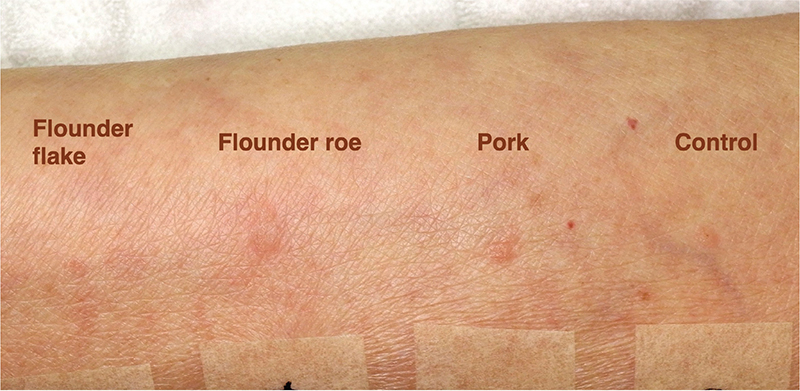
Fig. 2. Prick test showing hypersensitivity reactions to pork liver and flounder roe but not flounder flakes.
We reviewed 24 cases of α-Gal syndrome with hypersensitivity to flounder roe, collected from medical journals and abstracts of dermatological meetings in Japan, reported from 2013 to 2020. These cases, including the current one, are summarized in Table I (4–8).
| Cases | Age | Sex | Clinical manifestation | Abs to red meat‡ | Abs to α-Gal IgE¶ | Ref. | |
| Urticaria | Anaphylaxis | ||||||
| 1 | 72 | M | + | – | + | + | (4) |
| 2 | 76 | F | + | + | + | + | |
| 3 | 58 | F | + | + | + | + | |
| 4 | 47 | M | + | – | + | + | |
| 5 | 70 | M | + | – | + | + | |
| 6 | 78 | M | + | – | + | + | |
| 7 | 65 | M | + | + | + | + | |
| 8 | 69 | F | + | – | + | + | |
| 9 | 58 | M | + | – | + | + | |
| 10 | 70 | F | + | – | + | + | |
| 11 | 88 | M | + | – | + | + | |
| 12 | 66 | M | + | + | + | + | |
| 13 | 68 | M | + | – | + | + | |
| 14 | 76 | M | + | + | + | + | |
| 15 | 64 | F | + | + | + | + | |
| 16 | 82 | M | + | + | + | + | |
| 17 | 74 | F | + | + | + | + | |
| 18 | 72 | M | + | + | + | + | |
| 19 | 66 | M | + | – | + | + | |
| 20 | 78 | F | + | – | + | + | |
| 21 | 69 | M | + | – | + | + | (5) |
| 22 | 70 | M | + | + | + | n.d. | (6) |
| 23 | 67 | M | + | + | + | + | (7) |
| 24 | 73 | M | + | + | + | + | (8) |
| 25 | 82 | M | + | + | + | + | Our case |
| Total | 70.2 (± 8.7) | 0.67 | 100 | 52 | 100 | 100 | |
| ‡Presence (> 0.35 IU/mL) of specific IgE antibodies to either beef, pork, or lamb. ¶Presence (> 0.35 IU/mL) of specific IgE antibodies to α-Gal, detected using a bovine thyroglobulin-conjugated ImmunoCAP (Thermo Fisher Diagnostic Co., Tokyo, Japan). The “Total” column provides the mean age (years) and standard deviation, M/F ratio, and percentages (%) for urticaria, anaphylaxis, and positivity (%) for IgE antibodies to red meat and α-Gal. |
|||||||
DISCUSSION
This series of 25 cases, including the current one, highlights the risks of α-Gal syndrome associated with traditional Japanese dishes like nitsuke (boiled flounder with roe). Most patients were elderly (over 60 years old) and exhibited specific IgE antibodies to red meat and α-Gal, alongside a history of urticaria/anaphylaxis – hallmark features of the α-Gal syndrome. Anaphylaxis mostly occurred within 120 min of consuming flounder roe in these cases, a shorter timeframe than that observed with red meat. This suggests that α-Gal-related allergens in flounder roe may have unique bioavailability and abundance, enhancing their immunogenicity.
The exact α-Gal-related allergenic components in flounder roe remain incompletely characterized. Chinuki et al. (9) identified insoluble 100 kDa proteins in roe that cross-reacted with IgE in patient sera but did not detect α-Gal motifs using their methods. In contrast, early studies on hyosophorin, a glycoprotein found in flounder roe membranes, revealed a penta-antennary N-linked glycan chain rich in α-Gal motifs (10) (Fig. 1B). The motif consists of a terminal galactose molecule linked in an α-1,3-glycosidic bond to another galactose, which is connected to the protein backbone via a β-1,4 linkage to N-acetylglucosamine. Future research should explore whether some enzymes, such as β-GalNAc-ase, known to cleave glycosidic bonds derived from human tissues, such as the intestine and skin or bacterial flora, can expose α-Gal epitopes and trigger allergic responses.
In the USA, α-Gal syndrome affects an estimated 96,000 to 450,000 individuals and is a significant cause of anaphylaxis (11). Flounder is a dietary staple in Korea, Northern Europe, and Russia, as well as Japan. Furthermore, with the globalization of fusion cuisine, flounder roe consumption may increase worldwide, increasing anaphylaxis risks in α-Gal patients. These cases underscore the importance of thorough dietary histories and increased awareness of potential allergens in globally popular cuisines like Japanese food.
Right-eyed flounders (Hippoglossoides dubius) are distinct from left-eyed ones (Paralichthys olivaceus).
ACKNOWLEDGEMENTS
The authors sincerely thank Prof. K. Kitajima (Laboratory of Animal Cell Function, Bioscience and Biotechnology Center, Nagoya University), Prof. A. Seko (Japan Agency for Medical Research and Development), Prof. T. Taguchi (Laboratory of Organelle Pathophysiology, Graduate School of Life Sciences, Tohoku University), and Prof. E. Morita (Department of Dermatology, Shimane University) for their insightful suggestions regarding the potential association between hyosophorin, a glycoprotein in flounder roe containing α-Gal motifs, and anaphylaxis following roe ingestion in patients with α-Gal syndrome.
REFERENCES
- Commins SP, Jerath MR, Cox K, Erickson LD, Platts-Mills T. Delayed anaphylaxis to alpha-gal, an oligosaccharide in mammalian meat. Allergol Int 2016; 65: 16–20. https://doi.org/10.1016/j.alit.2015.10.001
- Hashizume H, Fujiyama T, Umayahara T, Kageyama R, Walls AF, Satoh T. Repeated amblyomma testudinarium tick bites are associated with increased galactose-α-1,3-galactose carbohydrate IgE antibody levels: a retrospective cohort study in a single institution. J Am Acad Dermatol 2018; 78: 1135–1141.e1133. https://doi.org/10.1016/j.jaad.2017.12.028
- Platts-Mills TAE, Li RC, Keshavarz B, Smith AR, Wilson JM. Diagnosis and management of patients with the α-Gal syndrome. J Allergy Clin Immunol Pract 2020; 8: 15–23.e11. https://doi.org/10.1016/j.jaip.2019.09.017
- Chinuki Y, Takahashi H, Morita E. Clinical and biochemical evaluation of twenty patients with red meat allergies. Jpn J Dermatol (in Japanese) 2013; 123: 1807–1814.
- Akutagawa K, Sakurai T, Yamada S, Harada M, Takahashi T. A case of cetuximab-induced anaphylactic shock. Sosei (in Japanese) 2020; 39: 65–68.
- Tohgi N, Yatai M, Maejima H, Takasu H, Amou Y, Kusunoki M. A case of anaphylaxis due to flounder roe. The 854th Tokyo Regional Dermatological Meeting, Tokyo, 2014.
- Honda Y, Yamamoto M, Nakajima K, Chinuki Y, Sano H. Delayed anaphylaxis after eating beef likely due to IgE antibody specific for galactose-α-1,3-galactose. Nishinihonhifu (in Japanese) 2015; 77: 453–455. https://doi.org/10.2336/nishinihonhifu.77.453
- Nakamura E, Toyoda Y, Yatagai T, Majima Y, Hashizume H. A case of alpha-Gal syndrome presenting anaphylactic shock after ingestion of flounder roe. The 119th Shizuoka Regional Dermatological Meeting, Shizuoka, 2017.
- Chinuki Y, Takahashi H, Morita E. IgE antibodies to galactose-α-1,3-galactose, an epitope of red meat allergen, cross-react with a novel flounder roe allergen. J Investig Allergol Clin Immunol 2022; 32: 324–326. https://doi.org/10.18176/jiaci.0754
- Seko A, Kitajima K, Iwasaki M, Inoue S, Inoue Y. Structural studies of fertilization-associated carbohydrate-rich glycoproteins (hyosophorin) isolated from the fertilized and unfertilized eggs of flounder, paralichthys olivaceus: presence of a novel penta-antennary N-linked glycan chain in the tandem repeating glycopeptide unit of hyosophorin. J Biol Chem 1989; 264: 15922–15929. https://doi.org/10.1016/S0021-9258(18)71567-6
- Iglesia EGA, Kwan M, Virkud YV, Iweala OI. Management of food allergies and food-related anaphylaxis. JAMA 2024; 331: 510–521. https://doi.org/10.1001/jama.2023.26857