ORIGINAL ARTICLE
Patient Needs and Treatment Goals in Chronic Atopic Pruritus: Does Eczema Make a Difference?
Svenja MÜLLER1# , Claudia ZEIDLER1#, Christian MESS2, Stefan M. KAHNERT3, Bernd LÖWE4, Angelika WEIGEL4, Felix WITTE1, Volker HUCK2, Lynhda NGUYEN2, Matthias AUGUSTIN5, Gina FRANK3, Konstantin AGELOPOULOS1, Henning WIEGMANN1, Ansgar KÖCHEL3, Rupert CONRAD3, Gudrun SCHNEIDER3, Stefan W. SCHNEIDER2, Sonja STÄNDER1, Inga HANSEN-ABECK2# and Finn ABECK2#
1Department of Dermatology and Center for Chronic Pruritus (KCP), University Hospital Münster, Münster, 2Department of Dermatology and Venereology, University Medical Center Hamburg-Eppendorf, Hamburg, 3Department of Psychosomatic Medicine and Psychotherapy, University Hospital Münster, Münster, 4Department of Psychosomatic Medicine and Psychotherapy, Centre for Internal Medicine, University Medical Centre Hamburg-Eppendorf, Hamburg, and 5Institute for Health Services Research in Dermatology and Nursing (IVDP), University Medical Center Hamburg-Eppendorf (UKE), Hamburg, Germany
#These authors contributed equally to this work.
Chronic pruritus (≥ 6 weeks) is a frequent symptom in atopic diseases, with phenotypes ranging from non-lesional skin to inflammatory diseases like atopic dermatitis. Data on patients’ needs and treatment goals depending on the skin phenotype and disease burden are limited. This study aimed to analyse the impact of distinct phenotypes of chronic atopic pruritus on disease burden and treatment goals. Another objective was to investigate whether the disease burden influences the treatment goals. Patient-reported outcomes of 1,086 adult patients (n = 529 with atopic dermatitis, n = 557 with chronic pruritus on non-lesional skin with atopic skin diathesis) were analysed age- and gender-matched (mean age 49.7 ± 19.0 years; n = 605 female [55.7%]), comparing pruritus intensity (Numeric Rating Scale), quality of life (Dermatology Life Quality Index, ItchyQol), anxiety and depression (Hospital Anxiety and Depression Scale), and patient needs (Patient Needs Questionnaire of the Patient Benefit Index-Pruritus). Although the disease burden was significantly higher in patients with atopic dermatitis (prolonged disease duration, increased quality of life impairment, higher pruritus intensity), the treatment goals of both phenotypes matched in 92.6%. The most important needs were to no longer experience itching, find a clear diagnosis and therapy, and have confidence in the therapy.
SIGNIFICANCE
Patients with chronic pruritus (CP) often experience prolonged disease courses, which are frequently associated with a substantial disease burden and insufficient treatment. Little is known about the mutual interactions between different CP phenotypes (CP on lesional skin vs on non-lesional skin [CPNL]) within the same disease spectrum, disease burden, and patients’ needs and treatment goals. Using atopic dermatitis as an example, this study demonstrates that patients with inflammatory skin lesions exhibit a higher disease burden compared with those with atopic CPNL. However, clinical management should consider that phenotype and disease burden have little influence on patients’ needs and treatment goals.
Key words: atopic dermatitis; atopic comorbidity; chronic pruritus; patient-reported outcomes; patient-centred care.
Citation: Acta Derm Venereol 2025; 105: adv42773. DOI: https://doi.org/10.2340/actadv.v105.42773.
Copyright: © 2025 The Author(s). Published by MJS Publishing, on behalf of the Society for Publication of Acta Dermato-Venereologica. This is an Open Access article distributed under the terms of the Creative Commons Attribution-NonCommercial 4.0 International License (https://creativecommons.org/licenses/by-nc/4.0/).
Submitted: Dec 20, 2024. Accepted after revision: Feb 17, 2025. Published: Mar 12, 2025.
Corr: Svenja Müller, MD, Department of Dermatology and Competence Center for Chronic Pruritus (KCP), University Hospital Münster, Münster, Germany. E-mail: Svenja.Mueller@ukmuenster.de
Competing interests and funding: SM was adviser, speaker, or investigator for Incyte Inc, Eli Lilly, LEO Pharma and Sanofi/Regeneron outside the submitted work. CZ is an investigator for Novartis, Janssen, Pfizer, UCB, Lilly, Abbvie, Boehringer Ingelheim, Sanofi, Regeneron, Leo, Galderma, and has received speaker honoraria/travel fees from Dermasence, Beiersdorf, Leo, Sanofi, Novartis, Unna Akademie, Allmiral, and AbbVie outside the submitted work. SMK has received a grant and support for attending meetings and travel from the German Research Foundation outside the submitted work (formally provided through the University Medical Centre Hamburg-Eppendorf, Germany, as lead institution of the research unit SOMACROSS). He has also received payment for lectures from the Educational Institute of Nursing and Health, University Hospital Münster, Germany, and expert witness fees in legal cases, all of which are outside the submitted work. BL reports research funding (no personal honoraria) from the German Research Foundation, the German Federal Ministry of Education and Research, the German Innovation Committee at the Joint Federal Committee, the European Commission’s Horizon 2020 Framework Programme, the European Joint Programme for Rare Diseases (EJP), the Ministry of Science, Research and Equality of the Free and Hanseatic City of Hamburg, Germany, and the Foundation Psychosomatics of Spinal Diseases, Stuttgart, Germany. He has received remuneration for several scientific book articles from various book publishers, from the Norddeutscher Rundfunk (NDR) for interviews in medical knowledge programmes on public television, and as a committee member from Aarhus University, Denmark. He received travel expenses from the European Association of Psychosomatic Medicine (EAPM), and accommodation and meals from the Societatea de Medicina Biopsyhosociala, Romania, for a presentation at the EAPM Academy at the Conferința Națională de Psihosomatică, Cluj-Napoca, Romania, October 2023. He received a travel grant for a lecture on the occasion of the presentation of the Alison Creed Award at the EAPM Conference in Lausanne, 12–15 June 2024. He received remuneration and travel expenses for a lecture at the Lindauer Psychotherapiewochen, April 2024. He has been President of the German College of Psychosomatic Medicine (DKPM) (unpaid) since March 2024 and was a member of the Board of the European Association of Psychosomatic Medicine (EAPM) (unpaid) until 2022. He is member of the EIFFEL Study Oversight Committee (unpaid). AW reports research funding (no personal honoraria) from the Werner Otto Foundation. She has received remuneration for a lecture at the Lindauer Psychotherapietage and she was treasurer of the EAPM (unpaid) until 2023. VH has received research funding from LEO Pharma GmbH in terms of an investigator-initiated trial outside the submitted work. LN has received lecture fees from Cynosure® Lutronic® outside the submitted work. MA has served as a consultant or paid speaker or has received research grants or honoraria for consulting and scientific presentations or has received travel reimbursements or participated in clinical trials for companies that manufacture drugs for the treatment of pruritus/prurigo, including AbbVie, Almirall, Eli Lilly, Galderma, Novartis, Pfizer, Sanofi, and Trevi. SWS was speaker and/or has received consultant funding from Almirall SA, GSK R&D Ltd, Incyte Corporation, LEO Pharma GmbH, Lilly Deutschland GmbH, Novartis Pharma GmbH, Sanofi-Aventis Deutschland GmbH, and Pfizer Pharma GmbH. SST was speaker and/or consultant and/or investigator and/or has received research funding from Amgen Inc, Almirall SA, Celldex Therapeutics Inc, Clexio Biosciences Ltd, Focus-Insight Healthtech Group Co. Ltd, Galderma Laboratorium GmbH, Galderma R & D, LLC, Galderma SA, Klirna Biotech Inc, GSK R&D Ltd, Incyte Corporation, LEO Pharma GmbH, Lilly Deutschland GmbH, Novartis Pharma GmbH, P. G. Unna Academy, Sanofi-Aventis Deutschland GmbH, Sanofi-Aventis R& D, Sanofi Genzyme Corporation, TouchIME, and Vifor Pharma Deutschland GmbH. IH-A and FA have received speaker honoraria from Sanofi outside the submitted work. The other authors have no conflict of interest to declare.
The authors would like to thank the German Research Foundation for funding the SOMACROSS research unit (RU 5211 to BL, GS, SWS, SST). The funding sources did not participate in study design and conduct, or in the data collection, management, analysis, and interpretation, or in preparation, review or approval of the manuscript, or in the decision to submit the article for publication.
INTRODUCTION
Chronic pruritus (CP; lasting ≥ 6 weeks) with an estimated lifetime prevalence of up to 25.5% can be induced by a variety of underlying diseases (1). Its clinical phenotype varies from non-lesional skin (CPNL) to inflammatory skin diseases (2).
CP is regarded as one of the most relevant persistent physical symptoms (synonymous with persistent somatic symptoms) in dermatology. As such, CP can persist for several months to years independently of its primary cause (3), and constitutes a significant burden for patients, healthcare professionals, and society as a whole (4). Specifically, CP profoundly impairs quality of life (QoL) through emotional distress, sleep disturbances, and challenges in daily activities (5) and is often accompanied by anxiety and depression (4). Furthermore, psychological factors appear to influence the perception and persistence of CP in addition to biological factors such as control of the underlying skin condition (3). Thus, biopsychosocial factors contribute to the persistence and meaningful disease burden of CP. Due to the high disease burden, patients with CP attach considerable importance to a range of therapeutic needs, which include not only pruritus relief and disease modification, with variations observed according to gender and clinical phenotype of CP (6).
A deeper understanding of the biopsychosocial factors contributing to CP across different clinical phenotypes including knowledge of patient needs and treatment goals is crucial for the development of effective interdisciplinary treatments (7). This involves carefully selecting both pharmaceutical and psychological interventions tailored to individual patient needs, promoting a more holistic and patient-centred management strategy (4, 8–11). However, limited knowledge exists regarding the reciprocal interactions between different CP phenotypes within the same disease spectrum, as well as their impact on disease burden, patient needs, and treatment goals.
To address this gap, the present study examines the impact of distinct phenotypes of atopic CP, specifically CP in AD (CP-AD; prevalence up to 97.2%) (12), and CPNL due to atopic skin diathesis (CPNL-ASD), on disease burden, patients’ needs, and treatment goals. This is achieved by assessing patient-reported outcomes (PRO), including pruritus intensity, QoL, and anxiety and depression, across age- and gender-matched patient groups. CP-AD and CPNL-ASD can be regarded as 2 diseases within 1 disease spectrum (type II inflammation), sharing similar comorbidities (e.g., personal or family history of asthma, allergies, or allergic rhinitis [AR]) (13, 14) and trigger factors (dry skin, heat, sweating, stress) (15, 16). Furthermore, the study investigates the impact of disease burden on patients’ needs and treatment goals within both phenotypes.
MATERIALS AND METHODS
Objectives
The primary objective of this study was to investigate the impact of distinct phenotypes of atopic CP (CP-AD, CPNL-ASD) on disease burden and patients’ needs and treatment goals irrespective of age and gender. The secondary objective was to analyse the influence of disease burden on patients’ needs and treatment goals within both phenotypes.
Ethical approval
Positive ethical approval from the ethics commission of the State Medical Association Westfalen-Lippe, Münster, Germany (2007-413-f-S) is available. All patients gave written informed consent.
Study design and setting
A matched cohort study design was employed using de-identified, routinely collected electronic health records (1 March 2012, to 31 August 2024) from the web-based patient database of the Center for Chronic Pruritus (KCP) in Münster, Germany, which includes over 15,000 individuals. The database has methodically gathered routine clinical data, including sociodemographic variables, medical history including patient-reported onset of disease, clinical presentation, pruritus-specific details such as pruritus intensity, patient-reported outcomes related to QoL, indicators of anxiety and depression, therapeutic needs and outcomes, comorbidities, and the presence of ASD (17). The assessment of ASD is conducted through an in-depth evaluation of the patient’s medical history, along with clinical and laboratory data, leading to the calculation of the Erlangen Atopy Score (EAS) (18).
Study population
Supported by experienced and well-trained data managers, we created 2 different cohorts by extracting data from all patients who were assigned to IFSI group I (CP on lesional skin) with a record of an AD diagnostic code and selecting all patients who were assigned to IFSI group II (CPNL), having a record of atopy or a documented EAS ≥ 10 points indicating a particular ASD (19).
The process of data cleaning involved removing incomplete records and entries with inconsistent or erroneous information. Additionally, patients with missing key demographic data such as age or gender were excluded. Following this, the remaining dataset was matched by age and gender to ensure comparability between CP-AD and CPNL-ASD samples.
Disease burden
To assess the disease burden, we analysed the following patient-reported outcomes: disease duration, pruritus intensity, QoL, and psychological symptoms of anxiety and depression.
Itch intensity was measured by using the Numerical Rating Scale (NRS), a validated and commonly applied method for quantifying pruritus severity (20). Patients rated their average pruritus (AP), and worst pruritus (WP) experienced in the last 24 h on a scale from 0 (indicating no pruritus) to 10 (indicating the most severe pruritus).
QoL was evaluated using the Dermatology Life Quality Index (DLQI, score range 0 to 30) and the ItchyQol (score range 22 to 110). The DLQI consists of 10 items to be answered on a 4-point Likert scale to find out how much the skin disease has affected the patient’s life in the last week (0 = not at all, 1 = a little, 2 = a lot, 3 = very much) (21). The ItchyQol is a 22-item questionnaire that covers the key domains “symptoms”, “functioning”, and “emotions”. Each question is scored from 1 to 5 (1 = never, 2 = rarely, 3 = sometimes, 4 = often, 5 = all of the time) (22, 23).
Psychological symptoms of anxiety and depression were assessed using the Hospital Anxiety and Depression Scale (HADS), which includes separate subscales for anxiety (HADS-A) and depression (HADS-D). Each individual item is rated from 0–3; each subscale ranges from 0 to 21 (0 = normal, 8–10 = borderline abnormal (possible anxiety or depression), 11–21 = abnormal (indicative of clinically significant anxiety or depression) (24).
Patients’ needs and treatment goals
To assess patients’ needs and treatment goals, we used the Patient Needs Questionnaire (PNQ), which includes 27 patient needs concerning treatment objectives that can be rated on a 5-point Likert scale (0 = not important at all or not applicable, 1 = slightly important, 2 = moderately important, 3 = fairly important, 4 = highly important) (25). The PNQ items were initially developed based on qualitative data from open patient surveys, with their final content reflecting patient input and clinical expertise (25, 26). The needs assessed cover various dimensions of life, such as physical and psychological well-being, work, and daily task performance, as well as social interactions and leisure activities (25). The PNQ is part of the Patient Benefit Index-Pruritus (PBI-P), a validated and widely used 2-stage tool to evaluate the benefit of therapy (25).
Statistical analysis
Descriptive statistics were applied, using frequencies for categorical variables and mean values with standard deviations for numerical variables to evaluate patient characteristics (age, sex, disease duration) and PROs to assess disease burden and patients’ needs and treatment goals.
Due to the exploratory study design, the 2 phenotypes were compared in terms of disease burden and treatment goals applying unpaired 2-sample t-tests for numerical and χ2 test of independence for categorical data without corrections for multiple testing.
Additional Pearson correlation tests were performed to investigate associations between patients’ needs and treatment goals (PNQ) and disease burden (pruritus intensity, QoL, anxiety and depression levels).
The statistical analyses were carried out using R version 4.4.1 (R Foundation for Statistical Computing, Vienna, Austria) (27).
RESULTS
Descriptive statistics
From the centre’s web-based patient database, we identified n = 2,486 patients suffering from CP-AD or CPNL-ASD. Data cleaning and matching of the CP-AD and the CPNL-ASD patients by age and gender resulted in a cohort of n = 1,086 patients with a mean age of 49.7 ± 19.0 years. Of these, 55.7% (n = 605) were female. Among all patients, 51.3% (n = 557) had CPNL-ASD and 48.7% (n = 529) had CP-AD (see Table I).
Disease burden
The mean disease duration stated by the patient was 10.2 ± 14.0 years. Patients with CP-AD reported a significantly longer disease duration (14.0 ± 16.9 years) than patients with CPNL-ASD (6.6 ± 9.1 years; p < 0.001).
All patients reported moderate pruritus (WP-NRS 5.7 ± 2.5, AP-NRS 5.2 ± 2.6), with pruritus intensity being significantly higher in patients with CP-AD than in patients with CPNL-ASD (WP-NRS 6.1 ± 2.4 vs 5.4 ± 2.5; p < 0.01, effect size Cohen’s d = 0.55).
There was a significant difference (p < 0.001) between the 2 groups in terms of QoL: patients with CPNL-ASD presented moderate impairment of QoL, while patients with CP-AD had a very large impairment (ItchyQol 61.6 ± 15.4 vs 70.4 ± 15.4; DLQI 8.6 ± 6.2 vs 11.9 ± 7.0; p < 0.001, effect size Cohen’s d = 0.29).
Both disease groups reported screening negative levels of anxiety (6.9 ± 3.9) and depressive symptoms (5.5 ± 4.2), while the level of depressive symptoms in CP-AD patients was significantly higher than in CPNL-ASD patients (p < 0.05). The comparison of all PRO of both groups is shown in Fig. 1.
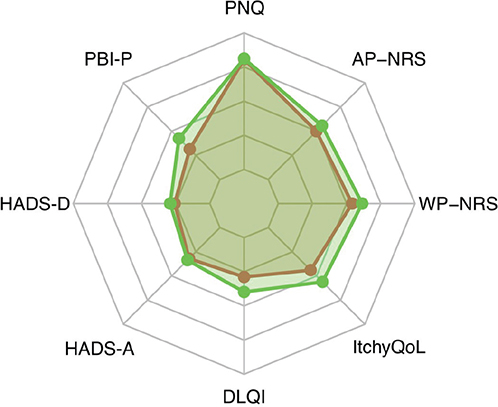
Fig. 1. Spider chart presenting patient-reported outcomes (PRO) in patients with CPNL-ASD (red) and CP-AD (green) based on the real ranges of each PRO. AP: average pruritus [0–10]; NRS: Numeric Rating Scale [0–10]; WP: worst pruritus [0–10]; ItchyQol [22–110]; DLQI: Dermatology Life Quality Index [0–30]; HADS: Hospital Anxiety and Depression Scale; -A: anxiety [0–21]; -D: depression [0–21]; PNQ: Patient Need Questionnaire [0–4], disease duration (years).
Patients’ needs and treatment goals
The mean need level of all patients was 3.2 ± 0.7 points with no significant differences between the 2 groups (p = 0.721) (Table II). The patient needs matched in 92.6% (Fig. 2).
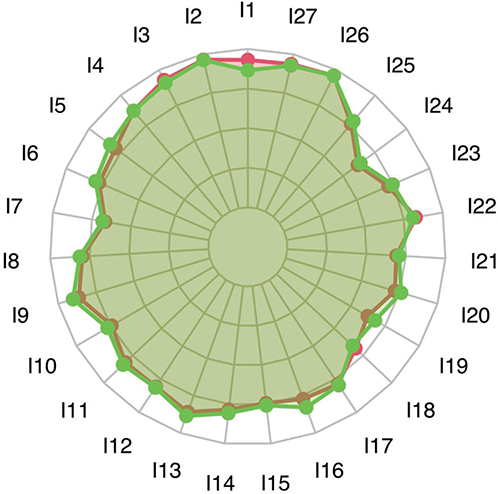
Fig. 2. Comparison of patients’ needs in patients with chronic pruritus on non-lesional skin with atopic skin diathesis (CPNL-ASD; red) with chronic pruritus in AD (green) as measured by the Patients Need Questionnaire (PNQ) of the Patient Benefit Index-Pruritus (PBI-P). The scale for all items ranges from 0 (not important) to 4 (very important). I1: to be free of pain; I2: to no longer experience itching; I3: to no longer have a burning sensation on the skin; I4: to be healed of all skin alterations; I5: to be able to concentrate better; I6: to be less nervous; I7: to be able to wear all types of clothing; I8: to be able to bathe and shower normally; I9: to be able to sleep better; I10: to be less depressed; I11: to gain in joy of living; I12: to have no fear that the disease will progress; I13: to be able to lead a normal daily life; I14: to be more productive in everyday life; I15: to be less of a burden to relatives and friends; I16: to be able to engage in normal leisure activities; I17: to be able to lead a normal working life; I18: to be able to have more contact with other people; I19: to dare to show oneself more; I20: to be less burdened in partnership; I21: to be able to have a normal sex life; I22: to be less dependent on doctor and clinic visits; I23: to need less time for daily treatment; I24: to have lower out-of-pocket-treatment costs; I25: to have fewer side effects; I26: to find a clear diagnosis and therapy; I27: to have confidence in the therapy.
In both groups, the most important needs were to no longer experience itching (3.9 ± 0.5), followed by to find a clear diagnosis and therapy (3.8 ± 0.5) and to have confidence in the therapy (3.7 ± 0.6).
Only 2 out of 27 needs differed significantly between patients with CPNL-ASD and CP-AD patients, these were to be free from pain (3.7 ± 0.7 vs 3.5 ± 1.0; p < 0.005, effect size Cohen’s d = 0.23) and to be able to engage in normal leisure activities (3.1 ± 1.2 vs 3.3 ± 0.9; p < 0.05, effect size Cohen’s d = 0.19). Some 95% of patients ranked the treatment goals to find a clear diagnosis and therapy and to have confidence in the therapy as quite or very important.
Impact of the disease burden on patients’ needs and treatment goals
In patients with CP-AD and CPNL-ASD, no correlations between pruritus intensity (WP-NRS) and the mean general need level (PNQ) were found in either group (Table III).
QoL correlated weakly with the mean general need level for CP-AD patients and for CPNL-ASD patients, with Pearson correlation coefficients of 0.3 (p < 0.001) and 0.46 (p < 0.001) as measured by DLQI and with Pearson correlation coefficients of 0.39 (p < 0.0001) and 0.26 (p < 0.01) as measured by ItchyQol, respectively.
The mean general need level was not significantly correlated with anxiety or depression in patients with CPNL-ASD or in patients with CP-AD (see Table III).
DISCUSSION
The present study shows that the phenotype in CP leads to a different disease burden, which is elevated in both phenotypes, but significantly higher in patients with inflammatory pruritic skin lesions. However, treatment goals seem to be largely independent of both the phenotype and the level of disease burden, as they match in 92.6%.
Disease burden
Our study confirms irrespective of the phenotype a high disease burden in atopic CP, as both phenotypes experience long disease courses, moderate pruritus intensity, a high overall need level, and significant impairment of QoL.
The higher disease burden of patients with CP-AD than of those with CPNL-ASD is underlined by longer disease durations, slightly higher pruritus intensities, and higher impairment of QoL.
Nevertheless, both phenotypes have an equally high overall need level. The high overall need level is comparable to findings from a cohort of 2,747 CP patients (mean PNQ 3.4) (6) and is notably higher than observed in another group of AD patients (mean PNQ 2.81, n = 50 patients) (26), but lower than in a validation study including 3,089 AR patients (of whom 19% had concomitant diseases like asthma or AD) (mean PNQ 3.9) (28). It can be hypothesized that the presence of a greater number of atopic comorbidities, as well as an elevated QoL impairment (29), contributes to an elevated general need level. However, it should be noted that the comparability may be limited, as the PBI-P (25) differs minimally from the standard version of the PBI that was used to examine AD patients (26) and the PBI-AR (28) of the previous studies.
Patients’ needs and treatment goals
The most important treatment goals in both groups were to no longer experience itching, to find a clear diagnosis and therapy, to no longer have a burning sensation on the skin, and to have confidence in the therapy.
Both phenotypes ranked the treatment goals to be able to lead a normal daily life, to be able to sleep better, to be able to concentrate better, and to gain in joy of living to be equally important.
To no longer experience itching has also been previously shown to be the most important need in AD patients (26) and the second most important goal in CP patients (6).
In the cohort of CP patients derived from a database collecting all aetiologies, the most important goal has been reported to be to find a clear diagnosis and therapy (6). For patients with CP, this need is very understandable, as CP can be caused by numerous underlying diseases (2). The fact that this treatment goal is equally important for patients with AD and is also rated the second most important of 27 treatment goals shows that patients with AD may be insufficiently informed about their disease. As called for in the 4th Davos Declaration, good patient education is essential to improve care (30). In addition to conveying the diagnosis, patient education should also include basic information on biopsychosocial interactions, e.g., how psychosocial aspects contribute to the persistence of CP (4).
Both groups stated that it was equally important to be healed of skin alterations; the mean PNQ of this item (3.5) corresponds approximately to that of AD (3.4 [26]) and CP (3.3 [6]) of the comparative studies. This suggests that acute scratch lesions may be equally as distressing for patients with CP as eczema is for those with AD.
We found that both phenotypes differed in only 2 out of 27 treatment targets. For patients with CPNL-ASD, it was significantly more important to be free of pain, whereas patients with CP-AD expressed a significantly stronger desire to be able to engage in normal leisure activities).
Skin pain often occurs together witch CP and affects between 42.7% and 92.2% of patients with AD (31). Understanding the relationship between CP and pain mechanisms could provide new insights for treating CP and chronic pain (32). Acute scratch lesions could potentially cause more harm than chronic eczema, as they may penetrate the skin more deeply and damage skin nerves (31). However, they also occur in AD, necessitating further investigation into whether neuroimmune crosstalk in the skin, possibly more strongly involving pain signalling (32), may play a more significant role in the pathophysiology of CPNL-ASD.
The comparably greater desire in CP-AD patients to be able to engage in normal leisure activities aligns with the severe impact on QoL of CP-AD patients, and is consistent with prior studies highlighting the considerable influence of AD with irritating eczema on leisure life and social withdrawal, even among children and adolescents (33, 34). Social isolation has been directly linked to depression in AD patients (35).
Impact of the disease burden on patients’ needs and treatment goals
Among all the PROs assessed to characterize the disease burden, it was only observed that the impairment of QoL showed a slight correlation with the importance of treatment goals. This indicates that treatment goals are disease-specific and largely unaffected by variations in disease burden within a disease spectrum. This observation is further supported by the finding that symptoms are in the focus of the treatment goals (3 of the top 5 most important treatment goals were to no longer experience itching, to no longer have a burning sensation on the skin, and to be free of pain) and not the underlying diseases such as AD, AR, or asthma.
Therefore, it can be inferred that the assessment of patients’ needs and treatment goals should be extended to other underlying conditions that precipitate CP to be able to establish a holistic therapeutic approach that is recommended for persistent physical symptoms (4) based on an increasing understanding of biopsychosocial interactions. This includes comprehensive patient education and adequate pharmacological and psychological interventions to improve the quality of life and achieve favourable disease modification (30, 36–39).
Limitations
The present study has several limitations, primarily due to its retrospective and monocentric design, which may restrict the generalizability of the findings. We do not believe that the excluded cases during data cleaning have influenced the results, as incomplete datasets were primarily removed to ensure high data quality by trained data specialists. The results could be biased, as university-based excellence centres may tend to attract patients with higher disease severity. Future research would benefit from exploring CP-AD and CPNL-ASD patients using data from national registries, enabling the investigation of additional potential influencing factors of patients’ needs and treatment goals such as disease severity of AD, further comorbidities associated with CP, or therapies received. Furthermore, the results cannot be transferred to patients with CP of other origins.
ACKNOWLEDGEMENTS
IRB approval status: Reviewed and approved by IRB; approval # 2007-413-f-S.
REFERENCES
- Matterne U, Apfelbacher CJ, Vogelgsang L, Loerbroks A, Weisshaar E. Incidence and determinants of chronic pruritus: a population-based cohort study. Acta Derm Venereol 2013; 93: 532-537. https://doi.org/10.2340/00015555-1572
- Ständer S. Classification of itch. Curr Probl Dermatol 2016; 50: 1–4. https://doi.org/10.1159/000446009
- Schneider G, Ständer S, Kahnert S, Pereira MP, Mess C, Huck V, et al. Biological and psychosocial factors associated with the persistence of pruritus symptoms: protocol for a prospective, exploratory observational study in Germany (individual project of the Interdisciplinary SOMACROSS Research Unit [RU 5211]). BMJ Open 2022;12: e060811. https://doi.org/10.1136/bmjopen-2022-060811
- Löwe B, Toussaint A, Rosmalen JGM, Huang WL, Burton C, Weigel A, et al. Persistent physical symptoms: definition, genesis, and management. Lancet 2024; 403: 2649–2662. https://doi.org/10.1016/S0140-6736(24)00623-8
- Lipman ZM, Yap QV, Rosen J, Nattkemper L, Yosipovitch G. The association of chronic pruritus with patients’ quality of life: a cross-sectional study. J Am Acad Dermatol 2022; 86: 448–450. https://doi.org/10.1016/j.jaad.2021.09.062
- Steinke S, Bruland P, Blome C, Osada N, Dugas M, Fritz F, et al. Chronic pruritus: evaluation of patient needs and treatment goals with a special regard to differences according Acta Derm Venereol 2025ActaDV 7/7 S. Müller et al. “Chronic atopic pruritus: patient needs and treatment goals” to pruritus classification and sex. Br J Dermatol 2017; 176: 363–370. Acta Dermato-Venereologica ActaDV Advances in dermatology and venereology https://doi.org/10.1111/bjd.14910
- Thünemann J, Müller S, Steinbrink K, Ständer S, Zeidler C. Chronic prurigo. J Dtsch Dermatol Ges 2024; 22: 813–823. https://doi.org/10.1111/ddg.15317
- Bieber T. Atopic dermatitis: an expanding therapeutic pipeline for a complex disease. Nat Rev Drug Discov 2022; 21: 21–40. https://doi.org/10.1038/s41573-021-00266-6
- Maintz L, Welchowski T, Herrmann N, Brauer J, Kläschen AS, Fimmers R, et al. Machine learning-based deep phenotyping of atopic dermatitis: severity-associated factors in adolescent and adult patients. JAMA Dermatol 2021; 157: 1414–1424. https://doi.org/10.1001/jamadermatol.2021.3668
- Labib A, Ju T, Yosipovitch G. Emerging treatments for itch in atopic dermatitis: a review. J Am Acad Dermatol 2023; 89: 338–344. https://doi.org/10.1016/j.jaad.2023.04.057
- Bernstein JA, Bernstein JS, Makol R, Ward S. Allergic rhinitis: a review. JAMA 2024; 331: 866–877. https://doi.org/10.1001/jama.2024.0530
- Zeidler C, Raap U, Witte F, Ständer S. Clinical aspects and management of chronic itch. J Allergy Clin Immunol 2023; 152: 1–10. https://doi.org/10.1016/j.jaci.2023.04.018
- Rupert J, Honeycutt JD. Pruritus: diagnosis and management. Am Fam Physician 2022; 105: 55–64.
- Heetfeld AB, Schill T, Schröder SS, Forkel S, Mahler V, Pfützner W, et al. Challenging a paradigm: skin sensitivity to sodium lauryl sulfate is independent of atopic diathesis. Br J Dermatol 2020; 183: 139–145. https://doi.org/10.1111/bjd.18564
- Ständer S. Atopic dermatitis. N Engl J Med 2021; 384: 1136–1143. https://doi.org/10.1056/NEJMra2023911
- Müller S, Witte F, Ständer S. Pruritus bei atopischer Dermatitis - vergleichende Bewertung neuer Therapieansätze. Dermatologie (Heidelb) 2022; 73: 538–549. https://doi.org/10.1007/s00105-022-05011-7
- Soto-Rey I, Rehr M, Bruland P, Zeidler C, Riepe C, Steinke S, et al. Electronic collection of multilingual patient-reported outcomes across Europe. Methods Inf Med 2018; 57: e107e114. https://doi.org/10.1055/s-0038-1675397
- Diepgen TL, Sauerbrei W, Fartasch M. Development and validation of diagnostic scores for atopic dermatitis incorporating criteria of data quality and practical usefulness. J Clin Epidemiol 1996; 49: 1031–1038. https://doi.org/10.1016/0895-4356(96)00119-9
- Heetfeld AB, Schill T, Schröder SS, Forkel S, Mahler V, Pfützner W, et al. Challenging a paradigm: skin sensitivity to sodium lauryl sulfate is independent of atopic diathesis. Br J Dermatol 2020; 183: 139–145. https://doi.org/10.1111/bjd.18564
- Storck M, Sandmann S, Bruland P, Pereira MP, Steinke S, Riepe C, et al. Pruritus Intensity Scales across Europe: a prospective validation study. J Eur Acad Dermatol Venereol 2021; 35: 1176–1185. https://doi.org/10.1111/jdv.17111
- Finlay AY, Khan GK. Dermatology Life Quality Index (DLQI): a simple practical measure for routine clinical use. Clin Exp Dermatol 1994; 19: 210–216. https://doi.org/10.1111/j.1365-2230.1994.tb01167.x
- Zeidler C, Steinke S, Riepe C, Bruland P, Soto-Rey I, Storck M, et al. Cross-European validation of the ItchyQoL in pruritic dermatoses. Acad Dermatol Venereol 2019; 33: 391–397. https://doi.org/10.1111/jdv.15225
- Desai NS, Poindexter GB, Monthrope YM, Bendeck SE, Swerlick RA, Chen SC. A pilot quality-of-life instrument for pruritus. J Am Acad Dermatol 2008; 59: 234–244. https://doi.org/10.1016/j.jaad.2008.04.006
- Zigmond AS, Snaith RP. The hospital anxiety and depression scale. Acta Psychiatr Scand 1983; 67: 361–370. https://doi.org/10.1111/j.1600-0447.1983.tb09716.x
- Blome C, Augustin M, Siepmann D, Phan NQ, Rustenbach SJ, Ständer S. Measuring patient-relevant benefits in pruritus treatment: development and validation of a specific outcomes tool. Br J Dermatol 2009; 161: 1143–1148.https://doi.org/10.1111/j.1365-2133.2009.09328.x
- Augustin M, Radtke MA, Zschocke I, Blome C, Behechtnejad J, Schäfer I, et al. The patient benefit index: a novel approach in patient-defined outcomes measurement for skin diseases. Arch Dermatol Res 2009; 301: 561–571. https://doi.org/10.1007/s00403-009-0928-8
- R Core Team (2021). R: A language and environment for statistical computing. Vienna, Austria: R Foundation for Statistical Computing. https://www.r-project.org/.
- Demoly P, Aubier M, Blay F de, Wessel F, Clerson P, Maigret P. Evaluation of patients’ expectations and benefits in the treatment of allergic rhinitis with a new tool: the patient benefit index - the benefica study. Allergy Asthma Clin Immunol 2015; 11: 8. https://doi.org/10.1186/s13223-015-0073-1
- Theunis J, Nordon C, Falissard B, Orri M, Mengeaud V, Misery L. Development and preliminary validation of the patient-reported Chronic Itch Burden Scale assessing health-related quality of life in chronic pruritus. Br J Dermatol 2022; 186: 8–95. https://doi.org/10.1111/bjd.20582
- Traidl-Hoffmann C, Afghani J, Akdis CA, Akdis M, Aydin H, Bärenfaller K, et al. Navigating the evolving landscape of atopic dermatitis: challenges and future opportunities: the 4th Davos declaration. Allergy 2024; 79: 2605–2624. https://doi.org/10.1111/all.16247
- Ständer S, Luger T, Kim B, Lerner E, Metz M, Adiri R, et al. Cutaneous components leading to pruritus, pain, and neurosensitivity in atopic dermatitis: a narrative review. Dermatol Ther (Heidelb) 2024; 14: 45–57. https://doi.org/10.1007/s13555-023-01081-0
- Yosipovitch G, Kim B, Luger T, Lerner E, Metz M, Adiri R, et al. Similarities and differences in peripheral itch and pain pathways in atopic dermatitis. J Allergy Clin Immunol 2024; 153: 904–912. https://doi.org/10.1016/j.jaci.2023.10.034
- Senra MS, Wollenberg A. Psychodermatological aspects of atopic dermatitis. Br J Dermatol 2014; 170: 38–43. https://doi.org/10.1111/bjd.13084
- Almutawa YM, AlGhareeb M, Bhattarai E, Aljalahma J. Investigation of the impact of atopic dermatitis (AD) on stress, depression, anxiety, and suicidal ideation: a systematic review and meta-analysis. Cureus 2024; 16: e63376. https://doi.org/10.7759/cureus.63376
- Mizara A, Papadopoulos L, McBride SR. Core beliefs and psychological distress in patients with psoriasis and atopic eczema attending secondary care: the role of schemas in chronic skin disease. Br J Dermatol 2012; 166: 986–993. https://doi.org/10.1111/j.1365-2133.2011.10799.x
- Müller S, Maintz L, Bieber T. Treatment of atopic dermatitis: recently approved drugs and advanced clinical development programs. Allergy 2024; 79: 1501–1515. https://doi.org/10.1111/all.16009
- Weisshaar E, Szepietowski JC, Dalgard FJ, Garcovich S, Gieler U, Giménez-Arnau AM, et al. European S2k Guideline on Chronic Pruritus. Acta Derm Venereol 2019; 99: 469–506. https://doi.org/10.2340/00015555-3164
- Alvarenga JM, Bieber T, Torres T. Emerging biologic therapies for the treatment of atopic dermatitis. Drugs 2024; 84: 1379–1394. https://doi.org/10.1007/s40265-024-02095-4
- Satoh T, Yokozeki H, Murota H, Tokura Y, Kabashima K, Takamori K, et al. 2020 guidelines for the diagnosis and treatment of cutaneous pruritus. J Dermatol 2021; 48: e399–e413. https://doi.org/10.1111/1346-8138.16066