RESEARCH LETTER
Successful Treatment with Dupilumab of Acquired Reactive Perforating Collagenosis with End-stage Renal Disease
Shanglin JIN, Xiaoyao FAN, Jin CHEN and Ying MA*
1Department of Dermatology, Huashan Hospital, Fudan University, 200040, P. R. China. *E-mail: alle_ma@163.com
Citation: Acta Derm Venereol 2025; 105: adv43108. DOI: https://doi.org/10.2340/actadv.v105.43108.
Copyright: © 2025 The Author(s). Published by MJS Publishing, on behalf of the Society for Publication of Acta Dermato-Venereologica. This is an Open Access article distributed under the terms of the Creative Commons Attribution-NonCommercial 4.0 International License (https://creativecommons.org/licenses/by-nc/4.0/).
Submitted: Feb 5, 2025; Accepted after revision: Feb 17, 2025; Published: Mar 18, 2025.
To the Editor,
Acquired reactive perforating collagenosis (ARPC) is a rare skin disorder characterized by the extrusion of collagen through the epidermis, leading to the formation of necrotic papules or plaques. It often occurs in patients with underlying conditions such as diabetes, chronic renal failure, or obesity. Treatment typically focuses on managing the underlying condition and controlling skin lesions with topical steroids and oral antihistamines to alleviate pruritus. However, as ARPC is rare and often associated with systemic diseases, treatment approaches should be individualized and sometimes may fail. Here, we show a case of ARPC in a young female patient with end-stage renal disease.
A 36-year-old female patient presented with a 1-year history of a pruritic rash affecting her trunk and limbs. She had a history of uraemia and was undergoing peritoneal dialysis. Despite taking various antihistamines and applying topical steroids, her symptoms persisted. Gabapentin was prescribed, but it caused foot swelling. On physical examination, diffusely distributed papules and nodules were observed on the trunk and limbs, with accompanying erosions, ulcers, and scars. The papules ranged in size from 2 to 10 mm. Laboratory tests revealed elevated creatinine (729 μmol/L) and reduced eGFR (5.7 mL/min/1.73 m²), along with an increased eosinophil count (0.63 × 10⁹/L) and a mild elevation in total immunoglobulin E (320 IU/mL). A skin biopsy from an erythematous-desquamative patch on the right upper limb revealed a cup-shaped epidermal depression with extruded necrotic collagen. The dermis showed proliferation of blood vessels and small-scale lymphocyte and neutrophil infiltration around the blood vessels, while Masson’s staining revealed collagen fibres penetrating the surface (Fig. 1). The diagnosis of ARPC was made. Following informed consent and after excluding relevant contraindications, treatment with dupilumab was initiated at a dose of 600 mg, followed by 300 mg every 2 weeks. Routine antihistamines and topical steroids were also applied. Twelve weeks after treatment, the patient experienced significant improvement in both the eruptions and pruritus, with residual post-inflammatory hyperpigmentation. During follow-up, the patient continued dupilumab without recurrence or adverse effects.
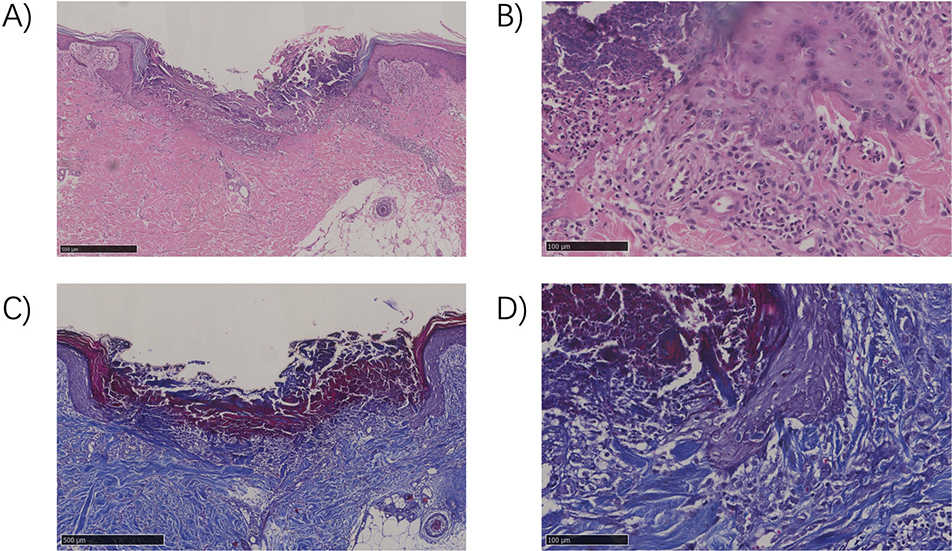
Fig. 1. Histopathology of acquired reactive perforating collagenosis. Histopathology of the skin lesion on the right upper limb at (A) 5X magnification and (B) 10X magnification. Necrotic collagen fibres penetrated into the surface using Masson’s staining at (C) 5X magnification and (D) 10X magnification.
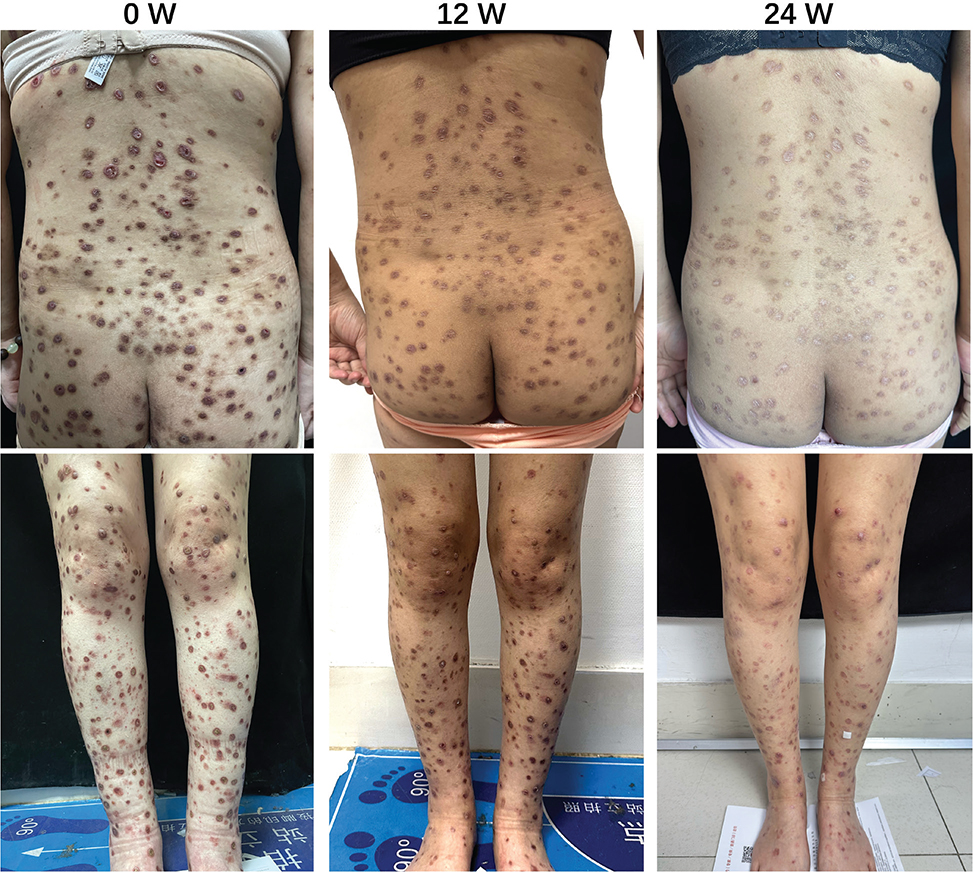
Fig. 2. Acquired reactive perforating collagenosis treated with dupilumab. Baseline and after dupilumab treatment. Written permission from the patient has been given to the authors to publish these photos.
ARPC is a rare skin disorder characterized by the transepidermal extrusion of denatured collagen fibres. It predominantly affects adults and is frequently associated with severe pruritus. ARPC is commonly seen in patients with underlying conditions such as diabetes and end-stage renal disease. Histologically, ARPC is characterized by a cup-shaped epidermal depression filled with basophilic keratin plugs, inflammatory cells, and denatured collagen fibres (1). The treatment of ARPC is challenging due to the absence of definitive guidelines. The goal is to alleviate itching and manage the underlying disease. Recent studies have shown that IL-4 and IL-13 play a direct role in pruritus by acting on pruritic neurons and are co-localized with GATA3 in ARPC lesions (2). Dupilumab, a fully human monoclonal antibody targeting IL-4Rα, is approved for treating moderate-to-severe atopic dermatitis and has been shown to be effective against prurigo nodularis and other pruritic conditions, including chronic pruritus of unknown origin and uremic pruritus (3). In this case, dupilumab treatment resulted in a significant reduction in pruritus and resolution of the rash after the pruritus subsided. The literature suggests that dupilumab may offer potential efficacy in treating ARPC by alleviating pruritus and preventing the microtrauma caused by scratching (4). Given its ability to target pruritus and its favourable safety profile, dupilumab could be considered a promising alternative to systemic steroids or immunosuppressants, particularly for patients with underlying systemic conditions such as diabetes and chronic kidney disease.
ACKNOWLEDGEMENTS
Funding sources: The National Natural Science Foundation of China (Grant No.82304053 and Grant No.82173444) and National Key Research and Development Program of China (Grant/Award No.2023YFC2509000).
The authors have no conflicts of interest to declare.
REFERENCES
- Faver IR, Daoud MS, Su WP. Acquired reactive perforating collagenosis: report of six cases and review of the literature. J Am Acad Dermatol 1994; 30: 575–580. https://doi.org/10.1016/S0190-9622(94)70065-6
- Liu B, Wu Y, Wu X, Zhong X, Xue R, Zhang Z. Dupilumab improve acquired reactive perforating collagenosis characterized by type 2 inflammation. Front Immunol 2023; 14: 1240262. https://doi.org/10.3389/fimmu.2023.1240262
- Butler DC, Berger T, Elmariah S, Kim B, Chisolm S, Kwatra SG, et al. Chronic pruritus: a review. JAMA 2024; 331: 2114–2124. https://doi.org/10.1001/jama.2024.4899
- Ying Y, Shuang C, Zhen-Ying Z. Dupilumab may be an alternative option in the treatment of acquired reactive perforating collagenosis combined with AD. Immun Inflamm Dis 2022; 10: e574. https://doi.org/10.1002/iid3.574