SHORT COMMUNICATION
Occupational Sensitization to Colophony Subsequently Giving Rise to Both Environmental and Occupational Allergic Contact Dermatitis
Jakob WILLNER*, Magnus BRUZE  , Jakob DAHLIN , Kajsa DAVIDSON KÄLLBERG and Cecilia SVEDMAN
Department of Occupational and Environmental Dermatology, Lund University, Skåne University Hospital, Jan Waldenströms gata 16, SE-205 02, Malmö, Sweden. *E-mail: jakob.willner@skane.se
Citation: Acta Derm Venereol 2025; 105: adv43296. DOI: https://doi.org/10.2340/actadv.v105.43296.
Copyright: © 2025 The Author(s). Published by MJS Publishing, on behalf of the Society for Publication of Acta Dermato-Venereologica. This is an Open Access article distributed under the terms of the Creative Commons Attribution-NonCommercial 4.0 International License (https://creativecommons.org/licenses/by-nc/4.0/).
Submitted: Mar 5, 2025. Accepted after revision: Jun 18, 2025. Published: Jul 10, 2025.
Competing interests and funding: The authors have no conflicts of interest to declare.
INTRODUCTION
In recent years, several young individuals from the Swedish Armed Forces have been referred to the Department of Occupational and Environmental Dermatology in Malmö due to suspected occupational allergic contact dermatitis from adhesives used prophylactically to prevent chafing. This is a follow-up of the first referred patient (1) and a description of a new one, both sensitized while serving in the Swedish Armed Forces. Both patients were re-referred within 2 years after ending their conscription due to suspected occupational and environmental allergic contact dermatitis, respectively.
MATERIALS AND METHODS
Patch testing
Test preparations were obtained from Chemotechnique Diagnostics (Vellinge, Sweden) or prepared in our laboratory. Furthermore, material and products obtained from Essity (BSN Medical SAS, Vibraye, France) were used in aimed testing. Ultrasonic bath extracts (2) in acetone and ethanol were made from the patients’ own products. Products were also tested as is. Finn ChamberAQUA® (SmartPractice, Phoenix, AZ, USA) was used. Patches were removed on day (D)2. Readings were performed twice by a dermatologist, on D3/4 and D7, with test classification according to the International Contact Dermatitis Research Group (3) and clinical relevance assessment according to the European Society of Contact Dermatitis (4).
Chemical analyses
Gas chromatography/mass spectrometry (5) was used to screen personal material for the presence of colophony. The chromotropic acid test was used to detect the presence of formaldehyde in the patient’s own material (6).
Ethical considerations
The patients gave written informed consent to publish their histories and photos.
RESULTS
Case 1: Occupational sensitization causing new occupational allergic contact dermatitis. A 25-year-old male grounds maintenance worker re-consulted our department for severe hand dermatitis after constructing a fence. The patient was initially investigated 1.5 years earlier due to severe blistering after using medical adhesives as a conscript (1). Allergy to colophony and the adhesives, as well as other substances, mostly fragrances, was diagnosed. He received oral and written information on his multiple sensitizations. A report on occupational injury was filed by his employer.
In December 2023 he constructed a pine-wood fence while wearing protective gloves. The skin of his hands was, prior to this fence work, unaffected. After a few days he started to experience irritation of his left (non-dominant) hand, and at the end of the week blisters appeared on the interstitia of the proximal phalanges. Although exposure ceased during the Christmas holidays, the dermatitis deteriorated resulting in large bullae (Fig. 1). Topical corticosteroids were prescribed by his general practitioner and the dermatitis had healed a fortnight later, by the end of his Christmas leave.
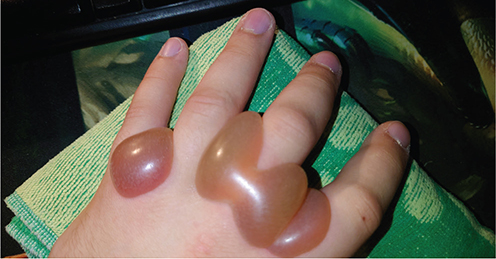
Fig. 1. Bullous dermatitis following exposure to sawdust.
Four months later, the patient presented with residual interstitial post-inflammatory changes. Colophony was suspected as the culprit agent as he was known to have a strong colophony allergy (1).
The patient’s own materials were patch tested; positive results are listed in Table I. Used gloves (as is) tested negative. Chemical analysis found colophony in the sawdust. He received new written and oral information and recommendations on what to avoid in his present occupation
| Material | Concentration and vehicle | Reaction |
| Case 1 | ||
| Sawdust | 100% alc. extracta | +++ |
| Sawdust | As is | ++ |
| Sawdust | 100% ac. extracta | ++ |
| Used gloves | 100% ac. extracta | ++ |
| Case 2 | ||
| Formaldehyde | 2% aq | ++ |
| Hydroabietyl alcohol | 10% pet | ++ |
| Canada balsam | 25% pet | ++ |
| Colophony | 20% pet | ++ |
| Colophony BSNb | 20% pet | ++ |
| Colophony | 60% softc | ++ |
| Fluoride varnishd | As is | ++ |
| Fluoride varnishd | 50% pet | ++ |
| Strappal® | As is | ++ |
| Strappal® | 100% ac. extracta | ++ |
| Leukoplast® | As is | ++ |
| Leukoplast® | 100% ac. extracta | ++ |
| Tensoplast® Sport | As is | ++ |
| Tensoplast® Sport | 100% ac. extracta | ++ |
| Boots, top inside seam | As is | ++ |
| Methyl hydrogenated rosinate | 20% pet | + |
| Abietic acid | 10% pet | + |
| Boots, top inside seam | 100% ac. extracta | + |
| Highest reaction magnitude from either reading is declared. a(2), bColophony supplied by the producer of medical adhesives; Essity, BSN medical SAS, Vibraye, France, c(13) dDuraphat® (Colgate-Palmolive Company, New York City, NY, USA), contains 33% colophony (14). cColophony supplied by the producer of medical adhesives, BSN Medical. alc: alcohol; ac: acetone; aq: aqueous; pet: petrolatum; soft: softisan. | ||
About a year later, he declared that he has been mostly asymptomatic. Minor dermatitis had subsided through self-care. He was still in grounds maintenance, but with adaptations so as to avoid colophony exposure.
Case 2: Occupational sensitization causing environmental allergic contact dermatitis. A previously healthy 20-year-old female student with no atopic history was referred to our department for suspected allergic contact dermatitis after wearing high boots.
During her conscription in 2023 the patient developed dermatitis of her feet and thighs following application of medical adhesives. The adhesives had previously been tolerated. She was successfully treated with oral betamethasone and emollients by army medics but ended her conscription without having been patch tested. A report on occupational injury was filed by the employer.
In spring 2024 the patient bought a pair of artificial leather boots that had a seam on the inside of the top. Bilateral dermatitis of the legs, corresponding to the placement of the seam, appeared after wearing the boots for one evening. The patient’s own pictures showed two areas of clearly demarcated erythema without any visible blistering around the circumference of the lower legs (Fig. 2).
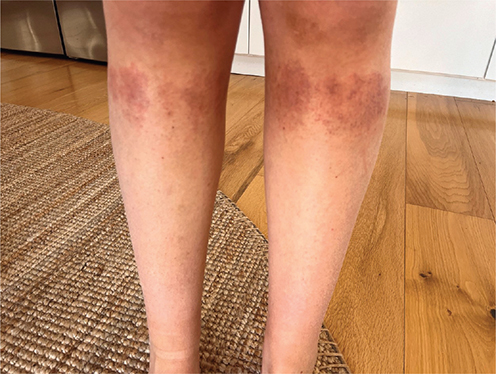
Fig. 2. Post-inflammatory changes after allergic contact dermatitis from colophony and formaldehyde in the seam of a pair of boots.
At referral a month later, patch testing was conducted using the Swedish baseline series, the Malmö extended baseline series, and a series used in previous investigations of conscripts (7). Additionally, the seam of her boots was patch tested and chemically analysed.
Positive patch test results are presented in Table I. Chemical analysis found both formaldehyde (20–40 ppm) and colophony in the boot seam.
The patient received written and oral information on how to avoid future exposure. One year later, she had been free of symptoms.
DISCUSSION
These patients were occupationally sensitized as conscripts, followed by elicitations on new locations in different environments in civilian life, illustrating the difficulty in eliminating exposure. Sensitization occurred at a young age and in their first occupation, resulting in a lifelong risk of dermatitis and other concomitant allergies (primarily fragrances and phenol-formaldehyde resin) (7, 8). Colophony is used in a wide variety of products, sometimes undeclared, and has even been found in products marketed as “hypoallergenic” (9).
In case 1, the dermatitis was most likely caused by colophony in the wood, which contaminated the gloves. Sawdust from pine wood can cause dermatitis in colo-phony-sensitive individuals (10). Allergy to the unused gloves cannot be excluded as they were not patch tested.
Case 2’s symptoms were interpreted as being caused by colophony in the seam. The formaldehyde concentration in the seam was low, although it possibly exacerbated the dermatitis (11).
The Swedish Armed Forces are aware of the sensitizing potential of medical adhesives, and stopped recommending the use of Optiplaste®-C following our department’s investigation of 27 conscripts (7). As demonstrated by Case 2, switching brands is often futile. Preventative taping is well known among outdoor enthusiasts and commonly advertised on social media (12), and it has been difficult for the Swedish Armed Forces to find alternative products. Perhaps other means of prophylaxis are preferable, as the evidence for preventative taping, to the best of the authors’ knowledge, is inconclusive.
In conclusion, these cases demonstrate the importance of thorough investigation and patient information, especially for young patients to enable informed career choices.
ACKNOWLEDGEMENTS
Data availability statement: The data that support the findings of this study are available on request from the corresponding author, JW. The data are not publicly available due to patient privacy.
REFERENCES
- Svedman C, Dahlin J, Hamnerius N, Adwa U, Bruze M. Occupational allergic contact dermatitis induced by adhesives used for prevention of chafing in the military forces: a case report. Contact Dermatitis 2023; 89: 391–393. https://doi.org/10.1111/cod.14398
- Bruze M, Trulsson L, Bendsøe N. Patch testing with ultrasonic bath extracts. Am J Contact Dermatitis 1992; 3: 133–137.
- Bruze M, Svedman C. Clarification and modification of the International Contact Dermatitis Research Group classification of patch test reactions on behalf of the International Contact Dermatitis Research Group. Dermatitis 2025 Jan 8 [Online ahead of print.]. https://doi.org/10.1089/derm.2024.0365
- Johansen JD, Aalto-Korte K, Agner T, Andersen KE, Bircher A, Bruze M, et al. European Society of Contact Dermatitis guideline for diagnostic patch testing: recommendations on best practice. Contact Dermatitis 2015; 73: 195–221. https://doi.org/10.1111/cod.12432
- Hamnerius N, Mowitz M. Intense skin reaction to a new glucose monitoring and insulin pump system. Contact Dermatitis 2020; 83: 524–527. https://doi.org/10.1111/cod.13663
- Gruvberger B, Bruze M, Fregert S, Lidén C. Allergens exposure assessment. In: Johansen JD, Frosch P, Lepoittevin, J-P, editors. Contact dermatitis. Berlin: Springer, 2011: p. 500–503. https://doi.org/10.1007/978-3-642-03827-3_27
- Hamnerius N, Dahlin J, Bruze M, Nilsson K, Sukakul T, Svedman C. Colophonium-related allergic contact dermatitis caused by medical adhesive tape used to prevent skin lesions in soldiers. Acta Derm Venereol 2023; 103: adv18428. https://doi.org/10.2340/actadv.v103.18428
- Bruze M. Simultaneous reactions to phenol-formaldehyde resins colophony/hydroabietyl alcohol and balsam of Peru/perfume mixture. Contact Dermatitis 1986; 14: 119–120. https://doi.org/10.1111/j.1600-0536.1986.tb01178.x
- Dendooven E, Foubert K, Naessens T, Pieters L, Lambert J, Goossens A, et al. Allergic contact dermatitis from (“hypoallergenic”) adhesives containing D-limonene. Contact Dermatitis 2022; 86: 113–119. https://doi.org/10.1111/cod.14008
- Meding B, Ahman M, Karlberg AT. Skin symptoms and contact allergy in woodwork teachers. Contact Dermatitis 1996; 34: 185–190. https://doi.org/10.1111/j.1600-0536.1996.tb02171.x
- Hauksson I, Pontén A, Gruvberger B, Isaksson M, Engfeldt M, Bruze M. Skincare products containing low concentrations of formaldehyde detected by the chromotropic acid method cannot be safely used in formaldehyde-allergic patients. Br J Dermatol 2016; 174: 371–379. https://doi.org/10.1111/bjd.14241
- Chronicles O. Avoid blisters when hiking // Leukotape can prevent and treat hotspots and blisters on the trail. online] [cited (2025-04-28). Available from: https://www.youtube.com/watch?v=0XuEa2J4SyU
- Bruze M, Dahlquist I, Fregert S. Patch testing with colophony at 60% concentration. Contact Dermatitis 1986; 15: 193. https://doi.org/10.1111/j.1600-0536.1986.tb01330.x
- Isaksson M, Bruze M, Björkner B, Niklasson B. Contact allergy to Duraphat. Scand J Dent Res 1993; 101: 49–51. https://doi.org/10.1111/j.1600-0722.1993.tb01646.x