RESEARCH LETTER
Sexually Transmitted Diseases: An Unprecedented Overview of Their Global Prevalence in a Study of 50,000 Participants
Bernard CRIBIER1, Charbel SKAYEM2,3, Catherine BAISSAC4, Yaron BENHAYOUN5, Bruno HALIOUA6, Charles TAIEB7, Marketa SAINT AROMAN8 and Marie ALETH RICHARD9
1Dermatology and Dermatopathology, Faculty of Medicine, University Hospital, University of Strasbourg, Strasbourg, France, 2Sorbonne University, Faculty of Medicine, Paris, France, 3Hôpital Ambroise Paré, Department of Dermatology, Boulogne Billancourt, France, 4Patient Centricity Department, Pharma, Dermocosmetics Care & Personal Care, Pierre Fabre, Toulouse, France, 5Data Scientist, European Market Maintenance Assessment, Tel Aviv, Israel, 6Dermatologist, Paris, France, 7Patients Priority Department, European Market Maintenance Assessment, FR-75006 Paris, France, 8Head of Corporate Medical Direction Pharma, Dermocosmetics Care & Personal Care, Pierre Fabre, Toulouse, France, and 9CEReSS-EA 3279, Research Centre in Health Services and Quality of Life Aix Marseille University Dermatology Department, University Hospital Timone, Assistance Publique Hôpitaux de Marseille, APHM, Marseille, France. E-mail: charles.taieb@emma.clinic
Citation: Acta Derm Venereol 2025; 105: adv43326. DOI: https://doi.org/10.2340/actadv.v105.43326.
Copyright: © 2025 The Author(s). Published by MJS Publishing, on behalf of the Society for Publication of Acta Dermato-Venereologica. This is an Open Access article distributed under the terms of the Creative Commons Attribution-NonCommercial 4.0 International License (https://creativecommons.org/licenses/by-nc/4.0/).
Submitted: Mar 8, 2025; Accepted after revision: Mar 13, 2025. Published: Apr 9, 2025.
Corr: Johan Kappelin, Dermatology Department, Landskrona Hospital, Vattenverksallén 15, SE-261 36 Landskrona, Sweden. E-mail: johan.kappelin@med.lu.se
Competing interests and funding: CB, and MSA are employed by the Pierre Fabre Laboratory. BC, YBH, CT, CS, MAR and BH have no conflict of interest in this study.
This study received a grant from Patient Centricity by Pierre Fabre.
Dear Editor,
Sexually transmitted infections (STIs) represent a major public health concern, with marked disparities depending on age, geographic region, and socioeconomic factors. The global burden of disease is significant, with a high prevalence of major STIs – 128 million cases of chlamydia, 29 million of gonorrhoea, 105 million of trichomoniasis, and 22.3 million of syphilis – according to the WHO global data from 2021 (1).
We conducted a large-scale study to provide a global overview of self-reported STIs using a questionnaire administered to diverse populations worldwide. The ALL PROJECT is a large-scale study involving individuals representative of the adult population in 20 countries across 5 continents. Participants were sampled from Europe (France, Italy, Germany, Poland, Portugal, Spain, Denmark; n = 17,500), Latin America (Brazil, Mexico; n = 6,501), Asia (China, India, South Korea; n = 10,500), North America (Canada, USA; n = 7,500), the Middle East (Israel, United Arab Emirates; n = 2,750), Australia (n = 2,000), and Africa (Kenya, South Africa, Senegal; n = 1,800). Representative and extrapolatable samples of the general population aged 16 years and older were surveyed in each country (2).
The questionnaire focused on patient experiences and collected information on demographics and the presence of a sexually transmitted infection. Participants were asked: “Do you currently have, or have you had in the past 12 months, a sexually transmitted disease?”
Multivariate logistic regression was employed to assess the association between the presence of an STI and explanatory variables, including sex (male vs female), location (urban vs semi-urban or rural), world region (Europe vs North America, Latin America, Asia, the Middle East, Africa), educational attainment (college degree vs no degree), and self-reported ethnicity (mixed vs Black, White, Asian, or other). Multicollinearity was checked using the Belsley–Kuh–Welsch technique, and heteroscedasticity and residual normality were assessed using the White and Lilliefors tests, respectively. A p-value of < 0.05 was considered statistically significant. Patients with missing data were excluded from the analysis. Statistical analysis was conducted using EasyMedStat (version 3.36; www.easymedstat.com).
A total of 50,552 individuals responded: 3.07% (n = 1,552) were uncertain about their STI status, and 3.82% (n = 1,931) reported having had an STI in the past 12 months (men: 1,087 [4.28%] vs women: 844 [3.35%], p < 0.001). The weighted prevalence, accounting for the sampling weight of each country, was 5.8% (Table I).
The prevalence of STIs was significantly higher among younger individuals: 5.36% in those aged 30 years and younger (n = 664), 4.11% in those aged 30–55 years (n = 1,017), and 1.47% in those aged 55 years and older (n = 178). In multivariate analysis, the absence of a university degree (OR = 1.32, [1.15–1.51], p < 0.0001) was associated with higher STI rates. Compared with Europe, living in North America (OR = 1.47, [1.20–1.80], p = 0.0002), Asia (OR = 1.60, [1.20–2.14], p = 0.0016), or the Middle East (OR = 1.72, [1.33–2.23], p < 0.0001) was also associated with higher STI rates.
Regarding ethnicity, reporting Asian (OR = 0.43, [0.33–0.58], p < 0.0001) or White ethnicity (OR = 0.53, [0.44–0.65], p < 0.0001) was associated with lower STI rates compared with mixed ethnicity. In contrast, living in Latin America (OR = 0.74, [0.60–0.92], p = 0.007), reporting a low income (OR = 0.51, [0.46–0.58], p < 0.0001), and living in a rural area (OR = 0.68, [0.59–0.79], p < 0.0001) were associated with lower STI rates. For Africa, the results of the multivariate analysis were not statistically significant. Being male or female was not independently associated with reporting an STI (Fig. 1).
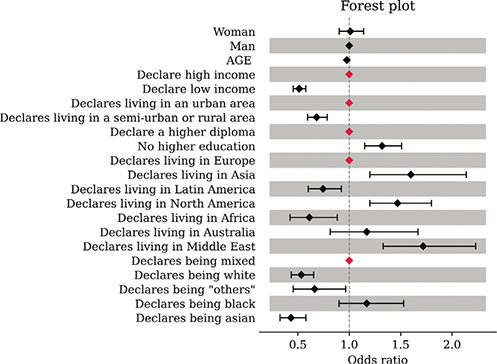
Fig. 1. Multvariate analysis results.
This study, the first of its size, provides valuable insights into the prevalence of STIs across 20 countries on 5 continents. With over 50,000 participants, it offers a global, comparative perspective, highlighting significant variations by age, region, education level, and ethnicity. The findings reveal increased STI prevalence among younger individuals, those with lower educational attainment, and residents of certain regions, particularly Europe, where rates are comparable to those reported in the EADV 2022 study on dermatological conditions (3). This congruence reinforces the validity of the data in a distinct sample.
WHO 2021 global data indicate that prevalence rates for the 4 major STIs range from 0.6% (syphilis) to 2.07% (trichomoniasis) (1). Laboratory-based data may underestimate prevalence, as self-reported data, like ours, suggest higher rates. From 2010 to 2019, global STI incidence rose significantly, with variations by age and region (4).
Striking results were observed in the Middle East and Africa, where STI screening programmes are often lacking despite high prevalence rates (5). The higher STI rates reported in the Middle East may reflect sample composition, such as the overrepresentation of migrant men (89% of the UAE population, according to the UN). In Africa, low reported prevalence rates may stem from cultural reluctance to discuss sexuality and the diversity of countries represented (e.g., South Africa, Senegal, Kenya). Moreover, the smaller sample size in Africa (1,800 respondents) compared with Europe (20,000 respondents) raises questions about potential bias, even with multivariate adjustments.
These findings are unique as they originate from self-reported data, offering a new perspective on STI epidemiology, distinct from laboratory or consultation-based studies.
Developing effective global strategies for STI prevention and treatment is critical (6–8). Our data, drawn from the largest study of its kind, provide essential insights that can inform global STI epidemiology, prevention, and treatment initiatives.
ACKNOWLEDGEMENTS
Data availability statement: The data that support the findings of this work are available from the corresponding author upon reasonable request.
Ethics statement: ID-RCB 2022-A01859-34.
Patient consent: All individuals gave their consent with the understanding that their information may be publicly available.
REFERENCES
- WHO. Global progress report on HIV, viral hepatitis and sexually transmitted infections, 2021. 2021 [accessed 15 Jan 2025]. Available from: https://www.who.int/publications/i/item/9789240027077
- Yosipovitch G, Skayem C, Aroman MS, Taieb C, Inane M, Hayoun YB, et al. International study on prevalence of itch: examining the role of itch as a major global public health problem. Br J Dermatol 2024; 191: 713–718. https://doi.org/10.1093/bjd/ljae260
- Richard MA, Paul C, Nijsten T, Gisondi P, Salavastru C, Taieb C, et al. EADV burden of skin diseases project team. Prevalence of most common skin diseases in Europe: a population-based study. J Eur Acad Dermatol Venereol 2022; 36: 1088–1096. https://doi.org/10.1111/jdv.18050
- Du M, Yan W, Jing W, Qin C, Liu Q, Liu M, et al. Increasing incidence rates of sexually transmitted infections from 2010 to 2019: an analysis of temporal trends by geographical regions and age groups from the 2019 Global Burden of Disease Study. BMC Infect Dis 2022; 22: 574. https://doi.org/10.1186/s12879-022-07544-7
- Obeid D, Alsuwairi F, Alnemari R, Al-Qahtani A, Kurdi W, Alfareh M, et al. Sexually transmitted infections in the Middle East and North Africa: comprehensive systematic review and meta-analysis. BMC Infect Dis 2024; 24: 1229. https://doi.org/10.1186/s12879-024-10153-1
- Chesson HW, Mayaud P, Aral SO. Sexually transmitted infections: impact and cost-effectiveness of prevention. In: Holmes KK, Bertozzi S, Bloom BR, Jha P, editors. Major infectious diseases. 3rd ed. Washington, DC: International Bank for Reconstruction and Development/The World Bank; 2017 Nov 3. Chapter 10.
- Gottlieb SL, Spielman E, Abu-Raddad L, Aderoba AK, Bachmann LH, Blondeel K, et al. WHO global research priorities for sexually transmitted infections. Lancet Glob Health 2024; 12: e1544–e1551. https://doi.org/10.1016/S2214-109X(24)00266-3
- WHO. Global health sector strategies on, respectively, HIV, viral hepatitis and sexually transmitted infections for the period 2022–2030. 2022. [accessed 15 Jan 2025]. Available from: https://www.who.int/publications/i/item/9789240053779