SHORT COMMUNICATION
Successful Control of Refractory Hidradenitis Suppurativa with Spesolimab: A Case Report
Yangfan LAI#, Yanzhuo HU#, Xiaoyao FAN, Baishuang YUE and Ying MA*
Department of Dermatology, Huashan Hospital, Fudan University, Shanghai, PR China. *E-mail: alle_ma@163.com
#These authors contributed to the work equally and should be regarded as co-first authors.
Citation: Acta Derm Venereol 2025; 105: adv43329. DOI: https://doi.org/10.2340/actadv.v105.43329.
Copyright: © 2025 The Author(s). Published by MJS Publishing, on behalf of the Society for Publication of Acta Dermato-Venereologica. This is an Open Access article distributed under the terms of the Creative Commons Attribution-NonCommercial 4.0 International License (https://creativecommons.org/licenses/by-nc/4.0/).
Submitted: Mar 9, 2025. Accepted after revision: Jun 2, 2025. Published: Jun 23, 2025.
Competing interests and funding: The authors have no conflicts of interest to declare.
This work was supported by the National Natural Science Foundation of China (Grant No.82304053 and Grant No.82173444) and the National Key Research and Development Program of China, Grant No.2023YFC2509000.
INTRODUCTION
Hidradenitis suppurativa (HS) is a chronic, refractory inflammatory skin disease primarily affecting the intertriginous pilosebaceous units (1). The disease manifests through the formation of painful nodules, abscesses, and dermal tunnels, which lead to irreversible scarring and significant discomfort, impairing patients’ quality of life (2). The pathogenesis of HS remains unclear, but microbial, hormonal, and lifestyle factors, as well as various immunological pathways involved in its inflammatory response, play a role (1). Treatment options include antibiotics, antiandrogens, metformin, traditional surgical interventions, and biologic therapies, effectively contributing to clinical improvement (2). TNF-α inhibitor adalimumab and IL-17 inhibitors such as secukinumab and bimekizumab have been approved for managing HS in some countries, but not yet in China (2). Here, we present a case of HS successfully managed with spesolimab, an IL-36R antibody approved for generalized pustular psoriasis (GPP) that also shows promise in treating HS.
CASE REPORT
Reporting no family history or comorbidity, a 20-year-old man had painful erythematous nodules on his buttocks and bilateral axillae for 2 years. These lesions subsequently developed into abscesses, resulting in scarring and pigmentation. During the 2 years without treatment, the patient’s symptoms gradually worsened and showed no signs of spontaneous improvement. After a 2-week course of 100 mg daily minocycline following an HS diagnosis at another hospital, the patient showed notable improvement. This relapsed after cessation of minocycline and he was later transitioned to subcutaneous adalimumab 40 mg weekly. The patient achieved temporary remission but quickly relapsed after the third dose of adalimumab, the deterioration manifesting as increased abscesses and nodules. Following a follow-up visit, the patient was treated with standard-dose minocycline in combination with adalimumab 40 mg weekly. However, after a fortnight there was still no sign of symptom improvement. As a result, the patient lost confidence in adalimumab, reduced the frequency of adalimumab to every other week, and eventually stopped treatment after the sixth dose of adalimumab, seeking help at our hospital (Fig. 1A, Hurley Stage III, IHS4 score:11). Then he received a 900 mg intravenous infusion of spesolimab, which is consistent with the dosage for GPP after systematic evaluation and exclusion of contraindications. Spesolimab treatment rapidly reduced the patient’s axillary abscesses, lowering the IHS4 score to 5 by Day 14 (Fig. 1B). To further improve the patient’s symptoms, we administered 2 more doses of 900 mg of spesolimab as maintenance therapy on Day 14 and Day 28. A total of 3 doses of 900 mg of spesolimab treatment every 2 weeks consistently alleviated the patient’s symptoms, reaching the mild stage by Day 28 (IHS4 score: 2, Fig. 1C), and the IHS4 score was reduced to 1 by Day 56. The improvement continues to be maintained after 4 months at the time of manuscript writing. Enzyme-linked immunosorbent assay (ELISA) of the patient’s peripheral blood showed a decrease of IL-1β, IL-17, IL-36α, TNF-α, CITH3, and MPO-DNA (Fig. 2). No adverse events were experienced.
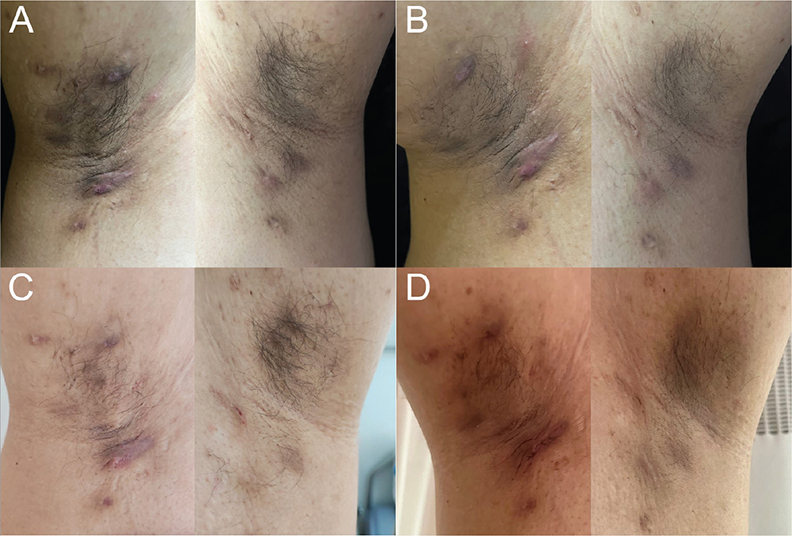
Fig. 1. Clinical response to spesolimab. (A) Pretreatment clinical image of the axillae. (B) Post-treatment clinical image on Day 14. (C) Posttreatment clinical image on Day 28. (D) Posttreatment clinical image on Day 56.

Fig. 2. Cytokine concentrations throughout the treatment period. Trends in inflammation and NETs-related biomarkers in patient serum detected by ELISA.
DISCUSSION
Based on the current understanding of the immunopathogenesis mechanism, molecular targets for therapeutic intervention of HS include IL-1, IL-17, and IL-36 (3). Neutrophils play a vital role in HS based on the current understanding of the immunopathogenesis mechanism (4). Activated through mechanisms such as phagocytosis, degranulation, and the formation of neutrophil extracellular traps (NETs), neutrophils contribute to autoinflammation and tissue damage in HS (5). Evidence shows that NETs are found in HS lesions and correlated with disease severity (1, 5). In lesions, keratinocytes secrete IL-36, which drives the production of pro-inflammatory cytokines, thus promoting Th1/Th17 axis response and the pathogenesis of HS (6).
Spesolimab, an IgG1 antibody targeting IL-36R, was granted for the treatment of GPP, where the process of neutrophil cell infiltration and Th1/Th17responses was observed (6, 7). Unlike the standard treatment regimen for GPP, more than 2 doses of spesolimab may be necessary for chronic inflammatory diseases such as HS. In a clinical trial (NCT04762277), a weekly 1200 mg subcutaneous injection of spesolimab was tested for people with moderate-to-severe HS. It demonstrated efficacy in improving lesions and reducing dermal tunnel counts, with a safety profile showing no adverse events leading to discontinuation in the spesolimab arm (8).
In this case, the patient’s symptoms were controlled with a lower dose, longer intervals, intravenous administration, and fewer treatment courses of spesolimab. This therapeutic approach, if further supported by more clinical studies, may potentially help reduce the financial burden associated with spesolimab treatment. In addition, we observed a downregulation of biomarkers involved in the IL-36 signalling pathway (IL-1β, IL-17, IL-36α, TNF-α) and NETs formation (CITH3, and MPO-DNA) in the patient’s peripheral blood, as measured by ELISA. Over a 120-day follow-up, the patient’s lesions remained controlled, and no adverse events were reported. Notably, a reduction in IL-36α and IL-17 levels was seen following spesolimab administration, suggesting a possible link between IL-36 pathway modulation and clinical improvement in this case.
While these findings are encouraging, they are based on a single case and should be interpreted with caution. This case highlights the potential of spesolimab in preventing the formation of NETs and the management of HS. Since there is no reported case to describe the use of spesolimab in HS in real-world research, further investigation into the long-term effects and the durability of remission is needed.
ACKNOWLEDGEMENTS
The authors would like to thank the patient for granting permission to publish this information.
REFERENCES
- Krueger JG, Frew J, Jemec GBE, Kimball AB, Kirby B, Bechara FG, et al. Hidradenitis suppurativa: new insights into disease mechanisms and an evolving treatment landscape. Br J Dermatol 2024; 190: 149–162. https://doi.org/10.1093/bjd/ljad345
- Zouboulis CC, Bechara FG, Fritz K, Goebeler M, Hetzer FH, Just E, et al. S2k guideline for the treatment of hidradenitis suppurativa / acne inversa – Short version. J Dtsch Dermatol Ges 2024; 22: 868–889. https://doi.org/10.1111/ddg.15412
- McCarthy S. Hidradenitis suppurativa. Annu Rev Med 2025; 76: 69–80. https://doi.org/10.1146/annurev-med-051223-031234
- Zouboulis CC, Frew JW, Giamarellos-Bourboulis EJ, Jemec GBE, Del Marmol V, Marzano AV, et al. Target molecules for future hidradenitis suppurativa treatment. Exp Dermatol 2021; 30: 8–17. https://doi.org/10.1111/exd.14338
- Ogawa Y, Muto Y, Kinoshita M, Shimada S, Kawamura T. Neutrophil extracellular traps in skin diseases. Biomedicines 2021; 9: 1888. https://doi.org/10.3390/biomedicines9121888
- Fukaura R, Akiyama M. Targeting IL-36 in inflammatory skin diseases. BioDrugs 2023; 37: 279–293. https://doi.org/10.1007/s40259-023-00587-5
- Blair HA. Spesolimab: first approval. Drugs 2022; 82: 1681–1686. https://doi.org/10.1007/s40265-022-01801-4
- Alavi A, Prens EP, Kimball AB, Frew JW, Krueger JG, Mukhopadhyay S, et al. Proof-of-concept study exploring the effect of spesolimab in patients with moderate-to-severe hidradenitis suppurativa: a randomized double-blind placebo-controlled clinical trial. Br J Dermatol 2024; 191: 508–518. https://doi.org/10.1093/bjd/ljae144