RESEARCH LETTER
Intermittent Low-dose Ritlecitinib in Refractory Paediatric Alopecia Areata: A Case Report with Therapeutic Implications
Yunhan HU1,2#, Cuilin XIE1#, Mengyao HU1, Yongjun CHEN1* and Ting YANG1*
1Department of Dermatology, Huangshi Central Hospital, Affiliated Hospital of Hubei Polytechnic University, Huangshi, Hubei 435000, China, and 2School of Medicine, Wuhan University of Science and Technology, Wuhan, Hubei. *E-mails: chenyongjun@hbpu.edu.cn and yangting@hbpu.edu.cn
#These authors contributed equally and should be considered as first authors.
Citation: Acta Derm Venereol 2025; 105: adv43607. DOI: https://doi.org/10.2340/actadv.v105.43607.
Copyright: © 2025 The Author(s). Published by MJS Publishing, on behalf of the Society for Publication of Acta Dermato-Venereologica. This is an Open Access article distributed under the terms of the Creative Commons Attribution-NonCommercial 4.0 International License (https://creativecommons.org/licenses/by-nc/4.0/).
Submitted: Apr 11, 2025; Accepted after revision: Apr 25, 2025; Published: Jun 16, 2025.
Competing interests and funding: The authors have no conflicts of interest to declare.
To the Editor,
Alopecia areata (AA) is a common non-scarring hair-loss disease with autoimmune characteristics and a tendency to recurrence. The incidence of AA in children is higher than in adults (1). Ritlecitinib has been approved for the treatment of severe AA in adults and children aged 12 years and older, but data on the safety and efficacy of its use for patients under 12 years old are scarce. Recent studies have demonstrated that oral ritlecitinib exhibits favourable short-term clinical efficacy and an acceptable tolerability profile in the treatment of AA in paediatric patients under 12 years old (2, 3).
We report a case of a 4-year-old preschool child with refractory AA. The patient’s first episode of hair loss occurred at the age of 1. At that time, there was a single focus of alopecia in the occipital region. The patient was initially treated with topical 5% minoxidil and halometasone 0. 05% cream. No improvement was observed, and the disease started to progress. By age 3, the boy experienced a near-total loss of scalp hair (Severity of Alopecia Tool [SALT] score of 95) and partial loss of eyebrows (Eyebrow Alopecia [EBA] score of 2). The patient had received dupilumab therapy (initial dose of 600 mg, followed by 300 mg every 2 weeks thereafter) for 3 months and subsequent oral tofacitinib treatment at 5 mg once daily for 1 month prior to presenting at my clinic several months later. This resulted in partial hair regrowth in several lesions, but partial hair regrowth in alopecic patches exhibited recurrent shedding characteristics. While partial hair regrowth was observed in some alopecic patches, these newly regenerated hairs demonstrated recurrent shedding patterns, suggesting treatment-refractory disease.
Upon admission, the patient presented with near-total hair loss on the scalp (Severity of Alopecia Tool [SALT] score of 95) and significant loss of the eyebrows (Eyebrow Alopecia [EBA] score of 2). Trichoscopic examination of the scalp showed numerous yellow dots, black dots, and broken hairs. No nail damage was observed. Laboratory tests, including full blood cell count, liver and kidney function tests, immunoglobulin E (IgE) levels, and dust mite tests were performed prior to treatment initiation. As no abnormalities were found, we recommended oral ritlecitinib at a dose of 50 mg once daily (50 mg QD). Unexpectedly, during follow-up, we found that his parents had administered 50 mg every other day (50 mg QOD) instead of the recommended dose. After 4 weeks of treatment, we noted significant hair regrowth on the scalp. This outcome significantly boosted the confidence in the treatment regimen of both the patient and his parents. Unfortunately, at the 4-week mark, the patient was hospitalized for sustained fever and subsequently diagnosed with Epstein–Barr virus (EBV) infection and transient elevated liver enzymes. Due to the acute infection, we advised discontinuing ritlecitinib until full recovery from the viral infection before considering resuming treatment. Four weeks after treatment discontinuation, the patient requested to take ritlecitinib on his own initiative because he was bullied at school due to alopecia areata. Given the previous effectiveness of the treatment, we maintained the recommendation of a 50 mg QOD dose. Further improvement was observed at subsequent follow-up visits after 12 and 24 weeks of therapy. After 24 weeks of treatment, the child’s scalp hair had almost fully grown back (SALT 5), and his eyebrows were completely restored to normal appearance (EBA=3), with no new infections during the treatment period and normal follow-up blood and liver function tests. The results are shown in Fig. 1.
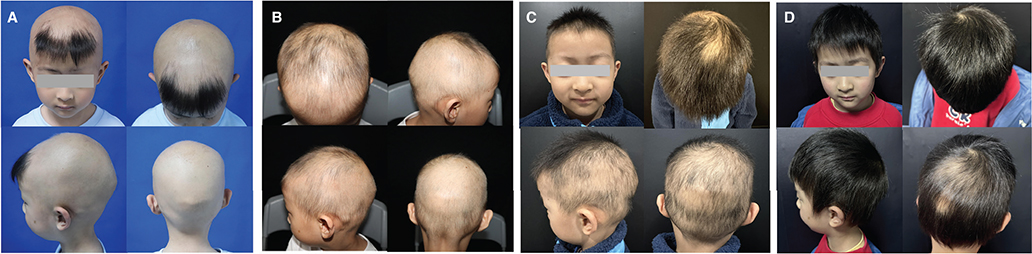
Fig. 1. (A) Before starting ritlecitinib therapy. (B) After 4 weeks of ritlecitinib. (C) After 12 weeks of ritlecitinib. (D) After 24 weeks of ritlecitinib therapy.
To our knowledge, this represents the first reported case of intermittent low-dose ritlecitinib (50 mg QOD) in preschool-aged children, demonstrating that reduced-frequency JAK inhibition can maintain therapeutic efficacy in paediatric patients. No severe adverse events were observed beyond the week-4 findings of Epstein–Barr virus (EBV) infection and elevated liver enzymes. While elevated liver enzymes are a well-documented class effect of JAK inhibitors, the causal relationship between ritlecitinib and EBV reactivation remains unclear. The unique pharmacodynamic profile of paediatric patients – including lower bodyweight and immature metabolic pathways – suggests that reduced-dose ritlecitinib (50 mg QOD) may optimize the therapeutic window by balancing efficacy and safety. Furthermore, the intermittent dosing regimen not only offers potential clinical advantages for patients but also takes into account socioeconomic considerations.
In conclusion, these preliminary results highlight the potential of ritlecitinib as a promising treatment option for children with AA, and large-scale prospective studies to further explore its efficacy and safety in paediatric AA are essential.
ACKNOWLEDGEMENTS
This study is supported by funding from the the Natural Science Foundation of Hubei Province(JCZRLH202501324).
Ethical approval: Reviewed and approved by the institutional research ethics boards of Huangshi Central Hospital (Hubei,China).
Ethics statement: The patient discussed in this manuscript has given written informed consent to the publication of the case details.
Data availability statement: The data that support the findings of this study are available from the corresponding author upon reasonable request.
REFERENCES
- Lee HH, Gwillim E, Patel KR, Hua T, Rastogi S, Ibler E, et al. Epidemiology of alopecia areata, ophiasis, totalis, and universalis: a systematic review and meta-analysis. J Am Acad Dermatol 2020; 82: 675–682. https://doi.org/10.1016/j.jaad.2019.08.032
- Gonzalez ME, Browning J, Smith S, Plotka A, Zhu JD, Parvatini S, et al. A phase 1, open-label study of the pharmacokinetics of ritlecitinib in children aged 6–12 years with alopecia areata. Pediatr Dermatol 2025, Feb 9. [Online ahead of print] https://doi.org/10.1111/pde.15895
- Huang J, Jian J, Li M, Ji R, Li J, Shi W. Effectiveness and tolerability of ritlecitinib in children with alopecia areata: a case series. J Am Acad Dermatol 2025; 92: 1395–1397. https://doi.org/10.1016/j.jaad.2025.01.090