RESEARCH LETTER
Cutaneous Squamous Cell Carcinoma in the Post-COVID-19 Era: Dramatic Increase of New Cases in 2023 in Two German Skin Tumour Centers
Peter MROTZEK1,2, Silke C. HOFMANN1, Alexander KREUTER3, Sebastian APPELBAUM4, Ulrich WESSELMANN1, Ulrich Peter WEHRY3 and Galina BALAKIRSKI1*
1Center for Dermatology, Allergology and Dermatosurgery, Helios University Hospital Wuppertal, University of Witten/Herdecke, Wuppertal, Germany, 2Faculty of Health, University of Witten/Herdecke, Witten, Germany, 3Department of Dermatology, Venereology and Allergology, Helios St. Elisabeth Hospital Oberhausen, University of Witten/Herdecke, Oberhausen, Germany, and 4Center for Clinical Trials, Department of Medicine, Faculty of Health, Witten/Herdecke University, Witten, Germany. *E-mail: galina.balakirski@helios-gesundheit.de
Citation: Acta Derm Venereol 2025; 105: adv43609. DOI: https://doi.org/10.2340/actadv.v105.43609.
Copyright: © 2025 The Author(s). Published by MJS Publishing, on behalf of the Society for Publication of Acta Dermato-Venereologica. This is an Open Access article distributed under the terms of the Creative Commons Attribution-NonCommercial 4.0 International License (https://creativecommons.org/licenses/by-nc/4.0/).
Submitted: 11 Apr 2025; Accepted after revision: 25 Apr 2025; Published: June 9, 2025.
Competing interests and funding: The authors have no conflicts of interest to declare.
To the Editor,
The incidence of non-melanoma skin cancer (NMSC) is described as rising worldwide (1). In a recent data analysis up to 2019, the annual incidence increase for cutaneous squamous cell carcinoma (cSCC) was estimated at 2.06% worldwide, with an even greater increase in countries with high socioeconomic status (2). However, the global outbreak of the COVID-19 pandemic in 2020 made it impossible to observe the further natural epidemiological development of this cutaneous neoplasia. Although a decline in tumour incidence was observed in many medical fields at the beginning of the COVID-19 pandemic (3), the incidence of cSCC in Europe did not show a significant reduction compared with 2019 according to a recent meta-analysis (4). Only a few data on the impact of the SARS-CoV-2 pandemic on cSCC incidence in Germany have been reported. It has been shown that inpatient surgical treatment for NMSC decreased by about 12–16% during the first year of the pandemic compared with 2019 (5, 6). Our working group found no decrease in the annual number of cSCCs in 2 German tumour centers in 2020 and 2021 compared with the year before the COVID-19 pandemic, but there was an increase of particularly thick tumours (˃ 6 mm tumour thickness) in both years, which could indicate a possible influence of the SARS-CoV-2 pandemic on the management of patients with cSCC (7). Information on the epidemiological development of cSCC in Europe and particularly in Germany after the end of the COVID-19 pandemic is currently very limited. Therefore, we investigated the number and clinical as well as histological characteristics of newly diagnosed cSCCs in the years 2022 and 2023 (post-COVID-19 era) and compared them with the already available data from 2019 to 2021 in 2 board-certified skin cancer centers in North Rhine-Westphalia (Wuppertal and Oberhausen) (7).
The project has been approved by the responsible ethics committee of University Witten/Herdecke (application number S-235/2021). For statistical analysis IBM SPSS Statistics (version 29.0, IBM Corp, Armonk, NY, USA) was used. Descriptive statistics of metric scaled data were given by mean and standard deviation (SD). Group comparisons were performed using ANOVA and t-test to compare the groups with each other. The distribution of categorical data was presented in absolute and relative frequencies and compared between groups using a χ2 test. All statistical hypothesis testing was two-tailed with a significance level of 0.05.
Neither the age nor the gender distribution of affected patients from 2020 to 2023 differed from those in 2019, indicating no changes in the patient population before, during, and after the end of the COVID-19 pandemic (Table I). The tumour thickness of the diagnosed tumours increased from 3.0 ± 3.0 mm in 2019 to 3.5 ± 3.4 mm in 2020, which proved to be statistically significant (p = 0.042). Although there was no significant difference in tumour thickness in 2021 compared with 2019 (p = 0.185), tumour thickness increased to 3.5 ± 2.9 mm and 3.7 ± 3.3 mm in 2022 and 2023, respectively, which was again statistically significant (p = 0.018 and p = 0.004). Regarding the annual number of thick tumours (tumour thickness ˃ 6 mm), significantly more of these tumours were diagnosed in 2021 and 2023 compared with 2019 (p = 0.042 and p = 0.041, respectively). Although there was also an increase in thick tumours in 2020 (13.5%) and 2022 (13.7%) compared with 2019 (8.2%), this was not statistically significant. In addition, there was a significant shift in the pT stages in 2021, 2022, and 2023 compared with 2019, with a decrease in pT1-stage tumours and an increase in pT2-stage tumours (Table I). There was also an important development in the total number of newly diagnosed cSCCs per year. During the COVID-19 pandemic, there was a slow increase in the number of tumours per year by 6.8% and 1.1% in 2020 and 2021 respectively compared with each preceding year. After the end of the SARS-CoV-2 pandemic, there was a slightly stronger increase of 9.5% in 2022, but a dramatic increase of 29.4% in the number of tumours in 2023 (Fig. 1).
| Factor | Year | p-value | ||||
| 2019 | 2020 | 2021 | 2022 | 2023 | ||
| Tumour thickness, mm, mean ± SD | 3.0 ± 3.0 | 3.5 ± 3.4** | 3.3 ± 3.1 | 3.5 ± 2.9** | 3.7 ± 3.3** | 0.045** |
| Age, years, mean ± SD | 80.8 ± 9.2 | 80.8 ± 10.2 | 80.3 ± 9.4 | 81.9 ± 8.3 | 80.7 ± 9.2 | 0.146 |
| Total number of newly diagnosed cSCCs, n (%) | 340 | 363 | 367 | 402 | 520 | |
| Tumour stage*, n (% | ||||||
| pT1 | 290 (85.3) | 293 (80.7) | 292 (79.6)** | 321 (79.9)** | 397 (76.3)** | 0.009** |
| pT2 | 14 (4.1) | 34 (9.4) | 53 (14.4)** | 56 (13.9)** | 76 (14.6)** | |
| pT3 | 28 (8.2) | 33 (9.1) | 12 (3.3)** | 10 (2.5)** | 22 (4.3)** | |
| N/A | 8 (2.4) | 3 (0.8) | 10 (2.7)** | 15 (3.7)** | 25 (4.8)** | |
| Tumour grading, n (%) | ||||||
| 1 | 145 (42.6) | 161 (44.4) | 156 (42.5) | 180 (44.8) | 226 (43.4) | 0.095 |
| 2 | 156 (45.9) | 161 (44.4) | 170 (46.3) | 152 (37.8) | 210 (40.4) | |
| 3 | 25 (7.4) | 31 (8.5) | 29 (7.9) | 53 (13.2) | 57 (11.0) | |
| N/A | 14 (4.1) | 10 (2.7) | 12 (3.3) | 17 (4.2) | 27 (5.2) | |
| Tumour thickness, n (%) | ||||||
| ≤ 6 mm | 312 (91.8) | 314 (86.5) | 313 (85.3)** | 347 (86.3) | 446 (85.8)** | 0.273 |
| > 6 mm | 28 (8.2) | 49 (13.5) | 54 (14.7)** | 55 (13.7) | 74 (14.2)** | |
| Perineural invasion | 2 (0.6) | 3 (0.8) | 1 (0.3) | 5 (1.2) | 1 (0.2) | 0.268 |
| Desmoplasia | 2 (0.6) | 0 (0) | 3 (0.8) | 4 (1.0)** | 6 (1.2)** | < 0.001** |
| Gender | ||||||
| Male | 230 (67.6) | 265 (73.0) | 243 (66.2) | 265 (65.9) | 358 (68.9) | 0.218 |
| Female | 110 (32.4) | 98 (27.0) | 124 (33.8) | 137 (34.1) | 172 (33.1) | |
| N/A: data not recorded or not available. *According to the 8th edition AJCC/UICC staging classification (2017).**Statistically significant change compared with the year 2019 (p < 0.05). | ||||||
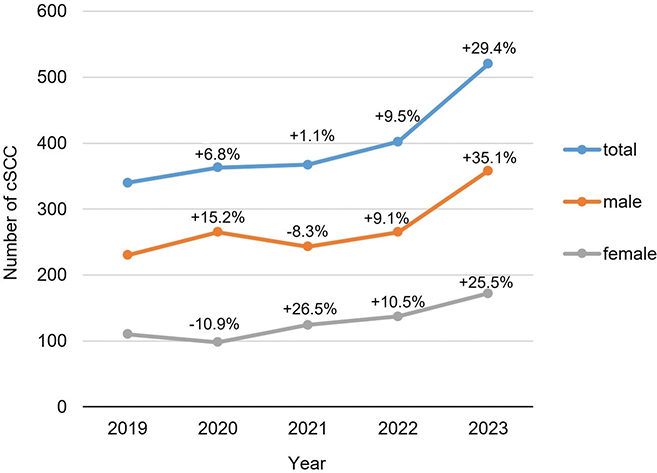
Fig. 1. Number of newly diagnosed cutaneous squamous cell carcinomas (cSCCs) by year at 2 board-certified skin cancer centers in North Rhine-Westphalia (Wuppertal and Oberhausen). The percentage increase in new cases is shown compared with the corresponding previous year.
Although there are some reports of large or high-risk cSCCs during the COVID-19 pandemic in European countries (8–10), most of the available data suggest that surgical procedures for cSCC across Europe were provided during the SARS-COV-2 pandemic without a significant delay (4, 10). However, analyses of cSCC incidence in the post-COVID-19 era are scarce. In line with currently available data, we found no demographic changes in affected patients during and after the COVID-19 pandemic regarding age and gender distribution. While we noticed a shift in pT stages towards slightly more advanced tumours and an increase in tumour thickness during the COVID-19 pandemic, this trend continued into 2023 after the SARS-COV-2 pandemic ended, so it remains unclear whether this is a general trend and not a pandemic-related effect. Notable, however, is the dramatic increase in newly diagnosed cSCCs in 2023: by 29.4% compared with the previous year. A clear explanation for this finding does not seem possible to the authors. A postponement effect after the COVID-19 pandemic may be possible to a certain extent, so that patients consulted a healthcare professional only after the end of the SARS-CoV-2 pandemic. Furthermore, unlike melanoma, cSCC lesions can usually be recognized by patients themselves, as tumours are associated with exophytic growth or bleeding, which usually leads patients to seek medical consultation. However, this fact alone does not explain the dramatic increase in incidence in combination with a higher tumour thickness and increased number of tumours with a thickness of over 6 mm in 2023. To summarize, we found a trend towards high-risk cSCC and an over-proportional increase in cSCC incidence after the end of the SARS-COV-2 pandemic in 2 board-certified skin cancer centers in Germany. Whether these changes are attributable to the COVID-19 pandemic or represent a general development in Western society must be identified in further longitudinal studies.
ACKNOWLEDGEMENT
The authors would like to thank Steffen Goldbach (Medical Documentation of the Department of Dermatology, Venereology and Allergology, Helios St. Elisabeth Hospital Oberhausen) for providing the clinical information on tumour diagnosis and thickness.
REFERENCES
- Hu W, Fang L, Ni R, Zhang H, Pan G. Changing trends in the disease burden of non-melanoma skin cancer globally from 1990 to 2019 and its predicted level in 25 years. BMC Cancer 2022; 22: 836. https://doi.org/10.1186/s12885-022-09940-3
- Zhou L, Zhong Y, Han L, Xie Y, Wan M. Global, regional, and national trends in the burden of melanoma and non-melanoma skin cancer: insights from the global burden of disease study 1990–2021. Sci Rep 2025; 15: 5996. https://doi.org/10.1038/s41598-025-90485-3
- Decker KM, Feely A, Bucher O, Czaykowski P, Hebbard P, Kim JO, et al. New cancer diagnoses before and during the COVID-19 pandemic. JAMA Netw Open 2023; 6: e2332363. https://doi.org/10.1001/jamanetworkopen.2023.32363
- Wall J, Gadsby-Davis K, Mistry K, Levell NJ, Venables ZC. Impact of the COVID-19 pandemic on international cutaneous squamous cell carcinoma incidence: a systematic review and meta-analysis. Skin Health Dis 2024; 4: e405. https://doi.org/10.1002/ski2.405
- Kleemann J, Meissner M, Özistanbullu D, Balaban Ü, Old O, Kippenberger S, et al. Impact of the Covid-19 pandemic on melanoma and non-melanoma skin cancer inpatient treatment in Germany: a nationwide analysis. J Eur Acad Dermatol Venereol 2022; 36: 1766–1773. https://doi.org/10.1111/jdv.18217
- Balakirski G, Assaf C, Dippel E, Fröhlich A, Kofler L, Kreuter A, et al. Auswirkungen der COVID-19-Pandemie auf die stationäre Dermatochirurgie in Deutschland. Retrospektive Auswertung der operativen Fälle aus neun Hautkliniken. Dermatologie (Heidelb) 2024; 75: 864–877. https://doi.org/10.1007/s00105-024-05417-5
- Balakirski G, Sabulyte S, Wesselmann U, Michalowitz AL, Kreuter A, Hofmann SC. Long-term effects of the COVID-19 pandemic on cutaneous squamous cell carcinoma: increase of thick tumors in two German dermatology clinics. J Dtsch Dermatol Ges 2023; 21: 910–913. https://doi.org/10.1111/ddg.15087
- Shahid S, Gao J, Corriero AC, Roszpopa J, Miranda BH. A study of the effects of delayed patient presentation on cutaneous SCC progression. J Plast Reconstr Aesthet Surg 2022; 75: 722–729. https://doi.org/10.1016/j.bjps.2021.09.015
- Taccioli F, Blessent CGF, Paganelli A, Fagioli F, Chester JM, Kaleci S, et al. Delay in cutaneous squamous cell carcinoma diagnosis due to interrupted services is associated with worse prognoses and modified surgical approaches. Cancers (Basel) 2024; 16: 1469. https://doi.org/10.3390/cancers16081469
- Díaz-Calvillo P, Sánchez-Díaz M, Rodríguez-Pozo JÁ, Martínez-Ruiz V, Martínez-López A, Arias-Santiago S. Impact of COVID-19 pandemic on cutaneous squamous cell carcinoma: a single-centre study of epidemiologic, clinic and histopathological factors. Actas Dermosifiliogr 2024; 115: 224–230. https://doi.org/10.1016/j.ad.2023.10.003
- Sangers TE, Wakkee M, Kramer-Noels EC, Nijsten T, Louwman MWJ, Jaspars EH, et al. Limited impact of COVID-19-related diagnostic delay on cutaneous melanoma and squamous cell carcinoma tumour characteristics: a nationwide pathology registry analysis. Br J Dermatol 2022; 187: 196–202. https://doi.org/10.1111/bjd.21050