SHORT COMMUNICATION
Systemic Inflammatory Indexes as Easy-to-Use Markers for Monitoring Psoriasis and Hidradenitis Suppurativa
Eugenia Veronica DI BRIZZI, Dario BUONONATO, Alfonso Luca FALCO, Elisabetta FULGIONE, Stefano CACCAVALE, Giuseppe ARGENZIANO and Anna BALATO
Dermatology Unit, Department of Mental and Physical Health and Preventive Medicine, University of Campania Luigi Vanvitelli, Naples, Italy.
E-mail: eugeniaveronica.dibrizzi@gmail.com
Citation: Acta Derm Venereol 2026; 106: adv43695. DOI: https://doi.org/10.2340/actadv.v106.43695.
Copyright: © 2026 The Author(s). Published by MJS Publishing, on behalf of the Society for Publication of Acta Dermato-Venereologica. This is an Open Access article distributed under the terms of the Creative Commons Attribution-NonCommercial 4.0 International License (https://creativecommons.org/licenses/by-nc/4.0/).
Submitted: Apr 23, 2025. Accepted after revision: Mar 20, 2026. Published: Apr 9, 2026.
Competing interests and funding: The authors have no conflicts of interest to declare.
INTRODUCTION
Psoriasis (PSO) and hidradenitis suppurativa (HS) are chronic inflammatory skin diseases associated with significant morbidity and reduced quality of life (1–3). Systemic inflammation plays a key role in their pathogenesis and may influence disease severity and treatment response (4, 5).
Disease severity is mainly assessed using clinical scores, such as the Psoriasis Area and Severity Index (PASI) for psoriasis and staging systems like the Hurley classification for HS (6). However, these tools are partly subjective and may not fully reflect systemic inflammatory activity.
Recently, blood-derived inflammatory indexes obtained from routine laboratory tests, including the neutrophil-to-lymphocyte ratio (NLR), systemic immune-inflammation index (SII), and systemic inflammation response index (SIRI), have been proposed as potential biomarkers of systemic inflammation (7).
The aim of this study was to evaluate the role of these indexes as biomarkers for disease monitoring and treatment response in patients with psoriasis and hidradenitis suppurativa.
MATERIALS, METHODS and RESULTS
This study consists of 2 parts: a cross-sectional observational study and a prospective study. The cross-sectional study involved adult patients with plaque psoriasis and/or hidradenitis suppurativa (HS), regardless of ongoing treatment, including systemic and biologic therapies. Healthy controls were also enrolled from individuals accompanying patients during clinical visits. The prospective study included a subgroup of psoriasis patients starting biologic therapy. Blood samples were collected at baseline (W0) and after 4 weeks of treatment (W4) to assess changes in inflammatory indexes. Data were collected at the Specialized Unit for Chronic Inflammatory Skin Diseases of the University of Campania “Luigi Vanvitelli”, Naples, Italy, between January and December 2024. Demographic and clinical data were recorded, including age, sex, body mass index (BMI), disease duration, previous and current therapies, and disease severity scores. Psoriasis severity was evaluated using PASI, BSA, and DLQI, while HS severity was assessed using Hurley stage, Sartorius score, and DLQI. Complete blood count parameters were used to calculate inflammatory indexes. NLR was calculated as neutrophils/lymphocytes, SII as neutrophils × platelets/lymphocytes, and SIRI as neutrophils × monocytes/lymphocytes.
Descriptive statistics were used to summarize demographic and clinical characteristics. Continuous variables were expressed as mean ± standard deviation, while categorical variables were reported as absolute numbers and percentages. Comparisons between independent groups were performed using the Mann–Whitney U test, whereas paired data in the prospective analysis were evaluated using the Wilcoxon signed-rank test. Correlations between inflammatory indexes (SII, NLR, SIRI) and disease severity (PASI for psoriasis and Sartorius score for HS) were assessed using Spearman’s correlation coefficient. A multivariate logistic regression model was used to evaluate factors associated with higher SII levels (≥ 500). Statistical analyses were performed using GraphPad Prism 6.0 (https://www.graphpad.com/) and SAS v9.3 (SAS Institute, Cary, NC, USA), with p < 0.05 considered statistically significant.
The study was conducted in accordance with the Declaration of Helsinki, and all participants provided written informed consent.
A total of 437 participants were included: 235 patients with psoriasis, 100 with hidradenitis suppurativa (HS), and 102 healthy controls. The overall population showed a predominance of males (60%), with a similar distribution in psoriasis (59%) and HS (62%). Mean age was 44 ± 15.5 years, with psoriasis patients being older than HS patients (53 ± 15.8 vs 35 ± 15.3 years). The mean body mass index was 27.6 ± 9.43, indicating a general tendency towards overweight.
Psoriasis patients showed a higher prevalence of comorbidities compared with HS patients. Detailed demographic and clinical characteristics are reported in Table I.
In the psoriasis cohort, mean PASI was 6.14 ± 5.56 and mean disease duration was 14.5 ± 13.3 years. Approximately 50% of patients were receiving systemic therapy at the time of evaluation, which may partially explain variability in disease severity scores. Lesions most frequently involved the limbs, trunk, and scalp.
In HS patients, the mean Sartorius score was 30.73 ± 12.72, with a mean disease duration of 8.9 ± 7.1 years. Lesions were most commonly located in the axillary and inguinal regions, often involving multiple anatomical sites.
The SII, NLR, and SIRI were significantly higher in psoriasis and HS patients compared with healthy controls. All analysed indexes were statistically significant lower in patients with ongoing treatment respect to those without any treatments (Fig. 1).
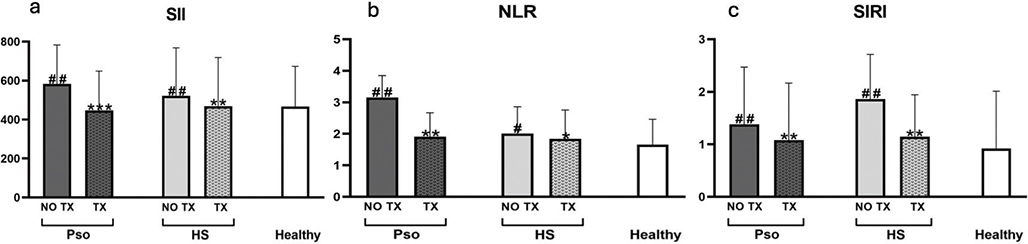
Fig. 1. Systemic Immune-Inflammation Index (SII), Neutrophil-to-Lymphocyte Ratio (NLR), and Systemic Inflammation Response Index (SIRI) in psoriasis (Pso), hidradenitis suppurativa (HS) and healthy subjects. Statistical significance is indicated as follows: ***p < 0.001, **p < 0.01, *p < 0.05 when the reference is represented by patients without any treatment (NO TX), whereas when comparison is vs healthy controls (Healthy) it is reported as follows ##p < 0.01, #p < 0.05. TX: patients on treatment.
Correlation analysis showed no significant association between inflammatory indexes and PASI score in psoriasis patients. In contrast, a significant positive correlation was observed between SII and Sartorius score in HS patients (Spearman r = 0.50, p < 0.05) (Fig. 2A).
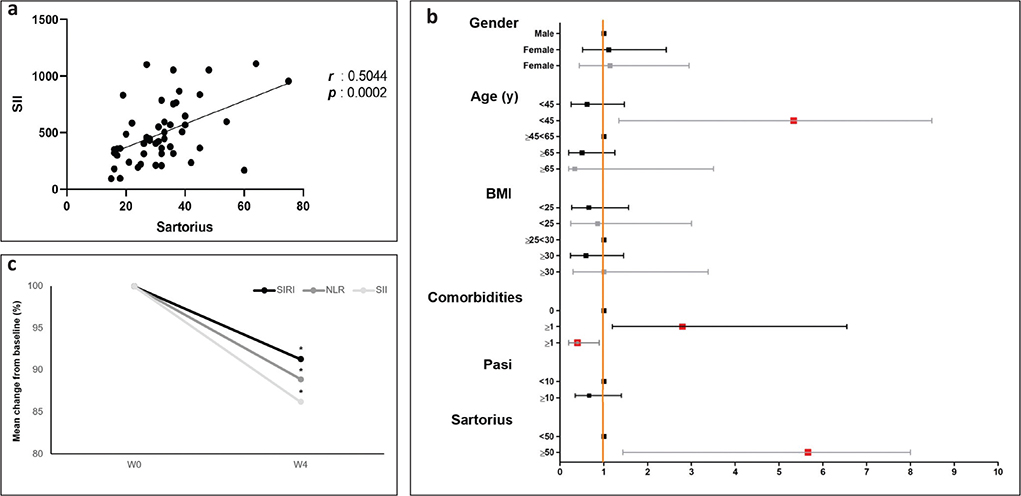
Fig. 2. (A) Correlation between Systemic Immune-Inflammation index (SII) and Sartorius score in patients with hidradenitis suppurativa. (B) Forest plot of the multivariate logistic regression model assessing clinical and demographic factors associated with SII ≥ 500 in psoriasis and hidradenitis suppurativa patients. Odds ratios and 95% confidence intervals are shown. (C) Mean percentage change in systemic inflammatory indexes (SII, Neutrophil-to-Lymphocyte Ratio, and Systemic Inflammation Response Index) from baseline (W0) to week 4 (W4) in psoriasis patients receiving biologic therapy. p < 0.05.
A cut-off value of ≥ 500 was established for SII, based on previous studies indicating its association with increased severity of psoriasis and psoriatic arthritis. Moreover, recent evidence suggests that elevated SII levels (≥ 479.15 × 10⁹/L) may also be linked to a higher risk of developing psoriasis in an outpatient population (8, 9). Patients with SII ≥ 500 were analysed to identify clinical factors associated with elevated systemic inflammation. In psoriasis patients, the presence of at least 1 comorbidity was associated with higher SII levels (OR 2.8; 95% CI 1.196–6.556; = 0.0158). In HS patients, age < 45 years and Sartorius score ≥ 50 were associated with increased odds of higher SII, whereas the presence of comorbidities showed an inverse association (Fig. 2B).
Patients receiving biologic therapy showed significantly lower SII values compared with those receiving non-biologic treatments in both psoriasis (p < 0.01) and HS (p < 0.05), whereas no significant differences were observed for NLR and SIRI.
Further analysis according to biologic drug class showed lower SII levels in patients treated with TNF-α inhibitors compared with IL-17 and IL-23 inhibitors. No differences between IL-17 and IL-23 inhibitors were observed in HS patients, whereas IL-17 inhibitors showed lower SII levels compared with IL-23 inhibitors in psoriasis patients.
A prospective analysis was performed in 23 psoriasis patients starting biologic therapy (anti-IL-17, n = 14; anti-IL-23, n = 9). After 4 weeks of treatment, a significant reduction in all inflammatory indexes was observed. SII decreased by 13.8%, NLR by 11.1%, and SIRI by 8.7% (p < 0.05) (Fig. 2C).
DISCUSSION
The therapeutic management of chronic inflammatory skin diseases such as psoriasis and hidradenitis suppurativa requires objective biomarkers to evaluate systemic inflammation and treatment response. In this context, blood-derived immune-inflammatory indexes, including the neutrophil-to-lymphocyte ratio (NLR), systemic immune-inflammation index (SII), and systemic inflammation response index (SIRI), have emerged as potential indicators of inflammatory activity (7).
In our study, patients with psoriasis and HS showed higher SII, NLR, and SIRI values compared with healthy controls, confirming the presence of systemic inflammatory activation in these diseases. These findings are consistent with previous studies reporting elevated inflammatory indexes in psoriasis and HS patients (10, 11). Moreover, treated patients showed significantly lower levels of these indexes compared with untreated patients, suggesting that systemic therapies may reduce systemic inflammatory burden. Similar reductions in inflammatory markers following biologic therapy have been previously reported in psoriasis patients (12). Our analysis also demonstrated a significant association between SII and disease severity in HS patients, as reflected by the correlation with Sartorius score. Previous studies have reported similar findings, indicating that SII may reflect the systemic inflammatory component underlying HS progression (13). However, conflicting results have also been described, suggesting that SII may partly reflect cardiovascular or metabolic risk rather than disease activity alone (14). In psoriasis, no significant correlation was observed between inflammatory indexes and PASI score. This finding suggests that systemic inflammation in psoriasis may be more closely related to comorbid burden than to cutaneous severity, as also suggested in previous studies (15).
Finally, our prospective analysis showed a rapid reduction of inflammatory indexes after biologic therapy, supporting their potential role as accessible biomarkers for monitoring treatment response in clinical practice.
ACKNOWLEDGEMENT
Ethics statement: The patients in this manuscript have given written informed consent to publication of their case details. This study follows the ethics guidelines.
REFERENCES
- Ziehfreund S, Wecker H, Mittag S, Weis J, Tizek L, Verkhoturova V, et al. Happiness across the borders: a cross-sectional study among patients with psoriasis and atopic dermatitis in Europe. J Eur Acad Dermatol Venereol 2025; 39: 529–542. https://doi.org/10.1111/jdv.20288
- Licata G, Di Brizzi EV, Castelli F, Giuffrida G, Stroppiana E, Dattola A, et al. Tildrakizumab and quality of life: deep dive into the impact of psoriasis and treatment on different domains: should psychosocial life impairment be considered a comorbidity? J Clin Med 2025; 14: 223. https://doi.org/10.3390/jcm14010223
- Zouboulis CC, Del Marmol V, Mrowietz U, Prens EP, Tzellos T, Jemec GB. Hidradenitis suppurativa/acne inversa: criteria for diagnosis, severity assessment, classification and disease evaluation. Dermatology 2015; 231: 184–190. https://doi.org/10.1159/000431175
- Parisi R, Symmons DP, Griffiths CE, Ashcroft DM. Identification and Management of Psoriasis and Associated ComorbidiTy (IMPACT) project team. Global epidemiology of psoriasis: a systematic review of incidence and prevalence. J Invest Dermatol 2013; 133: 377–385. https://doi.org/10.1038/jid.2012.339
- Di Brizzi EV, Buononato D, Benvenuto P, et al. Effectiveness and safety after a switch to tildrakizumab: a real world multicenter Italian study in psoriasis. Dermatol Pract Concept 2023; 13: e2023215. https://doi.org/10.5826/dpc.1304a215
- Mattei PL, Corey KC, Kimball AB. Psoriasis Area Severity Index (PASI) and the Dermatology Life Quality Index (DLQI): the correlation between disease severity and psychological burden in patients treated with biological therapies. J Eur Acad Dermatol Venereol 2014; 28: 333–337. https://doi.org/10.1111/jdv.12106
- Morariu SH, Cotoi OS, Tiucă OM, Baican A, Gheucă-Solovăstru L, Decean H, et al. Blood-count-derived inflammatory markers as predictors of response to biologics and small-molecule inhibitors in psoriasis: a multicenter study. J Clin Med 2024; 13: 3992. https://doi.org/10.3390/jcm13143992
- Ding Q, Li X, Lin L, Xie X, Jing W, Chen X, et al. Association between systemic immunity-inflammation index and psoriasis among outpatient US adults. Front Immunol 2024; 15: 1368727. https://doi.org/10.3389/fimmu.2024.1368727
- Satis S. New Inflammatory marker associated with disease activity in rheumatoid arthritis: the systemic immune-inflammation index. Curr Health Sci J 2021; 47: 553–557.
- Utlu Z. Evaluation of systemic immune and inflammatory biomarkers in hidradenitis suppurativa. Eur Rev Med Pharmacol Sci 2023; 27: 9267–9272.
- Tiucă OM, Morariu SH, Mariean CR, Tiucă RA, Nicolescu AC, Cotoi OS. Impact of blood-count-derived inflammatory markers in psoriatic disease progression. Life (Basel) 2024; 14: 114. https://doi.org/10.3390/life14010114
- Kulakli S, Oguz ID, Aksan B. Could blood cell-based inflammatory markers be used to monitor response to biologic therapy in psoriasis? Sisli Etfal Hastan Tip Bul 2023; 57: 536–542. https://doi.org/10.14744/SEMB.2023.43569
- Hayran Y, Şen O, Aktaş A. Systemic Immune-Inflammation Index (SII) correlates with disease severity in hidradenitis suppurativa patients. Indian J Dermatol 2023; 68: 208–209. https://doi.org/10.4103/ijd.ijd_532_22
- Kearney N, McCourt C, Hughes R, Alsharqi A, O’Kane D, Kirby B. Systemic immune inflammation index is a marker of cardiovascular risk and not just disease severity in hidradenitis suppurativa. J Eur Acad Dermatol Venereol 2022; 36: e928–e929. https://doi.org/10.1111/jdv.18322
- Zhao Y, Bai YP, Li LF. Association between systemic immune-inflammation index and psoriasis, psoriasis comorbidities, and all-cause mortality: a study based on NHANES. Immun Inflamm Dis 2024; 12: e70050. https://doi.org/10.1002/iid3.70050