ORIGINAL REPORT
Prevalence and Characteristics of Itch in Patients with Parkinson’s Disease
Sarah MARMOL1#, Rami H. MAHMOUD2#, Matthew FELDMAN1, Taylor PEABODY1, Omar MAHMOUD2, Jason MARGOLESKY1, Gil YOSIPOVITCH2 and Ihtsham Haq1
1Department of Neurology, University of Miami Miller School of Medicine, Miami, and 2Dr Phillip Frost Department of Dermatology and Cutaneous Surgery, University of Miami Miller School of Medicine, Miami, USA
#Denotes co-first authorship
Patients with Parkinson’s disease (PD) report increased pain sensitivity. Previous studies have found a larger area of itch hypersensitivity in PD patients, suggesting altered central processing. High levels of cutaneous α-synuclein, correlated with small-fibre neuro-pathy, may be another mechanism of pruritus in these patients. This study aims to characterize itch in PD patients without pruritic cutaneous disease and correlate it with disease characteristics. A total of 100 PD patients were surveyed using a modified numeric itch scale. Patients reporting chronic itch were included in the itch+ group. Demographic data were collected by retrospective chart review. In all, 41% of patients (41/100) reported itching. There was a significant correlation between PD duration and 24-h average itch severity (0.491, p = 0.002). Itch is common among PD patients, with a positive correlation between PD duration and itch severity. Further research is needed to study larger cohorts and elucidate underlying pathomechanisms. Itch is often an underappreciated symptom of PD with potentially significant quality-of-life implications. This is among the first studies to characterize the prevalence and characteristics of itch in a substantial cohort of PD patients and how they may be related to other disease characteristics.
SIGNIFICANCE
Itch is a burdensome but frequently overlooked non-motor symptom in Parkinson’s disease. Research in this field remains limited. This study demonstrates a high prevalence of itch in patients with Parkinson’s disease, typically of moderate intensity and with neuropathic characteristics. These findings underline the clinical relevance of itch in this population, suggest possible underlying neuropathic mechanisms, and highlight the need for further research to improve recognition and management.
Key words: itch; Parkinson’s disease; pruritus; prospective study.
Citation: Acta Derm Venereol 2025; 105: adv43908. DOI: https://doi.org/10.2340/actadv.v105.43908.
Copyright: © 2025 The Author(s). Published by MJS Publishing, on behalf of the Society for Publication of Acta Dermato-Venereologica. This is an Open Access article distributed under the terms of the Creative Commons Attribution-NonCommercial 4.0 International License (https://creativecommons.org/licenses/by-nc/4.0/).
Submitted: Jun 11, 2025. Accepted after revision: Oct 9, 2025. Published: Nov 12, 2025
Corr: Dr Gil Yosipovitch, 5555 Ponce de Leon, Coral Gables, FL 33146, USA. E-mail: gyosipovitch@med.miami.edu
Competing interests and funding: RM, SM, MF, and TP have no relevant affiliations or financial involvement with any organization or entity with a financial interest in or financial conflict with the subject matter or materials discussed in the manuscript. This includes employment, consultancies, honoraria, stock ownership or options, expert testimony, grants or patents received or pending, or royalties. JM has received research funding/salary support from NIH/NINDS. IH has received research funding and/or salary support from the NINDS, NIA, NIMH, Parkinson’s Foundation, American Parkinson’s Foundation of America, Parkinson’s Study Group, and the Michael J Fox Foundation. GY serves as an advisory board member for AbbVie, Arcutis, Amgen, Boehringer Ingelheim, Attovia Celldex, Escient Health, Eli Lilly, Galderma, LEO Pharma, Merck, Novartis, Pfizer, Regeneron Pharmaceuticals, Inc, Sanofi, Vifor, GSK, Celldex, and has Investigator Research support from Eli Lilly, LEO Pharma, Novartis, Pfizer, Galderma, Escient, Clexio, Regeneron, Sanofi, Celldex, Kiniksa, Pfizer, AbbVie.
INTRODUCTION
Parkinson’s disease (PD) is a systemic illness, characterized by motor and non-motor symptoms. Non-motor manifestations are often under-appreciated but greatly impact quality of life. α-synuclein deposits, part of the pathology of Lewy bodies in PD, have been identified in the skin (1). Peripheral α-synuclein deposition has been hypothesized to contribute to prodromal PD symptoms (2) and to dermal nerve fibre loss and decreased epidermal nerve fibre density (3–5). The presence of α-synuclein has also been correlated with small-fibre neuropathy, suggesting a role in peripheral nerve damage (6). Additionally, prior work has found a significantly larger area of itch hypersensitivity in PD patients following histamine application, suggesting a possible alteration in central processing (7).
PD is commonly associated with a range of itchy disorders including seborrheic dermatitis, bullous pemphigoid, rosacea, hypo- and hyperhidrosis, and medication side effects. As these skin pathologies may be levodopa-responsive, (2) further characterization of itch in PD patients is warranted.
Itch is a common symptom and is among the 50 most prevalent conditions worldwide (8, 9). A recent international study on the prevalence of itch by Yosipovitch et al. looked at over 50,000 individuals across 6 continents, representing a global population sample. The study found the worldwide prevalence of pruritus (acute and chronic itch) to be 39.8%, with a slight female predominance (40.7% vs 38.9% of women and men, respectively) (9). The estimated lifetime prevalence of chronic itch (> 6 weeks) ranges between 8% and 25.5% (8, 10). One study showed that itch prevalence increased with age from 12.3% (16–30 years) to 20.3% (61–70 years) (11). The relationship between PD, itch prevalence, and associated characteristics is not well studied. The purpose of the current study was to determine the prevalence and characteristics of itch in patients with Parkinson’s disease and whether there is a correlation with itch and disease characteristics.
METHODS
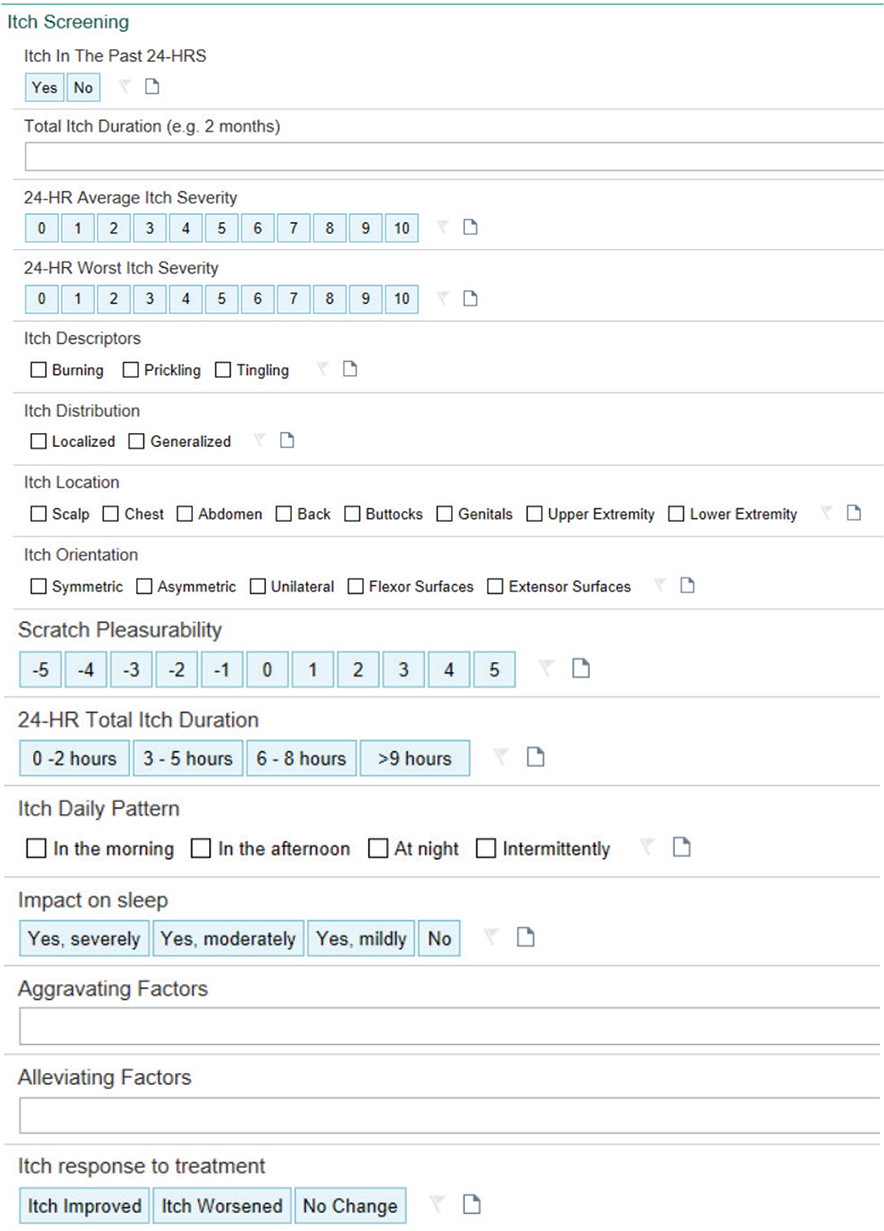
We surveyed 100 patients with PD, chosen at random from our movement disorders clinics at the University of Miami Miller School of Medicine, using a validated numeric rating itch scale (Fig. 1) (12). Patients were included in the itch+ group if they reported chronic history of itch, defined as itch > 6 weeks, on the questionnaire and did not have evidence of a pruritic cutaneous disease. Retrospective chart review was performed to collect demo-graphic data. Statistical analysis was then perform-ed using the 2-tailed t-test for unpaired data to compare demographic data between groups. Pearson correlation analysis was used to correlate itch characteristics with PD disease duration, Unified Parkinson’s Disease Rating Scale (UPDRS) On/Off medication scores (defined by evaluation when patients’ medications are working optimally vs when the effects are worn off, respectively), and levodopa equivalent daily dose (LEDD); p < 0.05 was considered significant. Statistical analysis was performed with the Statistical Package for Social Science Software (SPSS, version 29.0; IBM Corp, Armonk, NY, USA) for Windows. This study was approved by the IRB.
RESULTS
Of 100 PD patients surveyed, 41 reported itch. Full demo-graphics are given in Table I. Average age, gender, PD disease duration, UPDRS-III On and Off scores, and LEDD were not statistically significant between groups. Males represented a higher proportion of the cohort, but this was not significantly different between groups with itch and no itch.
Among patients with itch, average itch duration was 6.16 ± 12.98 years and PD duration was 7.88 ± 5.66 years. Correlations were made between PD clinical characteristics and itch characteristics (Table II). There was a positive, moderate correlation between PD duration and 24-h average itch severity (0.491, p = 0.002). When correcting for age, the correlation strengthened (0.522, p < 0.001). The other correlations remained insignificant following correction for age.
On an 11-point Numerical Rating Scale (NRS), average 24-h itch severity and average 24-h worst itch were 4.63 ± 2.34 and 5.37 ± 2.61, respectively. The most commonly reported 24-h itch duration was 0–2 h (94.74%), and scratch was rated as pleasurable with an average score of 3.06 ± 2.94 (scale; –5 to +5). The itch was most commonly characterized as having a burning quality (37.93%), localized distribution (87.50%), on the scalp (43.90%) or back (41.46%), with a symmetric orientation (54.05%), an intermittent daily pattern (79.49%), and with no impact on sleep (86.84%) (Table III). Aggravating factors included dry skin, not bathing, and use of hair products.
DISCUSSION
This study was the first to examine itch and its characteristics in a meaningful cohort of PD patients. We report that localized itch is a common complaint in 41% of PD patients, which may suggest that this symptom is neuropathic in origin. The itch is related to disease duration but not necessarily to the motor severity of PD.
Non-motor manifestations of PD are under-recognized. Within that category, itch is very unlikely to be discussed, recognized, or treated. Often, itch is even ignored by the patient despite being significantly bothersome, as it is not generally thought to be related to PD. Recognition could not only lead to a better understanding of the patient but also to symptomatic relief. Awareness of which patient demographics predispose a patient to different forms of itch, including differing severity and location, would allow us to be more precise in our management. In the future, this could serve as a platform to investigate itch as a biomarker for PD, as well as a harbinger for other cutaneous issues or impulse-control disorders.
Of note, the itch severity was rated as moderate and transient, and most patients did not report that it affected sleep. The authors therefore believe that aggressive therapies, such as with gabapentinoids, are unnecessary to treat itch of this severity, which differs from other common causes of neuropathic pruritus. Nevertheless, treatment may be warranted in some individuals if severity reaches a threshold such as to impact quality of life, and a more severe itch should prompt a dermatological evaluation to guide specific therapy if needed.
Among our patients with itch, the scalp and back were reported as the most common locations. These findings are consistent with the previously described skin biopsy findings of α-synuclein deposits in the scalp of PD patients (13) and the proximo-distal gradient of these deposits, with highest incidence in cervical regions followed by the back, then the extremities (6, 14). Given the growing use of α-synuclein skin biopsies, future correlations with biopsy findings among patients with itch may serve as a diagnostic biomarker. The mechanism of action may be related to small-fibre neuropathy secondary to α-synuclein deposits, systemic inflammation, and/or treatment side effects.
Other factors may be at play: central dysregulation may contribute to itch sensation as it has been demonstrated as a mechanism of central pain in PD, defined as tingling, burning, formication, or broadly, as neuropathic sensations, which may represent centrally mediated itch (15). Autonomic dysregulation and associated skin barrier disruptions may also contribute to itch. The relative pleasure of scratching in this cohort may represent a reactive neuroadaptive mechanism, whereby initial skin barrier defects initiate itch and the desire to scratch, which is further reinforced via a scratching-induced central reward mechanism involving residual dopamine release as suggested by preclinical studies (16,17). This may lead to further scratching and ultimately contribute to an itch–scratch cycle and neuronal sensitization. Furthermore, pruritus may occur secondary to primary pruritic dermatoses, several of which have been associated with PD, including seborrheic dermatitis.
Limitations
One limitation to our study is that patients self-reported their symptoms on the survey, raising the possibility of recall bias. This may partially explain why patients were not able to fill out all survey items, leading to decreased power. Although patients did not undergo a formal dermatological exam, they had no frank clinical signs of primary dermatoses that could explain their itch. Nevertheless, confounders such as incipient seborrheic dermatitis in the scalp, which is rather rare, may have some minor impact. The back, the second most common itchy area, is not an area of seborrheic dermatitis or skin diseases associated with PD. Another potential limitation is in the potential concurrent polyneuropathy or small-fibre neuropathies of other aetiologies. In addition, although concurrent medications were looked at, the focus of our analysis was on levodopa equivalent dose.
Further research is indicated to better understand the associated pathophysiology of pruritus in PD, including an assessment of metabolic derangements such as correlations with vitamin B12 and B6 levels, which may be reduced in PD.
Conclusion
Our study is a step forward in understanding the interplay between pruritus, a highly prevalent comorbidity in the PD patient population, and how it relates to PD characteristics. Pruritus is an exceedingly common and sometimes debilitating sensation that may present as a primary disease or a symptom. The mechanisms and associations of itch are vast and widely varied. Its effects are underemphasized, but recently there has been a significant increase in research in the field. Studying pruritus in the context of common diseases such as PD provides us with a more comprehensive understanding of the disease and helps inform management to optimize our patients’ quality of life. In this study, we found itch to be highly prevalent in PD patients and related to disease duration. We suspect that the pathophysiology may be related to small-fibre neuropathy, central dysregulation, autonomic alterations, and secondarily to associated primary dermatological conditions; nevertheless, further research on the underlying mechanisms of these associations is needed and will help improve PD patient outcomes.
ACKNOWLEDGEMENTS
Data availability statement: The data that support these findings are available upon reasonable request from the authors.
Ethics declarations: University of Miami IRB approved this study.
The authors confirm that they have read the Journal’s position on issues involved in ethical publication and affirm that this work is consistent with those guidelines.
REFERENCES
- Ikemura M, Saito Y, Sengoku R, Sakiyama Y, Hatsuta H, Kanemaru K, et al. Lewy body pathology involves cutaneous nerves. J Neuropathol Exp Neurol 2008; 67: 945–953. https://doi.org/10.1097/NEN.0b013e318186de48
- Niemann N, Billnitzer A, Jankovic J. Parkinson’s disease and skin. Parkinsonism Relat Disord 2021; 82: 61–76. https://doi.org/10.1016/j.parkreldis.2020.11.017
- Navarro-Otano J, Casanova-Mollà J, Morales M, Valls-Solé J, Tolosa E, Cutaneous autonomic denervation in Parkinson’s disease. J Neural Transm (Vienna) 2015; 122: 1149–1155. https://doi.org/10.1007/s00702-014-1355-3
- Dabby R, Djaldetti R, Shahmurov M, Treves TA, Gabai B, Melamed E, et al. Skin biopsy for assessment of autonomic denervation in Parkinson’s disease. J Neural Transm (Vienna) 2006; 113: 1169–1176. https://doi.org/10.1007/s00702-005-0431-0
- Zange L, Noack C, Hahn K, Stenzel W, Lipp A. Phosphorylated α-synuclein in skin nerve fibres differentiates Parkinson’s disease from multiple system atrophy. Brain 2015; 138: 2310–2321. https://doi.org/10.1093/brain/awv138
- Donadio V, Incensi A, Leta V, Giannoccaro MP, Scaglione C, Martinelli P, et al. Skin nerve α-synuclein deposits: a biomarker for idiopathic Parkinson disease. Neurology 2014; 82: 1362–1369. https://doi.org/10.1212/WNL.0000000000000316
- Sondrup MA, Bjergen C, Gaarskjær AN, Joseph A, Lassen RS, Mamedov S, et al. Investigation of itch in Parkinson disease. Itch 2021; 6: e49. https://doi.org/10.1097/itx.0000000000000049
- Roh YS, Choi J, Sutaria N, Kwatra SG. Itch: epidemiology, clinical presentation, and diagnostic workup. J Am Acad Dermatol 2022; 86: 1–14. https://doi.org/10.1016/j.jaad.2021.07.076
- Yosipovitch G, Skayem C, Aroman MS, Taieb C, Inane M, Hayoun YB, et al. International study on prevalence of itch: examining the role of itch as a major global public health problem. Br J Dermatol 2024; 191: 713–718. https://doi.org/10.1093/bjd/ljae260
- Matterne U, Apfelbacher CJ, Loerbroks A, Schwarzer T, Büttner M, Ofenloch R, et al. Prevalence, correlates and characteristics of chronic pruritus: a population-based cross-sectional study. Acta Derm Venereol 2011; 91: 674–679. https://doi.org/10.2340/00015555-1159
- Ständer S, Schäfer I, Phan NQ, Blome C, Herberger K, Heigel H, et al, Prevalence of chronic pruritus in Germany: results of a cross-sectional study in a sample working population of 11,730. Dermatology 2010; 221: 229–235. https://doi.org/10.1159/000319862
- Dawn A, Papoiu AD, Chan YH, Rapp SR, Rassette N, Yosipovitch G, et al. Itch characteristics in atopic dermatitis: results of a web-based questionnaire. Br J Dermatol 2009; 160: 642–644. https://doi.org/10.1111/j.1365-2133.2008.08941.x
- Gibbons CH, Wang N, Freeman R. Cutaneous alpha-synuclein from paraffin embedded autopsy specimens in Parkinson’s disease. J Parkinsons Dis 2017; 7: 503–509. https://doi.org/10.3233/JPD-171088
- Doppler K, Ebert S, Uçeyler N, Trenkwalder C, Ebentheuer J, Volkmann J, et al. Cutaneous neuropathy in Parkinson’s disease: a window into brain pathology. Acta Neuropathologica 2014; 128: 99–109. https://doi.org/10.1007/s00401-014-1284-0
- Vila-Chã N, Cavaco S, Mendes A, Gonçalves A, Moreira I, Fernandes J, et al. Central pain in Parkinson’s disease: behavioral and cognitive characteristics. Parkinsons Dis 2021; 2021: 5553460. https://doi.org/10.1155/2021/5553460
- Setsu T, Hamada Y, Oikawa D, Mori T, Ishiuji Y, Sato D, et al. Direct evidence that the brain reward system is involved in the control of scratching behaviors induced by acute and chronic itch. Biochem Biophys Res Commun 2021; 534: 624–631. https://doi.org/10.1016/j.bbrc.2020.11.030
- Inokuchi-Sakata S, Narita R, Takahashi Y, Ishiuji Y, Asahina A, Kato F. Region-specific activation in the accumbens nucleus by itch with modified scratch efficacy in mice: a model-free multivariate analysis. Mol Brain 2024; 17: 27. https://doi.org/10.1186/s13041-024-01101-w