ORIGINAL ARTICLE
Preferences of Dermato-oncologists for Adjuvant Therapy in Stage II Melanoma: A Nationwide Discrete Choice Experiment
Amelie KRAAZ1,2, Wiebke K. PEITSCH1, Laura RATUSZNIK3, Katharina DIEHL3–5, Christian KROMER  6, Dilan AKBARZADEH6, Marthe-Lisa SCHAARSCHMIDT 7 and Juliane WEILANDT1
1Department of Dermatology and Phlebology, Vivantes Klinikum im Friedrichshain, Berlin, 2Faculty of Medicine, Charité University Medicine Berlin, Berlin, 3Epidemiology and Public Health, Department of Medical Informatics, Biometry and Epidemiology, Friedrich-Alexander-Universität Erlangen-Nürnberg (FAU), Erlangen, 4Bavarian Cancer Research Center (BZKF), Erlangen, 5Comprehensive Cancer Center Erlangen-European Metropolitan Area of Nürnberg (CCC ER-EMN), Erlangen, 6Department of Dermatology, Venereology and Allergology, University Medical Center Göttingen, Göttingen, and 7Department of Dermatology, Venereology and Allergology, University Medical Centre Mannheim, Heidelberg University, Mannheim, Germany
Abstract
Adjuvant treatment decisions in stage IIB/C melanoma require careful weighing of benefits and risks. Our aim was to investigate how dermato-oncologists in Germany prioritize efficacy, toxicity, and application mode of modern adjuvants in these stages. In a nationwide discrete choice experiment physicians evaluated hypothetical treatment scenarios that varied in recurrence risk, risk of severe adverse events, type of adverse events, and mode of administration. Two patient profiles were presented, including a 55-year-old healthy patient in stage IIB (P1) and an 83-year-old patient in stage IIC with comorbidity (P2). Physicians (n = 112) preferred adjuvant therapy to the opt-out option in 86.4% of scenarios for P1 and in 60.5% for P2. The risk of severe adverse events was considered most important for both patients and significantly more relevant for P2 (relative importance score (RIS) 53.6 vs 40.2, p < 0.001), while recurrence risk was more relevant for P1 (RIS 36.3 vs 21.8, p < 0.001). Immune-related adverse events were less acceptable than gastrointestinal symptoms or pyrexia. Infusions at longer intervals were favoured compared with oral therapies. In conclusion, dermato-oncologists prioritized safety over efficacy, particularly in the older, comorbid patient. These preferences should be reconciled with patients’ preferences and treatment goals during shared decision-making.
SIGNIFICANCE
This study explored how skin cancer specialists in Germany make decisions regarding adjuvant treatment for patients with stage IIB/C melanoma. Using hypothetical scenarios, 112 physicians chose between different treatment options for a younger, healthier patient and an older patient with comorbidities. Physicians placed greatest importance on avoiding severe side effects, especially for the older patient. They preferred treatments given by infusion over pills and found immune-related adverse events less acceptable than other side effects. Overall, physicians most valued safety, particularly for older patients with comorbidity. These preferences should be reconciled with patients’ preferences and expectations.
Key words: conjoint analysis; immune checkpoint inhibitors; melanoma; treatment preferences; targeted therapy.
Citation: Acta Derm Venereol 2025; 105: adv44135. DOI: https://doi.org/10.2340/actadv.v105.44135.
Copyright: © 2025 The Author(s). Published by MJS Publishing, on behalf of the Society for Publication of Acta Dermato-Venereologica. This is an Open Access article distributed under the terms of the Creative Commons Attribution-NonCommercial 4.0 International License (https://creativecommons.org/licenses/by-nc/4.0/).
Submitted: Jun 13, 2025. Accepted after revision: Sep 10, 2025. Published: Sep 25, 2025.
Corr: Dr. med. Juliane Weilandt, Department of Dermatology and Phlebology, Vivantes Klinikum im Friedrichshain, Landsberger Allee 49, DE-10249 Berlin, Germany. E-mail: juliane_w@web.de
Competing interests and funding: WKP has served as investigator for AbbVie, Array Biopharma, Boehringer Ingelheim, Janssen-Cilag, Lilly, MSD, Novartis, Pfizer, and UCB Pharma, was a member of advisory boards of BMS, LEO Pharma, Lilly, MSD, Novartis, Pfizer, Roche, Sanofi, Sun Pharma, and UCB, has received speakers’ honoraria from ALK-Abello, AbbVie, Biotest, BMS, Janssen-Cilag (Johnson & Johnson), MSD, Novartis, Pfizer, Dr. Pfleger, and Roche, and received support for conferences from AbbVie, ALK-Abello, Almirall Hermal, Beiersdorf, BMS, Celgene, Dermapharm, Dermasence, Galderma, GSK, Immunocore, Janssen-Cilag, Kyowa Kirin, L’Oréal, La Roche Posay, LEO Pharma, Lilly, MSD, Mylan, Novartis, Pierre Fabre, Pfizer, Roche, Sanofi, Sun Pharma, and UCB. CK has been an adviser and/or received speaker’s honoraria from AbbVie, Janssen-Cilag (Johnson & Johnson), Novartis, Almirall, Boehringer Ingelheim, and Dermapharm. M-LS has been an adviser to and/or receiv-ed speakers’ honoraria from and/or received grants from and/or participated in clinical trials by the following companies: AbbVie, Almirall, Biogen Inc, BMS GmbH, Boehringer Ingelheim, Celgene, Eli Lilly, Johnson & Johnson Innovative Medicine, LEO Pharma, Merck Serono GmbH, MSD GmbH, Novartis Pharma GmbH, Sanofi-Aventis Deutschland GmbH Sanofi, and UCB. JW has received presentation fees from Novartis and Sanofi-Aventis and support for attending conferences from Pierre Fabre and Sanofi-Aventis. AK, LR, KD, and DA have no conflicts of interest.
This study was conducted without any support from the pharmaceutical industry, and the manuscript was prepared independent of pharmaceutical companies. The conflicts of interest disclosed above did not influence the study design, data interpretation, or content of this manuscript.
INTRODUCTION
Treatment of melanoma has evolved significantly with the advent of immune checkpoint inhibitors (ICI) and BRAF/MEK inhibitors. Implemented first for metastatic disease, PD-1 inhibitors and BRAF/MEK inhibitors successively became standard for adjuvant therapy of stage III melanoma (1–4). More recently, PD-1 inhibitors were approved for adjuvant treatment in stage IIB and IIC (5–9), which are associated with worse melanoma-specific survival than stage IIIA (10, 11). Despite absence of metastases at primary diagnosis, the 10-year risk of recurrence is as high as 45% in stage IIB and 50–66% in stage IIC (10). Adjuvant therapy with PD-1 antibodies for 1 year can reduce this risk by approximately 40% (5–8, 12). However, these treatments entail the risk of immune-related adverse events (AE), which are severe in 10–17%, potentially irreversible, and, though rarely, even fatal (6, 8, 12, 13).
Patients with BRAF V600-mutated stage III melanoma have the additional option of adjuvant targeted therapy with dabrafenib/trametinib, which improves 10-year recurrence-free survival by 48% (4). Another BRAF/MEK inhibitor combination, encorafenib/binimetinib, was investigated as adjuvant treatment in stage IIB/C in the COLUMBUS-AD trial (14), but this trial was terminated prematurely. Toxicities of BRAF/MEK inhibitors include pyrexia and gastrointestinal AE. They may be severe in 40–60%, but usually resolve rapidly after treatment cessation (15).
Choosing the most appropriate adjuvant therapy for each patient requires careful balancing of benefits and risks in the context of patient-specific factors such as age, comorbidity, and Eastern Cooperative Oncology Group (ECOG) performance status as well as individual preferences. Alternatively, forgoing adjuvant therapy may be the best option for some patients, particularly elderly ones and those with a favourable prognosis after surgery alone. In order to identify a concept that is optimal from the medical perspective, but also fits the patient’s individual needs, wishes, and treatment goals, these aspects have to be discussed thoroughly during shared decision-making. As physicians’ attitudes towards efficacy, toxicity, and recurrence risk may influence the method of counselling and treatment recommendations, understanding their preferences and unravelling potential differences between physicians’ and patients’ perspectives is critical.
In a previous study, we found that patients with metastatic melanoma most valued treatment efficacy, followed by safety, while the treatment process mattered less (16). Preferences of patients with melanoma in stages IIB–IIID for adjuvant therapy with BRAF/MEK and PD-1 inhibitors are currently being investigated, but little is known about preferences of dermato-oncologists in this context.
The aim of our study was to assess how dermato-oncologists prioritize outcome and process attributes of adjuvant therapies for stage IIB/C melanoma. Using a discrete choice experiment (DCE), we sought to examine the trade-offs physicians are willing to make between efficacy, side effects, and treatment burden.
MATERIALS AND METHODS
Study population
Data collection was conducted from 16 March 2024 to 21 November 2024 nationwide across Germany. Dermatologists, oncologists, and residents in dermatology with at least 1 year’s experience in melanoma therapy were eligible for participation. Participants were recruited through email newsletters of the German Working Group Dermatological Oncology (Arbeitsgemeinschaft Dermatologische Onkologie, ADO), which currently comprises more than 650 members, emails to the heads of all 82 certified German skin cancer centres, and information stands at relevant conferences. All participants received detailed information on the study and gave informed consent before participation. The study was approved by the Ethics Committee of the Faculty of Medicine of Charité University Medicine Berlin (EA4/110/17, amendment 29 December 2023) and was conducted in accordance with the Declaration of Helsinki.
Data collection
The questionnaire including the DCE was created with Sawtooth Software (Lighthouse Studio version 9.15.4, Provo, UT, USA). Participants could choose between an online and a paper-and-pencil version. The first part contained questions on sociodemographic characteristics, professional background, and experience with melanoma therapies. The second part comprised the DCE.
Discrete choice experiment (DCE)
For generating the DCE, the PD-1 inhibitors pembrolizumab and nivolumab and the BRAF/MEK inhibitor combinations encorafenib/binimetinib and dabrafenib/trametinib were decomposed into outcome and process attributes and attribute levels. Outcome attributes encompassed the risk of recurrence within the first year, the risk of severe treatment-related AE, and typical treatment-related AE. Recurrence risk within the first year was chosen because accordant data were available for both PD-1 inhibitors at the time of drafting the questionnaire. The process attribute referred to the mode and frequency of application. Each attribute was associated with levels realistically reflecting the different treatments and the opt-out option (Table I). Attributes and levels were determined based on literature review (5, 8, 12, 14, 17–19) and expert consultation.
Using Sawtooth Software, hypothetical choice scenarios were generated by combining the different attributes and levels. Twenty-two choice scenarios were randomly assigned to each questionnaire based on an orthogonal design with balanced level overlap. In each scenario, participants were asked to choose between 2 paired treatment options and an opt-out option. Additionally, 2 fixed control scenarios, in which 1 option was clearly superior, were included for validation. Scenarios were generated for 2 distinct patient profiles: Patient 1 (P1), 55 years, non-ulcerated melanoma with a Breslow index of 6 mm, stage IIB, BRAF V600 mutation, ECOG status 0 and arterial hypertension as comorbidity; and Patient 2 (P2), 83 years, ulcerated melanoma with a Breslow index of 6 mm, stage IIC, BRAF V600 mutation, ECOG status 1 and chronic kidney disease stage III, atrial fibrillation, and insulin-dependent type 2 diabetes as comorbidities. An example of a DCE is presented in Table II. After completing the DCE for each patient, participants were asked whether they would indeed recommend adjuvant treatment for this patient.
Relative importance scores (RIS) and part-worth utilities (PWU) were calculated individually for each attribute, patient profile, and participant and averaged across the study population. Hierarchical Bayesian estimation was applied to determine PWU for each attribute level, with positive values indicating greater preference (utility) and negative values indicating disutility. RIS were computed by dividing the utility range (difference between highest and lowest values) of each attribute by the sum of all attribute ranges.
Statistical analysis
Statistical analyses were performed using IBM SPSS Statistics (Version 29, IBM Corp, Armonk, NY, USA). Categorical variables were reported as absolute and relative frequencies. Metric variables were summarized using means, standard deviations, medians, and interquartile ranges. Subgroup analyses based on professional qualification (specialists vs residents) were performed with Mann–Whitney U test for continuous variables and Pearson χ2 test for categorical variables. Differences in RIS and PWU between the two patient profiles were analysed with the non-parametric Wilcoxon test. Differences in adjuvant treatment recommendations between the two patients were assessed using the χ2 test. A p-value < 0.05 was considered statistically significant.
RESULTS
Study population
A total of 115 physicians participated in the study. Three of them had to be excluded due to insufficient professional experience (n = 2) or incorrect answers to the control questions (n = 1). Data of 112 participants were included in the following analyses.
The mean age of the cohort was 41.1 years (SD: 11.1; range: 25–74), and 58.9% of the participants were female. The vast majority (95.5%) were dermatologists, and 67% were board-certified specialists. More than half (58.9%) were employed at university hospitals. Regarding professional positions, 10.7% were chief physicians, 9.8% executive senior physicians, 35.7% senior physicians, 10.7% specialists, and 33.0% residents (Table III).
| Characteristics | Participants (n = 112) |
| Sex, n (%) | |
| Male | 46 (41.1) |
| Female | 66 (58.9) |
| Age, years | |
| Mean (SD) | 41.1 (11.1) |
| Median (range) | 38.5 (25.0–74.0) |
| Specialty, n (%) | |
| Dermatology | 107 (95.5) |
| Oncology | 5 (4.5) |
| Qualification, n (%) | |
| Resident | 37 (33.0) |
| Specialist | 75 (67.0) |
| Workplacea, n (%) | |
| Hospital | 104 (92.9) |
| University hospital | 66 (58.9) |
| Non-university hospital | 38 (33.9) |
| Practice | 14 (12.5) |
| Single practice | 2 (1.8) |
| Joint practice | 3 (2.7) |
| Medical service centre | 9 (8.0) |
| Positiona, n (%) | |
| Hospitalb | 105 (93.8) |
| Resident | 35 (31.3) |
| Specialist | 7 (6.3) |
| Senior physician | 40 (35.7) |
| Executive senior physician | 11 (9.8) |
| Chief physician | 12 (10.7) |
| Practice | 14 (12.5) |
| Resident | 3 (2.7) |
| Employed specialist | 6 (5.4) |
| Practice owner | 5 (4.5) |
| Working hours, n (%) | |
| Full time | 91 (81.3) |
| Part time | 20 (17.9) |
| Currently not workingc | 1 (0.9) |
| Professional experience as a physician, years | |
| Mean (SD) | 14.4 (10.7) |
| Median (range) | 12.0 (1.0–40.0) |
| Experience in melanoma treatment, years | |
| Mean (SD) | 10.7 (9.4) |
| Median (range) | 7.5 (1.0–35.0) |
| Melanoma patients treated per year, n | |
| Mean (SD) | 324.5 (424.2) |
| Median (range) | 200 (6–2,500) |
| Melanoma patients treated with adjuvant or palliative systemic therapy per year, n | |
| Mean (SD) | 113.0 (143.6) |
| Median (range) | 72 (0–1,000) |
| Melanoma patients treated with adjuvant systemic therapy per year, n | |
| Mean (SD) | 55.5 (64.4) |
| Median (range) | 40 (0–350) |
| aCategories not exclusive, b1 retired participant referred to his/her former working position, cdue to parental leave or retirement. SD: standard deviation. |
|
The average professional experience was 14.4 years (SD: 10.7), and the average experience with melanoma therapy 10.7 years (SD: 9.4). Participants managed on average 324.5 (SD: 424.2) melanoma patients per year, including 113.0 (SD: 143.6) patients with systemic therapy (see Table III).
Treatment preferences
Participants preferred adjuvant therapy to the opt-out option in 86.4% of the scenarios for P1 (55 years, stage IIB) and 60.5% of the scenarios for P2 (83 years, stage IIC; p < 0.001).
When opting for adjuvant treatment, the risk of severe AE was considered to be the most important attribute for both patients (P1: RIS 40.2, P2: RIS 53.6), followed by the risk of recurrence within the first year (P1: RIS 36.3, P2: RIS 21.8,). The type of AE and the mode and frequency of application were regarded as less relevant (Fig. 1).
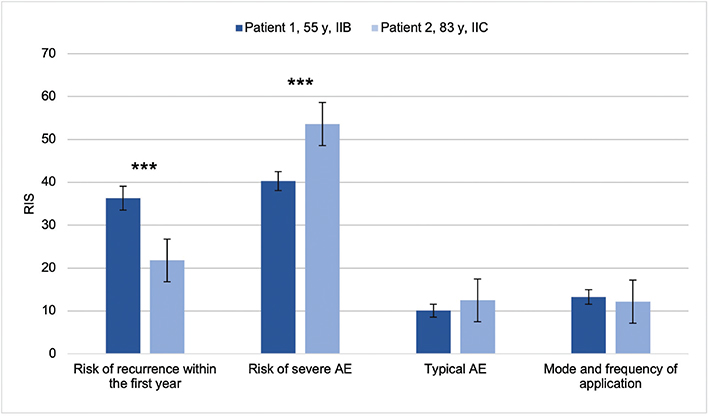
Fig. 1. Physicians’ preferences for treatment attributes. Participants identified the risk of severe adverse events (AE) as the most important attribute across both patient profiles, followed by the risk of recurrence within the first year. The risk of recurrence was considered significantly more relevant for the younger patient with stage IIB melanoma than for the older one in stage IIC (p < 0.001), while the risk of severe AE was more critical for the older patient (p < 0.001). The type of AE and the mode and frequency of application had lower priority, with no significant differences observed between the 2 patients. Bars indicate mean relative importance scores (RIS) with 95% confidence intervals. P-values are based on Wilcoxon test. ***p < 0.001.
Participants consistently favoured lower risks of recurrence and severe AE (Fig. 2A, B). Regarding the type of AE, gastrointestinal symptoms and pyrexia (P1: PWU 18.9, P2: PWU 21.7) were preferred to immune-related AEs for both patients (P1: PWU –18.9, P2: PWU –21.7; Fig. 2C). Concerning the mode and frequency of administration, infusions every 3 to 6 weeks (P1: PWU 14.3, P2: PWU 17.5) and infusions every 2 to 4 weeks (P1: PWU 10.0, P2: PWU 3.8) were favoured more that oral regimens requiring 5 tablets (P1: PWU –8.5, P2: PWU 0.7) or 12 tablets per day (P1: PWU –15.8, P2: PWU –21.9; Fig. 2D).
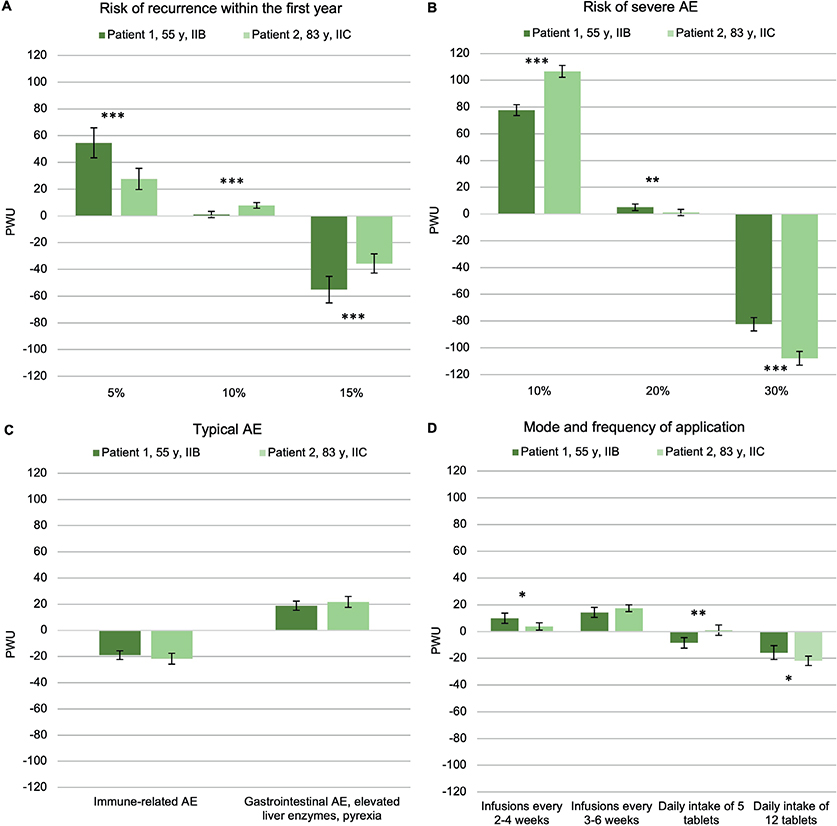
Fig. 2. Utilities of attribute levels compared between patient profiles. (A) A 5% recurrence risk had significantly higher part-worth utilities (PWU) for the younger patient in stage IIB (P1) than for the older one in stage IIC (P2; p < 0.001), whereas a 10% or 15% recurrence risk was perceived as less acceptable for the younger patient (p < 0.001 compared with the older one). (B) A 10% risk of severe adverse events (AE) was ranked higher for P2 than for P1 (p < 0.001), whereas 20% and 30% AE risks were less acceptable for P2 (p = 0.001 and p < 0.001 compared with P1, respectively). (C) Gastrointestinal symptoms and fever were preferred over immune-related AE, with no significant differences observed between patient profiles (p = 0.320). (D) Participants favoured intravenous infusions administered every 3–6 weeks, followed by infusions every 2–4 weeks, whereas oral regimens requiring intake of 5 or 12 tablets per day had lower PWU. Infusions every 2–4 weeks were valued more highly for P1 than for P2 (p = 0.018), while no significant difference between the 2 patients was noted for the 3–6 week regimen (p = 0.288). Taking 5 tablets daily was significantly more acceptable for P2 (p = 0.001), whereas the 12 tablet regimen was less preferred for this patient (p = 0.024). Bars indicate mean PWU with 95% confidence intervals. P-values are based on Wilcoxon test. *p < 0.05, **p < 0.01, ***p < 0.001.
When the participants were asked explicitly whether they would recommend adjuvant therapy for the 2 patients, treatment was advocated by 88.4% for P1 and by 56.3% for P2 (p = 0.008).
Impact of professional qualification on preferences
Specialists in dermatology or oncology rated the type of AE as significantly more relevant for P2 than residents (RIS 13.9 vs 9.6, p=0.014; Fig. 3B). In particular, they judged immune-mediated AE as less tolerable (PWU –26.1 vs –12.9, p = 0.002) and gastrointestinal symptoms or pyrexia as more acceptable for this patient (PWU 26.1 vs 12.9, p = 0.002). No significant differences were observed for the remaining attributes for P2 or for any attributes for P1 (Fig. 3A, B).
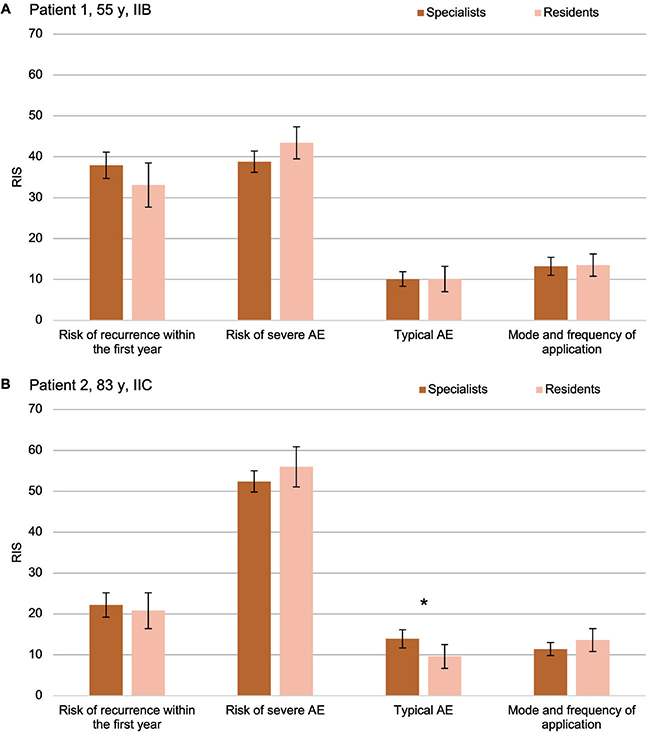
Fig. 3. Impact of professional qualification on physicians’ preferences. (A) For the younger patient (P1), the relevance of safety, efficacy, and application-related attributes did not differ significantly between specialists and residents. (B) For the older patient with more comorbidities (P2), specialists assigned significantly greater importance to the type of adverse events (AE) than residents (p = 0.014). Bars indicate mean relative importance scores (RIS) with 95% confidence intervals. P-values were calculated with the Mann–Whitney U test. *p < 0.05.
When explicitly asked if they would recommend adjuvant therapy, specialists were less likely than residents to affirm this both for P1 (82.7% vs 100%, p = 0.007) and for P2 (47.9% vs 75.7%, p = 0.005).
Comparison of treatment preferences between patient profiles
The risk of recurrence was rated more relevant for P1 than for P2 (RIS 36.3 vs 21.8, p < 0.001; see Fig. 1). A 5% recurrence risk was valued higher for P1 (PWU 54.6 vs 27.7, p < 0.001), whereas a 10% or 15% recurrence risk was perceived as less desirable for P1 compared with P2 (10% recurrence risk: PWU 0.5 vs 7.9, p < 0.001; 15% recurrence risk: PWU –55.1 vs –35.6, p < 0.001; see Fig. 2A).
Conversely, participants assigned greater importance to the risk of severe AE for P2 than for P1 (P2: RIS 53.6 vs 40.2, p < 0.001; see Fig. 1). A 10% AE risk was weighted higher for P2 (PWU 106.7 vs 77.7, p < 0.001), while 20% and 30% risks were considered less acceptable for P2 than for P1 (20% AE risk: PWU 1.1 vs 5.1, p = 0.001, 30% AE risk: PWU –107.8 vs –82.8, p < 0.001; see Fig. 2B).
The mode of application was rated as slightly more important than the type of AE for P1 (RIS 13.3 and 10.1), whereas the opposite was observed for P2 (RIS 12.2 and 12.5), but the differences between both patients were not significant (see Fig. 1). However, physicians favoured infusions every 2–4 weeks significantly more for P1 than for P2 (p = 0.018; see Fig. 2D). Intake of 5 tablets per day was regarded as more acceptable for P2 (p = 0.001), whereas 12 tablets per day were less preferred for this older patient (p = 0.024; Fig. 2D). Regarding the type of AE, PWU did not differ significantly between the two patients (see Fig. 2C).
DISCUSSION
Our study provides insights into how dermato-oncologists prioritize treatment attributes when considering adjuvant therapy in stage IIB/C melanoma. We show how they balance recurrence risk reduction with toxicity risks in light of patient-specific characteristics like age, comorbidities, and tumour stage. The cohort comprised 112 experienced physicians and is likely representative of dermato-oncologists working in German skin cancer centres.
Physicians opted for adjuvant therapy in 86.4% of the scenarios for the 55-year-old patient in stage IIB and in 60.5% of the scenarios for the 83-year-old patient in stage IIC. In previous DCE on adjuvant melanoma therapy, treatment was chosen in 78–86% of the scenarios (20, 21). However, these studies focused on adjuvant treatment in stage III and did not account for patient-specific characteristics, which may explain the higher opt-in rates compared with our older patient.
Our participants ranked the risk of severe AE as the most important attribute across both patient profiles, followed by the risk of recurrence within the first year. This cautious attitude contrasts with physicians’ preferences for adjuvant melanoma therapy in stage III, where efficacy was valued higher (20–23). The high priority of safety observed in our cohort may be explained by the facts that we focused on stage IIB/C and that the levels for the attribute “risk of severe AE” ranged up to 30%. Structured interviews by Livingstone et al. similarly identified melanoma substage, risk–benefit profile, treatment burden, and uncertainty regarding efficacy as primary determinants in adjuvant immunotherapy decisions (24).
Treatment preferences were influenced by clinical experience. Specialists had greater concerns about immune-mediated AE than residents in the older patient, possibly because they have encountered severe immune-mediated AE more frequently. They bear full responsibility for management of these AE, whereas residents can refer to senior colleagues. Specialists were also less likely than residents to recommend adjuvant therapy explicitly, possibly because residents adhere more closely to guidelines, whereas experienced physicians incorporate practical experience and offer a more nuanced benefit–risk assessment during consultation.
Attribute weighting varied between patient profiles. For the younger patient with stage IIB melanoma, recurrence risk was more influential, whereas for the older patient with stage IIC and comorbidities, concerns about toxicity were more relevant, indicating that physicians are more willing to accept AE in younger patients, but prioritize safety in older, comorbid ones. In line with our findings, Livingstone et al. reported a lower likelihood of recommending immunotherapy for patients aged > 80 years with low performance status, especially if their recurrence risk was low or comorbidities reduced life expectancy (24). Kähler et al. found that older patients demanded higher treatment efficacy to accept adjuvant therapy (23). It is well conceivable that efficacy-related attributes gain importance with increasing melanoma stage, resulting in higher opt-in rates for adjuvant therapy in stage III than in stage II, particularly in older patients.
Our participants rated type of AE and mode and frequency of administration as less relevant than recurrence risk and severe AE, findings substantially compatible with results by Beusterien et al. (20) but in contrast to the DCE by Stellato et al., in which physicians valued dosing regimen as the second most important attribute (21). Regarding the type of AE, our cohort preferred gastrointestinal symptoms and pyrexia over immune-related AE, consistent with findings from the GERMELATOX-A study (23).
Our participants preferred infusions to oral therapies, especially if the latter involved a large number of tablets, matching preferences of patients for treatment of metastatic melanoma identified in our previous DCE (16) but discordant with other studies. In the study by Stellato et al., funded by Novartis, physicians had strong preferences for tablets, while patients weighted tablets and 30-min infusions every 3 weeks similarly (21). Physicians and patients from the study by Kähler et al. also favoured oral therapies, though many expressed no clear preference (23). A study by Beisel et al. on treatment adherence of melanoma patients to adjuvant therapy in stage III/V showed better adherence to intravenous treatments than to oral therapies (98.4% vs 91.2%) (25). Indeed, complexity of the treatment regimen due to a large number of tablets or specific instructions for intake may pose a major barrier to adherence.
When asked explicitly, 88.4% of our participants favoured treatment for the younger patient in stage IIB, whereas only 56.3% advocated adjuvant therapy for the older patient in stage IIC. Real-world data show acceptance rates between 77% and 91% in stage III and IV (26–28). Data on acceptance of modern adjuvants in stage IIB/C are scarce, but opt-in rates appear to be considerably lower. According to a study by Mechow et al., modern adjuvants were accepted by only 43.1% in stage IIB/C (28). The main reasons for opting against adjuvant therapy were fear of AE, advanced age, and comorbidities.
Limitations
Our study was conducted exclusively in Germany. Therefore, its results may not be conferrable to other countries with different healthcare systems. Even if our cohort comprised experienced dermato-oncologists from many different skin cancer centres, results should be validated in a larger sample. As a DCE relies on hypothetical scenarios, the choices made by participants may not fully reflect real-world decision-making. Additionally, the number of attributes and attribute levels that can be included in a DCE has to be limited to prevent information overload, which may have led to omission of potentially relevant attributes. Moreover, we incorporated an adjuvant oral treatment option into our scenarios, as the COLUMBUS-AD trial was ongoing at the time of study conceptualization. However, this trial has been discontinued, and it is uncertain whether another oral therapy will become available as adjuvant treatment in stage II. As patient characteristics, including age, comorbidities, and tumour stage, have a substantial impact on treatment decisions, predefined patient profiles were used to enable a structured comparison of participant preferences. However, treatment decisions may differ in real-world settings with varying patient characteristics. Finally, physicians’ preferences may change over time as new medications and updated long-term data on adjuvant melanoma treatment become available.
Conclusions
This study provides valuable insights into preferences of dermato-oncologists in Germany for adjuvant melanoma therapy in stage IIB/C. The risk of severe AE emerged as the most important attribute, followed by the risk of recurrence. Decisions were strongly influenced by patient characteristics: while recurrence risk was a more relevant factor for the younger patient, toxicity concerns played a dominant role in the older one. Preferences also varied with regard to administration route and number of tablets, favouring less burdensome regimens. These findings underscore the need for shared decision-making approaches that balance clinical evidence with patients’ values and individual benefit–risk considerations, particularly in populations with a higher burden of comorbidities. Understanding physicians’ preferences and reconciling them with patients’ preferences, needs, and treatment goals may contribute to improve shared decision-making in stage II melanoma.
ACKNOWLEDGEMENTS
Data availability statement: The datasets used and analysed during the current study are available from the corresponding author upon reasonable request.
IRB approval status: The study was conducted in accordance with the principles of the Declaration of Helsinki and approved by the Ethics Committee of the Faculty of Medicine of Charité University Medicine Berlin (EA4/110/17, amendment 29.12.2023).
REFERENCES
- Eggermont AM, Kicinski M, Blank CU, Mandala M, Long GV, Atkinson V, et al. Seven-year analysis of adjuvant pembrolizumab versus placebo in stage III melanoma in the EORTC1325/KEYNOTE-054 trial. Eur J Cancer 2024; 211: 114327. https://doi.org/10.1016/j.ejca.2024.114327
- Larkin J, Weber J, Del Vecchio M, Gogas H, Arance AM, Dalle S, et al. Adjuvant nivolumab versus ipilimumab (CheckMate 238 trial): reassessment of 4-year efficacy outcomes in patients with stage III melanoma per AJCC-8 staging criteria. Eur J Cancer 2022; 173: 285–296. https://doi.org/10.1016/j.ejca.2022.06.041
- Ascierto PA, Del Vecchio M, Mandala M, Gogas H, Arance AM, Dalle S, et al. Adjuvant nivolumab versus ipilimumab in resected stage IIIB-C and stage IV melanoma (CheckMate 238): 4-year results from a multicentre, double-blind, randomised, controlled, phase 3 trial. Lancet Oncol 2020; 21: 1465–1477. https://doi.org/10.1016/S1470-2045(20)30494-0
- Long GV, Hauschild A, Santinami M, Kirkwood JM, Atkinson V, Mandala M, et al. Final results for adjuvant dabrafenib plus trametinib in stage III melanoma. N Engl J Med 2024; 391: 1709–1720. https://doi.org/10.1056/NEJMoa2404139
- Long GV, Luke JJ, Khattak MA, de la Cruz Merino L, Del Vecchio M, Rutkowski P, et al. Pembrolizumab versus placebo as adjuvant therapy in resected stage IIB or IIC melanoma (KEYNOTE-716): distant metastasis-free survival results of a multicentre, double-blind, randomised, phase 3 trial. Lancet Oncol 2022; 23: 1378–1388. https://doi.org/10.1056/NEJMoa2404139
- Luke JJ, Ascierto PA, Khattak MA, de la Cruz Merino L, Del Vecchio M, Rutkowski P, et al. Pembrolizumab versus placebo as adjuvant therapy in resected stage IIB or IIC melanoma: final analysis of distant metastasis-free survival in the phase III KEYNOTE-716 study. J Clin Oncol 2024; 42: 1619–1624. https://doi.org/10.1200/JCO.23.02355
- Luke JJ, Ascierto PA, Khattak MA, Rutkowski P, Del Vecchio M, Spagnolo F, et al. Pembrolizumab versus placebo as adjuvant therapy in resected stage IIB or IIC melanoma: long-term follow-up, crossover, and rechallenge with pembrolizumab in the phase III KEYNOTE-716 study. Eur J Cancer 2025; 220: 115381. https://doi.org/10.1016/j.ejca.2025.115381
- Kirkwood JM, Del Vecchio M, Weber J, Hoeller C, Grob JJ, Mohr P, et al. Adjuvant nivolumab in resected stage IIB/C melanoma: primary results from the randomized, phase 3 CheckMate 76K trial. Nat Med 2023; 29: 2835–2843. https://doi.org/10.1038/s41591-023-02583-2
- Kirkwood JM, Mohr P, Hoeller C, Grob JJ, Del Vecchio M, Lord-Bessen J, et al. Patient-reported outcomes with adjuvant nivolumab versus placebo after complete resection of stage IIB/C melanoma in the randomized phase 3 CheckMate 76 K trial. Eur J Cancer 2025; 220: 115371. https://doi.org/10.1016/j.ejca.2025.115371
- Garbe C, Keim U, Amaral T, Berking C, Eigentler TK, Flatz L, et al. Prognosis of patients with primary melanoma stage I and II according to American Joint Committee on Cancer Version 8 validated in two independent cohorts: implications for adjuvant treatment. J Clin Oncol 2022; 40: 3741–3749. https://doi.org/10.1200/JCO.22.00202
- Garbe C, Keim U, Suciu S, Amaral T, Eigentler TK, Gesierich A, et al. Prognosis of patients with stage III melanoma according to American Joint Committee on Cancer Version 8: a reassessment on the basis of 3 independent stage III melanoma cohorts. J Clin Oncol 2020; 38: 2543–2551. https://doi.org/10.1200/JCO.19.03034
- Luke JJ, Rutkowski P, Queirolo P, Del Vecchio M, Mackiewicz J, Chiarion-Sileni V, et al. Pembrolizumab versus placebo as adjuvant therapy in completely resected stage IIB or IIC melanoma (KEYNOTE-716): a randomised, double-blind, phase 3 trial. Lancet 2022; 399: 1718–1729. https://doi.org/10.1016/S0140-6736(22)00562-1
- Patrinely JR Jr, Johnson R, Lawless AR, Bhave P, Sawyers A, Dimitrova M, et al. Chronic immune-related adverse events following adjuvant anti-PD-1 therapy for high-risk resected melanoma. JAMA Oncol 2021; 7: 744–748. https://doi.org/10.1001/jamaoncol.2021.0051
- van Akkooi AC, Hauschild A, Long GV, Mandala M, Kicinski M, Govaerts AS, et al. COLUMBUS-AD: phase III study of adjuvant encorafenib + binimetinib in resected stage IIB/IIC BRAF V600-mutated melanoma. Future Oncol 2023; 19: 2017–2027. https://doi.org/10.2217/fon-2023-0414
- Garutti M, Bergnach M, Polesel J, Palmero L, Pizzichetta MA, Puglisi F. BRAF and MEK inhibitors and their toxicities: a meta-analysis. Cancers (Basel) 2022; 15. https://doi.org/10.3390/cancers15010141
- Weilandt J, Diehl K, Schaarschmidt ML, Kieker F, Sasama B, Pronk M, et al. Patient preferences in adjuvant and palliative treatment of advanced melanoma: a discrete choice experiment. Acta Derm Venereol 2020; 100: adv00083. https://doi.org/10.2340/00015555-3422
- Weber J, Mandala M, Del Vecchio M, Gogas HJ, Arance AM, Cowey CL, et al. Adjuvant nivolumab versus ipilimumab in resected stage III or IV melanoma. N Engl J Med 2017; 377: 1824–1835. https://doi.org/10.1056/NEJMoa1709030
- Eggermont AMM, Blank CU, Mandala M, Long GV, Atkinson V, Dalle S, et al. Adjuvant pembrolizumab versus placebo in resected stage III melanoma. N Engl J Med 2018; 378: 1789–1801. https://doi.org/10.1056/NEJMoa1802357
- Long GV, Hauschild A, Santinami M, Atkinson V, Mandala M, Chiarion-Sileni V, et al. Adjuvant dabrafenib plus trametinib in stage III BRAF-mutated melanoma. N Engl J Med 2017; 377: 1813–1823. https://doi.org/10.1056/NEJMoa1708539
- Beusterien K, Middleton MR, Wang PF, Rao S, Kotapati S, Sabater J, et al. Patient and physician preferences for treating adjuvant melanoma: a discrete choice experiment. J Cancer Ther 2017; 08: 37–50. https://doi.org/10.4236/jct.2017.81004
- Stellato D, Thabane M, Eichten C, Delea TE. Preferences of Canadian patients and physicians for adjuvant treatments for melanoma. Curr Oncol 2019; 26: e755–e765. https://doi.org/10.3747/co.26.5085
- Kähler KC, Blome C, Forschner A, Gutzmer R, Hauschild A, Heinzerling L, et al. The outweigh of toxicity versus risk of recurrence for adjuvant interferon therapy: a survey in German melanoma patients and their treating physicians. Oncotarget 2018; 9: 26217–26225. https://doi.org/10.18632/oncotarget.25439
- Kähler KC, Gutzmer R, Angela Y, Livingstone E, Lodde G, Meiss F, et al. Preferences of physicians for treatment-related toxicity vs recurrence in melanoma (GERMELATOX-A): the doctors’ perspective. J Cancer Res Clin Oncol 2024; 150: 252. https://doi.org/10.1007/s00432-024-05713-6
- Livingstone A, Dempsey K, Stockler MR, Howard K, Long GV, Carlino MS, et al. Adjuvant immunotherapy recommendations for stage III melanoma: physician and nurse interviews. BMC Cancer 2021; 21: 1014. https://doi.org/10.1186/s12885-021-08752-1
- Beisel C, Poretta T, Sheppard VB, Hurtado-de Mendoza A, Sipsma H, Fuqua E, et al. Adherence to adjuvant therapy in patients with resected melanoma: an application of the theory of planned behavior. Adv Ther 2022; 39: 4061–4075. https://doi.org/10.1007/s12325-022-02221-2
- Lodde G, Forschner A, Hassel J, Wulfken LM, Meier F, Mohr P, et al. Factors influencing the adjuvant therapy decision: results of a real-world multicenter data analysis of 904 melanoma patients. Cancers (Basel) 2021; 13: 2319. https://doi.org/10.3390/cancers13102319
- Hoffmann M, Hayoz S, Ozdemir BC. Prescription patterns, recurrence, and toxicity rates of adjuvant treatment for stage III/IV melanoma: a real world single-center analysis. Biology (Basel) 2022; 11: 422. https://doi.org/10.3390/biology11030422
- Mechow N, Peitsch WK, Diehl K, Ohletz J, Herz J, Eisert L, et al. Adjuvant treatment decisions of patients with stage IIB/C and III melanoma in routine clinical practice. Eur J Dermatol 2024; 34: 651–661. https://doi.org/10.1684/ejd.2024.4796