ORIGINAL REPORT
Short-term Abrocitinib Combined with Medicated Topical Therapy Provides Rapid Improvement in Pruritus in Elderly Patients with Moderate-to-severe Atopic Dermatitis: A Retrospective, Observational Real-world Study
Yajie YU1*, Yanqing CHEN1*, Yuping ZHANG2, Mukai CHEN3, Yongzhi HAN4, Xinsheng CHEN5, Lei LING6, Xueling TAN7, Junping ZHAO7, Rongzhi LIAO8, Jiajun HE9, Danyi HUANG1, Juan LUO1, Chen LI2# and Han MA1#
1Department of Dermatology, The Fifth Affiliated Hospital, Sun Yat-sen University, Zhuhai City, Guangdong Province, 2Department of Dermatology, Zhongshan City People’s Hospital, Zhongshan City, Guangdong Province, 3Department of Dermatology, The First Affiliated Hospital of Sun Yat-Sen University, Guangzhou City, Guangdong Province, 4Department of Dermatology, Guangdong Provincial People’s Hospital (Guangdong Academy of Medical Sciences), Southern Medical University, Guangzhou City, Guangdong Province, 5Department of Dermatology, The Second Affiliated Hospital of Guangzhou University of Chinese Medicine, Guangzhou City, Guangdong Province, 6The First People’s Hospital of Foshan, Foshan City, Guangdong Province, 7Jiangmen Dermatology Hospital of Guangdong Province, Jiangmen City, Guangdong Province, 8Department of Dermatology, Zhongshan City Tanzhou Hospital, Zhongshan City, Guangdong Province, and 9Department of Dermatology, Jiangmen Central Hospital, Jiangmen City, Guangdong Province, China
*These authors contributed equally to this work and should be considered co-first authors.
#These authors contributed equally to this work and should be considered co-corresponding authors.
Abrocitinib, an oral small-molecule Janus kinase 1 (JAK1) inhibitor, is used for the treatment of moderate-to-severe atopic dermatitis (AD). However, due to safety concerns, further clinical experience is warranted, especially for elderly patients with AD. The aim of this study was to assess the rapidity, effectiveness, and safety of short-term abrocitinib in combination with medicated topical therapy for managing moderate-to-severe AD in elderly patients. A total of 57 elderly patients (≥65 years old) with moderate-to-severe AD who received oral abrocitinib at a dose of 100 mg/day, combined with topical medicated therapy for a minimum of 2 weeks, were included in the analysis. Results indicated that 91.23% of patients achieved the PP-NRS response at Week 2, and itching remained well controlled at Week 12. Additionally, 47.37% of patients achieved EASI-50, and 14.04% reached EASI-75 by Week 2. Notably, none of the 57 patients experienced any adverse events during the 12-week follow-up period. A shorter duration of AD was associated with better efficacy. Short-term abrocitinib in combination with medicated topical therapy may represent a new treatment approach in clinical practice for elderly AD patients, offering a rapid-onset and convenient treatment option to alleviate itching, achieve treatment goals, and manage medication risks simultaneously.
SIGNIFICANCE
This study is a multicentre, retrospective, observational, self-comparison real-world study. With the ageing of society, the prevalence of atopic dermatitis among the elderly is gradually increasing. Notably, pruritus stands as the most prevalent and burdensome symptom of atopic dermatitis. We aim to introduce a treatment option that provides rapid relief, is convenient to administer, and effectively alleviates itching while achieving therapeutic goals and managing potential medication-related risks for elderly patients with atopic dermatitis.
Key words: atopic dermatitis; elderly patients; abrocitinib; pruritus; real-world data.
Citation: Acta Derm Venereol 2025; 105: adv43888. DOI: https://doi.org/10.2340/actadv.v105.44210.
Copyright: © 2025 The Author(s). Published by MJS Publishing, on behalf of the Society for Publication of Acta Dermato-Venereologica. This is an Open Access article distributed under the terms of the Creative Commons Attribution-NonCommercial 4.0 International License (https://creativecommons.org/licenses/by-nc/4.0/).
Submitted: Jun 23, 2025. Accepted after revision: Nov 4, 2025. Published: Nov 19, 2025.
Corr: Han Ma, 52 Meihua East Road, Xiangzhou District, Zhuhai City, Guangdong Province, China, 519000. E-mail: mhan@mail.sysu.edu.cn;
Chen Li, No2 Sunwen East Road, Zhongshan City, Guangdong Province, China, 528499. E-mail: knoberlee@163.com.
Competing interests and funding: The authors have no conflicts of interest to declare.
This work was supported by the National Natural Science Foundation of China (82203936) and Guangdong Provincial Basic and Applied Basic Research Fund (2021A1515110592).
INTRODUCTION
Atopic dermatitis (AD) is a specific type of eczema and a common chronic inflammatory skin disease, characterized by intense pruritus, pain, sleep disturbances, and a significant impact on overall quality of life (1–3). Typically, this chronic condition, marked by pruritus, begins during infancy and is typified by dry skin, eczematous lesions, and lichenification. Due to its frequent association with atopy, which includes conditions such as asthma, allergic rhinitis, and environmental as well as food allergies, AD is regarded as a systemic disease (4, 5). Moreover, it imposes a substantial burden of morbidity on affected individuals. Over the last 3 decades, there has been a gradual rise in the global prevalence of AD (6). In developed countries, the prevalence of AD in children has reached levels ranging from 10% to 20%. Although the increase in AD prevalence in China occurred later than that observed in Western developed countries, Japan, and South Korea (7, 8), it has experienced a rapid surge over the past decade.
AD in the elderly has garnered significant attention in recent decades (9, 10). Due to the ageing of its population, China is expected to reach 400 million elderly individuals by 2035. Recent research indicated that with the ageing of society, the prevalence of AD among the elderly is gradually increasing, leading to its classification as a distinct subgroup known as elderly AD (11, 12). Clinical presentations typically include chronic or recurrent pruritic eczematous lesions and lichenification, primarily localized to flexor areas, the face (known as “atopic red face”), and the neck (referred to as “dirty neck”). In the elderly, there is a predilection for the “reverse sign” wherein unaffected folds of the knees and elbows are accompanied by lichenification (13, 14). The elderly also tend to exhibit overall dry skin. Moreover, elderly AD patients frequently present with comorbidities such as hypertension, heart disease, spinal conditions, and cerebrovascular disorders, which pose challenges to treatment and necessitate medication restrictions (15). Notably, pruritus stands as the most prevalent and burdensome symptom of AD (16). It plays a pivotal role in diminishing the overall quality of life in affected individuals. Consequently, we assert that alleviating pruritus must be regarded as the primary therapeutic objective in the treatment of elderly AD.
In recent years, the therapeutic landscape for AD has seen rapid expansion, with a surge in both available treatments and emerging therapies (17). There is a wealth of evidence supporting the efficacy of various JAK inhibitors in managing moderate-to-severe AD, including baricitinib, upadacitinib, and abrocitinib (18–20). Abrocitinib, an oral medication taken once daily, functions as a selective inhibitor of JAK1. Numerous clinical trials have substantiated its safety and efficacy, particularly among patients afflicted with moderate-to-severe AD, with a focus on adult populations (18, 21). However, most studies involving abrocitinib have not specifically evaluated its effects in elderly AD patients separately from other age groups. Limited data from 1 study involving 145 elderly AD patients demonstrated that abrocitinib was effective in this population, with no significant differences compared with younger patients. Nevertheless, the incidence of serious adverse events was found to be higher and dose-dependent (22). Real-world data, especially concerning the Asian elderly population, remain scarce.
Consequently, our study aims to evaluate short-term abrocitinib in combination with topical therapy for moderate-to-severe atopic dermatitis in elderly patients, focusing on speed of response, overall efficacy, and safety, to introduce a treatment option that provides rapid relief, is convenient to administer, and effectively alleviates itching while achieving therapeutic goals and managing potential medication-related risks.
MATERIALS AND METHODS
Study design
This study is a multicentre, retrospective, observational, self-comparison real-world study conducted in Guangdong Province, China, from October 2022 to October 2024. Patients were recruited based on medical records, ensuring no prior participation in clinical trials. Inclusion criteria required patients to be aged ≥ 65 years, have a confirmed diagnosis of moderate-to-severe AD by a certified dermatologist, possess an Eczema Area and Severity Index (EASI) score ≥ 16, an affected body surface area ≥ 10%, and a baseline Peak Pruritus Numerical Rating Scale (PP-NRS) score ≥ 4. For patients with facial or neck involvement, it was required that allergic contact dermatitis be ruled out.
A total of 57 eligible elderly patients received oral abrocitinib (100 mg once daily) for at least 2 weeks. Topical therapies included medium-potency corticosteroid cream, crisaborole ointment, tacrolimus cream, or nonmedicated emollients. After 2 weeks, treatment was adjusted based on patient needs and costs. Some patients continued abrocitinib intermittently, while others relied solely on topical therapy if skin lesions were well controlled.
Efficacy measures
The primary endpoint of this study was the proportion of patients achieving the PP-NRS response (defined as a ≥ 4-point improvement on the PP-NRS [scores range from 0 to 10] from baseline) by the end of Week 2. Key secondary endpoints included the proportions of patients achieving ≥ 50% (EASI-50) and ≥75% (EASI-75) improvement in EASI score at Week 2. Additionally, itching control was assessed via telephone follow-up at Week 12. To explore factors associated with therapeutic efficacy, patients were divided into 2 groups: good response group (achieving EASI-50 by Week 2) and poor response group.
Safety measurements
Throughout the 12-week follow-up, any new or worsening event after the first abrocitinib dose was recorded as an adverse event (AE). AEs included infection (especially herpes zoster), malignancy, laboratory value abnormalities (haematology, clinical chemistry, and urinalysis), and cardiovascular/thromboembolic events (MACE or VTE) reported by the patient.
Statistical analysis
Baseline characteristics of elderly AD patients were summarized using means and standard deviations (SDs) for continuous variables and counts/percentages for categorical variables. To identify factors associated with efficacy, χ2 tests were used to compare gender, disease severity, and topical therapy options, with Fisher’s exact test applied when appropriate. Additionally, age, duration of AD, initial EASI score, and initial PP-NRS score were compared across these same groups using the Mann–Whitney U test. Furthermore, a multivariable logistic regression analysis was conducted, adjusting for confounding variables including age, gender, duration of AD, severity, EASI score, and PP-NRS score. Statistical results were displayed as odds ratios (OR) with their corresponding 95% confidence intervals (CIs). The threshold for statistical significance was set at a p-value of < 0.05, using a two-tailed test. All statistical analyses were performed using SPSS version 29.0 (IBM Corp, Armonk, NY, USA).
RESULTS
Patients
Overall, 57 patients (38 men [66.67%] and 19 women [33.33%]; mean age [SD],72.40 [5.14] years) were enrolled. The median duration of AD was 5.49 ± 6.88 years. Based on EASI scores, 24 patients (42.11%) had moderate disease (EASI score:16–21) and 33 patients (57.89%) had severe disease (EASI score ≥ 21.1). Baseline demographic and clinical characteristics are summarized in Table I.
Efficacy
At baseline, the mean PP-NRS score was 8.25 ± 0.95, which significantly decreased to 3.07 ± 1.40 at Week 2 (p < 0.001; mean percentage reduction: 63.04%). By Week 12, the mean PP-NRS score reduced further to 1.25 ± 0.99. The PP-NRS response rate at Week 2 was 91.23%.
The mean EASI score at baseline was 23.80 ± 6.68 and significantly reduced to 12.01 ± 5.72 at week 2 (p < 0.001), with a mean percentage reduction of 50.27% (Fig. 1). The proportions of patients achieving EASI-50 and EASI-75 at Week 2 were 47.37% and 14.04%, respectively. Clinical outcomes are summarized in Table II. Representative clinical photos of an elderly AD patient before and after 2 weeks of treatment are shown in Fig. 2.
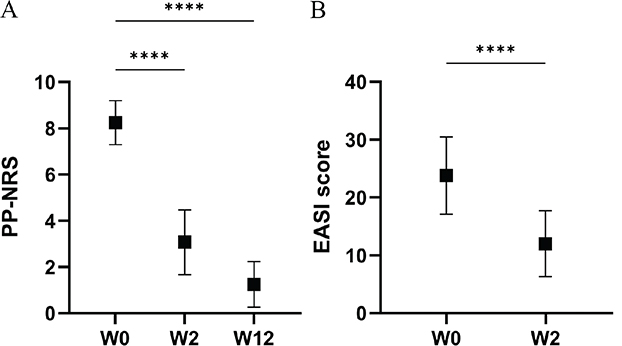
Fig. 1. Results describing improvement in terms of mean variation of Peak Pruritus Numerical Rating Scale (PP-NRS) and Eczema Area and Severity Index (EASI) score. (A) Results describing improvement in terms of mean variation of PP-NRS from baseline to week 12. (B) Results describing improvement in terms of mean variation of EASI score from baseline to week 2. ****p 0.001.
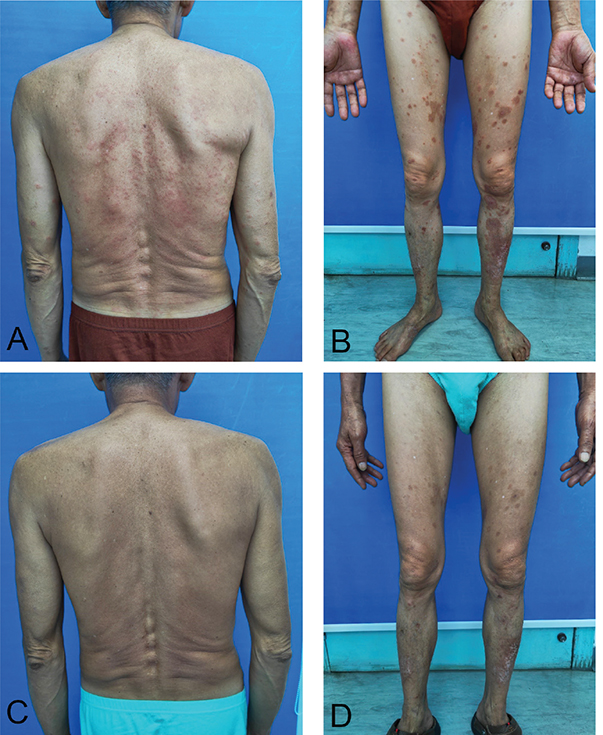
Fig. 2. Clinical photographs of an elderly atopic dermatitis patient document marked clearance of lesions within 2 weeks of treatment initiation. (A, B) Clinical photos prior to therapy. (C, D) Clinical photos after therapy at week 2.
Safety profile
None of the 57 patients experienced any adverse events during the 12-week follow-up period.
Efficacy-related factors
Univariate and multivariate logistic regression analyses were conducted to identify factors associated with treatment efficacy, defined as achieving an EASI-50 response at Week 2. As indicated in Table III, significant differences were observed between the 2 groups in terms of the duration of AD, disease severity, initial EASI score, initial PP-NRS score, and the administration of topical PDE4 inhibitor. These findings suggest that these factors may be associated with therapeutic efficacy. Additionally, multivariate logistic regression analyses further revealed that a shorter duration of AD (OR = 1.278; p = 0.013) was independently associated with a better treatment response (Table IV).
| Variable | Good response (n = 27) |
Poor response (n = 30) |
p-value |
| Age, years, median [IQR] | 70.00 [68.00, 75.00] | 73.00 [68.00, 77.00] | 0.391 |
| Gender, male, n (%) | 17 (63.0) | 21 (70.0) | 0.574 |
| Duration of AD, years, median [IQR] | 1.30 [0.80, 3.20] | 5.40 [1.30, 13.25] | 0.003* |
| Severe AD, n (%) | 10 (37.0) | 23 (76.7) | 0.002* |
| EASI score, median [IQR] | 18.80 [18.00, 23.60] | 25.30 [22.15, 30.28] | 0.001* |
| PP-NRS score, median [IQR] | 8.00 [7.00, 8.00] | 9.00 [8.00, 9.00] | 0.002* |
| Topical therapy options, n (%) | |||
| Topical glucocorticoids | 17 (63.0) | 20 (66.7) | 0.770 |
| Topical calcineurin inhibitor | 0 (0) | 2 (6.7) | 0.492 |
| Topical PDE4 inhibitor | 4 (14.8) | 0 (0) | 0.044* |
| Nonmedicated emollients only | 8 (29.6) | 10 (33.3) | 0.764 |
| Good response: achieve EASI-50 response at week 2. Poor response: fail to achieve EASI-50 at week 2. *p < 0.05. | |||
| Factor | OR, 95% CI | p-value |
| Age | 1.159 (0.978, 1.374) | 0.088 |
| Gender (male) | 1.230 (0.223, 6.790) | 0.812 |
| Duration of AD | 1.278 (1.052, 1.551) | 0.013* |
| Severe AD (EASI score ≥ 21.1) | 3.797 (0.325, 44.403) | 0.288 |
| EASI score | 1.042 (0.889, 1.220) | 0.614 |
| PP-NRS score | 2.099 (0.799, 5.514) | 0.132 |
| OR: odds ration; CI: confidence interval. *p < 0.05. | ||
DISCUSSION
The real-world study for the efficacy and safety of abrocitinib in Chinese elderly AD patients has not been reported previously to our knowledge. The results in our real-world study showed that 91.23% of patients achieved the PP-NRS response at week 2, proving the advantage of the treatment scheme in quick effect. The itching can still be well controlled at week 12, which reached a satisfactory level, while 47.37% of patients achieved EASI-50 at week 2, and 14.04% of patients achieved EASI-75 at week 2, also confirming the rapidity and effectiveness of the therapeutic strategy in elderly AD. Additionally, none of the 57 patients experienced any AEs during the 12-week follow-up period, further confirming the safety of the therapeutic strategy in elderly AD. Short-term abrocitinib combined with medicated topical therapy may become a new treatment approach in clinical applications for elderly AD, providing a rapid-onset and convenient treatment option to alleviate itching, achieve treatment goals, and simultaneously manage medication risks.
The standard treatment and management approach for elderly AD is similar to that of adult AD. It includes basic care practices such as proper bathing, regular application of moisturizing emollients, and avoiding contact with potential allergens and triggers in the environment and food. Additionally, treatment may involve the use of topical corticosteroids and topical calcineurin inhibitors to address inflammation and itching. Patient education is also an integral part of the management, which includes correcting habits like excessive friction and scratching, and providing information on the nature and severity of the disease (23).
An international consensus has been proposed on the core framework of “treat-to-target” (T2T) in the systemic treatment of moderate-to-severe AD (24). The concept of T2T involves designing a treatment strategy that prioritizes patient needs, emphasizes patient participation in disease management, and respects individual preferences. Its central aspect is determining clear treatment goals. The treatment plan is developed with a goal-oriented approach. By breaking down the treatment goals and considering the disease’s current state, the efficacy and safety of different treatment options are thoroughly assessed, while also taking into account the individual needs of the patients. The treatment plan is then continuously and dynamically adjusted based on the patient’s response to the treatment (25). For AD, “treat-to-target” refers to achieving comprehensive disease control, including relieving symptoms, resolving skin lesions, improving the overall quality of life, and establishing long-term disease management (26). The AAD recommends that physicians should build their treatment plan based on the patient’s experience, AD status, preferences, and comorbidities (27). In the process of disease management, patients preferred AD treatments that maximize itch control while minimizing AE risks to successfully achieve treatment goals (28).
Recently, the concept of minimal disease activity (MDA) criteria for AD has been proposed and advocated for the evaluation and treatment of AD (29). This approach is grounded on the principles of treat-to-target and shared decision-making, emphasizing therapies that aim to achieve minimal disease activity through collaborative decisions between patients and clinicians. By prioritizing patient-centred care, this strategy enhances patient engagement, improves adherence to treatment, and ultimately leads to better outcomes (30). Our proposed treatment strategy – combining short-term abrocitinib with topical therapies – aligns closely with the MDA concept. It is designed to rapidly relieve itching and skin lesions, thereby meeting patients’ immediate needs and improving overall treatment adherence.
In this study, our primary focus was on assessing the PP-NRS response for several compelling reasons. First, we observed that pruritus is the most prevalent and burdensome symptom experienced by patients with AD. It significantly impacts the patients’ quality of life and well-being (31, 32). Second, elderly patients may prioritize the alleviation of itching over other aspects of the condition, such as improvements in skin lesions. While there are several objective scoring scales available to evaluate skin lesions in AD, addressing pruritus becomes particularly crucial for elderly patients. Therefore, we emphasize the significance of effectively managing and reducing pruritus as a critical objective in the treatment of elderly AD patients.
Given the economic constraints in China, where many patients have to cover their own treatment expenses, there is a possibility that some patients may discontinue medication once their itching symptoms improve in the short term. Although traditional systemic therapies such as prednisone and cyclosporine have been found to provide rapid relief, comorbidities common in the elderly may limit their use due to inherent risks associated with their off-target toxicity and drug–drug interactions (33, 34). The literature suggests that, at least based on safety, JAK inhibitors should be positioned ahead of traditional systemic therapies for the treatment of AD (35). Considering these factors, our aim is to propose a treatment strategy that can rapidly alleviate itching symptoms and enhance the quality of life for patients. This approach will not only reduce the financial burden on patients but also help manage the medication risks associated with treating elderly AD patients.
Abrocitinib is a JAK1 selective inhibitor under investigation for the treatment of moderate-to-severe AD with inadequate response to topical therapy. In phase 3 studies, significantly greater proportions of adolescents and adults receiving abrocitinib monotherapy (200 mg or 100 mg) achieved remarkable therapeutic effect (assessed by IGA responses, EASI-75 responses, and PP-NRS4 responses) compared with placebo, with a manageable and consistent safety profile (13). Abrocitinib combined with medicated topical therapy was similarly well tolerated and effective at controlling moderate-to-severe AD in adolescents and adults (36, 37). However, there is still a lack of evidence regarding the efficacy and tolerability of abrocitinib combined with medicated topical therapy in elderly AD. Based on recent available data from head-to-head comparisons and meta-analysis studies, JAK inhibitors showed a faster onset of action and slightly higher efficacy at 16 weeks compared with biologic agents, even as early as week 2 of treatment (38).
In this study, both univariate and multivariate logistic regression analyses revealed that a shorter duration of AD was associated with a better response to abrocitinib in combination with medicated topical therapy among elderly AD patients. Furthermore, our findings suggested that patients with moderate AD severity, a lower initial EASI score, a lower PP-NRS score, and those receiving topical PDE4 inhibitor were more likely to achieve a favourable response. These results hold significant clinical implications for guiding treatment strategies. Considering the patient’s overall condition, it is advisable to initiate systemic therapy early and combine it appropriately with a local PDE4 inhibitor.
Limitations
The present study acknowledges several limitations that warrant consideration. First, this study was confined to a limited geographical region, specifically Guangdong Province in China, with a relatively modest sample size, a short follow-up duration, and absence of laboratory data, which restrict the generalizability of the findings. Future research endeavours should prioritize larger-scale, multicentre studies with extended follow-up periods to comprehensively evaluate the long-term trajectories of patients’ conditions, including symptom relapse, late-onset adverse events, and longitudinal laboratory changes. Second, the patient cohort exhibited a significant male predominance, which may introduce bias in the assessment of treatment efficacy and safety. Subsequent studies should strive to enrol a more balanced gender distribution to elucidate potential sex-specific differences in treatment outcomes. Furthermore, the diagnosis and management of elderly AD remain fraught with uncertainties and unresolved questions. To advance our understanding and optimize the clinical management of elderly AD, further in-depth, rigorous research is imperative.
Conclusions
We strongly advocate the use of a therapeutic strategy combining short-term abrocitinib with medicated topical therapy for treating moderate-to-severe AD in elderly patients. In our study, this approach was well tolerated and led to significant improvements in symptoms among elderly AD patients. This therapeutic strategy provides a rapid-onset, convenient treatment option that effectively alleviates itching and achieves therapeutic goals while simultaneously managing medication-related risks. For future research, it is essential to focus on investigating the long-term efficacy and safety of abrocitinib in elderly patients with moderate-to-severe AD. Conducting such studies will contribute to a more comprehensive understanding of the treatment’s effectiveness and safety profile in this specific population. By gaining deeper insights into the long-term outcomes of abrocitinib use in elderly AD patients, we can further optimize treatment strategies and enhance the overall management of this condition.
ACKNOWLEDGEMENTS
IRB approval status: This study has garnered approval from the Medical Ethics Committee of The Fifth Affiliated Hospital, Sun Yat-sen University (Approval number: #K85-1).
REFERENCES
- Blauvelt A, Teixeira HD, Simpson EL, Costanzo A, De Bruin-Weller M, Barbarot S, et al. Efficacy and safety of upadacitinib vs dupilumab in adults with moderate-to-severe atopic dermatitis: a randomized clinical trial. JAMA Dermatol 2021; 157: 1047–1055. https://doi.org/10.1001/jamadermatol.2021.3023
- Newton L, DeLozier AM, Griffiths PC, Hill JN, Hudgens S, Symonds T, et al. Exploring content and psychometric validity of newly developed assessment tools for itch and skin pain in atopic dermatitis. J Patient Rep Outcomes 2019; 3: 42. https://doi.org/10.1186/s41687-019-0128-z
- Silverberg JI, Gelfand JM, Margolis DJ, Boguniewicz M, Fonacier L, Grayson MH, et al. Pain is a common and burdensome symptom of atopic dermatitis in United States adults. J Allergy Clin Immunol Pract 2019; 7: 2699–2706.e7. https://doi.org/10.1016/j.jaip.2019.05.055
- Darlenski R, Kazandjieva J, Hristakieva E, Fluhr JW. Atopic dermatitis as a systemic disease. Clin Dermatol 2014; 32: 409–413. https://doi.org/10.1016/j.clindermatol.2013.11.007
- Ungar B, Garcet S, Gonzalez J, Dhingra N, Correa da Rosa J, Shemer A, et al. An integrated model of atopic dermatitis biomarkers highlights the systemic nature of the disease. J Invest Dermatol 2017; 137: 603–613. https://doi.org/10.1016/j.jid.2016.09.037
- Kolb L, Ferrer-Bruker SJ. Atopic dermatitis. 2023 Aug 8. In: StatPearls [Internet]. Treasure Island, FL: StatPearls Publishing, 2025.
- Takeuchi S, Esaki H, Furue M. Epidemiology of atopic dermatitis in Japan. J Dermatol 2014; 41: 200–204. https://doi.org/10.1111/1346-8138.12331
- Choi WJ, Ko JY, Kim JW, Lee KH, Park CW, Kim KH, et al. Prevalence and risk factors for atopic dermatitis: a cross-sectional study of 6,453 Korean preschool children. Acta Derm Venereol 2012; 92: 467–471. https://doi.org/10.2340/00015555-1252
- Tanei R. Atopic dermatitis in the elderly. Inflamm Allergy Drug Targets 2009; 8: 398–404. https://doi.org/10.2174/1871528110908050398.
- Tanei R, Katsuoka K. Clinical analyses of atopic dermatitis in the aged. J Dermatol 2008; 35: 562–569. https://doi.org/10.1111/j.1346-8138.2008.00524.x
- Bocheva GS, Slominski RM, Slominski AT. Immunological aspects of skin aging in atopic dermatitis. Int J Mol Sci 2021; 22: 5729. https://doi.org/10.3390/ijms22115729
- Nettis E, Ortoncelli M, Pellacani G, Foti C, Di Leo E, Patruno C, et al. A multicenter study on the prevalence of clinical patterns and clinical phenotypes in adult atopic dermatitis. J Investig Allergol Clin Immunol 2020; 30: 448–450. https://doi.org/10.18176/jiaci.0519
- Bieber T, D’Erme AM, Akdis CA, Traidl-Hoffmann C, Lauener R, Schäppi G, et al. Clinical phenotypes and endophenotypes of atopic dermatitis: where are we, and where should we go? J Allergy Clin Immunol 2017; 139: S58–S64. https://doi.org/10.1016/j.jaci.2017.01.008
- Williamson S, Merritt J, De Benedetto A. Atopic dermatitis in the elderly: a review of clinical and pathophysiological hallmarks. Br J Dermatol 2020; 182: 47–54. https://doi.org/10.1111/bjd.17896
- Tanei R. Clinical characteristics, treatments, and prognosis of atopic eczema in the elderly. J Clin Med 2015; 4: 979–997. https://doi.org/10.3390/jcm4050979
- Silverberg JI, Simpson EL, Thyssen JP, Gooderham M, Chan G, Feeney C, et al. Oral difelikefalin reduces moderate-to-severe pruritus and expression of pruritic and inflammatory biomarkers in subjects with atopic dermatitis. J Allergy Clin Immunol 2023; 152: 916–926. https://doi.org/10.1016/j.jaci.2023.06.023
- Kim RW, Lam M, Abuabara K, Simpson EL, Drucker AM. Targeted systemic therapies for adults with atopic dermatitis: selecting from biologics and JAK inhibitors. Am J Clin Dermatol 2024; 25: 179–193. https://doi.org/10.1007/s40257-023-00837-w
- Simpson EL, Sinclair R, Forman S, Wollenberg A, Aschoff R, Cork M, et al. Efficacy and safety of abrocitinib in adults and adolescents with moderate-to-severe atopic dermatitis (JADE MONO-1): a multicentre, double-blind, randomised, placebo-controlled, phase 3 trial. Lancet 2020; 396: 255–266. https://doi.org/10.1016/S0140-6736(20)30732-7
- Hagino T, Saeki H, Fujimoto E, Kanda N. Efficacy and safety of baricitinib treatment for moderate to severe atopic dermatitis in real-world practice in Japan. J Dermatol 2023; 50: 869–879. https://doi.org/10.1111/1346-8138.16763
- Hagino T, Hamada R, Yoshida M, Fujimoto E, Saeki H, Kanda N. Effectiveness and safety of upadacitinib in combination with topical corticosteroids in adolescent patients with moderate-to-severe atopic dermatitis. Clin Cosmet Investig Dermatol 2023; 16: 3201–3212. https://doi.org/10.2147/CCID.S439053
- Blauvelt A, Silverberg JI, Lynde CW, Bieber T, Eisman S, Zdybski J, et al. Abrocitinib induction, randomized withdrawal, and retreatment in patients with moderate-to-severe atopic dermatitis: results from the JAK1 Atopic Dermatitis Efficacy and Safety (JADE) REGIMEN phase 3 trial. J Am Acad Dermatol 2022; 86: 104–112. https://doi.org/10.1016/j.jaad.2021.05.075
- Simpson EL, Silverberg JI, Nosbaum A, Winthrop KL, Guttman-Yassky E, Hoffmeister KM, et al. Integrated safety analysis of abrocitinib for the treatment of moderate-to-severe atopic dermatitis from the phase II and phase III clinical trial program. Am J Clin Dermatol 2021; 22: 693–707. https://doi.org/10.1007/s40257-021-00618-3
- Tanei R. Atopic dermatitis in older adults: a review of treatment options. Drugs Aging 2020; 37: 149–160. https://doi.org/10.1007/s40266-020-00750-5
- De Bruin-Weller M, Biedermann T, Bissonnette R, Deleuran M, Foley P, Girolomoni G, et al. Treat-to-target in atopic dermatitis: an international consensus on a set of core decision points for systemic therapies. Acta Derm Venereol 2021; 101: adv00402. https://doi.org/10.2340/00015555-3751
- Grine L, de la Brassinne M, Ghislain PD, Hillary T, Lambert J, Segaert S, et al. A Belgian consensus on the definition of a treat-to-target outcome set in psoriasis management. J Eur Acad Dermatol Venereol 2020; 34: 676–684. https://doi.org/10.1111/jdv.16104
- Werfel T, Heratizadeh A, Aberer W, Ahrens F, Augustin M, Biedermann T, et al. Update “Systemic treatment of atopic dermatitis” of the S2k-guideline on atopic dermatitis. J Dtsch Dermatol Ges 2021; 19: 151–168. https://doi.org/10.1111/ddg.14371
- Farmer WS, Marathe KS. Atopic dermatitis: managing the itch. Adv Exp Med Biol 2024; 1447: 191–207. https://doi.org/10.1007/978-3-031-54513-9_16
- Feldman SR, Guerin A, Gauthier-Loiselle M, Claxton AJ, Hazra NC, Meng Y, et al. Patient preferences for treatment attributes in moderate-to-severe atopic dermatitis: a discrete choice experiment. J Dermatolog Treat 2024; 35: 2345739. https://doi.org/10.1080/09546634.2024.2345739
- Silverberg JI, Gooderham M, Katoh N, Aoki V, Pink AE, Binamer Y, et al. Combining treat-to-target principles and shared decision-making: international expert consensus-based recommendations with a novel concept for minimal disease activity criteria in atopic dermatitis. J Eur Acad Dermatol Venereol 2024; 38: 2139–2148. https://doi.org/10.1111/jdv.20229
- Lugović-Mihić L, Barac E, Tomašević R, Parać E, Zanze L, Ljevar A, et al. Atopic dermatitis-related problems in daily life, goals of therapy and deciding factors for systemic therapy: a review. Pharmaceuticals (Basel) 2024; 17: 1455. https://doi.org/10.3390/ph17111455
- Pierce EJ, Burge RT, Hirst AJ, Fox AM, Suokas AK, Yi Y. Economic burden of itch-related sleep loss in moderate-to-severe atopic dermatitis in the United Kingdom. Dermatol Ther (Heidelb) 2024; 14: 1103–1114. https://doi.org/10.1007/s13555-024-01153-9
- Ebata T, Ohya Y, Ohshima Y, Andoh T, Tominaga M, Kataoka Y, et al. Recommendation for itch assessment from the atopic itch consensus meeting (AICOM). Arerugi 2024; 73: 171–179. https://doi.org/10.15036/arerugi.73.171
- Drucker AM, Lam M, Flohr C, Thyssen JP, Kabashima K, Bissonnette R, et al. Systemic therapy for atopic dermatitis in older adults and adults with comorbidities: a scoping review and international eczema council survey. Dermatitis 2022; 33: 200–206. https://doi.org/10.1097/DER.0000000000000845
- Teng Y, Zhong H, Yang X, Tao X, Fan Y. Current and emerging therapies for atopic dermatitis in the elderly. Clin Interv Aging 2023; 18: 1641–1652. https://doi.org/10.2147/CIA.S426044
- Daniele S, Bunick C. JAK Inhibitor safety compared to traditional systemic immunosuppressive therapies. J Drugs Dermatol 2022; 21: 1298–1303. https://doi.org/10.36849/JDD.7187
- Thyssen JP, Bewley A, Ständer S, Castro C, Misery L, Kim BS, et al. Abrocitinib provides rapid and sustained improvement in skin pain and is associated with improved quality of life outcomes in adult and adolescent patients with moderate-to-severe atopic dermatitis. Dermatology 2024; 240: 243–253. https://doi.org/10.1159/000535285
- Eichenfield LF, Flohr C, Sidbury R, Siegfried E, Szalai Z, Galus R, et al. Efficacy and safety of abrocitinib in combination with topical therapy in adolescents with moderate-to-severe atopic dermatitis: the JADE TEEN randomized clinical trial. JAMA Dermatol 2021; 157: 1165–1173. https://doi.org/10.1001/jamadermatol.2021.2830
- Freitas E, Torres T. New molecules for atopic dermatitis treatment beyond biological therapy. Curr Opin Allergy Clin Immunol 2023; 23: 210–215. https://doi.org/10.1097/ACI.0000000000000910