SHORT COMMUNICATION
Successful Treatment of Comorbid SAPHO Syndrome and Hidradenitis Suppurativa with Upadacitinib
Deepika NARAYANAN1, Tiffaney TRAN2, Valeria DUQUE-CLAVIJO3, Hung Q. DOAN4* and Stephen K. TYRING1,2
1Center for Clinical Studies, Houston, 2Department of Dermatology, The University of Texas Health Science Center at Houston, Houston, TX, USA, 3Universidad de los Andes, Bogotá, Colombia, and Department of Dermatology, Division of Internal Medicine, The University of Texas MD Anderson Cancer Center, Houston, TX 77030, USA. *E-mail: HQDoan@mdanderson.org
Citation: Acta Derm Venereol 2025; 105: adv44265. DOI: https://doi.org/10.2340/actadv.v105.44265.
Copyright: © 2025 The Author(s). Published by MJS Publishing, on behalf of the Society for Publication of Acta Dermato-Venereologica. This is an Open Access article distributed under the terms of the Creative Commons Attribution-NonCommercial 4.0 International License (https://creativecommons.org/licenses/by-nc/4.0/).
Submitted: Jun 29, 2025. Accepted after revision: Oct 28, 2025. Published: Dec 16, 2025
Competing interests and funding: The authors have no conflicts of interest to declare.
INTRODUCTION
Synovitis, acne, pustulosis, hyperostosis, and osteitis (SAPHO) syndrome and hidradenitis suppurativa (HS) are both chronic auto-inflammatory conditions that can be debilitating and challenging to treat (1, 2). The coexistence of SAPHO syndrome and HS is rare, and treatment may involve a combination of immunosuppressive agents and tumour necrosis factor-α (TNFα) blockade. Here, we present the first published case of comorbid SAPHO syndrome and HS successfully treated with upadacitinib, an oral Janus kinase (JAK)-1 inhibitor.
CASE PRESENTATION
A 48-year-old man with comorbid SAPHO syndrome and HS presented with a 1-year history of painful, pruritic plaques predominantly affecting the palms and soles. He had failed multiple prior treatments, including topical corticosteroids, ixekizumab, and infliximab. At the time of presentation, he was taking cyclosporine 100 mg daily and prednisone 40 mg daily, and review of systems was positive for arthralgias and bone pain. Physical examination demonstrated well-demarcated plaques on the palms, forearms, abdomen, legs, and soles, and acne on the upper trunk. In addition, bilateral axillae and groin exhibited draining nodules, sinus tracts, and scarring consistent with Hurley stage II HS. For HS, previous treatments included oral doxycycline and surgical procedures, both of which were ineffective. His skin lesions remained unchanged at 1-month follow-up (Fig. 1). During this visit, cyclosporine was discontinued, and upadacitinib 15 mg daily was initiated while prednisone was continued and later tapered to 20 mg daily after 2 months. Three months later, he exhibited significant improvement in skin lesions, prompting an increase in upadacitinib to 30 mg daily and further tapering of prednisone till discontinuation (Fig. 2). After 5 months of upadacitinib treatment, his signs and symptoms of SAPHO were completely resolved, and the patient achieved HS Clinical Response (HiSCR), defined as ≥ 50% reduction in abscesses and inflammatory nodules without increase in abscesses or draining fistulas. He was successfully tapered off steroids and has been maintained on upadacitinib 30 mg daily monotherapy without adverse effects for 11 months.
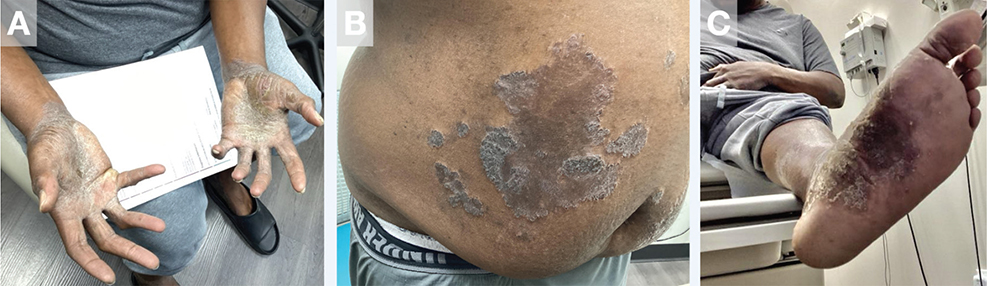
Fig. 1. Synovitis, acne, pustulosis, hyperostosis, and osteitis (SAPHO) syndrome at 1-month follow-up while on cyclosporine and prednisone, prior to upadacitinib initiation. Skin examination revealed well-demarcated plaques on the (A) palms and forearms, (B) abdomen, and (C) soles and legs. Acne lesions on the upper trunk not pictured.
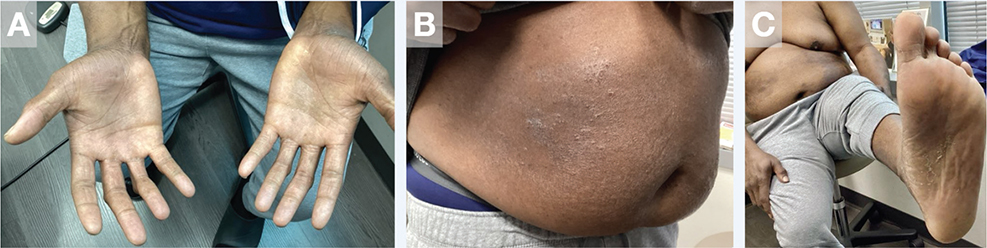
Fig. 2. Synovitis, acne, pustulosis, hyperostosis, and osteitis (SAPHO) syndrome 3 months after upadacitinib initiation with prednisone taper. Skin examination showed notable improvement of lesions on the (A) palms and forearms, (B) abdomen, and (C) soles and legs. Arthralgias and bone pain also improved.
DISCUSSION
The term SAPHO was first introduced by Chamot and Benhamou between 1987 and 1988 to describe a constellation of osteoarticular and cutaneous symptoms (3, 4), and its pathogenesis remains incompletely understood. Unlike spondyloarthritis, SAPHO is not associated with increased HLA-B27 frequency despite overlapping clinical features such as peripheral arthritis, enthesitis, spinal involvement, and psoriasiform skin findings. Furthermore, the coexistence of SAPHO with HS has been increasingly recognized within the spectrum of HS-related autoinflammatory syndromes including pyoderma gangrenosum, acne, and suppurative hidradenitis (PASH), pyogenic arthritis, pyoderma gangrenosum, acne, and suppurative hidradenitis (PAPASH), and other rarer variants (5). SAPHO lacks a standardized classification system, and laboratory findings are nonspecific with no known serum markers (1). Radiological assessments primarily highlight osteoarticular changes.
Treatment of SAPHO typically includes nonsteroidal anti-inflammatory drugs, steroids, bisphosphonates, and disease-modifying antirheumatic drugs such as methotrexate, sulfasalazine, and cyclosporine (1). Elevated cytokine levels, including IL-8, IL-17, IL-18, and TNFα, suggest involvement of the Th17 pathway, leading to the increased use of anti-TNFα and anti-IL-17 agents. While these biologics have shown efficacy in treating osteoarticular involvement, skin manifestations often remain treatment-resistant (6).
Recent reports highlight the emerging role of JAK inhibitors, including tofacitinib, baricitinib, and upadacitinib, in SAPHO treatment (7, 8). In parallel, reviews of targeted biologic therapies in HS have also highlighted JAK inhibition as a promising investigational strategy (9). JAKs are intracellular enzymes that relay signals from cytokine or growth factor receptors on the cell membrane, regulating processes such as haematopoiesis and immune function. In this pathway, JAKs phosphorylate and activate signal transducers and activators of transcription (STATs), which influence intracellular activity, including gene expression. Upadacitinib, an oral selective JAK1 inhibitor, modulates the JAK–STAT pathway, reducing pro-inflammatory cytokine activity and dampening inflammatory responses (10).
In this case, off-label use of upadacitinib led to significant symptom improvement in our patient and was well tolerated, representing a novel case of comorbid SAPHO syndrome and HS successfully treated with JAK inhibition. This case underscores the potential of JAK inhibitors as a promising therapeutic option for patients with both SAPHO and HS, warranting further studies. Nevertheless, as a single case report, our findings are limited by the absence of long-term follow-up and may not be generalizable. In addition, while no adverse effects were observed in this patient, JAK inhibitors are associated with potential safety concerns, including increased risks of infection, thrombosis, and malignancy, which must be carefully considered prior to initiating therapy.
ACKNOWLEDGEMENT
Patient consent: Written patient consent was obtained for use of their photographs and medical information to be published online and with the understanding that this information may be publicly available and discoverable via search engines.
REFERENCES
- Ferraioli M, Levani J, De Luca R, Matucci-Cerinic C, Gattorno M, Guiducci S, et al. What is new and what is next for SAPHO syndrome management: a narrative review. J Clin Med 2025; 14: 1366. https://doi.org/10.3390/jcm14041366
- Sabat R, Jemec GBE, Matusiak Ł, Kimball AB, Prens E, Wolk K. Hidradenitis suppurativa. Nat Rev Dis Prim 2020; 6: 18. https://doi.org/10.1038/s41572-020-0149-1
- Benhamou C, Chamot AM, Kahn MF. Le syndrome synovite–acné–pustulose–hyperostose–ostéite (SAPHO). Ann Dermatol Venereol 1988; 115: 613–618.
- Chamot AM, Benhamou CL, Kahn MF, Beraneck L, Kaplan G, Prost A. Le syndrome acné pustulose hyperostose ostéite (SAPHO). Résultats d’une enquête nationale. 85 observations. Rev Rhum Mal Osteoartic 1987; 53: 187–196.
- Maronese CA, Moltrasio C, Marzano AV. Hidradenitis suppurativa-related autoinflammatory syndromes: an updated review on the clinics, genetics, and treatment of pyoderma gangrenosum, acne and suppurative hidradenitis (PASH), pyogenic arthritis, pyoderma gangrenosum, acne and suppurative hidradenitis (PAPASH), synovitis, acne, pustulosis, hyperostosis and osteitis (SAPHO), and rarer forms. Dermatol Clin 2024; 42: 247–265. https://doi.org/10.1016/j.det.2023.12.004
- Firinu D, Barca MP, Lorrai MM, Perra S, Cabras S, Muggianu E, et al. TH17 cells are increased in the peripheral blood of patients with SAPHO syndrome. Autoimmunity 2014; 47: 389–394. https://doi.org/10.3109/08916934.2014.906582
- Yue Q, Ma M, Liu S, Wu Y, Li C. JAKi: can it be used to treat SAPHO syndrome? Int J Rheum Dis 2024; 27: e14930. https://doi.org/10.1111/1756-185X.14930
- Ma M, Lu S, Hou X, Li C. Novel JAK-1 inhibitor upadacitinib as a possible treatment for refractory SAPHO syndrome: a case report. Int J Rheum Dis 2023; 26: 2335–2337. https://doi.org/10.1111/1756-185X.14774
- Tan IJ, Nguyen HN, Wolfe SM, Agarwal P, Cohen BA. Targeted biologic therapies for hidradenitis suppurativa. Int J Mol Sci 2025; 26: 8887. https://doi.org/10.3390/ijms26188887
- Duggan S, Keam SJ. Upadacitinib: first approval. Drugs 2019; 79: 1819–1828. https://doi.org/10.1007/s40265-019-01211-z