SHORT COMMUNICATION
JAK1 Inhibition with Upadacitinib in a Patient with Refractory Severe Chronic Spontaneous Urticaria and Concomitant Rheumatoid Arthritis: Complete Resolution of Urticaria and Remission of Rheumatoid Arthritis
Israel MAGEN1,2, Iris LEIBOVICH2,3 and Eli MAGEN2,4*
1Department of Medicine A, Barzilai University Medical Center, Ashkelon, Israel, 2Faculty of Health Sciences, Ben-Gurion University of the Negev, Beer-Sheva, Israel, 3Allergy, Clinical Immunology, and Angioedema Unit, Barzilai University Medical Center, Ashkelon, Israel, and 4Department of Medicine A, Assuta Ashdod University Hospital, Ashdod, Israel. *E-mail: allergologycom@gmail.com
Citation: Acta Derm Venereol 2025; 105: adv44312. DOI: https://doi.org/10.2340/actadv.v105.44312.
Copyright: © 2025 The Author(s). Published by MJS Publishing, on behalf of the Society for Publication of Acta Dermato-Venereologica. This is an Open Access article distributed under the terms of the Creative Commons Attribution-NonCommercial 4.0 International License (https://creativecommons.org/licenses/by-nc/4.0/).
Submitted: Jul 4, 2025. Accepted after revision: Aug 26, 2025. Published: Sep 10, 2025.
Competing interests and funding: The authors have no conflicts of interest to declare.
INTRODUCTION
Chronic spontaneous urticaria (CSU) is defined by the spontaneous recurrence of wheals, angioedema, or both, for more than 6 weeks in the absence of identifiable triggers (1). CSU significantly impacts quality of life and work productivity, particularly in patients with inadequate response to guideline-based therapy (1). Second-generation H1-antihistamines are recommended as first-line treatment, with escalation up to 4 times the standard dose. In refractory cases, omalizumab and cyclosporine A are considered next steps (2). Despite these options, approximately 10% of patients remain poorly controlled (3).
JAK inhibitors are widely used across multiple inflammatory diseases (4). Selective JAK1 inhibition, as achieved with upadacitinib, is of particular interest given its role in cytokine signalling relevant to mast cell and basophil activation and inflammation (5).
CASE PRESENTATION
A 42-year-old female with a 2-year history of CSU was referred to our clinic due to persistent, severe urticaria and angioedema despite multiple prior treatments. She also had a diagnosis of rheumatoid factor (RF) and anti-cyclic citrullinated peptide (anti-CCP) seropositive rheumatoid arthritis (RA), diagnosed at age 36.
Her CSU was characterized by daily, generalized wheals (> 50 lesions/day), severe pruritus (Visual Analogue Scale: 9/10), and frequent episodes of angioedema affecting the lips and periorbital regions (2–3 times per week). Her disease activity scores confirmed the severity: Urticaria Activity Score over 7 days (UAS7) was maximal at 42/42, the Urticaria Control Test (UCT) was 0/16, and the Dermatology Life Quality Index (DLQI) was 21/30, indicating an extremely severe impact on her life.
Her therapeutic history for CSU included failure to respond to an updosed regimen of fexofenadine (180 mg 4 times daily). Subsequently, she started omalizumab (300 mg subcutaneously every 4 weeks) for 3 months and continued a 6-month course of high-dose omalizumab (450 mg subcutaneously every 4 weeks) with no clinical improvement, classifying her as a non-responder. Multiple courses of systemic corticosteroids (prednisone 20–40 mg/day) provided only transient and partial relief.
Her concomitant RA, initially stable on methotrexate (15 mg/week) and adalimumab (40 mg biweekly), had flared over the past year. Clinical examination revealed active synovitis in multiple metacarpophalangeal and proximal interphalangeal joints, with morning stiffness exceeding 2 h. Laboratory parameters were consistent with high disease activity: C-reactive protein (CRP) was 18.4 mg/L (reference < 5 mg/L), erythrocyte sedimentation rate (ESR) was 48 mm/h (reference < 20 mm/h), total serum IgE: 49 IU/mL (reference: < 87 IU/mL), anti-thyroid peroxidase (anti-TPO) antibodies: < 5 IU/mL (reference: < 35 IU/mL), and her Disease Activity Score 28-CRP (DAS28-CRP) was 5.6. Serology was strongly positive for RF (202 IU/mL; reference < 30 IU/mL) and anti-CCP antibodies (127 U/mL; reference < 20 U/mL – normal, 20–39 EU/mL – weakly positive, 40–59 EU/mL – moderately positive, > 59 EU/mL – strongly positive).
Given the dual burden of active, refractory CSU and RA, a strategic decision was made to discontinue adalimumab and initiate upadacitinib 15 mg once daily, aiming to address the shared JAK-dependent inflammatory pathways of both conditions.
The clinical response was both rapid and profound. Within 2 weeks of commencing upadacitinib, the patient reported a greater than 75% reduction in wheal formation and pruritus. By week 8, she achieved complete resolution of all urticarial symptoms (UAS7 = 0) (Fig. 1). This complete response has been sustained for over 12 months of continuous therapy. Concurrently, her RA has entered remission, with her DAS28-CRP score decreasing to 2.1 and normalization of CRP and ESR levels. The treatment was well tolerated with no adverse events reported.
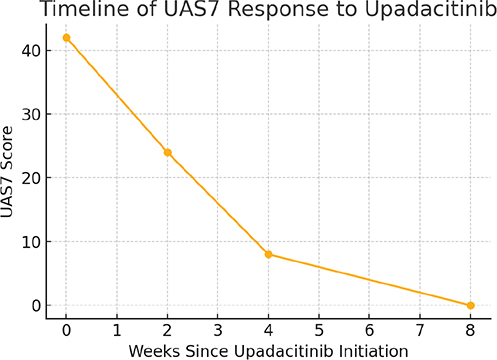
Fig. 1. Timeline of Urticaria Activity Score 7 (UAS7) after upadacitinib initiation.
DISCUSSION
This case highlights the potential of targeted JAK1 inhibition as a powerful therapeutic strategy for severe, refractory CSU. The mechanism of action is biologically plausible. By inhibiting JAK1, upadacitinib effectively blocks the signalling of key cytokines involved in both Type 1 (IFN-γ) and Type 2 (IL-4, IL-13) inflammation, both of which are implicated in CSU pathogenesis (7). This blockade can reduce mast cell and basophil activation, downregulate FcεRI expression, and mitigate the effects of pathogenic autoantibodies (7, 8).
While other JAK inhibitors like ruxolitinib, tofacitinib, and baricitinib have shown efficacy in refractory CSU in isolated case reports (8–10), this case is significant for several reasons. First, it demonstrates the success of a selective JAK1 inhibitor, suggesting that targeting this specific kinase may be sufficient to control urticarial inflammation. Second, the patient’s dramatic response, despite being a primary non-responder to high-dose omalizumab, suggests that JAK inhibition may be effective in patients whose disease is not predominantly IgE-driven or who have exhausted other biologic options. The parallel remission of her severe seropositive RA underscores the utility of upadacitinib in treating complex poly-autoimmunity by targeting a common, central signalling node. Notably, an ongoing phase 2 trial is investigating povorcitinib, another JAK inhibitor, for the treatment of CSU, further supporting the potential role of this therapeutic class (11).
This case report has several limitations. Unfortunately, neither the basophil activation test nor basophil FcεRI expression were available in our clinical setting, precluding a more precise endotyping of the patient’s CSU. In addition, cyclosporine A was not administered, although it might have been considered as an alternative therapy in the context of a potential Type IIb autoimmune CSU. These limitations highlight that our observations cannot define endotype-specific responsiveness to JAK1 inhibition but do provide mechanistic context that may help delineate subgroups of CSU patients who could benefit from this approach.
In conclusion, this case provides compelling evidence that JAK1 inhibition using upadacitinib can induce rapid and sustained remission in patients with severe, refractory CSU. It represents a promising therapeutic avenue, particularly for the challenging patient population with comorbid inflammatory diseases. This observation warrants further investigation through randomized controlled trials to formally establish the efficacy and safety of selective JAK1 inhibition in the management of CSU.
ACKNOWLEDGEMENT
IRB approval status: Written informed consent was obtained from the patient for publication of this case report, with the understanding that this information may be publicly available.
REFERENCES
- Zuberbier T, Abdul Latiff AH, Abuzakouk M, Aquilina S, Asero R, Baker D, et al. The international EAACI/GA²LEN/EuroGuiDerm/APAAACI guideline for the definition, classification, diagnosis, and management of urticaria. Allergy 2022; 77: 734–766. https://doi.org/10.1111/all.15090
- Kolkhir P, Fok JS, Kocatürk E, Li PH, Okas TL, Marcelino J, et al. Update on the treatment of chronic spontaneous urticaria. Drugs 2025; 85: 475–486. https://doi.org/10.1007/s40265-025-02170-4
- Kaplan A, Lebwohl M, Giménez-Arnau AM, Hide M, Armstrong AW, Maurer M. Chronic spontaneous urticaria: focus on pathophysiology to unlock treatment advances. Allergy 2023; 78: 389–401. https://doi.org/10.1111/all.15603
- Tanaka Y, Luo Y, O’Shea JJ, Nakayamada S. Janus kinase-targeting therapies in rheumatology: a mechanisms-based approach. Nat Rev Rheumatol 2022; 18: 133–145. https://doi.org/10.1038/s41584-021-00726-8
- Mohamed MF, Bhatnagar S, Parmentier JM, Nakasato P, Wung P. Upadacitinib: mechanism of action, clinical, and translational science. Clin Transl Sci 2024; 17: e13688. https://doi.org/10.1111/cts.13688
- Zhang TY, Zeng YP. Off-label use of JAK1 inhibitor upadacitinib in dermatology. Arch Dermatol Res 2025; 317: 363. https://doi.org/10.1007/s00403-025-03890-z
- Wong D, Waserman S, Sussman GL. Endotypes of chronic spontaneous urticaria and angioedema. J Allergy Clin Immunol 2025; 156: 17–23. https://doi.org/10.1016/j.jaci.2025.04.004
- Fukunaga A, Ito M, Nishigori C. Efficacy of oral ruxolitinib in a patient with refractory chronic spontaneous urticaria. Acta Derm Venereol 2018; 98: 904–905. https://doi.org/10.2340/00015555-3006
- Mansouri P, Mozafari N, Chalangari R, Martits-Chalangari K. Efficacy of oral tofacitinib in refractory chronic spontaneous urticaria and urticarial vasculitis. Dermatol Ther 2022; 35: e15932. https://doi.org/10.1111/dth.15932
- Weaver M, Gierer S, Badawi A. A case of comorbid alopecia universalis and chronic spontaneous urticaria treated with baricitinib. Ann Allergy Asthma Immunol 2024; 133: S134.
- ClinicalTrials.gov. Study of povorcitinib (INCB54707) in participants with chronic spontaneous urticaria. NCT05936567. Available from: https://clinicaltrials.gov/study/NCT05936567